Hello, Guest!

Hello, Guest!

Main Category Group

Caught and Crushed by Pinch Points

Caught and between. These two mild words describe a type of injury which is anything but mild. Instead, they refer to being caught between two moving objects or a moving object and a stationary object. The result is compression and crushing injuries which can be fatal. The places where these incidents occur are called "pinch points."

Caught and Crushed by Pinch Points2018-10-18T00:00:00+00:00

Chocking and Blocking Safety

Chocking is the act of using a wedge to immobilize the wheels of a vehicle or equipment to keep it from accidentally moving. Chocking the wheels of a vehicle, such as a truck or trailer, physically stops the movement of wheels to prevent runaways that can injure workers and destroy property.

Chocking and Blocking Safety2018-10-18T00:00:00+00:00

Distractions Derail Safety

The ever-increasing use of smartphones finds most of with our heads down staring into the glow of text messages, games, tweets, twitters, selfies and more. One of the downsides to this obsession is that people mistakenly think they can perform their jobs safely while they use these devices.

Distractions Derail Safety2018-10-18T00:00:00+00:00

Forklift Safety Checklists

Like any other piece of mechanical equipment, forklifts pose dangers not just to operators but to others in the vicinity. This tool will significantly help prevent these incidents as well as consequential safety violations and citations. HOW TO USE THE TOOL Here are two checklists you can adapt and use to ensure forklifts/powered industrial trucks meet equipment and maintenance standards.

Forklift Safety Checklists2018-10-18T00:00:00+00:00

Focus On: 8 Ideas to Revitalize Your Team’s Morale and Productivity

People or profits? Results or relationships? Safety or Savings? As supervisors we often feel an enormous amount of pressure (spoken or unspoken) to make these types of difficult decisions. We also feel a great deal of conflict as well over the choices we make.  Effective leaders focus on both results and relationships.

Focus On: 8 Ideas to Revitalize Your Team’s Morale and Productivity2018-10-17T00:00:00+00:00

Industrial Ergonomics Hazards Assessment Checklist

Adapt and use this Hazards Assessment to determine areas of potential and existing ergonomic and materials handling concerns.

Industrial Ergonomics Hazards Assessment Checklist2018-10-17T00:00:00+00:00

Ergonomic Injury Record Review

To root out ergonomic injuries you must be proactive. The first step is to do a record review and create a “snapshot” of worker injuries, so you can analyze causes and identify trends. Here’s a form you can adapt and use at your workplace to perform an effective records review.

Ergonomic Injury Record Review2018-10-16T00:00:00+00:00

Tool: Ergonomic Injuries Data Summary and Corrective Actions

Once you gather ergonomic injury records and analyze the data, you must translate your findings into corrective actions. Fill out a separate version of this form for each type of ergonomically-related injury suffered by your workers.  Using this form will enable you to organize your injury data, determine appropriate corrective action, and establish priorities.

Tool: Ergonomic Injuries Data Summary and Corrective Actions2018-10-16T00:00:00+00:00

Be Safety-Conscious Off-the-Job too!

How safety-conscious are you when you are off-the-job? You can do a lot to increase your safety just by paying attention to your attitude and habits. You may be relaxing, but you can still relax safely!

Be Safety-Conscious Off-the-Job too!2018-10-15T00:00:00+00:00

Can You Do the Chemical Splash Dash?

If a chemical splashed onto your skin or into your eye, could you get to a safety shower or eyewash station quickly? The time to consider that question is now, not when you are faced with an emergency. You need to know where this equipment is located, the shortest route to reach it and how to use it effectively.

Can You Do the Chemical Splash Dash?2018-10-15T00:00:00+00:00

Office Safety

Most offices have few hazardous chemicals and no heavy or moving machinery. If the worst that can happen is a paper cut, why do we need to talk about safety training? Because a paper cut isn’t the worst that can happen. Office employees still need to know what to do in case of an emergency, and accidents are surprisingly common. Also, people who sit down and use computers most of the day need to watch out for ergonomic issues.

Office Safety2018-10-15T00:00:00+00:00

Falls Through Floor and Wall opening

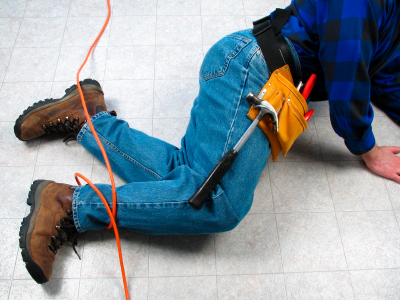
It takes a split-second of inattention, a slight change in working conditions, a forgetful co-worker, or a lax safety program for you to fall through an opening.

Falls Through Floor and Wall opening2018-10-15T00:00:00+00:00

Ask the Expert: How do you turn a good safety program into a great safety program?

You must create a safety culture where workers feel comfortable participating. Build trust by engaging employees in all aspects by asking for concerns, opinions and solutions.

Ask the Expert: How do you turn a good safety program into a great safety program?2018-10-13T00:00:00+00:00

By the Numbers: 10 Tips for Emergency Response Plans

Being prepared for an emergency is part of your employers and your responsibility. For help developing your emergency response planning, Ready.gov offers the following guidance.

By the Numbers: 10 Tips for Emergency Response Plans2018-10-11T00:00:00+00:00

Picture This: Emergency Exit Nightmare

Let’s start with the obvious hazard – a blocked emergency exit. Blocked by conveyors, carts, trash, and cardboard boxes.

Picture This: Emergency Exit Nightmare2018-10-11T00:00:00+00:00

Don’t Let a Trench Be your Grave Safety Talk

Excavations and trenches more than 4-5 ft/1.2-1.5 m deep (depending on your federal, state, and provincial regulations) require a protective system is in place to protect workers from cave-ins. If a protective system isn’t in place – don’t enter the excavation. Look out for your safety and the safety of your co-workers and don’t become another buried body of an excavation cave-in.

Don’t Let a Trench Be your Grave Safety Talk2018-10-11T00:00:00+00:00

Home Health Care – Body Mechanics

The purpose of using proper body mechanics is simple???To Prevent Injury. One of the most strenuous and potentially hazardous parts of home healthcare is bending, stretching and reaching. This program teaches how to reduce risk and prevent injury. Lift assist equipment such as gait belts, bath boards, grab bars and others are discussed as ways to reduce lifting demands. Viewers are taught to properly assess their environment and correct hazards before incidents occur. Safe Client Transfers and Ambulation are addressed in detail.

Home Health Care – Body Mechanics2018-10-01T00:00:00+00:00

Road Rage and Aggressive Driving (12 min)

Road Rage & Aggressive Driving ??? In any discussion of Drivers Safety, one of the most dangerous hazards is the Human Factor???the unpredictability of all the drivers on the road???and the way that emotion can influence the way we drive. Road Rage is responsible for over half of the fatal crashes on our roadways each year.

Road Rage and Aggressive Driving (12 min)2018-10-01T00:00:00+00:00

Active Shooter Awareness Video- Helping Prevent Tragedy – (9 min) Spanish

Incidents involving active shooters continue to be in the news. These acts of violence are becoming more commonplace in today's society, and although your chances of being a victim of an active shooter incident are minuscule, it is important your organization and your associates plan and be prepared for such an incident. Active shooters can strike where we live, where we work, where we study, where we shop or any other environment. No business or institution is immune to the potential of an active shooter attack. The purpose of this informational training is not to alarm viewers, but to enlighten them regarding some of the elements of an active shooter scenario and what they should do to be prepared to deal with such an act.

Active Shooter Awareness Video- Helping Prevent Tragedy – (9 min) Spanish2018-10-01T00:00:00+00:00

Safety Orientation For Industrial Environment – Spanish

Employees in industrial environments face different hazards than those in office or warehousing environments. For this reason they need training that addresses the hazards they face in the course of their job. This program covers General Safety Rules, Workplace Hazards, PPE, Machine Guarding, Emergency Action Plans, Slips & Falls, Housekeeping, Working at Heights, Hand & Electrical Tools, Hazard Communication, Forklifts, Proper Body Mechanics and other vital information.

Safety Orientation For Industrial Environment – Spanish2018-10-01T00:00:00+00:00

Securing Loads Safely – Spanish

This program helps employees comply with DOT regulations relating to securing loads on tractor trailers. Topics include: different types of trucks and associated loading requirements, load securement procedures, number of straps needed for different loads, working load limits and other related safety information. Great training to ensure you and your vehicles are not cited or placed out of service due to non-compliance issues.

Securing Loads Safely – Spanish2018-10-01T00:00:00+00:00

Tool: Supervisor’s Guide – Responding to Domestic Violence in the Workplace

Domestic violence often crosses over into the workplace and many domestic violence victims are in danger of being attacked, harassed, or stalked while at work. Would you know what to do if an employee came to you about violence they are experiencing at home? Does your organization have a plan? An organization’s response to and support of victims can help to keep the workplace safe and secure for everyone.

Tool: Supervisor’s Guide – Responding to Domestic Violence in the Workplace2018-10-01T00:00:00+00:00

Home Health Care – Elder/Child Abuse and Neglect

Elder and child Abuse. Tragic. Horrifying. Unthinkable. Yet, it???s estimated hundreds of thousands of elders and children are abused each year. Estimated because our picture of elder and child abuse is limited, due to the hidden and complex nature of the problem and the failure of healthcare workers and others to report elder and child abuse consistently. It can be hard to spot the more subtle forms of neglect and abuse. They???re often unrecognized, because victims tend to be isolated. By learning to recognize elder or child abuse and neglect, by learning how to respond to the cases and by committing yourself to safeguarding clients in your care.

Home Health Care – Elder/Child Abuse and Neglect2018-10-01T00:00:00+00:00
Go to Top