
Skip to content

Hello, Guest!

  • Home
  • All Topics
  • Resources
    • OSHA Program Wizards
      • Emergency Action Plan
      • Transitional Work Program
      • Personal Protective Equipment
      • Energy Control (LOTO)
      • Hazard Communication (HAZCOM)
      • Confined Space Program
      • Hearing Conservation Program
      • Ergonomics Program
      • More…
    • Program Audits
      • Confined Space
      • Emergency Planning
      • Employee Training
      • Hazard Recognition and Control
      • Hearing Conservation
      • IIPP
      • Lockout Tagout
      • Personal Protective Equipment
      • More…
    • Major Loss Source Assessment Tools
      • Amputation
      • Falls from Elevation – Construction
      • Falls from Elevation – Extension Ladders
      • Falls from Elevation – Orchard Ladder
      • Falls from Elevation – Stepladders
      • Lifting Below the Knees
      • Lifting With Arms Extended
      • More…
    • Supervisor Resources
      • California SB 553 Workplace Violence Prevention
      • New York Workplace Violence Prevention
      • Employer’s Guide HazCom
      • Employer’s Guide Lockout Tagout
      • 2026 OSHA Outreach 10 Hour Virtual Training Course
      • Forklift Train the Trainer
      • Train the Trainer
      • Business Case for Safety
      • Special Reports
      • Newsletters
      • Incident Investigations
    • Training Calendars and Bundles
      • ICW Ladder Elimination Challenge
      • Quarterly Safety Checkup
      • Training Calendars by Industry
      • Essential 29
      • Landscaping Safety
      • Fundamental 55
      • Tree Trimming
      • Towing Bundle
    • Training Engagement and Retention
      • Picture This
      • Stats and Facts
      • Fatality Reports
      • Puzzles and Games
      • Safety Checklists
    • Webinars
      • Work Comp Fraud: The Modern Fraudster
      • Returning to the Workplace During COVID-19
      • Respiratory Protection Must Haves
      • Beat the Heat: Outdoors
      • Beat the Heat: Indoors
      • More…
    • When An Injury Occurs
      • Help Injured Workers
      • Nurse Triage Hotline
      • If You’ve Been Injured
      • Transitional Work Program
      • Incident Investigation Wizard Form
      • Top 10 Tips to Lower Your Ex-Mod
  • Webinars
    • Webinars
      • Work Comp Fraud: Identifying the Modern Fraudster
      • Returning to the Workplace During COVID-19
      • Breathe Easier With These Respiratory Protection Must Haves
      • Beat the Heat: Outdoors
      • Beat the Heat: Indoors
      • Machine Guarding: 7 Questions Everyone Should Ask
      • 5 Tips for Impactful Safety Observations
      • More…
  • Ask The Expert
  • Favorites

Hello, Guest!

  • Home
  • All Topics
  • Resources
    • OSHA Program Wizards
      • Emergency Action Plan
      • Transitional Work Program
      • Personal Protective Equipment
      • Energy Control (LOTO)
      • Hazard Communication (HAZCOM)
      • Confined Space Program
      • Hearing Conservation Program
      • Ergonomics Program
      • More…
    • Program Audits
      • Confined Space
      • Emergency Planning
      • Employee Training
      • Hazard Recognition and Control
      • Hearing Conservation
      • IIPP
      • Lockout Tagout
      • Personal Protective Equipment
      • More…
    • Major Loss Source Assessment Tools
      • Amputation
      • Falls from Elevation – Construction
      • Falls from Elevation – Extension Ladders
      • Falls from Elevation – Orchard Ladder
      • Falls from Elevation – Stepladders
      • Lifting Below the Knees
      • Lifting With Arms Extended
      • More…
    • Supervisor Resources
      • California SB 553 Workplace Violence Prevention
      • New York Workplace Violence Prevention
      • Employer’s Guide HazCom
      • Employer’s Guide Lockout Tagout
      • 2026 OSHA Outreach 10 Hour Virtual Training Course
      • Forklift Train the Trainer
      • Train the Trainer
      • Business Case for Safety
      • Special Reports
      • Newsletters
      • Incident Investigations
    • Training Calendars and Bundles
      • ICW Ladder Elimination Challenge
      • Quarterly Safety Checkup
      • Training Calendars by Industry
      • Essential 29
      • Landscaping Safety
      • Fundamental 55
      • Tree Trimming
      • Towing Bundle
    • Training Engagement and Retention
      • Picture This
      • Stats and Facts
      • Fatality Reports
      • Puzzles and Games
      • Safety Checklists
    • Webinars
      • Work Comp Fraud: The Modern Fraudster
      • Returning to the Workplace During COVID-19
      • Respiratory Protection Must Haves
      • Beat the Heat: Outdoors
      • Beat the Heat: Indoors
      • More…
    • When An Injury Occurs
      • Help Injured Workers
      • Nurse Triage Hotline
      • If You’ve Been Injured
      • Transitional Work Program
      • Incident Investigation Wizard Form
      • Top 10 Tips to Lower Your Ex-Mod
  • Webinars
    • Webinars
      • Work Comp Fraud: Identifying the Modern Fraudster
      • Returning to the Workplace During COVID-19
      • Breathe Easier With These Respiratory Protection Must Haves
      • Beat the Heat: Outdoors
      • Beat the Heat: Indoors
      • Machine Guarding: 7 Questions Everyone Should Ask
      • 5 Tips for Impactful Safety Observations
      • More…
  • Ask The Expert
  • Favorites
Selecting Hand Tools – Spanish
Favorite Print Email English

Los Riesgos

Usar la herramienta equivocada o usar una herramienta incorrectamente puede causar lesiones ergonómicas debilitantes. El riesgo de lesiones aumenta cuando los trabajadores están expuestos con frecuencia a posturas incómodas, presión por contacto o agarre con pellizcos. Con el tiempo, la exposición a posturas incómodas o a presiones de contacto perjudiciales puede contribuir a una lesión.

Sé un mejor supervisor

Las herramientas manuales que se ajustan a las manos de un trabajador y al trabajo que realiza pueden reducir el riesgo de lesiones. Aquí hay 11 consejos para la selección de herramientas manuales para compartir con sus empleados.

  • Para las herramientas de una sola mano utilizadas para tareas eléctricas: Seleccione una herramienta que se sienta cómoda con un diámetro de mango en el rango de 1 1/4 pulgadas a 2 pulgadas. Puede aumentar el diámetro agregando una funda al mango. El mango de potencia proporciona la máxima potencia de mano para tareas de alta fuerza.  Todos los dedos se enrollan alrededor del mango.

  • Para herramientas de una sola mano usadas para tareas de precisión: Seleccione una herramienta con un diámetro de mango de 1/4 de pulgada a 1/2 pulgada.
  • Para herramientas de doble mango (tipo alicate) utilizadas para tareas de energía: Seleccione una herramienta con una amplitud de agarre que sea de al menos 2 pulgadas cuando esté completamente cerrada y no más de 3 1/2 pulgadas cuando esté completamente abierta. Cuando se requiera una fuerza continua, considere el uso de una pinza, un agarre o una pinza de bloqueo.
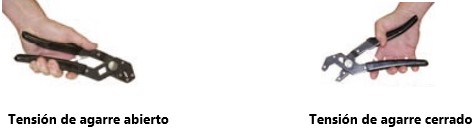
  • Para herramientas de doble mango (tipo alicate) utilizadas para tareas de precisión: Seleccione una herramienta con una extensión de agarre que no sea menor de 1 pulgada cuando esté completamente cerrada y no más de 3 pulgadas cuando esté completamente abierta. 
  • Para herramientas de doble mango para pellizcar, agarrar o cortar: Seleccione una herramienta con mangos que tengan resortes para devolver los mangos a la posición abierta.
  • Seleccione una herramienta sin bordes afilados o ranuras para los dedos en el mango.
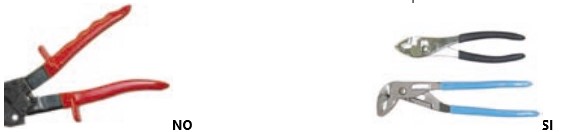
  • Seleccione una herramienta que esté revestida de material blando. Añadiendo un manguito al mango de la herramienta, se mejora la superficie pero también se aumenta el diámetro o la extensión del mango.
  • Seleccione una herramienta con un ángulo que le permita trabajar con la muñeca recta. Los mangos curvados son mejores que los rectos cuando se aplica la fuerza horizontalmente (en la misma dirección que el antebrazo y la muñeca rectos). Los mangos rectos son mejores que los mangos curvados cuando se aplica la fuerza verticalmente.
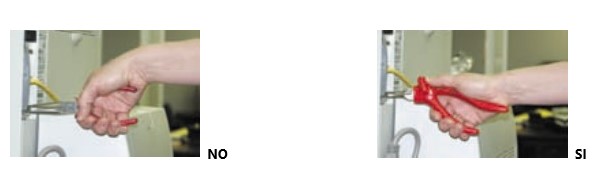
 

  • Seleccione una herramienta que pueda ser usada con su mano dominante o con cualquiera de las dos manos.
  • Para tareas que requieren mucha fuerza: Seleccione una herramienta con un mango más largo que la parte más ancha de su mano – generalmente de 4 a 6 pulgadas. Evite la presión de contacto asegurándose de que el extremo del mango no presione los nervios y vasos sanguíneos de la palma de su mano. Si el mango es demasiado corto, el extremo presionará contra la palma de la mano y puede causar una lesión.
  • Seleccione una herramienta que tenga una superficie antideslizante para un mejor agarre. Al agregar una funda a la herramienta se mejora la textura de la superficie del mango. Para evitar que la herramienta se deslice dentro de la funda, asegúrese de que la funda se ajuste bien durante el uso.

Véase la lista de control ergonómico para la selección de las herramientas manuales.

https://choosehandsafety.com/sites/default/files/docs/NIOSH_guide_to_selecting_hand_tools.pdf

New Safety Talks

New Safety Talks

Vicky Pickford2026-06-15T23:37:40+00:00
GHS – Pictograms Meeting Kit
Giovanni Tejada 22026-06-15T16:58:51+00:00
Dermal Absorption Safety Meeting Kit – Spanish
Giovanni Tejada 22026-06-15T16:57:21+00:00
Scaffold Safety Meeting Kit
Giovanni Tejada 22026-06-15T16:57:21+00:00
Scaffold Safety Meeting Kit – Spanish
Giovanni Tejada 22026-06-15T16:55:53+00:00
Inspection Basics Meeting Kit
Giovanni Tejada 22026-06-15T16:55:53+00:00
Inspection Basics Meeting Kit – Spanish

New eLearning

Giovanni Tejada 22026-06-15T17:02:34+00:00
Criticality Safety: Preventing the Unthinkable (Spanish)
Giovanni Tejada 22026-06-15T17:02:22+00:00
Workplace Cleanliness – SPANISH
Giovanni Tejada 22026-06-15T17:01:58+00:00
Drug and Alcohol-Free Workplace – USA (Spanish)
Giovanni Tejada 22026-06-15T17:00:58+00:00
Hurricane Preparedness – Spanish
Giovanni Tejada 22026-06-15T17:00:41+00:00
ESSENTIAL 29: Drug and Alcohol-Free Workplace – USA
Giovanni Tejada 22026-06-15T16:59:36+00:00
Domestic Violence in the Workplace for Managers

Upcoming Events & Webinars

Damian Tollens2025-01-31T09:55:18+00:00
Feb 11 – Performance and Cultural Alignment
Damian Tollens2025-02-12T19:53:20+00:00
Feb 26 – Avoid Common Overhead Crane and Rigging Mistakes
Rick Tobin2024-10-24T16:57:11+00:00
Nov 13 – Defensive Driving For Changing Seasons
Rick Tobin2024-10-24T17:10:53+00:00
Nov 29 – What to Expect From a Health & Safety Inspection
Rick Tobin2024-10-24T17:13:55+00:00
Dec 5 – Top Safety Issues During the Holiday Season
Rick Tobin2024-10-24T17:13:30+00:00
Dec 19 – Safer in ’25: The 3 Pillars of Safety Culture
Vicky Pickford2021-01-26T00:00:00+00:00

See What's Trending

Emergency Lighting and Exit Sign Requirements – Quick Tips

Emergency Lighting and Exit Sign Requirements – Quick Tips

SCBA Cylinder Hydrostatic Testing – Quick Tips

SCBA Cylinder Hydrostatic Testing – Quick Tips

2026 OSHA Outreach 10 Hour Virtual Training Course

2026 OSHA Outreach 10 Hour Virtual Training Course

Elevator/Lift Safety Stats and Facts

Elevator/Lift Safety Stats and Facts

Forklift Train the Trainer Course

Forklift Train the Trainer Course

Forklift Training and Certification Instructions

Forklift Training and Certification Instructions

Contact Us

800-ICW-SAFETY (800.429.7233)SAFETYOnDemand@icwgroup.com

Additional Links

Manage eLearning
View list of learners
Help

Terms of Use | Legal Notice & Privacy Policy
©2023 ICW Group , All Rights Reserved

Page load link


Video Tutorials to Help You Get Started

Since it's your first time, you may want to checkout some of the video tutorials.

eLearning overview

Managing learners

Assigning courses

Reporting & Analytics

When you are ready to go, close this window.
Don't show this again
Go to Top


