
Skip to content

Hello, Guest!

  • Home
  • All Topics
  • Resources
    • OSHA Program Wizards
      • Emergency Action Plan
      • Transitional Work Program
      • Personal Protective Equipment
      • Energy Control (LOTO)
      • Hazard Communication (HAZCOM)
      • Confined Space Program
      • Hearing Conservation Program
      • Ergonomics Program
      • More…
    • Program Audits
      • Confined Space
      • Emergency Planning
      • Employee Training
      • Hazard Recognition and Control
      • Hearing Conservation
      • IIPP
      • Lockout Tagout
      • Personal Protective Equipment
      • More…
    • Major Loss Source Assessment Tools
      • Amputation
      • Falls from Elevation – Construction
      • Falls from Elevation – Extension Ladders
      • Falls from Elevation – Orchard Ladder
      • Falls from Elevation – Stepladders
      • Lifting Below the Knees
      • Lifting With Arms Extended
      • More…
    • Supervisor Resources
      • California SB 553 Workplace Violence Prevention
      • New York Workplace Violence Prevention
      • Employer’s Guide HazCom
      • Employer’s Guide Lockout Tagout
      • 2026 OSHA Outreach 10 Hour Virtual Training Course
      • Forklift Train the Trainer
      • Train the Trainer
      • Business Case for Safety
      • Special Reports
      • Newsletters
      • Incident Investigations
    • Training Calendars and Bundles
      • ICW Ladder Elimination Challenge
      • Quarterly Safety Checkup
      • Training Calendars by Industry
      • Essential 29
      • Landscaping Safety
      • Fundamental 55
      • Tree Trimming
      • Towing Bundle
    • Training Engagement and Retention
      • Picture This
      • Stats and Facts
      • Fatality Reports
      • Puzzles and Games
      • Safety Checklists
    • Webinars
      • Work Comp Fraud: The Modern Fraudster
      • Returning to the Workplace During COVID-19
      • Respiratory Protection Must Haves
      • Beat the Heat: Outdoors
      • Beat the Heat: Indoors
      • More…
    • When An Injury Occurs
      • Help Injured Workers
      • Nurse Triage Hotline
      • If You’ve Been Injured
      • Transitional Work Program
      • Incident Investigation Wizard Form
      • Top 10 Tips to Lower Your Ex-Mod
  • Webinars
    • Webinars
      • Work Comp Fraud: Identifying the Modern Fraudster
      • Returning to the Workplace During COVID-19
      • Breathe Easier With These Respiratory Protection Must Haves
      • Beat the Heat: Outdoors
      • Beat the Heat: Indoors
      • Machine Guarding: 7 Questions Everyone Should Ask
      • 5 Tips for Impactful Safety Observations
      • More…
  • Ask The Expert
  • Favorites

Hello, Guest!

  • Home
  • All Topics
  • Resources
    • OSHA Program Wizards
      • Emergency Action Plan
      • Transitional Work Program
      • Personal Protective Equipment
      • Energy Control (LOTO)
      • Hazard Communication (HAZCOM)
      • Confined Space Program
      • Hearing Conservation Program
      • Ergonomics Program
      • More…
    • Program Audits
      • Confined Space
      • Emergency Planning
      • Employee Training
      • Hazard Recognition and Control
      • Hearing Conservation
      • IIPP
      • Lockout Tagout
      • Personal Protective Equipment
      • More…
    • Major Loss Source Assessment Tools
      • Amputation
      • Falls from Elevation – Construction
      • Falls from Elevation – Extension Ladders
      • Falls from Elevation – Orchard Ladder
      • Falls from Elevation – Stepladders
      • Lifting Below the Knees
      • Lifting With Arms Extended
      • More…
    • Supervisor Resources
      • California SB 553 Workplace Violence Prevention
      • New York Workplace Violence Prevention
      • Employer’s Guide HazCom
      • Employer’s Guide Lockout Tagout
      • 2026 OSHA Outreach 10 Hour Virtual Training Course
      • Forklift Train the Trainer
      • Train the Trainer
      • Business Case for Safety
      • Special Reports
      • Newsletters
      • Incident Investigations
    • Training Calendars and Bundles
      • ICW Ladder Elimination Challenge
      • Quarterly Safety Checkup
      • Training Calendars by Industry
      • Essential 29
      • Landscaping Safety
      • Fundamental 55
      • Tree Trimming
      • Towing Bundle
    • Training Engagement and Retention
      • Picture This
      • Stats and Facts
      • Fatality Reports
      • Puzzles and Games
      • Safety Checklists
    • Webinars
      • Work Comp Fraud: The Modern Fraudster
      • Returning to the Workplace During COVID-19
      • Respiratory Protection Must Haves
      • Beat the Heat: Outdoors
      • Beat the Heat: Indoors
      • More…
    • When An Injury Occurs
      • Help Injured Workers
      • Nurse Triage Hotline
      • If You’ve Been Injured
      • Transitional Work Program
      • Incident Investigation Wizard Form
      • Top 10 Tips to Lower Your Ex-Mod
  • Webinars
    • Webinars
      • Work Comp Fraud: Identifying the Modern Fraudster
      • Returning to the Workplace During COVID-19
      • Breathe Easier With These Respiratory Protection Must Haves
      • Beat the Heat: Outdoors
      • Beat the Heat: Indoors
      • Machine Guarding: 7 Questions Everyone Should Ask
      • 5 Tips for Impactful Safety Observations
      • More…
  • Ask The Expert
  • Favorites
Respirator Selection Requirement of Substance Specific Requirements – Quick Tips
Favorite Print Email

The Occupational Safety and Health Administration (OSHA) issued its final rule for assigned protection factors (APFs) and maximum use concentrations (MUCs) in the Federal Register on August 24, 2006. This document focuses on the mandatory selection provisions of APFs, MUCs and the APF Table, and their roles in the Substance Specific standards

The APF is the workplace level of respiratory protection that a respirator or class of respirators is expected to provide to employees when the employer implements a continuing, effective respiratory protection program.

MUC is the maximum atmospheric concentration of a hazardous substance from which an employee can be expected to be protected when wearing a respirator, and is determined by the assigned protection factor of the respirator or class of respirators and the exposure limit of the hazardous substance. The MUC is the upper limit at which the class of respirator is expected to provide protection. Whenever exposures approach the MUC, the next higher class of respirators should be selected. Employers must not apply MUCs to conditions that are immediately dangerous to life or health (IDLH).

The MUC for respirators can be determined by multiplying the APF specified for the respirator by the OSHA permissible exposure limit (PEL), short-term exposure limit (STEL) or ceiling limit. When no OSHA exposure limit is available for a hazardous substance, the MUC must be determined on the basis of relevant available information and informed professional judgment.

Employers must use the APFs and MUCs to select the appropriate type of respirator that meets or exceeds the required level of employee protection. Selection is based on the airborne contaminant level found in the workplace and the maximum concentration of the contaminant in which a particular type of respirator can be used.

29 Code of Federal Regulations (CFR) 1910.134(d)(3)(i)(A)

Table 1 Assigned Protection Factors (5)
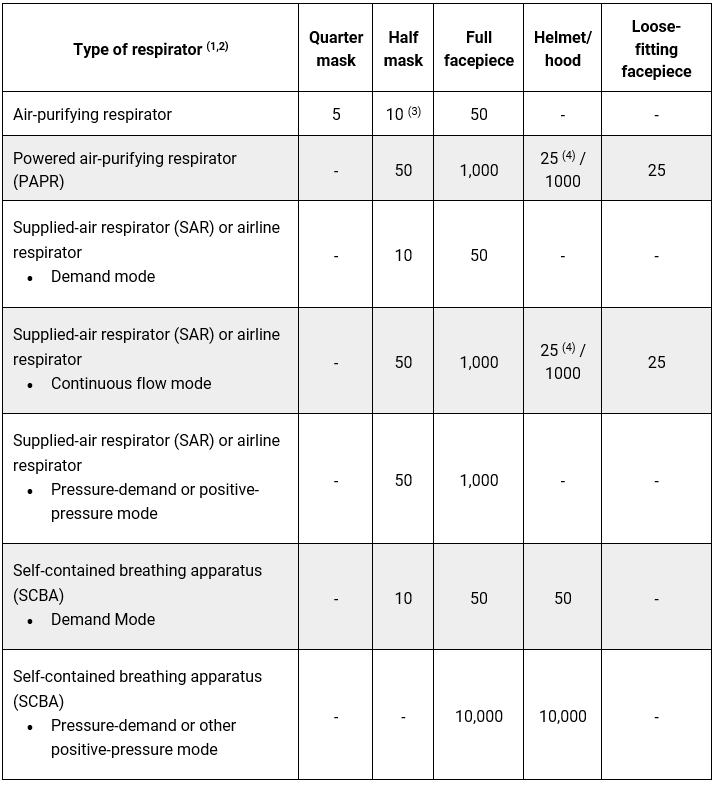
Notes:
1 Employers may select respirators assigned for use in higher workplace concentrations of a hazardous substance for use at lower concentrations of that substance, or when required respirator use is independent of concentration.
2 The assigned protection factors in Table 1 are only effective when the employer implements a continuing, effective respirator program as required by this section ( 29 CFR 1910.134 ), including training, fit testing, maintenance and use requirements.
3 This APF category includes filtering facepieces, and half masks with elastomeric facepieces.
4 The employer must have evidence provided by the respirator manufacturer that testing of these respirators demonstrates performance at a level of protection of 1,000 or greater to receive an APF of 1,000. This level of performance can best be demonstrated by performing a workplace protection factor (WPF) or simulated workplace protection factor (SWPF) study or equivalent testing. Absent such testing, all other PAPRs and SARs with helmets/hoods are to be treated as loose-fitting facepiece respirators and receive an APF of 25.
5 These APFs do not apply to respirators used solely for escape. For escape respirators used in association with specific substances covered by 29 CFR 1910 subpart Z, employers must refer to the appropriate substance-specific standards in that subpart. Escape respirators for other IDLH atmospheres are specified by 29 CFR 1910.134 (d)(2)(ii).

Common Subpart Z Toxic and Hazardous Substances:

Commonly Asked Questions

Q: What is IDLH?

A: Immediately dangerous to life or health (IDLH) is an atmosphere that poses an immediate threat to life, would cause irreversible adverse health effects, or would impair an individual’s ability to escape from a dangerous atmosphere.

Q: How are cartridge/canister change out schedules calculated?

A: In the absence of an end of service life indicator (ESLI), a cartridge/canister change out schedule is required for gas-and vapor-removing respirators and should be based on objective information or data that will ensure that the canisters and cartridges are changed before the end of their service life. Usually, manufacturers have software to estimate a change out schedule for their cartridges or canisters. Change out schedules are not the same from one manufacturer’s cartridges or canisters to that of another manufacturer. This is because the volume and type of adsorbent varies between manufacturers. Additionally, OSHA has mandatory change out schedules for cartridges for certain substances.

Q: Are arrows required in addition to marking pipes?

A: Yes. ASME A13.1-2015 states that arrows shall be used on either end or both ends of the label to show the direction of flow. Arrows should be placed every 50 feet on straight runs, on both sides of wall, floor or ceiling penetrations, and near valves, flanges and changes in pipe direction, and at any line entry or re-entry point.


The information contained in this article is intended for general information purposes only and is based on information available as of the initial date of publication. No representation is made that the information or references are complete or remain current. This article is not a substitute for review of current applicable government regulations, industry standards, or other standards specific to your business and/or activities and should not be construed as legal advice or opinion. Readers with specific questions should refer to the applicable standards or consult with an attorney.

Source: Grainger Know How – https://www.grainger.com/know-how

New Safety Talks

New Safety Talks

Vicky Pickford2026-06-15T23:37:40+00:00
GHS – Pictograms Meeting Kit
Giovanni Tejada 22026-06-15T16:58:51+00:00
Dermal Absorption Safety Meeting Kit – Spanish
Giovanni Tejada 22026-06-15T16:57:21+00:00
Scaffold Safety Meeting Kit
Giovanni Tejada 22026-06-15T16:57:21+00:00
Scaffold Safety Meeting Kit – Spanish
Giovanni Tejada 22026-06-15T16:55:53+00:00
Inspection Basics Meeting Kit
Giovanni Tejada 22026-06-15T16:55:53+00:00
Inspection Basics Meeting Kit – Spanish

New eLearning

Giovanni Tejada 22026-06-15T17:02:34+00:00
Criticality Safety: Preventing the Unthinkable (Spanish)
Giovanni Tejada 22026-06-15T17:02:22+00:00
Workplace Cleanliness – SPANISH
Giovanni Tejada 22026-06-15T17:01:58+00:00
Drug and Alcohol-Free Workplace – USA (Spanish)
Giovanni Tejada 22026-06-15T17:00:58+00:00
Hurricane Preparedness – Spanish
Giovanni Tejada 22026-06-15T17:00:41+00:00
ESSENTIAL 29: Drug and Alcohol-Free Workplace – USA
Giovanni Tejada 22026-06-15T16:59:36+00:00
Domestic Violence in the Workplace for Managers

Upcoming Events & Webinars

Damian Tollens2025-01-31T09:55:18+00:00
Feb 11 – Performance and Cultural Alignment
Damian Tollens2025-02-12T19:53:20+00:00
Feb 26 – Avoid Common Overhead Crane and Rigging Mistakes
Rick Tobin2024-10-24T16:57:11+00:00
Nov 13 – Defensive Driving For Changing Seasons
Rick Tobin2024-10-24T17:10:53+00:00
Nov 29 – What to Expect From a Health & Safety Inspection
Rick Tobin2024-10-24T17:13:55+00:00
Dec 5 – Top Safety Issues During the Holiday Season
Rick Tobin2024-10-24T17:13:30+00:00
Dec 19 – Safer in ’25: The 3 Pillars of Safety Culture
Vicky Pickford2022-05-22T00:00:00+00:00

See What's Trending

Emergency Lighting and Exit Sign Requirements – Quick Tips

Emergency Lighting and Exit Sign Requirements – Quick Tips

2026 OSHA Outreach 10 Hour Virtual Training Course

2026 OSHA Outreach 10 Hour Virtual Training Course

SCBA Cylinder Hydrostatic Testing – Quick Tips

SCBA Cylinder Hydrostatic Testing – Quick Tips

Forklift Train the Trainer Course

Forklift Train the Trainer Course

Forklift Training and Certification Instructions

Forklift Training and Certification Instructions

Elevator/Lift Safety Stats and Facts

Elevator/Lift Safety Stats and Facts

Contact Us

800-ICW-SAFETY (800.429.7233)SAFETYOnDemand@icwgroup.com

Additional Links

Manage eLearning
View list of learners
Help

Terms of Use | Legal Notice & Privacy Policy
©2023 ICW Group , All Rights Reserved

Page load link


Video Tutorials to Help You Get Started

Since it's your first time, you may want to checkout some of the video tutorials.

eLearning overview

Managing learners

Assigning courses

Reporting & Analytics

When you are ready to go, close this window.
Don't show this again
Go to Top


