
Skip to content

Hello, Guest!

  • Home
  • All Topics
  • Resources
    • OSHA Program Wizards
      • Emergency Action Plan
      • Transitional Work Program
      • Personal Protective Equipment
      • Energy Control (LOTO)
      • Hazard Communication (HAZCOM)
      • Confined Space Program
      • Hearing Conservation Program
      • Ergonomics Program
      • More…
    • Program Audits
      • Confined Space
      • Emergency Planning
      • Employee Training
      • Hazard Recognition and Control
      • Hearing Conservation
      • IIPP
      • Lockout Tagout
      • Personal Protective Equipment
      • More…
    • Major Loss Source Assessment Tools
      • Amputation
      • Falls from Elevation – Construction
      • Falls from Elevation – Extension Ladders
      • Falls from Elevation – Orchard Ladder
      • Falls from Elevation – Stepladders
      • Lifting Below the Knees
      • Lifting With Arms Extended
      • More…
    • Supervisor Resources
      • California SB 553 Workplace Violence Prevention
      • New York Workplace Violence Prevention
      • Employer’s Guide HazCom
      • Employer’s Guide Lockout Tagout
      • 2026 OSHA Outreach 10 Hour Virtual Training Course
      • Forklift Train the Trainer
      • Train the Trainer
      • Business Case for Safety
      • Special Reports
      • Newsletters
      • Incident Investigations
    • Training Calendars and Bundles
      • ICW Ladder Elimination Challenge
      • Quarterly Safety Checkup
      • Training Calendars by Industry
      • Essential 29
      • Landscaping Safety
      • Fundamental 55
      • Tree Trimming
      • Towing Bundle
    • Training Engagement and Retention
      • Picture This
      • Stats and Facts
      • Fatality Reports
      • Puzzles and Games
      • Safety Checklists
    • Webinars
      • Work Comp Fraud: The Modern Fraudster
      • Returning to the Workplace During COVID-19
      • Respiratory Protection Must Haves
      • Beat the Heat: Outdoors
      • Beat the Heat: Indoors
      • More…
    • When An Injury Occurs
      • Help Injured Workers
      • Nurse Triage Hotline
      • If You’ve Been Injured
      • Transitional Work Program
      • Incident Investigation Wizard Form
      • Top 10 Tips to Lower Your Ex-Mod
  • Webinars
    • Webinars
      • Work Comp Fraud: Identifying the Modern Fraudster
      • Returning to the Workplace During COVID-19
      • Breathe Easier With These Respiratory Protection Must Haves
      • Beat the Heat: Outdoors
      • Beat the Heat: Indoors
      • Machine Guarding: 7 Questions Everyone Should Ask
      • 5 Tips for Impactful Safety Observations
      • More…
  • Ask The Expert
  • Favorites

Hello, Guest!

  • Home
  • All Topics
  • Resources
    • OSHA Program Wizards
      • Emergency Action Plan
      • Transitional Work Program
      • Personal Protective Equipment
      • Energy Control (LOTO)
      • Hazard Communication (HAZCOM)
      • Confined Space Program
      • Hearing Conservation Program
      • Ergonomics Program
      • More…
    • Program Audits
      • Confined Space
      • Emergency Planning
      • Employee Training
      • Hazard Recognition and Control
      • Hearing Conservation
      • IIPP
      • Lockout Tagout
      • Personal Protective Equipment
      • More…
    • Major Loss Source Assessment Tools
      • Amputation
      • Falls from Elevation – Construction
      • Falls from Elevation – Extension Ladders
      • Falls from Elevation – Orchard Ladder
      • Falls from Elevation – Stepladders
      • Lifting Below the Knees
      • Lifting With Arms Extended
      • More…
    • Supervisor Resources
      • California SB 553 Workplace Violence Prevention
      • New York Workplace Violence Prevention
      • Employer’s Guide HazCom
      • Employer’s Guide Lockout Tagout
      • 2026 OSHA Outreach 10 Hour Virtual Training Course
      • Forklift Train the Trainer
      • Train the Trainer
      • Business Case for Safety
      • Special Reports
      • Newsletters
      • Incident Investigations
    • Training Calendars and Bundles
      • ICW Ladder Elimination Challenge
      • Quarterly Safety Checkup
      • Training Calendars by Industry
      • Essential 29
      • Landscaping Safety
      • Fundamental 55
      • Tree Trimming
      • Towing Bundle
    • Training Engagement and Retention
      • Picture This
      • Stats and Facts
      • Fatality Reports
      • Puzzles and Games
      • Safety Checklists
    • Webinars
      • Work Comp Fraud: The Modern Fraudster
      • Returning to the Workplace During COVID-19
      • Respiratory Protection Must Haves
      • Beat the Heat: Outdoors
      • Beat the Heat: Indoors
      • More…
    • When An Injury Occurs
      • Help Injured Workers
      • Nurse Triage Hotline
      • If You’ve Been Injured
      • Transitional Work Program
      • Incident Investigation Wizard Form
      • Top 10 Tips to Lower Your Ex-Mod
  • Webinars
    • Webinars
      • Work Comp Fraud: Identifying the Modern Fraudster
      • Returning to the Workplace During COVID-19
      • Breathe Easier With These Respiratory Protection Must Haves
      • Beat the Heat: Outdoors
      • Beat the Heat: Indoors
      • Machine Guarding: 7 Questions Everyone Should Ask
      • 5 Tips for Impactful Safety Observations
      • More…
  • Ask The Expert
  • Favorites
What is NFPA 704 – Quick Tips
Favorite Print Email

National Fire Protection Association (NFPA) 704 (Standard System for the Identification of the Hazards of Materials for Emergency Response) is a simple, readily recognized system used for identifying the hazards of materials and the severity of those hazards. A four section multicolor “square-on-point” (diamond/placard) is used to address the health, flammability, instability and special hazards presented by short-term, acute exposures that could occur during fires, spills or other similar emergencies.

Hazard Ratings

The severity of a hazard is indicated by a numerical rating that ranges from zero (minimal hazard) to four (severe hazard). The hazards are arranged and color-coded as follows:

  • Health (blue) at nine o’clock
  • Flammability (red) at twelve o’clock
  • Instability (yellow) at three o’clock
  • Special hazards (white) at six o’clock

Generally, special hazard symbols are kept to a minimum for emergency and simplicity reasons – W (unusual reactivity with water), OX (oxidizer) and SA (simple asphyxiant gas).

Assignment of Ratings

The assignment of these ratings is to be performed by a technically competent person who is experienced in interpreting the hazard criteria spelled out in Chapters 5 – 8 of NFPA 704. The competent person can determine the ratings for a material by using the information found on a Hazard Communication 2012 compliant Safety Data Sheet (SDS) and comparing it to the criteria. The following sections of the SDS should be reviewed when determining the rating:

  • Health – Section 11
  • Flammability – Section 9
  • Instability – Section 10
  • Special Hazards – Sections 9, 10, and 11

The hazard category numbers given in Section 2 of the SDS must not be used as the hazard ratings on the NFPA 704 diamond /placard.

A common question regarding the ratings is how to determine a number when there are a variety of different chemicals in the facility. Section 4.2.3.3 of NFPA 704 provides three different methods to rate multiple chemicals. A single sign can be used to summarize the maximum ratings contributed by the materials. The ratings for a chemical that contains multiple ingredients should be obtained from data for the mixture as presented on the SDS.

Location and Sizes

The NFPA 704 diamond / placard is meant to provide quick hazard information for emergency responders and therefore should be visible where responders are likely to enter. Local authorities have jurisdiction as to where and how many are needed, but NFPA suggests at a minimum the signs should be located on:

  • Two exterior walls of a building or facility;
  • Each access to a room or area; or
  • Each principal means of access to an exterior storage area

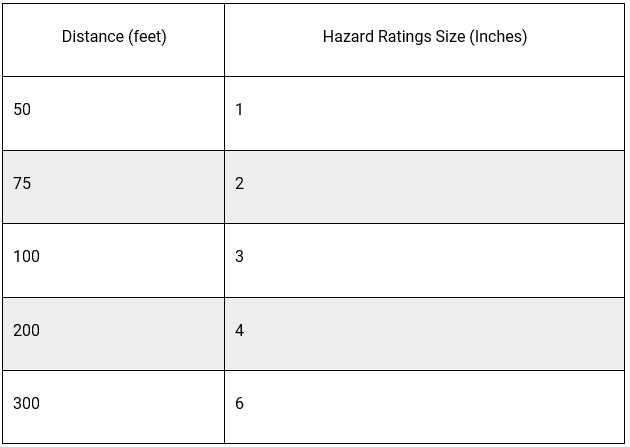
The size of the diamond / placard is dependent on the distance at which the hazard ratings must be legible. The numbers should be visible from a minimum distance of 50 feet. NFPA 704 recommended distances and letter heights are outlined below:
NFPA 704 and the Revised Hazard Communication Standard

One of the integral pieces of the Occupational Safety and Health Administration’s (OSHA’s) revised Hazard Communication Standard was the incorporation of Revision 3 of the United Nations’ Globally Harmonized System of Classification and Labeling of Chemicals (GHS). The revised standard requires the use of standardized “shipped container labels” and 16-section SDSs. However, the revised standard still allows for alternative methods of labeling workplace containers – such as the NFPA 704 labels.

Employers are required to ensure that containers in the workplace are labeled. You may replicate the “shipped container label” or you may label workplace containers with alternative labels, such as the NFPA 704 label. Containers of hazardous chemicals in the workplace must at a minimum include the product identifier and general information concerning the hazards of the chemical. Whatever method you choose, employees need to have access to complete hazard information.

Commonly Asked Questions

Q: Is the NFPA 704 a requirement? Who enforces this requirement?

A: The NFPA 704 standard is a voluntary standard. NFPA 704 signs are required when another federal, state or local regulation or code requires their use. Some of the more widely adopted and used NFPA codes that require 704 signs for specific occupancies, storage and hazardous materials include:

  • NFPA 1 – Fire Code
  • NFPA 30 – Flammable and Combustible Liquids Code
  • NFPA 45 – Standard on Fire Protection for Laboratories Using Chemicals
  • NFPA 55 – Compressed Gases and Cryogenic Fluids Codes
  • NFPA 400 – Hazardous Materials Code

Source

NFPA 704 Standard System for the Identification of the Hazards of Materials for Emergency Response – 2012 Edition


The information contained in this article is intended for general information purposes only and is based on information available as of the initial date of publication. No representation is made that the information or references are complete or remain current. This article is not a substitute for review of current applicable government regulations, industry standards, or other standards specific to your business and/or activities and should not be construed as legal advice or opinion. Readers with specific questions should refer to the applicable standards or consult with an attorney.

Source: Grainger Know How – https://www.grainger.com/know-how

New Safety Talks

New Safety Talks

Giovanni Tejada 22025-12-15T17:40:31+00:00
Dermal Absorption Safety Meeting Kit
Steeven Molina2025-10-22T23:34:43+00:00
Working with Dangerous Goods – Safe Handling Meeting kit
Steeven Molina2025-10-22T23:34:43+00:00
Working with Dangerous Goods – Safe Handling Meeting kit – Spanish
Steeven Molina2025-10-22T23:33:50+00:00
Working Safely with Ornamental Trees: Protecting Yourself, Your Team, and Your Trees Meeting Kit
Steeven Molina2025-10-22T23:33:48+00:00
Working Safely with Ornamental Trees: Protecting Yourself, Your Team, and Your Trees Meeting Kit – Spanish
Steeven Molina2025-10-22T23:31:25+00:00
Working Safely in Shrub, Lawn, and Garden Services Meeting Kit

New eLearning

Giovanni Tejada 22026-02-26T18:36:07+00:00
Work Comp Anti-Fraud Training – Spanish
Giovanni Tejada 22026-02-26T18:46:12+00:00
Work Comp Anti-Fraud Training
Steeven Molina2025-10-22T22:59:24+00:00
Flood Ready
Michelle Vera2025-10-14T23:29:51+00:00
Recognizing and Preventing Abuse & Neglect for Home Health Care Workers
Michelle Vera2025-10-14T23:28:38+00:00
Incident and Accident Investigation for Supervisors and Managers
Michelle Vera2025-10-14T23:26:46+00:00
Drug-Free Workplace: A Supervisor’s Guide to a Safe and Supportive Environment

Upcoming Events & Webinars

Damian Tollens2025-01-31T09:55:18+00:00
Feb 11 – Performance and Cultural Alignment
Damian Tollens2025-02-12T19:53:20+00:00
Feb 26 – Avoid Common Overhead Crane and Rigging Mistakes
Rick Tobin2024-10-24T16:57:11+00:00
Nov 13 – Defensive Driving For Changing Seasons
Rick Tobin2024-10-24T17:10:53+00:00
Nov 29 – What to Expect From a Health & Safety Inspection
Rick Tobin2024-10-24T17:13:55+00:00
Dec 5 – Top Safety Issues During the Holiday Season
Rick Tobin2024-10-24T17:13:30+00:00
Dec 19 – Safer in ’25: The 3 Pillars of Safety Culture
Vicky Pickford2022-06-11T00:00:00+00:00

See What's Trending

Emergency Lighting and Exit Sign Requirements – Quick Tips

Emergency Lighting and Exit Sign Requirements – Quick Tips

2026 OSHA Outreach 10 Hour Virtual Training Course

2026 OSHA Outreach 10 Hour Virtual Training Course

Forklift Train the Trainer Course

Forklift Train the Trainer Course

Forklift Training and Certification Instructions

Forklift Training and Certification Instructions

SCBA Cylinder Hydrostatic Testing – Quick Tips

SCBA Cylinder Hydrostatic Testing – Quick Tips

Upcoming Live Virtual Training Classes: Forklift Train the Trainer

Upcoming Live Virtual Training Classes: Forklift Train the Trainer

Contact Us

800-ICW-SAFETY (800.429.7233)SAFETYOnDemand@icwgroup.com

Additional Links

Manage eLearning
View list of learners
Help

Terms of Use | Legal Notice & Privacy Policy
©2023 ICW Group , All Rights Reserved

Page load link


Video Tutorials to Help You Get Started

Since it's your first time, you may want to checkout some of the video tutorials.

eLearning overview

Managing learners

Assigning courses

Reporting & Analytics

When you are ready to go, close this window.
Don't show this again
Go to Top


