Cleaning Products Can Lead to Asthma Infography

Source: https://www.eco3premierclub.com
Source: https://www.eco3premierclub.com

Fuente: https://www.nj.gov/
This course teaches employees how to identify common bloodborne pathogens in the workplace, how they are transmitted, engineering and work practice controls used to prevent contact with, and infection from, body fluids, and what to do if exposure occurs. (Spanish Version)

Source: https://www.rallye-stars.com

Fuente: https://www.beedigital.es
Hazardous chemicals are a leading cause of workplace injuries and illnesses. In addition to costly workers’ compensation claims and embarrassing publicity, failure to control chemical hazards at your workplace is a good way to get into deep trouble with OSHA.
Hazard communication, also known as HazCom, is a set of processes and procedures that employers and importers must implement in the workplace to effectively communicate hazards associated with chemicals during handling, shipping, and any form of exposure.
Hazard Communication Standard (HCS) violations consistently rank in the top 3 of OSHA’s ten most frequently cited standards list, with citations issued in nearly all industries.
To help you avoid these consequences, ensure your compliance, and greatly reduce the risk of an accident/incident related to hazardous chemicals, Safety OnDemand has built this 12-step Employer’s Guide to walk you through a complete path to HazCom compliance. Click on the buttons below to get started. Keep in mind that you are not forced to go to each step sequentially, the Guide was built so you can jump in and out at any stage.
| What You NEED To Do |
| As an employer, you are required by law to comply with the following HazCom standards: Hazard Communication, Subpart Z standards, the OSHA Process Safety Management (PSM) standard. You can have a working HazCom policy and procedure, without an incident, and not be compliant and risk fines and civil litigation. Download a model HazCom policy that is compliant and can be quickly edited to use in your workplace; however, it is also critical that you audit your policies & procedures every year, or as needed, to accommodate changes in legislation. |
The starting point for compliance is recognizing the 3 principal sources of OSHA chemical safety requirements:
When employees work with chemicals, they face a number of health hazards, including irritation, and physical hazards, such as flammability and corrosion. The United States Occupational Safety and Health Administration (OSHA) stipulates that chemical manufacturers and importers must evaluate the hazards of the chemicals with which they deal and pass along that information through labels and safety data sheets. Similarly, any employer with hazardous chemicals in the workplace must design and institute a written hazard communication program, which includes labeling all containers, giving all employees access to safety data sheets, and conducting a training program for all employees who could be exposed to the hazards. OSHA’s Hazard Communication Standard (HCS) specifies how to communicate information about the hazards and how to take protective measures.
The HCS ensures employees have the right to know the chemicals to which they are exposed in the workplace and their hazards. Employees not only must have access to the information, but they also must participate in employers’ training programs and know how to actively and effectively protect themselves. The Hazard Communication Standard also informs employers about designing and implementing these effective protective programs for employees who could be exposed to hazardous chemicals. OSHA’s overall goal is to reduce the number of chemical source illnesses and injuries in workplaces across the nation.
The standard that gave workers the right to know, now gives them the right to understand.
The Hazard Communication Standard (HCS) is now aligned with the Globally Harmonized System of Classification and Labeling of Chemicals (GHS). This update to the Hazard Communication Standard (HCS) will provide a common and coherent approach to classifying chemicals and communicating hazard information on labels and safety data sheets. This update will also help reduce trade barriers and result in productivity improvements for American businesses that regularly handle, store, and use hazardous chemicals while providing cost savings for American businesses that periodically update safety data sheets and labels for chemicals covered under the hazard communication standard.
In order to ensure chemical safety in the workplace, information about the identities and hazards of the chemicals must be available and understandable to workers. OSHA’s Hazard Communication Standard (HCS) requires the development and dissemination of such information:
| What You NEED To Do |
As an employer, you need to identify a single person that is responsible for “owning” the HazCom program. Too many cooks in the kitchen make it very difficult to stay on top of legislated and industry requirements. This person, should be responsible for the following:
|
The answer to that question depends on who you are, and what you do.
If you manufacture or import chemicals, you’re responsible for classifying the hazards of those chemicals. Appendixes A and B of the Standard contain instructions you’ll need to do this. Based on that classification, you must then use information included in Appendix C to determine what hazard information, including signal words and pictograms, you’ll need to include on labels for all chemical products you ship downstream.
You also need to develop SDSs for all chemical products you import or manufacture. There are 3 circumstances in which you’re required to supply SDSs. First, you must supply them with initial shipments of chemical products to downstream users. Second, you must include a new SDS with the next shipment after you revise the SDS for any reason. Third, you must send an SDS whenever requested to do so by a downstream user.
As a manufacturer or importer, you’re at the top of the supply chain, and everyone downstream depends upon the accuracy of the shipped labels and SDSs you supply. That’s why it’s especially important that you get it right!
The HazCom Standard defines a “distributor” as “a business, other than a chemical manufacturer or importer, which supplies hazardous chemicals to other distributors or to employers.” Basically, this means that you’re a distributor if you receive chemical products from a primary manufacturer, and then ship them to users downstream.
You’re responsible for including shipped labels and SDSs with the chemicals you ship downstream. That means you should stay on top of the chemical suppliers who ship to you in order to make sure they’re sending you accurate hazard information for the products they supply.
Employers are the end-users of chemicals, and have the important responsibility to ensure that their own employees have the information they need about the hazards of chemicals in the workplace. Remember the discussion about the “bad ole days” before there was a HazCom standard – what a dangerous time it was for workers? OSHA developed employer requirements under the HazCom Standard to help reduce the potential for those situations.
The very beginning of the HazCom standard requires employers to have a “comprehensive HazCom program.” But what does that mean, exactly? To meet OSHA’s requirements, an employer needs to include these 5 components in their plan:
Although S&R employees may not directly use chemicals to perform their job duties, a basic understanding of the known and potential company chemical hazards should be provided. This is necessary in the event containers get damaged during transport or through movement within the building, as well as in storage.
You may have a well-trained chemical response team which cleans up leaking or spilled containers, but your shipping and receiving workers are the first-line of defense in the facility in this regard. And further, storage of many chemicals certainly requires knowledge of incompatible products and conditions to avoid.
As a result, make sure the S&R employees know:
In addition to these topics, safe transportation of chemicals and use of secondary containers should be reviewed.
And occasionally, workplaces receive chemicals in error. A driver pulls away and a drum is accidentally left behind sitting on the dock, and it is not yours. This product could be one that your facility is not familiar with. Until the foreign chemical can be removed from the workplace, it may present a new hazard if it’s leaking, or even in normal storage. S&R should be aware how to respond to these events.
Your responsibilities also vary depending on the employment contract of the workers in question.
Typically, the staffing agency and the host employer share training responsibilities for temporary workers. Generic training on the basics of HazCom is often provided to workers by the staffing agency. However, depending on the nature of the site-specific requirements of the workplace or the anticipated job duties, the staffing agency’s training may not be sufficient to protect temporary workers fully.
As a recommended practice, work closely with staffing agencies and review the nature and types of training provided. In many cases, you’ll need to supplement temporary worker HCS training. As OSHA states, “Many OSHA standards include specific safety and health training requirements to ensure that workers have the required skills and knowledge to safely perform their work.” Hazard communication is one such standard that often requires specific information to be relayed to the temporary worker.
As with your other employees, ensure your temporary workers understand:
Of all employees groups, maintenance often present the biggest challenges in compliance, especially when it comes to chemical exposure. Typically, in small to medium-sized companies, these workers handle a variety of tasks, and your maintenance crew can create or repair almost anything.
This may mean they are using chemicals in non-traditional or inappropriate ways, perhaps welding in the plant near flammable products, or using multiple (and possibly incompatible) chemicals without sufficient ventilation or respirators.
And depending on the nature of your company structure, maintenance workers may also purchase chemicals and bring them into the plant without any tracking process. This can create issues with compliance, as well as safety and health. Safety Data Sheets and chemical inventories often don’t reflect these purchases, and hazards associated with these chemicals might not be included in HCS training.
There are several ways to prevent these types of inadequacies in the HazCom program, including:
Hazard Communication is meant to be a program that is regularly and consistently used, as it provides several layers of safety for your workers. HazCom compliance is the responsibility of everyone who has known (or potential) exposure to chemical hazards. But this is only possible if everyone understands how to apply the standard to their duties.
The HCS shouldn’t be gathering dust on the shelf, nor should the HazCom training be a one-and-done method. The foundational aspects of HazCom are an ongoing, daily process for all workers who have known or potential exposure to chemicals in the course of their job duties.
However, often that is not the case. Employees may not grasp the relevance of HazCom in meaningful ways which protect them from chemical health hazards or protect the facility from physical hazards, like fire. OSHA has stated, “An employer’s training program is to be a forum for explaining to employees not only the hazards of the chemicals in their work area, but also how to use the information generated in the hazard communication program.” In short, workers must know how to use what they’ve learned.
Of course, training for HazCom is required initially, before workers are exposed to chemical hazards, and additionally, if a new health or physical hazard is introduced. But as HazCom training is not compulsory on an annual basis, workers can easily forget the material and the elements of the standard that keep them safe.
Clearly employers must focus HCS on the workers with obvious hazards, such as those mixing or directly handling chemicals. But other employees in your company likely have potential HCS exposure, too. And some workers might have unusual chemical exposures, by virtue of their job functions.
| What You NEED To Do |
| As with any other hazard, the starting point in managing chemical dangers is to identify and assess hazards at your own workplace. Specifically, you must create a hazardous chemical inventory. You’ve likely already done this, but if not, we’ve outlined how to get started below or you can download our HazCom Audit and Hazardous Material Inventory Form to get started. |
The first stage in complying with the OSHA Hazard Communication Standard is to create a list of all the hazardous chemicals in your workplace.
What To Look For
What you’re looking for are “hazardous chemicals,” which the HazCom standard defines as any “chemical which is a physical hazard or a health hazard.”
“Health hazard” means a chemical for which there’s statistically significant evidence based on at least one study conducted in accordance with established scientific principles that acute or chronic health effects may occur in exposed employees, which includes chemicals which are carcinogens, toxic or highly toxic agents, reproductive toxins, irritants, corrosives, sensitizers, hepatotoxins, nephrotoxins, neurotoxins, agents which act on the hematopoietic system, and agents which damage the lungs, skin, eyes, or mucous membranes. Appendix A of the standard provides further definitions and explanations; and Appendix B describes the criteria used to determine whether a chemical is considered hazardous for purposes of the standard.
“Physical hazard” means a chemical for which there’s scientifically valid evidence that it’s a:
Where To Look
The hazardous chemicals inventory can cover either the entire workplace or different work areas. Start by looking at the physical site. Identify chemicals in containers, including pipes, but also think about chemicals generated in the work operations, OSHA explains in its guidelines. For example, welding fumes, dusts, and exhaust fumes are all sources of chemical exposures.
Also look beyond the physical stuff. Examine your purchasing records to identify the kinds of chemicals you have at your workplace. Read labels provided by suppliers for hazard information.
How To Look
The best way to prepare a comprehensive list, according to OSHA guidelines, is to survey the workplace. The guidelines also recommend that you take the “broadest possible perspective when doing the survey.”
“Sometimes people think of ‘chemicals as being only liquids in containers. The standard covers chemicals in all physical forms – liquids, solids, gases, vapors, fumes, and mists – whether they are ‘contained’ or not.” The hazardous nature of the chemical and the potential for exposure are the factors which determine whether a chemical is covered. If it’s not hazardous, it’s not covered. If there is no potential for exposure (e.g., the chemical is inextricably bound and cannot be released), the rule does not cover the chemical.”
What To Do Next
Once you compile your list, verify that you have Safety Data Sheets (SDSs) for each of them. Check your files against your inventory. If any are missing, contact your supplier and request one. Make a written record documenting such requests, either by copy of a letter or a note regarding telephone conversations.
If you have SDSs for chemicals that are not on your list, figure out why. Maybe you don’t use the chemical anymore. Or maybe you missed it in your survey. Some suppliers do provide SDSs for products that are not hazardous. These do not have to be maintained by you.
1. OSHA Says You Have To
The HazCom standard requires employers to implement a written hazard communication program at their worksite. Under Sec. 1910.1200(e)(1)(i)), the program must include a list of hazardous chemicals at the site.
2. It’s Crucial to Hazard Assessment and Program Development
The list isn’t just a piece of paper; it’s a hazard assessment. The list is an inventory of all hazardous chemicals in the workplace at a given point in time. You can then group these substances into major hazard classes, such as flammable, corrosive, toxic and reactive. By mapping out the key chemical hazards in your workplace, the inventory then becomes the point of departure for creating a written hazard communication program appropriate to deal with these hazards.
3. It Helps You Comply With SDS Requirements
The inventory is a tool that helps you comply with the requirement (Section 1910.1200(g)(1)) of ensuring that there’s an appropriate, up-to-date SDS for each hazardous chemical in your workplace.
4. It Helps You Comply With Training Requirements
The inventory also helps you comply with HazCom training requirements because it maps out the hazardous chemicals to which your employees are exposed and require safety training and education to deal with..
5. Helps Identify and Correct Supply Problems
Inventories can help you identify potential hazardous chemical supply problems or inefficiencies and that you can proceed to correct. For example, the inventory might reveal an opportunity to store smaller quantities of a hazardous chemical by consolidating storage locations or to streamline your ordering process so that an employee can’t inadvertently order a particular product for which ample supplies already exist in different storage sites.
6. Makes It Easier to Consider Less Hazardous Substitutes
Conducting a hazardous chemicals inventory gives you the chance to consider replacing current products with substitutes that are less dangerous to worker health and safety as well as the environment.
Conclusion: Inventory Is a Work in Progress
Keep in mind that conducting an inventory just gives you a snapshot of the hazardous chemicals in your workplace at a given time. Changes in operations may lead to the elimination of some hazardous chemicals and the introduction of new ones. So establish a method for ensuring that the inventory is reviewed and updated at least once a year. In addition, develop a method for adding new chemicals the first time they’re used in the workplace.
| What You NEED To Do |
| The HazCom standard requires employers to ensure that each hazardous chemical used in the workplace have a safety data sheet, or SDS. Your supplier should provide you an SDS for each chemical. You can use SDS Search to search and download any missing SDS. You may also want to download our infographic on how to read an SDS or make use of our instructor-led or online training on the Globally Harmonized System (GHS) and how to engage with SDSs. |
Safety Data Sheets (SDSs) are summary documents that provide information about the hazards of a product and advice about safety precautions. SDSs are usually written by the manufacturer or supplier of the product. In some circumstances, an employer may be required to prepare an SDS (e.g., when the product is produced and used exclusively in that workplace).
SDSs provide more detailed hazard information about the product than the label. They are an important resource for workplaces and workers to help you learn more about the product(s) used. Use this information to identify the hazards of the products you use and to protect yourself from those hazards, including safe handling and emergency measures.
SDSs tell users what the hazards of the product are, how to use the product safely, what to expect if the recommendations are not followed, how to recognize symptoms of exposure, and what to do if emergencies occur.
OSHA only requires safety data sheets (SDSs) for hazardous products or chemicals. GLT Products, along with other manufacturers are not required to provide SDSs for non-hazardous materials or products. OSHA has left it up to the producer whether or not they should provide SDSs for non-hazardous materials. Many organizations often supply SDSs for liability purposes, not for compliance. In fact, OSHA does not encourage manufacturers to maintain SDSs for non-hazardous products or chemicals.
HCS 2012 defines a health hazard as:
“…a chemical which is classified as posing one of the following hazardous effects: acute toxicity (any route of exposure); skin corrosion or irritation; serious eye damage or eye irritation; respiratory or skin sensitization; germ cell mutagenicity; carcinogenicity; reproductive toxicity; specific target organ toxicity (single or repeated exposure); or aspiration hazard. The criteria for determining whether a chemical is classified as a health hazard are detailed in Appendix A to §1910.1200 — Health Hazard Criteria.
HCS 2012 defines a physical hazard as:
“…a chemical that is classified as posing one of the following hazardous effects: explosive; flammable (gases, aerosols, liquids, or solids); oxidizer (liquid, solid or gas); self-reactive; pyrophoric (liquid or solid); self-heating; organic peroxide; corrosive to metal; gas under pressure; or in contact with water emits flammable gas. See Appendix B to §1910.1200 — Physical Hazard Criteria.
We encourage everyone to click here to view the full details of OSHA’s rules on Hazard Communication Standards.
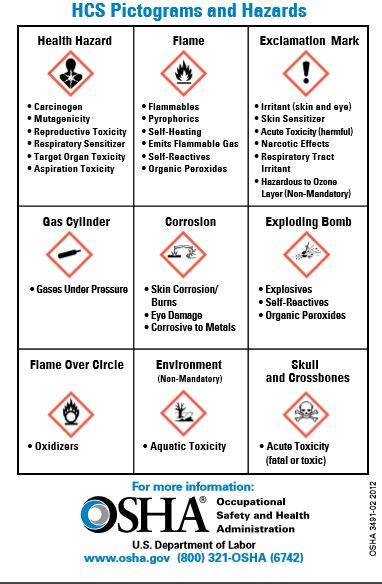
As of June 2015, the Hazard Communication Standard (HCS) now requires pictograms on labels to alert users of the chemical hazards to which they may be exposed to. Displayed below are pictograms of the symbols that represent a distinct hazard(s). The pictogram on the label is determined by the chemical hazard classification.
The simple fact to keep in mind is that if it is a hazardous chemical or product, a safety data sheet will be required. If it is a manufactured product, the odds of an SDS existing may be slim.
The Hazardous Products Regulations (HPR) specifies the sections and content for the SDS. Schedule 1 within the HPR outlines the section number and heading that must be presented in the specified order, as follows:
| SDS Section and Heading | Specific Information Elements | |
|---|---|---|
| 1 | Identification |
|
| 2 | Hazard identification |
|
| 3 | Composition/Information on ingredients |
NOTE: Confidential business information rules can apply |
| 4 | First-aid measures |
|
| 5 | Fire-fighting measures |
|
| 6 | Accidental release measures |
|
| 7 | Handling and storage |
|
| 8 | Exposure controls/ Personal protection |
|
| 9 | Physical and chemical properties |
|
| 10 | Stability and reactivity |
|
| 11 | Toxicological information | Concise but complete description of the various toxic health effects and the data used to identify those effects, including:
|
| 12 | Ecological information*** |
|
| 13 | Disposal considerations*** | Information on safe handling for disposal and methods of disposal, including any contaminated packaging |
| 14 | Transport information*** |
|
| 15 | Regulatory information*** | Safety, health and environmental regulations specific to the product |
| 16 | Other information | Date of the latest revision of the SDS |
SDSs are required to be accurate at the time of sale. An SDS will be required to be updated when the supplier becomes aware of any “significant new data”. The definition of “significant new data” is:
New data regarding the hazard presented by a hazardous product that change its classification in a category or subcategory of a hazard class, or result in its classification in another hazard class, or change the ways to protect against the hazard presented by the hazardous product.
This definition means that an SDS must be updated when there is new information that changes how the hazardous product is classified, or when there are changes to the way you will handle or store or protect yourself from the hazards of the product.
SDSs will be required to be updated within 90 days of the supplier being aware of the new information. If you purchase a product within this 90 day time period, the supplier must inform you of the significant new data and the date on which it became available in writing.
Yes. Employers will be required to make sure that all hazardous products have an up-to-date SDS when it enters the workplace. The SDSs must be readily available to the workers who are exposed to the hazardous product, and to the health and safety committee or representative.
Employers may computerize the SDS information as long as:
As mentioned, in some circumstances, an employer may be required to prepare an SDS (e.g., when the product is produced and used in the workplace).
Always be familiar with the hazards of a product before you start using it. You should look at an SDS, match the name of the product on the container to the one on the SDS, know the hazards, understand safe handling and storage instructions, as well as understand what to do in an emergency.
You can think of the SDS as having four main purposes. It provides information on:
For most people who work with hazardous products, you should always:
A few things to know:
| What You NEED To Do |
| Eliminating chemical hazards in the workplace removes the risks they pose. The next best is substituting the hazardous chemical for something non-hazardous or less hazardous. These activities can reduce the costs and work associated with storing and disposing of chemicals and training and equipping employees. It can also reduce liabilities and costs from downtime due to accidents and occupational injuries and illnesses. It is important when substituting chemicals to select safer alternatives and not just swap one harmful agent for another, which could do even more harm to employees and downstream users of products. Download a worksheet for how to select chemical substitutes. |
Chemicals in the workplace lead to over 190,000 illnesses and 50,000 deaths annually in the United States. These shocking statistics, referenced by OSHA on its chemical substitution web page, stem from a 2006 California Policy Research Center report entitled “Green Chemistry in California: A Framework for Leadership in Chemicals Policy and Innovation.”
Statistics aside, there is a global growing awareness that more can and should be done to safeguard employees, our communities, and the environment from the effects of hazardous chemicals. Chemical substitution has been identified as one of the primary tools for achieving those ends, and on that front, OH&S professionals are uniquely positioned to take the lead.
There are myriad reasons for transitioning away from hazardous chemicals to safer alternatives. On a basic level, it conforms to the hierarchy of controls, which posits that there is an order in which hazards should be dealt with, with the most effective controls considered first and the least effective controls used when necessary. The controls in order of effectiveness are:
Looking at these controls through the lens of chemical safety, the order makes sense. Eliminating chemical hazards in the workplace removes the risks they pose. Next best is substituting the hazardous chemical for something non-hazardous or less hazardous. These activities can reduce the costs and work associated with storing and disposing of chemicals and training and equipping employees. It can also reduce liabilities and costs from downtime due to accidents and occupational injuries and illnesses.
It is important when substituting chemicals to select safer alternatives and not just swap one harmful agent for another, which could do even more harm to employees and downstream users of products.
If a company is unable to remove the hazard entirely or minimize it, then it should look next at engineering controls, which physically change the workplace to remove the hazard or place a barrier between the hazard and the worker. Next, it should look at administrative controls that require employer/employee actions to align with new processes that seek to mitigate risks. If a hazard cannot be controlled by the methods described above, then an employer may have to resort to PPE, which is generally considered the least effective method of control.
The benefits of chemical substitution go beyond safety, and a strong business case can be made that chemical substitution benefits include improvements to productivity through gained efficiencies, as demonstrated by the American Industrial Hygiene Association (AIHA) in a 2008 study, “Demonstrating the Business Value of Industrial Hygiene.” These efforts, the study concluded, positively contribute to a company’s bottom line.
Proof of the business case can be seen in the marketplace today: Local, state, federal, and international regulations are mandating the move toward safety alternatives; consumers are demanding safer products and services and are rewarding companies that provide it, and communities are holding business more accountable for their actions; larger downstream companies are mandating safer chemicals and tighter hazard communication protocols from upstream suppliers. In today’s marketplace, sustainability is good business.
OSHA has outlined seven steps it recommends for making the transition successful. Those steps are:
More specifically, OSHA recommends:
Substitution of currently-used materials with less hazardous materials is one of the most effective ways of eliminating or reducing exposure to materials that are toxic or pose other hazards. A hazard is the source of danger or injury. A hazard includes any chemical or material that has the ability or a property that can cause an adverse health effect or harm to a person under certain conditions. Risk, on the other hand, is the probability or chance that exposure to a chemical hazard will actually cause harm to a person or cause an adverse effect.
Other occupational hygiene methods for controlling employee exposure to chemicals include elimination, isolation, enclosure, local exhaust ventilation, process or equipment modification, good housekeeping, administrative controls and personal protective equipment. All these methods reduce or eliminate the risk of injury or harm by interrupting the path of exposure between the hazardous material and the worker. Substitution removes the hazard at the source.
Extreme care must be taken to ensure that one hazard is not being exchanged for another, especially one that could even be a more serious hazard. Before deciding to replace a chemical, one must know what risks the chemical poses to the employees, the environment, the equipment and facilities. If the risks are serious, then alternatives should be considered. A thorough understanding of the potential risks associated to the alternative solution is necessary.
The selection of a substitute can be a very complex process. In large organizations the selection process may involve a committee with representatives from engineering, purchasing, industrial hygiene, safety, maintenance, research and development, environmental control, waste management, shipping, and the supervisors and workers who directly work with the product. In smaller organizations, one person may carry out many of these functions.
Use safety data sheets (SDSs) and other sources of chemical information to compare the hazards of various products. For easier comparison, set up a table with the following categories for each potential substitute. The important properties to compare are:
Although substitution is the most direct method of reducing hazards, it is not always practical. A very careful evaluation must be done before any substitution plan to ensure that the new, alternative chemical does not pose a greater hazard than the currently used product. For example, a less environmentally harmful substance may actually pose a more significant risk for the health of the workers.
The Health and Safety Executive (HSE) in the United Kingdom recommends a seven step process when considering substitution*. These steps include:
| What You NEED To Do |
| First of all, you should know that the main trigger to the requirement to develop a written plan is having hazardous chemicals, as defined by the HazCom Standard, in the workplace. There aren’t many exceptions to this requirement, and in fact, a 2015 enforcement directive makes clear that an employer needs to develop a plan “whether the employer generates the hazard or the hazard is generated by other employers.” So, if your own operations don’t involve hazardous chemicals but the operations of your onsite contractors you do, you’d still need to develop a plan that specifically addresses those chemical hazards, including procedures for training your own employees about those hazards. Download a model HazCom program that you can edit and implement. |
As it turns out, there are only two situations in which employers subject to OSHA’s HazCom Standard, who have hazardous chemicals in the workplace, do not need to have a Written HazCom Plan.
The first instance pertains to work operations where employees only handle chemicals in sealed containers that are not opened under normal conditions of use, such as many storage and distribution warehouses. If you’re an employer at such a facility you need to: ensure that labels on incoming containers of hazardous chemicals are not removed or defaced; maintain copies of SDSs received with shipments and obtain SDSs when requested by employees; make SDSs accessible to employees during each work shift; and provide employees with HazCom training. However, you would not need to have a Written Plan.
Even if your facility handles only sealed containers, you might still find it valuable to have a Written HazCom Plan, considering that you need a system for storing and providing access to SDSs, maintaining shipped container labels and providing employee HazCom training. In the event of an OSHA inspection, you’d need to convince the inspector you’re meeting your compliance obligations, and without anything written down, which, for example, describes your training program, you may have some difficulty with that. For this reason, it’s worthwhile to go beyond the regulatory requirement and draft a Written Plan. It can help explain and provide documented evidence of your HazCom management practices.
The second example of an employer who does not need to have a Written HazCom Plan pertains to laboratory operations subject to OSHA’s Laboratory Standard, which covers “laboratory use” of small amounts of a limited variety of chemicals on a non-production basis. If your laboratory operations fall under that category, you’d need to have a written Chemical Hygiene Plan (CHP) instead, which contains information and plans more specific to a lab environment, such as maintenance of fume hoods and decontamination procedures. But remember, if your lab engages in production-related operations, including quality control, the Lab Standard would not apply and you’d need to have a Written HazCom Plan for those operations.
As we can already see, we need a pretty good grounding in the HazCom Standard to understand the requirements. You need to walk before you can run, and you need to ground yourself in the HazCom Standard before you sit down to start writing your plan. While this may seem like an obvious, logical place to start, surprisingly, few people actually seem to do this, which may help explain why deficiencies with the Written HazCom Plan are among the most commonly cited HazCom violations for employers.
Be sure to get a broad understanding of the Standard as a whole, and of requirements for the Written Plan in particular, which are found in 1910.1200(e). These requirements include:
Before you even put pen to paper or fingers to keyboard, collect the information you need. Do a walk-through of your whole facility to identify chemicals, being sure not to miss chemicals in boiler rooms, maintenance areas, storage sheds, or inside reservoirs of large machines. Talk to supervisors and Purchasing Department representatives to fill in any gaps.
Go beyond identifying obvious chemical containers, too. Look for examples of unlabeled pipes that may contain chemical products. Also pay attention to the ways chemicals are used, and specific hazards that may be created from their use. Is there dust visible? What about fumes or vapors? These are details you’ll need to know to be fully aware of the chemical hazards in your facility and the routes of exposures employees may have.
As all of the above requirements show, you’ll need to be very familiar with not only the requirements of the HazCom Standard, but also specific operations at your establishment pertaining to hazardous chemicals. Which brings us to our next point.
I hope it’s becoming clear by now, but let’s state it right out: Writing a HazCom Plan is serious business.
Don’t make the mistake that many employers make, and simply find a template from somewhere and stop customizing the template for your workplace after filling in some of the obvious details like company name and address. There are many templates out there issued by trade associations, safety organizations and professional groups, and it’s fine to take advantage of that material. But take it for what it is: help on getting started, rather than a shortcut to your destination. A better template that gives you the guidance needed to actually create a compliant written plan will give you a big advantage here.
In my experience, many employers who have a less than robust HazCom Plan are working from a perspective of trying to simply “meet obligations” or “document compliance,” which is to say that they see it largely as a paper exercise. That also explains why once employers complete the Written Plan, they tend to file it away, whether on a computer desktop or on a shelf, instead of actually using it on an ongoing basis to manage chemical safety.
That’s their loss. First of all, failure to have a Written Plan that accurately describes hazards and hazard communication practices at your establishment can lead to compliance violations, and fines. Federal OSHA issued 4,806 violations for Written Plan deficiencies between December 1, 2013 and July 30, 2018, and the agency recently increased monetary penalties by 2.5% compared with 2018 levels.
Remember that the plan has to be specifically about your hazards, your management practices, and your program details at your establishment. Make sure your plan includes all of the site-specific details listed in the “Learn the Background” section of this article. Additionally, make sure you’ve spelled out who’s responsible for key aspects of your program. A 2015 enforcement directive makes clear that OSHA expects your plan to designate the individuals responsible for managing labels on shipped containers, and workplace labels, and for obtaining and managing access to SDSs.
But the biggest loss that can happen if you treat your HazCom plan as just a paper exercise is the ability to improve safety for your workforce. It takes time and effort to develop a good HazCom Plan, but the reward is a blueprint for increasing chemical awareness, reducing risks of chemical exposures and related injuries, and potentially improving employee retention.
Spend the time to write a good plan, and use it as your playbook, which is what it’s intended to be.
The effectiveness of your Written Plan, and the ultimate benefits of having it, are achieved when your workforce is aware of the Plan’s existence, understand its content, and know where and how to access it.
When I was involved in corporate EHS, I used to find it useful to casually ask employees I passed walking through the facility if they knew where to find the HazCom plan if they ever wanted to review it. Many times they knew exactly where and how to do that, but other times they didn’t. That usually meant that it was time for at least a quick refresher on the basics of the program with their department, and that it might also be a good idea to review the details of our HazCom training program and see if there were any reasons for the gap in awareness we were seeing.
If your workers have job assignments requiring travel between different workplaces, you may keep the written plan at the primary work location. However, in that situation it’s going to be even more important to be inform all employees how to access the plan, and confirm their understanding.
We can start to see here that there is a close relationship between the requirement to have a HazCom plan and the requirement to conduct training. They reinforce each other and changes in one should lead to changes in the other.
When might we need to change our written HazCom plan? Basically, we’d need to update the plan whenever it no longer accurately described the chemical hazards and hazard communication practices at our facility.
For example, let’s say that since the last time we updated our plan, we brought flammable chemicals on-site. That means we should update our written plan to include the new information, as well as any relevant details about storage and safe usage practices, and if we’ve never provided training on flammable hazards before, the HazCom standard requires us to train employees on that hazard class. The mutually reinforcing relationship between the HazCom Plan and training should come into play here. The training should include the information about flammables in the written plan, and the plan should spell out the specific kinds of training employees need to have.
You should also update the HazCom plan, and the relevant aspects of training, if you make any other significant changes to your program, including workplace labeling, methods of providing access to SDSs, details of the written plan itself, or the identities of individuals with specific responsibilities, such as oversight of labeling and SDSs. If you have a plan with names of people who no longer work for your company listed for the latter, it’s a sure sign that you’re not updating your plan as often as you should, and could be risking violations and chemical-related incidents as a result.
Someone out there might now be thinking, “OK, but when do I need to update the plan? In other words, how long can I go without updating the plan before OSHA decides to give me a violation?” I can understand the motivation behind that question, but it’s the wrong question.
It is of a matter for any given enforcement officer to decide whether the specific details she’s seeing constitute a HazCom violation. But whether or not you will get a violation is not the only consideration, or even the most important one. The more important factor, since your plan is intended to be your playbook, is whether failure to update your plan will result in a loss of effectiveness of your HazCom program as a whole, and a loss in safety for your workforce. Any changes to your HazCom program that are not described in your plan probably also won’t be adequately communicated to employees, and that may have a serious impact on your safety performance. Go beyond compliance, and strive for the most effective program possible.
Source: https://www.msdsonline.com/2019/03/08/intro-to-hazcom-part-four-writing-a-good-hazcom-plan/
| What You NEED To Do |
| All labels are required to have pictograms, a signal word, hazard and precautionary statements, the product identifier, and supplier identification. Any chemical in your workplace must have an SDS and a label that complies with HazCom standards. Click here for the OSHA Brief on Hazard Communication Standard: Labels and Pictograms, and here for some direction on identifying pictograms. |
Let’s take a closer look at the requirements for shipped labels and workplace labels.
If you are a manufacturer, distributor or importer who ships chemicals to downstream users, you’re going to need to develop shipped labels and affix them to the immediate containers of those chemicals before you ship them to customers.
Of course, the very first thing you need to do is to classify the hazards of your chemical products. Appendix A of the HazCom Standard describes how to classify the health hazards of your chemicals, and Appendix B describes how to classify the physical hazards of the chemicals. Once you’ve completed that process, you’re ready to move on to Appendix C, which tells you how to allocate physical and health hazard information on a shipped container label.
There are six required elements of a shipped label:
There are 9 pictograms that can be used to represent the various hazard classifications. Eight of them are mandatory if triggered by the hazard classification process, while the ninth pictogram (for environmental hazards) is optional. The pictograms are shown below, and must be represented exactly as shown to avoid confusion.

These don’t have to be presented in any particular order on the shipped label, but they must be present when required based on the classification process. You may provide any additional information you think might be helpful as long as the shipped label includes the six required elements above, and doesn’t include any information that contradicts the required information or causes confusion.
What would OSHA consider to be contradictory or confusing information? Great question! One example might be a diamond-shaped symbol in red, white and black that is not one of the nine pictograms shown above. Such a symbol could be easily confused for a GHS/HazCom pictogram. In an emergency, any uncertainty about a chemical’s hazards is dangerous.
The first thing to know about workplace containers is that you most likely have a lot more of them than you realize.
You probably aware of some of the more visible containers, such as transfer buckets and safety cans, but you might not realize that machine reservoirs are workplace containers, too. These are the internal tanks within larger machines for holding oil or coolant. These tend to be out of sight and out of mind, because you don’t notice them the way you notice a drum or tank sitting in the corner. However, you have obligations to communicate the hazards of these chemicals to your employees all the same.
In some workplaces, there may be dozens or even hundreds of machines with fluid reservoirs, and if you don’t have a labeling system for those containers, your employees are at risk. Knowing the number and capacity of all of these containers will also help you determine the applicability of environmental regulations like Spill Prevention Countermeasure and Control Act (SPCC), or Emergency Planning and Community Right to Know Act (EPCRA) Tier II reporting.
While you’re inspecting the reservoirs of large machines out on the shop floor, you may also want to direct your attention to the area underneath those machines. You’ll likely see “drip pans” beneath the fluid hoses and fittings, as well as a little bit of leakage of whatever fluid is in the system – typically some form of oil. Hopefully you’ll also see a workplace label on the pan indicating the fluid inside and any associated hazard information. If you don’t, you at least can take consolation in knowing you’re far from being the first person to forget to label these containers, but it’s important that you get busy labeling them right away!
So, a big part of getting workplace labeling right is recognizing all of your secondary containers, and making sure that any and all of them are labeled. Another important piece is understanding the HazCom Standard’s requirements for workplace labeling.
Unlike the very prescriptive requirements for shipped container labels, HazCom requirements for workplace labels are more flexible. Employers do have a few options. You can either replicate the manufacturer’s shipped container label, or you can create your own workplace labels containing the product identifier and a combination of other pieces of chemical hazard information. Please see the image below to get an idea what these options might look like.

But please realize that these options aren’t equally good! The easiest, most effective option is to simply replicate the manufacturer’s shipped label. Do this, and you’ve met your labeling obligations. If you choose an option other than that, you’re going to need a system in place to provide any information from the shipped label that isn’t directly included on your workplace label. That additional information may include training, work instructions, risk assessments, signage, and the SDSs for the chemical in question.
The key point here is that any alternative workplace labeling system, consisting of the label plus other information, must provide your workers with immediate access to specific information regarding the physical and health hazards of the chemical. Even more importantly, you’ll need to be ready to prove to OSHA that your system works in the event they ever ask – such as during an inspection. That’s why we recommend simply replicating the shipped label whenever possible.
If you consistently work with specific chemicals in your operations and place them in workplace containers, you can buy secondary containers from certain industrial supply stores that come with pre-affixed labels containing the chemical name and other hazard communication elements, such as pictograms. In a recent letter of interpretation, OSHA stated that the use of these pre-labeled containers is consistent with their workplace labeling requirements, as long as your system makes all hazardous chemical information available to workers. This includes any information from the shipped label that’s not included on the workplace label. So again, use the labeling system that works best for you, but replicating the shipped label for use on your workplace containers remains the easiest, most direct way to demonstrate compliance in the event of an OSHA inspection.
A good software-based chemical management solution can be a big help here. The right software can let you quickly print a workplace label that replicates the shipped label, giving you a consistent workplace labeling system that efficiently conveys chemical hazard information to your workers. Do you have smaller workplace containers such as test tubes and vials that don’t have enough space for a full shipped label, and may often need to be replaced as they become illegible? A good solution will enable you to easily create and print labels containing selected GHS elements that, in combination with training and other elements, can help you provide the required hazard information to your employees.
| What You NEED To Do |
| An important aspect of the HazCom program is to ensure that someone (e.g., the HazCom Coordinator or a designee) is responsible for obtaining and maintaining the SDSs for every hazardous chemical in the workplace. If an SDS is not received automatically from the distributor, one must be requested as soon as possible. If the request for an SDS does not produce the information needed, the local OSHA area office should be contacted for assistance. |
Paragraph (g) of HazCom 2012 states that employers must have an SDS in the workplace for each hazardous chemical they use.
If an SDS is missing, one must be requested from the distributor. To shows good faith effort to obtain an SDS, it is prudent to document the request (e.g., keep copy of the letter or e-mail; make a note regarding telephone contact). A hazardous chemical for which there is no SDS on file should not be used until the SDS is obtained.
An important aspect of the HazCom program is to ensure that someone (e.g., the HazCom Coordinator or a designee) is responsible for obtaining and maintaining the SDSs for every hazardous chemical in the workplace. If an SDS is not received automatically from the distributor, one must be requested as soon as possible. If the request for an SDS does not produce the information needed, the local OSHA area office should be contacted for assistance.
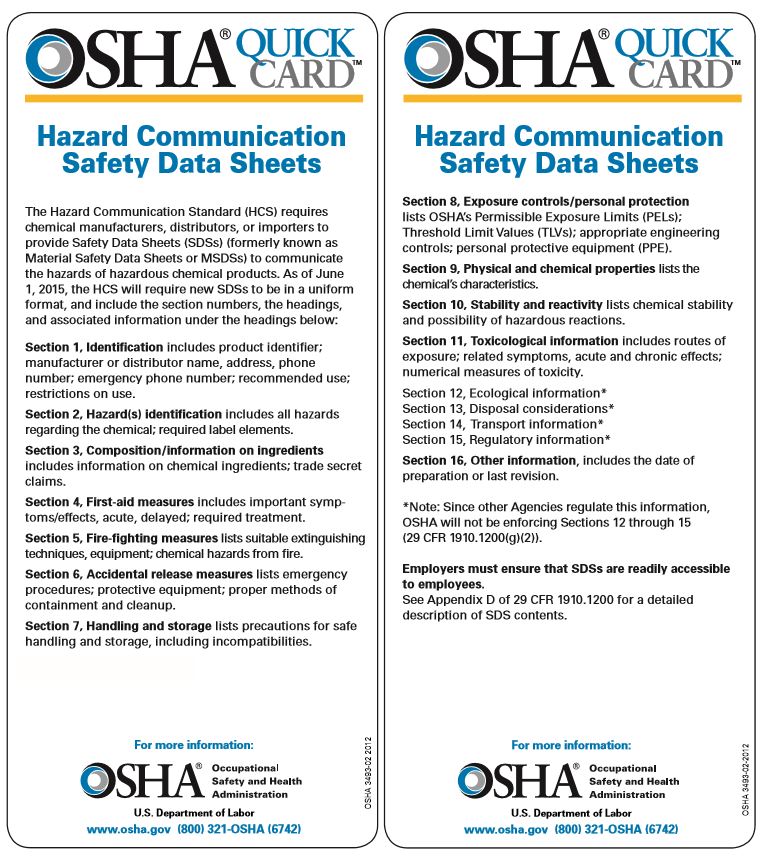
The SDSs have 16 internationally agreed upon components or sections that contain information for many different audiences (e.g., employers, workers, safety and health professionals, emergency responders, government agencies, and consumers). Consequently, the sections have been organized so that the information of most use to exposed workers, emergency responders, and others who do not need extensive technical detail is in the beginning of the SDS (Table 5).

For example, a description of a chemical’s health effects appears in Section 2 (Hazard identification), but the toxicological data upon which the determination of these effects is based appears in Section 11 (Toxicological information). All of the sections are available to any reader, but there is a difference between what is necessary for a broader audience and what might be needed by others designing protective measures or providing medical services.
The information in some of the sections is non-mandatory because they address information that involves the requirements of other government bodies, and thus they are not under OSHA’s jurisdiction. Even though these sections are not considered mandatory by OSHA, the sections are still required. They provide useful information related to ecological, disposal, and transportation-specific issues under the regulatory control of other agencies.
Employers must not only maintain copies of SDSs, they must also ensure that the SDSs are readily accessible to workers during their work shifts. Some employers keep the SDSs in a binder in a central location, others provide access electronically. However, if access to SDSs is provided electronically, there must be an adequate back-up system in place in the event of a power outage, equipment failure, or other emergency involving the primary electronic system.
Familiarity with the information in each section of an SDS will enable both employers and employees to quickly access this information in case of an emergency. A section-by-section description of the information required for each part of the SDS is available in Appendix D of HazCom 2012.
OSHA also developed a QuickCard™ on SDSs (OSHA 3493) available on the OSHA Hazard Communication website.
The SDSs must be in English, although the employer may maintain copies in other languages.
Software is available to help you easily author SDSs based on required standards, manage and maintain your collection of SDSs as well as access your safely cloud-based safety data sheets at any time.
| What You NEED To Do |
| OSHA’s 1910.1200 Hazard Communication Standard, commonly referred to as HazCom, are rules and regulations in place to ensure workers are informed of any chemical hazards they may encounter while on the job. The HazCom standard requires organizations have proper container labeling and safety data sheets to communicate the potential dangers the chemicals pose and what to do in the event of an emergency. As such, a critical part of OSHA’s HazCom requirements is that employers need to provide employees with proper training on how to remain safe when working with hazardous chemicals. Click here to assign HazCom training now. |
HazCom training should occur at the time of an employee’s initial assignment, and whenever a new chemical is introduced into their work area. It is not required to be re-administered annually.
While OSHA does not specify a particular format for such training, organizations should always aim for the most effective training format for the topic at hand. It’s also important to remember that in addition to employee training, HazCom standards require chemical-specific information to always be available through labels and safety data sheets.
The training can cover categories of hazards (e.g. carcinogenicity) or specific chemicals, but OSHA outlines several key topics that need to be included. For example, employees must be trained in the methods used to detect the presence of the hazardous chemicals in the work area. This includes how to read monitoring devices, as well as the visual appearance or odor when chemicals are released.
HazCom training must also include the various hazards that may result due to unprotected exposure to chemicals. This ranges from potential physical and health hazards, to more specific combustible dust and pyrophoric gas hazards. Any hazards that are not otherwise classified but may still pose a risk due to the presence of a chemical, must also be included. Furthermore, it is critical employees are trained in the measures they can take to protect themselves from these hazards. Any specific safety procedures that an organization has implemented to protect employees from exposure to hazardous chemicals should also be covered during HazCom training.
Finally, OSHA requires organizations to train employees in the details of their hazard communication program. Training should cover the explanation of chemical labels, the workplace’s labeling system, safety data sheet (SDS), and the how employees can obtain and use appropriate hazard information.
Any organizations found to be noncompliant with HazCom Standards will face severe fines for endangering their employees. OSHA categorizes failure to abide by HazCom Standards as a “willful” violation, which as of 2022 can result in a fine of up to $145,027 per violation, with this number to be adjusted for inflation each year. Violations can range from improper posting of safety data sheets to inadequate employee training in hazard communication.
The most efficient way to ensure HazCom Standards are being followed is to have a system that compiles all the necessary training data to be reviewed and tracked.
| What You NEED To Do |
| Your occupational safety and health responsibility to your employees is not that HazCom training is given, it is that HazCom training is understood. Use knowledge checks and reinforce your training to make sure that employees know their responsibilities and understand what they are required to do as a part of your HazCom program. |
Both workers and employers have a responsibility to work together when it comes to safety in the workplace.
Your responsibility as an employer doesn’t stop once the training session is completed, you need to ensure the training is absorbed.
Research in cognitive science and psychology shows that testing, done right, can be an exceptionally effective way to learn. Taking tests, as well as engaging in well-designed activities before and after tests, can produce better recall of facts—and deeper and more complex understanding—than an education without exams.
Of course, all of Safety OnDemand training includes quizzes and knowledge checks throughout the training, but here are some additional resources you can use to conduct some HazCom quizzes:
| What You NEED To Do |
| It cannot be stated enough, your occupational health and safety responsibility to your employees is not that HazCom training is given, it is that HazCom training is understood. Use knowledge checks and reinforce your training to make sure that employees know their responsibilities and understand what they are required to do as a part of your HazCom program. Click here to assign retraining to your employees. |
Reference Interpretation and Compliance Letters:
Additional training is to be done whenever a new physical or health hazard is introduced into the work area, not a new chemical. For example, if a new solvent is brought into the workplace, and it has hazards similar to existing chemicals for which training has already been conducted, then no new training is required. As with initial training, and in keeping with the intent of the standard, the employer must make employees specifically aware which hazard category (i.e., corrosive, irritant, etc.) the solvent falls within. The substance-specific data sheet must still be available, and the product must be properly labeled. If the newly introduced solvent is a suspect carcinogen, and there has never been a carcinogenic hazard in the workplace before, then new training for carcinogenic hazards must be conducted for employees in those work areas where employees will be exposed. It is not necessary that the employer retrain each new hire if that employee has received prior training by a past employer, an employee union, or any other entity. General information, such as the rudiments of the HCS could be expected to remain with an employee from one position to another. The employer, however, maintains the responsibility to ensure that their employees are adequately trained and are equipped with the knowledge and information necessary to conduct their jobs safely. It is likely that additional training will be needed since employees must know the specifics of their new employers’ programs such as where the MSDSs are located, details of the employer’s in-plant labeling system, and the hazards of new chemicals to which they will be exposed. For example, (h)(3)(iii) requires that employees be trained on the measures they can take to protect themselves from hazards, including specific procedures the employer has implemented such as work practices, emergency procedures, and personal protective equipment to be used. An employer, therefore, has a responsibility to evaluate an employee’s level of knowledge with regard to the hazards in the workplace, their familiarity with the requirements of the standard, and the employer’s hazard communication program.
Reference Interpretation and Compliance Letters:
| What You NEED To Do |
| Each year, the Occupational Safety and Health Administration (OSHA) releases a list of the 10 most frequently cited safety and health violations for the fiscal year. Violations of the Hazard Communication Standard are always near the top of the list. Here are several important compliance points for environment, health, and safety (EHS) managers that can help them prevent their organizations from becoming the next statistic. Download a self-audit checklist. |
HazCom applies to every employer whose workers may be exposed to hazardous chemicals and requires the employer to make employees aware of these hazards. So, if you have hazardous chemicals at your workplace, here are four key compliance points to keep in mind as you manage workplace health and safety.
Compliance point 1: Make sure there is a list of hazardous substances used in your workplace and a safety data sheet (SDS) readily available for each substance used. You must prepare a list of all hazardous chemicals known to be present in the workplace as part of your written hazard communication program (more on this in point 2 below) using a product identifier that is referenced on the appropriate SDS. If an SDS is missing, you must get it from the manufacturer, distributor, or other source. The list will eventually serve as an inventory of every substance for which an SDS is required. Manufacturers, importers, or distributors must provide an SDS to their customers for each hazardous chemical at the time of the first shipment of the chemical. If you rely on SDSs supplied by a manufacturer, importer, or distributor, you are not liable for their accuracy as long as you have accepted the SDS in “good faith”; that is, without blank spaces or obvious inaccuracies. If you encounter any inaccurate or missing information on an SDS, you should report it to the chemical manufacturer or distributor.
Compliance point 2: Make sure you have an updated written hazard communication program that deals with SDSs, labeling, and training. The written hazard communication program is the blueprint for HazCom—and it is the first thing an OSHA compliance officer or inspector will ask to see. It does not have to be long or spell out your program in meticulous detail, but it must be well thought out, clear, and comprehensive, at the very least outlining all the parts of the program you are implementing. The written program should be readily accessible and available to all employees. It must describe the labels and other forms of warning in the workplace, the SDSs, and how the employee information and training requirement will be met.
Compliance point 3: Make sure each container that holds a hazardous substance is labeled with a product identity and a hazard warning. You must ensure that each hazardous chemical covered by HazCom has an appropriate label that remains firmly attached and legible. You must also make sure that all employees that may be exposed to the chemical know how to read the label and use the information it conveys to protect themselves.
Companies that manufacture or import chemicals are required to create the standardized label for a particular chemical that includes a harmonized signal word, pictogram, and hazard statement for each hazard class and category in accordance with the Globally Harmonized System of Classification and Labelling of Chemicals (GHS). Precautionary statements must also be provided. If you purchase chemicals, you can rely on the labels provided by your suppliers.
As an alternative to labeling your individual process containers, you may:
All information supplied on the alternative labels must be consistent with the GHS label system; for example, there must be no conflicting hazard statement and pictogram.
Compliance point 4: You must develop a HazCom employee training program that includes:
Yes, this is a lot of information and some of it is fairly complex. However, this final compliance point is crucial—not only for compliance matters but also for the health and well-being of all of your employees. Do not treat training like a chore! Create a program that clearly communicates these important concepts, ensures the engagement of all employees, and promotes long-term retention of information and skills.
Source: https://ehsdailyadvisor.blr.com/2020/11/four-key-compliance-points-for-your-hazard-communication-program/
Performing annual audits of your HazCom program ensures that you never let your compliance slip and that you are always protecting your employees. Here are some sample tools you can use to help in your next audit:
There are many work situations where chemicals are routinely relied upon to get the work done. But just as important as the safe handling of these chemicals, is their safe storage.
There are a variety of strategies used to effectively segregate incompatible chemicals. One of the most common and effective strategy for storing chemicals utilizes a simple three-step approach.
The three-step approach is the most effective strategy for safe chemical storage: Materials should be sorted by physical state, then with other compatible materials, and finally sorted into easily accessible and returnable containers.
Hay muchas situaciones de trabajo en las que se confía habitualmente en los productos químicos para realizar el trabajo. Pero tan importante como la manipulación segura de estos productos químicos, es su almacenamiento seguro.
SEGREGACIÓN
Hay una variedad de estrategias utilizadas para separar eficazmente los productos químicos incompatibles. Una de las estrategias más comunes y efectivas para el almacenamiento de productos químicos utiliza un simple enfoque de tres pasos.
RIESGOS/PELIGROS POTENCIALES PARA EL ALMACENAMIENTO SEGURO DE PRODUCTOS QUÍMICOS
PRINCIPIOS CLAVE DEL ALMACENAMIENTO DE PRODUCTOS QUÍMICOS
MEJORES PRÁCTICAS DE ALMACENAMIENTO DE PRODUCTOS QUÍMICOS
El enfoque de tres pasos es la estrategia más eficaz para el almacenamiento seguro de productos químicos: Los materiales deben clasificarse por su estado físico, después con otros materiales compatibles y, por último, en contenedores fácilmente accesibles y retornables.

Fuente: https://es.scribd.com

Workers in childcare facilities educate and care for infants, toddlers, and preschool age children. Childcare may not seem like a hazardous occupation, but every workplace has hazards and risks. Childcare workers should pay attention to their own safety while they nurture children.
Keeping children and workers safe is a key responsibility of all childcare centres. It is simply impossible to watch all children all the time, so hazard identification and elimination becomes a key part of the strategy. Hazard identification is not something that simply can be done every quarter and then forgotten. Daily checks should be conducted of all indoor and outdoor areas. A system should be in place that ensures all hazards are reported and acted upon. To support these daily checks, there should be regular safety audits conducted as well as having food safety plans and infection control policies and procedures in place.
Hazards are present in many different forms. Armed with a simple checklist, childcare workers can look at the childcare centre and identify any potential hazards that could cause harm to children or workers.
Things to critically examine include:
Mechanical or electrical risks can be caused by any piece of machinery, equipment, or kitchen appliance. Besides representing mechanical hazards, there is also some risk of fire if items are not properly maintained. Things to look for include:
Chemical risks can be present in substances that contain acids, poisons, or aggressive cleaning agents. Risks from exposure or improper use include fire and poisoning. Things to look for:
Biological risks include such nasties as bacteria, viruses, mould, and vermin. Where these things are present there are risks of cross-contamination and food poisoning. Things to look for:
Keeping workers and children safe is the responsibility of all childcare facilities. Childcare workers from the outside may not appear to encounter hazardous situations, but there is more than meets the eye. There are many dangerous and hazardous risks for workers and children in childcare operations.