
Skip to content

Hello, Guest!

  • Home
  • All Topics
  • Resources
    • OSHA Program Wizards
      • Emergency Action Plan
      • Transitional Work Program
      • Personal Protective Equipment
      • Energy Control (LOTO)
      • Hazard Communication (HAZCOM)
      • Confined Space Program
      • Hearing Conservation Program
      • Ergonomics Program
      • More…
    • Program Audits
      • Confined Space
      • Emergency Planning
      • Employee Training
      • Hazard Recognition and Control
      • Hearing Conservation
      • IIPP
      • Lockout Tagout
      • Personal Protective Equipment
      • More…
    • Major Loss Source Assessment Tools
      • Amputation
      • Falls from Elevation – Construction
      • Falls from Elevation – Extension Ladders
      • Falls from Elevation – Orchard Ladder
      • Falls from Elevation – Stepladders
      • Lifting Below the Knees
      • Lifting With Arms Extended
      • More…
    • Supervisor Resources
      • California SB 553 Workplace Violence Prevention
      • New York Workplace Violence Prevention
      • Employer’s Guide HazCom
      • Employer’s Guide Lockout Tagout
      • 2026 OSHA Outreach 10 Hour Virtual Training Course
      • Forklift Train the Trainer
      • Train the Trainer
      • Business Case for Safety
      • Special Reports
      • Newsletters
      • Incident Investigations
    • Training Calendars and Bundles
      • ICW Ladder Elimination Challenge
      • Quarterly Safety Checkup
      • Training Calendars by Industry
      • Essential 29
      • Landscaping Safety
      • Fundamental 55
      • Tree Trimming
      • Towing Bundle
    • Training Engagement and Retention
      • Picture This
      • Stats and Facts
      • Fatality Reports
      • Puzzles and Games
      • Safety Checklists
    • Webinars
      • Work Comp Fraud: The Modern Fraudster
      • Returning to the Workplace During COVID-19
      • Respiratory Protection Must Haves
      • Beat the Heat: Outdoors
      • Beat the Heat: Indoors
      • More…
    • When An Injury Occurs
      • Help Injured Workers
      • Nurse Triage Hotline
      • If You’ve Been Injured
      • Transitional Work Program
      • Incident Investigation Wizard Form
      • Top 10 Tips to Lower Your Ex-Mod
  • Webinars
    • Webinars
      • Work Comp Fraud: Identifying the Modern Fraudster
      • Returning to the Workplace During COVID-19
      • Breathe Easier With These Respiratory Protection Must Haves
      • Beat the Heat: Outdoors
      • Beat the Heat: Indoors
      • Machine Guarding: 7 Questions Everyone Should Ask
      • 5 Tips for Impactful Safety Observations
      • More…
  • Ask The Expert
  • Favorites

Hello, Guest!

  • Home
  • All Topics
  • Resources
    • OSHA Program Wizards
      • Emergency Action Plan
      • Transitional Work Program
      • Personal Protective Equipment
      • Energy Control (LOTO)
      • Hazard Communication (HAZCOM)
      • Confined Space Program
      • Hearing Conservation Program
      • Ergonomics Program
      • More…
    • Program Audits
      • Confined Space
      • Emergency Planning
      • Employee Training
      • Hazard Recognition and Control
      • Hearing Conservation
      • IIPP
      • Lockout Tagout
      • Personal Protective Equipment
      • More…
    • Major Loss Source Assessment Tools
      • Amputation
      • Falls from Elevation – Construction
      • Falls from Elevation – Extension Ladders
      • Falls from Elevation – Orchard Ladder
      • Falls from Elevation – Stepladders
      • Lifting Below the Knees
      • Lifting With Arms Extended
      • More…
    • Supervisor Resources
      • California SB 553 Workplace Violence Prevention
      • New York Workplace Violence Prevention
      • Employer’s Guide HazCom
      • Employer’s Guide Lockout Tagout
      • 2026 OSHA Outreach 10 Hour Virtual Training Course
      • Forklift Train the Trainer
      • Train the Trainer
      • Business Case for Safety
      • Special Reports
      • Newsletters
      • Incident Investigations
    • Training Calendars and Bundles
      • ICW Ladder Elimination Challenge
      • Quarterly Safety Checkup
      • Training Calendars by Industry
      • Essential 29
      • Landscaping Safety
      • Fundamental 55
      • Tree Trimming
      • Towing Bundle
    • Training Engagement and Retention
      • Picture This
      • Stats and Facts
      • Fatality Reports
      • Puzzles and Games
      • Safety Checklists
    • Webinars
      • Work Comp Fraud: The Modern Fraudster
      • Returning to the Workplace During COVID-19
      • Respiratory Protection Must Haves
      • Beat the Heat: Outdoors
      • Beat the Heat: Indoors
      • More…
    • When An Injury Occurs
      • Help Injured Workers
      • Nurse Triage Hotline
      • If You’ve Been Injured
      • Transitional Work Program
      • Incident Investigation Wizard Form
      • Top 10 Tips to Lower Your Ex-Mod
  • Webinars
    • Webinars
      • Work Comp Fraud: Identifying the Modern Fraudster
      • Returning to the Workplace During COVID-19
      • Breathe Easier With These Respiratory Protection Must Haves
      • Beat the Heat: Outdoors
      • Beat the Heat: Indoors
      • Machine Guarding: 7 Questions Everyone Should Ask
      • 5 Tips for Impactful Safety Observations
      • More…
  • Ask The Expert
  • Favorites
Beards Don’t Filter the Coronavirus
Favorite Print Email

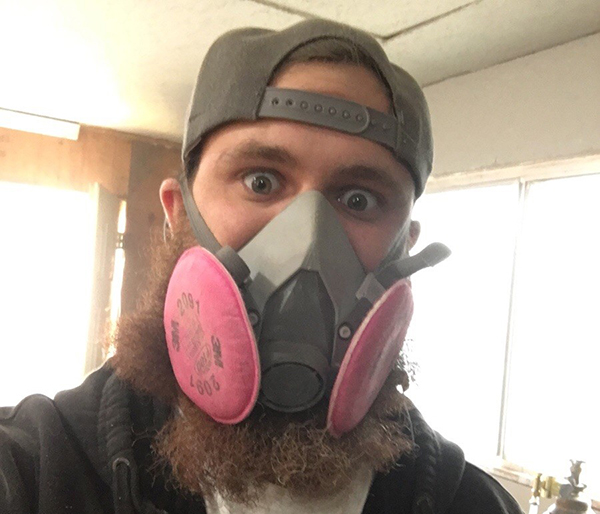
No matter what style of facial hair you sport, it’s our humble opinion that all beards are beautiful. The Centers for Disease Control and Prevention (CDC), however, disagrees.

Not all facial hair is created equal, according to a CDC infographic on the best facial hair styles suited to N95 respirator masks, which are intended to help shield you from airborne particles.

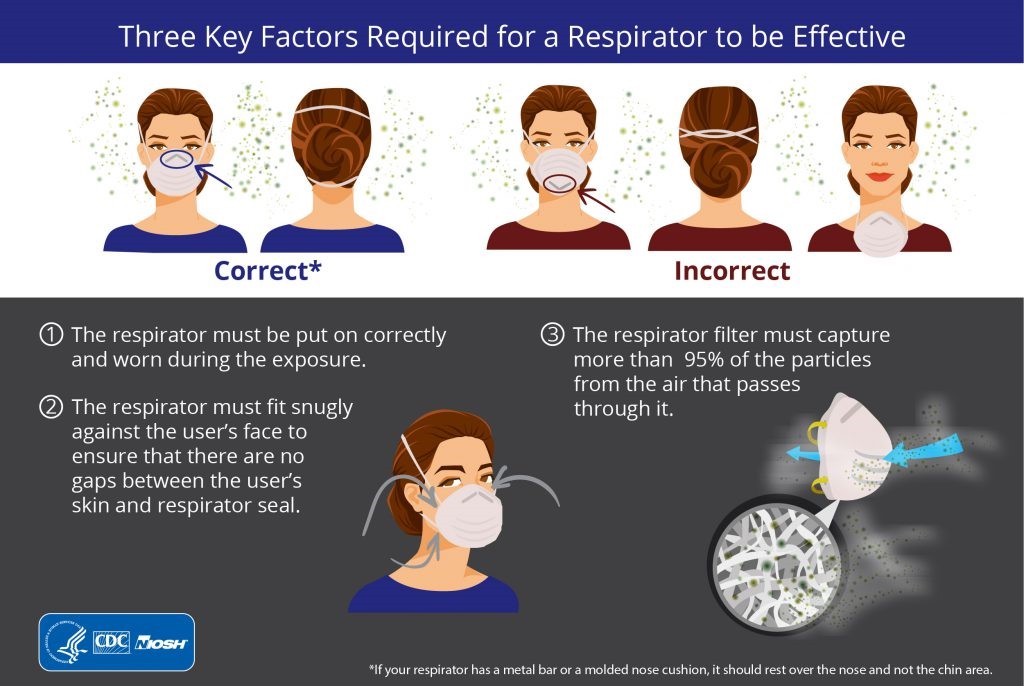
According to the U.S. Food and Drug Administration (FDA), an N95 respirator blocks at least 95 percent of very small airborne particles down to 0.3 microns (one micron = one millionth of a meter). Gases, vapors, and other particles in the air that respirator masks are meant to prevent the wearer from breathing in will take the path of least resistance to bypass the respirators filter.
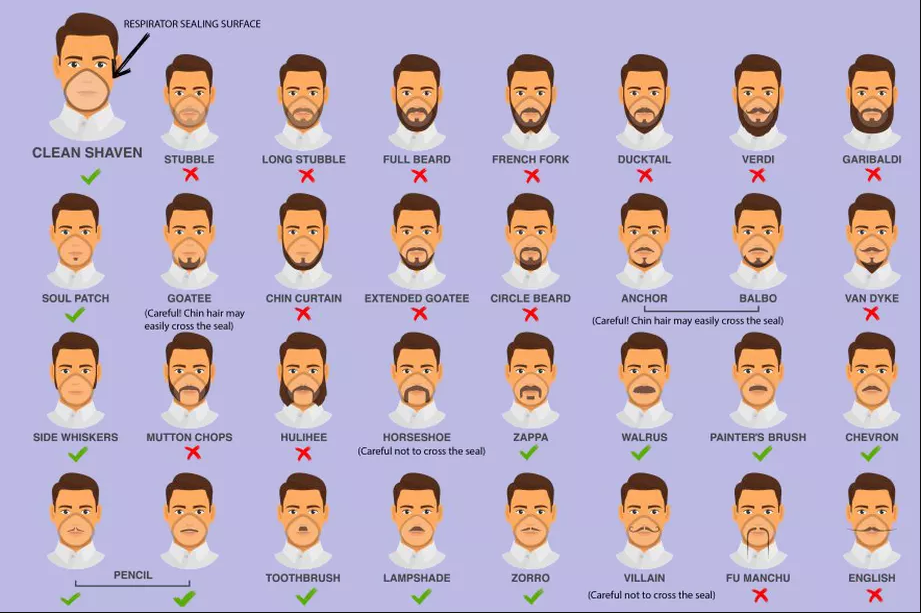
So, what’s the problem with your beard? Can’t that just act like another barrier?

Not exactly. While human hair “appears to be very thin to the naked eye,” according to the CDC, it’s actually much larger in size than the particles you want to avoid inhaling. N95 masks protect you from airborne particles down to 0.3 microns, but hair thickness ranges from 1/1500 to 1/500 of an inch in diameter. So if we assume each of your beard hairs are .002 inches thick in diameter, that translates to 50.8 microns. That’s going to create a COVID-19 size entryway.

Overall, the CDC reports that any presence of facial hair that gets in the way of a respirator mask’s seal can cause 20 to 1,000 times more leakage as compared to a clean-shaven mask-wearer.

Fit Testing

If you’ve ever performed QNFT (quantitative) respirator fit testing, you know that the process can sometimes be challenging and interspersed with occasional failed results which require you to retest.

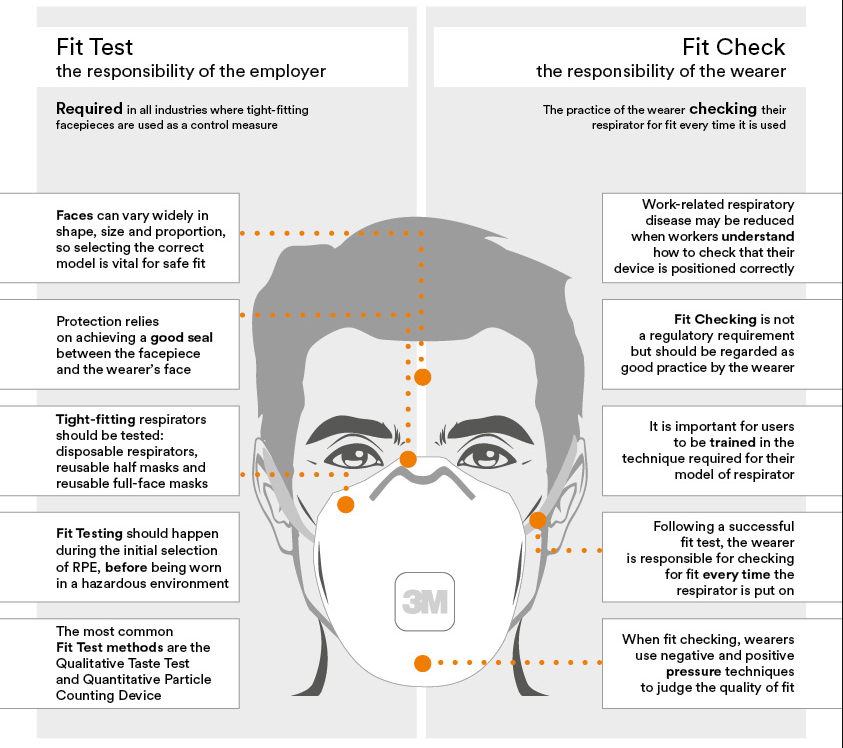
The reason we perform respirator fit testing is to verify that the user can obtain an effective seal and level of comfort with their chosen respirator. We also want to make sure that the respiratory protection being worn provides the user with the best possible protection when required. The fit test is an opportunity for the user to demonstrate their level of competence with donning, doffing, and user seal check training. CSA Z94.4 requires that we repeat the test every other year or when there is a change to the respirator, physical condition of the user, or PPE being worn.

Here are some tips, tricks, and basic troubleshooting suggestions that we have learned over the years to help with your QNFT fit testing program.

  • A 3M disposable respirator with valve. So many masks to choose from, so many faces to fit. There is no such thing as one size fits all. A common reason that N95 respirators don’t fit (besides being too big or too small) is that the metal nose piece isn’t properly fitted. Once a respirator is chosen, proper donning procedures will instruct users to use two hands (two fingers on each hand) to form the metal band evenly over their nose. Using one hand (thumb and index finger) can create an uneven bend resulting in a respirator leak.
  • Filtering Facepiece (N95) Probe Placement A fit testing probe needs to be installed in order to conduct a fit test on a filtering facepiece respirator. Respirator leaks can be created when installing this probe. It is important that the probe be installed to the left or right of exhalation valves and away from seams in respirator material. Start by inserting the probe to the midway point on the inside of the facepiece. Then, continue while applying pressure on the sealing push nut/rivet. When done correctly, respirator material should be seen around the joint of the 2 components.
  • Beards First off, CSA Z94.4 stipulates that no facial hair may come into contact with the seal area of the respirator. Annex M in the Standard provides guidance on what is acceptable. Basically, if facial hair is – or could be – in the mask sealing area, you can’t conduct a fit test.

Maintenance & Hygiene

Everyone is aware of the potential transmission of germs and bacteria via our hands. If you’re fit testing, here are some useful tips to for the safety of the fit tester and respirator user.

  • Wear disposable non-latex gloves when handling someone else’s respirator
  • If a shared “test” respirator needs to be wiped out between uses, have the person being tested do the wiping. If they bring their own respirator for the test, offer a wipe so it can be cleaned. This promotes respirator hygiene and provides a clean respirator for the test.
  • Always verify that all components of the respirator are in place prior to the fit test.
  • When putting a mask adapter on a respirator, use new, clean tubing to go from the mask adapter to inside the mask. The fit test adapter kits come with replacement tubing and additional can be ordered as needed.
  • Occasionally, moisture can condense in the twin tubes between the respirator fit tester and the mask adapter. This occurs because exhaled breath is humid and can condense in the hose during testing. The easy solution is to carry a spare, ‘clean’ twin tube that you can swap out on demand. They can also be cleaned and dried as necessary.
Smoking

Smokers inhale a lot of particulate, but it can take at least 30 minutes for all those small particulates to migrate out of the lungs. If you test too soon after smoking, the instrument will count those particles and won’t be able to tell if it’s a leak or cigarette smoke that is resulting in particles showing up in the test.

Equipment Failure

Sometimes the equipment doesn’t work. Not often, but not never. Remember, it’s drawing air in when it’s turned on, so never let the hose fall to the floor without a filter on it. Dust bunnies are bad for the optics. So is bouncing and bumping – sometimes this causes an optics misalignment to occur, so the instrument stops counting particles.
Sources
https://blogs.cdc.gov/niosh-science-blog/2018/01/04/respirators-public-use/
https://www.popularmechanics.com/science/health/a31119260/cdc-coronavirus-facial-hair-chart/
https://blogs.cdc.gov/niosh-science-blog/2017/11/02/noshave/
https://safetynetwork.3m.com/blog/wp-content/uploads/2017/10/J402922_SG_PSD_18_Respirator-poster-amend_2017_PRINT_POSTER-FV.jpg
https://www.levitt-safety.com/blog/respirator-fit-testing-basic-troubleshooting/


New Safety Talks

New Safety Talks

Giovanni Tejada 22025-12-15T17:40:31+00:00
Dermal Absorption Safety Meeting Kit
Steeven Molina2025-10-22T23:34:43+00:00
Working with Dangerous Goods – Safe Handling Meeting kit
Steeven Molina2025-10-22T23:34:43+00:00
Working with Dangerous Goods – Safe Handling Meeting kit – Spanish
Steeven Molina2025-10-22T23:33:50+00:00
Working Safely with Ornamental Trees: Protecting Yourself, Your Team, and Your Trees Meeting Kit
Steeven Molina2025-10-22T23:33:48+00:00
Working Safely with Ornamental Trees: Protecting Yourself, Your Team, and Your Trees Meeting Kit – Spanish
Steeven Molina2025-10-22T23:31:25+00:00
Working Safely in Shrub, Lawn, and Garden Services Meeting Kit

New eLearning

Giovanni Tejada 22026-02-26T18:36:07+00:00
Work Comp Anti-Fraud Training – Spanish
Giovanni Tejada 22026-02-26T18:46:12+00:00
Work Comp Anti-Fraud Training
Steeven Molina2025-10-22T22:59:24+00:00
Flood Ready
Michelle Vera2025-10-14T23:29:51+00:00
Recognizing and Preventing Abuse & Neglect for Home Health Care Workers
Michelle Vera2025-10-14T23:28:38+00:00
Incident and Accident Investigation for Supervisors and Managers
Michelle Vera2025-10-14T23:26:46+00:00
Drug-Free Workplace: A Supervisor’s Guide to a Safe and Supportive Environment

Upcoming Events & Webinars

Damian Tollens2025-01-31T09:55:18+00:00
Feb 11 – Performance and Cultural Alignment
Damian Tollens2025-02-12T19:53:20+00:00
Feb 26 – Avoid Common Overhead Crane and Rigging Mistakes
Rick Tobin2024-10-24T16:57:11+00:00
Nov 13 – Defensive Driving For Changing Seasons
Rick Tobin2024-10-24T17:10:53+00:00
Nov 29 – What to Expect From a Health & Safety Inspection
Rick Tobin2024-10-24T17:13:55+00:00
Dec 5 – Top Safety Issues During the Holiday Season
Rick Tobin2024-10-24T17:13:30+00:00
Dec 19 – Safer in ’25: The 3 Pillars of Safety Culture
Vicky Pickford2023-09-03T19:49:42+00:00

See What's Trending

Emergency Lighting and Exit Sign Requirements – Quick Tips

Emergency Lighting and Exit Sign Requirements – Quick Tips

2026 OSHA Outreach 10 Hour Virtual Training Course

2026 OSHA Outreach 10 Hour Virtual Training Course

Forklift Train the Trainer Course

Forklift Train the Trainer Course

Forklift Training and Certification Instructions

Forklift Training and Certification Instructions

SCBA Cylinder Hydrostatic Testing – Quick Tips

SCBA Cylinder Hydrostatic Testing – Quick Tips

Upcoming Live Virtual Training Classes: Forklift Train the Trainer

Upcoming Live Virtual Training Classes: Forklift Train the Trainer

Contact Us

800-ICW-SAFETY (800.429.7233)SAFETYOnDemand@icwgroup.com

Additional Links

Manage eLearning
View list of learners
Help

Terms of Use | Legal Notice & Privacy Policy
©2023 ICW Group , All Rights Reserved

Page load link


Video Tutorials to Help You Get Started

Since it's your first time, you may want to checkout some of the video tutorials.

eLearning overview

Managing learners

Assigning courses

Reporting & Analytics

When you are ready to go, close this window.
Don't show this again
Go to Top

