
The duty to have fall protection and Ineffective or missing fall protection have been OSHA’s most-cited violation for more than 10-years running.
Not only has ineffective or missing fall protection been on the Occupational Safety and Health’s (OSHA’s) most-cited violation for more than 10-years running, according to the Bureau of Labor Statistics falls to a lower level were the fourth leading fatal event and the fifth leading event resulting in cases with days away from work in 2019.
OSHA provides specific rules to address the hazards of falls from height, including the height at which fall protection is required – four feet for general industry, six feet for construction, 10-feet for scaffold erection, 15-feet for steel erection and whenever employees are working over dangerous equipment/machinery at any height. Floor holes, open-sided platforms, floors, and runways must be properly guarded. And before any employee is exposed to a fall hazard, the employer must provide training covering:
- Fall from height hazards in the work area and how to recognize them,
- Procedures to be followed to minimize the hazards,
- Procedures for installing, inspecting, operating, maintaining, and disassembling personal fall protection systems that are going to be used, and
- Correct use of personal fall protection systems and equipment
Fall Protection Program
When developing a fall protection program, the first step is to identify all tasks that require employees to work at heights. Any time a worker is at a height, there is a risk of falling.
The second step is to assess the level of risk that could result from exposure to working at height. Risk is the combination of the likelihood of being exposed to the hazard and the potential severity or consequence associated with that exposure. Generally, the greater the height, the greater the risk is of sustaining a more severe injury.
Once all working at height hazards have been identified and the risk of each job task has been assessed the next step is to prioritize the hazards and risks for mitigation. By prioritizing, an action list is created. When creating the action list, the amount of risk an organization is willing to tolerate or accept allows appropriate control measures to be utilized for each job task.
The next step is control of the working at height hazards. Once a hazard has been identified and assessed, hazard controls must be put in place to either eliminate or reduce the workers’ exposure to it. Working at height hazards are controlled either by removing or reducing their ability to cause harm. Traditionally, the National Institute for Occupational Safety and Health’s (NIOSH’s) Hierarchy of Controls is used as a means to determine how to implement feasible and effective control solutions. One representation of this Hierarchy is shown below.

Although each control method can be effective at reducing exposures to working at height hazards, those at the top of the pyramid are considered most effective. Elimination controls can be as simple as moving the work to ground level and eliminating the work height. Substitution can be using a mobile elevating work platform to raise properly secured workers to perform the task When hazards cannot be physically removed or replaced, engineering controls, administrative controls, and personal protective equipment (PPE) are often used in combination with one another to reduce the risk of working at heights.
A last step to take in a fall protection program is assessing residual risk after control measures have been implemented. Residual risk is the amount of risk that remains after controls are implemented. It is important to monitor both the hazard and the control to make sure that the control is working effectively and that exposure to the working at height hazard has been reduced or eliminated.
If exposure to hazards cannot be engineered completely out and safe work practices and other forms of administrative controls cannot provide sufficient additional protection, a supplementary method of control is the use of personal protective equipment.
Three Basic PPE Categories
- Positioning: Devices that hold a worker in place while allowing hands-free work. These devices must limit free fall to less than two feet. Positioning is comprised of four basic components:
- Anchor point: Certified (evaluated by a qualified person) two times the foreseeable force; Non-certified (selected by a competent person) tested to 3000-pound (lb.) load
- Body wear: Full-body harness and/or belt
- Connecting device: Rebar chain assembly
- Fall arrest backup: Shock-absorbing lanyard or self-retracting lifeline (SRL)
- Restraint: Devices used to limit the worker from reaching an unprotected edge or other fall hazard. This is accomplished by limiting the length of the connector. Restraint is comprised of three basic components:
- Anchor point: Certified (evaluated by a qualified person) two times the foreseeable force; Non-certified (selected by a competent person) tested to 1000-lb. load
- Body wear: Full-body harness and/or belt
- Connecting device: Fixed-length lanyard
- Personal Fall Arrest System (PFAS): Devices used to help safely absorb the energy produced in a fall event. Applies to any free fall from an elevated position of four feet or more in general industry or six feet or more in construction. A PFAS is comprised of three basic components:
- Anchor point: Certified (evaluated by a qualified person) two times the maximum arresting force (1800 lb.); Non-certified (selected by a competent person) tested to 5000-lb. load
- Body wear: Full-body harness only
- Connecting device: Shock-absorbing lanyard or SRL
Harnesses and Belts
Full-body harnesses wrap around the waist, shoulders, and legs (see Figures A, B and C). A D-ring located in the center of the back between the shoulder blades when properly adjusted is the fall arrest connection point. In the event of a fall, a full-body harness distributes the force of the impact throughout the trunk of the body, not just in the abdominal area. This allows the pelvis and shoulders to help absorb the shock, reducing the impact to the abdominal area. Full-body harnesses come with optional side, front and shoulder D-rings. Side and front D-rings are connection points used for work positioning only. Shoulder D-rings are for retrieval from confined spaces.
Three factors determine the arresting force from a fall: lanyard material type, free fall distance and the weight of the worker. The use of a shock-absorbing lanyard or a higher tie-off point can help reduce the impact force.
Body belts with a D-ring located on the rear waist are for travel restraint and hip D-rings are for positioning applications.
Connection Devices
Connection devices attach the belt or harness to the tie-off point. This can be one device, such as a shock-absorbing lanyard, positioning and restraint lanyards, self-retracting lifelines (SRLs), leading-edge SRLs or a combination of devices that include items such as work lines, rope grabs, tie-off straps, and carabiners.
Shock-absorbing lanyards can be used both to restrain workers in position and to arrest falls. When using a restraint lanyard, the length should be kept as short as possible and never used for any vertical free fall hazard application. Restraint lanyards are available in a variety of materials, including steel cables, nylon rope, nylon webbing and polyester webbing. Shock-absorbing lanyards (see Figures A and C) can be made of steel, nylon rope, nylon webbing or Dacron webbing.
All shock-absorbing lanyards incorporate a “shock pack” that will deploy to absorb the energy produced during a fall event. The “shock pack” must reduce the potential fall arrest force to less than 1800 lbs. Use of a shock-absorbing lanyard is recommended because it typically limits the arresting force from a six-foot drop to less than 900 lbs. A shock-absorbing lanyard used for a fall is limited to allow a maximum six-foot free fall. For this reason, most lanyards are a maximum of six feet long. However, if a higher tie-off point is used, the shock-absorbing lanyard can be longer as long as the free fall distance does not exceed six feet.
Lifelines add versatility to the fall arrest system. When used in conjunction with rope grabs (see Figure C), a lifeline allows the worker to move along the length of the line rather than having to disconnect and re-connect to a new tie-off point. The rope grab is engineered to help arrest a fall instantly. A rope grab and lifeline system is a passive form of protection, allowing the user to move as long as tension is slack on the lifeline. If a fall occurs, the tension on the rope grab triggers the internal mechanism to arrest the fall. An SRL (see Figure B) automatically retracts any slack line between the worker and the tie-off point. While this type of line doesn’t require a rope grab, it must be kept directly above the worker to help eliminate any potential swing hazard if the worker falls.
A cross-arm strap (see Figure A) is used at a tie-off point with a large diameter, such as an I-beam. The cross-arm strap then provides the anchor to which a shock-absorbing lanyard, restraint lanyard or SRL can directly attach. Using a cross-arm strap helps ensure the lanyards and/or lifelines do not become abraded or twisted from wrapping around the I-beam. A carabiner (see Figure D) works in the same situations. It is used for tie-off points with a diameter of one to five inches, and then the lanyard is attached to the carabiner.
Tie-Off (Anchor) Points
A tie-off point (see Figures A, B, C and D) is where the shock-absorbing lanyard or SRL is attached to a structural support. When shock-absorbing lanyards or an SRL are being used, ensuring that the anchor point is at or above the D-ring point of the harness will minimize the free fall distance. This also helps ensure that the shock-absorbing lanyard or SRL doesn’t interfere with personal movement. Workers must also tie off in a manner that ensures no lower level will be struck during a fall. To calculate this when using a shock-absorbing lanyard, add the height of the worker, the shock-absorbing lanyard length, the stated elongation distance listed on the device and a safety factor of three feet. To calculate when using a SRL, add the height of the worker, the maximum free fall distance of two feet, the maximum deceleration distance of three and one-half feet, and a safety factor of three feet. The sum of these distances should not be greater than the distance measured from the work surface the worker is standing on to the next level or object below that any part of their body could strike if they fell.
Other Devices
For confined space applications, a tripod and winch system is used as both the tie-off point and connection device. It is used in conjunction with a full-body harness to lower and raise workers into tanks or manholes. Make sure that the tripod system you choose is designed for your application. Never use a material handling device for personnel use unless it is specifically designed to do so.
Ladder lifeline systems protect workers wearing personal fall protection equipment from falls when climbing fixed ladders. The systems consist of a cable or channel, with a grabbing device attached for a connection point.
- Tie-off point
- Lifeline
- Rope grab
- Shock-absorbing lanyard
- Cross-arm strap
- Retractable lifeline
- Full-body harness
- Restraining belt
- Restraining lanyard
- Carabiner
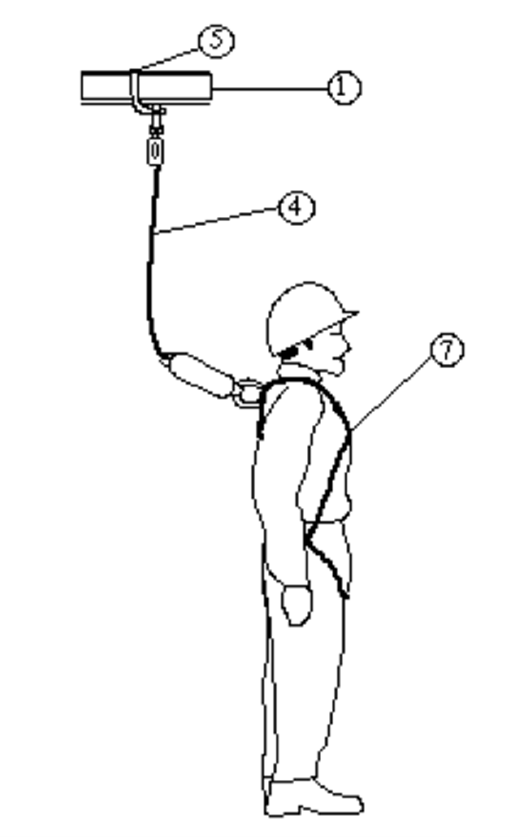
Figure B
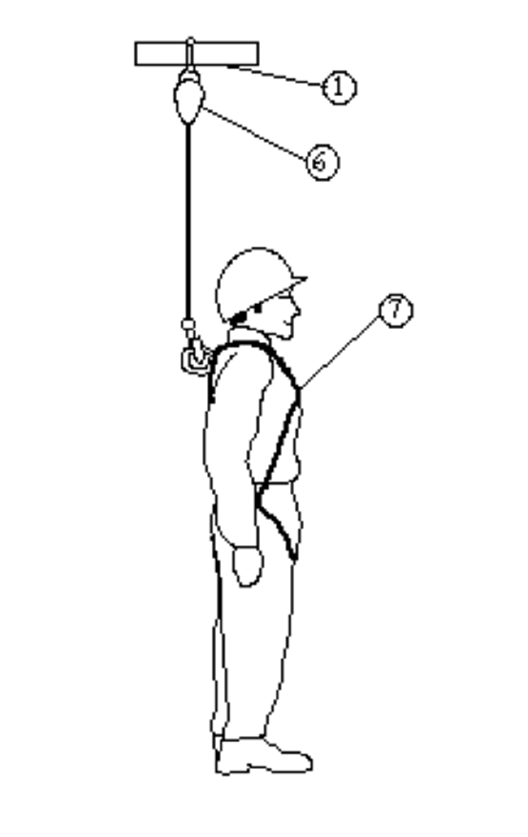
Figure C
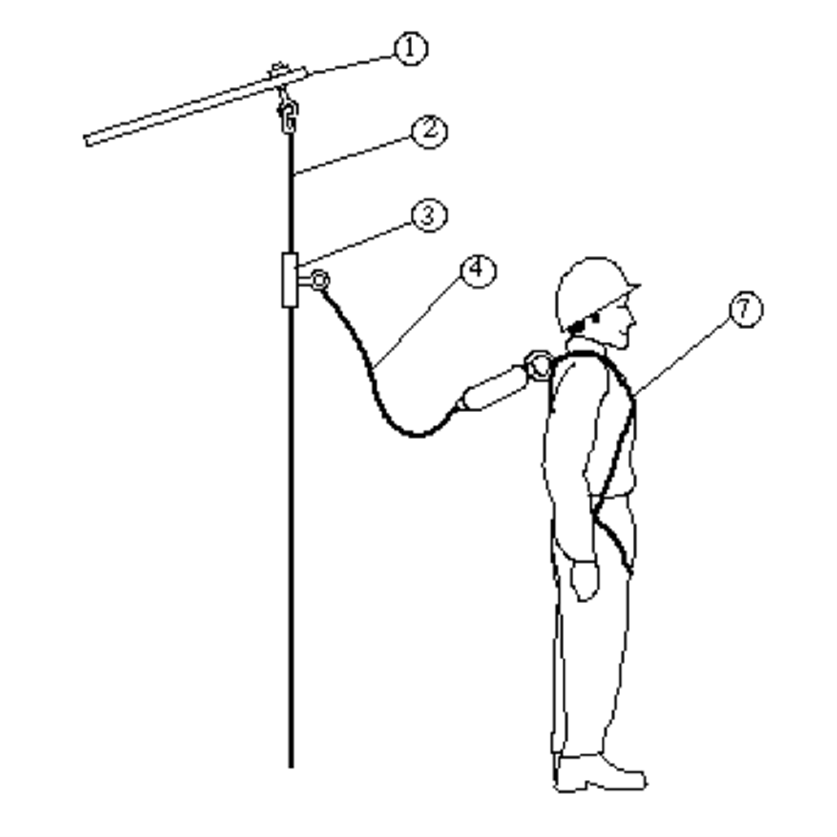
Figure D

Fall Rescue
Any fall rescue program should be as safe as possible and must take as little time as possible to bring a fallen worker to safety. When a fall occurs, any number of factors can create challenges to the effective rescue of the victim. Weather conditions, physical obstacles and the condition of the victim can consume time and create hindrances for rescue personnel.
All rescue plans should be regularly reviewed to ensure the procedures are manageable and realistic in their time estimates. Employers should act in their own best interests by implementing the safest and quickest rescue plan and by practicing procedures to maximize preparation for a real emergency.
OSHA recommends these general rescue plan guidelines:
- Rescue suspended workers as quickly as possible
- Be aware of the potentially life-threatening risks of orthostatic intolerance and suspension trauma
- Be aware of signs and symptoms of orthostatic intolerance
- Be aware that suspended workers who are unconscious or have head injuries are particularly at risk for orthostatic intolerance
- Be aware of the factors that can increase the risk of suspension trauma
- Be aware that some authorities advise against moving the rescued workers to a horizontal position too quickly
Visit OSHA for more information on the OSHA bulletin on orthostatic intolerance and rescue.
To help alleviate the potential for orthostatic intolerance for a conscious suspended worker, the use of trauma straps can provide comfort and relieve pressure, which improves blood circulation until rescuers arrive. Straps are designed to work with most brands of harnesses; adding a second device provides better support and balance for the fallen worker.
Inspection and Maintenance
OSHA regulations require that all personal fall protection systems be inspected before initial use during each work shift for mildew, wear, damage, other deterioration, and defective components. To properly maintain the devices, periodic cleaning is necessary. All surfaces should be cleaned with a mild detergent soap, and air dried away from excess heat. ANSI/ASSP Z359.11-2021 suggests at a minimum to comply with all manufacturer instructions regarding the inspection, maintenance, and storage of the fall protection equipment.
IMPORTANT NOTE: ANY EQUIPMENT EXPOSED TO A FALL MUST BE TAKEN OUT OF SERVICE AND NOT USED.
Sources
29 CFR 1910 Subpart D, Walking-Working Surfaces
29 CFR 1910 Subpart F, Powered Platforms, Manlifts, and Vehicle-Mounted Platforms
29 CFR 1926 Subpart E, Personal Protective and Life Saving Equipment
29 CFR 1926 Subpart L, Scaffolds
29 CFR 1926 Subpart M, Fall Protection
29 CFR 1926 Subpart R, Steel Erection
29 CFR 1926 Subpart X, Stairways and Ladders
ANSI/ASSP A10 Construction and Demolition Standards
ANSP/ASSP Z359 Fall Protection Code
ANSI/ASSP Z359.11-2021 Safety Requirements for Full-Body Harnesses
Bureau of Labor Statistics Census of Fatal Occupational Injuries, Fatal Occupational Injuries by Event, 2019
Bureau of Labor Statistics Employer-Reported Workplace Injury and Illnesses, 2019
Quick Tips #192: Hazard Assessment Form
Frequently Asked Questions
Q: Fall protection is required whenever employees are working over dangerous equipment/machinery at any height. Does OSHA define “dangerous equipment”?
A: Yes, OSHA defines “dangerous equipment” as “equipment, such as vats, tanks, electrical equipment, machinery, equipment or machinery with protruding parts, or other similar units, that, because of their function or form, may harm an employee who falls into or onto the equipment.”
Q: Must fall protection harnesses be taken out of service after a specified amount of time – five years?
A: No – general guidelines from OSHA, ANSI/ASSP and most manufacturers state fall protection equipment does not have a specified shelf-life or life expectancy. The reference to five years comes from an older ANSI/ASSP A10 standard. ANSI/ASSP A10 addresses construction and demolition and one of the requirement listed in an older A10 standard was that unless the manufacturer specifies otherwise, harnesses should be removed from service after five years. ANSI/ASSP Z359 Fall Protection Code which applies to both general industry and construction does not include that language.
The information contained in this article is intended for general information purposes only and is based on information available as of the initial date of publication. No representation is made that the information or references are complete or remain current. This article is not a substitute for review of current applicable government regulations, industry standards, or other standards specific to your business and/or activities and should not be construed as legal advice or opinion. Readers with specific questions should refer to the applicable standards or consult with an attorney.
Source: Grainger Know How – https://www.grainger.com/know-how






 800-ICW-SAFETY (800.429.7233)
 SAFETYOnDemand@icwgroup.com


