Eye Protection – Seeing is Believing Meeting Kit – Spanish

QUÉ ESTÁ EN RIESGO

El tipo de protección ocular -gafas de seguridad, gafas, protectores faciales o cascos- debe cumplir los requisitos de la Administración de Seguridad y Salud en el Trabajo (OSHA) y del Instituto Nacional de Normalización de Estados Unidos (ANSI).

CUÁL ES EL PELIGRO

TIPOS DE PROTECCIÓN OCULAR

Gafas de seguridad básicos. Un par de gafas de seguridad básicas proporciona protección cuando existe la posibilidad de que entren partículas en el ojo por la parte delantera. Las lentes de seguridad en monturas de gafas normales no se consideran gafas de seguridad adecuadas. La mayoría de las gafas de seguridad básicas no ofrecen protección lateral, pero algunas gafas de seguridad disponen de protección lateral permanente o desmontable para proteger el ojo por arriba, por abajo y por los lados. Cuando elija unas gafas de seguridad con protección lateral, asegúrese de que los laterales no interfieren con su visión periférica.

Gafas de protección graduadas. Las gafas de seguridad graduadas son de plástico o de metal y están disponibles con cristales bifocales y tintados. Tenga cuidado cuando elija lentes tintadas, ya que estas lentes tardan en desaparecer, lo que puede ser peligroso cuando se pasa con frecuencia del interior al exterior de las áreas de trabajo. Elija lentes tintadas cuando las actividades puedan incluir destellos brillantes de luz.

Gafas. Las gafas proporcionan una protección económica desde todos los ángulos porque se ajustan perfectamente a los ojos. Este tipo de protección ocular es especialmente adecuado para trabajos como el manejo de motosierras, el amolado y el remachado. Las gafas son especialmente útiles porque suelen ajustarse a la mayoría de las gafas graduadas y suelen estar ventiladas con una solución antivaho. Dos de los modelos más comunes de gafas son las de copa o las de malla metálica. Si se trabaja con productos químicos, elija gafas con orificios de ventilación descentrados.

Caretas faciales. Las caretas faciales son una protección secundaria y deben llevarse junto con las gafas o las caretas. Este tipo de protección ocular está especialmente diseñado para proteger al usuario del calor, el resplandor y los objetos voladores. Los protectores faciales pueden acoplarse a los cascos para aquellos trabajos que también requieran protección para la cabeza.

Cascos y gafas de soldador. Los cascos de soldador están equipados con lentes filtrantes especiales que protegen los ojos de los fuertes rayos ultravioleta e infrarrojos que pueden dañar permanentemente los ojos y causar ceguera. Las gafas de soldador tienen varios tonos de lentes filtrantes para proteger de las chispas, los rayos y las partículas voladoras. Hable con su distribuidor local para determinar el tono de lente filtrante que necesita para los distintos tipos de soldadura. Existen lentes fijas o elevadas para los cascos de soldadura y las gafas.

COMO PROTEGERSE

CAPACITAR A LOS TRABAJADORES EN EL USO DE LOS EQUIPOS DE SEGURIDAD – MANDATOS DE LA OSHA

  • Lea las instrucciones sobre la protección de los ojos que aparecen en las etiquetas y en las hojas de datos de seguridad de los materiales.
  • Asegúrese de que la protección ocular se ajusta y protege contra los peligros específicos del trabajo.
  • Compruebe que las gafas ofrecen protección frontal y lateral para evitar que los peligros pasen por debajo o alrededor del protector.
  • Utilice gafas debajo de los protectores faciales. Las pantallas y los cascos de soldador por sí solos no proporcionan una protección ocular completa.
  • Asegúrese de entender cuándo debe usar la protección ocular y cómo usarla y ajustarla correctamente.
  • Si lleva lentes de contacto, no las lleve en zonas donde exista la posibilidad de que le entren cuerpos extraños en los ojos. Las motas de polvo e incluso los líquidos pueden alojarse bajo las lentes de contacto.
  • Mantenga limpias y en buen estado las gafas de seguridad u otros protectores oculares.

LISTA DE COMPROBACIÓN DE LA SEGURIDAD OCULAR

Cree un entorno de trabajo seguro

  • Reduzca al mínimo los riesgos de caída o inestabilidad de los residuos
  • Asegúrese de que las herramientas funcionan y de que los dispositivos de seguridad (protectores de las máquinas) están en su sitio
  • Asegúrese de que los trabajadores (especialmente los voluntarios) sepan utilizar las herramientas correctamente
  • Mantenga a los transeúntes fuera del área de peligro

Evaluar los riesgos de seguridad

  • Identifique los principales peligros del lugar
  • Identifique los peligros que suponen los trabajadores cercanos, la maquinaria de gran tamaño y la caída/desplazamiento de materiales/objetos

Utilice la protección ocular y facial adecuada

  • Seleccione la protección ocular adecuada para el peligro
  • Asegúrese de que la protección ocular está en buenas condiciones
  • Asegúrese de que la protección ocular se ajusta y permanece en su sitio

Utilice buenas prácticas de trabajo

  • Precaución: cepille, sacuda o aspire el polvo y los residuos de los cascos, el pelo, la frente o la parte superior de la protección ocular antes de quitarse la protección
  • No se frote los ojos con las manos o la ropa sucia
  • Limpie las gafas regularmente

Cómo ajustarse

  • Las gafas de protección deben ajustarse cómodamente, pero de forma segura
  • Las gafas deben ajustarse con el centro de la lente delante de los ojos
  • Ajuste las correas para que las gafas queden bien ajustadas contra el puente de la nariz y colóquelas en la parte posterior de la cabeza para un buen ajuste
  • Las patillas de las gafas deben tocar el lateral de la cabeza y curvarse detrás de las orejas

CONCLUSIÓN

Imagine que no puede ver por ambos ojos. Luego imagínese que no puede ver en absoluto. Ahora, ¿se toma en serio el hecho de tomar todas las precauciones y medidas para proteger su vista en su lugar de trabajo?


Eye Protection – Seeing is Believing Meeting Kit

WHAT’S AT STAKE

The type of eye protection—safety glasses, goggles, face shields, or helmets—must meet the requirements of the Occupational Safety and Health Administration (OSHA) and the American National Standards Institute (ANSI).

WHAT’S THE DANGER

TYPES OF EYE PROTECTION

Basic Safety Glasses. A pair of basic safety glasses provides protection when there is potential for particles to enter the eye from the front. Safety lenses in regular eyeglass frames are not considered suitable safety glasses. Most basic safety glasses do not provide side protection, but side protection is available on some safety glasses through either permanent or detachable side shields to protect the eye from above, below and on the sides. When choosing safety glasses with side protection, make sure that the sides do not interfere with your peripheral vision.

Prescription Safety Glasses. Prescription safety glasses are made of either plastic or metal and are available in both bifocals and tinted lenses. Use caution when choosing tinted lenses because these lenses take time for the tinting to disappear which can be hazardous when frequently going between inside and outside work areas. Choose tint lenses when activities may include bright flashes of light.

Goggles. Goggles provide inexpensive protection from all angles because they fit snugly around the eyes. This type of eye protection is especially good for jobs such as chainsaw operation, grinding, and riveting. Goggles are especially useful because they typically fit over most prescription eyeglasses and are usually ventilated with an anti-fog solution. Two of the most common models of goggles are eyecup or wire mesh. If working around chemicals, choose goggles with off-set ventilation ports.

Face Shields. Face shields are secondary protection and must be worn in conjunction with either glasses or goggles. This type of eye protection is especially designed to protect the user from heat, glare, and flying objects. Face shields can be attached to hard hats for those jobs that also require head protection.

Welding Helmets and Goggles. A welding helmet is equipped with special filtering lenses that protect the eyes from the strong ultraviolet and infrared rays that can permanently damage eyes and cause blindness. Welding goggles have various filter lens shades to protect against sparks, rays, and flying particles. Talk with your local dealer to determine the filter lens shade that you need for the various types of welding. Stationary or lift-front lenses are available for both welding helmets and goggles.

HOW TO PROTECT YOURSELF

TRAIN WORKERS IN USE OF SAFETY EQUIPMENT – OSHA MANDATES

  • Read the instructions on protecting eyes that appear on labels and material safety data sheets.
  • Make sure eye protection fits and protects against the specific hazards of the job.
  • Check that eyewear provides front and side protection to prevent hazards from getting under or around the protector.
  • Wear goggles under face shields. Shields and welding helmets alone do not provide complete eye protection.
  • Make sure you understand when to wear the eye protection and how to properly use it and adjust it.
  • If you have contact lenses, do not wear them in areas where there is a chance that foreign matter could enter your eyes. Specks of dust and even liquids can become lodged under contacts.
  • Keep safety glasses or other eye protectors clean and in good condition.

BEST EYE SAFETY CHECKLIST

Create a safe work environment

  • Minimize hazards from falling or unstable debris
  • Make sure that tools work and safety features (machine guards) are in place
  • Make sure that workers (particularly volunteers) know how to use tools properly
  • Keep bystanders out of the hazard area

Evaluate safety hazards

  • Identify the primary hazards at the site
  • Identify hazards posed by nearby workers, large machinery, and falling/shifting material/objects

Wear the proper eye and face protection

  • Select the appropriate eye protection for the hazard
  • Make sure the eye protection is in good condition
  • Make sure the eye protection fits and will stay in place

Use good work practices

  • Caution—Brush, shake, or vacuum dust and debris from hardhats, hair, forehead, or the top of the eye protection before removing the protection
  • Do not rub eyes with dirty hands or clothing
  • Clean eyewear regularly

Making It Fit

  • Protective eyewear should fit comfortably, but securely
  • Goggles should fit with the center of the lens in front of the eyes
  • Adjust straps so goggles fit snuggly against the bridge of the nose and place them low on the back of the head for good fit
  • Spectacle sidepieces should touch the side of the head and curl behind the ears

FINAL WORD

Envision being unable to see out of both your eyes. Then envision not being able to see at all. Now, are you serious about taking all the precautions and steps to protect your eyesight at your workplace?


Workplace Suicides Stats and Facts

FACTS

  1. The Centers for Disease Control and Prevention states that between 2012 and 2015, occupational suicide rates were highest among males in the construction and extraction sector. Among females, it was highest in arts, entertainment, sports and media.
  2. Sudden and traumatic for colleagues, the suicide incidents can prompt ripples of anger and guilt across an organization, potentially damaging productivity.
  3. Most of the people who die by suicide are of working age.
  4. Suicide is death caused by injuring oneself with the intent to die. A suicide attempt is when someone harms themselves with any intent to end their life, but they do not die as a result of their actions.
  5. Suicide is connected to other forms of injury and violence. For example, people who have experienced violence, including child abuse, bullying, or sexual violence have a higher suicide risk.
  6. People who attempt suicide and survive may experience serious injuries that can have long-term effects on their health. They may also experience depression and other mental health concerns.
  7. Suicide and suicide attempts affect the health and well-being of friends, loved ones, co-workers, and the community. When people die by suicide, their surviving family and friends may experience shock, anger, guilt, symptoms of depression or anxiety, and may even experience thoughts of suicide themselves.

STATS

  • The U.S. suicide rate has been rising steadily since the turn of the century, growing from 10.4 instances per 100,000 people in 2000 to 14 instances per 100,000 in 2017. That’s a 33% increase since 1999 and the highest rate on record since 1942. Several factors are likely to blame for the trend such as the country’s opioid crisis, alcoholism and stress. Unsurprisingly and tragically, the growing suicide rate is also manifesting itself in American workplaces and a record number of people killed themselves on the job in 2018.
  • That’s according to the Bureau of Labor Statistics who found that there were 304 workplace suicides across the U.S. last year, an 11% increase from 2017 and the highest number since the data was first tracked 26 years ago.
  • In 2018, the groups conducted an online survey of 256 people from 41 states and found that 46% of the respondents said they knew at least one friend, co-worker or family member who had attempted suicide, while 43% reported having lost at least one friend to suicide. Additionally, a 2018 analysis from the Centers for Disease Control and Prevention concluded that suicides among the U.S. working age population rose 34%.
  • Suicide rates increased 33% with a small decline in 2019. Suicide is the 10th leading cause of death in the United States. It was responsible for more than 47,500 deaths in 2019, which is about one death every 11 minutes.3 In 2019, 12 million American adults seriously thought about suicide, 3.5 million planned a suicide attempt, and 1.4 million attempted suicide.
  • 20% of the American workforce experiences some form of mental disorder, and depression and substance abuse are among the most common problems.


Workplace Suicides Stats and Facts – Spanish

HECHOS

  1. Los Centros para el Control y la Prevención de Enfermedades afirman que, entre 2012 y 2015, las tasas de suicidio laboral fueron más altas entre los varones del sector de la construcción y la extracción. Entre las mujeres, fue más alta en artes, entretenimiento, deportes y medios de comunicación.
  2. Repentinos y traumáticos para los compañeros, los incidentes de suicidio pueden provocar ondas de ira y culpa en toda una organización, lo que puede dañar la productividad.
  3. La mayoría de las personas que mueren por suicidio están en edad de trabajar.
  4. El suicidio es la muerte causada por una lesión a uno mismo con la intención de morir. Un intento de suicidio es cuando alguien se daña a sí mismo con la intención de acabar con su vida, pero no muere como resultado de sus acciones.
  5. El suicidio está relacionado con otras formas de lesión y violencia. Por ejemplo, las personas que han sufrido violencia, incluyendo el abuso infantil, el acoso escolar o la violencia sexual tienen un mayor riesgo de suicidio.
  6. Las personas que intentan suicidarse y sobreviven pueden sufrir lesiones graves que pueden tener efectos a largo plazo en su salud.También pueden sufrir depresión y otros problemas de salud mental.
  7. El suicidio y los intentos de suicidio afectan a la salud y el bienestar de los amigos, los seres queridos, los compañeros de trabajo y la comunidad. Cuando las personas mueren por suicidio, sus familiares y amigos sobrevivientes pueden experimentar conmoción, ira, culpa, síntomas de depresión o ansiedad, e incluso pueden experimentar pensamientos de suicidio ellos mismos.

ESTADÍSTICAS

  • La tasa de suicidio en Estados Unidos ha aumentado de forma constante desde el cambio de siglo, pasando de 10,4 casos por cada 100.000 personas en 2000 a 14 casos por cada 100.000 en 2017. Esto supone un aumento del 33% desde 1999 y la tasa más alta registrada desde 1942. Es probable que la tendencia se deba a varios factores, como la crisis de opioides del país, el alcoholismo y el estrés. Como es lógico y trágico, la creciente tasa de suicidio también se manifiesta en los lugares de trabajo estadounidenses y un número récord de personas se suicidó en el trabajo en 2018.
  • Eso es según la Oficina de Estadísticas Laborales que encontró que hubo 304 suicidios en el lugar de trabajo en todo Estados Unidos el año pasado, un aumento del 11% con respecto a 2017 y el número más alto desde que los datos fueron rastreados por primera vez hace 26 años.
  • En 2018, los grupos llevaron a cabo una encuesta en línea de 256 personas de 41 estados y encontraron que el 46% de los encuestados dijeron que conocían al menos a un amigo, compañero de trabajo o miembro de la familia que había intentado suicidarse, mientras que el 43% informó haber perdido al menos un amigo por suicidio. Además, un análisis de 2018 de los Centros para el Control y la Prevención de Enfermedades concluyó que los suicidios entre la población estadounidense en edad laboral aumentaron un 34%.
  • Las tasas de suicidio aumentaron un 33% con un pequeño descenso en 2019. El suicidio es la décima causa de muerte en Estados Unidos. Fue responsable de más de 47.500 muertes en 2019, lo que supone aproximadamente una muerte cada 11 minutos.3 En 2019, 12 millones de adultos estadounidenses pensaron seriamente en el suicidio, 3,5 millones planearon un intento de suicidio y 1,4 millones lo intentaron.
  • El 20% de la población activa estadounidense experimenta algún tipo de trastorno mental, y la depresión y el abuso de sustancias se encuentran entre los problemas más comunes.


Workplace Suicides Fatality Report

Amazon worker died by suicide at Las Vegas facility

Employees were sent home with pay shortly after the incident, an Amazon spokesperson said.

A man who appeared to have “fallen or jumped” was pronounced dead inside an Amazon facility in North Las Vegas, Nevada, early Monday, police said. The coroner later determined the man died by suicide.

Officers arrived just before 7 a.m. and found the man inside the building on East Tropical Parkway, in the northeast corner of metropolitan Las Vegas, said Alexander Cuevas, a spokesperson for the North Las Vegas Police Department.

On Tuesday afternoon, a spokeswoman for the Clark County Office of the Coroner/Medical Examiner identified the man as 48-year-old Paul Vilscek, who lived in Las Vegas. She said that the cause of death was “blunt or injury to the head, trunk and extremities” and that the manner of death was suicide.

Amazon spokesperson Lisa Levandowski said: “We’re deeply saddened by this tragic incident. Their family and loved ones are in our thoughts, and we’re supporting our employees during this difficult time.”

She said that employees were sent home with pay shortly after the incident and that they were being offered grief counseling.

An Amazon employee who spoke on condition of anonymity out of fear of losing her job said that when she arrived for work just after 7 a.m., police cars and ambulances were in the parking lot.

Shortly afterward, Amazon staff members began installing barricades adjacent to where the worker was found, the employee said.

“Nobody knew what was going on,” she said. “Everyone was so confused.”

The woman said supervisors told workers to continue working until about 9:40 a.m., when they were all sent home.

“That really upsets me,” she said. “The managers knew what was going on and were going to the area but didn’t send us home immediately. Someone just passed away. It just proves to me that managers at Amazon don’t really care as long as they get their numbers done.”

The facility, known as LAS7 after the airport code for the nearby Las Vegas airport, opened in May 2019. It is the largest Amazon fulfillment center in the state, at 855,000 square feet.

According to a post on Reddit, management texted LAS7 workers telling night shift workers not to come to work and saying both day and night workers would be paid for their regular shifts.


Workplace Suicides Fatality Report – Spanish

Un trabajador de Amazon se suicida en las instalaciones de Las Vegas

Los empleados fueron enviados a casa con paga poco después del incidente, dijo un portavoz de Amazon.

Un hombre que parecía haber “caído o saltado” fue declarado muerto dentro de una instalación de Amazon en el norte de Las Vegas, Nevada, el lunes temprano, dijo la policía. El forense determinó más tarde que el hombre murió por suicidio.

Los agentes llegaron justo antes de las 7 de la mañana y encontraron al hombre dentro del edificio en East Tropical Parkway, en la esquina noreste del área metropolitana de Las Vegas, dijo Alexander Cuevas, un portavoz del Departamento de Policía de North Las Vegas.

El martes por la tarde, una portavoz de la Oficina del Médico Forense del Condado de Clark identificó al hombre como Paul Vilscek, de 48 años, que vivía en Las Vegas. Dijo que la causa de la muerte fue “una lesión contundente en la cabeza, el tronco y las extremidades” y que la forma de la muerte fue un suicidio.

La portavoz de Amazon, Lisa Levandowski, dijo: “Estamos profundamente entristecidos por este trágico incidente. Su familia y sus seres queridos están en nuestros pensamientos, y estamos apoyando a nuestros empleados durante este difícil momento.”

Dijo que los empleados fueron enviados a casa con sueldo poco después del incidente y que se les estaba ofreciendo asesoramiento de duelo.

Una empleada de Amazon que habló bajo condición de anonimato por miedo a perder su trabajo dijo que cuando llegó al trabajo justo después de las 7 de la mañana, había coches de policía y ambulancias en el aparcamiento.

Poco después, el personal de Amazon comenzó a instalar barricadas junto al lugar donde se encontró al trabajador, dijo la empleada.

“Nadie sabía lo que estaba pasando”, dijo. “Todo el mundo estaba muy confundido”.

La mujer dijo que los supervisores dijeron a los trabajadores que siguieran trabajando hasta aproximadamente las 9:40 de la mañana, cuando todos fueron enviados a casa.

“Eso me molesta mucho”, dijo. “Los encargados sabían lo que estaba pasando y se dirigían a la zona, pero no nos enviaron a casa inmediatamente. Alguien acaba de fallecer. Esto me demuestra que a los gerentes de Amazon no les importa realmente mientras hagan sus números”.

La instalación, conocida como LAS7 por el código del cercano aeropuerto de Las Vegas, abrió en mayo de 2019. Es el mayor centro de cumplimiento de Amazon en el estado, con 855,000 pies cuadrados.

Según un post en Reddit, la gerencia envió un mensaje de texto a los trabajadores de LAS7 diciéndoles que los trabajadores del turno de noche no vinieran a trabajar y diciendo que tanto los trabajadores diurnos como los nocturnos recibirían el pago de sus turnos regulares.


Workplace Suicides Picture This

workplace-suicide-pt

Source: https://www.irmi.com


Workplace Suicides Picture This – Spanish

workplace-suicide-ptspn

Fuente: https://www.saludcastillayleon.es


Eye Protection – Seeing is Believing Stats and Facts

FACTS

  1. Particles of rocks, soil, crop material or other foreign objects thrown from equipment that chops or grinds can cause unexpected eye injury to the operator or bystander.
  2. Eye injuries are more likely to occur when servicing equipment than when operating it.
  3. Simple hand tools can cause severe eye injuries.
  4. Almost 70 percent of all eye injuries result from flying or falling objects striking the eye.
  5. Contact with chemicals (liquids, gases, dusts, fumes, or vapors) causes another 20 percent of eye injuries.
  6. Swinging objects — most of the remaining injuries are caused by objects that swing from an attached position. Tree limbs, ropes, chains, or tools are common examples.
  7. Bloodborne pathogens and bodily fluids — In health care, maintenance, and housekeeping fields, there is a danger of these liquids being splashed into the eyes.
  8. Other causes — electrical arcs and sparks, molten metal, and radiant energy from welding, cutting, lasers, and ultraviolet and infrared light also contribute to eye injury.
  9. While eye injuries can occur in just about any job, mechanics, repairers, carpenters, plumbers, assemblers, sanders, and grinding machine operators are most likely to be victims.

STATS

  • Eye injuries in the workplace are very common. The National Institute for Occupational Safety and Health (NIOSH) reports that every day about 2,000 U.S. workers sustain job-related eye injuries that require medical treatment.
  • 60% of workers who suffered an eye injury were wearing no eye protection or the wrong type of eye protection at the time of the accident.
  • 90% of work-related eye injuries could be avoided if workers wore eye protection. (American Academy of Ophthalmology)
  • BLS reported that more than 50 % of workers injured while wearing eye protection thought the eyewear had minimized their injuries.


Eye Protection – Seeing is Believing Stats and Facts – Spanish

HECHOS

  1. Las partículas de rocas, tierra, material de cultivo u otros objetos extraños arrojados por los equipos que pican o trituran pueden causar lesiones oculares inesperadas al operador o a los transeúntes.
  2. Es más probable que las lesiones oculares se produzcan cuando se realiza el mantenimiento del equipo que cuando se utiliza.
  3. Las herramientas manuales sencillas pueden causar lesiones oculares graves.
  4. Casi el 70 por ciento de las lesiones oculares se producen por el impacto de objetos que vuelan o caen sobre el ojo.
  5. El contacto con productos químicos (líquidos, gases, polvos, humos o vapores) provoca otro 20% de las lesiones oculares.
  6. Objetos que se balancean: la mayoría de las lesiones restantes están causadas por objetos que se balancean desde una posición fija. Las ramas de los árboles, las cuerdas, las cadenas o las herramientas son ejemplos comunes.
  7. Patógenos transmitidos por la sangre y fluidos corporales – En los ámbitos de la atención sanitaria, el mantenimiento y la limpieza, existe el peligro de que estos líquidos salpiquen los ojos.
  8. Otras causas: los arcos eléctricos y las chispas, el metal fundido y la energía radiante de la soldadura, el corte, el láser y la luz ultravioleta e infrarroja también contribuyen a las lesiones oculares.
  9. Aunque las lesiones oculares pueden producirse en casi cualquier trabajo, los mecánicos, reparadores, carpinteros, fontaneros, montadores, lijadores y amoladores son los que más probabilidades tienen de ser víctimas.

ESTADÍSTICAS

  • Las lesiones oculares en el lugar de trabajo son muy frecuentes. El Instituto Nacional de Seguridad y Salud en el Trabajo (NIOSH) informa de que cada día unos 2.000 trabajadores estadounidenses sufren lesiones oculares relacionadas con el trabajo que requieren tratamiento médico.
  • El 60% de los trabajadores que sufrieron una lesión ocular no llevaban protección ocular o llevaban el tipo de protección ocular equivocado en el momento del accidente.
  • El 90% de las lesiones oculares relacionadas con el trabajo podrían evitarse si los trabajadores llevaran protección ocular. (Academia Americana de Oftalmología)
  • El BLS informó de que más del 50% de los trabajadores que se lesionaron llevando protección ocular pensaban que las gafas habían minimizado sus lesiones.


Eye Protection – Seeing is Believing Fatality File – Spanish

Troy Bridgeman trabajó para–Hammond Power Solutions en Southgate Drive. Era un lugar divertido para trabajar, y se hizo muy amigo de la gente de la planta, así como del personal de la oficina y los directivos.

La empresa había introducido recientemente una norma que obligaba a todos los trabajadores a llevar gafas de seguridad. Hoy en día es una norma estándar en la mayoría de las fábricas, pero en aquel entonces se encontró con cierta resistencia. La gente argumentaba que las gafas eran incómodas y poco favorecedoras y que llevarlas todo el tiempo, incluso cuando no estaban soldando o haciendo alguna otra actividad que pudiera poner en peligro los ojos, era innecesario. Habían trabajado en la planta durante años sin lesionarse los ojos, así que ¿por qué iban a tener que empezar a llevar gafas ahora?

No era un gran fan de la nueva norma.

El responsable de salud y seguridad se tomaba su trabajo muy en serio. Quería que el lugar de trabajo fuera más seguro.

Compartió una historia sobre una experiencia personal que tuvo en relación con la seguridad ocular.

Contó que llevaba gafas de seguridad siempre que hacía trabajos de jardinería en su casa.

Un día, estaba cortando el césped y, efectivamente, su vecino empezó a burlarse de sus gafas. Intentó ignorarlo y siguió cortando el césped hasta que oyó a su vecino gemir de dolor. La cuchilla del cortacésped golpeó una piedra, haciéndola añicos y enviando fragmentos en todas direcciones. Uno de los fragmentos golpeó a su vecino directamente en el ojo y casi lo dejó ciego.

El gerente contó la historia con grave seriedad, pero algo en ella era divertido.

No fue la primera ni la única vez que su sentido del humor le metió en problemas, pero sí la primera vez que volvió a morderle años después.

Tenía un gran seto que separaba su patio de los vecinos de ambos lados. Dos veces al año alquilaba un corta setos industrial para recortarlo. Un trabajo sucio y sudoroso, y también peligroso.

Nunca había llevado gafas de seguridad mientras cortaba el seto, pero este año decidió hacerlo. Sin embargo, al no encontrar un par en la casa, tras una breve búsqueda, siguió sin ellas. Al fin y al cabo, nunca se había lesionado al cortar el seto.

A los pocos minutos, un trozo de metralla de arbusto le golpeó directamente en el blanco del ojo derecho, haciéndole un corte tan fuerte que sangró.

El dolor era insoportable y temía haberle causado daños permanentes.

Le avergüenza admitir que necesitó 20 años y la amenaza de perder un ojo para aprender esa valiosa lección.


Eye Protection – Seeing is Believing Fatality File

Troy Bridgeman worked for Hammond Power Solutions on Southgate Drive. It was a fun place to work, and he made a lot of friends with people in the plant as well as with the office staff and managers.

The company had recently introduced a rule requiring everyone on the shop floor to wear safety glasses. It is a standard policy in most manufacturing facilities today, but back then it was met with some resistance. People argued the glasses were uncomfortable and unflattering and that wearing them all the time, even when they weren’t brazing or doing some other potentially eye-threatening activity, was unnecessary. They had worked in the plant for years without injuring their eyes, so why should they have to start wearing glasses now?

He wasn’t a big fan of the new rule.

The health and safety manager took his job very seriously. He was looking to make the workplace safer.

He shared a story about a personal experience he had regarding eye safety.

He told us that he wore safety glasses whenever he did yard work around his home.

One day, he was mowing his lawn and, sure enough, his neighbor started making fun of his glasses. He tried to ignore him and carried on mowing the lawn until he heard his neighbor groan in agony. The blade from the lawnmower struck a stone, shattering it and sending shards in all directions. One of the fragments hit his neighbor directly in the eye and nearly blinded him.

The manager told the story with grave seriousness, but something about it was funny.

It wasn’t the first or only time his sense of humor got him in trouble, but it is the first time it came back to bite him years later.

He had a large hedge separating his yard from his neighbors on both sides. Twice a year he rented an industrial hedge trimmer to cut it back. A dirty, sweaty job and it is also dangerous.

He had never worn safety glasses while cutting the hedge, but this year decided to do so. However, when he couldn’t find a pair in the house, after a short search, he carried on without them. After all, he never got injured trimming the hedge before.

Within minutes a rogue piece of shrub shrapnel hit him directly in the white of his right eye, cutting it so bad it bled.

The pain was excruciating, and he feared he might have caused permanent damage.

He is embarrassed to admit it took 20 years and the threat of losing an eye to learn that valuable lesson.


Workplace Violence Meeting Kit – Spanish

QUÉ ESTÁ EN RIESGO

La violencia en el lugar de trabajo es cualquier amenaza, comportamiento perturbador, intimidación, agresión física o acto de violencia en el lugar de trabajo, incluido el homicidio.

La violencia en el lugar de trabajo es una de las principales causas de muerte en el mundo empresarial, sólo superada por el transporte. Este problema creciente puede tener efectos muy perjudiciales para la moral, la reputación y los ingresos, por lo que es algo que las empresas tienen que abordar ahora.

Diferentes factores contribuyen a que alguien pueda experimentar la violencia en el trabajo. Las personas que trabajan donde se intercambia dinero tienen un mayor factor de riesgo de sufrir violencia laboral. Otras profesiones, como los servicios médicos de urgencia, los agentes de policía, los trabajadores sanitarios, los representantes del servicio de atención al cliente y los conductores de reparto, tienen más probabilidades de sufrir violencia en el trabajo. Factores como la hora del día en que se trabaja, la zona geográfica del trabajo, el hecho de trabajar solo o en grupos reducidos, también influyen en que alguien tenga más probabilidades de sufrir violencia laboral.

CUÁL ES EL PELIGRO

PERSONAS QUE CORREN EL RIESGO DE SUFRIR VIOLENCIA EN EL LUGAR DE TRABAJO 

El sector sanitario es uno de los más susceptibles a la violencia laboral. Casi la mitad de los médicos de urgencias dicen haber sufrido una agresión física en el trabajo. Otros sectores vulnerables son la educación, el transporte y el comercio minorista.

Las mujeres, en particular, son vulnerables a la violencia doméstica en el lugar de trabajo.

Su tasa de homicidios en el trabajo es más del doble que la de los hombres (19% frente al 8%), y el 32% de los homicidios son cometidos por la pareja.

Los taxistas, el personal sanitario y otras ocupaciones de trabajo social presentan algunas de las tasas más elevadas de violencia laboral.

Las ocupaciones con mayor riesgo de violencia en el lugar de trabajo son las que interactúan con el público, las que están abiertas por la noche y las que sirven alcohol.

Muchos factores de riesgo en el lugar de trabajo pueden aumentar la probabilidad de violencia en el trabajo. Los empleados pueden correr un mayor riesgo de violencia si:

  • Intercambian dinero con el público – por ejemplo, como asociados de ventas o cajeros de banco.
  • Trabajan con personas volátiles e inestables.
  • Trabajan solos, en un grupo pequeño o en una zona aislada.
  • Prestan servicios o cuidados.
  • Trabajar en un establecimiento que sirva alcohol.
  • Trabajar hasta altas horas de la noche o en una zona con un alto índice de delincuencia.
  • Trabajar como repartidor o taxista, profesional de la salud, representante de atención al cliente, trabajador de servicios públicos o agente de la ley.

COMO PROTEGERSE

MEDIDAS PARA PREVENIR LA VIOLENCIA LABORAL 

Las investigaciones demuestran que la prevención de la violencia laboral es posible incluso con un pequeño esfuerzo.

  1. Analice su lugar de trabajo: Es necesario realizar un análisis exhaustivo de su lugar de trabajo para comprender en qué debe centrarse la mayor parte de la capacitación en prevención de la violencia laboral. Hágase estas preguntas.
  • ¿Ha habido violencia en su lugar de trabajo antes?
  • ¿Cuándo, de qué tipo y quién estuvo involucrado?
  • ¿Cómo se gestionó?
  • ¿Qué sistemas se pusieron en marcha después, y fueron eficaces?
  • Si no ha habido incidentes violentos en la historia de su empresa, ¿qué está haciendo bien?
  • ¿Existen lagunas en sus políticas de violencia en el lugar de trabajo? ¿Dónde?
  • ¿Cuál es la seguridad del entorno físico? ¿Qué puertas permanecen cerradas? ¿Cómo se protege a los empleados si salen tarde por la noche?

2. Creer un entorno de apoyo: Todo programa de capacitación comienza con el desarrollo de una relación con los empleados. Es importante que usted y su departamento de RRHH hagan que los empleados se sientan escuchados y apoyados en el trabajo.

3. Ofrecer capacitación sobre comunicación y empatía: La capacitación en materia de violencia en el lugar de trabajo suele consistir en cómo manejar un episodio violento en el momento en que se produce, pero ofrecer a los trabajadores capacitación en materia de comunicación eficaz y empática puede prevenirlo antes de que se produzca.

4. Establecer una política clara sobre la violencia en el lugar de trabajo: ¿Cómo se va a gestionar la violencia en el lugar de trabajo? ¿Qué apoyos o medidas disciplinarias existen para las amenazas y acciones verbales y no verbales?
5. Comprometerse con un lugar de trabajo no violento: Comprometerse con un lugar de trabajo no violento significa asignar regularmente recursos -dinero y tiempo- a la capacitación de los trabajadores y a la prevención de la violencia en el lugar de trabajo.

6. Capacitar a los empleados para que reconozcan las señales de advertencia: Capacitar a los empleados para que estén atentos a las señales de advertencia de una posible violencia en el lugar de trabajo puede detener un incidente antes de que empiece. Los signos de advertencia de la violencia potencial incluyen algunos o todos los siguientes:

  • Consumo excesivo de alcohol o drogas
  • Cambios de comportamiento que incluyen un mal rendimiento en el trabajo
  • Depresión o retraimiento
  • Quejas por trato injusto
  • Violación de las políticas de la empresa
  • Cambios de humor y reacciones exageradas a las críticas o evaluaciones
  • Paranoia

7. Crea un plan de acción, compártalo con los empleados y practíquelo: En los años 50 había simulacros de ataques nucleares; en el siglo XXI se han sustituido por simulacros de tiradores activos y simulacros de encierro. Nadie quiere pensar en el peor escenario posible, y mucho menos practicarlo con regularidad, pero tener un plan en marcha podría salvar vidas.

CONCLUSIÓN

Informar de cualquier actividad sospechosa, ya sea al público o a otro empleado, cuando se trate de situaciones que puedan conducir a la violencia en el trabajo. Cuando se enfrente a una situación de violencia laboral con otro compañero de trabajo, no se enfrente a él. Abandone la zona cuando pueda hacerlo con seguridad e informe de la situación inmediatamente a un supervisor. Si su supervisor inmediato no se toma en serio la denuncia, acuda a un nivel superior de supervisión para corregir el problema.


Eye Protection – Seeing is Believing Infographic – Spanish

Eye-Protection-Seeing-is-Believing-Infographic-Spanish

Fuente:https://globalproteccion.es


Eye Protection – Seeing is Believing Infographic

Eye-Protection-Seeing-is-Believing-Infographic

Source: https://ehs.utk.edu


Workplace Violence Stats and Facts

FACTS

  1. Workplace violence is the act of physical violence, intimidation, or any other form of harassment that takes place in a working environment. It can range from the most common types like verbal abuse or threats to the more severe ones like sexual harassment or physical assaults, and in extreme cases, homicide.
  2. Shootings that result in homicides are by far the deadliest acts of violence that can occur in the workplace. The investigators have concluded that the most common problems active shooters face in their lives are issues with mental health and financial stability. Those two issues are by far the biggest stressors.
  3. The majority of assaults happen in private companies. Men are twice as likely to be the victims of violent crime at work compared to women.
  4. Workplace violence has become the second biggest cause of death in the business world, after traffic accidents.
  5. Over the period between 2008 and 2017, the number of mass shootings has increased by more than two times compared to the 10-year period between 1998 and 2007.
  6. When workplace violence statistics are taken into consideration, it is clear that health-care workers continue to be the most victimized individuals.
  7. Workplace violence stats show an increase in the frequency and severity of violent events that happen in and around the workplace. Those violent acts have escalated to the point where mass shootings occur more often.

STATS

  • Nearly 75% of all assaults happen in health care.
  • 44% of school teachers reported workplace assaults.
  • An alarming 30,000 workplace sexual assaults happen to women each year.
  • Co-workers commit 21% of all assaults that end in homicide at work.
  • 27% of all mass shootings have occurred in the workplace.
  • 96% of all shooters are lone males.
  • Nearly 2 million Americans are victims of violence in their workplace each year, according to the US Bureau of Labor Statistics
  • 16% of all workplace fatalities are due to workplace violence
  • It is estimated that 25 percent of workplace violence goes unreported
  • Workplace violence indicate that 86% of all employees are unaware of past incidents in the company.
  • 45% of American workers are aware of workplace violence prevention programs.
  • 65% of workplace homicides happened during a robbery.
  • Workplace homicide statistics show terrifying data that two-thirds of all robberies end in homicides
  • 12% of workers feel unsafe at work.
  • Men are 23 times more likely to die in the workplace compared to women.


Workplace Violence Fatality File – Spanish

Un “empleado descontento” mata a 2 compañeros de trabajo y hiere a un agente dentro de un Walmart de Misisipi

Un “empleado descontento” mató a dos compañeros de Walmart e hirió a un agente de policía que respondió el martes en el extremo noroeste de Misisipi, según las autoridades.

El incidente mortal comenzó alrededor de las 6:32 a.m. en el supermercado antes de que otro oficial que respondió finalmente hiriera al tirador, que luego fue puesto bajo custodia, dijo un despachador de la policía de Southaven.

Dos empleados fueron “asesinados sin sentido esta mañana en nuestra ciudad”, dijo a la prensa el jefe de policía de Southaven, Macon Moore. Southaven es un suburbio de Memphis, Tennessee, que está a unos 16 kilómetros de distancia.

Las primeras llamadas al 911 se produjeron a las 6:33 de la mañana y los agentes llegaron a las 6:36, dijo la policía. Dos agentes intercambiaron disparos con el sospechoso, al que encontraron en el aparcamiento de la tienda, dijo Moore.

El tirador está detenido y fue identificado por la policía como Martez Tarrell Abram, de 39 años. Abram hirió a un agente antes de que el otro lo abatiera, dijo la policía.

Las autoridades dijeron que Abrams fue suspendido de Walmart a la espera del resultado de una investigación.

“Uno de nuestros oficiales recibió un disparo en este momento. Se salvó gracias a su chaleco”, dijo Moore. “En ese momento, el sospechoso fue abordado por otro oficial. Fue alcanzado dos veces por los disparos de nuestro agente. Fue detenido”.

El sospechoso fue trasladado a un hospital local para ser operado de una herida de bala, dijeron las autoridades. Horas después del ataque, un equipo de artificieros seguía en el lugar examinando un paquete sospechoso.

El alcalde de Southaven, Darren Musselwhite, dijo que el tirador era un “empleado descontento” con “un agravio personal con su empleador”.

Las autoridades dijeron que había 60 empleados dentro de la tienda cuando comenzaron los disparos.

Hace apenas dos semanas, la policía y los bomberos de Southaven realizaron un simulacro de tirador activo, según Moore y Musselwhite.

“El entrenamiento que hicimos dio sus frutos hoy”, dijo Musselwhite.

El cliente Phil Cox, de 70 años, acababa de salir de ese Walmart cuando oyó un disparo cerca de él en el aparcamiento, se giró y vio a un hombre, a no más de 12 metros de él, entrando corriendo en la tienda. Ese hombre fue identificado más tarde como el pistolero, según el testigo.

“Estuvimos a milisegundos de estar muy cerca de él, de acercarnos a él y quizás de estar en la línea de fuego”. Cox, residente en Forrest City (Arkansas), que había pasado la noche en el cercano Baptist Memorial Hospital-DeSoto participando en un programa de investigación del sueño, declaró a NBC News.

“Ahora que hemos tenido tiempo para pensar en ello, es alarmante que estuviéramos tan cerca”, dijo.


Workplace Violence Picture This

Workplace-Violence-pt

Source: https://www.shrm.org


Workplace Violence Picture This – Spanish

Workplace-Violence-ptspn

Fuente: http://prevencionar.com.mx


Lockout Tagout Employer’s Guide

OSHA states that “Compliance with the lockout tagout standard prevents an estimated 120 fatalities and 50,000 injuries each year.”, which is why every relevant industry needs to be able to develop and implement necessary lockout tagout (LOTO) programs.

It goes without saying that industrial equipment can be dangerous when it’s being used. That’s why machines are designed with safety equipment and operators wear personal protective equipment when using them.

But machinery can also present hazards when it’s not in operation. As long as energy sources such as electricity, natural gas, steam, pressurized water, and compressed air are attached to the machine, a hazard exists. Workers who maintain or repair the equipment, or who will be working in close proximity to it, need to be made aware of these hazards and recognize that steps have been taken to protect them.

That’s why OSHA requires a formal lockout tagout program. While it may seem that having a formal program with multiple steps may be overkill, it actually makes good sense. After all, most companies use a variety of equipment that has very different safety practices. In addition, any number of workers may be asked to deal with the equipment, and some will be more familiar with it than others.

Just as airline pilots with thousands of hours in the cockpit still go through step-by-step checklists before even the shortest flight – even though they could probably perform the actions in their sleep – having a detailed lockout tagout program is one of the best ways to ensure that nobody gets injured and no machinery gets damaged.

***

To help you ensure your compliance, and greatly reduce the risk of an accident/incident related to lockout tagout, Safety OnDemand has built this 9-step Employer’s Guide to walk you through a complete path to LOTO compliance. Click on the buttons below to get started. Keep in mind that you are not forced to go to each step sequentially, the Guide was built so you can jump in and out at any stage.


Lockout Tagout Employer’s Guide Step 1: Definitions You Need To Know To Get Started

What You NEED To Do
Before you start evaluating, creating, or changing your LOTO procedures, you need to make sure that you and everyone else involved in the process is using a common language concerning the risks and hazards. You don’t need to have a degree in electrical engineering, but you do need to know the difference between kinetic and potential energy, and why de-energization is so important.

There are often hidden sources of energy still present even after the main energy source has been disconnected from the equipment. These hidden energy sources are commonly known as kinetic energy and potential energy. De-energization means removing the energy from machinery or equipment, and lockout refers to using lock(s) to isolate an energy source or to ensure machinery or equipment is inoperable. In order to properly de-energize equipment, it’s essential that employers implement controls to eliminate or reduce the risk of these energy sources.

BACK TO START | NEXT STEP OF 9

Before you start building or auditing your LOTO procedures, you need to have a common lexicon, or shared definition of the following key terms as per regulations.

What is de-energization and lockout?

De-energization means removing the energy from machinery or equipment. Lockout refers to using lock(s) to isolate an energy source or to ensure machinery or equipment is inoperable.

De-energization and lockout must be done in combination to effectively prevent the release of energy that could potentially cause injuries.

There are often hidden sources of energy still present even after the main energy source has been disconnected from the equipment. These hidden energy sources are commonly known as kinetic energy and potential energy. To properly de-energize equipment, it’s essential that employers implement controls to eliminate or reduce the risk of these energy sources.

When is de-energization and lockout required?

Machinery or equipment must be de-energized and locked out when maintenance work is being done, or any time safeguarding is removed, bypassed, or circumvented.

Maintenance is any work performed to keep machinery or equipment in a safe operating condition. This includes installing, repairing, cleaning, and lubricating the equipment, as well as clearing any obstructions in the machinery.

Which Employees are at Risk of Injury?

Employees risk of injury from equipment and machines varies depending on what they are doing. There are two categories of employee:

  • Authorized Employees or Persons – A qualified person who locks out or tags out specific machines or equipment in order to perform cleaning, repairing, servicing, setting-up, and adjusting operations on that machine or equipment. An Affected Employee becomes an Authorized Employee when that employee’s duties including performing cleaning, repairing, servicing, setting-up, and adjusting operations covered under this section.
  • Affected Employees – An employee whose job requires them to operate or use a machine or equipment on which cleaning, repairing, servicing, setting-up or adjusting operations are being performed under lockout or tagout, or whose job requires the employee to work in an area in which such activities are being performed under lockout or tagout.

What are normal Production Operations? Using machines or equipment to perform their intended production functions.

What is a Prime Mover? The source of mechanical power for a machine.

Cord and Plug Connected Equipment: Equipment where the only energy source is electrical power provided by a plug in connection.

Energized: Connected to an energy source or containing residual or stored energy.

Energy Isolating Device: A mechanical device that physically prevents the transmission or release of energy. This includes: Valves, Breakers, Switches; Blank Flanges for piping systems; Restraining Devices to prevent movement of parts; etc.

Hydraulic Energy: The energy derived from the motion and pressure of a liquid, such as water or oil.

Mechanical Energy: The energy of moving parts of a machine.

Pneumatic Energy: The energy derived from the motion and pressure of a gas, such as air.

Potential Energy: The stored energy that can be drawn upon to do work (e.g., suspended loads and compressed springs).

Qualified Person, Attendant or Operator: A person designated by the employer who by reason of his training and experience has demonstrated his ability to safely perform his duties and, where required, is properly licensed in accordance with federal, state or local laws and regulations.


Lockout Tagout Employer’s Guide Step 2: Make Sure You Are Compliant

What You NEED To Do
You can have a LOTO program in place that works, but if it isn’t compliant with OSHA legislation, you are still at risk of fines and civil litigation even if there is never an accident or incident. This employer guide will walk you through setting up a compliant program, but familiarizing yourself with the regulations is always a good practice.

In fact, the OSHA standard outlines the minimum requirements for controlling hazardous energy (pressure, gas, electricity, etc.). It requires employers to have a program in place to make sure employees lock out machines before servicing or maintaining them. Employers mush establish the procedures for removing the energy source from machines and putting the appropriate devices on them to prevent unexpected startup or reenergization. It must also address any stored energy the machine may have.

BACK TO START | NEXT STEP OF 9

What are the OSHA lockout tagout requirements?

The OSHA standard outlines the minimum requirements for controlling hazardous energy (pressure, gas, electricity, etc.). It requires employers to have a program in place to make sure employees lock out machines before servicing or maintaining them.

Employers mush establish the procedures for removing the energy source from machines and putting the appropriate devices on them to prevent unexpected startup or reenergization. It must also address any stored energy the machine may have.

They must also train the employees on the program they establish and inspect the procedures regularly. This means at the very least once a year.

If tags are going to be used instead of lock there must be additional levels of employee protection to prevent the accidental injury or death of employee.


How do I know if OSHA CFR 1910.147 applies to me?

If your company has employees who service or maintain machines that could potentially cause an injury then most likely the regulations surrounding lockout tagout apply to you.

Any time someone must construct, install, set up, adjust, inspect, modify, maintain, or service a machine or piece of equipment you must have a procedure in place to do it safely.

Even tasks like lubricating, cleaning, unjamming, or changing the attachments must follow the proper lockout procedure.

Essentially, if your people work in or on machines that could smash, cut, shock, trap, burn, or injure in any other way an employee you are better off having a lockout tagout program in place.

There are a few cases that it does not apply to, such as routine servicing that is required in normal production use of the machinery.

CFR 1910.147 does not apply to agriculture, construction, and maritime industries or oil and gas well drilling and service. However, other standards do apply.


What activities and operations are not covered?

  • Servicing and maintenance of equipment performed during normal production operations if: the safeguarding provisions of Subpart O, and other applicable general industry standards are effective in preventing worker exposure to hazards created by the unexpected energization or startup of machines or equipment, or the release of energy.
  • Minor tool changes and adjustments, and other minor servicing activities that take place during normal production operations which are routine, repetitive, and integral to the use of that production equipment, as long as workers are effectively protected by alternative measures which provide effective machine safeguarding protection (See Subpart O).
  • Construction, agriculture, and maritime workers.
  • Installations under the exclusive control of electric utilities for power generation, transmission, and distribution.
  • Exposure to electrical hazards from work on, near, or with conductors or equipment in electric utilization installations.
  • Oil and gas well drilling and servicing.
  • Work on cord and plug connected electrical equipment, if: the equipment is unplugged from the energy source and the authorized employee has exclusive control of the plug.
  • Hot tap operations that involve transmission and distribution systems for gas, steam, water, or petroleum products on pressurized pipelines, if: continuity of service is essential, shutdown of the system is impractical, documented procedures are followed, and employees are effectively protected by special equipment.


California Standards

OSHA Standards

Control of hazardous energy is addressed in specific OSHA standards for general industry, maritime, and construction. This section highlights OSHA standards and documents related to control of hazardous energy (lockout tagout).

OSHA Standards

General Industry (29 CFR 1910)
General Industry (29 CFR 1910) Related Information
1910 Subpart J – General Environmental Controls 1910.147, The control of hazardous energy (lockout tagout). Related Information
1910 Subpart R – Special Industries 1910.261, Pulp, paper, and paperboard mills. Related Information
1910.269, Electric Power Generation, Transmission, and Distribution. Related Information
1910 Subpart S – Electrical 1910.306, Specific purpose equipment and installations. Related Information
1910.333, Selection and use of work practices. Related Information
Maritime (29 CFR 1915, 1917, 1918)
Maritime (29 CFR 1915, 1917, 1918) Related Information
1917 Subpart C – Cargo Handling Gear and Equipment 1917.48, Conveyors. Related Information
1918 Subpart G 1918.64, Powered conveyors. Related Information


Construction (29 CFR 1926)
Construction (29 CFR 1926) Related Information
1926 Subpart D – Occupational Health and Environmental Controls 1926.64, Process safety management of highly hazardous chemicals. For requirements as they pertain to construction work, follow the requirements in 29 CFR 1910.119. Related Information
1926 Subpart K – Electrical 1926.417, Lockout and tagging of circuits. Related Information
1926 Subpart Q 1926.702, Requirements for equipment and tools. Related Information


Other Standards

State Standards

There are 28 OSHA-approved State Plans, operating state-wide occupational safety and health programs. State Plans are required to have standards and enforcement programs that are at least as effective as OSHA’s and may have different or more stringent requirements.

Other State Standards and Guidance

Additional Directives

Note: The directives in this list provide additional information that is not necessarily connected to a specific OSHA standard highlighted on this Safety and Health Topics page.

National Consensus Standards and Recommendations from other Professional Organizations

American National Standards Institute (ANSI)


BACK TO START | NEXT STEP


Lockout Tagout Employer’s Guide Step 3: Recognize Types and Sources of Hazardous Energy

What You NEED To Do
Each year, approximately 3,000 workers suffer lost-time injuries from being caught in dangerous parts of equipment or machinery during maintenance or cleaning, according to Bureau of Labor Statistics (BLS) data. Further, each year there are approximately 60 fatalities from similar exposures.

In addition to caught-in exposure, workers face struck-by, crushing, electric shock, burn, and other hazards when maintenance work is done without properly controlling the release of energy, i.e., through a lockout tagout (LOTO) program.

Energy sources including electrical, mechanical, hydraulic, pneumatic, chemical, thermal, or other sources in machines and equipment can be hazardous to workers. During the servicing and maintenance of machines and equipment, the unexpected startup or release of stored energy can result in serious injury or death to workers.

BACK TO START | NEXT STEP OF 9

When machines or equipment are being prepared for service or maintenance, they often contain some form of “hazardous energy” that can cause harm to people in the area.

When we talk about hazardous energy, we mean any type of energy that can be released and might harm a person. This could include energy of the following types:

  • Chemical
  • Electrical
  • Hydraulic
  • Mechanical
  • Pneumatic
  • Thermal
  • Other sources of energy

Without the use of proper LOTO safety procedures, the serviced equipment can unexpectedly start up or otherwise release these forms of energy. This can lead to injuries and even death to the people working on the machine and even to others working in the area or living in the community.

Energy sources including electrical, mechanical, hydraulic, pneumatic, chemical, thermal, or other sources in machines and equipment can be hazardous to workers. During the servicing and maintenance of machines and equipment, the unexpected startup or release of stored energy can result in serious injury or death to workers.

Guide to Types of Hazardous Energy

Consider just a few examples:

  • A worker is servicing a press, another worker comes by and starts the press, and the service worker is caught up in the press, causing an amputation
  • Workers are repairing a connection in piping, and somewhere up that same line another worker opens a valve, sending fluids down the pipe that ultimately spill on and burn the maintenance workers
  • A conveyor jams, a worker reaches in to try to clear the jam, the conveyor jam is suddenly and unexpectedly freed, and the worker is crushed as a result
  • A worker is servicing a machine, and at the same time internal wiring in the machine shorts, causing the maintenance worker to be shocked

All of these are examples of hazardous energy causing harm. And that’s what LOTO safety is all about–making these these types of hazardous energy are controlled so they’re never released and never cause harm.

BACK TO START | NEXT STEP


Lockout Tagout Employer’s Guide Step 4: When is Lockout Tagout Required?

What You NEED To Do
Do you know when your employees need to observe lockout tagout and when they don’t? Do they?

The law says that lockout tagout is required when the unexpected energization or start up (or release of stored energy ) of machines, equipment or prime movers could injure workers during cleaning, repairing, servicing, setting-up, adjusting and un-jamming.

BACK TO START | NEXT STEP OF 9

When is Lockout Tagout Required?

Lockout tagout is required when the unexpected energization or start up (or release of stored energy) of machines, equipment or prime movers could injure workers during cleaning, repairing, servicing, setting-up, adjusting and un-jamming.

1. During Cleaning, Servicing, Adjusting Operations:

    • Machinery or equipment capable of movement must be stopped and power source(s) de-energized or disengaged.
    • Accident prevention signs or tags or both must be placed on the controls of the power source of the machinery or equipment.
    • If necessary, the moveable parts must be mechanically blocked or locked out to prevent inadvertent movement, or release of stored energy.

2. Exception

    • If machinery or equipment must move during these operations you must minimize the hazard by providing and requiring the worker to use extension tools (eg., extended swabs, brushes, scrapers) or other methods, or means to protect workers from injury. Workers must receive thorough training on the safe use and maintenance of these tools, methods or means.

3. During Repair Work and Setting-Up Operations, Machines, Equipment /Prime Movers:

    • Must be locked out or positively sealed in the “off” position if they have lockable controls (or are readily adaptable to lockable controls).
    • Must be de-energized or disconnected from their power source (or other actions taken to effectively prevent inadvertent movement or release of stored energy) if they do not have lockable controls
    • Accident prevention signs and tags (or both) must be placed on the controls.

4. Outside Servicing Personnel

    • Whenever outside servicing personnel are to be engaged in activities covered by the lockout/tagout regulation, the employer’s on-site lockout or tagout procedures must be followed.


Other Requirements

Other Requirements

Under certain specific conditions or when working on certain types of machines and equipment, lockout/tagout is not required. Instead, other requirements apply.

During Cleaning, Servicing, Adjusting, Repair Work and Setting-Up Operations If You Are:

  • Making Minor Tool Changes and Adjustments, and Other Minor Servicing Activities: that take place during normal production operations and, are routine, repetitive and integral to the use of equipment or machinery for production and, using alternative measures to provide effective protection
  • Using Cord and Plug Connected Electrical Equipment: which can be unplugged from the energy source and the plug is under the exclusive control of the employee performing the work


When Working With Repetitive Process Machines

On repetitive process machines, such as numerical control machines, which require power or current continuance to maintain indexing and where repair, adjustment, testing, or setting-up operations cannot be accomplished with the prime mover or hazardous energy source disconnected, such operations may be performed under the following conditions:

  • The operating station where the machine may be activated must at all times be under the control of a qualified operator or craftsman.
  • All participants must be in clear view of the operator or in positive communication with each other.
  • All participants must be beyond the reach of machine elements which may move rapidly and present a hazard to them.
  • Where machine configuration or size requires that the operator leave his control station to install tools, and where machine elements exist which may move rapidly if activated, such elements must be separately locked out by positive means.
  • During repair procedures where mechanical components are being adjusted or replaced, the machine shall be de-energized or disconnected from its power source.


BACK TO START | NEXT STEP


Lockout Tagout Employer’s Guide Step 5: What are the Basic Steps of Locking and Tagging Out a System?

What You NEED To Do
Steps of a Lockout Tagout program include: Prepare for Shutdown, Notify All Affected Employees, Equipment Shutdown, Isolation of System From Hazardous Energy, Dissipation (Removal) of Residual or Stored Energy, Lockout Tagout, Verify Isolation, Perform Maintenance or Service Activity, Remove Lockout Tagout Devices. Download a model LOTO procedure that you can quickly edit and make your own.

BACK TO START | NEXT STEP OF 9

Lockout and tag out processes involve more than putting a lock on a switch. They are comprehensive step-by-step processes that involve communication, coordination, and training.

Affected person – persons who are not directly involved in the work requiring the hazardous energy control, but who are (or may be) located in the work area.

Authorized person – a person who is qualified to engage in hazardous energy control because of knowledge, training, and experience and has been assigned to engage in such control.

Steps of a lockout tagout program include:


1. Prepare for Shutdown

1. Prepare for shutdown

The authorized person will identify which sources of energy are present and must be controlled; and more importantly, identify what method of control will be used. This step involves completing sets of specific work instructions that outline what controls and practices are needed to lock and tag out a system before performing any activity.

2. Notify All Affected Employees

2. Notify all affected employees

The authorized person will communicate the following information to notify affected persons:

  • What is going to be included for lockout tagout.
  • Why it is going to be included for lockout tagout.
  • For approximately how long will the system be unavailable.
  • Who is responsible for lockout tagout.
  • Who to contact for more information.

3. Equipment Shutdown

3. Equipment Shutdown

If the system is operating it should be shutdown in its normal manner. Use manufacturer instructions or in-house work instructions. Equipment shutdown involves ensuring controls are in the off position, and verifying that all moving parts such as flywheels, gears, and spindles have come to a complete stop.

4. Isolation of system from hazardous energy

4. Isolation of system from hazardous energy

The exact written instructions will be specific to that system in the workplace. In general, the following procedures are used:

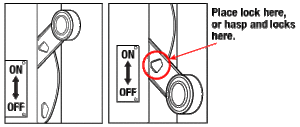
  • Electrical energy – Switch electrical disconnects to the off position. Visually verify that the breaker connections are in the off position. Lock the disconnects into the off position.


Figure 1: Electrical lockout


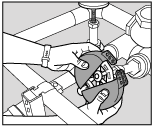
  • Hydraulic and Pneumatic potential energy – Set the valves in the closed position and lock them into place. Bleed off the energy by opening the pressure relief valves, then closing the airlines.


Figure 2: Hydraulic and Pneumatic lockout


  • Mechanical potential energy – carefully release energy from springs that may still be compressed. If this is not feasible, block the parts that may move if there is a possibility that the spring can transfer energy to it.
  • Gravitational potential energy – Use a safety block or pin to prevent the part of the system that may fall or move.
  • Chemical energy – locate chemical supply lines to the system and close and lockout the valves. Where possible, bleed lines and/or cap ends to remove chemicals from the system.

5. Dissipation (removal) of residual or stored energy

5. Dissipation (removal) of residual or stored energy

In general, examples include:

  • Electrical energy – To find a specific method to discharge a capacitor for the system in question, contact the manufacturer for guidance. Many systems with electrical components, motors, or switch gears contain capacitors. Capacitors store electrical energy. In some cases, capacitors hold a charge and may release energy very rapidly (e.g., similar to the flash of a camera). In other cases, capacitors are used to remove spikes and surges in order to protect other electrical components. Capacitors must be discharged in the lockout process in order to protect workers from electrical shock.
  • Hydraulic and Pneumatic potential energy – Setting the valves in the closed position and locking them into place only isolates the lines from more energy entering the system. In most cases, there will still be residual energy left in the lines as pressurized fluid. This residual energy can be removed by bleeding the lines through pressure relief valves. Verify depressurization or use flange-breaking techniques. Contact the manufacturer for more specific details, or if no pressure relief valves are available, what other methods are available.
  • Mechanical potential energy – Carefully release energy from springs that may still be compressed. If this is not possible, use blocks to hold the parts that may move if the energy is released.
  • Gravitational potential energy – If feasible, lower the part to a height where falling is impossible. If this is not possible, contact the manufacturer for guidance.
  • Chemical energy – If available, bleed lines and/or cap ends to remove chemicals from the system.

6. Lockout Tagout

6. Lockout Tagout

When the system’s energy sources are locked out, there are specific guidelines that must be followed to make sure that the lock cannot be removed, and the system cannot be inadvertently operated. These guidelines include:

  • Each lock should only have one key (no master keys are allowed).
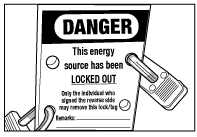
  • There should be as many locks on the system as there are people working on it. For example, if a maintenance job requires 3 workers, then 3 locks should be present – each of the individuals should place their OWN lock on the system. Locks can only be removed by those who installed them, and should only be removed using a specific process – see step 9 below.


Figure 3: Example of multiple locks on a lockout tag

7. Verify Isolation

7. Verify Isolation

Verify that the system is properly locked out before beginning any work. Verification can take place in several ways:

  • The machine, equipment, or process controls (push buttons, switches, etc.) are engaged or activated and the result is observed. No response means isolation is verified. Return controls to the safe position (off).
  • Visual inspection of:
    • Electrical connections to make sure they are open.
    • Suspended parts are lowered to a resting position or blocked to prevent movement.
    • Other devices that restrain machine or process movement.
    • Valve positioning for double block and bleed (for pipes or ducts) – closing two valves of a section of a line, and then bleeding (or venting) the section of the line between the two closed valves.
    • Presence of solid plate used to absolutely close a line – called line blanking (for pipes or ducts).
    • Any other acceptable method of energy isolation.
  • Testing of the equipment:
    • Test circuitry (should be done by a certified electrician) – note: equipment with capacitors needs to be cycled until all energy is drained.
    • Check pressure gauges to make sure hydraulic and pneumatic potential energy has been removed.
    • Check temperature gauges to make sure thermal energy has been discharged.

Choose the method that will best make sure that the energy to the system has been isolated without creating other hazards during the verification.

8. Perform Maintenance or Service Activity

8. Perform Maintenance or Service Activity

Complete the activity that required the lockout process to be started.

9. Remove Lockout Tagout devices

9. Remove Lockout Tagout Devices

To remove locks and tags from a system that is now ready to be put back into service, the following general procedure can be used:

  • Inspect the work area to make sure all tools and items have been removed.
  • Confirm that all employees and persons are safely located away from hazardous areas.
  • Verify that controls are in a neutral position.
  • Remove devices and re-energize machine.
  • Notify affected employees that servicing is completed.

*Note – it is good practice to make sure any individual who placed a lock on the system should also be present when the system is re-started. This practice helps make sure those employees working on the system are not in a hazardous area when the machine is restarted.


BACK TO START | NEXT STEP