Transportation and Field Trip Safety: Child Restraints, Ratios, and Emergency Plans Fatality File – Spanish

1 Muerto y 5 en Estado Crítico Tras Choque de Autobús Escolar

Al menos una persona ha fallecido y cinco se encuentran en estado crítico tras el vuelco de un autobús escolar en una autopista de Carolina del Sur, según informan varios medios de comunicación.

El jueves 17 de abril, un autobús escolar que transportaba a unos 35 estudiantes y dos adultos regresaba de una excursión fuera de Charlotte, Carolina del Norte, hacia la escuela secundaria Pine Ridge, cuando un neumático reventó en la Interestatal 77 en el condado de Chester, informaron ABC News y el medio local WIS10.

La Oficina del Sheriff del condado de Chester informó a los medios que recibieron reportes del accidente alrededor de la 1:47 p. m., hora local.

El autobús circulaba en dirección sur por la I-77 cuando «se salió de la carretera por la derecha, chocó contra una barrera de seguridad y volcó», dijo el sargento Tyler Tidwell, de la Patrulla de Carreteras de Carolina del Sur, según ABC News.

Un ocupante del autobús falleció, añadió Tidwell al medio. No proporcionó más información sobre la víctima mortal.

Varios pasajeros quedaron atrapados dentro del autobús cuando el vehículo volcó, con la puerta hacia abajo, según el medio local News 19 WLTX. Un portavoz de la Oficina del Sheriff del condado de Chester agregó que hubo «múltiples heridos» y que los afectados fueron trasladados al hospital.

Las imágenes compartidas por WSOCTV9 mostraron helicópteros y equipos de servicios médicos de emergencia llegando al lugar, mientras el tráfico era desviado debido al cierre de las carreteras.

Fuente:  https://people


Transportation and Field Trip Safety: Child Restraints, Ratios, and Emergency Plans Picture This

image

This image shows a school bus filled with children heading to a field trip. The driver is focused on the road, but a nearby monitor seems distracted, while the seat belts on several child-sized seats are either improperly fastened or not in use at all. In the back of the bus, a teacher is struggling to maintain control of a small group of excited children, while others are standing or moving around. Outside, the weather is changing, and dark clouds are approaching. There are no visible emergency evacuation plans or child safety seats.

In the chaos of field trips, safety is often compromised due to improper planning or underestimating risks. Transportation accidents and injuries are not always caused by a single act of negligence—they happen when child restraint systems, proper staff-to-child ratios, and emergency procedures are overlooked. One child standing could lead to an injury during a sudden stop, or a poorly restrained child could become a projectile in a crash. Always ensure children are properly restrained, staffing ratios are maintained, and emergency plans are in place and communicated clearly. It’s not just about getting to the destination; it’s about getting there safely.


Transportation and Field Trip Safety: Child Restraints, Ratios, and Emergency Plans Picture This – Spanish

image

La imagen muestra un autobús escolar lleno de niños que se dirigen a una excursión. El conductor está concentrado en el camino, pero un monitor cercano parece distraído, mientras que los cinturones de seguridad de varios asientos infantiles están mal sujetos o no se utilizan. En la parte trasera del autobús, un maestro intenta controlar a un pequeño grupo de niños emocionados, mientras otros están de pie o moviéndose.

En el caos de las excursiones, la seguridad a menudo se ve comprometida debido a una mala planificación o a subestimar los riesgos. Los accidentes y lesiones de transporte no siempre son causados por un solo acto de negligencia, ocurren cuando se pasan por alto los sistemas de sujeción infantil, las proporciones adecuadas de personal-niños y los procedimientos de emergencia.

Un niño de pie podría sufrir una lesión durante una frenada brusca, o un niño mal sujeto podría convertirse en un proyectil en un choque. Asegúrate siempre de que los niños estén correctamente sujetos, que se mantengan las proporciones de personal y que los planes de emergencia estén establecidos y comunicados claramente. No se trata solo de llegar al destino; se trata de llegar de forma segura.


Playground and Equipment Safety Checks: What to Inspect Daily Stats and Facts – Spanish

HECHOS

  1. Equipo Desgastado o Dañado: el plástico agrietado, el metal oxidado o los componentes debilitados pueden fallar durante el uso, provocando caídas repentinas o colapsos estructurales.
  2. Herrajes y Elementos de Fijación Sueltos: Los pernos, tuercas y conectores que faltan o están flojos pueden provocar inestabilidad en columpios, toboganes y estructuras para trepar.
  3. Sujetadores Sueltos: pernos, tuercas y conectores faltantes o aflojados pueden causar inestabilidad en columpios, toboganes y estructuras de escalada.
  4. Peligros de Atrapamiento: las aberturas en los equipos pueden atrapar la cabeza, el cuello o las extremidades de un niño, creando un riesgo de estrangulamiento o lesiones graves.
  5. Superficies Amortiguadoras Inadecuadas: las superficies de protección desgastadas, compactadas o ausentes aumentan la gravedad de las lesiones durante las caídas.
  6. Bordes Filosos y SalieAntes: bordes metálicos expuestos, piezas rotas o pernos sobresalientes pueden causar cortes, perforaciones o engancharse con la ropa.
  7. Espacio y Distancia de Seguridad Inadecuados Entre los Equipos: Una distancia insuficiente entre las estructuras puede provocar colisiones, atropellos o un uso inseguro de los equipos.

ESTADÍSTICAS

  • En Estados Unidos, más de 200.000 niños son atendidos anualmente por lesiones relacionadas con áreas de juegos, siendo las caídas en superficies inseguras o mal mantenidas la principal causa (U.S. Consumer Product Safety Commission, datos recientes).
  • Las caídas representan aproximadamente el 50 % o más de las lesiones en áreas de juegos, a menudo vinculadas a superficies amortiguadoras inadecuadas o al estado del equipo (CPSC, tendencias 2021-2023).
  • En Canadá, los incidentes en áreas de juegos resultan en miles de visitas a urgencias anualmente, identificándose el estado del equipo y los peligros en superficies como factores clave (Public Health Agency of Canada, años recientes).
  • Los datos estadounidenses muestran que el equipo defectuoso o mal mantenido contribuye a una parte significativa de las lesiones graves en áreas de juegos, incluyendo fracturas y lesiones en la cabeza (informes de CPSC, ciclos recientes).
  • En Canadá, las caídas desde equipos de áreas de juegos son la principal causa de lesiones entre niños en entornos supervisados, a menudo vinculadas a las condiciones de la superficie y al desgaste del equipo (datos de vigilancia de lesiones canadienses, años recientes).
  • Peligros de Resbalones y Tropiezos: las superficies mojadas, los desechos y el suelo irregular crean riesgos de caídas, especialmente en áreas de juego de alta actividad.


Playground and Equipment Safety Checks: What to Inspect Daily Meeting Kit – Spanish

QUÉ ESTÁ EN RIESGO

El tiempo en el área de juegos es una de las partes más activas del día, cuando los niños trepan más alto, se mueven más rápido y ponen a prueba sus límites, y es justo entonces cuando los pequeños problemas pueden convertirse en lesiones reales. Un perno suelto, una superficie desgastada o algo fuera de lugar puede no parecer importante al principio, pero si se pasa por alto, puede convertirse rápidamente en un riesgo de seguridad.

CUÁL ES EL PELIGRO

Las áreas de juegos pueden parecer seguras a simple vista, pero cuando se pasan por alto los problemas, pueden provocar lesiones reales durante el juego activo.

Fallos del Equipo Durante el Uso

Cuando las piezas se aflojan, se rompen o se desplazan inesperadamente, los niños pueden perder el equilibrio, caer desde una altura o quedar atrapados en componentes filosos o en movimiento, lo que provoca cortes, lesiones por pellizcos o caídas más graves.

Pérdida de Protección Contra Impactos

Si las superficies se desgastan, se endurecen, se mojan o se cubren con desechos, dejan de absorber correctamente los impactos, lo que aumenta la gravedad de lesiones como contusiones, fracturas o impactos en la cabeza durante las caídas.

Cambios en las Condiciones del Entorno

El clima y la temperatura pueden alterar rápidamente la seguridad del equipo en uso, haciendo que las superficies estén resbaladizas, inestables o lo suficientemente calientes como para causar quemaduras, lo que aumenta el riesgo de accidentes repentinos.

Peligros Pasados por Alto y Respuesta Tardía

Cuando las inspecciones se hacen con prisa o la visibilidad es limitada, los pequeños problemas pasan desapercibidos hasta que los niños ya están expuestos, y los retrasos en notar o reaccionar pueden hacer que las lesiones sean más graves.

COMO PROTEGERSE

Mantener seguras las áreas de juegos comienza con inspecciones diarias constantes y con estar atento a las condiciones cambiantes antes de que los niños comiencen a jugar. Las pequeñas comprobaciones realizadas todos los días son las que evitan problemas mayores más adelante.

Inspecciona el Equipo Antes de Usarlo

Recorre toda el área de juegos y observa de cerca el equipo, no solo desde la distancia. Comprueba si hay algo suelto, roto, filoso o inestable, y asegúrate de que todas las piezas estén firmes y seguras para usar.

Revisa las Superficies y los Alrededores

Las superficies deben estar niveladas, limpias y ser capaces de absorber impactos.

  • Busque zonas duras, compactadas, húmedas o irregulares
  • Retire los escombros, el agua estancada o cualquier peligro
  • Asegúrese de que los caminos y las zonas de aterrizaje estén despejados

Evalúa el Clima y las Condiciones Ambientales

Las condiciones pueden cambiar la seguridad del equipo. Antes de usarlo, comprueba si las superficies están resbaladizas, demasiado calientes o afectadas por el clima, y ajusta o restringe el uso si es necesario.

Mantén la Visibilidad y la Supervisión

Conoce dónde están tus puntos ciegos y colócate de manera que puedas ver a todos los niños. Evita las distracciones y mantente activamente involucrado para poder reaccionar rápidamente si algo cambia.

Toma Acción de Inmediato

Si algo no se ve bien, no lo ignores.

  • Retira o bloquea los equipos inseguros
  • Reporta los problemas de inmediato
  • No permitas el uso hasta que el peligro esté solucionado
  • Mantén la consistencia todos los días

Sé Constante todos los Días

La seguridad se basa en la rutina. Realizar las mismas revisiones todos los días garantiza que los pequeños problemas se detecten a tiempo y que el patio de recreo siga siendo seguro para todos.

CONCLUSIÓN

Las áreas de juegos están construidas para divertirse, pero la seguridad depende de lo que se revise antes de que el juego comience. Tomarse unos minutos para inspeccionar el equipo, las superficies y las condiciones cada día ayuda a detectar pequeños problemas antes de que se conviertan en lesiones.


Playground and Equipment Safety Checks: What to Inspect Daily Stats and Facts

FACTS

  1. Worn or Damaged Equipment: Cracked plastic, rusted metal, or weakened components can fail during use, leading to sudden falls or structural collapse.
  2. Loose Hardware and Fasteners: Missing or loosened bolts, nuts, and connectors can cause instability in swings, slides, and climbing structures.
  3. Entrapment Hazards: Openings in equipment can trap a child’s head, neck, or limbs, creating a risk of strangulation or serious injury.
  4. Inadequate Impact Surfacing: Worn, compacted, or missing protective surfacing increases the severity of injuries during falls.
  5. Sharp Edges and Protrusions: Exposed metal edges, broken parts, or protruding bolts can cause cuts, punctures, or snagging hazards.
  6. Slip and Trip Hazards: Wet surfaces, debris, and uneven ground create fall risks, especially in high-activity play areas.
  7. Poor Equipment Spacing and Clearance: Insufficient distance between structures can lead to collisions, struck-by incidents, or unsafe use of equipment.

STATS

  • In the United States, over 200,000 children are treated annually for playground-related injuries, with falls to unsafe or poorly maintained surfaces as the leading cause (U.S. Consumer Product Safety Commission, recent reporting).
  • Falls account for approximately 50% or more of playground injuries, often linked to inadequate surfacing or equipment condition (CPSC, 2021–2023 data trends).
  • In Canada, playground-related incidents result in thousands of emergency visits annually, with equipment condition and surface hazards identified as key contributing factors (Public Health Agency of Canada, recent years).
  • U.S. safety data shows that defective or poorly maintained equipment is a contributing factor in a significant portion of serious playground injuries, including fractures and head injuries (CPSC reports, recent cycles).
  • In Canada, falls from playground equipment are the leading cause of injury among children in supervised settings, often tied to surface conditions and equipment wear (Canadian injury surveillance data, recent years).


Playground and Equipment Safety Checks: What to Inspect Daily Fatality File

1-Year-Old Boy Dies at Daycare Facility After Slipping Through Small Opening on Playground Toy Slide

A 1-year-old boy is dead after his head became trapped in a small opening when he slipped on a toy slide at a daycare facility in Missouri.

On Thursday, Jan. 8, police responded to a call about “a child not breathing” at an in-home daycare facility outside Potosi, KSDK News reported. The infant had “slipped through a small opening on a playground slide” and their head “became lodged, restricting the airway and resulting in a loss of oxygen,” said Washington County Sheriff Dwayne Reed in a news release shared on Facebook.

“Two deputies with the Washington County Sheriff’s Office (WCSO) were the first responders on scene and immediately initiated life-saving measures, including CPR,” said Reed.

Fire Department personnel and the Ambulance District arrived shortly afterwards and also attempted life-saving measures on the child. The infant, however, later died as a result of the injuries sustained, the police confirmed.

Source: https://people.com


Playground and Equipment Safety Checks: What to Inspect Daily Fatality File – Spanish

Niño de 1 Año Muere en Guardería Tras Quedar Atrapado en una Pequeña Apertura de un Tobogán

Un niño de 1 año murió después de que su cabeza quedara atrapada en una pequeña apertura cuando resbaló en un tobogán de juguete en una guardería en Misuri. El jueves 8 de enero, la policía respondió a una llamada sobre un niño que no respiraba en una guardería en domicilio cerca de Potosi, según informó KSDK News.

El bebé se había deslizado a través de una pequeña apertura en un tobogán de área de juegos y su cabeza quedó atrapada, restringiendo las vías respiratorias y resultando en pérdida de oxígeno, dijo el sheriff del condado de Washington, Dwayne Reed, en un comunicado. Dos diputados fueron los primeros en llegar al lugar e iniciaron de inmediato medidas para salvar la vida, incluida RCP.

El personal del Departamento de Bomberos y del Distrito de Ambulancias llegó poco después y también intentó medidas para salvar la vida del niño. Sin embargo, el bebé falleció posteriormente como resultado de las lesiones sufridas, confirmó la policía.

Fuente: https://people.com


Playground and Equipment Safety Checks: What to Inspect Daily Picture This

image

This image shows a busy playground where children are actively using slides, swings, and climbing structures during recess. A staff member is supervising from a distance, but no visible inspection has been done before use. One swing chain shows signs of wear and rust, a slide surface appears wet and slightly uneven, and bolts on a climbing structure look loose. Nearby, the ground covering is uneven with exposed hard patches where protective surfacing has worn away. Toys and small objects are scattered across the play area, creating hidden trip hazards as children run and play without noticing the risks.

In playground environments, serious injuries often happen not because of one major failure, but because small hazards go unnoticed and uncorrected. Worn equipment, loose hardware, damaged surfaces, and poor housekeeping can quickly lead to falls, entrapments, or struck-by incidents. Children move fast, take risks, and rely on the environment being safe, which means daily inspections are critical. Always check equipment for stability, inspect chains, bolts, and connections, ensure surfaces are even and impact-absorbing, remove debris, and address hazards immediately before children use the area. A quick inspection can prevent a serious injury.


Playground and Equipment Safety Checks: What to Inspect Daily Picture This – Spanish

image

La imagen muestra un área de juegos concurrida donde los niños usan activamente toboganes, columpios y estructuras de escalada durante el recreo. Un miembro del personal supervisa desde la distancia, pero no se ha realizado ninguna inspección visible antes del uso. Una cadena del columpio muestra signos de desgaste y oxidación, una superficie del tobogán parece mojada y ligeramente irregular, y los pernos de una estructura de escalada se ven flojos.

En entornos de áreas de juegos, las lesiones graves a menudo no ocurren por una sola falla importante, sino porque pequeños peligros pasan desapercibidos y sin corregir. El equipo desgastado, el hardware suelto, las superficies dañadas y la mala limpieza pueden conducir rápidamente a caídas, atrapamientos o incidentes por golpes.

Los niños se mueven rápido, asumen riesgos y dependen de que el entorno sea seguro, lo que significa que las inspecciones diarias son críticas. Siempre verifica la estabilidad del equipo, inspecciona las cadenas, los pernos y las conexiones, asegúrate de que las superficies sean parejas y absorban impactos, retira los desechos y atiende los peligros de inmediato antes de que los niños usen el área. Una inspección rápida puede prevenir una lesión grave.


Playground and Equipment Safety Checks: What to Inspect Daily Meeting Kit

WHAT’S AT STAKE

Playground time is one of the most active parts of the day, where children climb higher, move faster, and push their limits, and that’s exactly when small issues can turn into real injuries. A loose bolt, a worn surface, or something out of place might not seem like a big deal at first, but when it’s missed, it can quickly become a safety risk.

WHAT’S THE DANGER

Playgrounds can look safe at a glance, but when issues are missed, they can quickly lead to real injuries during active play.

Equipment Failures During Use

When parts loosen, break, or shift unexpectedly, children can lose balance, fall from height, or get caught on sharp or moving components, leading to cuts, pinching injuries, or more serious falls.

Loss of Impact Protection

If surfaces become worn, hard, wet, or covered with debris, they no longer absorb impact properly, increasing the severity of injuries like bruises, fractures, or head impacts during falls.

Changing Conditions from the Environment

Weather and temperature can quickly alter how safe equipment is to use, making surfaces slippery, unstable, or hot enough to cause burns, which increases the risk of sudden accidents.

Missed Hazards and Delayed Response

When inspections are rushed or visibility is limited, small problems go unnoticed until children are already exposed, and delays in noticing or reacting can make injuries more severe.

HOW TO PROTECT YOURSELF

Keeping playgrounds safe starts with consistent daily inspections and staying aware of changing conditions before children begin to play. Small checks done every day are what prevent bigger problems later.

Inspect Equipment Before Use

Walk the entire play area and look closely at equipment, not just from a distance. Check for anything loose, broken, sharp, or unstable, and make sure all parts are secure and safe for use.

Check Surfaces and Surroundings

Surfaces should be even, clean, and able to absorb impact.

  • Look for hard, compacted, wet, or uneven areas
  • Remove debris, standing water, or hazards
  • Make sure pathways and landing zones are clear

Assess Weather and Environmental Conditions

Conditions can change how safe equipment is. Before use, check if surfaces are slippery, too hot, or affected by weather, and adjust or restrict use if needed.

Maintain Clear Visibility and Supervision

Know where your blind spots are and position yourself so you can see all children. Avoid distractions and stay actively engaged so you can respond quickly if something changes.

Take Action Immediately

If something doesn’t look right, don’t ignore it.

  • Remove or block off unsafe equipment
  • Report issues right away
  • Do not allow use until the hazard is fixed

Stay Consistent Every Day

Safety comes from routine. Doing the same checks every day ensures small issues are caught early and the playground stays safe for everyone.

FINAL WORD

Playgrounds are built for fun, but safety depends on what you check before the play begins. Taking a few minutes to inspect equipment, surfaces, and conditions each day helps catch small issues before they turn into injuries.


Mold Awareness in the Workplace – Spanish

Course Description

This course will cover what you to look for when it comes to mold awareness, what mold problems usually start with, how they can affect people, and what to do if you spot something that does not seem right. (Spanish Version)


Mold Awareness in the Workplace

Course Description

This course will cover what you to look for when it comes to mold awareness, what mold problems usually start with, how they can affect people, and what to do if you spot something that does not seem right.


Hazard Identification and Risk Assessment – Spanish

Course Description

This course will walk through how to think like an assessor, how to observe work with a safety lens, how to judge the level of risk, and how to make sound decisions about controls. It will talk through real situations, common mistakes, and how supervisors and workers can work together to strengthen the safety culture in their workplace. (Spanish Version)


Telehandlers: Safe Operation – Spanish

Course Description

This course will help you understand telehandler capabilities, stability, safe driving, load handling, site hazards, and communication practices that keep everyone protected. (Spanish Version)


Microlearning and Mentorship: How to Train Boomers, Millennials, and Gen Z Together

The best multigenerational safety training is not one format

Safety managers are often told that every generation learns differently. There is truth in that, but it can lead to the wrong conclusion. The answer is not to build one training program for Boomers, another for Millennials, another for Gen X, and another for Gen Z. That creates complexity, reinforces stereotypes, and misses the real point.

The better approach is to build training that combines structure with conversation.

Microlearning gives workers short, focused safety lessons they can absorb without being pulled away from the job for long periods. Mentorship gives workers access to experience, judgment, stories, and context that no module can fully capture. Supervisor-led discussions connect both to the actual task, site, shift, and hazard. When those pieces work together, multigenerational training becomes a strength instead of a challenge.

This matters because today’s workforce is not simply divided by age. It is divided by exposure, experience, confidence, technology comfort, physical demands, communication habits, and trust. A new worker may be digitally fluent but unsure how to challenge an unsafe instruction. An experienced worker may have exceptional hazard recognition but little patience for generic refresher training. A mid-career supervisor may understand the system but struggle to turn training into meaningful discussion.

The solution is not to choose one learning style. It is to create a training rhythm where people learn briefly, talk honestly, apply quickly, and reinforce often.

A story that shows the difference

A safety manager at a regional manufacturing company once described a recurring problem with hand injuries. The organization had delivered annual machine safety training for years. Workers completed the course. Supervisors documented attendance. The procedures were clear.

The incidents still happened.

When the safety manager looked closer, the issue was not that workers lacked information. Newer workers understood the rules but did not always recognize when a routine adjustment was becoming risky. Experienced workers recognized the risk but had developed informal workarounds that were faster than the written procedure. Supervisors assumed everyone understood the gap because the topic had been covered so many times.

The training was technically complete, but the learning was not moving across the workforce.

The company changed its approach. Before the next machine safety refresher, workers completed a short digital lesson focused on one specific risk point: clearing jams. The lesson took less than ten minutes and included a real-world scenario. Then supervisors held a short team discussion at the machine. Experienced operators were asked to explain where people usually get into trouble and what they watch for before stopping work. Newer workers were asked what still felt unclear.

That one change altered the conversation. The refresher no longer felt like another reminder. It became a transfer of judgment. The digital lesson created a common foundation. The experienced workers added context. The supervisor tied both back to the procedure and expectation.

That is the power of combining microlearning and mentorship.

Why microlearning works, but not by itself

Microlearning has become popular because it fits the reality of modern work. Workers are busy. Supervisors are stretched. Attention is fragmented. Pulling employees into long training sessions for every topic is often impractical, especially in operations where staffing, production, and coverage are constant pressures.

Short, focused lessons can help. They reduce cognitive overload. They allow training to be repeated more often. They make it easier to deliver refreshers close to the moment of need. For newer workers, microlearning can build confidence by breaking complex topics into manageable pieces. For experienced workers, it can reduce frustration by avoiding lengthy reviews of material they already understand.

Recent workforce data supports the importance of better, more consistent training for younger frontline workers. Axonify’s 2025 survey of Gen Z frontline workers reported that 90 percent said better training would make them more confident on the job, 89 percent said it would help them handle difficult situations, 82 percent said it would increase productivity, and 81 percent said it would encourage them to stay longer in their roles. (Axonify)

Those numbers are important because they show that younger workers do not simply want faster training. They want training that helps them function better, handle pressure, and see a future in the organization. Safety managers should pay attention to that. Confidence is not just an HR metric. In safety, confidence affects whether a worker asks a question, stops a task, reports a near miss, or admits they are unsure.

But microlearning has a limit. A short lesson can introduce a concept, reinforce a rule, or remind workers of a hazard. It cannot fully replace the judgment that comes from seeing how risk behaves in real work. That is where mentorship comes in.

Why mentorship still matters

Mentorship is not outdated. In safety, it may be more important than ever.

Experienced workers carry knowledge that is difficult to capture in formal training. They know where the job tends to drift from the procedure. They know which controls are strong and which ones are fragile. They know what a machine sounds like before it jams, where a new worker is likely to stand when they are uncertain, and which tasks become more dangerous at the end of a long shift.

That knowledge is not always written down because it developed through experience. It came from close calls, adjustments, informal coaching, and years of watching work go right and wrong.

When organizations fail to transfer that knowledge, newer workers are left to learn it the hard way.

Mentorship gives safety training depth. It turns a rule into a story. It turns a checklist into a conversation. It gives new workers a chance to ask questions they may not ask in a classroom or online module. It also gives experienced workers a meaningful role, which can re-engage people who have tuned out repetitive safety messaging.

The key is to make mentorship intentional. Leaving it to chance creates uneven results. Some workers receive excellent guidance. Others receive very little. A strong training system makes mentoring part of the learning process without turning it into a burden.

The problem with choosing digital or human training

Many organizations treat digital learning and hands-on mentoring as competing options. That is a mistake.

Digital learning provides consistency. Mentorship provides context. Safety training needs both.

Without digital structure, training can become inconsistent across shifts, sites, and supervisors. One crew gets a strong explanation. Another gets a rushed talk. One supervisor covers the key risk points. Another assumes people already know. Over time, this inconsistency becomes a safety exposure.

Without mentorship and conversation, digital training can become detached from the work. Workers complete modules but do not connect the content to the specific hazards they face. Experienced employees may see it as box checking. Newer workers may pass a quiz but still hesitate when the situation becomes messy.

A blended model solves this by giving everyone the same foundation and then localizing the learning through discussion, coaching, and field application.

This is where SafetyNow can be positioned naturally. A platform with training content, LMS tracking, meeting kits, talks, tools, and templates gives safety managers the structure they need. But the real value increases when supervisors use that structure to spark field conversations. The module starts the lesson. The crew discussion makes it real. The supervisor follow-up turns it into behavior.

A multigenerational workforce needs a learning ecosystem

The phrase “training calendar” can make safety learning sound like a sequence of isolated events. January is slips, trips, and falls. February is lockout. March is ergonomics. April is workplace violence. The topics rotate, but the learning often does not compound.

A multigenerational workforce needs something more connected.

Think of safety training as an ecosystem. Microlearning introduces or reinforces a focused idea. Mentorship adds lived experience. Toolbox talks create shared discussion. Field observations confirm whether the lesson is being applied. Refresher modules bring the topic back before it fades. Near misses feed new examples into the system.

This approach works across generations because each worker connects with the content in more than one way. A younger worker may appreciate the short digital lesson but gain confidence during the discussion. An experienced worker may not need the basic reminder but may engage when asked to share how the hazard appears in real conditions. A supervisor may use the same material to create consistency while still adapting the conversation to the crew.

That is more powerful than trying to guess which generation likes which format.

The role of stories in making training stick

Stories are one of the strongest bridges between microlearning and mentorship. A short module may teach the rule, but a story explains why the rule matters.

A new worker may remember a line from a policy for a week. They may remember a veteran’s close-call story for years.

Consider a fall protection refresher. A digital lesson can quickly review anchor points, inspection requirements, tie-off rules, and common mistakes. That is necessary. But the lesson becomes more memorable when an experienced worker adds, “The moment that gets people here is not when they’re working at height. It’s when they’re moving from one spot to another and think they’ll only be disconnected for a second.”

That sentence carries practical wisdom. It identifies the real danger point. It tells newer workers where attention should sharpen. It also challenges experienced workers who may have normalized the same risky transition.

Good safety training does not choose between instruction and story. It uses both.

Why younger workers need guided confidence

Younger workers are often described as wanting fast, digital, flexible learning. That may be true, but it is incomplete. What many newer workers really need is guided confidence.

The Axonify data is useful here because it shows that Gen Z frontline workers connect better training with confidence, productivity, better handling of difficult situations, reduced burnout, and retention. (Axonify) That is not a request for entertainment. It is a request for practical support.

In safety, guided confidence means workers know what to do when they are uncertain. They know how to ask a question without feeling embarrassed. They know when to stop work, who to tell, and what will happen next. They also know that supervisors and experienced coworkers will not treat uncertainty as weakness.

Microlearning can help by giving newer workers repeated exposure to key hazards and decisions. Mentorship strengthens that by allowing them to test their understanding in conversation. The combination helps new workers move from “I completed the course” to “I know what to watch for, and I know what to do when something feels wrong.”

That is a major safety difference.

Why experienced workers need respect and challenge

Experienced workers do not need to be told the basics in the same way year after year. That does not mean they do not need training. It means they need training that respects their experience and challenges their assumptions.

A veteran employee may have outstanding judgment, but they may also rely on habits formed under different conditions. Equipment changes. Staffing changes. Production pressure changes. The worker’s body changes. A task that was once manageable may now require different controls. A shortcut that felt harmless ten years ago may be more dangerous in a faster, leaner, more crowded operation.

Mentorship should not become a way of preserving every old habit. It should be a way of examining experience. The best conversations ask experienced workers what they know, but also what has changed.

A supervisor might ask, “Where has this task become harder than it used to be?” or “What did we used to get away with that we shouldn’t accept anymore?” Those questions honour experience without romanticizing it.

How supervisors make the blend work

Supervisors are the link between training content and workplace behavior. If they treat training as paperwork, everyone else will too. If they treat it as a useful conversation, the crew is more likely to engage.

A strong supervisor does not simply assign a microlearning module and move on. They use it as a setup. After the lesson, they ask what stood out, where the topic shows up in daily work, and what

newer workers should be watching for. They invite experienced workers to add examples. They clarify expectations. Then they observe whether behavior changes in the field.

That follow-through is what separates training delivery from training transfer.

Deloitte’s 2025 Gen Z and Millennial Survey notes that these generations are focused on learning, and it highlights the importance of skills development as work changes. (Deloitte) In safety, supervisors are central to that development because they turn learning into practice. An LMS can assign the lesson. A supervisor helps the worker apply it under real conditions.

Building a practical microlearning and mentorship model

A safety manager does not need to redesign the entire training program overnight. The best approach is to start with one high-risk topic and build a repeatable rhythm.

Start with a short digital lesson that introduces the hazard, the rule, and the expected behavior. Keep it focused. The lesson should prepare the worker for discussion, not replace it.

Follow with a supervisor-led conversation. Ask experienced workers where the risk shows up in real work. Ask newer workers what feels unclear. Tie the discussion back to the procedure or control.

Then move to field application. Supervisors observe the task, coach in the moment, and look for the specific behavior the training addressed.

Finally, reinforce the lesson later. Use a short refresher, a near miss example, or a toolbox talk to bring the topic back before it fades.

This rhythm is simple, but it works because it reflects how people actually learn. They receive information, discuss it, apply it, and revisit it.

What this looks like in a real safety calendar

Take a monthly topic like material handling. In a traditional program, workers might attend a session or complete a module. The topic is covered and the calendar moves on.

In a blended model, the month is structured differently. Week one introduces a short lesson on one specific risk, such as awkward lifts during rushed tasks. Week two includes a supervisor discussion about where awkward lifts actually occur on the site. Week three pairs newer workers with experienced employees to review how they plan lifts, use equipment, or ask for help. Week four uses a brief refresher based on observations from the floor.

The topic is not simply delivered. It is developed.

That same model can be used for machine guarding, driving safety, slips and falls, workplace violence, heat stress, lockout, or any other recurring risk. SafetyNow’s meeting kits, talks, and LMS content can provide the structure, while the supervisor and crew make the training specific to the workplace.

Measuring whether the approach is working

The success of microlearning and mentorship should not be measured only by completion rates. Completion matters, but it is not the whole story.

Look for changes in participation. Are newer workers asking more questions? Are experienced workers sharing more practical examples? Are supervisors having better follow-up conversations? Are near miss reports becoming more detailed?

Also look for changes in repeat issues. If the same unsafe behaviors keep showing up, the training is not transferring. If workers begin identifying risks earlier and correcting each other more constructively, the system is improving.

Retention and engagement matter too. If younger workers say training helps them feel more confident and supported, that has safety value. If experienced workers feel respected rather than talked down to, their influence can strengthen the culture.

The business benefit of getting this right

For CEOs, business owners, HR leaders, and safety managers, the value of this approach goes beyond training quality.

Better training reduces incidents, but it also improves productivity, retention, and operational consistency. When workers understand risk earlier, they make fewer disruptive mistakes. When supervisors can rely on consistent training tools, they spend less time reinventing content. When experienced workers are engaged as mentors, the organization protects knowledge that would otherwise disappear through retirement or turnover.

The business case becomes especially clear in industries with labour shortages or high turnover. Every time a new worker leaves before becoming fully competent, the organization loses time, money, and safety momentum. Better training and support can help reduce that churn. The Axonify survey’s finding that 81 percent of Gen Z frontline workers say better ongoing support would encourage them to stay longer should matter to any organization struggling with retention. (Axonify)

Safety training is not just a compliance cost. Done well, it is part of workforce stability.

Avoiding the biggest mistakes

The first mistake is using microlearning as a shortcut. Short training is only useful if it is focused and reinforced. A three-minute module that no one discusses or applies may be efficient, but it may not be effective.

The second mistake is using mentorship casually. Pairing a new worker with an experienced one is not enough if the experienced worker is not prepared to coach, explain, and model safe behavior.

The third mistake is treating generational differences as fixed truths. Workers are individuals. Some older workers like digital tools. Some younger workers value in-person coaching. Some people learn best through discussion, others through repetition. A blended system works because it gives people multiple ways to engage without reducing them to a label.

The fourth mistake is failing to involve supervisors. Training cannot live only in the LMS or only in the safety department. Supervisors carry it into daily work.

Closing perspective

The strongest multigenerational safety training does not ask whether Boomers, Millennials, Gen X, or Gen Z learn best from videos, classrooms, coaching, or conversation. It recognizes that safety requires all of them at different moments.

Microlearning gives structure. Mentorship gives context. Supervisor-led conversation gives meaning. Field reinforcement turns learning into behavior.

That is the model safety managers should be building.

A multigenerational workforce is not a training problem to solve. It is a safety advantage to organize. Younger workers bring fresh eyes, questions, and comfort with new tools. Experienced workers bring judgment, stories, and pattern recognition. Supervisors bring structure and accountability. Platforms like SafetyNow can help hold the pieces together so training stays consistent, practical, and repeatable.

When those elements work together, safety training becomes more than content delivery. It becomes knowledge transfer. And in a workplace where risk changes quickly, that may be one of the most valuable forms of training an organization can provide.



Safe Food Handling and Snack Time Hygiene Meeting Kit

WHAT’S AT STAKE

Snack time in childcare isn’t just about eating, it’s a daily moment where hygiene, supervision, and safe habits all come together, and when small things get missed, it can quickly turn into a safety concern, which is why staying consistent and paying attention during these routines helps keep everyone safe.

WHAT’S THE DANGER

Snack time may seem simple, but it brings together multiple risks that can affect both health and safety if routines are not followed consistently.

Hygiene and Cross-Contamination

Children frequently touch shared surfaces, food, and their faces, which allows germs to spread quickly between hands, toys, tables, and snacks when proper handwashing and cleaning are missed.

Food Handling Risks

Improper storage, expired food, or unsafe preparation can introduce contamination, especially when staff rush or skip steps during busy routines.

Choking Hazards

Young children are still developing chewing and swallowing skills. Foods that are not cut appropriately or lack of close supervision can increase the risk of choking during snack time.

Allergy Exposure

Even small amounts of allergenic foods can cause serious reactions. Cross-contact, unclear labeling, or lack of awareness about dietary restrictions can put children at risk.

HOW TO PROTECT YOURSELF

Keeping snack time safe means staying consistent with hygiene, food handling, and active supervision. These routines need to be followed every time, because small gaps are what lead to problems.

Start with Hygiene

Clean hands and surfaces are your first line of defense. Children should wash their hands with soap and water before eating, and tables must be cleaned and disinfected before and after snack time. Staff should also wash hands before handling food and after any activity that could introduce contamination.

Keep the Environment Controlled and Consistent

A clean, organized space supports safety and supervision. Clean spills quickly, keep areas clear, and follow the same routines every day so nothing gets missed, even during busy moments.

Handle Food Safely

Food must be stored, prepared, and served properly to prevent contamination and reduce risk.

  • Check food condition and expiration before serving
  • Use clean utensils and avoid direct hand contact with ready-to-eat food
  • Keep food at safe temperatures and avoid cross-contact
  • Never serve food that has been dropped or improperly stored

Stay Fully Attentive During Snack Time

Supervision during eating should always be active. Stay positioned where you can see all children, watch how they are eating, and avoid distractions so you can respond quickly if something changes.

Reduce Choking and Allergy Risks

Children need food that matches their age and ability, along with close supervision.

  • Cut food into appropriate sizes and ensure children remain seated
  • Never allow walking, running, or playing while eating
  • Know each child’s allergies and prevent food sharing
  • Follow all allergy procedures and keep emergency response ready

FINAL WORD

Snack time may feel routine, but it’s one of the moments where small actions make a big difference. When you stay present and follow the routine every time, snack time stays safe, simple, and part of a healthy day.


Safe Food Handling and Snack Time Hygiene Meeting Kit – Spanish

QUÉ ESTÁ EN RIESGO

La hora del refrigerio en el cuidado infantil no se trata solo de comer; es un momento diario en el que la higiene, la supervisión y los hábitos seguros se combinan, y cuando se omiten pequeños detalles, puede convertirse rápidamente en un problema de seguridad. Por eso, ser constante y prestar atención durante estas rutinas ayuda a mantener a todos seguros.

CUÁL ES EL PELIGRO

La hora del refrigerio puede parecer sencilla, pero combina varios riesgos que pueden afectar tanto la salud como la seguridad si las rutinas no se siguen de manera constante.

Higiene y Contaminación Cruzada

Los niños tocan con frecuencia superficies compartidas, alimentos y sus propias caras, lo que permite que los gérmenes se propaguen rápidamente entre las manos, los juguetes, las mesas y los refrigerios cuando se omite el lavado de manos y la limpieza adecuados.

Riesgos en la Manipulación de Alimentos

El almacenamiento incorrecto, los alimentos vencidos o la preparación insegura pueden introducir contaminación, especialmente cuando el personal se apresura u omite pasos durante las rutinas más cargadas.

Riesgos de Asfixia

Los niños pequeños aún están desarrollando sus habilidades para masticar y tragar. Los alimentos que no se cortan adecuadamente o la falta de supervisión cercana pueden aumentar el riesgo de asfixia durante la hora del refrigerio.

Exposición a Alérgenos

Incluso pequeñas cantidades de alimentos alergénicos pueden provocar reacciones graves. El contacto cruzado, el etiquetado poco claro o la falta de conocimiento sobre las restricciones alimentarias pueden poner a los niños en riesgo.

COMO PROTEGERSE

Mantener la hora del refrigerio segura significa ser constante con la higiene, la manipulación de alimentos y la supervisión activa. Estas rutinas deben seguirse cada vez, porque los pequeños descuidos son los que provocan los problemas.

Comienza con la Higiene

Las manos y las superficies limpias son tu primera línea de defensa. Los niños deben lavarse las manos con agua y jabón antes de comer, y las mesas deben limpiarse y desinfectarse antes y después de la hora del refrigerio. El personal también debe lavarse las manos antes de manipular alimentos y después de cualquier actividad que pueda introducir contaminación.

Mantén el Entorno Controlado y Constante

Un espacio limpio y organizado favorece la seguridad y la supervisión. Limpia los derrames con rapidez, mantén las áreas despejadas y sigue las mismas rutinas todos los días para que nada se omita, incluso en los momentos más ocupados.

Manipula los Alimentos de Forma Segura

Los alimentos deben almacenarse, prepararse y servirse correctamente para evitar la contaminación y reducir el riesgo.

  • Comprueba el estado y la fecha de caducidad de los alimentos antes de servirlos
  • Usa utensilios limpios y evita el contacto directo de las manos con los alimentos listos para consumir
  • Mantén los alimentos a temperaturas seguras y evita el contacto cruzado
  • Nunca sirvas alimentos que se hayan caído o almacenado incorrectamente

Mantén Plena Atención Durante la Hora del Refrigerio

La supervisión durante la comida debe ser siempre activa. Mantente en una posición desde la que puedas ver a todos los niños, observa cómo están comiendo y evita las distracciones para poder reaccionar rápidamente si algo cambia.

Reduce los Riesgos de Asfixia y Alergias

Los niños necesitan alimentos adecuados a su edad y capacidad, además de una supervisión constante.

  • Corta los alimentos en trozos del tamaño adecuado y asegúrate de que los niños permanezcan sentados
  • Nunca permitas que caminen, corran o jueguen mientras comen
  • Conoce las alergias de cada niño y evita que compartan la comida
  • Sigue todos los procedimientos relacionados con las alergias y ten preparados los medios de respuesta de emergencia

CONCLUSIÓN

La hora del refrigerio puede parecer rutinaria, pero es uno de los momentos en los que las pequeñas acciones marcan una gran diferencia. Cuando estás presente y sigues la rutina cada vez, la hora del refrigerio se mantiene segura, sencilla y forma parte de un día saludable.


Safe Food Handling and Snack Time Hygiene Stats and Facts

FACTS

  • Hand Hygiene Failures: Handling food without proper handwashing after contact with surfaces, waste, or bodily fluids can transfer harmful pathogens directly to ready-to-eat items.
  • Cross-Contamination: Using the same utensils, gloves, or surfaces for raw and ready-to-eat foods can spread bacteria and allergens without visible signs.
  • Improper Glove Use: Reusing gloves or failing to change them between tasks creates the same contamination risk as bare hands.
  • Time and Temperature Abuse: Leaving food at unsafe temperatures during preparation or snack service allows rapid bacterial growth.
  • Unclean Surfaces and Equipment: Food contact surfaces that are not properly cleaned and sanitized can harbor pathogens that contaminate multiple batches of food.
  • Chemical Contamination: Cleaning agents used near food without proper control can contaminate food or food-contact surfaces, leading to exposure risks.
  • Ill Food Handlers: Workers handling food while sick can transmit viruses such as norovirus through direct contact or contaminated surfaces.

STATS

  • In the United States, food service and preparation workers recorded over 93,000 nonfatal occupational injuries and illnesses in 2023, many involving exposure to harmful substances and unsafe hygiene practices (U.S. Bureau of Labor Statistics).
  • The U.S. Bureau of Labor Statistics reported that exposure to harmful substances or environments accounted for thousands of workplace illness cases in food service settings between 2021 and 2023.
  • In Canada, the food and beverage service sector reported over 6,000 lost-time injury claims annually in recent years, including incidents linked to contamination, burns, and chemical exposure (Association of Workers’ Compensation Boards of Canada).
  • U.S. data shows that contact with objects and equipment and exposure incidents are among the leading causes of injury in food preparation occupations, reflecting unsafe handling and sanitation practices (BLS, 2022–2023).
  • In Canada, workers in accommodation and food services consistently experience injury rates above the national average for service industries, with frequent exposure to hazardous substances and environments (AWCBC, 2021–2023).
  • The U.S. Census of Fatal Occupational Injuries indicates that food preparation and serving occupations report multiple fatalities each year, including cases involving exposure, burns, and unsafe work conditions (BLS CFOI, 2021–2023).


Safe Food Handling and Snack Time Hygiene Stats and Facts – Spanish

HECHOS

  • Fallos en la Higiene de las Manos: manipular alimentos sin lavarse las manos correctamente después del contacto con superficies, residuos o fluidos corporales puede transferir patógenos directamente a los alimentos listos para consumir.
  • Contaminación Cruzada: usar los mismos utensilios, guantes o superficies para alimentos crudos y listos para consumir puede propagar bacterias y alérgenos sin signos visibles.
  • Uso inadecuado de los Guantes: Reutilizar los guantes o no cambiarlos entre una tarea y otra conlleva el mismo riesgo de contaminación que trabajar con las manos desnudas.
  • Abuso del Tiempo y la Temperatura: dejar los alimentos a temperaturas inseguras durante la preparación o el servicio del refrigerio permite un crecimiento bacteriano rápido.
  • Superficies y Equipos Sucios: las superficies de contacto con los alimentos que no se limpian y desinfectan correctamente pueden albergar patógenos que contaminan múltiples lotes.
  • Contaminación Química: Los productos de limpieza utilizados cerca de los alimentos sin el control adecuado pueden contaminar los alimentos o las superficies que entran en contacto con ellos, lo que conlleva riesgos de exposición.
  • Manipuladores Enfermos: los trabajadores que manipulan alimentos mientras están enfermos pueden transmitir virus como el norovirus por contacto directo o superficies contaminadas.

ESTADÍSTICAS

  • En Estados Unidos, los trabajadores de servicios y preparación de alimentos registraron más de 93.000 lesiones y enfermedades ocupacionales no mortales en 2023, muchas relacionadas con la exposición a sustancias peligrosas y prácticas de higiene inseguras (Bureau of Labor Statistics).
  • El Bureau of Labor Statistics de EE. UU. informó que la exposición a sustancias o entornos peligrosos representó miles de casos de enfermedad laboral en entornos de servicio de alimentos entre 2021 y 2023.
  • En Canadá, el sector de servicios de alimentos y bebidas reportó más de 6.000 reclamos anuales por lesiones con tiempo perdido en años recientes, incluidos incidentes vinculados a contaminación, quemaduras y exposición química (AWCBC).
  • Los datos estadounidenses muestran que el contacto con objetos y equipos y los incidentes por exposición se encuentran entre las principales causas de lesiones en las ocupaciones de preparación de alimentos (BLS, 2022-2023).
  • En Canadá, los trabajadores de alojamiento y servicios de alimentos experimentan tasas de lesiones consistentemente superiores al promedio nacional para industrias de servicios, con exposición frecuente a sustancias y entornos peligrosos (AWCBC, 2021-2023).
  • El Censo de Lesiones Ocupacionales Mortales de EE. UU. indica que las ocupaciones de preparación y servicio de alimentos reportan múltiples fatalidades cada año, incluidos casos relacionados con exposición, quemaduras y condiciones laborales inseguras (BLS CFOI, 2021-2023).


Safe Food Handling and Snack Time Hygiene Fatality File – Spanish

Un Empleado Muere Tras Mezclar Productos de Limpieza Incompatibles

Aproximadamente a las 5:00 p. m. del 7 de noviembre de 2019, un empleado se encontraba trabajando en un restaurante de servicio completo. Desempeñaba el cargo de gerente general y supervisaba el funcionamiento del restaurante. Al menos dos compañeros de trabajo estaban presentes en el momento del incidente. El primer compañero era un cocinero. El empleado estaba trabajando con el cocinero para limpiar y ordenar el pasillo trasero del restaurante. El segundo trabajador presente era el subgerente general. El empleado iba a transferir el control del restaurante al subgerente general en breve. El empleado n.º 1 dejó al cocinero limpiando el área. El subgerente general llegó para comenzar a trabajar poco después de que el empleado abandonara el área. El subgerente general mantuvo una breve conversación con el cocinero. Poco después de eso, el cocinero derramó un galón de Super 8, un desinfectante a base de hipoclorito de sodio, por todo el piso del pasillo trasero. A continuación, el cocinero abandonó la zona. Cuando regresó, vertió un galón de Scale Kleen, un desincrustante a base de ácido, por todo el pasillo trasero. El segundo líquido se combinó con el Super 8. El cocinero comenzó entonces a fregar el piso con un cepillo de mango largo. La combinación de estos productos químicos de limpieza dio lugar a la creación de una atmósfera tóxica. Los vapores irritaban las vías respiratorias, los ojos y la piel de las personas que se encontraban en la zona inmediata y circundante. El cocinero notificó el problema al subgerente general. El subgerente general intentó eliminar la mezcla por la puerta trasera del restaurante. El cocinero había dejado la puerta abierta. El empleado se hizo cargo de la tarea de sacar con una escobilla la mezcla de productos químicos de limpieza por la puerta trasera. Pronto se vio afectado por los vapores. Sufrió una convulsión de la que no se recuperó. Tras su evidente debilitamiento, los compañeros de trabajo contactaron a los servicios de emergencia. Estos tomaron el control de la situación al llegar. El empleado fue trasladado a un hospital. El empleado fue declarado muerto en el hospital. Mientras tanto, entre el momento en que se contactó a los servicios de emergencia y su llegada, el cocinero continuó sacando la mezcla de productos químicos de limpieza por la puerta trasera. También atravesó la zona de peligro para ir a la cocina a retirar algunos alimentos de la freidora. Fue uno de los muchos trabajadores del restaurante que inicialmente evacuaron a través de la zona de peligro. Varios de estos trabajadores también regresaron a la zona de peligro antes de que hubiera indicios de que la atmósfera peligrosa hubiera remitido. Solo el empleado, el cocinero y el subgerente general participaron directamente en la respuesta al incidente. El empleado falleció como consecuencia de este incidente. Su empleador consideró que una afección médica preexistente contribuyó a su reacción grave. Muchos otros trabajadores sufrieron diversos grados de irritación en las vías respiratorias, los ojos y la piel. Ocho trabajadores fueron ingresados en el hospital para observación y pruebas, y fueron dados de alta poco después. Según los informes de la policía y los bomberos de Burlington, Massachusetts, otras seis personas también fueron ingresadas en el hospital por la misma razón. La atmósfera tóxica creada por la combinación del Super 8 y el Scale Kleen fue la causa del daño.

Fuente: Osha.gov


Safe Food Handling and Snack Time Hygiene Picture This

image

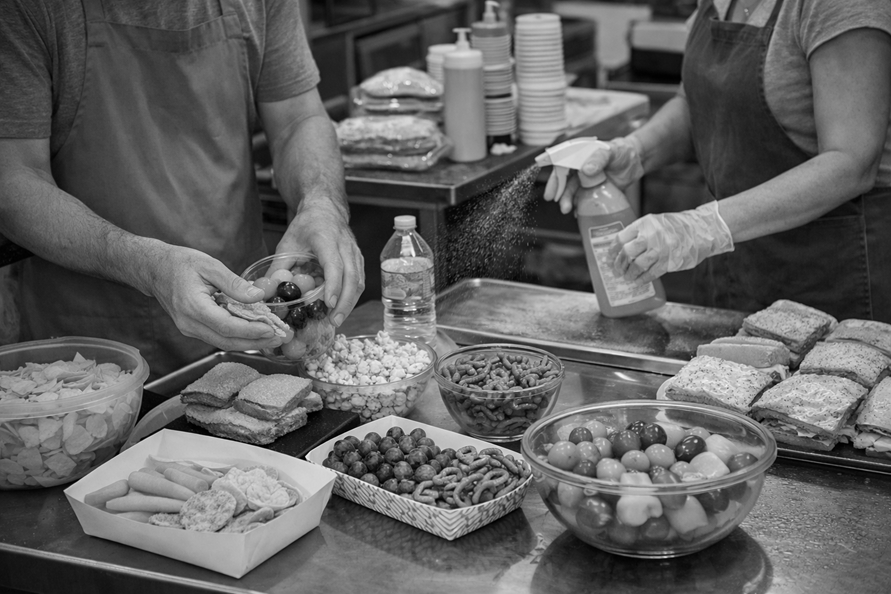
This image shows a food preparation and snack distribution area where workers are handling ready-to-eat items for a group setting. A worker is preparing snacks without washing their hands after handling raw food and frequently touches shared surfaces like counters, containers, and utensils. Nearby, another worker is using a chemical cleaner on a surface close to uncovered food, while gloves are either not being used or are being reused between tasks. The environment appears busy, and the focus is on keeping up with demand rather than maintaining strict hygiene practices.

In food handling environments, serious incidents don’t always look dramatic—but they can have severe consequences. Contamination can occur in seconds through unwashed hands, improper glove use, cross-contact between raw and ready-to-eat foods, or unsafe chemical use near food. These breakdowns can lead to foodborne illness outbreaks, allergic reactions, or chemical exposure affecting both workers and consumers. Always wash hands thoroughly before handling food, use gloves correctly and change them between tasks, keep cleaning chemicals away from food contact surfaces, and follow strict hygiene protocols at all times. Safe food handling isn’t just about cleanliness—it’s about protecting lives.


Safe Food Handling and Snack Time Hygiene Picture This – Spanish

image

La imagen muestra un área de preparación y distribución de alimentos donde los trabajadores manipulan productos listos para consumir destinados a un grupo. Un trabajador prepara refrigerios sin haberse lavado las manos después de manipular alimentos crudos y toca con frecuencia superficies compartidas como mostradores, recipientes y utensilios. Cerca, otro trabajador usa un limpiador químico sobre una superficie próxima a alimentos descubiertos, mientras los guantes no se utilizan o se reutilizan entre tareas.

En entornos de manipulación de alimentos, los incidentes graves no siempre parecen dramáticos, pero pueden tener consecuencias severas. La contaminación puede ocurrir en segundos a través de manos sin lavar, uso inadecuado de guantes, contacto cruzado entre alimentos crudos y listos para consumir, o uso inseguro de productos químicos cerca de los alimentos.

Lávate siempre bien las manos antes de manipular alimentos, usa los guantes correctamente y cámbialos entre tareas, mantén los productos químicos de limpieza alejados de las superficies de contacto con alimentos y sigue protocolos estrictos de higiene en todo momento. La manipulación segura de alimentos no se trata solo de limpieza: se trata de proteger vidas.


Safe Food Handling and Snack Time Hygiene Fatality File

Employee is killed when incompatible cleaning chemicals

At approximately 5:00 p.m. on November 7, 2019, an employee was working at a full-service restaurant. He was working as the general manager, and he was overseeing the operation of the restaurant. At least two coworkers were present at the time of the incident. The first coworker was a cook. The employee was working with the cook to clean and organize the back hallway of the restaurant. The second worker present was the assistant general manager. The employee would be transferring control of the restaurant to the assistant general manager soon. Employee #1 left the cook to clean the area. The assistant general manager arrived to start working shortly after the employee left the area. The assistant general manager had a brief conversation with the cook. Shortly after that, the cook poured a gallon of Super 8, a sodium hypochlorite-based disinfectant, all over the floor of the back hallway. The cook then left the area. When he returned, he poured a gallon of Scale Kleen, an acid-based scale remover, all over the back hallway. The second liquid combined with the Super 8. The cook then began to scrub the floor with a long-handled brush. The combination of these cleaning chemicals resulted in the creation of a toxic atmosphere. The fumes were irritating to the respiratory tract, eyes, and skin of the people in the immediate and surrounding area. The cook notified the assistant general manager of the problem. The assistant general manager attempted to clear the mixture out of the back door of the restaurant. The cook had propped the door open. The employee took over the effort of squeegeeing the combination of cleaning chemicals out of the back door. He was soon overcome by the fumes. He sustained a seizure from which he did not recover. Following his noticeable debilitation, the coworkers contacted emergency services. They took over control of the scene when they arrived. The employee was taken to a hospital. The employee was declared dead at the hospital. Meanwhile, between the time emergency services had been contacted and their arrival, the cook continued to squeegee the combination of cleaning chemicals out the back door. He also went through the danger area to the kitchen to remove some food from the fryer. He was one of many of the restaurant workers who initially evacuated through the danger area. Several of these workers also returned to the danger prior to any evidence that the hazardous atmosphere had subsided. Only the employee, the cook, and the assistant general manager were involved directly in the response to the incident. The employee died as the result of this incident. His employer believed that a pre-existing medical condition contributed to his severe reaction. Numerous other workers sustained varying degrees of irritation to their respiratory tracts, eyes, and skin. Eight workers were admitted to the hospital for observation and testing and released shortly thereafter. According to reports by the Burlington MA police and fire departments, six other individuals were also admitted to the hospital for the same reason. The toxic atmosphere created by the combination of the Super 8 and the Scale Kleen was the cause of the harm.

Source: https://www.osha.gov


Active Shooter Awareness: Prevent Tragedy – Spanish

Course Description

This course focuses first on prevention, then on personal safety, and finally on recovery and support. At every stage, the goal is to reduce harm, not dramatize risk. (Spanish Version)