Focus On: Six Ways You Can Die in a Confined Space

Confined spaces are notorious for hazards, often hidden that you can’t see or smell. Too many times when a hazard in a confined space is recognized it is too late for the entrants in the space to save themselves. Here are six hazardous and deadly confined space situations.


  1. You can suffocate from lack of oxygen inside the space. Other chemicals can displace the oxygen and turn the atmosphere deadly in a matter of seconds. Oxygen levels should be between 19.5% and 23.5%. Anything lower is an oxygen deficient atmosphere. Anything higher is an oxygen rich atmosphere which leads to an increased risk of fire and explosion.

  1. You can be poisoned from breathing toxic or contaminated air inside the space. This air can come from work done in the space or exhaust from machines, equipment, and other work done outside the space.

  1. You can be killed by an explosion caused by ignition of flammable or combustible substances. Hot work, sparks, and high temperatures/pressures are often found inside confined spaces.

  1. You can be trapped inside the space and unable to evacuate from a fire or other emergency.

  1. You can be hit and killed by a vehicle or equipment while entering or exiting the space. This is common in road and utility work where confined spaces are in or near roadways and other traffic areas.

  1. You can drown or suffocate if the space is engulfed with water, soil or other materials.


Tool: Confined Space Hazard Assessment Worksheet

Use/modify this form to identify hazards associated with a confined space and to determine procedures and safety precautions required for entry into the space. This form is to be completed by a trained and competent Confined Space Entry Supervisor.


By the Numbers: Confined Space Injuries and Deaths

Permit required confined spaces have long been – and still are – the leading cause of multiple fatalities in the workplace. According to investigations of confined space incidents by the National Institute for Occupational Safety and Health (NIOSH):

  • 60% of confined-space fatalities are would-be rescuers.
  • 85% of the time a SUPERVISOR was present.
  • 29% of the dead were SUPERVISORS.
  • 31% had WRITTEN Confined Space Entry PROCEDURES.
  • 0% used the WRITTEN PROCEDURES.
  • 15% had Confined Space TRAINING.
  • 0% had a RESCUE PLAN.
  • 60% of “WOULD-BE” RESCUERS died.
  • 95% were AUTHORIZED by supervision.
  • 0% of the spaces were TESTED prior to entry.
  • 0% were VENTILATED.

Source: https://ohsonline.com/Articles/2018/08/01/We-Must-Change-the-Statistics-of-Confined-Space-Injuries-and-Fatalities.aspx?Page=1


Tool: Confined Space Classification Decision Tree

Confined Space Classification Decision Tree

Use this Decision Tree to help you determine if a confined space is a permit-required confined space or a non-permit confined space.

  1. Do You Have Any Confined Spaces in Your Workplace? [  ] Yes  [  ] No

Explanation: A space is considered a confined space if:

  • It’s big enough and so configured that a worker can enter it bodily and perform work inside;
  • It has limited or restricted means of entry or exit, e.g., tanks, vessels, silos, storage bins, hoppers, vaults and pits; and
  • It’s not designed for continuous occupancy.

Instructions: If there aren’t any spaces like this in your workplace, the standard doesn’t apply to you and you don’t have to go any farther. But if you do, keep going.

  1. Are any of the Confined Spaces You’ve Identified Permit Confined Spaces? [  ] Yes  [  ] No

Explanation: Evaluate the confined spaces in your workplace and classify them as either:

  • Non-permit confined spaces, i.e., those that don’t contain or potentially contain hazards capable of causing death or serious harm to an entrant which you can allow workers to enter; or
  • Permit confined spaces, i.e., spaces that do contain actual or potential hazards that require additional safety measures to prevent entry or ensure it’s safe. To be considered a permit space a confined space must have at least one of the following characteristics it/its:
    • Contains or potentially contains a hazardous atmosphere, i.e., one that may cause death, incapacitation or impairment of self-rescue including:
      • Flammable gas, vapor or mist above 10% of its lower flammable limit (LFL);
      • Airborne combustible dust at a concentration at or above its LFL
      • Oxygen concentration of below 19.5% or above 23.5%;
      • Concentration of a substance above or potentially above its Permissible Exposure Limits (PELs) or dose limit; or
      • Any other atmospheric condition immediately dangerous to life or health (IDLH).
    • Contains a material that could engulf an entrant;
    • Configuration could result in trapping or asphyxiating an entrant by inwardly converging walls or a floor that slopes downward and tapers to a smaller cross-section; or
    • Contains any other recognized safety or health hazard.

Instructions: If you have only non-permit spaces, skip Section 3 and proceed to Section 4 of the Assessment. If you have permit spaces, go to Section 3.

  1. If You Have Permit Confined Spaces, Have You Implemented the Proper Safety Measures? [  ] Yes  [  ] No

Explanation: You have 2 options for dealing with permit spaces:

  • Seal them off so that nobody can enter them; or
  • If you allow entry, implement a confined spaces entry program to ensure safety measures are taken before and during each entry.

Instructions: Use the 10 Steps to Creating a Confined Space Entry Workplan to find out what safety measures are required and how to implement each of them.

  1. Do You Reassess and, if Necessary, Reclassify Confined Spaces? [  ] Yes  [  ] No

Explanation: The rules vary depending on how the confined space is currently classified.

  • Confined Spaces Currently Classified as Permit Spaces: If workers enter any confined spaces you classified as non-permit confined spaces, reassess the confined space when there are changes to the configuration of the confined space or the work done inside it. You then must decide based on the reassessment whether to reclassify the non-permit space as a permit space.
    • Don’t reclassify the space as a permit space if it still doesn’t contain or have the potential to contain hazards of death or serious bodily injury to entrants.
    • Reclassify the space as a permit space if you determine that the confined space contains or has the potential to contain hazards of death or seriously bodily harm upon entry. In this situation, you must immediately bar entry unless and until you establish a confined spaces entry program for the space.
  • Confined Spaces Currently Classified as Non-Permit Spaces: A permit space can be reclassified as a non-permit space if you can demonstrate that entry hazards, including hazardous atmospheres have been eliminated.You must create written certification documenting the basis for this determination that lists.
    1. The date
    2. The location of the space
    3. The signature of the person making the determination


Workplan: 10 Steps to Creating a Confined Space Entry Program

Working in a confined space is one of the most dangerous of all workplace hazards. In fact, it’s been calculated that working in a confined space is 150 times more dangerous than doing the same job outside of the space. While this Workplan is geared toward compliance remember, compliance is often only the minimum set of requirements for safety.

Step 1: Identify Permit-Required Confined Spaces

Determine if you have any confined spaces and then classify the spaces as either:

  • Non-permit confined spaces – spaces that don’t contain or potentially contain hazards capable of causing death or serious harm to entrants; or
  • Permit-required confined spaces – spaces that do contain actual or potential hazards capable of causing death or serious harm such as:
    • Hazardous atmosphere – oxygen deficient/enriched, flammable, explosive, or fatal gases/chemical vapors
    • Engulfment – potential for space to suddenly fill with liquid, sand, etc.
    • Entrapment – narrow or tapering spaces, vat and bin floors that slope in and downward

Step 2: Prohibit Unauthorized Entry into Permit-Required Confined Spaces

  • Secure all permit-required confined spaces:
    • Secure the entrance using physical barriers, locks, warning devices or a combination to bar unauthorized entry.
    • Notify workers of the existence, location and dangers of the space by posting warning signs or other effective means of communication.
  • Decide how you’re going to handle the space going forward. Your options:
    • Seal off the space so nobody can enter it; or
    • Implement a confined spaces entry program to ensure safe entry into the space.

The rest of this Workplan covers the steps necessary to implement a confined space entry program for permit-required spaces.

Step 3: Establish Acceptable Atmospheric Conditions for Entry

Common required atmospheric conditions include:

  • Oxygen levels between 19.5% and 23.5% (23% in some Canadian provinces).
  • Flammable gases, vapors or mists at or below 10% of their lower flammable or lower explosive limit (LFL)/(LEL).
  • Concentrations of airborne combustible dusts below their LFL.
  • Concentration of substances above/potential to be above Permissible Exposure Limits (PELs).
  • Any other atmospheric condition immediately dangerous to life or health (IDLH).

Step 4: Establish Atmospheric Testing Criteria

  • Atmospheric testing of permit spaces is required before entry and as often as necessary during entry to verify acceptable atmospheric conditions are still present.
  • Establish in the entry procedure that:
    • Workers are required to evacuate the space immediately if atmospheric conditions no longer meet the specified acceptability standards.
    • Re-entry is banned after evacuation until new testing verifies the atmosphere is safe.
  • Testing must be carried out in the following sequence using instruments meant for testing only that condition:
    • First: Oxygen
    • Second: Combustible gas
    • Third: Toxic gases and vapors

Use the Confined Spaces Hazard Assessment Worksheet prior to each entry and keep it at the site and in your records.

Step 5: Establish Engineering Controls for Atmospheric Hazards

A confined space entry program must list engineering controls used to manage hazardous atmospheres in the space. Acceptable methods include:

  • Ventilation – mechanical systems that force fresh air into the confined space and/or exhaust contaminated air while workers are inside it.
  • Purging – introducing substances such as an inert gas, steam or water into a confined space to displace or flush out contaminants before workers enter the space.
  • Inerting – introducing an inert (un-reactive) gas such as nitrogen or carbon dioxide into a confined space to completely displace all oxygen.
  • Isolation – disconnecting, blanking or blinding or using an equivalent engineered system to prevent a hazardous substance contained in adjacent pipelines from seeping or leaking into the permit space.

Step 6: Establish Control Methods for Physical Hazards

Protect against physical hazards by using:

  • Fall protection
  • Respirators/supplied air
  • LOTO
  • Piping isolation
  • Hearing protection
  • Pumps to remove water
  • Barriers
  • Non-sparking tools

Step 7: Establish Safe Entry and Exit Procedures

  • An entry procedure must list:
    • Safety measures required by regulations, e.g., hazard assessment.
    • Verification of acceptable conditions of entry.
    • Use of engineering controls to eliminate or control atmospheric hazards.
  • Entry must be overseen by an “entry supervisor” who only allows entry after ensuring all safety measures have been carried out.
  • For each entry, there must be one or more “attendants” who remain outside the space near the entrance to keep an eye on the entry, communicate with the authorized entrants inside, and provide help in case of an emergency. *No one, including attendants and entry supervisors must ever enter a confined space without specific training and protective gear.
  • Entry permits must:
    • Always be issued by the entry supervisor before entry and posted at the entry site whenever authorized entrants are inside the space.
    • List essential information about the entry and steps taken to ensure its safety.

Step 8: Provide PPE and Safety Equipment

  • Provide authorized entrants needed equipment such as respirators and hardhats, rescue or retrieval systems and gear, and communication equipment.
  • Require proper inspection, use, care, maintenance and storage of PPE and safety equipment.

Step 9: Provide Rescue and Emergency Response

  • Provide for rescue of authorized entrants if emergencies arise after they enter the space.
  • The preferred rescue method is to use retrieval systems that make it unnecessary to send in rescue personnel.
  • If rescue personnel are required, take steps to ensure rescue operations are as safe as possible.

Step 10: Conduct Training and Instruction

  • A confined space entry program must provide that all personnel involved in permit-required confined space entry and rescue receive training necessary to be “proficient” before they’re allowed to carry out those duties.
  • Confined spaces safety training must be provided to:
  1. Authorized entrants
  2. Attendants
  3. Entry supervisors
  4. Rescue personnel


Tool: Confined Space Reclassification Form

Confined Space Reclassification Form

Instructions: A Permit-Required Confined Space may be reclassified as a non-permit confined space if:

  1. The space does not contain actual or potential atmospheric hazards; and
  2. All hazards may be eliminated without entry into the space.

The reclassification is valid only while the confined space remains free from hazards. If hazards arise during entry, the space must be evacuated immediately and re-evaluated for hazards.

The reclassification is valid only for the specific entry indicated below.

Location: ___________________________________________________________

Description of Space: __________________________________________________

Purpose of Entry: _____________________________________________________

Description of Hazard Originally in Space Methods Used to Eliminate Hazard Methods of Verifying Hazard Has Been Eliminated

Instructions: Attach all atmospheric testing data relied on in reclassifying the space as a non-permit confined space.

Additional Comments:

Certifying Employee: ___________________________________  Date: _____________________________


Tool: High Risk Jobs for Eye and Face Injuries


HIGH RISK JOBS FOR EYE AND FACE INJURY RECOMMENDED PROTECTIVE EYEWEAR

Job Hazards Protective eyeware
AUTO REPAIR
  • Mechanics are more likely than the average worker to be injured on the job; contact with objects and equipment, such as parts and materials, represent a significant hazard.
  • Eye injuries can occur as a result of sparks from cutting torches and airborne pieces of metal launched from bench grinders.
  • Goggles
  •  Safety glasses with side shields
CARPENTRY
  • Carpentry and general repairs pose the threat of eye injury from flying wood, metal and concrete chips.
  • Other risks include hammering, chiseling, drilling, stripping paint, splitting tiles or concrete slabs, painting ceilings and laying insulation.
  • Goggles
  • Safety glasses with side shields for impact protection
CONSTRUCTION
  • Construction has a much higher rate of eye injuries than any other industry.
  • In construction, more than 10,000 eye injuries occur each year forcing employees to miss work.
  • Nails, tiny pieces of metal, splinters and cut wire ends.
  • Cement mixing, sawing, grinding and chipping produce dust and grit.
  • Goggles
  • Safety glasses with side shields
DRIVING
  • Good vision is a necessity both for the safety of drivers as well as others on the road.
  • It is also important for drivers to protect themselves against harmful UV rays, glare and airbag injuries to the eye.
  • Polycarbonate lenses with UV protection and antireflective coating
ELECTRICAL WORK
  • Due to the nature of their overhead work, electrical workers are at increased risk for eye injuries from flying particles such as nails, small pieces of metal and cut wire ends, falling objects or sparks striking the eye.
  • Electricians also face a higher threat of burns, which can lead to blindness.
  • Safety glasses with side shields for impact protection
  • Arc rated face shield to protect against arc flash.
 

HEALTHCARE, LAB/HOUSEKEEPING

  • Infectious diseases can be transmitted through the mucous membranes of the eye as a result of direct exposure or from touching the eyes with contaminated fingers or other objects.
  • Infections can range from minor to more serious diseases such as HIV, B virus (HBV) or possibly influenza.
  • Googles
  • Face shield
MANUFACTURING
  •  Manufacturing eye injuries are most likely to result from work that generates flying particles, fragments, sparks, dust, hazardous substances or radiation.
  • Tasks with the highest risk of eye injuries are grinding, welding and hammering.
  • Other high-risk activities include cutting, drilling, spraying, smelting, sanding, chipping and chiseling.
  • Spectacles
  • Goggles
  • Safety glasses with side shields
PLUMBING
  • Chemical and material exposure is a common source of eye injury for plumbers.
  • Plumbers also may receive burns from hot equipment parts, steam lines and the release of hot water or steam.
  • Cutting or grinding can also cause eye injuries from flying particles.
  • Spectacles
  • Goggles
  • Safety glasses with side shields
WELDING
  • Chemical burns to one or both eyes from splashes of industrial chemicals or cleaning products are common.
  • Thermal burns.
  • Among welders, their assistants and nearby workers, UV radiation burns (welder’s flash) routinely damage workers’ eyes and surrounding tissue.
  • Welding googles
  • Welding helmets


Multiple-Fatality Confined Space Incident

An independent contractor was found dead at the bottom of an eight-foot-deep underground vault at a sawmill. The contractor was there to perform an annual inspection of the backflow device of the mill’s waterline.

At 3:30 p.m. the contractor arrived at the sawmill and proceeded with the inspection. This was his fourth year conducting this inspection at the mill. He removed the steel cover of the manhole and lowered a ladder into the eight-foot-deep vault. There was 14 inches of water in the bottom of the vault.

At 4:00 p.m. a truck driver arrived at the sawmill to pick up a load of lumber and noticed the contractor’s truck and the open manhole. He walked over and saw the contractor’s body in the water at the bottom of the vault. Emergency services were called.

  • The first person to arrive at the scene after EMS was called, was the shipping supervisor, who entered the vault in a rescue attempt.
  • A few seconds later, one of the maintenance men arrived and went into the vault to assist with rescue. Neither man was wearing respiratory protection and within two to three minutes both men had passed out.
  • Two policemen arrived at the scene, entered the vault (without respiratory protection), and had to be helped out.
  • The paramedics arrived and attempted rescue (without respiratory protection) and also had to be helped out.
  • The firemen arrived on scene, donned their breathing apparatus, and went in to remove the three men at the bottom.
    • Two men were face down in the water (the contractor and the shipping supervisor).
    • The third man (the maintenance man) was in a sitting position against the wall, his head was not in the water.

The three men removed from the hole, the two policemen, and the two paramedics were transported to a local hospital.

  • The contractor and shipping supervisor were pronounced dead on arrival by the attending physician.
  • The maintenance man was hospitalized in serious condition.
  • The two policemen and two paramedics were treated and released.

Oxygen levels in the space were found to be at 7% – far below the required minimum of 19.5%.  Exposure to atmospheres containing less than 10% oxygen can rapidly overcome a person and bring about unconsciousness without warning so they are incapable of helping themselves.

A state safety investigator believes the algae bloom and bacterial action in the water caused/contributed to the low oxygen levels.

Effects of Oxygen-Deficiency
Oxygen concentration Health effects of persons at rest (% vol)
19% Some adverse physiological effects occur, but they may not be noticeable.
15-19%
  • Impaired thinking and attention.
  • Increased pulse and breathing rate.
  • Reduced coordination.
  • Decreased ability to work strenuously.
  • Reduced physical and intellectual performance without awareness.
12-15%
  • Poor judgment.
  • Faulty coordination.
  • Abnormal fatigue upon exertion.
  • Emotional upset.
10-12%
  • Very poor judgment and coordination.
  • Impaired respiration that may cause permanent heart damage.
  • Possibility of fainting within a few minutes without warning.
  • Nausea and vomiting.
<10%
  • Inability to move.
  • Fainting almost immediate.
  • Loss of consciousness.
  • Convulsions.
  • Death.

https://www.airproducts.com/~/media/Files/PDF/company/safetygram-17.pdf

This is a text-book confined space multiple-fatality incident. The only “lucky” part of this incident is the death toll could have been 7.

Final Word

  • Companies with confined spaces must have a confined space entry program.
  • Companies contracting to have a service performed on their property should implement and enforce a safety program to be followed by the contractor.
  • Independent contractors who are required/expected to enter confined spaces must take measures to protect themselves.
    • The victim had done this work three times before at the mill and countless times at other locations, and likely didn’t give much thought that this job would be any different than the last three times.
  • Training and education about the dangers of confined spaces and the risk involved in trying to perform without training and PPE is not optional. It must be done.
  • Entry procedures must be developed, posted, and enforced.
  • All workers should educate themselves on confined space dangers and their right to refuse work they believe to be unsafe.

https://www.cdc.gov/niosh/face/in-house/full8706.html


Tool: Confined Space Entry Procedure and Permit

One of the core elements that a confined spaces entry program must include is a safe entry procedure. And one of the things required for entry into a confined space is an entry permit.

8 Things an Entry Procedure Must Include

The entry procedure sets out the measures, procedures and practices taken to ensure the entry is carried out safely and in accordance regulatory requirements. At a minimum, the entry procedure must do 8 things:

  1. Require identification and evaluation of permit space hazards before entry.
  2. Specify acceptable conditions of entry, including but not limited to atmospheric conditions.
  3. Allow for authorized entrants, i.e., workers authorized to enter the space, and/or workers’ representatives to observe atmospheric monitoring and testing.
  4. Require isolation of the permit space.
  5. Specify the method that must be used to eliminate or control atmospheric hazards—purging, inerting, flushing and/or ventilation.
  6. Require that barriers to confined spaces be provided to protect entrants from hazards created by pedestrians, vehicles or other external factors.
  7. Stipulate acceptable conditions must be verified throughout the duration of the entry.
  8. Require cancellation of the entry permit and isolation of the permit space after the authorized entry ends or entry operation is completed.

Review of Entry Procedure

The entry procedure must be reviewed at least once a year or whenever there’s reason to believe that the procedure or other confined spaces safety measures aren’t providing workers the necessary protection to identify and correct problems. Triggers of review include:

  • Somebody enters a permit space without authorization.
  • You detect a new hazard in the space not covered by the existing permit or procedure.
  • You detect a hazard in the space not allowed by the permit or procedure.
  • An injury or near miss occurs during entry operations.
  • There’s a change in the configuration or use of the permit space.
  • Workers complain the permit space program isn’t effective.

Entry Permit

Specific examples of when an entry permit is required include any time the hazard and risk assessment determine the measures to control the risk involve the following:

  • Atmospheric monitoring
  • Isolation
  • Lockout
  • Ventilation
  • Safeguarding devices
  • Respiratory protection

Entry into a confined space cannot occur until the permit is completed and approval to enter is given.

  • The permit must be kept at the job site for the duration of the job.
  • If there is an interruption in the work or a change in the alarm conditions for which entry was approved, a new Confined Space Entry Permit must be completed.
  • A written copy of operating and rescue procedures must also be at the work site for the duration of the job.

The entry permit must list the following information:

  1. Space to be entered
  2. Location of the space
  3. Purpose of entry
  4. Date and authorized duration of permit
  5. Names or identification numbers of:
    1. Workers permitted to act as attendants.
    2. Authorized entrants, i.e., workers permitted to enter the space.
  6. Name of the entry supervisor and space to sign his/her name verifying entry conditions are acceptable and entry can begin.
  7. Hazards of the space
  8. Measures used to isolate the space and eliminate or control hazards before entry.
  9. Acceptable entry conditions
  10. Results of initial and periodic atmospheric tests performed and the names or initials of the testers and by an indication of when tests were performed.
  11. Rescue and emergency services available and the means (such as the equipment to use and the numbers to call) for summoning those services.
  12. Communication procedures used by authorized entrants and attendants to maintain contact during the entry.
  13. PPE, testing equipment, communications equipment, alarm systems and rescue equipment, to be provided.
  14. Any other information necessary under the circumstances to include to ensure employee safety.
  15. Any additional permits, such as for hot work, that have been issued to authorize work in the permit space.


By the Numbers: Eye Injuries

  1. Over 2,000 work-related eye injuries happen each year in North America.
  2. 60% of workers who suffered an eye injury were wearing no eye protection or the wrong type of eye protection at the time of the accident.
  3. 90% of work-related eye injuries could be avoided if workers wore eye protection. (American Academy of Opthalmology)
  4. Men between the ages of 25-44 comprise 80 % of all workplace eye injury victims.
  5. Eye injuries account for nearly 45% of all head injuries that lead to missed work days.
  6. 61% of eye injuries occur in manufacturing, construction or trade jobs.


Focus On: How to Do a PPE Hazard Assessment

Are your workers in danger of becoming a statistic? Thousands of people are blinded each year from work-related eye injuries that could have been prevented with the proper selection and use of eye and face protection. Personal protective equipment (PPE) for the eyes and face is designed to prevent or lessen the severity of injuries to workers. But, to be effective you must first know what hazards your workers are exposed to by doing a hazard assessment.

Hazards

Hazard type Examples of Hazard Common Related Tasks
Impact Flying objects such as large chips, fragments, particles, sand, and dirt Chipping, grinding, machining, masonry work, wood working, sawing, drilling, chiseling, powered fastening, riveting, and sanding
Heat Anything emitting extreme heat Furnace operations, pouring, casting, hot dipping, and welding
Chemicals Splash, fumes, vapors, and irritating mists Acid and chemical handling, degreasing, plating, and working with blood
Dust Harmful dust Woodworking, buffing, and general dusty conditions
Optical Radiation Radiant energy, glare, and intense light Welding, torch-cutting, brazing, soldering, and laser work
Environmental Factors High humidity, extreme cold/heat, and sources of motion in the area. Industrial freezer work, working with molten metals
Human Factors Length of work with safety equipment, worker fit and comfort, compatibility with prescription eyewear. Employees with corrective lenses should either wear eye protection that incorporates the prescription into the design or wear additional eye protection over their prescription lenses.


Be a Better Supervisor

Complying with PPE requirements begins with a hazard assessment. Here’s an overview of common requirements and how to comply with them.

When Are Assessments Required?

A competent person who has the training and experience necessary to understand the work and the hazards it poses should perform a PPE Hazard Assessment:

  • Before a project begins or a site opens.
  • Before construction or significant alterations at a site.
  • Daily at sites where conditions and hazards change frequently.
  • On a frequent and regular basis to catch and prevent development of unsafe and unhealthy conditions.
  • When:
    • New work processes are introduced.
    • Work processes or operations change
  • Significant incidents suggest that:
    • Hazards have changed.
    • Hazards not identified in previous assessments are present.
    • Current PPE isn’t providing enough protection.

Verification of Hazard Assessment

Most safety regulations require employers to provide written verification that a hazard assessment has been completed. The document should:

  • Identify the workplace evaluated.
  • Identify the person certifying that the evaluation has been performed.
  • Include the date(s) of the hazard assessment.
  • Include a statement that identifies the document as a “certification of hazard assessment.”

What Must Hazard Assessments Cover?

In its simplest form, a hazard assessment used for PPE consists of 3 pieces of information:

  1. What work or tasks the employee performs that exposes them to a hazard.
  2. What those hazards are.
  3. When or where are the work/tasks performed.

When assessing hazards, make sure you don’t limit your assessment to just the obvious ones. For example:

  • Look at warnings on the machinery you use and read the owner’s manual.
  • Check with other companies in your industry who have similar processes or equipment.
  • Ask experienced employees and newcomers for their insights.


Tool: PPE Hazard Assessment Form

PPE HAZARD ASSESSMENT FORM

Use and modify this sample form to help you determine what hazards workers are exposed to and what PPE must be worn to protect them.

  • If you check YES, determine if the hazard can be eliminated.
  • If NO, can the method or equipment be changed to eliminate the hazard?
    • If so, consider doing it.
  • If the hazard can’t be eliminated, would adding a guard protect employees from the hazard, e.g., machine guards?
    • If this is the case, indicate a guard is being installed.
  • In the last column, list the type of PPE the worker will be required to use.


PERSONAL PROTECTIVE EQUIPMENT HAZARD ASSESSMENT


Facility____________________  Dept.________________ Date_________

Supervisor _________________   Job ______________________________


EYES & FACE
Hazard Yes No Eliminated, Guarded? PPE Required
Flying particles        
Molten metals        
Liquid chemicals        
Acids        
Caustic liquids        
Chemical gases or vapors        
Light radiation        
Other        
Head
Hazard Yes No Eliminated, Guarded? PPE Required
Flying objects        
Falling objects        
Work done overhead        
Elevated conveyors        
Hitting against fixed object        
Forklift hazards        
Exposed electrical conductors        
Other        
Feet
Hazard Yes No Eliminated, Guarded? PPE Required
Flying objects        
Rolling objects        
Objects piercing sole        
Electrical hazards        
Wet, slippery or hot surfaces        
Chemical exposure        
Environmental        
Other        
Hands
Hazard Yes No Eliminated, Guarded? PPE Required
Skin absorption        
Cuts or lacerations        
Abrasions        
Punctures        
Chemical burns        
Thermal burns        
Temperature extremes        
Other        
Respiratory
Hazard Yes No Eliminated, Guarded? PPE Required
Dusts        
Fogs        
Fumes        
Mists        
Smokes        
Sprays        
Vapors        
Other        
Torso
Hazard Yes No Eliminated, Guarded? PPE Required
Hot metals        
Cuts        
Acids        
Radiation        
Other        
Comments:


Certification


This hazard assessment has been performed to determine the required type of PPE for each affected worker.

The assessment includes:

  • Walk-through survey
  • Specific job analysis
  • Review of accident statistics
  • Review of safety equipment selection guideline materials
  • Selection of appropriate required PPE

Assessment Certified by (Supervisor) ______________________ Date _____________________


Focus On: Confined Spaces

Let’s get serious about confined space safety. Confined spaces can be seriously dangerous and are the leading cause of multiple fatalities in the workplace. Here’s why…

A confined space has limited openings for entry or exit, is large enough for entering and working, but is not designed for continuous worker occupancy. Examples: vaults, tanks, bins, manholes, pits, silos, pipelines.

Oxygen Levels

High oxygen levels in a confined space increase the risk of fire and explosion. Materials that would not normally catch fire or burn in normal air may do so extremely quickly and easily.

Low oxygen levels can lead to unconsciousness and death. Common causes of oxygen deficiency:

  1. Oxygen is used up when metals rust.
  2. During combustion (i.e. propane heaters, cutting and welding, internal combustion engines).
  3. Oxygen is replaced by other gases – welding gases or gases forced into the space to prevent corrosion.
  4. Micro-organisms use up oxygen (i.e. sewer lines and fermentation vessels).
  5. Rust and biological matter.

Toxic Atmospheres

Toxic atmosphere causes:

  1. Evaporation of liquids such as liquid fuel in a tank.
  2. Pockets of gas released when waste materials are disturbed – i.e. hydrogen sulfide released from manure pits during cleaning.
  3. Cutting, welding, painting, and grinding work done inside the space.
  4. Outside sources – i.e. exhaust from vehicles and equipment.

At certain concentrations some substances become immediately dangerous to life and health (IDLH). Even brief exposure to these substances can cause death or permanent damage to vital organs.

Explosive Atmospheres

In addition to oxygen enriched atmospheres, other causes for explosive atmospheres include:

  1. Ignition of gases and vapors.
  2. Combustible dust – i.e. coal and grain dusts.
  3. Chemical reactions
  4. Substances used in the space – i.e. welding gases, methane, hydrogen, solvents.

Ignition sources to be aware of:

  1. Open flames.
  2. Welding arcs and arcing of electrical motors.
  3. Sparks from metal impact (tools striking a metal pipe), static electricity.
  4. Lighting in the space.

Physical Hazards

Physical hazards cover a wide range of hazards common to confined spaces.

  1. Engulfment or drowning from loose materials such sand, grain, soil, sawdust and water.
  2. Granular materials (particularly when wet) such as grain can form bridges or shelves above a worker that break free and engulf an entrant.
  3. Slips, trip, and fall hazards.
  4. Hazardous energy – shock, accidental start-up, moving equipment parts.
  5. Harmful substances entering through piping.
  6. Poor visibility, noise, and temperature extremes.

Be a Better Supervisor

To help prevent confined space injuries and fatalities employers must have a written confined space entry program. Part of the program includes identifying confined spaces  non-permit and permit-required) on site. Employers must inform exposed employees of the existence, location, and hazards of all permit-required spaces. It is your responsibility to help your employer carry these out these responsibilities.

Assessment and Entry Permit

A hazard assessment  and an entry permit are required for every permit-required confined space entry. A confined space entry program must:

  • Designate an entry supervisor be provided for each permit space entry.
  • List entry supervisor qualifications; and
  • Describe the entry supervisor’s duties.

Entry into the space cannot occur until the permit is completed and approval to enter is given.

  • The permit must be kept at the job site for the duration of the job.
  • If there is an interruption in the work or a change in the alarm conditions for which entry was approved, a new entry permit must be completed.
  • A written copy of operating and rescue procedures must also be at the work site for the duration of the job.

Click here for a list of what information the entry permit is required to have.

Implement Hazard Controls

Hazardous Atmospheres

All confined spaces should be tested for atmospheric hazards prior to entry and in many cases, testing is required throughout the duration of the work. Testing must be done by a trained user and all testing equipment must be in good condition, properly calibrated, and warning alarms set to the right levels.

Elimination of the substance is the best way to remove the risk – but if that isn’t possible other  control measures  must be used.

  • Ventilation
  • Purging
  • Inerting
  • Flushing

In toxic and low oxygen atmospheres where the hazards can’t be eliminated, air-purifying and supplied-air respirators are required.

Physical Hazards

Protect against physical hazards by using:

  • Fall protection
  • Respirators/supplied air
  • LOTO
  • Piping isolation
  • Hearing protection
  • Pumps to remove water
  • Barriers
  • Non-sparking tools

Communication and Emergency Response

The ability for confined space entrants, attendants, and supervisors to communicate is critical, required, and in some cases, lifesaving. A communication system should allow for communication:

  • With others inside the confined space.
  • With those outside it.
  • To summon help in case of an emergency.

Ideally, communication methods should be:

  • Hands-free
  • Wireless
  • Full-duplex
  • Independently powered
  • Integrated with hearing protection

The preferred method of rescue is to use retrieval systems that make it unnecessary to send in rescue personnel. If retrieval systems won’t be effective and you must rely on rescue personnel to enter the space, you must take steps to ensure rescue operations are as safe as possible.

Ongoing

Finally, it is important to closely monitor confined spaces on an ongoing basis.

  • You must review the entry procedure at least once a year and more frequently any time you have reason to believe it’s not providing entrants the necessary safety.
    • Triggers for review include near misses or injuries, unauthorized entries, detection of new or unpermitted hazards inside the space, changes in the space’s use or configuration and worker complaints.
  • You must reassess non-permit spaces and decide whether to reclassify them as permit spaces when there are changes to the configuration of the space or the work done inside it.
  • You can also reclassify permit as non-permit if you can demonstrate that it no longer contains the actual or potential hazards that led you to classify it as a permit space.


Protect Your Eyes and Face

What’s at Stake?

Safety eyewear and face shields can save you from injuries which can lead to blindness and facial disfigurement.  Prompt treatment of eye and facial injuries reduces the risk of permanent damage.

What’s the Danger?

Your face is at risk from many potential hazards at work. Flying and falling objects, materials, and dust can irritate your eyes and injure your face and eyes. Burns and toxic effects from chemicals are also serious eye and face hazards. So are solvents and corrosive substances. These hazards can cause painful, long-term injuries.

How to Protect Yourself

Wear eye and face protection on the job. Your supervisor will help you choose the right protection for the danger and tell you when to wear it.

  1. Safety glasses
    These look like ordinary glasses, but they are made of impact-resistant material that protects you from flying objects. In many instances, you will need to wear your safety glasses with side shields.
  2. Goggles
    These are made to protect you from chemical splashes or impact from flying objects which could damage your eyes. Make sure you have the right ones for the job. For example, don’t use vented googles when working with hazardous chemicals.
  3. Shaded eyewear
    These protect you from radiation burns to the eyes. Safety glasses with ultraviolet protection may be required for outdoor work. Special eye protection might be required for work with lasers. Welding helmets have special shaded eye pieces and must always be worn when welding. Anyone working near a welding operation must wear the right safety glasses to protect against radiation burns to the eye.
  4. Face shields and head coverings
    In addition to safety glasses or goggles, use face shields and head coverings while doing overhead work and to provide more protection against splashing, flying and falling objects.
  5. Avoid hazards
    Proper arrangement of work equipment and materials helps you stay away from hazards. Machine guards shield you from wood or metal chips. Exhaust systems remove particles from the air. Splash guards help protect you from harmful liquids. Screens keep you away from hazards such as light radiation.
  6. Eye those chemicals
    Read the label and safety data sheet before using any chemical substance. Use safety eyewear as instructed.
  7. Prompt treatment
    Learn where the eyewash station is and find out how to operate it. You might need to use it while temporarily blinded by a chemical splash. Always get prompt first aid treatment for any eye injury.

Final Word

Protect your face and your eyes. Wear your eye and face protection


Confined Spaces: Racing to The Rescue Is Deadly

Safety Talk

What’s at Stake?

Two employees from a local construction company were assigned to repair a sewer line leak. One employee was responsible for entering the sewer—a confined space—to repair the leak. The other stayed topside as a standby person.

During the repair, toxic fumes overcame the employee inside the confined space, who collapsed unconscious into a waist-deep pool of water. The standby employee, recognizing the emergency, entered the sewer to rescue his co- worker. Sadly, he was unprepared and untrained to handle the toxic fumes. Instead of a heroic rescue, both men were pronounced dead at the scene.

Confined spaces—like storage tanks, pits, boilers, and sewers—can harbor or rapidly generate hazards that cause death. That’s why a critical link for people working inside a confined space is the standby person or attendant. If you’re a confined space attendant and think all the risks are inside the confined space, think again. Over 60% of confined space deaths don’t involve people assigned to work in the confined space – they involve the standby person or other would-be rescuers who enter the confined space in an emergency. Today we’ll review where the role of a standby person starts—and most importantly, stops—in order to prevent unnecessary injuries and deaths during a confined space emergency.

What’s the Danger?

1 of every 10 confined space emergencies will result in death. Confined spaces are riddled with dangers—here are a few of the most common:

  • Lack of oxygen
  • Toxic or combustible air – sometimes undetectable
  • Excessive heat
  • Unguarded machinery
  • Exposed wiring
  • Untrained personnel entering confined spaces

When you perform standby duties for a confined space operation, you may encounter situations where a co-worker inside the confined space becomes injured or unconscious. There is one action you must take immediately: initiate and follow your organization’s emergency response procedures. Not doing so immediately increases the chance of injury or death for you and everyone else involved.

How to Protect Yourself

No matter the situation, resist the urge to race into a confined space unprepared. Stick to the organization’s emergency procedures. A co-worker may be visibly injured, screaming for help, or slumped and motionless, only increasing the urge to help. Don’t. You’ll likely meet the same fate as your co-worker, particularly if the hazard has to do with the air, which it does 90% of the time.

A few other key practices can minimize your risk during a confined space emergency:

  • When possible, continue communicating with those inside the confined space and relay this information to your organization’s rescue team
  • Warn non-rescue or unauthorized personnel not to enter the confined space, even if they want to attempt a rescue
  • If unauthorized personnel attempt to enter the confined space, do not initiate or encourage physical contact that can injure one or both of you. Instruct them repeatedly to exit immediately. Do not under any circumstances follow them into the confined space.
  • If the person inside the confined space is attached to a retrieval line and you are trained to use the retrieval line, attempt to remove the person with it; however, do not alter the retrieval line or place yourself in danger if it is not working properly.

Equally important, ensure a few important steps are completed before and during any entry into a confined space, reducing the potential for injuries or death:

  • Testing the confined space for toxic gases before any entry is attempted.
  • Testing and using two-way communication equipment before and during entry and verifying the key words or signals that will be used in certain situations.
  • Ensuring procedures for any necessary lock-out of electricity or machinery have been completed before entry.
  • Maintaining consistent communication and alertness throughout the confined space operation. Because death by asphyxiation can occur in minutes, regular communication or other check-ins at regular intervals are critical.
Final Word

Responding properly and quickly to an injured or unconscious co-worker in a confined space is critical. If you’re the standby person and encounter this type of event, resist the urge to enter the confined space and attempt a heroic rescue – racing into toxic fumes or other confined space hazards is likely to leave you dead or injured as well. 


Workplan: How to Implement an Eye and Face PPE Program

The use of proper eye and face protection, such as safety glasses, goggles, face shields and helmets can prevent countless eye injuries. Safety regulations require employers provide eye and face protection whenever there is a hazard potential and engineering and administrative controls couldn’t eliminate the hazard or provide enough protection. This Workplan focuses on implementing an Eye and Face PPE program but can easily be modified to include all PPE.

Step 1: Conduct a PPE Hazard Assessment

Many jobs and tasks have the potential to cause injury eye and face injuries. Doing a thorough hazard assessment allows you to identify hazardous processes, areas, jobs, and tasks where PPE is necessary and required.

Common sources of injury include:

Impact – Forcible contact from flying objects, such as large chips, fragments, particles, sand, and dirt from chipping, grinding, machining, masonry work, wood working, sawing, drilling, riveting and/or sanding.

Heat – Emission of extreme heat from furnace operations, pouring, casting, hot dipping, welding or other similar operations.

Chemical – Liquid splash and droplets, fumes, vapors and irritating mists from acid and chemical handling, degreasing and plating.

Dust – Nuisance or fine dust from woodworking, buffing or general dusty conditions.

Optical Radiation – Ultraviolet (UV) and blue light, infrared (IR), glare and intense light from welding, torch-cutting, -brazing, -soldering, and laser work.

Electrical – Arc flashes and sparks from working around electricity.

Environmental Factors – Working environment and the temperature of area where safety equipment is being used such as high humidity and sources of motion in the area.

Human Factors – Length of work with safety equipment, worker fit and comfort, compatibility with prescription eyewear; employees with corrective lenses should either wear eye protection that incorporates the prescription into the design or wear additional eye protection over their prescription lenses.


Step 2: Select and Provide the Right Types of PPE

When selecting the most suitable eye and face protection consider these factors:

  • Level of protection against hazards.
  • Proper fit and comfort.
  • Allows for unrestricted vision and movement.
  • Durable and easily cleanable.
  • Allows for unrestricted functioning of any other required PPE.

All protective eye and face wear must comply with the American National Standards Institute (ANSI) or Canadian Standards Association (CSA) standards Z87.1/CSA Z94.3.

Step 3: Provide Training

Workers must be trained on the hazards that exist in the workplace and the hazards of their specific jobs and tasks. If these activities require them to wear PPE, they must be trained on:

  • When PPE must be worn, and disciplinary action taken when requirements aren’t followed.
  • The kind/type to wear – i.e. sunglasses are not effective protection during welding operations.
  • How to recognize hazards and what to do if they have questions about what PPE will best protect them.
  • Correct and safe donning and doffing procedures (putting on and taking off PPE).
  • Safe use and useful life of their equipment.
  • When PPE should be replaced and how the replacement process works.

Refresher training should be done:

  • Annually when required – i.e. hearing protection and respirators.
  • When tasks or processes change, and the PPE requirements change.
  • When a different or new type of PPE is being used.
  • When workers are observed not wearing or caring for their PPE properly.

Step 4: Keep Documentation

It’s important to document everything related to your PPE program:

  • PPE hazard assessment and review of potential engineering controls.
  • PPE selection process(es).
  • Initial training, annual or refresher retraining program.
  • Disciplinary actions taken when someone is found not using their PPE.

Documentation is important because it lets you gauge the effectiveness of your PPE requirements and ensure all workers receive the necessary training. It is also your best defense if there are problems in the future either with workers who are non-compliant or when regulatory inspections take place.

You are establishing due diligence if you can document four key provisions of your PPE program:

  1. You performed a written hazard assessment and you selected and provided the right PPE to your workers.
  2. You developed specific rules and procedures for workers regarding the use of the PPE.
  3. You provided appropriate training to workers regarding all aspects of the use of PPE.
  4. You enforced your rules about PPE whenever you saw violations of them.


Picture This: Confined Space Whack-a-Mole

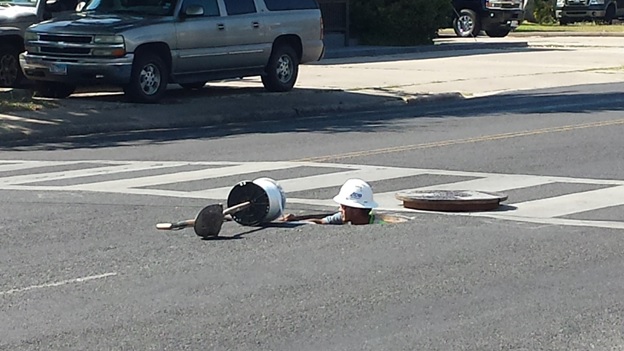
This image depicts the kind of confined space work that goes on every day. It also shows something else that happens every day – lack of protective controls while working in a confined space. Take a minute and see how many violations and other safety missteps you can find in this picture.

https://i.redd.it/cfv5gqm4fwuy.jpg

How many issues did you find? Here’s a list of some of them:

  1. The area doesn’t appear to be barricaded – at least not what we can tell from the picture.
  2. No entry attendants or entry supervisor are present.
  3. No visible sign of an entry permit.
  4. Atmospheric monitoring instruments are nowhere to be seen.
  5. Ventilation system is not set up/being used.
  6. There’s no retrieval system in place (i.e. tripod and winch) for rescue.

Whether you are a confined space entry supervisor, attendant, or entrant, take time to review the entry procedures and permit for each space before anyone enters the space. If there’s not a procedure and permit in place and the space is permit-required – do not begin work until safety procedures have been followed.

Entry procedures include having:

  1. A plan for initial entry.
  2. Assigned attendants – whose only job is to watch the space.
  3. An effective means of communication set up between entrants and attendants/entry supervisors.
  4. Specified work procedures within the confined space.
  5. Rescue procedures in place.

Final Word

Permit-required confined space entry procedures must be part of your employers confined space entry program. Following these procedures will save your life and the lives of bystanders who may attempt rescue (unprepared and unprotected).


Picture This: Someone is About to Get Schooled with Sparks to the Eyes and Face

https://www.reddit.com/r/OSHA/comments/andoe8/cutting_steel_in_school_on_a_chair/

This image was taken at a school – one man is using an angle grinder to cut something while the other man holds the piece on a chair for “support”.

Using an angle grinder can be extremely dangerous for several reasons. If the wheel isn’t the right size or type, or is defective, it could break apart and become a dangerous projectile. One that can take off a finger, put out an eye, or do serious and sometimes fatal damage.

One Reddit user commented on this post “Happened yesterday at work, co-worker of mine, “Jim” was using said grinder, kicked back, snagged his untucked shirt, then reeled in and sliced his lower stomach, 18 stitches later…”

The job requires a stable and supported area for the piece being grinded such as a table vice or clamp. Additionally, the men should be wearing hearing protection, safety glasses with side shields, and a face shield. Need proof? Just look at what can happen:

http://i.imgur.com/hc0qVrf.jpg


Infographic: Types of Safety Lenses


OSHA News Brief

11 Feb 2020

Last 30 Days

  • February 10 – Region 4 – U.S. Department of Labor Cites Georgia Farm for Exposing Employees to Safety Hazards Following Fatality
  • February 10 – Federal Register 85:7606-7610 – Nationally Recognized Testing Laboratories; Proposed Policy for Transitioning to Satellite Notification and Acceptance Program (SNAP) Termination
  • February 10 – Federal Register 85:7606 – Senior Executive Service; Appointment of Members to the Performance Review Board
  • February 06 – Trade Release – U.S. Department of Labor Launches New Webpage to Observe 50th Anniversary of the Occupational Safety and Health Act of 1970
  • February 06 – Federal Register 85:6979-6980 – Asbestos in General Industry; Extension of the Office of Management and Budget’s (OMB) Approval of Collection of Information
  • February 05 – Region 8 – Federal Court Orders Railway to Pay $696,173 for Lost Wages After U.S. Department of Labor Finds Railway Retaliated Against Whistleblower
  • February 05 – Trade Release – U.S. Department of Labor Revises National Emphasis Program to Reduce or Eliminate Worker Exposure to Silica
  • February 05 – Federal Register 85:6580-6582 – Access to Employee Exposure and Medical Records; Extension of the Office of Management and Budget’s (OMB) Approval of Information Collection (Paperwork) Requirements
  • February 04 – Region 3 – U.S. Department of Labor Fines Pennsylvania Company $280,874 For Overexposing Employees to Toxic Hexavalent Chromium Fumes
  • February 03 – Region 4 – Former Owner of Florida-Based SB Framing Services Sentenced For Willfully Violating Federal Fall Protection Standards
  • February 03 – Federal Register 85:5996-5998 – Beryllium Standards for General Industry, Construction and Maritime; Extension for the Office of Management and Budget’s (OMB) Approval of the Information Collection (Paperwork) Requirements
  • January 31 – Region 1 – U.S. Department of Labor Cites New Hampshire Stone Products Manufacturer for Hazards Following Employee Fatality
  • January 31 – Federal Register 85:5724-5725 – Agency Information Collection Activities; Submission for OMB Review; Comment Request; Respirable Crystalline Silica Standards for General Industry, Maritime and Construction
  • January 31 – Federal Register 85:5723-5724 – Agency Information Collection Activities; Submission for OMB Review; Comment Request; Cadmium in Construction Standard
  • January 31 – Federal Register 85:5722-5723 – Agency Information Collection Activities; Submission for OMB Review; Comment Request; Benzene Standard
  • January 31 – Federal Register 85:5721-5722 – Agency Information Collection Activities; Submission for OMB Review; Comment Request; Lead in General Industry Standard
  • January 30 – Region 5 – U.S. Department of Labor Orders Michigan School District to Reinstate, Pay $102,905 to Second Employee Terminated for Warning of Unsafe Conditions
  • January 30 – Region 4 – U.S. Department of Labor Cites Two Alabama Contractors For Exposing Employees to Hazards After Fatal Trench Collapse
  • January 30 – Region 1 – U.S. Department of Labor, Maine Department of Labor and Maine School of Masonry Partner to Promote Worker Safety
  • January 29 – Federal Register 85:5255-5256 – Agency Information Collection Activities; Submission for OMB Review; Comment Request; Special Dipping and Coating Operations
  • January 29 – Federal Register 85:5252-5253 – Agency Information Collection Activities; Submission for OMB Review; Comment Request; Welding, Cutting, and Brazing Standard
  • January 29 – Federal Register 85: 5250-5251 – Agency Information Collection Activities; Submission for OMB Review; Comment Request; Derricks Standard
  • January 28 – Region 3 – U.S. Department of Labor Fines Roofing Contractor $605,371 For Exposing Employees to Fall Hazards at 3 Pennsylvania Worksites
  • January 27 – Region 3 – U.S. Department of Labor Cites Pennsylvania Excavation Contractor For Exposing Employees to Trenching Hazards
  • January 27 – Region 2 – U.S. Department of Labor Again Cites New Jersey Aluminum Manufacturer for Safety Failures after Employee Hospitalized
  • January 27 – Region 4 – Florida Shooting Range Agrees to Pay Terminated Employee $30,000 To Settle U.S. Department of Labor Whistleblower Allegations
  • January 21 – National Release – U.S. Department of Labor Commemorates 50 Years of the Occupational Safety and Health Act of 1970 with “Protecting the American Workforce” Campaign
  • January 17 – Region 3 – U.S. Department of Labor Cites Philadelphia Refinery For Process Safety Management Hazards after Fire and Explosions
  • January 16 – Region 1 – U.S. Department of Labor Cites Target Corp. For Blocked Emergency Exit Access at Two Massachusetts Stores
  • January 16 – Region 4 – U.S. Department of Labor Cites Plumbing Contractor for Exposing Employees to Hazards After Fatal Trench Collapse in Mississippi
  • January 15 – Federal Register 85: 2292-2303 – Department of Labor Federal Civil Penalties Inflation Adjustment Act Annual Adjustments for 2020
  • January 14 – Region 4 – U.S. Department of Labor Proposes $1,007,717 in Fines Against North Florida Roofing Contractor for Egregious Fall Hazards
  • January 13 – Region 1 – U.S. Department of Labor and Avalon Bay Communities Partner To Promote Worker Safety on Massachusetts Construction Project
  • January 10 – Region 10 – U.S. Department of Labor Forms Alliance with Boise School District To Promote Workplace Safety and Health
  • January 10 – Region 4 – Florida Roofing Contractor Found in Contempt after Failing to Pay $2,202,049 in Penalties for Safety and Health Violations
  • January 10 – Region 5 – U.S. Department of Labor Cites Valve Manufacturer for Exposing Employees to Lead, Copper and Other Hazards at Wisconsin Facility

Source: https://www.osha.gov/whatsnew.html


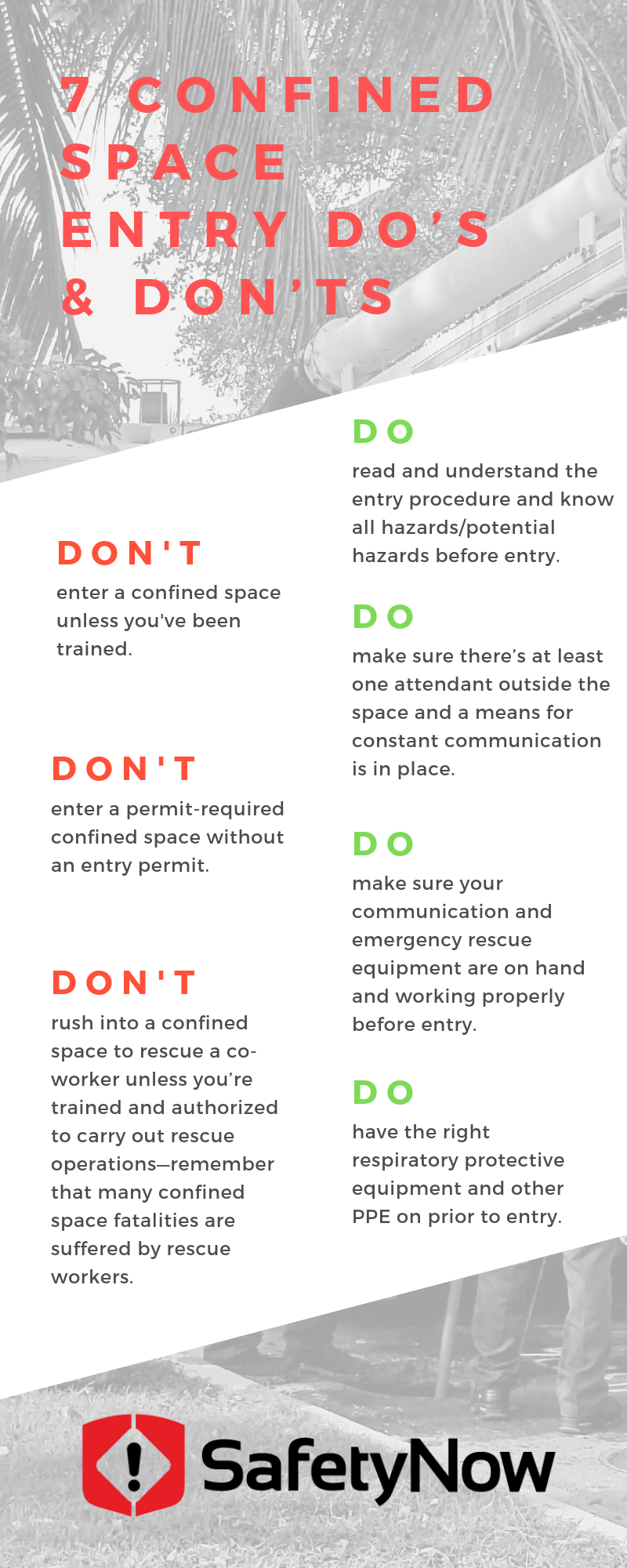
Infographic: Seven Confined Space Entry Do’s and Don’ts


Workplace Hazards: What They Are and How to Spot Them Infographic

“infographic supplied by LabSource“


News You Can Use: OSHA Crane Operator Qualification

On November 9, 2018 OSHA published a Final Rule amending the requirements for crane and derrick operator training, certification, and employer evaluation (29 CFR 1926 Subpart CC).

The final rule required:

1. Employers to:

a. train operators as needed to perform assigned crane activities; and

b. evaluate operators and document successful completion of the evaluations.

2. Crane operators to:

a. be certified or licensed; and

b. receive ongoing training as needed to operate new equipment.

The deadline for training was December 9, 2018. If you already evaluated your operators prior to Dec. 9, 2018, you do not have to conduct those evaluations again, but you will need to document when the evaluations were completed.

The evaluation and documentation requirements become effective on February 7, 2019.

Training

Under the new Final Rule, operator certification can be based on crane “type” or “crane type and capacity.” This is a change from the 2010 rule – which required certification based on “crane type and capacity. “

Operators who are not yet certified are classified as “operators-in-training.” Employers must provide them with sufficient formal and practical instruction to ensure they have the skills, knowledge, and ability to recognize and avert risk needed to operate their cranes safely.

Operators-in-training can operate cranes without being certified (subject to certain restrictions), and they must be continuously monitored. The employer is also responsible for retraining as necessary.

Evaluation

Under the Final Rule employers are required to evaluate operators to ensure they:

  1. Possess the skills and knowledge necessary to operate the crane(s) they are assigned (taking into account the cranes’ size and configuration), as well as the hoisting activities required.
  2. Demonstrate they have the ability to “recognize and avert” risk.

The Final Rule also clarifies what is required for post-certification training:

  1. Determine level of practical and formal training needed by an operator to possess the skills, knowledge, and ability to recognize risk and operate equipment safely.
  2. Re-train as necessary.
  3. Training methods chosen by the employer must be effective and responsive to each operator’s training needs.

Documentation

The evaluations must be documented. The evaluation document, which must be available at the worksite, must include at least the following:

  • Names of the operator and the evaluator (who also must sign it).
  • Date the evaluation was conducted.
  • Make, model, and configuration of the crane.

Helpful links:


Fundamentals of First Aid: CPR

Safety Talk

What’s at Stake?

If a person suffers from a heart attack, sudden cardiac arrest, or other medical condition where they are no longer breathing or their heart stops working, quick action is a must.

What’s the Danger?

The blood carries oxygen and the heart pumps the blood and oxygen throughout the body. The lack of oxygen can cause brain damage in only a few minutes and a person may die within eight to 10 minutes. Carrying out cardiopulmonary resuscitation (CPR) manually pumps the heart, keeping the blood flowing around the body and to the brain. Doing rescue breaths raises the oxygen levels, which is vital for reducing brain damage.

It can take many minutes for emergency medical support (EMS) to arrive and CPR must be carried on until the paramedics arrive.

How to Protect Yourself

  1. Know the safety basics
  • Call 911 immediately you notice someone has collapsed.
  • Assess the scene.
  • Proceed with care only if it’s safe to do so.
  1. Know the signs
  • Unconscious – they will not be responding to you talking to them or touching them.
  • They have no pulse.
  • You cannot feel their breath when you put your cheek near their mouth.
  1. Not trained, but in the know
  • Lay the person on his or her back.
  • Carry out hands-only CPR.
    • Uninterrupted chest compressions of about 100 a minute until paramedics arrive.
    • Compressions are repeatedly pressing hard down on the lower middle of the person’s rib cage (the sternum or breastbone) and releasing.
    • This presses down on the heart to keep it pumping and also causes suction, so the person ‘breathes’ and gets some oxygen to the lungs and blood
    • Sing ‘Stayin’ Alive’ by the Bee Gees in your head to get the rhythm.
  1. Trained and ready to go
  • Start CPR with 30 chest compressions.
  • Check airway for obstructions.
  • If airway clear, start doing rescue breathing.
  • If airway blocked, carry out mouth to nose rescue breathing.
  • Now continue with 30 compressions to 1 rescue breath until the paramedics arrive.
  1. Trained but rusty
  • If you’ve previously received CPR training but you’re not confident in your abilities, then just do chest compressions at a rate of about 100 a minute.
  • Continue until EMS personnel arrive.
  1. Do not use this approach on newborns.

Final Word

Carrying out CPR correctly can make a huge difference to the outcome for a person suffering from a cardiac arrest. Even if you are not trained, knowing how to do chest compressions until help arrives, is essential.


A Million Excuses – (10 min)

This all new video, although humorous, delivers hard-hitting impact for all employees. The program examines the ???million??? excuses offered by employees for not following established safety policies and procedures, not wearing Personal Protective Equipment and for not using common sense on the job. When employee???s see the excuses in this program, it may cause them to examine some of their own attitudes which may be unsafe.