Quick Course – How You Can Prevent Violence in the Workplace
Course Description
In this quick course you’ll learn how to identify and protect yourself from violent situations in the workplace.
Course Description
In this quick course you’ll learn how to identify and protect yourself from violent situations in the workplace.
Course Description
Machine guards serve a vital role in the workplace. They reduce the risk of cuts, lacerations, amputations, and other injuries. This quick course will teach you about the importance of machine guards and how to use them to your advantage.
Course Description
Dressing properly is extremely important to preventing cold stress. This course will outline some tips for dressing properly when working in cold conditions.
Course Description
Lockout/tagout is a procedure designed to prevent accidents when working on equipment. This procedure is the key to your safety when working on equipment.
Course Description
Out of everyone on the workforce, the obvious greatest risk comes from new workers. Not only is their inexperience with the field or worksite a risk to themselves, but they are also a risk to everyone else. This quick course will educate you on common risks posed by new workers and integrate new workers safely in the workplace.
Course Description
In this quick course, you will learn how to identify electrocution hazards and take preventative measures to make the workplace safer.
Course Description
Loud noises and prolonged exposure can over time lead to hearing loss. In this quick course, you will learn how to identify common hazards and take precautionary methods to protect your hearing.
Course Description
Bloodborne pathogens pose a serious danger to your health and opportunities in life. Worse of all, the transmission of bloodborne pathogens are possible in any work environment. In this quick course, you will learn about common hazards and strategies to protect yourself.
Course Description
In this quick course, you will learn about common electrical hazards and how to protect yourself and others against them while on the job.
Course Description
In this quick course, you will learn how to identify common vertical fall hazards and utilize best practices for reducing the risk of falls.
Course Description
In this quick course, you’ll learn what types of fire extinguishers are used for different fires and the PASS method to using a fire extinguisher.
Course Description
This Quick Course will cover some tips and procedures for post-pandemic reopening.
Course Description
In this quick course, you will learn about common respiratory workplace hazards and how to properly use your respiratory to avoid respiratory damage and illness.
Course Description
Slips and trips are among the most common causes of injuries in the workplace, they are also among the most easily preventable. This quick course will go over ways to prevent slips and trips in the workplace.
Course Description
Heat is not only a hazard in outdoor work, but is present in indoor environments and poses the same risks of heat exhaustion, rash, and stroke. In this quick course, you will learn about common heat hazards and precautionary measures you can take for your and others’ safety.
Operating heavy equipment or a motor vehicle is inherently a hazardous task, however, backing up creates more risk for incidents to occur. According to the National Safety Council, backing accidents cause 500 deaths and 15,000 injuries per year. All too often unnecessary backing is responsible for injuries or property damage incidents. It is important to consider the hazards of backing and what can be done to mitigate these hazards.
With increased blind spots, backing leaves drivers and operators at more risk for error resulting in damage or injury. The most serious incident occurring due to backing is fatalities of ground personnel. Dump trucks followed by semi-trucks and ordinary pickups are responsible for the majority of back over incidents in the past 10 years on the job. Outside of struck-by incidents involving ground personnel, there are many other hazards to consider. A few hazards include:
DANGERS
A driver’s field of vision is very limited when backing up a vehicle. Blind spots are the areas around the vehicle that cannot be seen by either looking directly with your eyes or by using your mirrors. Blind spots will vary from vehicle to vehicle, but generally they are to the:
The field of vision may also be blocked or obstructed by part of the vehicle (e.g., a structural post, the hood or back/trunk, or the overall height of the vehicle), the load (e.g., gravel, dirt, boxes, or cargo), poorly placed or damaged mirrors, or poor visibility due to weather (e.g., fog, rain, darkness).
BEST PRACTICES AND SAFEGUARDS TO MITIGATE THE HAZARDS OF BACKING UP
Spotters: Using a spotter has been proven to keep workers safe. However, spotters also are in danger of being hit by a backing vehicle. Several steps can be taken to help keep workers safe.
Backing up can almost always be eliminated or greatly reduced when proper preplanning is used. Elimination should always be the first choice before relying on less effective safeguards such as backup cameras or a spotter.
FACTS
STATS
A 39-year-old father of five was killed when he was run over by a dump truck. He was a truck driver with 12 years of experience and had been with his employer for more than two years.
There were two single-bed dump trucks and a front-end loader on site. The loader operator filled the back of one of the trucks, told the victim that he could leave and observed the victim getting into the cab of the truck. The second driver observed the victim getting into his truck and checking his left-hand mirror. He then was seen in the right-hand mirror while slowly backing up so he could keep track of the front-end loader. His back-up alarms were working.
The loader operator rotated his loader so he could scoop material to put in the second driver’s truck after it was positioned. He was rotating the loader back to dump, and saw the victim out of his truck, behind the second driver’s truck. Before the loader operator could respond, the second driver’s truck struck the victim, knocking him down and pinning him under the wheels of the truck.
Emergency medical assistance was called. The victim was pronounced dead at the scene.
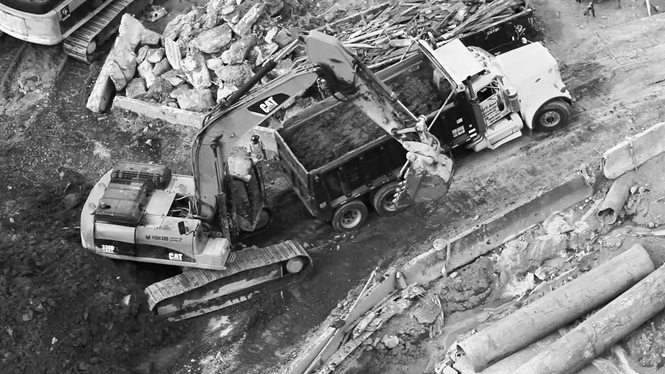
See this image and how deadly the end could be for this worker standing between those two heavy equipment in operation and one of them backing up. A backover incident occurs when a backing vehicle strikes a worker who is standing, walking, or kneeling behind the vehicle. These incidents can be prevented.
Backover accidents can happen for a variety of reasons. Drivers may not be able to see a worker in their blind spot. Workers may not hear backup alarms because of other worksite noises or because the alarms are not functioning. A spotter assisting one truck may not see another truck behind him. Workers riding on vehicles may fall off and get backed over. Drivers may assume that the area is clear and not look in the direction of travel. Sometimes, it is unclear why a worker was in the path of a backing vehicle. A combination of factors can also lead to backover incidents.
El manejo de equipos pesados o de un vehículo de motor es una tarea intrínsecamente peligrosa, sin embargo, dar marcha atrás crea más riesgo de que se produzcan incidentes. Según el Consejo Nacional de Seguridad, los accidentes por retroceso causan 500 muertes y 15.000 lesiones al año. Con demasiada frecuencia, el retroceso innecesario es responsable de lesiones o incidentes con daños materiales. Es importante tener en cuenta los peligros de dar marcha atrás y lo que se puede hacer para mitigarlos.
Con el aumento de los ángulos muertos, el retroceso deja a los conductores y operadores en mayor riesgo de cometer errores que resulten en daños o lesiones. El incidente más grave que se produce debido al retroceso es la muerte del personal de tierra. Los camiones volquetas, seguidos de los semirremolques y las camionetas normales, son responsables de la mayoría de los incidentes de atropello en los últimos 10 años en el trabajo. Aparte de los incidentes de atropello del personal de tierra, hay muchos otros peligros que hay que tener en cuenta. Algunos de ellos son:
El campo de visión de un conductor es muy limitado cuando retrocede un vehículo. Los puntos ciegos son las zonas alrededor del vehículo que no se pueden ver ni mirando directamente con los ojos ni utilizando los retrovisores. Los puntos ciegos varían de un vehículo a otro, pero por lo general se encuentran en la parte;
El campo de visión también puede estar bloqueado u obstruido por una parte del vehículo (por ejemplo, un poste estructural, el capó o la parte trasera/maletero, o la altura total del vehículo), la carga (por ejemplo, grava, suciedad, cajas o carga), espejos mal colocados o dañados, o una mala visibilidad debido a las condiciones meteorológicas (por ejemplo, niebla, lluvia, oscuridad).
MEJORES PRÁCTICAS Y SALVAGUARDIAS PARA MITIGAR LOS PELIGROS DEL RETROCESO
Vigilantes: Se ha demostrado que el uso de un observador mantiene la seguridad de los trabajadores. Sin embargo, los observadores también corren el riesgo de ser golpeados por un vehículo que retrocede. Se pueden tomar varias medidas para ayudar a mantener la seguridad de los trabajadores.
El retroceso casi siempre puede eliminarse o reducirse en gran medida cuando se utiliza una planificación previa adecuada. La eliminación debe ser siempre la primera opción antes de confiar en salvaguardias menos eficaces, como las cámaras de seguridad o un observador.
Un hombre de 39 años, padre de cinco hijos, murió al ser atropellado por un camión volquete. Era un conductor de camión con 12 años de experiencia y llevaba más de dos años en su empresa.
En el lugar había dos camiones volquetes de una sola caja y una cargadora frontal. El operador de la pala cargadora llenó la parte trasera de uno de los camiones, le dijo a la víctima que podía marcharse y observó cómo ésta subía a la cabina del camión. El segundo conductor observó a la víctima subiendo a su camión y comprobando su retrovisor izquierdo. A continuación, le vio por el espejo derecho mientras retrocedía lentamente para poder seguir la pista del cargador frontal. Sus alarmas de retroceso funcionaban.
El operador de la cargadora giró su cargadora para poder recoger material para ponerlo en el camión del segundo conductor después de que se posicionara. Estaba girando la cargadora de nuevo para volcar, y vio a la víctima fuera de su camión, detrás del camión del segundo conductor. Antes de que el operador de la pala cargadora pudiera responder, el camión del segundo conductor golpeó a la víctima, derribándola e inmovilizándola bajo las ruedas del camión.
Se solicitó asistencia médica de urgencia. La víctima fue declarada muerta en el lugar de los hechos.
Observe esta imagen y lo mortal que podría ser el final para este trabajador que está parado entre esos dos equipos pesados en funcionamiento y uno de ellos retrocediendo. Un incidente de retroceso ocurre cuando un vehículo que retrocede golpea a un trabajador que está parado, caminando o arrodillado detrás del vehículo. Estos incidentes pueden prevenirse.
Los accidentes por retroceso pueden ocurrir por una variedad de razones. Los conductores pueden no ver a un trabajador en su punto ciego. Los trabajadores pueden no oír las alarmas de retroceso debido a otros ruidos del lugar de trabajo o porque las alarmas no funcionan. Un observador que asiste a un camión puede no ver a otro camión detrás de él. Los trabajadores que van en los vehículos pueden caerse y ser arrollados. Los conductores pueden suponer que la zona está despejada y no mirar en el sentido de la marcha. A veces, no está claro por qué un trabajador estaba en la trayectoria de un vehículo que retrocedía. Una combinación de factores también puede conducir a incidentes de retroceso.
While it is not always hazardous to work alone, it can be when other circumstances are present. Whether a situation is a high or low risk will depend on the location, type of work, interaction with the public, or the consequences of an emergency, incident, injury, etc. This wide variety of circumstances makes it important to assess each situation individually.
Implementing health and wellness programs in the workplace can lead to increased morale and productivity. Fill in the missing letters to complete the puzzle.