Fire Safety at Home Meeting Kit – Spanish

QUÉ ESTÁ EN RIESGO

SEGURIDAD CONTRA INCENDIOS EN EL HOGAR

Peligro de incendio en su casa y sus alrededores

La mayoría de los incendios se producen dónde nos sentimos más seguros: en nuestras casas. Pero todo el mundo puede actuar para prevenir y sobrevivir a los incendios. Los detectores de humo en funcionamiento y un plan de escape practicado en casa proporcionan la mejor protección en un incendio doméstico. En la mayoría de los incendios, tiene tan sólo 3 minutos para escapar una vez que suena la alarma de humo.

CUÁL ES EL PELIGRO

CAUSAS DE LOS INCENDIOS Y DE LAS MUERTES POR INCENDIO

La cocina es la principal causa de los incendios domésticos en los Estados Unidos. Los incendios en la cocina suelen ser consecuencia de la falta de atención a la hora de cocinar y de errores humanos, más que de fallos mecánicos en las cocinas u hornos.

El descuido al fumar es la principal causa de muerte por incendio. Los detectores de humo y la ropa de cama y los muebles tapizados resistentes al humo son importantes elementos disuasorios de los incendios.

La calefacción es la segunda causa de los incendios residenciales y la segunda causa de las muertes por incendio. Sin embargo, los incendios de la calefacción son un problema mayor en las casas unifamiliares que en los apartamentos. A diferencia de los apartamentos, los sistemas de calefacción de las casas unifamiliares no suelen tener un mantenimiento profesional.

Los incendios provocados son la tercera causa principal de los incendios residenciales y de las muertes por incendios residenciales. En los inmuebles comerciales, los incendios provocados son la principal causa de muertes, lesiones y pérdidas en dólares.

COMO PROTEGERSE

CONSEJOS DE SEGURIDAD PARA PREVENIR LOS INCENDIOS DOMÉSTICOS

1.        Compruebe los detectores de humo

Los detectores de humo e incendios son su primera línea de defensa contra el peligro. Cuando el humo y el calor entran en ese pequeño dispositivo de la pared, los sensores de su interior hacen sonar la alarma. Esto significa que puede detectar el problema antes de que se convierta en una emergencia. Así que asegúrese de mantener sus detectores de humo y de incendios en buen estado.

Instale detectores de humo en cada piso y en cada dormitorio.

Pruebe cada mes

Acostúmbrese a probar sus detectores de humo e incendios una vez al mes. Sólo le llevará unos minutos comprobarlos, y puede salvar su casa en caso de emergencia.

Pida a un compañero (sus hijos, su cónyuge o un compañero de piso) que escuche la alarma en una habitación lejana. El detector de humo puede estar funcionando, pero no sirve de nada si toda la casa no puede oírlo. Haga esto con cada uno de los detectores de humo de su casa una vez al mes para mantenerlos en buen estado.

Cambie las pilas cuando sea necesario

Cuando las pilas de los detectores de humo estén bajas, lo sabrá. Esos molestos chirridos cada pocos minutos no son sólo por diversión. Son alertas de batería baja y no deben ser ignoradas. Si se produce un incendio en su casa y las pilas del detector de humo están agotadas, la alarma no sonará, poniendo su casa en mayor riesgo.

2.       Vigile sus electrodomésticos

Los electrodomésticos, como las cocinas y las lavadoras, facilitan la vida diaria, pero también pueden suponer un riesgo de incendio. Según la Agencia Nacional de Protección contra Incendios (NFPA), la mitad de los incendios domésticos comienzan en la cocina.

En la cocina

Con tantos electrodomésticos en un mismo lugar, merece un poco de atención extra.

A la hora de ponerse a cocinar, asegúrese de que el horno, los fogones y cualquier placa caliente estén lejos de elementos inflamables como cortinas, trapos o productos químicos. No dejes la habitación desatendida si puedes evitarlo. Y tenga a mano un extintor en la cocina por si se produce un incendio por grasa u otras emergencias.

Zonas de descanso

Empieza por echar un vistazo a tu colchón para asegurarte de que contiene productos químicos ignífugos en su interior. Para una mayor protección, considere la posibilidad de utilizar una funda de colchón ignífuga.

Los buenos hábitos y las prácticas inteligentes de seguridad contra incendios también pueden ayudar a prevenir incendios en el dormitorio. Las mantas eléctricas, fumar en la cama, los calefactores y los enchufes sobrecargados son peligros en el dormitorio. Si fuma, hágalo fuera. Utilice sólo mantas eléctricas con capacidad de apagado automático. Y evita sobrecargar las tomas de corriente y las regletas con demasiados enchufes.

El salón

Si tiene una chimenea, su sala de estar o estudio puede ser un punto caliente de riesgo de incendio. Mantenga la estufa o la chimenea limpias y libres de residuos o elementos inflamables (incluso cuando no se utilicen). Tener un árbol de Navidad cerca del fuego suena acogedor, pero puede ser muy peligroso si no se toman las precauciones adecuadas.

Cuando utilice la chimenea, mantenga las ventanas de cristal abiertas y la pantalla metálica cerrada. Esto permite que el aire entre en la chimenea pero evita que los brasas salten al suelo. Utilce herramientas seguras para el fuego, como atizadores de hierro, para mover los troncos del interior. Nunca utilices las manos.

El lavadero

El lavadero parece un lugar extraño para los riesgos de incendio hasta que recuerde que la pelusa de la secadora es inflamable. Cuando se trata de lugares comunes en su casa para que se inicien los incendios, el cuarto de la lavadora ve su parte justa. Estos electrodomésticos de gran potencia pueden sobrecalentarse, especialmente si los conductos de ventilación no se limpian con regularidad.

Garaje y en las zonas exterior

Las parrillas, las hogueras y los fuegos artificiales son los culpables obvios de los incendios en el exterior y en el patio trasero. El fertilizante y algunas marcas de tierra para macetas contienen materiales inflamables que pueden arder con el calor o después de que alguien se fume un cigarrillo.

Guarde sus suministros de jardinería en un lugar fresco y seco.

Tanto si se trata de la parrilla como del sol del verano, mantenga los productos inflamables alejados del calor. Designe un armario fresco y oscuro para los productos inflamables y asegúrese de que todos los miembros de la familia sepan dónde van.

Mantenga los materiales combustibles, como la pintura y la gasolina, en sus envases originales. Guarde los envases de pintura bien cerrados boca abajo para que la pintura cree un sello. La gasolina debe almacenarse en recipientes diseñados para ella. Si un recipiente se agrieta o tiene una fuga, transfiera su contenido a un nuevo recipiente del mismo material que el original.

CONCLUSIÓN

La mejor manera de evitar un incendio en el hogar es tomar medidas para prevenirlo. Siga las medidas de prevención mencionadas anteriormente. Lo siguiente que hay que hacer es estar preparado si se produce un incendio en el hogar. Tener un plan y practicarlo puede mantener a su familia a salvo durante una situación de incendio.
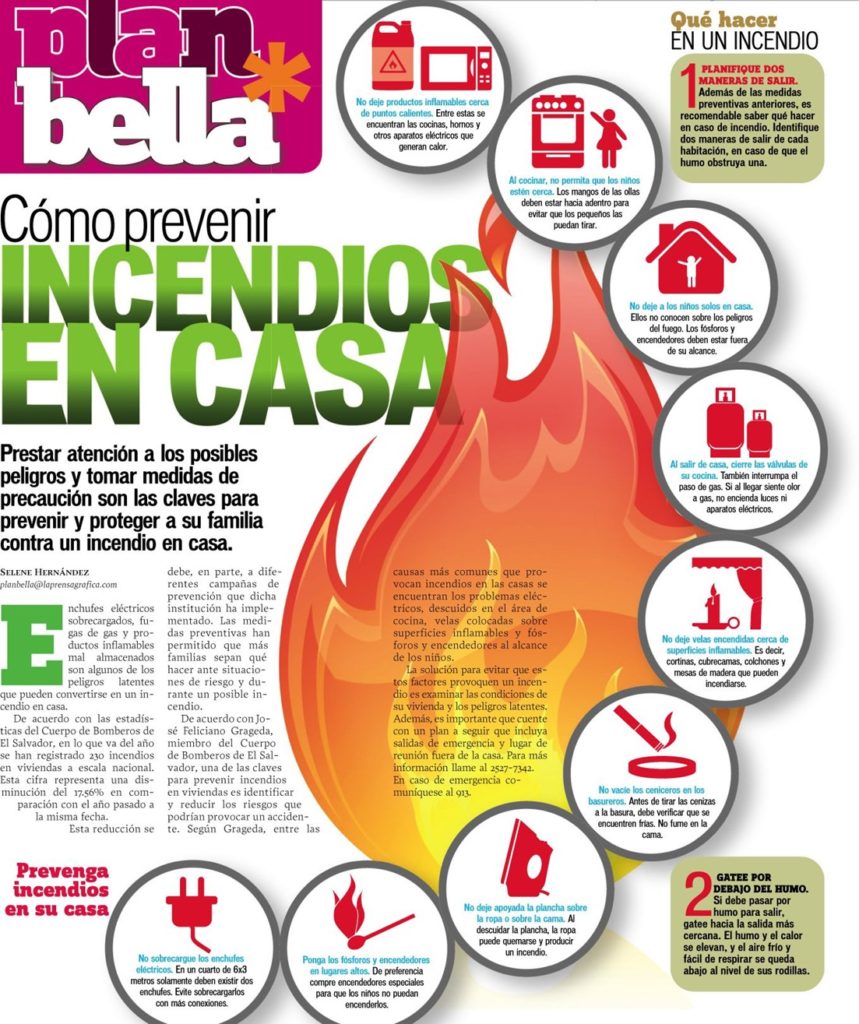


Fire Safety at Home Stats and Facts – Spanish

HECHOS

  1. La mayoría de los incendios domésticos comienzan en la cocina. La cocina es la principal causa de lesiones por incendios en el hogar. Los incendios en la cocina suelen empezar por el sobrecalentamiento de la grasa y por cocinar sin vigilancia. Las cocinas eléctricas están implicadas en más incendios que las de gas.
  2. Fumar es la principal causa de incendios mortales en los EE.UU. La segunda causa más común de incendios mortales es el equipo de calefacción.
  3. Los incendios provocados son la tercera causa más común de los incendios domésticos.
  4. Más personas mueren por inhalación de humo que por las llamas. El fuego puede absorber todo el oxígeno de una habitación y sustituirlo por humo y gases venenosos incluso antes de que las llamas lleguen a la habitación. Muchas veces, las personas mueren por falta de oxígeno antes de que el fuego llegue a su habitación.
  5. Cada año, el fuego mata a más estadounidenses que todos los desastres naturales juntos.
  6. Aproximadamente dos tercios de todas las muertes por incendio se producen en hogares en los que no funciona la alarma de incendios.

ESTADÍSTICAS

  • Cada año mueren más de 5.000 personas en incendios, más de 25.000 resultan heridas y las pérdidas directas de bienes se estiman en más de 9.000 millones de dólares.
  • Estados Unidos tiene una de las tasas de mortalidad por incendio más altas del mundo industrializado. En 1998, la tasa de mortalidad por incendio en Estados Unidos fue de 14,9 muertes por millón de habitantes.
  • Unos 100 bomberos mueren cada año en incidentes relacionados con su trabajo.
  • El fuego es la tercera causa de muerte accidental en el hogar; al menos el 80% de todas las muertes por incendio se producen en las residencias que más afectan a la vida de los jóvenes, los ancianos y los desfavorecidos.
  • Cada año se declaran unos 2 millones de incendios. Muchos otros no se denuncian, causando más lesiones y pérdidas materiales.
  • Se calcula que las pérdidas materiales debidas a los incendios ascienden a 8.600 millones de dólares anuales.


Fire Safety at Home Fatality Report – Spanish

Un hombre murió después de un incendio que quemó a través de una casa de Pomona temprano el miércoles, dijeron las autoridades.

El hombre, cuyo nombre no ha sido revelado por las autoridades, fue declarado muerto en el Hospital Nyack después de que las llamas arrasaran la casa en el 286 de Quaker Road, dijo el jefe de bomberos de Hillcrest, Chris Bowers.

La policía de Haverstraw y la oficina del sheriff del condado de Rockland, que está investigando el incendio, no facilitaron ninguna información al respecto.

Un vecino llamó al fuego a las 3:03 de la madrugada después de ver las llamas en la casa, dijo Bowers. Las llamas se estaban extendiendo fuera de la parte trasera de la casa de una sola planta hasta el techo cuando los bomberos llegaron, dijo, y un vecino dijo a los bomberos que el dueño de casa puede haber estado en el interior.

Los bomberos registraron la casa y encontraron al hombre, que era la única persona en la casa, inconsciente en un dormitorio, dijo Bowers. Los bomberos le practicaron la reanimación cardiopulmonar hasta que llegó una ambulancia que lo trasladó al hospital, donde fue declarado muerto.

Alrededor de 75 bomberos de cinco departamentos pasaron unos 45 minutos controlando el incendio, dijo Bowers. Las llamas saltaron al ático y causaron importantes daños en la casa, dijo.

Los bomberos encontraron detectores de humo en la casa, que está en venta, pero los detectores de humo no parecían funcionar, dijo Bowers.

Los bomberos de Monsey, Spring Valley, Suffern y Thiells también respondieron, dijo Bowers.


Fire Safety at Home – Picture This – Spanish


Excavation Safety Meeting Kit

Excavation General Safety Talk

According to the Bureau of Labor Statistics, from 2013-2017 there were 97 trenching fatalities in the construction industry – an average of 19 per year, from a low of 10 deaths in 2014 to a high of 33 in 2016 [BLS, 2019]. Excavations are a common sight on construction sites all across the United States. This work can come with numerous hazards, but excavation work can be made safe by following basic safety guidelines.

THE MAIN HAZARDS ASSOCIATED WITH EXCAVATION WORK INCLUDE:

  • Surface encumbrances.
  • Excavation collapse. (cave-ins)
  • Loose rock or soil.
  • Contact with underground services and/or overhead power lines.
  • Falling loads – Materials falling onto people working in the excavation.
  • Mobile equipment – People and vehicles falling into the excavation.
  • Vehicular traffic – People being struck by plant machines.
  • Undermining of nearby structures.
  • Access/egress to/from excavation.
  • Hazardous atmospheres.
  • Ground water. (drawing)
  • Accidents to members of the public.
  • Poisonous gases collecting in an excavation
  • Falls into the excavation 

OSHA EXCAVATION SAFETY MEASURES

  • Inspect trenches daily before work begins.
  • Check weather conditions before work, be mindful of rain and storms.
  • Keep heavy equipment away from trench edges.
  • Be mindful of the location of utilities underground.
  • Always wear proper protective equipment.
  • Don’t work beneath raised loads.
  • Conduct atmosphere tests. If low oxygen and toxic gases were detected, workers must not enter the trench.
  • Protective systems like benching, sloping, shoring and shielding must be created. Planning and implementation of safety measures must be done by a competent person.
  • Use a checklist to perform regular self-inspections – download free excavation safety checklists here.

NIOSH TOP EXCAVATION SAFETY TIPS

  • Train a specific individual to oversee each excavation job and properly enforce specific safety regulations.
  • Have an expert examine soil stability before the dig.
  • Trenches over 20 feet in depth need a site-specific, professionally engineered protective system.
  • Develop and have employees practice a trench collapse emergency plan.
  • Before work begins and throughout each workday, the job foreman or the safety enforcement employee should recheck the excavation site for soil and safety apparatus stability, especially after a storm.
  • Trench exit ladders should never be over 25 feet away from the workers inside.
  • Notify subcontractors of the trench location and make sure they keep vehicles and other heavy equipment at a safe distance from the trench.
  • Closely monitor the trench for hazards other than cave-ins such as noxious gases, or unstable edges.
  • Teach employees about trench collapse warning signs.

CAVE – INS

Employers can help reduce injuries and fatalities caused by cave-ins.

  1. Never enter an unprotected trench.
  2. Park heavy equipment as far from trench edges as possible. Keep soil or other materials at least two feet away from the sides of the trench.
  3. Find out where utilities are located underground before crews start digging.
  4. Inspect trenches daily before work begins and after storms or other events that may cause changes to the trench.
  5. When exposed to traffic, workers can prevent accidents by wearing highly visible clothing such as traffic safety vests.
  6. Educate workers on the dangers involved in excavation and on proper safety precautions.
  7. Never work beneath suspended loads of materials.
  8. When the trench is more than four feet deep, test atmospheric conditions before work begins.
  9. Create systems to protect workers and prevent collapses.
    • Benching – Building steps into the sides of an excavation
    • Sloping – Angling the trench wall away from the excavation
    • Shoring – Installing supports such as aluminum hydraulics to prevent soil movement
    • Shielding – Protecting workers with trench boxes or other protective equipment
  1. Provide safe entrances and exits to the trench. OSHA requires that ladders, steps, or ramps be used whenever a trench or excavation is more than four feet deep and that all employees work within 25 feet of these provisions at all times.

FINAL WORD

No worker’s life should end in a trench. Cave-ins during excavations are some of the most common and grisliest causes of worker fatalities in construction, yet they are entirely preventable. With proper training, procedures, and supplies, employers can help to prevent these accidents.


Excavation Safety Stats and Facts

FACTS

  1. Trenched areas sometimes have depleted oxygen levels, and the atmosphere can also be contaminated by toxic gases and chemicals.
  2. Hitting utility lines when digging can cause electrocution and material gas leaks.
  3. Before digging, have an expert examine soil stability.
  4. Develop and have employees practice a trench collapse emergency plan.
  5. Hiring a professional engineer or a qualified professional to design a system that prevents cave-ins is critical to prevent injury and jobsite fatalities.

STATS

  • The OSHA investigations showed that schedule time was more important than safety in 88 percent of the incidents. Seventy-two percent of the fatalities occurred in trenches less than nine feet deep. Only nine percent occurred deeper than 15 feet.
  • The most commonly killed employees were construction laborers (53%), with plumbers and pipe fitters following next at nine percent. Most (58%) were killed while installing pipe.
  • Fifty-six percent of these fatalities were Hispanics, and 52 percent were foreign-born. For 44 percent, Spanish was their primary language.  At least 30 percent had been working for their employer for less than a year, and most (59%) worked for a subcontractor.
  • Only six percent were union members. Since, nationwide, about 20 percent of construction work is union, the expected rate of union fatalities would be near 20 percent.  The lower rate suggests that union jobs are safer, that supervisors and workers on union sites are better trained and that the union offers the kind of protection that workers need to speak up about safety issues on the worksite.
  • Just over half the employers had a written safety and health program, but, of these, only 40 percent covered trenching. Sixty-five percent provided no trench safety training.  Most employers (71%) had never been inspected by OSHA, but 21 percent had been previously cited by OSHA for trench safety violations.
  • About three in every four fatalities occurred at residential worksites. Most companies were small; 42 percent had fewer than ten employees.  Though, typically, five or less workers were present on the site when the incident occurred, most of the projects (52%) involved contracts worth $100,000 or more.


Excavation Safety Fatality Report

Carlos Moncayo, a 22-year-immigrant from Ecuador. He died on April 6 when a 13-foot deep trench he was working in collapsed at a New York City construction site. Inspectors repeatedly had warned contractors supervising the site that the trench was an imminent hazard because it was not properly shored up. Lacking support walls, the trench eventually did collapse. Moncayo was buried up to his neck and crushed to death by thousands of pounds of dirt.

On August 5, the Manhattan district attorney indicted two companies and two supervisors for causing Moncoya’s death. Harco Construction, Sky Materials, foreman Wilmer Cueva and site superintendent Alfonso Prestia have been charged with manslaughter, negligent homicide and endangerment.


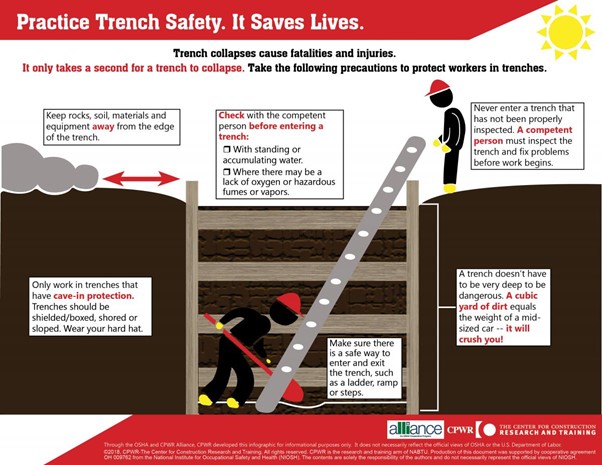
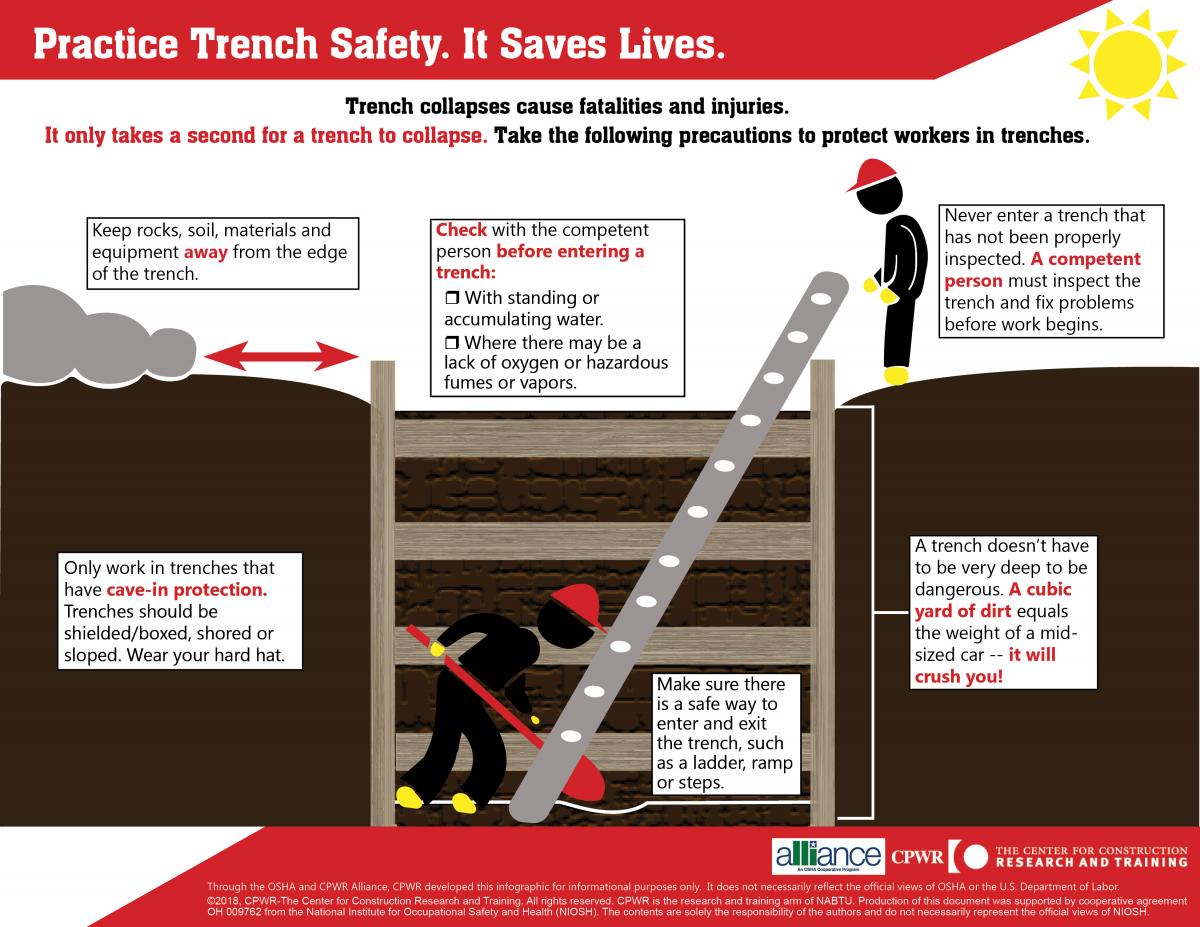
Excavation Safety – Picture This

Source: cpwr.com


Excavation Safety Meeting Kit – Spanish

QUÉ ESTÁ EN RIESGO

Charla sobre seguridad general en la excavación

Según la Oficina de Estadísticas Laborales, entre 2013 y 2017 se produjeron 97 muertes en zanjas en la industria de la construcción, un promedio de 19 por año, desde un mínimo de 10 muertes en 2014 hasta un máximo de 33 en 2016 [BLS, 2019]. Las excavaciones son algo habitual en las obras de construcción de todo Estados Unidos. Este trabajo puede conllevar numerosos peligros, pero el trabajo de excavación puede ser seguro si se siguen las directrices básicas de seguridad.

CUÁL ES EL PELIGRO

LOS PRINCIPALES PELIGROS ASOCIADOS A LOS TRABAJOS DE EXCAVACIÓN SON:

  • Estanqueidad de la superficie.
  • Colapso de la excavación. (Derrumbes)
  • Rocas o suelos sueltos.
  • Contacto con servicios subterráneos y/o líneas eléctricas aéreas.
  • Caída de cargas – Materiales que caen sobre las personas que trabajan en la excavación.
  • Equipos móviles – Caída de personas y vehículos en la excavación.
  • Tráfico de vehículos – Personas golpeadas por las máquinas de la planta.
  • Socavación de estructuras cercanas.
  • Acceso/regreso a/desde la excavación.
  • Atmósferas peligrosas.
  • Aguas subterráneas. (Planos)
  • Accidentes para el público.
  • Gases venenosos que se acumulan en una excavación
  • Caídas en la excavación

COMO PROTEGERSE

MEDIDAS DE SEGURIDAD EN LAS EXCAVACIONES SEGÚN LA OSHA

  • Inspeccione las zanjas diariamente antes de comenzar el trabajo.
  • Compruebe las condiciones meteorológicas antes de trabajar, tenga en cuenta la lluvia y las tormentas.
  • Mantenga el equipo pesado alejado de los bordes de la zanja.
  • Tenga en cuenta la ubicación de los servicios públicos subterráneos.
  • Lleve siempre el equipo de protección adecuado.
  • No trabaje debajo de cargas elevadas.
  • Realice pruebas de atmósfera. Si se detecta un nivel bajo de oxígeno y gases tóxicos, los trabajadores no deben entrar en la zanja.
  • Deben crearse sistemas de protección como bancos, taludes, apuntalamientos y blindajes. La planificación y la aplicación de las medidas de seguridad deben ser realizadas por una persona competente.
  • Utilice una lista de comprobación para realizar auto inspecciones periódicas: descargue aquí listas de comprobación gratuitas sobre seguridad en las excavaciones.

PRINCIPALES CONSEJOS DE SEGURIDAD EN LAS EXCAVACIONES DE NIOSH

  • Forme a una persona específica para que supervise cada trabajo de excavación y aplique correctamente las normas de seguridad específicas.
  • Haga que un experto examine la estabilidad del suelo antes de la excavación.
  • Las zanjas de más de 6 metros de profundidad necesitan un sistema de protección específico para el lugar y diseñado por un profesional.
  • Desarrolle y haga que los empleados practiquen un plan de emergencia de colapso de zanjas.
  • Antes de comenzar el trabajo y a lo largo de cada jornada, el capataz de la obra o el empleado encargado de velar por la seguridad debe volver a comprobar la estabilidad del suelo y de los aparatos de seguridad en el lugar de la excavación, especialmente después de una tormenta.
  • Las escaleras de salida de la zanja nunca deben estar a más de 25 pies de distancia de los trabajadores que están dentro.
  • Notifique a los subcontratistas la ubicación de la zanja y asegúrese de que mantienen los vehículos y otros equipos pesados a una distancia segura de la zanja.
  • Supervise de cerca la zanja para detectar otros peligros que no sean derrumbes, como gases nocivos o bordes inestables.
  • Enseñe a los empleados las señales de advertencia de derrumbamiento de zanjas.

DERRUMBE

Los empleadores pueden ayudar a reducir las lesiones y las muertes causadas por los derrumbes.

  1. Nunca entre en una zanja sin protección.
  2. Aparque el equipo pesado lo más lejos posible de los bordes de la zanja. Mantenga la tierra u otros materiales a una distancia mínima de dos pies de los lados de la zanja.
  3. Averigüe dónde se encuentran los servicios públicos subterráneos antes de que las cuadrillas comiencen a cavar.
  4.  Inspeccione las zanjas diariamente antes de comenzar el trabajo y después de tormentas u otros eventos que puedan causar cambios en la zanja.
  5. Cuando estén expuestos al tráfico, los trabajadores pueden prevenir accidentes usando ropa muy visible, como chalecos de seguridad para el tráfico.
  6.  Eduque a los trabajadores sobre los peligros que conlleva la excavación y sobre las precauciones de seguridad adecuadas.
  7. Nunca trabaje debajo de cargas suspendidas de materiales.
  8. Cuando la zanja tenga más de cuatro pies de profundidad, compruebe las condiciones atmosféricas antes de comenzar el trabajo.
  9. Cree sistemas para proteger a los trabajadores y evitar derrumbes.
    • Escalones – Construir escalones en los lados de una excavación
    • Inclinación – Inclinación de la pared de la zanja lejos de la excavación
    • Apuntalamiento – Instalación de soportes, como los hidráulicos de aluminio, para evitar el movimiento del suelo
    • Blindaje – Proteger a los trabajadores con cajas de zanja u otros equipos de protección
  10. Proporcione entradas y salidas seguras a la zanja. La OSHA exige que se utilicen escaleras, peldaños o rampas siempre que una zanja o excavación tenga más de cuatro pies de profundidad y que todos los empleados trabajen a menos de 25 pies de estas disposiciones en todo momento.

CONCLUSIÓN

La vida de ningún trabajador debería acabar en una zanja. Los derrumbes durante las excavaciones son una de las causas más comunes y espeluznantes de muertes de trabajadores en la construcción, pero son totalmente evitables. Con la formación, los procedimientos y los suministros adecuados, los empresarios pueden ayudar a prevenir estos accidentes.


Excavation Safety Stats and Facts – Spanish

HECHOS

Las zonas de zanjas a veces tienen niveles de oxígeno agotados, y la atmósfera también puede estar contaminada por gases tóxicos y productos químicos.

  1. Golpear las líneas de servicios públicos al excavar puede causar electrocución y fugas de gas material.
  2. Antes de cavar, haga que un experto examine la estabilidad del suelo.
  3. Desarrolle y haga que los empleados practiquen un plan de emergencia de colapso de zanjas.
  4. Contratar a un ingeniero profesional o a un profesional cualificado para que diseñe un sistema que evite los derrumbes es fundamental para evitar lesiones y muertes en la obra.

ESTADÍSTICAS

  • Las investigaciones de la OSHA demostraron que el tiempo de trabajo era más importante que la seguridad en el 88% de los incidentes. El 72% de las muertes se produjeron en zanjas de menos de 2 metros de profundidad. Sólo el 9% se produjo a más de 4 metros de profundidad.
  • Los empleados que más murieron fueron los obreros de la construcción (53%), seguidos por los fontaneros e instaladores de tuberías, con un 9%. La mayoría (58%) murieron mientras instalaban tuberías.
  • El 56% de estas víctimas mortales eran hispanos y el 52% habían nacido en el extranjero. Para el 44%, el español era su idioma principal.  Al menos el 30% llevaba menos de un año trabajando para su empresa y la mayoría (59%) trabajaba para un subcontratista.
  • Sólo el seis por ciento estaba afiliado a un sindicato. Dado que, en todo el país, alrededor del 20% de los trabajos de construcción están sindicalizados, la tasa esperada de muertes por culpa de los sindicatos sería cercana al 20%.  La tasa más baja sugiere que los trabajos sindicalizados son más seguros, que los supervisores y los trabajadores de las obras sindicalizadas están mejor formados y que el sindicato ofrece el tipo de protección que los trabajadores necesitan para hablar de los problemas de seguridad en la obra.
  • Algo más de la mitad de los empresarios tenían un programa de seguridad y salud por escrito, pero, de ellos, sólo el 40% cubría las zanjas. El 65% no impartía formación sobre seguridad en las zanjas.  La mayoría de los empresarios (71%) nunca habían sido inspeccionados por la OSHA, pero el 21% habían sido citados anteriormente por la OSHA por violaciones de la seguridad en las zanjas.
  • Aproximadamente tres de cada cuatro muertes se produjeron en obras residenciales. La mayoría de las empresas eran pequeñas; el 42% tenía menos de diez empleados.  Aunque, por lo general, había cinco o menos trabajadores en la obra cuando se produjo el incidente, la mayoría de los proyectos (52%) incluían contratos por valor de 100.000 dólares o más.


Excavation Safety Fatality Report – Spanish

Carlos Moncayo, un inmigrante de 22 años procedente de Ecuador. Murió el 6 de abril al derrumbarse una zanja de 4 metros de profundidad en la que trabajaba en una obra de Nueva York. Los inspectores habían advertido repetidamente a los contratistas que supervisaban la obra que la zanja constituía un peligro inminente porque no estaba debidamente apuntalada. Al carecer de muros de apoyo, la zanja acabó derrumbándose. Moncayo quedó enterrado hasta el cuello y murió aplastado por miles de kilos de tierra.

El 5 de agosto, el fiscal del distrito de Manhattan acusó a dos empresas y a dos supervisores de causar la muerte de Moncayo. Harco Construction, Sky Materials, el capataz Wilmer Cueva y el superintendente de la obra Alfonso Prestia han sido acusados de homicidio involuntario, homicidio por negligencia y puesta en peligro.


Excavation Safety – Picture This – Spanish


Why Pretty Good Isn’t Good Enough – Training Tip

Failure to understand instructions, especially because of a language barrier, is a recipe for disaster. For a Taiwanese food production worker, it proved fatal.

As a supervisor, you may assume that a worker from another country has a pretty good grasp of English. The following story shows why pretty good isn’t good enough.

What Happened

A 54-year-old food production worker who was employed by a New York State pizza dough manufacturer died of severe neck lacerations and blood loss after he was struck by an energized cutting blade while cleaning a dough machine.

The victim had turned off and locked power switches controlling the machine before he and a co-worker proceeded to clean it. The plant lockout/tagout procedure called for setting the control buttons of the dough chunker to “off” and “manu.” However, the victim set those controls in the “on” and “auto” positions.

At one point the co-worker asked the victim for the key to unlock the main power switch for one of the machines, so the dough bowl could be raised. The victim was bending over and extended his head through the bottom opening of the hopper when his co-worker activated the power switch.

Hearing noises, the co-worker rushed to the victim and observed that he had been partially decapitated by the energized steel blade. The worker died at the scene.

The Investigation

Investigators determined that the company’s lockout/tagout training program included viewing a 35-minute video in English, along with some text training and hands-on training.

During some of the training sessions, the victim’s employer had hired professional translators to translate written training material into Mandarin Chinese for three employees at the plant. However, the hands-on training sessions were conducted solely in English.

The plant manager and safety coordinator said each worker had been taught how to shut down a machine and isolate its energy source, release any potentially hazardous stored energy, test to verify that the energy source was isolated, and lock the energy control device securely in the “off” position. The plant safety coordinator said the victim had seemed to understand English fairly well.

Recommendations

Their recommendations included the following:

Periodic inspections should be conducted to ensure that company procedures are being followed.

Employees need retraining in the event of an incident, a near miss or changes to procedures or equipment. Those workers whose first language is not English should receive both text training and hands-on training in their native language.

Bottom Line

Appearances can be deceiving. Assuming that a worker has adequate English language comprehension to understand complex instructions involves taking a big leap of faith. It’s a risk you cannot afford to take. Make sure training is offered in a language your workers understand.


What’s a Safe Height to Stack Materials?

Stacking materials too high can cause the stack to collapse. So what’s the right height for a stack? It all depends. There are 6 things you need to think about in determining the safe height to stack materials:

  1. What you’re stacking: Different materials have different characteristics affecting their stability when they’re stacked. Thus, for example, lumber should be stacked no more than 16 feet high, while loose bricks should be stacked no higher than 7 feet.
  2. The surface you’re stacking on: The safe height of a stack is affected by whether the stack is resting on the floor, shelving, a truck, a forklift, etc. Example: Forklifts should not be stacked more than 20 feet high.
  3. What containers the materials are in: The size, weight and shape of the container directly affects its stability. Example: Stacks of the same height aren’t of the same stability if one stack contains square boxes and the other round barrels.
  4. How heavy the stacked item is: The gross weight of the item you’re stacking affects how many of each item you can stack on top of each other without creating gravity issues or overtaxing the surface you’re stacking on.
  5. The stacking arrangement: How you stack materials impacts the stability of the stack. Thus:
    • The heaviest materials should be at the bottom of the stack
    • Bags and bundles must be stacked in interlocking rows
    • Boxed materials must be banded in place with cross-ties or shrink plastic fiber
    • Drums, barrels, and kegs must be stacked symmetrically
  1. The storage conditions: The stability of stacked materials is affected by environmental conditions like wind, temperature and humidity. Thus, for example, humidity could deteriorate and weaken wooden pallets and shelving and make them more susceptible to collapse.


The Distance Between Trauma and Post-Traumatic Stress is Short – Managing Yourself

Few people get through life without witnessing a traumatic event. Maybe you are driving and spot another car spinning out of control before it crashes it’s hit by a semi-truck. Or perhaps something terrible happens at work and you witness employees losing their lives.

People who have witnessed such events often will say their lives have been turned upside down because nothing shows the fragility of human life quite like knowing that someone who was alive two seconds ago is gone.

It’s common for witnesses to keep replaying horrifying images in their minds for days or weeks. It’s a switch that cannot be shut off, no matter how much one might want to.

Nausea, loss of appetite, dizziness, headache, depression, confusion, grief, nightmares, insomnia, helplessness, fear, confusion, and a sense of detachment from reality are among the symptoms of stress related to involvement in traumatic events.

People handle these events differently. Some want to talk out their feelings are quite emotional, while others clam up and stuff their feelings inside.

But failing to deal with one’s feelings will not make them disappear. Such avoidance can lead to post-traumatic stress disorder (PTSD), and intense emotional/physical reaction to a traumatic event that can last for months.

People suffering from PTSD may withdraw from activities, people, laces and thoughts or feelings related to the traumatic incident.

They also may become irritable and prone to outbursts of anger and find it difficult to concentrate. Flashbacks and nightmares along with physical symptoms, such as chills and shaking are associated with PTSD.

As a supervisor who witnesses a traumatic event, you will be caught in a whirlwind of activities in the days following it, including being interviewed by police and government occupational safety and health officials.

You may believe it’s important to not show or share your feelings with workers, because you may be seen as a weak person who cannot handle a tough situation. In reality, not taking to workers about what you are all feeling may lead them to believe you are cold and unfeeling. How you decide to deal with that issue is your business, but you’ll need to deal with your own feelings in the aftermath of a traumatic event.

Here are some coping strategies from the US CDD you can use. Share these with others that may be going through the same thing.

  • Understand that your symptoms are normal, especially in the first few days following a traumatic event.
  • Try to stick to your usual routine.
  • Find ways to relax and be kind to yourself.
  • Recognize that you cannot control everything.
  • Do not shy away from situations, people, and places that remind you of the trauma.
  • Take time to resolve day-to-day conflicts so they do not add to your stress.
  • Turn to family, friends, clergy, or professionals for support and talk about your experiences and feelings with them.
  • Try to engage in leisure and recreational activities, even though that may be the last thing you feel like doing.
  • Recognize the need for seeking trained help and call a mental health center if you are feeling overwhelmed.

According to the CDC, about half of those with PTSD recover within three months without treatment. This is not always the case – sometimes, symptoms do not go away on their own or last for more than three months. This depends on the many factors including the severity of the event, exposure to the event or seriousness of the threat to life, the number of times an event happened, a history of past trauma, and psychological problems before the event.

Everyone deals with trauma differently – there is no single solution for everyone but using some of these coping strategies for yourself or knowing them so you are able to help others can start the path for healing.


Why Workers Don’t Use PPE

In a past survey, 82% of safety professionals said they observed their workers failing to use required personal protective equipment (PPE) at least once in the span of a year.

Why Workers Don’t Use PPE

Of course, ensuring proper use of PPE by workers isn’t just a compliance obligation; it’s a vital safety measure. So why don’t workers use the stuff?

Employer’s Fault for Lack of PPE Use

At over 85%, the most common worker reason survey respondents cited was lack of awareness about PPE and why it’s important to use. This is clearly a problem that providing appropriate safety training would solve.

Another common reason for not using PPE: the workers said that PPE wasn’t available at their workplace or that it didn’t fit right. Each of these reasons could and should have been addressed by the employer.

So, if any of your workers are citing reasons like this, shame on you.

Worker’s Fault for Lack of PPE Use

The other common reasons cited are not so much reasons as excuses by workers who understood the importance of using PPE but chose not to due to some complaint about the PPE.

Complaint – PPE Was Uncomfortable

If your workers are saying this, you can easily help them find an alternate solution – whether it’s a different style of eye protection or a better fitting hardhat. In many cases, if the PPE isn’t comfortable the worker may not be wearing it properly.

Complaint – PPE Made Them Too Hot

If your workers are finding it hot, you may want to consider checking out the temperature in the area – check your ventilation and get some airflow. This may not solve the issue completely but could help with your workers objections.

Complaint – PPE Hampered Productivity or Made Job Tasks Harder

Find out how the PPE is causing issues with getting work done. In some cases, you may be able to find a way to improve efficiencies. In other cases, you and your workers may just have to understand that in order to be safe, the work may take a little longer.

Complaint – PPE Made Them Look Unattractive

Not much to say here! It’s not about looks – it’s about being safe. End of story.

Don’t Write Off the PPE Complaints

We all understand that lack of comfort and such aren’t valid excuses for not using PPE. So, it would be easy to label the excuses as “shame-on-the worker”.

But it’s not as simple as that. At the end of the day, who’s to blame for a workers’ failure to use PPE is less important than understanding why they’re not using it and making sure they do.

So, if your workers are using excuses like “it’s too hot,” you need to know what they’re complaining about and address the problem—either by making the PPE “less hot” or getting the worker to use it the way it is. Anything less might result in an OSHA violation and a fatal or serious injury.


Handling Materials Safely

Almost every worker handles materials at some point during the work day. Using the right method of moving materials combined with the correct personal protective equipment is the only way to reduce the threat of injury.

Stacking Materials

When it comes to preventing injury, stacking materials properly is just as important as using proper lifting techniques and the right equipment to move a load.

  • Before stacking any materials, it is important that the material type, height and weight are given consideration.
  • If a skid is to be used, inspect the skid for damage.
  • Stacking materials too high or too deep on a shelf will increase the risk of injury when materials are being manually moved.
  • When stacking bags or bundles, use interlocking rows to increase the stability of the load.
  • When stacking drums, barrels, and kegs, use a symmetrical pattern. If they are to be stacked on their ends, use a sheet of plywood or skid inserted between the levels to provide stability and an even surface for each level. When stored on their sides, block the bottom tier to prevent the bottom drums from rolling out from under the load.
  • All cylindrical materials such as structural steel, poles, and tubing must be stacked and blocked to prevent spreading or tilting. Pipes, bars, and tubing should be stored in racks that run parallel to the warehouse aisles to eliminate a safety hazard for those who use the aisles.

Hand Carts

Hand cart injuries occur when wrists and fingers are caught in the cart itself, between the cart and the load, or between the load and another stationary object. Also in danger are feet and legs being crushed by the cart or the load being moved. Handcart use can result in serious back and shoulder strain, as well as straining leg and arm muscles.

Lifting And Moving

Roughly 75 per cent of all material handling workers will suffer a back injury at some time during their working life. Using a hand cart, instead of strength when moving objects can save workers from a stress injury. If they have to lift, use correct lifting and moving methods for loads within your strength limit combined with proper protective equipment. Prior to lifting materials, assess each load for weight, sharp edges, slivers, and wet or greasy spots. Also assess the route to ensure it is clear of clutter, spills and obstructions.

If the load requires a team to lift the material, chose team members who are of similar size and strength. Choose one leader to direct the team and issue lifting, moving and setting down commands. Try to equally distribute the load among all team members.

Irregular Objects

Although boxes and cartons are not considered to be irregular shaped objects, there is still a correct way to lift and carry. Grasp a carton with one hand on the top and one hand on the bottom, both placed in opposite corners of the box. Sacks should also be lifted using opposite corners. But once the sack has been lifted, it should be shifted so that it rests against your hip or stomach so you can swing the sack up and over your shoulder. If you cannot swing it over your shoulder, then the sack is too heavy. Irregular objects can be shaped irregularly or unevenly weighted. Such objects require special solutions. If the object is unwieldy and will not allow you to securely grasp and lift the object, then you should seek assistance and/or use a handcart. When carrying long objects such as pipes and tubing, the correct method is to balance the objects on your shoulders. When carrying long sections, use a guide to make sure the way is always clear of workers who could be injured by the jutting pipes.


Quick Course – Be a Safety Leader

An employer or supervisor can’t stand by you every second to see that safety rules are followed. You must take charge of your safety because you have the most to gain — and the most to lose.


Drunk Driving Meeting Kit

Being involved in an accident like drink driving, affects more than just yourself. It affects your family emotionally as well as financially.

DRUNK DRIVING COST

The first thing to come to mind is the expensive nature of drunk driving. Cost is measured in financial terms and the affect on the person’s life. The average cost for a person’s first DUI connection is anywhere from $9000 to $24,000.

A DUI can also cost you your job or make it difficult for you to find a new job. Many employers will not hire someone with a recent DUI or will fire someone who has got one while working for them. Many employers require employees to be able to drive a company vehicle and maintain a clean driving record. A DUI is virtually an instant way to lose your ability to drive a company vehicle.

DRUNK DRIVING HAS CONSEQUENCES

If someone drives drunk and survives a crash that injures or kills other people, he or she must live with the consequences. That emotional burden can be worse than any bodily harm.

But the physical perils of drunk driving are immense, too. Impaired driving can cause accidents that lead to paralysis, disfigurement, brain damage, and even death.

Impaired driving is also a crime. Drunk drivers often pay significant fines, lose their license, and face higher insurance costs. Common punishments for conviction of a drunken driving-related offense can include:

  • Driver’s license suspension / revocation
  • Imprisonment in jail
  • Vehicle impoundment
  • Vehicle license plate confiscation
  • Ignition interlock device (IID) restrictions
  • Alcohol abuse evaluations
  • Mandatory alcohol abuse treatment programs
  • Monitored sobriety

COMMON SENSE MITIGATION TO REDUCE RISK OF DRUNK DRIVING

Find your designated driver. Designate a driver who will not drink before you go out. Never assume that someone will volunteer, and make sure that you don’t put all the responsibility on the same person every time. If you feel guilty, offer to buy their dinner or to pay for gas.

Hold each other accountable. When you do go out with friends, coworkers, or family, make a plan with friends to hold each other accountable. Encourage each other to drink water in between alcoholic beverages. If they’ve been drinking, take their keys away from them. Call a cab or offer to give them a ride to pick their car up in the morning.

Be a responsible host. If you’re hosting your own gathering, offer non-alcoholic beverages and make sure everyone has a safe ride home. Monitor your own drinking to ensure that you help guests make safe choices.

Plan alcohol-free activities. Plan activities with friends and family that don’t always involve drinking. Whether it’s being active, enjoying good conversation, exploring a new place, or visiting your favorite spot, you don’t need alcohol to make the evening a memorable one.

SOLUTIONS TO REDUCE DRINKING AND DRIVING

  • DWI courts are effective in reducing drinking and driving while intoxicated. They work with hard-core repeat offenders. They do so by treating alcohol addiction. The recidivism or failure rate of DWI and DUI courts is very low.
  • The single most effective measure to reduce drunk driving is automatic license revocation.
  • Automatic license revocation along with required jail appears to be even more effective.
  • Confiscating license plates.
  • Requiring ignition interlock devices. They prevent persons with alcohol on their breath from starting a vehicle.
  • Vehicle impoundment.
  • Expanding alcohol server training programs.
  • Using social norms programs. They correct the false belief that most people sometimes drive under the influence of alcohol.
  • Requiring alcohol testing in fatal crashes. That would help the prosecution of drunk drivers.

PROTECT YOURSELF

  • Don’t drive if alcohol-impaired. It’d dangerous and illegal. And also don’t ride with anyone who has too much to drink. Remember, drunk drivers usually kill themselves and their passengers.
  • Serve as a Designated Driver.
  • Always use a safety seat belt.
  • Use four-lane highways whenever possible.
  • Avoid rural roads.
  • Avoid travel after midnight. Especially on Fridays and Saturdays.
  • Drive defensively.
  • Buy safe vehicles. Refer to safety ratings before buying your next vehicle.
  • Never use illegal drugs. They cause a large proportion of traffic fatalities.
  • Never drive when fatigued. The dangers are similar to intoxication. A drunk or fatigued driver has slowed reactions and impaired judgment. And a driver who nods off at the wheel has no reactions and no judgment!
  • Don’t use a cell phone, apply make-up, comb your hair, or eat while driving. Drivers using cell phones are four times more likely to have an accident than other drivers.
  • Steer clear of aggressive drivers. Aggressive drivers may be responsible for more deaths than drunk drivers.

FINAL WORD

There is never such a thing as “just a drive down the street” when you are drunk. It may seem like an easier and quicker option compared to finding a designated driver, but it is a decision that could change your life or someone else’s life forever. Think before you decide to drive drunk.


Drunk Driving Stats and Facts

FACTS

  1. The largest group at risk for drinking and driving are those who binge drink. This means they consume a large amount of alcohol in a short period of time, putting them at risk for harmful side effects. It takes roughly 30 minutes to two hours for alcohol to be absorbed into your bloodstream.
  2. Any amount of alcohol in your bloodstream can impact your driving ability. The effects of alcohol abuse vary greatly, putting you at risk for causing an accident or highway injury.
  3. When alcohol is in your system, it affects how quickly you’re able to respond to different situations. Drinking slows your response time, which can increase the likelihood of an accident.
  4. Heavy drinking affects your motor skills such as eye, hand and foot coordination. Without crucial coordination skills, you may be unable to avoid an impending harmful situation.
  5. Alcohol, no matter how much or how little, can influence your concentration. Your attention span is dramatically reduced with drinking, which significantly increases the chance of an accident.
  6. Your brain controls how you judge certain circumstances. When operating a motorized vehicle, your judgement skills play an important role in how you make decisions. Your judgement helps you stay alert and aware of surrounding conditions while driving.

STATS

  • Impairment is not reliant upon the type of alcohol consumed, rather the number of drinks over a certain period of time. Despite myths and misconceptions, coffee, a cold shower, or exercise will not make a person more sober; only time will.
  • On average, a drunk driver will drive 80 times under the influence before their first arrest.
  • Every 51 minutes in America, someone is killed in a drunk driving crash. That equates to 27 people every day. Offer to be your parents’ designated driver to ensure that everybody gets home safe. Sign up for Parents Ride Shotty.
  • For drivers under 21, the U.S. has a No Tolerance policy that does not allow any alcohol to be in the blood system while behind the wheel. The consequences could include expensive fines, loss of license or jail.
  • Someone is injured in a drunk driving incident every 120 seconds.
  • In 2011, 9,878 people were victims of drunk drivers.
  • Between 50 to 75% of the people who have had their licenses revoked due to driving under the influence drive illegally without their license.
  • Traffic accidents are the leading cause of death for teens, and roughly 1/3 of these accidents involve alcohol or another substance.
  • Since the early 1980s, alcohol-related traffic deaths per population have been cut in half with the greatest proportional declines among persons 16-20 years old.
  • In 2010, of the fatalities among children ages 14 and younger, 17 percent occurred in alcohol impaired-driving crashes.
  • Kids and teens who get involved with alcohol at a young age are 7 times more likely to be involved in an alcohol-related crash in their lives.


Drunk Driving Fatality Report

The Carrollton Crash

The crash occurred around 11 p.m. when a drunk driver in a pickup truck was traveling on the wrong side of the interstate and slammed into the oncoming school bus.

Ten-year-old Patty Nunnallee was among the 24 children killed, and Chuck Kytta, one of the chaperones on the trip, was one of three adults who died.

His wife, Janet Kytta Hancock, said she later learned that he had been standing in the stairwell at the front of the bus when the crash happened, and he burned to death.

At first, when she arrived at the First Assembly of God Church that night after receiving a call about a problem with the bus, there were lists of names posted that divided up the passengers into injured and missing. Her husband’s name was on the missing list.

“I couldn’t figure out why he would be missing. He was an adult, he had a wallet,” she said. “The fire was so fast, and it was so hot that Chuck actually burned to death. He didn’t die of smoke inhalation. It was horrible. It was just unimaginable.”

Don Karol, a senior highway accident investigator with the National Transportation Safety Board, told ABC News that he believes that no one died as a direct result of the collision, but rather from the fire and smoke inhalation in the aftermath.

The truck “hit the bus in the right front, and it was enough to basically damage the suspension, and the whole front end of the bus got pushed rearward. The fuel tank that is right behind that area got punctured,” Karol said.

The bus was filled to capacity, Karol said, with 66 passengers and a driver, and because the front exit was inaccessible due to the crash, all 67 adults and children were trying to get out of the one rear exit.

That one rear exit was partially blocked by coolers that had been pushed toward the back of the bus, which Karol said “exacerbated the problem.”

The layout of seats was also a factor, as the bus’s “very wide” rows of seats left only left 12 inches for the aisle, Karol said.

Two other safety issues that reared their dangerous heads that night were a lack of guard frames around the fuel tank, which could have prevented it from being punctured in the crash, and the toxic, highly flammable material in the bus seats.

Autopsy reports showed Patty Nunnallee had certain toxins in her system which indicated she was the last one to die, her mother said.

“I was honestly hoping that the immense heat would have killed her instantly,” Nunnallee said. “But the autopsy showed that because of the gas in her blood, she had to have breathed it in and she was the only one” to have such toxins in her system.


Drunk Driving – Picture This

DRINKING AND DRIVING IS DEADLY

What’s wrong in this picture? Drinking and driving while either impaired or drunk is dangerous. Drivers with high blood alcohol concentration (BAC) are at much greater risk of traffic crashes. This means more injuries and deaths.

Every single injury and death caused by drunk driving is preventable. In fact, the proportion of alcohol-impaired driving crashes has dropped greatly over time.

Plenty of people know that drinking and driving don’t mix — but many still do it. According to the Centers for Disease Control and Prevention, there are over 300,000 incidents of drinking and driving each day. And arrest doesn’t typically mark the first time a person drives under the influence: The average drunk driver does so over 80 times before getting caught. The risks are high, but the solutions are simple.

Driving after even one drink is just not worth it. Ride with a sober friend, ask someone else to drive or call a parent or older sibling.  Be sure to always keep a DUDE around: DESIGNATED UNIMPAIRED DRIVER EXTRAORDINAIRE.


Drunk Driving Meeting Kit – Spanish

QUÉ ESTÁ EN RIESGO

Estar involucrado en un accidente como el de la conducción bajo los efectos del alcohol, afecta a algo más que a uno mismo. Afecta a su familia tanto emocional como económicamente.

COSTE DE LA CONDUCCIÓN BAJO LOS EFECTOS DEL ALCOHOL

Lo primero que nos viene a la mente es el coste de la conducción bajo los efectos del alcohol. El costo se mide en términos financieros y el efecto en la vida de la persona. El coste medio de la primera conexión de una persona con un DUI es de entre 9.000 y 24.000 dólares.

Un DUI también le puede costar su trabajo o hacer que sea difícil para usted encontrar un nuevo trabajo. Muchos empleadores no contratarán a alguien con un DUI reciente o despedirán a alguien que haya obtenido uno mientras trabaja para ellos. Muchos empleadores requieren que los empleados puedan conducir un vehículo de la empresa y mantener un historial de conducción limpio. Un DUI es prácticamente una forma instantánea de perder la capacidad de conducir un vehículo de la empresa.

CUÁL ES EL PELIGRO

CONDUCIR EBRIO TIENE CONSECUENCIAS

Si alguien conduce ebrio y sobrevive a un accidente que hiere o mata a otras personas, debe vivir con las consecuencias. Esa carga emocional puede ser peor que cualquier daño corporal.

Pero los peligros físicos de la conducción bajo los efectos del alcohol también son inmensos. La conducción bajo los efectos del alcohol puede causar accidentes que provocan parálisis, desfiguración, daños cerebrales e incluso la muerte.

Conducir bajo los efectos del alcohol es también un delito. Los conductores ebrios suelen pagar multas importantes, perder el carné de conducir y enfrentarse a costes de seguro más elevados. Los castigos comunes por la condena de un delito relacionado con la conducción en estado de ebriedad pueden incluir:

  • Suspensión/revocación de la licencia de conducir
  • Prisión en la cárcel
  • Confiscación del vehículo
  • Confiscación de la placa del vehículo
  • Restricciones del dispositivo de bloqueo de encendido (IID)
  • Evaluaciones de abuso de alcohol
  • Programas obligatorios de tratamiento del abuso de alcohol
  • Sobriedad supervisada

COMO PROTEGERSE

MITIGACIÓN DE SENTIDO COMÚN PARA REDUCIR EL RIESGO DE CONDUCIR EBRIO

Busque a su conductor designado. Designe a un conductor que no vaya a beber antes de salir. Nunca de por sentado que alguien se ofrecerá, y asegúrese de no cargar toda la responsabilidad en la misma persona cada vez. Si se siente culpable, ofrézcale a pagar la cena o la gasolina.

Responsabilícense mutuamente. Cuando salga con amigos, compañeros de trabajo o familiares, haga un plan con sus amigos para que sean responsables mutuamente. Anímense a beber agua entre las bebidas alcohólicas. Si han estado bebiendo, quíteles las llaves. Llama a un taxi u ofrézcase a llevarles a recoger su vehículo por la mañana.

Sea un anfitrión responsable. Si usted es el anfitrión de su propia reunión, ofrezca bebidas no alcohólicas y asegúrese de que todo el mundo tenga un viaje seguro a casa. Controle su propio consumo de alcohol para asegurarse de que ayuda a los invitados a tomar decisiones seguras.

Planifique actividades sin alcohol. Planifique actividades con amigos y familiares que no siempre impliquen beber. Ya sea estar activo, disfrutar de una buena conversación, explorar un nuevo lugar o visitar su lugar favorito, no es necesario el alcohol para que la velada sea memorable.

SOLUCIONES PARA REDUCIR EL CONSUMO DE ALCOHOL Y LA CONDUCCIÓN

  • Los tribunales de alcoholemia son eficaces para reducir el consumo de alcohol y la conducción en estado de embriaguez. Trabajan con los reincidentes más duros. Lo hacen tratando la adicción al alcohol. La tasa de reincidencia o fracaso de los tribunales de DWI y DUI es muy baja.
  • La medida más eficaz para reducir la conducción bajo los efectos del alcohol es la revocación automática del permiso.
  • La revocación automática del permiso junto con la obligación de ir a la cárcel parece ser aún más eficaz.
  • La confiscación de las matrículas.
  • Exigir dispositivos de bloqueo de encendido. Éstos impiden que las personas con aliento a alcohol pongan en marcha un vehículo.
  • Confiscación de vehículos.
  • Ampliar los programas de formación de servidores de alcohol.
  • Utilizar programas de normas sociales. Corrigen la falsa creencia de que la mayoría de las personas conducen a veces bajo los efectos del alcohol.
  • Exigir pruebas de alcoholemia en los accidentes mortales. Eso ayudaría a la persecución de los conductores ebrios.

PROTÉJASE

  • No conduzca si está bajo los efectos del alcohol. Es peligroso e ilegal. Y tampoco viaje con alguien que haya bebido demasiado. Recuerda que los conductores ebrios suelen matarse a sí mismos y a sus pasajeros.
  • Haga de conductor designado.
  • Utilice siempre el cinturón de seguridad.
  • Utilice carreteras de cuatro carriles siempre que sea posible.
  • Evite las carreteras rurales.
  • Evite viajar después de medianoche. Especialmente los viernes y sábados.
  • Conduzca a la defensiva.
  • Compre vehículos seguros. Consulte las clasificaciones de seguridad antes de comprar su próximo vehículo.
  • No consuma nunca drogas ilegales. Son la causa de una gran proporción de las muertes en el tráfico.
  • No conduzca nunca con fatiga. Los peligros son similares a los de la intoxicación. Un conductor ebrio o fatigado tiene reacciones más lentas y una capacidad de juicio reducida. Y un conductor que se queda dormido al volante no tiene capacidad de reacción ni de juicio.
  • No utilice el teléfono móvil, ni se maquille, ni se peine, ni coma mientras conduce. Los conductores que utilizan el teléfono móvil tienen cuatro veces más probabilidades de sufrir un accidente que los demás conductores.
  • Aléjese de los conductores agresivos. Los conductores agresivos pueden ser responsables de más muertes que los conductores ebrios.

CONCLUSIÓN

Nunca existe la opción de “dar un paseo por la calle” cuando está borracho. Puede parecer una opción más fácil y rápida en comparación con la búsqueda de un conductor designado, pero es una decisión que podría cambiar su vida o la de otra persona para siempre. Piense antes de decidirse a conducir ebrio.


Drunk Driving Stats and Facts – Spanish

HECHOS

  1. El mayor grupo de riesgo de beber y conducir es el de los bebedores compulsivos. Esto significa que consumen una gran cantidad de alcohol en un corto periodo de tiempo, lo que les hace correr el riesgo de sufrir efectos secundarios perjudiciales. El alcohol tarda entre 30 minutos y dos horas en ser absorbido por el torrente sanguíneo.
  2. Cualquier cantidad de alcohol en el torrente sanguíneo puede afectar a la capacidad de conducir. Los efectos del abuso de alcohol varían mucho, lo que le pone en riesgo de causar un accidente o una lesión en la carretera.
  3. Cuando el alcohol está en su sistema, afecta a la rapidez con la que es capaz de responder a diferentes situaciones. Beber ralentiza su tiempo de respuesta, lo que puede aumentar la probabilidad de un accidente.
  4. El consumo excesivo de alcohol afecta a tus habilidades motoras, como la coordinación de ojos, manos y pies. Sin habilidades cruciales de coordinación, puede ser incapaz de evitar una situación inminente de peligro.
  5. El alcohol, por mucho o poco que sea, puede influir en su concentración. Su capacidad de atención se reduce drásticamente con la bebida, lo que aumenta significativamente la posibilidad de un accidente.
  6. Tu cerebro controla la forma en que juzgas ciertas circunstancias. Al conducir un vehículo motorizado, su capacidad de juicio desempeña un papel importante en la toma de decisiones. Su juicio le ayuda a mantenerse alerta y a ser consciente de las condiciones del entorno mientras conduce.

ESTADÍSTICAS

  • El deterioro no depende del tipo de alcohol consumido, sino del número de bebidas durante un determinado periodo de tiempo. A pesar de los mitos y las ideas erróneas, el café, una ducha fría o el ejercicio no harán que una persona esté más sobria; sólo el tiempo lo hará.
  • Por término medio, un conductor ebrio conducirá 80 veces bajo los efectos del alcohol antes de su primera detención.
  • Cada 51 minutos en Estados Unidos, alguien muere en un accidente por conducir ebrio. Eso equivale a 27 personas cada día. Ofrécete a ser el conductor designado de tus padres para que todos lleguen a casa sanos y salvos. Apúntate a Parents Ride Shotty.
  • Para los conductores menores de 21 años, Estados Unidos tiene una política de No Tolerancia que no permite que haya alcohol en el sistema sanguíneo mientras se está al volante. Las consecuencias pueden incluir multas costosas, la pérdida de la licencia o la cárcel.
  • Cada 120 segundos alguien resulta herido en un incidente de conducción bajo los efectos del alcohol.
  • En 2011, 9.878 personas fueron víctimas de conductores ebrios.
  • Entre el 50 y el 75% de las personas a las que se les ha retirado el carné por conducir bajo los efectos del alcohol conducen ilegalmente sin carné.
  • Los accidentes de tráfico son la principal causa de muerte de los adolescentes, y en aproximadamente 1/3 de estos accidentes está implicado el alcohol u otra sustancia.
  • Desde principios de la década de 1980, las muertes de tráfico relacionadas con el alcohol por población se han reducido a la mitad, con los mayores descensos proporcionales entre las personas de 16 a 20 años.
  • En 2010, de las víctimas mortales entre los niños de 14 años o menos, el 17% se produjeron en accidentes por conducción bajo los efectos del alcohol.
  • Los niños y adolescentes que se involucran con el alcohol a una edad temprana tienen 7 veces más probabilidades de verse involucrados en un accidente relacionado con el alcohol en su vida.


Drunk Driving Fatality Report – Spanish

El accidente de Carrollton

El accidente se produjo en torno a las 11 de la noche, cuando un conductor ebrio a bordo de una camioneta circulaba por el lado contrario de la interestatal y chocó contra el autobús escolar que circulaba en sentido contrario.

Patty Nunnallee, de diez años, se encontraba entre los 24 niños muertos, y Chuck Kytta, uno de los acompañantes del viaje, fue uno de los tres adultos que fallecieron.

Su esposa, Janet Kytta Hancock, dijo que más tarde se enteró de que él había estado de pie en la escalera de la parte delantera del autobús cuando se produjo el accidente, y murió calcinado.

Al principio, cuando llegó a la Iglesia de la Primera Asamblea de Dios esa noche tras recibir una llamada sobre un problema con el autobús, había listas de nombres publicadas que dividían a los pasajeros en heridos y desaparecidos. El nombre de su marido estaba en la lista de desaparecidos.

“No podía entender por qué estaba desaparecido. Era un adulto, tenía una cartera”, dijo. “El fuego fue tan rápido y estaba tan caliente que Chuck murió quemado. No murió por inhalación de humo. Fue horrible. Fue simplemente inimaginable”.

Don Karol, investigador principal de accidentes de carretera de la Junta Nacional de Seguridad del Transporte, dijo a ABC News que cree que nadie murió como resultado directo de la colisión, sino por el fuego y la inhalación de humo en las secuelas.

El camión “golpeó el autobús en la parte delantera derecha, y fue suficiente para dañar básicamente la suspensión, y toda la parte delantera del autobús fue empujada hacia atrás … El depósito de combustible, que está justo detrás de esa zona, quedó perforado”, dijo Karol.

El autobús iba lleno, dijo Karol, con 66 pasajeros y un conductor, y como la salida delantera era inaccesible debido al accidente, los 67 adultos y niños intentaban salir por la única salida trasera.

Esa única salida trasera estaba parcialmente bloqueada por neveras que habían sido empujadas hacia la parte trasera del autobús, lo que, según Karol, “agravó el problema”.

La disposición de los asientos también fue un factor, ya que las filas de asientos “muy anchas” del autobús sólo dejaban 12 pulgadas para el pasillo, dijo Karol.

Otros dos problemas de seguridad que asomaron sus peligrosas cabezas aquella noche fueron la falta de marcos de protección alrededor del depósito de combustible, que podría haber evitado que se pinchara en el accidente, y el material tóxico y altamente inflamable de los asientos del autobús.

Los informes de la autopsia mostraron que Patty Nunnallee tenía ciertas toxinas en su sistema que indicaban que fue la última en morir, dijo su madre.

“Sinceramente, esperaba que el inmenso calor la hubiera matado al instante”, dijo Nunnallee. “Pero la autopsia demostró que, debido al gas que había en su sangre… tuvo que haberlo respirado y fue la única” que tenía esas toxinas en su organismo.