Fall Protection – Picture This – Spanish


Opioid Abuse Meeting Kit – Spanish

QUÉ ESTÁ EN RIESGO

La dependencia de los opiáceos está aumentando en Estados Unidos, ya sea de medicamentos con receta o de sustancias ilegales como la heroína.  Las empresas y los responsables de seguridad pueden combatir el abuso de sustancias en el lugar de trabajo con un Programa de Asistencia al Empleado dirigido a la dependencia del alcohol y las drogas en el trabajo.

¿QUÉ SON LOS OPIOIDES?

El término “opioides” se refiere a los medicamentos de prescripción utilizados para aliviar el dolor, así como a las drogas ilegales como la heroína. Los opioides son altamente adictivos. En New Hampshire, y en todo Estados Unidos, hay una crisis de adicción a los opioides. Esta crisis incluye la heroína, el fentanilo de la calle, otros opioides ilícitos y el mal uso de los medicamentos recetados.

Las repercusiones de esta crisis son muchas, entre ellas las muertes por sobredosis, el auto descuido y la negligencia de los seres queridos, el abuso de niños y ancianos, los recién nacidos que experimentan el síndrome de abstinencia, el desempleo, la falta de vivienda y los efectos sobre la salud como el VIH, la hepatitis C, el daño hepático y los problemas cardíacos.

CUÁL ES EL PELIGRO

4 CUESTIONES PRINCIPALES

Los cuatro problemas principales que surgen con el abuso de drogas y alcohol en el lugar de trabajo son:

  • Muerte prematura/accidentes mortales
  • Lesiones/índices de accidentes
  • Absentismo/bajas extraordinarias por enfermedad
  • Pérdida de producción

ABUSO DE OPIOIDES: PRESCRIPCIÓN DE EAP

En lugar de despedir a un empleado tras descubrirse su consumo de drogas o alcohol, un EAP con tratamiento contra el alcoholismo y la drogadicción se amortiza principalmente con una reducción de los costes sanitarios, según el Consejo Nacional sobre Alcoholismo y Drogodependencia.

EFECTOS DEL ABUSO DE OPIOIDES

Los efectos secundarios del abuso de opioides son bastante variados y pueden incluir:

  • Somnolencia
  • Letargo
  • Paranoia
  • Depresión respiratoria

Imagínese cómo el abuso de opioides y los efectos secundarios que conlleva pueden tener efectos negativos en el trabajo de quienes sufren la adicción. No sólo la persona que está bajo la influencia de las drogas corre un mayor riesgo de lesionarse o morir en el trabajo, sino también todos los que le rodean.

PROBLEMAS DE ADICCIÓN

El consumo de sustancias suele considerarse como una adicción o dependencia, pero el consumo puede estar en cualquier punto del espectro o escala, desde el recreativo hasta el frecuente y el problemático. En consecuencia, las repercusiones en la vida y el trabajo son diversas. El Centro de Adicciones y Salud Mental utiliza las siguientes “4 C” para describir la adicción:

  • ansia de consumo
  • pérdida de control de la cantidad o la frecuencia de consumo
  • compulsión por el consumo
  • consumo a pesar de las consecuencias

ELEMENTOS DEL TRABAJO QUE CONTRIBUYEN AL CONSUMO DE SUSTANCIAS

Diversos y numerosos factores organizativos, personales y sociales pueden desempeñar un papel importante para que una persona decida consumir una sustancia. Sin embargo, en general, algunos factores relacionados con el trabajo pueden ser

  • un alto nivel de estrés,
  • situaciones de alta demanda/bajo control,
  • baja satisfacción en el trabajo,
  • largas horas o turnos irregulares,
  • la fatiga,
  • tareas repetitivas,
  • períodos de inactividad o aburrimiento,
  • el aislamiento,
  • falta de oportunidades de promoción,
  • falta de supervisión, remota o irregular y,
  • fácil acceso a sustancias.

COMO PROTEGERSE

RECURSOS PARA AYUDAR A LOS EMPLEADOS

He aquí algunas formas de ayudar a sus empleados a gestionar el dolor:

Combata el estigma. Haga saber a los empleados que pueden buscar tratamiento de forma confidencial sin poner en peligro su trabajo.

Aproveche el EAP. Un Programa de Asistencia al Empleado (EAP) ofrece asesoramiento, información y apoyo para todo tipo de problemas. Es especialmente útil para que los directivos puedan ayudar en situaciones desconocidas, como el consumo de opiáceos en el lugar de trabajo.

Eduque a los empleados. Informe a sus empleados de los riesgos de los opioides. Ayude a informarles sobre otras opciones para controlar el dolor: terapia ocupacional, fisioterapia, tratamiento de salud conductual, acupuntura y masajes.

Redacte una política escrita. El departamento jurídico de su empresa puede ayudarle a redactar una política que aborde el uso de opiáceos recetados, así como los riesgos del uso indebido de opiáceos en el lugar de trabajo, para ayudar a garantizar la seguridad y la salud de los empleados.

Impartir formación a los supervisores. Los directivos también necesitan una educación y formación adecuadas sobre los recursos disponibles para ayudar a un empleado que pueda estar experimentando un problema personal o familiar relacionado con los opioides.

CONCLUSIÓN

Si sospecha que un compañero de trabajo sufre un problema de adicción, hable con un supervisor. El abuso de opiáceos no es sólo un problema de ellos cuando se traslada al lugar de trabajo. Los efectos secundarios que conlleva el consumo de estas drogas pueden crear situaciones peligrosas en las que muchas personas podrían resultar heridas o morir en el trabajo.


Opioid Abuse Stats and Facts – Spanish

HECHOS

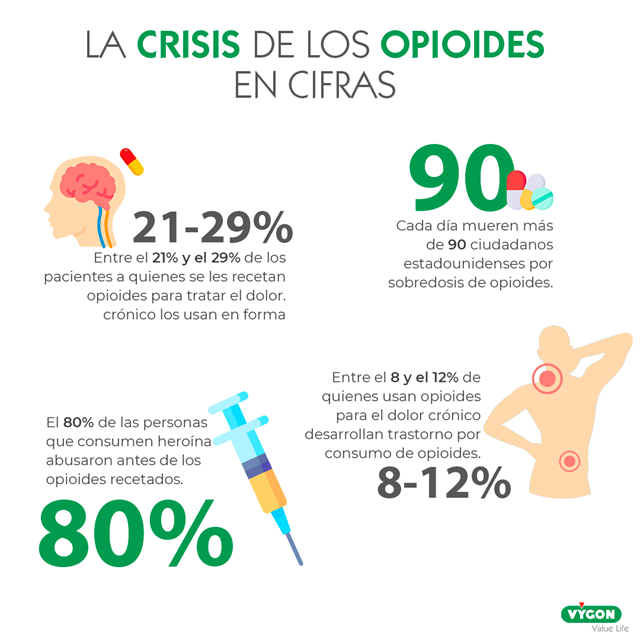
  1. Por primera vez en la historia de Estados Unidos, una persona tiene más probabilidades de morir por una sobredosis accidental de opioides que por un accidente de tráfico.
  2. La prescripción adecuada de opioides es esencial para proteger la salud y la seguridad de los beneficiarios de Medicare. Uno de cada tres beneficiarios de la Parte D de Medicare recibió un opioide recetado en 2016.
  3. Sólo la mitad de los empleadores están muy seguros de que tienen las políticas y los recursos de RRHH adecuados para hacer frente al uso y abuso de opioides en el lugar de trabajo.
  4. Los empleadores están más preocupados por la contratación de trabajadores cualificados, y por los beneficios de los empleados y los costes de compensación de los trabajadores, que por el uso de opioides de prescripción legal por parte de los empleados o el uso/venta ilícita de opioides.
  5. El uso indebido de opiáceos con receta entre los estudiantes de último año de secundaria se encuentra en su índice más bajo desde que la encuesta comenzó a evaluarlo.

ESTADÍSTICAS

  • Estados Unidos está inmerso en una epidemia de sobredosis de opioides. Los opioides (incluidos los opioides recetados, la heroína y el fentanilo) mataron a más de 47.600 personas en 2017, más que cualquier otro año registrado. El 37% de todas las muertes por sobredosis de opioides implican un opioide recetado.
  • 95% – En 2017, el 95% de las 70.067 muertes por sobredosis en Estados Unidos se produjeron entre la población en edad laboral, personas de entre 15 y 64 años. Se desconoce cuántos estaban empleados en el momento de su muerte.
  • 3,8% – Según la Encuesta Nacional sobre el Uso de Drogas y la Salud, se estima que el 3,8% de los encuestados de 18 años o más informaron del uso de opioides ilícitos en el último año. Se estima que el 63,0% de estos consumidores de opiáceos ilícitos autodeclarados estaban empleados a tiempo completo o parcial.
  • 25% – La Oficina de Estadísticas Laborales (BLS) informó que las muertes por sobredosis en el trabajo por uso no médico de drogas o alcohol aumentaron al menos un 25% anualmente entre 2013 y 2017. Las 272 muertes por sobredosis en el lugar de trabajo reportadas en 2017 representaron el 5,3% de las muertes por lesiones laborales ese año, en comparación con el 1,8% en 2013. Se desconoce cuántas de estas muertes fueron causadas por opioides específicamente.
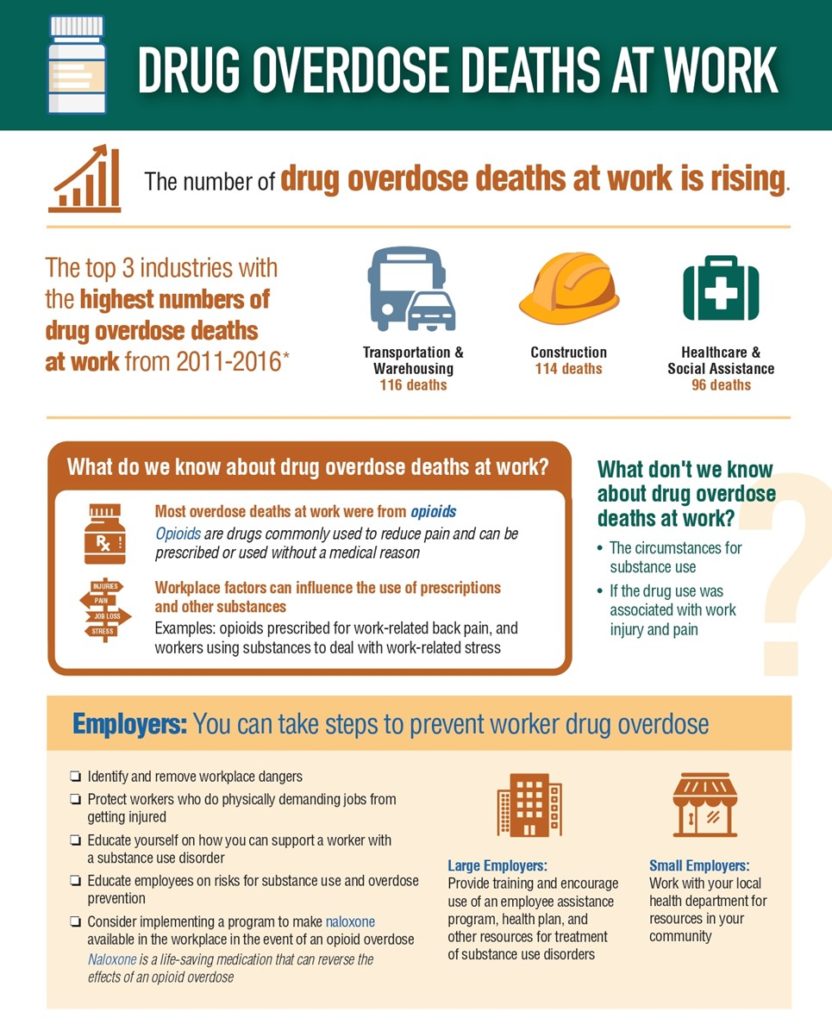
  • En un análisis del NIOSH de los datos del BLS para los años 2011 a 2016, el 43% de las muertes por sobredosis de drogas en el trabajo se produjeron en solo tres industrias: Transporte y Almacenamiento, Construcción y Asistencia Sanitaria y Social.
  • 14,8 días – Los trabajadores con un trastorno por consumo de sustancias actual pierden una media de 14,8 días al año, mientras que el subconjunto con un trastorno por consumo de analgésicos pierde una media de 29 días al año. Esto contrasta con una media de 10,5 días para la mayoría de los empleados, y una media de 9,5 días para los trabajadores que se están recuperando de un trastorno por consumo de sustancias.
  • Las visitas a los servicios de urgencias por sobredosis de opioides aumentaron un 30% en todas las partes de Estados Unidos desde julio de 2016 hasta septiembre de 2017.
  • Más de 760.000 personas han muerto desde 1999 por sobredosis de drogas. Dos de cada tres muertes por sobredosis de drogas en 2018 involucraron un opioide.


Opioid Abuse Fatality Report – Spanish

El impacto de la crisis de los opioides llegó a la comunidad médica de Missouri el 15 de diciembre de 2014. Ese fue el día en que, a solo dos meses de cumplir 30 años, Derek sucumbió a una sobredosis de opioides.

La noticia fue devastadora para su madre, Kelly O’Leary, voluntaria desde hace mucho tiempo de la Alianza de la Sociedad Médica Metropolitana de San Luis, y su marido Timothy O’Leary, MD, oncólogo de radiación en el Hospital Mercy Jefferson, cerca de San Luis.

“Era un buen chico. Era muy inteligente y no quería que esto sucediera”, dijo Kelly. “Su muerte fue completamente innecesaria”.

Según los estándares normales, Derek estaba bien logrado para su edad. Se había graduado en la universidad, había obtenido un MBA y había servido durante cinco años en la Marina de Estados Unidos. Estaba comprometido para casarse. Pero, en los últimos 12 años, también había luchado de forma intermitente contra la adicción a los opiáceos.

La relación de Derek con los opioides comenzó de forma inocente. En 2002, tras romperse el brazo jugando al fútbol americano en el instituto a los 17 años, le recetaron Oxycontin como medida normal para aliviar el dolor. Un año después, jugando al fútbol, se rompió el brazo en el mismo lugar. Le volvieron a recetar Oxycontin.

Derek había descrito a su madre cómo, más allá del alivio del dolor, el Oxycontin le hacía sentir diferente.

Después del instituto, Derek asistió a la Universidad de Florida, donde se licenció. Pero Kelly veía que las cosas no iban bien. Después de la universidad, la familia le instó a iniciar un tratamiento ambulatorio. Kelly recordó: “Había estado bebiendo mucho y abusando de las recetas. Encontraron Vicadin en su organismo. Tuvo un fallo hepático a los 22 años por culpa del Vicadin”.

Afortunadamente, el tratamiento ambulatorio tuvo éxito. Derek trabajó durante un año y luego se alistó en la Marina, donde manejaba radares y sonares. En la Marina, los marineros son sometidos a pruebas de drogas con regularidad, señaló Kelly.

Pero en su quinto año en la Marina, tuvo mala suerte y se lesionó la rodilla. Los cirujanos de la Marina le practicaron una cirugía experimental. Sin conocer el historial de Derek o a pesar de él, le recetaron Oxycontin. La adicción volvió a aparecer. Derek siguió recibiendo recetas del enfermero.

Finalmente, la Marina se dio cuenta de que tenía un problema y le puso en tratamiento, que continuó después de terminar su alistamiento.

Once meses después de dejar la Marina, Derek vivía en Toronto con su novia. Planeaban casarse y mudarse a San Luis.

Pero la adicción se impuso. Derek fue encontrado muerto en su apartamento ese diciembre. El informe toxicológico mostró que su organismo contenía fentanilo, la forma sintética de alta potencia de la heroína. También se encontraron cinco medicamentos recetados que obtenía a través de la VA como veterano discapacitado.


Opioid Abuse – Picture This – Spanish


Fall Protection Meeting Kit

Working at heights is any work where a person could fall a distance and be injured. This event might include, for example, falling from a step ladder, off of a roof, or through an unguarded hole in the ground or floor. Fall protection may also be required when working above an open-top tank, bin, hopper, or vat.

FALLS IN THE WORKPLACE – CAUSES

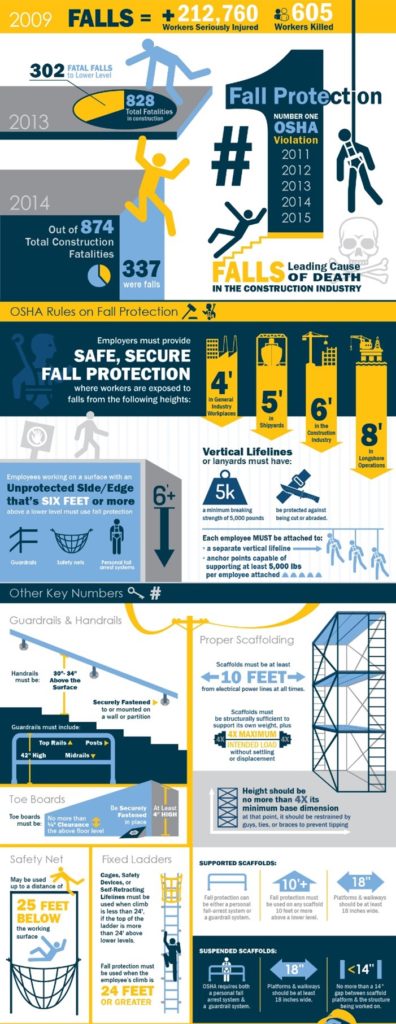
OSHA requires that fall protection be provided at elevations of four feet in general industry workplaces, five feet in shipyards, six feet in the construction industry and eight feet in longshoring operations. In addition, OSHA requires that fall protection be provided when working over dangerous equipment and machinery, regardless of the fall distance.

WORKERS FALL DESPITE PREVENTION EFFORTS

  • Unguarded leading edges
  • Open holes
  • Improper or missing guardrails
  • Damaged equipment (ladders, stairs, safety equipment, etc.)
  • Unmarked elevation changes
  • working conditions such as poor lighting, slippery walking surfaces, and poor housekeeping practices exist;
  • fall-protection equipment is not available, not used, or is misused;
  • work practices are poor due to unclear job procedures, lack of training for workers and workers rushing and taking short-cuts to meet deadlines.

BEST PRACTICES TO AVOID FALLS IN THE WORKPLACE

The best way to avoid falls is by eliminating work tasks that require working at heights in the first place. Elimination is not always possible so the risk of falling has to be mitigated through safeguards.

  • Engineering controls such as physical barriers and guardrails are two fall prevention systems that are effective in preventing falls from heights.
  • Using a proper fall arrest system such as a full body harness, self-retracting lanyard, and approved anchor point with 100% tie-off is another way to prevent or mitigate the consequences of a fall.
  • Proper use of ladders. This includes using three points of contact when climbing, not leaning to one side while on the ladder, setting the ladder at the proper angle, securing the ladder, etc.
  • Proper housekeeping in work areas is important in preventing falls at the same level as well as falls from heights.
  • Warning signs and other methods of communicating fall hazards to nearby workers.

OSHA FALL PROTECTION FOR WORKERS

Effective fall protection comes in two basic forms: fall restraint systems and fall arrest systems.

Guardrails and handrails

  • Guardrails must include top rails, midrails, and posts, and must be 42 inches’ high
  • Stair rails must be securely fastened to or mounted on a wall or partition, and be 30 to 34 inches above the surface

Toe boards

  • Use barriers at the base of a working area, and prevent tools from falling or employees’ feet from slipping over an edge
  • Must be at least four inches high, be securely fastened in place, and have no more than 1/4-inch clearance above floor level

Full-body or chest harness

  • Keeps an employee suspended in the event of a fall
  • Body belts, which work in conjunction with harnesses, are not by themselves considered acceptable as part of a personal fall arrest system in the construction industry and should be used only for positioning.

Safety net

  • May be used up to a distance of 25 feet below the working surface
  • Especially useful on construction sites

Proper scaffolding

  • When scaffolding is at least 10 feet above the lower level, a competent person must determine the feasibility and safety requirements for providing fall protection for employees building or dismantling scaffolds
  • Scissor lifts are considered to be scaffolding and require fall protection when at least 10 feet off the ground; however, most scissor lifts are outfitted with guardrails, which satisfies OSHA’s fall protection requirement
  • When working on suspended scaffolding, employees must be tied to an anchor point or use a fall protection system that’s not connected to the scaffold

TRAINING, TRAINING, TRAINING 

Without proper and timely training both at the onset of employment and updated refresher programs, all the words of caution and prevention of fall dangers and hazards will go unanswered.

All new and current employees should be given instructions on the proper use of fall protection devices before they begin to work. Prior to permitting employees into areas where fall hazards exist, all employees must also be trained regarding fall protection plan requirements.

FINAL WORD

There are many factors that can cause or contribute to a fall occurring in the workplace. Unsafe conditions paired with unsafe actions of workers while working at heights is a recipe for disaster.


Fall Protection Stats and Facts

FACTS

Workers continue to fall because:

  1. working conditions such as poor lighting, slippery walking surfaces, and poor housekeeping practices exist.
  2. protective devices like guardrails are missing.
  3. equipment such as ladders and scaffolds are in poor condition or not used properly.
  4. fall-protection equipment is not available, not used, or is misused,
  5. work practices are poor due to unclear job procedures, lack of training for workers and workers rushing and taking short-cuts to meet deadlines.
  6. The highest frequency of fall-related fatalities was experienced by the construction industry, while the highest counts of nonfatal fall injuries continue to be associated with the health services and the wholesale and retail industries. (CDC)

STATS

  • Falls are one of the leading causes of unintentional injuries in the United States, accounting for approximately 8.9 million visits to the emergency department. (NSC)
  • A total of 5,190 workers were killed on the job in 2016; 849 of them died from falls. Of those, approximately 170 died from a fall off of a ladder, and falls of six feet or greater off of ladders are often fatal.
  • In 2016 there were 229,240 nonfatal cases involving falls, slips, trips; the lowest since 2014.
  • In 2016 there were 849 fatal work-related falls, slips, and trips (in all sectors), with an increase every year since 2011 with 681.
  • Services, wholesale, and retail trade industries account for 60 percent of slip and fall accidents.
  • At 25 percent, slip and fall injuries are the most frequently reported work accidents.
  • Falls are the primary cause of lost time at work.
  • 22 percent of falls result in more than 31 days of missed work.
  • In Canada, more than 40,000 workers get injured annually due to fall accidents.


Fall Arrest: Fatality Report

Cessco Fabrication and Engineering Ltd. pleaded guilty in Edmonton Alberta provincial court to a single charge of failing to ensure a worker used a fall protection system for the Jan. 19, 2016, death of Barry Maitland.

Maitland, a pressure welder for 29 years, was fatally injured after falling more than five metres (17 feet) from the top of a liquified natural gas storage vessel on which he was preforming a weld. He later died in hospital.

“We miss him,” Linda Maitland, his widow, said outside court. “The kids still talk about him today. My granddaughter especially — ‘I miss papa, I wish he was here.’ Because you don’t say goodbye.”

Maitland had just started a night shift in a fabrication shop at Cessco’s Edmonton facility at 7310 99 St. on the day of the accident.

Maitland, 52, was setting up to perform a weld on top of the LNG equipment, which measured 28 metres long and just over four metres in diameter. At some point, he stepped off an aerial work platform used to hold his welding equipment.

An agreed statement of facts states Maitland did not anchor the lanyard on his fall protection harness before stepping off the platform. A short time later, the night shift supervisor and another worker heard Maitland hit the concrete floor, though no one witnessed the fall itself.

Under a joint submission on sentencing, Cessco will pay a $5,000 fine and pay the Manufacturer’s Health and Safety Association $170,000 to create an enhanced fall protection program.

An autopsy found Maitland’s cause of death was blunt cranial trauma, according to the agreed facts. It also found evidence of alcohol in his system and severe heart disease, including an enlarged heart.

A medical examiner said it was possible Maitland experienced symptoms of angina or irregular heartbeat, which could have contributed to the fall.

Court heard Maitland was known as a very safety conscious worker who regularly raised issues during safety meetings. His family described him as “anal retentive when it came to safety.”

He loved to cook, and was famous within his family for his homemade pizzas. He also mentored family members entering the welding trade.

“The boys were constantly trying to upstage their dad — ‘I’m a better welder, I can do this better than you can,’” Linda Maitland recalled. “Barry would be like, ‘Yeah, no, I don’t think so, let’s go try.’”

Linda Maitland said that while she received compensation from Occupational Health and Safety for her husband’s death, she will end up having to sell her home.

As for the sentence, “I’m OK with it,” she said. “They’re looking into becoming safer, and I know they’re remorseful. The right guys that should have heard my victim impact statement aren’t here.”


Fall Protection – Picture This


Flu Safety Meeting Kit

INTRODUCTION

Who has not experienced being affected with the flu at some point? For those older than 65 and those who have weak immune systems are particularly at risk. Flu seasons vary in intensity from year to year. In the past 3 decades, the influenza virus has been most active in February and December. But the virus is usually most active in late October and lasts as late as early May.

FLU VACCINATIONS

Cold and flu prevention in the workplace image Influenza vaccination is the best way to prevent infection with the flu, but no vaccines are available to prevent common colds. A flu shot is also recommended for individuals with a high risk of flu complications.

Influenza vaccination reduces the likelihood of flu even for healthy adults. It is important to get a flu shot every year, as the vaccines are updated annually to include the most recent influenza strains.

To ensure the vaccine has enough time to stimulate antibody production before flu season, make sure you are vaccinated during autumn. Workplace vaccination is mandatory and paid for by employers of people who work in some industries (e.g. for healthcare workers in direct contact with patients or infected body fluids). In other industries it is voluntary, although employers may fund workplace vaccination programs because they maximize the number of employees who get immunized and minimize absenteeism due to influenza infection. Employers may also help their staff get vaccinated by making it easier to get the flu shot.

GENERAL PREVENTION OF THE FLU SPREAD

Ways to Prevent the Spread of the Flu

  1. Getting vaccinated the single best way to prevent getting the flu.
  2. Avoid close contact with people who are sick. When you are sick, keep your distance from others to protect them from getting sick too.
  3. If possible, stay home from work, school, and errands when you are sick. This will help prevent spreading your illness to others. Image if over half of your work crew missed work for more than a week because of an infected worker coming into work. In some businesses where timelines are tight a situation like this can cause serious financial issues.
  4. Cover your mouth and nose with a tissue when coughing or sneezing. It may prevent those around you from getting sick.
  5. Washing your hands often will help protect you from germs. If soap and water are not available, use an alcohol-based hand rub.
  6. Avoid touching your eyes, nose, mouth. Germs are often spread when a person touches something that is contaminated with germs and then touches his or her eyes, nose, or mouth.
  7. Clean and disinfect frequently touched surfaces at home, work or school, especially when someone is ill. 

TIPS FOR PREVENTING THE SPREAD OF FLU AT WORK

Employees are crucial resource at any business. Steps to take during to flu season, to protect employees are:

  1. Encourage all employees to get a seasonal flu vaccine each fall. CDC recommends everyone 6 months and older get an annual flu vaccine.
  2. Consider hosting a flu vaccine clinic at your workplace, if possible. Provide resources to employees about where they can get a flu vaccine in their community. The vaccine finder application is a free online service to search for vaccines in your areas.
  3. Develop and review sick leave policies the encourage sick workers to stay at home without fear of any reprisals.
  4. Advise all employees to stay home if they are sick until at least 24 hours after their fever (temperature of 100 degrees Fahrenheit or 37.8 degrees Celsius or higher) is gone without the use of fever-reducing medicines.
  5. Sick employees should be asked to go home. Employees who appear to have a flu symptom upon arrival or become sick during the work day should be promptly separated from others and asked to go home.
  6. Develop other flexible policies to allow workers to telework (if feasible) and create other leave policies to allow workers to stay home to care for sick family members or care for children if schools close.
  7. Instruct employees who are well, but who have a sick family member at home with the flu, that they can go to work as usual. These employees should monitor who have a certain underlying medical condition or who are pregnant should promptly call their health care provider for advice if they become sick.
  8. Provide resources and a work environment that promotes preventive actions to reduce the spread of flu. For example, provide tissues, no-touch trash cans, hand soap, and/or hand sanitizer.
  9. Diseases can look different in men and women. That´s true of coronary artery disease. It´s true of osteoporosis, lupus, and depression. And it may be true of the flu. “The concept of the man flu, as commonly defined, is potentially unjust.” We need a better understanding of how the flu affects men and women and why it may affect them differently.
  10. Until then, we should all do what we can to prevent the flu and limit its spread. Getting the flu vaccination, good handwashing, and avoiding others while sick are good first steps.

MORE PROTECTION/PREVENTION

Staying Healthy Reduces the Risk of Infections like Cold and Flu.

  • Maintain a healthy diet.
  • Exercise regularly but avoid very strenuous exercise;
  • Avoid stress;
  • Get plenty of sleep;
  • Quit smoking:
  • Stay properly hydrated by drinking plenty of fluids;
  • Drink alcohol in moderation.

FINAL WORD

Workplaces should be equipped with a range of hygiene products that can be used to prevent transmission of cold and flu. These include tissues, soap, paper towels and disinfectant gels and wipes. Talk to your employer about providing these products if they do not already.


Flu Stats and Facts

FACTS

  1. Flu influenza is typically contagious for 24 hours before symptoms appear, and continuous to be contagious for up to seven days.
  2. Cold and flu spread more easily in cold winter months because they thrive in colder, less humid environments.
  3. Cold and flu viruses are highly contagious and the contagious period begins immediately after infection. In the early stages of infection, a person with a cold or flu does not have symptoms like a blocked nose or coughing.
  4. When an infected person coughs or sneezes, their cold or flu virus becomes airborne and survives for approx. one hour in the air. If another person inhales the air carrying the cold or flu droplets, they can catch the virus.

STATS

Flu statistics

  • Each year, 5% to 20% of the U.S population will get the flu on average.
  • Adults get the flu twice per decade on average, but children are infected once very year on average.
  • An estimated 140,000 to 810,000 Americans are hospitalized each year because of complications from the fly illness.
  • 12,000 to 6,000 people have died each year from flu related in the U.S over the past decade.

Flu transmission

  • People infected with the flu can spread it to others up to about 6 feet away through airborne droplets that are exchanged when people who have the flu cough, sneeze, or talk.
  • Those infected with the flu are mist contagious in the first three to four days after their illness begins, but the virus can be spread before those who are infected.

Here’s how you catch the flu:

  • 24 hours-how long you can infect others before you have flu symptoms.
  • 5-7 days-the length of time after getting sick that you can still pass infection.
  • 2 days-the time between when you´re exposed and when you show symptoms


Flu Fatality Report

The Flu Killed a Healthy 21-Year-Old Man.

Most people view influenza as routine, if unpleasant, possibility each winter. But the case of a 21-year-old man in Pennsylvania is a poignant reminder that sometimes, the worst-case scenario is more serious than sick days and bed rest.

Kyle Baughman, an aspiring personal trainer living in Latrobe, came home for Christmas not feeling well, his mother, Beverly, told WPXI. His symptoms persisted after returning to work after the holidays. ¨I think he thought, I just got the flu, I’ll be alright. I’ll go rest a little bit,¨ Beverly Baughman told WPXI.

Just a few days later, however, Kyle Baughman died at University pf Pittsburgh Medical Center Presbyterian hospital from flu-related organ failure, according to his family.



Flu – Picture This

What’s wrong in this picture? There are two office workers that are suffering flu illness on the worksite and they are being a potential individual to spread this illness to others easily. Flu is potentially a serious respiratory illness that can cause missed work, hospitalization, and, in some cases, even death.

Protect yourself from flu with a flu vaccine. While getting a flu vaccine will not protect against COVID-19, it can protect you from becoming sick with flu.

Employees are a crucial resource at any business. There are steps you can take now, and during the flu season, to help protect the health of your employees.

Flu vaccination is especially important for people at high risk for flu complications. Individuals at high risk for flu complications should seek medical attention right away if they do become sick with flu.


Flu Safety Meeting Kit – Spanish

QUÉ ESTÁ EN RIESGO

INTRODUCCIÓN

¿Quién no ha sufrido alguna vez la experiencia de verse afectado por la gripe? Los mayores de 65 años y las personas con un sistema inmunitario débil corren un riesgo especial. Las temporadas de gripe varían en intensidad de un año a otro. En las últimas 3 décadas, el virus de la gripe ha sido más activo en febrero y diciembre.   Pero el virus suele ser más activo a finales de octubre y dura hasta principios de mayo.

CUÁL ES EL PELIGRO

VACUNAS CONTRA LA GRIPE

Prevención de la gripe y el resfriado en el lugar de trabajo. La vacunación contra la gripe es la mejor manera de prevenir la infección por el virus de la gripe, pero no existen vacunas para prevenir los resfriados comunes. La vacuna de la gripe también se recomienda a las personas con alto riesgo de sufrir complicaciones por la gripe.

La vacunación antigripal reduce la probabilidad de contraer la gripe incluso en adultos sanos. Es importante vacunarse contra la gripe todos los años, ya que las vacunas se actualizan anualmente para incluir las cepas de gripe más recientes.

Para que la vacuna tenga tiempo suficiente para estimular la producción de anticuerpos antes de la temporada de gripe, asegúrese de vacunarse durante el otoño. La vacunación en el lugar de trabajo es obligatoria y pagada por los empleadores de las personas que trabajan en algunas industrias (por ejemplo, para los trabajadores sanitarios en contacto directo con pacientes o fluidos corporales infectados). En otros sectores es voluntaria, aunque los empresarios pueden financiar programas de vacunación en el lugar de trabajo porque así se maximiza el número de empleados que se inmunizan y se minimiza el absentismo debido a la infección por gripe. Los empresarios también pueden ayudar a su personal a vacunarse facilitando la obtención de la vacuna contra la gripe.

COMO PROTEGERSE

PREVENCIÓN GENERAL DEL CONTAGIO DE LA GRIPE

Formas de prevenir el contagio de la gripe

  1. Vacunarse es la mejor manera de prevenir el contagio de la gripe.
  2. Evite el contacto estrecho con personas enfermas. Cuando estés enfermo, mantén la distancia con los demás para evitar que ellos también enfermen.
  3. Si es posible, quédese en casa y no vaya al trabajo, al colegio o a hacer recados cuando esté enfermo. Esto ayudará a evitar el contagio de tu enfermedad a los demás. Imagínese que más de la mitad de su equipo de trabajo faltara al trabajo durante más de una semana debido a que un trabajador infectado llegara al trabajo. En algunas empresas en las que los plazos son ajustados una situación como esta puede causar graves problemas financieros.
  4. Cúbrase la boca y la nariz con un pañuelo de papel al toser o estornudar. Puede evitar que los que te rodean enfermen.
  5. Lavarse las manos con frecuencia le ayudará a protegerse de los gérmenes. Si no dispone de agua y jabón, utilice un desinfectante de manos a base de alcohol.
  6. Evite tocarse los ojos, la nariz y la boca. Los gérmenes suelen propagarse cuando una persona toca algo que está contaminado con gérmenes y luego se toca los ojos, la nariz o la boca.
  7. Limpie y desinfecte las superficies que se tocan con frecuencia en casa, el trabajo o la escuela, especialmente cuando alguien está enfermo.

CONSEJOS PARA PREVENIR EL CONTAGIO DE LA GRIPE EN EL TRABAJO

Los empleados son un recurso crucial en cualquier empresa. Los pasos a seguir durante la temporada de gripe, para proteger a los empleados son:

  1. Anime a todos los empleados a vacunarse contra la gripe estacional cada otoño. Los CDC recomiendan que todos los mayores de 6 meses se vacunen contra la gripe cada año.
  2. Considere la posibilidad de organizar una clínica de vacunación contra la gripe en su lugar de trabajo, si es posible. 3. Proporcione recursos a los empleados sobre dónde pueden vacunarse contra la gripe en su comunidad. La aplicación de búsqueda de vacunas es un servicio gratuito en línea para buscar vacunas en sus áreas.
  3. Desarrolle y revise las políticas de baja por enfermedad que animan a los trabajadores enfermos a quedarse en casa sin miedo a ninguna represalia.
  4. Aconseje a todos los empleados que se queden en casa si están enfermos hasta al menos 24 horas después de que la fiebre (temperatura de 100 grados Fahrenheit o 37,8 grados Celsius o más) haya desaparecido sin el uso de medicamentos antifebriles.
  5. Se debe pedir a los empleados enfermos que se vayan a casa. Los empleados que parezcan tener un síntoma de gripe al llegar o que se enfermen durante la jornada laboral deben ser separados rápidamente de los demás y se les debe pedir que se vayan a casa.
  6. Desarrolle otras políticas flexibles que permitan a los trabajadores laborar por teletrabajo (si es factible) y cree otras políticas de permisos que permitan a los trabajadores quedarse en casa para cuidar a familiares enfermos o cuidar a los niños si los colegios cierran.
  7. Indique a los empleados que estén bien, pero que tengan un familiar enfermo en casa con gripe, que pueden ir a trabajar como de costumbre. Estos empleados que tienen una determinada condición médica subyacente o que están embarazadas deben llamar rápidamente a su proveedor de atención médica para que les aconseje si se enferman.
  8. Proporcione recursos y un entorno de trabajo que promueva acciones preventivas para reducir la propagación de la gripe. Por ejemplo, proporcione pañuelos de papel, cubos de basura que no se puedan tocar, jabón de manos y/o desinfectante de manos.
  9. Las enfermedades pueden tener un aspecto diferente en hombres y mujeres. Así ocurre con la enfermedad de las arterias coronarias. Lo mismo ocurre con la osteoporosis, el lupus y la depresión. Y puede ser cierto en el caso de la gripe. “El concepto de gripe masculina, tal como se define comúnmente, es potencialmente injusto”. Necesitamos comprender mejor cómo afecta la gripe a los hombres y a las mujeres y por qué puede afectarles de forma diferente.
  10. Hasta entonces, todos debemos hacer lo que podamos para prevenir la gripe y limitar su propagación. Vacunarse contra la gripe, lavarse bien las manos y evitar a los demás mientras se está enfermo son buenos primeros pasos.

MÁS PROTECCIÓN/PREVENCIÓN

Mantenerse sano reduce el riesgo de infecciones como el resfriado y la gripe.

  • Mantenga una dieta saludable.
  • Haga ejercicio con regularidad, pero evita los ejercicios muy extenuantes;
  • Evite el estrés;
  • Duerma mucho;
  • Dejar de fumar:
  • Manténgase bien hidratado bebiendo mucho líquido;
  • Beba alcohol con moderación.

CONSEJOS DE SALUD

Duerma lo suficiente, manténgase físicamente activo, controle el estrés, beba mucho líquido y coma alimentos nutritivos.

CONCLUSIÓN

Los lugares de trabajo deben estar equipados con una serie de productos de higiene que pueden utilizarse para prevenir la transmisión del resfriado y la gripe. Entre ellos se encuentran pañuelos de papel, jabón, toallas de papel y geles y toallitas desinfectantes. Hable con su empleador para que le proporcione estos productos si aún no lo hace.


Flu Stats and Facts – Spanish

HECHOS

  1. La gripe es normalmente contagiosa durante 24 horas antes de que aparezcan los síntomas, y continúa siendo contagiosa hasta siete días.
  2. El resfriado y la gripe se propagan más fácilmente en los meses fríos de invierno porque se desarrollan en ambientes más fríos y menos húmedos.
  3. Los virus del resfriado y la gripe son muy contagiosos y el periodo de contagio comienza inmediatamente después de la infección. En las primeras etapas de la infección, una persona resfriada o con gripe no presenta síntomas como la nariz tapada o la tos.
  4. Cuando una persona infectada tose o estornuda, su virus del resfriado o de la gripe se transmite por el aire y sobrevive durante aproximadamente una hora en el aire. Si otra persona inhala el aire que transporta las gotitas del resfriado o la gripe, puede contagiarse del virus.

ESTADÍSTICAS

Estadísticas de la gripe

  • Cada año, entre el 5% y el 20% de la población estadounidense contrae la gripe por término medio.
  • Los adultos contraen la gripe dos veces por década de media, pero los niños se infectan una vez al año de media.
  • Se calcula que entre 140.000 y 810.000 estadounidenses son hospitalizados cada año por complicaciones derivadas de la enfermedad de la mosca.
  • Entre 12.000 y 6.000 personas han muerto cada año por causas relacionadas con la gripe en EE.UU. durante la última década.

Transmisión de la gripe

  • Las personas infectadas por la gripe pueden contagiarla a otras a una distancia de hasta 1,8 metros a través de las gotitas que se intercambian en el aire cuando las personas que tienen la gripe tosen, estornudan o hablan.
  • Las personas infectadas por la gripe son más contagiosas en los primeros tres o cuatro días tras el comienzo de su enfermedad, pero el virus puede propagarse antes que los infectados.

A continuación se explica cómo se contrae la gripe:

  • 24 horas-el tiempo que se puede contagiar a otras personas antes de presentar los síntomas de la gripe.
  • 5-7 días-el tiempo después de enfermarse que aún puede transmitir la infección.
  • 2 días: el tiempo que transcurre entre la exposición y la aparición de los síntomas.


Flu Fatality Report – Spanish

La gripe mató a un hombre sano de 21 años.

La mayoría de la gente ve la gripe como una posibilidad rutinaria, aunque desagradable, cada invierno. Pero el caso de un hombre de 21 años en Pensilvania es un recordatorio conmovedor de que, a veces, el peor escenario es más grave que los días de enfermedad y el reposo en cama.

Kyle Baughman, un aspirante a entrenador personal que vivía en Latrobe, llegó a casa por Navidad sin sentirse bien, dijo su madre, Beverly, a WPXI. Sus síntomas persistieron después de volver al trabajo tras las vacaciones. ¨Creo que pensó, ‘Sólo tengo la gripe, estaré bien. Voy a descansar un poco”, dijo Beverly Baughman a WPXI.

Sin embargo, pocos días después, Kyle Baughman murió en el hospital Presbiteriano del Centro Médico de la Universidad de Pittsburgh por un fallo orgánico relacionado con la gripe, según su familia.


Flu – Picture This – Spanish

¿Qué hay de malo en esta imagen? Hay dos trabajadores de la oficina que están sufriendo la enfermedad de la gripe en el lugar de trabajo y están siendo un individuo potencial para propagar esta enfermedad a otros fácilmente. La gripe es una enfermedad respiratoria potencialmente grave que puede causar bajas laborales, hospitalización y, en algunos casos, incluso la muerte.

Protéjase de la gripe con la vacuna antigripal. Aunque vacunarse contra la gripe no le protegerá contra el COVID-19, sí puede protegerle de enfermar de gripe.

Los empleados son un recurso crucial en cualquier empresa. Hay medidas que puede tomar ahora, y durante la temporada de gripe, para ayudar a proteger la salud de sus empleados.

La vacunación contra la gripe es especialmente importante para las personas con alto riesgo de sufrir complicaciones por la gripe. Las personas con alto riesgo de sufrir complicaciones por la gripe deben buscar atención médica de inmediato si se enferman de gripe.


Opioid Abuse Meeting Kit

Opioid dependency is on the rise in the United States, whether it is prescription medications or illegal substances such as heroin.  Companies and safety managers can combat substance abuse in the workplace with an Employee Assistance Program targeting both alcohol and drug dependency on the job.

WHAT ARE OPIOIDS?

The term “opioids” refers to prescription medications used to relieve pain as well as illegal drugs such as heroin. Opioids are highly addictive. In New Hampshire, and across the United States, there is an opioid addiction crisis. This crisis includes heroin, street fentanyl, other illicit opioids, and the misuse of prescription drugs.

The repercussions of this crisis are many, including overdose deaths, self-neglect and neglect of loved ones, child and elder abuse, newborns experiencing withdrawal, unemployment, homelessness, and health effects such as HIV, Hepatitis C, liver damage and heart problems.

4 MAIN ISSUES

The four main issues arising with drug and alcohol abuse in the workplace are:

  • Premature death/fatal accidents
  • Injuries/accident rates
  • Absenteeism/extra sick leave
  • Loss of production

OPIOID ABUSE: EAP PRESCRIPTION

Rather than firing an employee after drug or alcohol use is discovered, an EAP with alcohol and drug treatment pays for itself mainly with a reduction in healthcare costs, according to National Council on Alcoholism and Drug Dependence.

OPIOID ABUSE EFFECTS

The side effects of opioid abuse are fairly varied and may include:

  • Drowsiness
  • Lethargy
  • Paranoia
  • Respiratory depression

Imagine how opioid abuse and the side effects it brings could have negative effects on the work of those who suffer from addiction. Not only is the person who is under the influence of the drugs at an increased risk for injury or death while at work, but everyone around the worker is as well.

ADDICTION ISSUES

Substance use is often thought of as an addiction or dependence, but use can be anywhere on the spectrum or scale from recreational to frequent to problematic. As a result, there are varying impacts on lives and work. The Centre for Addiction and Mental Health use the following “4 C’s” to describe addiction:

  • craving
  • loss of control of amount or frequency of use
  • compulsion to use
  • use despite consequences

ELEMENTS OF WORK THAT CONTRIBUTE TO THE USE OF SUBSTANCES

Various and numerous organizational, personal and social factors can play a major role why a person may choose to use a substance. In general, however, some work-related factors can include:

  • high stress,
  • high demand/low control situations,
  • low job satisfaction,
  • long hours or irregular shifts,
  • fatigue,
  • repetitious duties,
  • periods of inactivity or boredom,
  • isolation,
  • lack of opportunity for promotion,
  • lack of, remote, or irregular supervision and,
  • easy access to substances.

RESOURCES TO HELP EMPLOYEES

Here are some ways to help your employees manage pain:

  • Fight the stigma. Let employees know that they can confidentially seek treatment without jeopardizing their jobs.
  • Take advantage of the EAP. An Employee Assistance Program (EAP) offers counseling, information and support for all types of issues. It’s especially useful for managers to help with unfamiliar situations such as opioid misuse in the workplace.
  • Educate employees. Let your employees know the risks of opioids. Help educate them about other options for managing pain: occupational therapy, physical therapy, behavioral health treatment, acupuncture and massage.
  • Draft a written policy. Your company’s legal department can assist with drafting a policy that addresses the use of prescribed opioids as well as the risks of opioid misuse in the workplace to help ensure employees are safe and healthy.
  • Conduct supervisor training. Managers also need proper education and training about the resources available to help an employee who may be experiencing a personal or family problem involving opioids.

FINAL WORD

If you suspect a coworker is suffering from an addiction problem speak with a supervisor. Opioid abuse is not just their problem when it carries over into the workplace. The side effects these drugs bring with their use can create dangerous situations where many people could be injured or killed on the job.


Opioid Abuse Stats and Facts

FACTS

  1. For the first time in U.S. history, a person is more likely to die from an accidental opioid overdose than from a motor vehicle crash.
  2. Appropriate prescribing of opioids is essential to protecting the health and safety of Medicare beneficiaries. One in three Medicare Part D beneficiaries received a prescription opioid in 2016.
  3. Only half of employers are very confident that they have the appropriate HR policies and resources to deal with opioid use and misuse in the workplace.
  4. Employers are more concerned about hiring qualified workers, and employee benefits and worker compensation costs than they are about employee use of legal prescription opioids or illicit use/sale of opioids.
  5. Misuse of prescription opioids among high school seniors is at its lowest rate since the survey began assessing it.

STATS

  • The US is in the midst of an opioid overdose epidemic. Opioids (including prescription opioids, heroin, and fentanyl) killed more than 47,600 people in 2017, more than any year on record. 37% of all opioid overdose deaths involve a prescription opioid.
  • 95% – In 2017, 95% of the 70,067 US drug overdose deaths occurred among the working age population, persons aged 15-64 years. It is unknown how many were employed at the time of their death.
  • 8% – According to the National Survey of Drug Use and Health, an estimated 3.8% of respondents age 18 years or older reported illicit opioid use in the past year. An estimated 63.0% of these self-reported illicit opioid users were employed full- or part-time.
  • 25% – The Bureau of Labor Statistics (BLS) reported that overdose deaths at work from non-medical use of drugs or alcohol increased by at least 25% annually between 2013 and 2017. The 272 workplace overdose deaths reported in 2017 accounted for 5.3% of occupational injury deaths that year, as compared to 1.8% in 2013. It is unknown how many of these deaths were caused by opioids specifically.
  • In a NIOSH analysis of BLS data for the years 2011 to 2016, 43% of drug overdose deaths at work occurred in only three industries – Transportation & Warehousing, Construction, and Healthcare & Social Assistance.
  • 8 days – Workers with a current substance use disorder miss an average of 14.8 days per year, while the subset with a pain medication use disorder miss an average of 29 days per year. This is in contrast to an average of 10.5 days for most employees, and an average 9.5 days for workers in recovery from a substance use disorder.
  • Emergency department visits for opioid overdoses rose 30% in all parts of the US from July 2016 through September 2017.
  • More than 760,000 people have died since 1999 from a drug overdose. Two out of three drug overdose deaths in 2018 involved an opioid.


Opioid Abuse Fatality Report

The impact of the opioid crisis struck home within the Missouri physician community on Dec. 15, 2014. That’s the day when, just two months’ shy of his 30th birthday, Derek succumbed to an opioid overdose.

The news was devastating for his mother, Kelly O’Leary, a long-time volunteer with the St. Louis Metropolitan Medical Society Alliance, and her husband Timothy O’Leary, MD, a radiation oncologist at Mercy Jefferson Hospital near St. Louis.

“He was a good kid. He was very smart, and didn’t want this to happen,” Kelly said. “His death was completely unnecessary.”

By normal standards, Derek was well-accomplished for his age. He had graduated from college, earned an MBA, and served for five years in the U.S. Navy. He was engaged to be married. But, over the last 12 years, he had also struggled off and on with opioid addiction.

Derek’s involvement with opioids began innocently. In 2002, after breaking his arm playing high school football at age 17, he was prescribed Oxycontin as a normal course of pain relief. Then, playing football a year later, he broke his arm in the same place. He was prescribed Oxycontin again.

Derek had described to his mom how, beyond pain relief, the Oxycontin made him feel different.

After high school, Derek attended the University of Florida where he earned a bachelor’s degree. But Kelly could see things were not right. Following college, the family urged him to enter outpatient treatment. Kelly recalled: “He had been drinking a lot and abusing prescriptions. They found Vicadin in his system. He had liver failure at age 22 from Vicadin.”

Fortunately, the outpatient treatment was successful. Derek worked for a year and then joined the Navy where he handled radar and sonar. In the Navy, sailors are drug tested regularly, Kelly noted.

But in his fifth year in the Navy, he ran into bad luck and injured his knee. Navy surgeons performed an experimental surgery. Unaware of Derek’s history or in spite of it, they prescribed Oxycontin. The addiction returned. Derek continued to get prescriptions from the nurse practitioner.

Eventually the Navy did realize he had a problem, and got him into treatment which he continued after his enlistment ended.

Eleven months after leaving the Navy, Derek was living in Toronto with his girlfriend. They planned to marry and move to St. Louis.

But the addiction took over. Derek was found dead in his apartment that December. The toxicology report showed his system had fentanyl, the high-potency synthetic form of heroin. They also found five prescription medications he was obtaining through the VA as a disabled veteran.



Opioid Abuse – Picture This


OSHA Program Wizard: Fleet Safety Program

In 2020 the Bureau of Labor Statistics reported that transportation and material moving occupations had the highest number of fatalities.  The most dangerous profession was heavy and tractor-trailer truck drivers, with 766 deaths in 2020. Implementing a comprehensive fleet safety program provides the framework and systematic approach to reducing the risk associated with fleet operations.


Quick Course – Know How To Find Emergency Exits

Every day, without noticing, we pass doors that have “Exit” signs. Usually we don’t remember that emergency exit doors are vital to our safety.


Chemical Safety Course

Key Takeaways:

– Identifying all workplace chemical hazards and the risks associated with them.
– Understanding the conditions which present an exposure risk, possible routes of exposure, and the factors influencing an individual’s reaction to a chemical exposure incident.
– Practicing safety precautions on the behalf of both workers and employers to minimize exposure to chemicals.
– Learning safe storage, transport, and disposal practices for hazardous chemicals.
– Understanding appropriate response actions in the event of a chemical incident.

Course Description

This course will teach trainees to recognize chemical hazards in the workplace, being able to detect them, protect themselves and understand existing Hazcom programs.


Off The Job Safety Course

This course will cover the most common hazards off the job and how to avoid them.