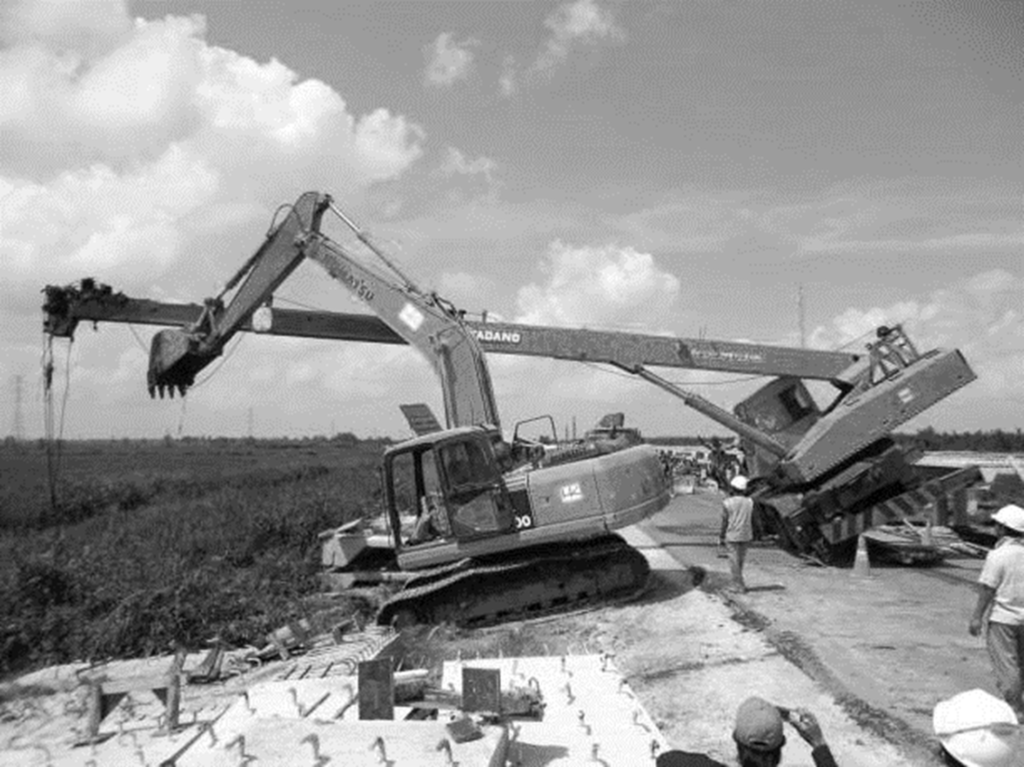
Heavy Equipment Operation – Picture This – Spanish

¿Qué hay de malo en esta imagen? Casi todos los proyectos de construcción cuentan con equipos y maquinaria pesados que se utilizan para realizar tareas y fines diversos. Las maquinarias pesadas, como las excavadoras y las pavimentadoras, ayudan a los trabajadores de la construcción a realizar más trabajo en menos tiempo. Sin embargo, aunque las maquinarias pesadas ayudan a realizar más trabajo con mayor rapidez, también pueden ser peligrosos si no se utilizan correctamente. Usted y su maquinaria tendrán que evaluar su entorno operativo y otras condiciones de trabajo para asegurarse de que su maquinaria pesada se utiliza correctamente. La maquinaria pesada sólo debe ser manejada por un profesional certificado que tenga la formación y experiencia adecuadas para la maquinaria en cuestión, junto con la supervisión de la dirección.


Good Enough Mindset Meeting Kit

We have all heard the refrain its ¨good enough¨. However when dealing with workplace safety that phrase ¨good enough¨ does not meet the safety bar. Safety is all about identifying and addressing hazards in the workplace. Proper time and moreover energy must be applied to eliminate, or at least to mitigate Hazards in addition to the identification of those hazards.

What is the origin of the phrase ¨Good Enough¨?

Here are some reasons why workers may accept unnecessary risk performing their responsibilities.

  1. Complacency. For individuals who have been doing their work for long periods of time, complacency can be one of the biggest challenges to avoiding a “good enough” mindset.
  2. Lack of training or understanding. Some workers, especially those less experienced, may not understand the importance of taking certain steps to protect themselves and those around them while completing their work.
  3. The culture of their work group or the company as a whole support tolerating risk. When supervisors or coworkers do not follow safety rules or procedures then others around them are more willing to also not follow the rules and settle for good enough.
  4. Lack of energy or fatigue. There are many times we do not feel 100%. Lack of energy is a huge problem across the U.S. with all the demands we deal with both at home and at work. When fatigue or lack of energy becomes an issue our work suffers, including being safe while at work.

HOW TO AVOID A “GOOD ENOUGH” MINDSET

Here are tips to help create your own safety MINDSET and avoid a ¨Good Enough¨ MINDSET:

AWARE: Pay attention. Stay alert to the possible hazards in your work environment so that you can take steps to correct or guard against them. For example, knowing that there’s snow and ice on the ground will help you wear the correct footwear and be mindful of walking around icy spots.

FOCUS: Concentrate on the task(s) at hand. Distractions, boredom or fatigue can lead to accidents and other safety hazards. Take good care of yourself. Getting plenty of rest and staying alert may prevent accidents.

STRONG: Have the strength to do the right thing even when it’s easier not to. Follow safety procedures. Remind co-workers of safety precautions. Follow district policy at all times.

PATIENCE: Take the time to do things correctly every time – like always buckling your seatbelt, even on quick trips. Be aware of your surroundings – even if you need to take a moment to assess the setting. There are no shortcuts to safety.

RESPONSIBLE: Take responsibility for a safe work environment. If you see something out of place, pick it up or alert someone who can help. Someone may fall on that item and become injured if you don’t. You can’t ever assume that someone else will take action – let it be you!

THINK: Stop to think before you act. Accidents are not the result of bad luck. They occur when someone decides (consciously or not) to take a chance. Be smart and avoid taking unnecessary risks. Take the time to thoughtfully ensure that objects are safely in their place, and conditions are favorable for your activity before you begin.

BEST PRACTICES TO AVOID ¨GOOD ENOUGH¨ MINDSET

The underlying organizational culture and safety mindset determines the degree to which safety is integral to everyday thought processes and work habits. That´s why creating and championing a ¨safety first¨ mindset must be everyone´s job.

Best practices include:

  • Provide safety training and/or refresher training for all workers;
  • Provide warnings in the form of signs, posters, toolbox talks, etc;
  • Send out safety memos by mail or email;
  • Place safety reminders in employee payroll envelopes;
  • Provide weekly toolbox talks to remind workers about safety related to specific jobsite tasks.

OVERVIEW

We must all be passionate about safety and constantly reinforce it within our collective consciousness. It’s one thing to say “safety matters”, but it’s another to have it indelibly etched into the mind of the workforce so that it is second nature for them to take care of themselves and their team members every day on the job. We stay safe together. Safety as a way of life is a cultural mindset that can be ingrained and built upon year over year.

TAKEAWAYS

  • Don’t get hurt and do everything you can to keep other people from being hurt.
  • Safety doesn’t cost. It pays.
  • If you don’t think it’s safe, don’t do it.

FINAL WORD

“Good enough” is a mindset that plagues individuals both at work and at home in different aspects of life. When we aim lower than what we know our potential is we are leaving a lot on the table. When it comes to safety at work, aiming lower than what is expected can lead to serious injuries.


Good Enough Mindset Stats and Facts

FACTS

  1. Human factors like rushing, frustration, fatigue and complacency can increase the risk of making a mistake, clouding a decision, or causing an injury. But not everyone recognizes the scale of these problems, nor do they realize they can be managed with personal safety skills.
  2. Studies indicate and common sense suggests new workers with less than six months’ experience on the job are more likely to be involved in an accident than experienced workers.
  3. The primary causes of new workers getting injured are: 1) the absence of established safe job procedures, 2) inadequate appreciation of the dangers involved, and 3) lack of proper training.
  4. Training plays a vital part in the risk exposure and risk avoidance equation. Inexperienced, inadequately trained workers are more likely to place themselves in greater risk inadvertently because they do not know better. The inexperienced worker has no basis for judging the risk associated with a particular behavior other than the training. An inexperienced worker may determine the risk to be higher than an experienced co-worker. The inexperienced worker is less likely to be complacent, take chances, or deviate from the training.
  5. Injuries, big or small, are difficult to prevent with compliance alone as they are largely the result of worker actions—usually fuelled by complacency and other human factors like rushing, frustration, and fatigue—that lead to inattention and unintentional errors.

STATS

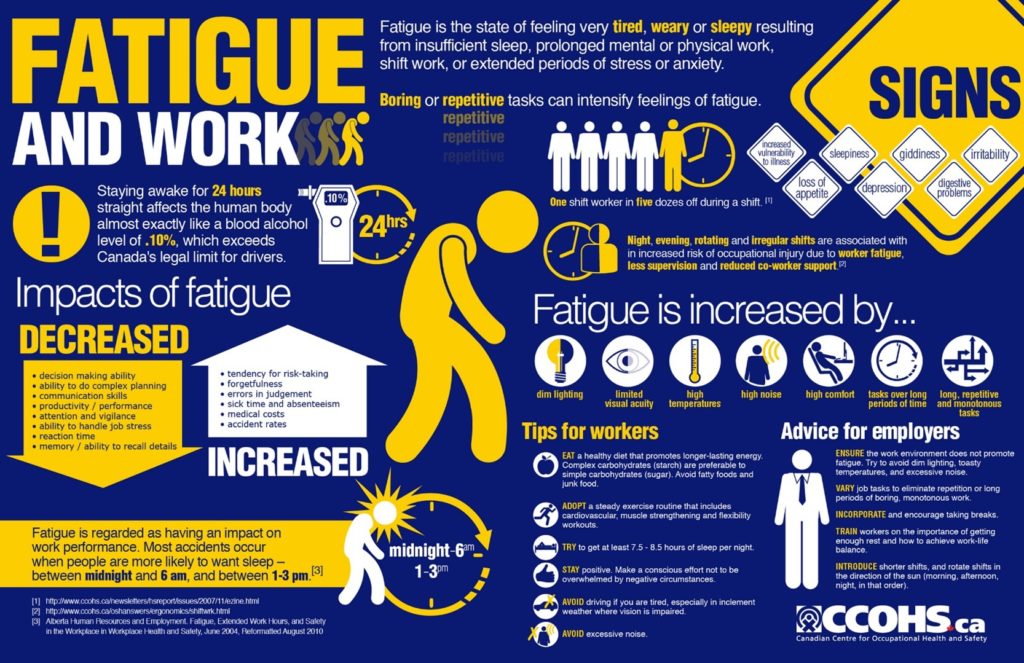
  • More than 69% of workers feel fatigued at work
  • According to a 2018 survey report by the National Safety Council (NSC), two-thirds of the US labor force experiences workplace fatigue. This means that almost 107 million out of the 160 million US workers are affected by occupational fatigue.
  • According to numerous studies, being awake for long periods of time is akin to being inebriated. A loss of two hours of sleep is similar to having 3 beers, while a loss of 4 hours is equivalent to having a six pack in the amount of impairment.
  • In the US, the legal alcohol limit for driving varies from state to state. But, the standard is .008 for residential drivers and .004 for commercial drivers. This means that fatigued people who are driving home from work or as part of their work are putting themselves and the people around them at severe risk.
  • According to Wrike’s United States stress statistics from 2019, only 6% of workers don’t report feeling stressed at work. Around 23% of them described their stress levels as high, while 6% said their levels of stress were unreasonably high. This statistic indicates that working in a stressful working environment is the rule, not the exception.
  • 35% of respondents said their main source of stress at work was their boss.


Good Enough Mindset – Picture This

Source: https://www.ccohs.ca


Office Safety Meeting Kit

Most of the efforts to make a company safer are put into what is considered high hazard work. For example in a construction setting, the majority of energy is almost always focused towards keeping the workers in the field safe. While it is very important to address the hazards and safety in the field, there is still a need for a safety for those workers in offices in the company. There are tens of thousands of injuries sustained by office workers every year according to the Bureau of Labor Statistics. This number is significant and safety in the office should be taken seriously.

FIVE OF THE COMMON OFFICE HAZARDS:

Slips, Trips and Falls: Universal slip, trip and fall culprits include unattended spills, wet floors, exposed cords, unstable work surfaces, uneven floors, loose rugs and cluttered areas.

Ergonomic Injuries: Office workers spend many hours a day seated at a desk, working on a computer, resulting in ergonomic strains and other injuries related to posture and repetitive movement.

Eye Strain: Spending a large portion of your workday at the computer can cause eyestrain, according to the Mayo Clinic. Eyes may become dry and irritated, and workers may begin having trouble focusing. Light levels should be suitable for the work task—for instance, manual detail work may require higher levels of lighting, but staring at a computer monitor does not, the NSC said.

Fire Safety: According to the latest available data, fire departments responded to approximately 17,500 office fires in 2012, which resulted in $643 million in property damage, according to the National Fire Protection Association.

Indoor Air Quality: The prevalence of poor indoor air quality has contributed to a rise in occupational asthma and other respiratory disorders, chemical sensitivity and allergies, according to the NSC. Some of the reasons for poor air quality are inadequate ventilation systems; office overcrowding; the presence of cleaning chemicals and pesticides; water damage and mold growth; cubicle design that blocks off air flow to work areas; too much or too little humidity; and poor housekeeping, which leads to dirty work environments.

EVALUATE THE OFFICE FOR HAZARDS

Here are some ways to prevent falls:

  1. Keep the office free from clutter. Boxes should be stacked out of the way of traffic. Trash and spills should be cleaned up from the floor.
  2. Re-route electrical cords away from traffic areas.
  3. Remove from service any defective chairs.
  4. Close drawers so nobody will trip over them.
  5. Don’t use makeshift climbing equipment such as boxes stacked on chairs. Use stepladders and stepstools correctly.

Fires:

  • Make sure emergency numbers, first aid contacts and evacuation procedures for your office are posted where everyone can see them.
  • Know where to find fire extinguishers and how to use them.
  • Do not overload electrical circuits.

Chemical Hazards:

Know the chemicals that you work with or those that are used nearby. A tour of your office could reveal a surprising number of hazardous materials such as cleaning fluids, art supplies and solvents.

Safe Lifting:

Use materials handling equipment such as furniture carts to avoid lifting heavy objects.

Falling Objects:

  • Filing cabinets can cause serious injury. Open just one drawer at a time. If you open more than that, you risk the cabinet falling over onto you. Load filing cabinet drawers evenly, starting with the bottom ones.
  • Make sure shelves are securely anchored, and do not overload them. Do not place heavy objects on overhead shelves.

TOP SEVEN SAFETY TIPS FOR OFFICE WORKERS TO PREVENT WORKPLACE INJURIES

  1. Make sure your desk setup is ergonomic

To maintain a neutral posture, your head should be centered over your neck and shoulders, wrists flat and elbows resting comfortably at your side. If your feet won’t touch the ground unless you lean forward, use a footrest.

  1. Take regular breaks to get up and move around.

Sitting all day puts office workers at risk for numerous health problems. Warm up and stretching gives you easy exercises you can do at work.

  1. When it’s slippery due to ice and snow, walk like a penguin when entering and leaving your office.

Winter slips and falls in parking lots are extremely common. To avoid them, walk like a penguin by walking flat footed taking short, slow steps. It’s also important to wear sensible footwear and carry only what you can handle.

  1. Use a headset for prolonged or frequent phone use

Cradling the phone between your shoulder and ear can cause neck and back pain.

  1. Keep your workplace tidy

Clean up spills immediately, keep aisles free of clutter, and tie up or secure cords so they don’t pose a trip hazard.

  1. Don’t let electrical cords create a fire risk

Avoid running electrical cords under carpet or through windows and doorways. Also, don’t fasten them with unapproved devices, such as staples.

  1. Know your office emergency procedures

Make sure you know what to do in the event of a fire, storm, violent intruder, medical problem or other emergency.

FINAL WORD

Because of the general perception that construction or oilrig work is much more dangerous than office environment work, much more education is needed to dispel that perception. Along with fractures, dislocations, strains, sprains and contusions, in recent years illness has increased among the office worker population.


Stats and Facts: Office Safety

FACTS

  1. The Center for Disease Control (CDC) cites falling as the most common office related accident. The CDC found that office workers are 2 to 2.5 times more likely to suffer an injury from a fall than non-office workers. The most common causes of office falls include:
    • Slipping on wet floors
    • Reaching for something while sitting in an unstable chair
    • Tripping over loose carpeting, electrical cords, an open file drawer, or objects in walkways
    • Using a chair instead of a ladder
    • Poor lighting/visibility
  1. According to the Occupational Safety and Health Administration, OSHA, “Adapting tasks, workstations, tools, and equipment to fit the worker can help reduce physical stress on a worker’s body and eliminate many potentially serious, disabling work-related musculoskeletal disorders (MSDs).
  2. Homicide is the fourth-leading cause of fatal occupational injuries in the United States. In fact, of the 4,547 fatal workplace injuries that occurred in the U.S. in 2010, 506 were workplace homicides. One of the best ways employers can prevent workplace violence is to establish a zero-tolerance policy toward violence in the workplace and implement a workplace violence prevention program.

STATS

  • Roughly 40% of workplace deaths occurred in transportation incidents. Other leading causes were fall/slips and trips, deaths from being struck by objects or equipment, and exposure to harmful chemicals.
    • Transportation incidents – 40%
    • Falls, slips, trips – 17%
    • Violence and other injuries by persons or animals – 16%
    • Contact with objects and equipment – 14%
    • Exposure to harmful substances or environments – 10%
    • Fires and explosions – 2%ing or improperly used electrical equipment
  • The U.S. Bureau of Labor Statistics (BLS) data reveals that workplace deaths jumped 7% from 2015 to 2016, and stayed roughly the same thru 2017, leading to the deaths of 5,147 workers across all industries in 2017.
  • In a 2014 report B.L.S. said that more than 3 million nonfatal workplace injuries and illnesses were reported by private industry employers in 2013.


Fatality Report: Office Safety

Tax Auditor Dies At His Desk, Not Found For Two Days

Standing Working in the tax profession can sometimes be lonely – with long hours and lots of document intensive, as opposed to people intensive, work to do – but a Finnish tax office found out just how lonely it can be. A tax official in Finland died at his desk while checking tax returns – and nobody noticed for two days.

The unidentified man, who was in his 60s, died in his Helsinki office while checking tax returns. He had his office door closed at the time. According to a government official at the office, “People thought he wanted to work in peace and no-one disturbed him.”

Anita Wickstroem, director at the Helsinki tax office, told AFP news agency, “He was very much working alone and often visiting companies, while his friends and colleagues who used to have lunch or coffee with him were busy in meetings or outside the office at the time.”

Two days later, a friend called to have lunch. When the man didn’t answer, his colleagues discovered that the man had died.

There were about 30 employees in the same department who were on the same floor at the time. The head of personnel at the office said everyone at the tax office was feeling “dreadful.”

It’s worth pointing out that the story, which was recently reported by Prof. Paul Caron at the excellent Tax Prof Blog, isn’t exactly recent: it was reported by the BBC and the New York Times, among others, in 2004.

The story is, however, timely. This time of year, folks in the tax profession tend to rush by each other: there are deadlines to meet and clients to make happy. But do me a favor: say hello to the folks you work with once in a while – even a quick knock on the door with a wave. Bring an extra cup or two of Starbucks or a box of Krispy Kreme doughnuts by the office and offer them around.


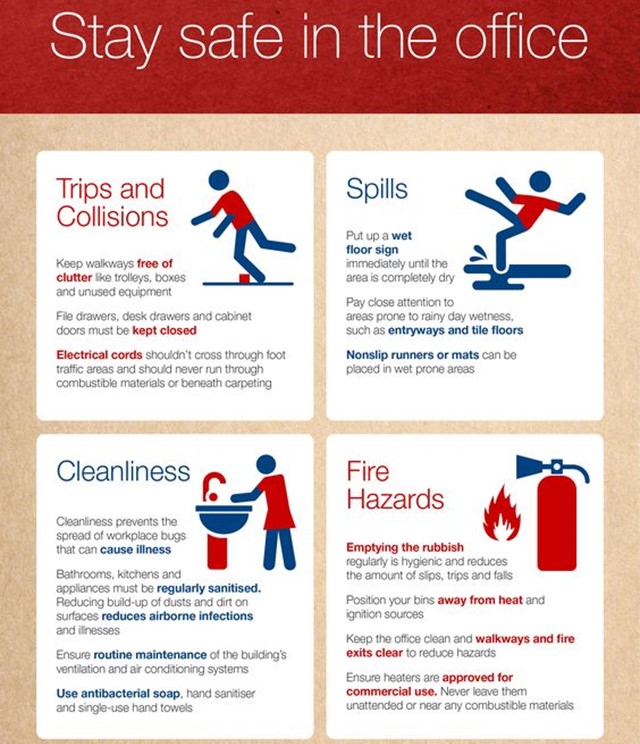
Office Safety – Picture This

Source: https://www.safetyandhealthmagazine.com


Office Safety Meeting Kit – Spanish

QUÉ ESTÁ EN RIESGO

Charla sobre seguridad en la oficina

La mayor parte de los esfuerzos para hacer que una empresa sea más segura se dedican a lo que se considera un trabajo de alto riesgo. Por ejemplo, en un entorno de construcción, la mayor parte de la energía se centra casi siempre en mantener la seguridad de los trabajadores sobre el terreno. Si bien es muy importante abordar los peligros y la seguridad en el campo, sigue siendo necesaria la seguridad de los trabajadores en las oficinas de la empresa. Según la Oficina de Estadísticas Laborales, los trabajadores de oficina sufren decenas de miles de lesiones cada año. Esta cifra es significativa y la seguridad en la oficina debe tomarse en serio.

CUÁL ES EL PELIGRO

CINCO DE LOS RIESGOS MÁS COMUNES EN LAS OFICINAS:

Resbalones, tropiezos y caídas: Los culpables universales de los resbalones, tropiezos y caídas son los derrames desatendidos, los suelos mojados, los cables expuestos, las superficies de trabajo inestables, los suelos irregulares, las alfombras sueltas y las zonas desordenadas.

Lesiones ergonómicas: Los trabajadores de oficina pasan muchas horas al día sentados en un escritorio, trabajando con un ordenador, lo que provoca tensiones ergonómicas y otras lesiones relacionadas con la postura y los movimientos repetitivos.

Tensión ocular: Pasar una gran parte de la jornada laboral frente al ordenador puede provocar fatiga visual, según la Clínica Mayo. Los ojos pueden resecarse e irritarse, y los trabajadores pueden empezar a tener problemas para enfocar. Los niveles de luz deben ser adecuados para la tarea de trabajo; por ejemplo, el trabajo manual de detalle puede requerir niveles más altos de iluminación, pero mirar fijamente un monitor de ordenador no, dijo el NSC.

Seguridad contra incendios: Según los últimos datos disponibles, los departamentos de bomberos respondieron a aproximadamente 17.500 incendios en oficinas en 2012, que resultaron en 643 millones de dólares en daños materiales, según la Asociación Nacional de Protección contra Incendios.

Calidad del aire interior: La prevalencia de la mala calidad del aire interior ha contribuido a un aumento del asma ocupacional y otros trastornos respiratorios, la sensibilidad química y las alergias, según el NSC. Algunas de las razones de la mala calidad del aire son los sistemas de ventilación inadecuados, el hacinamiento en las oficinas, la presencia de productos químicos de limpieza y pesticidas, los daños causados por el agua y la aparición de moho, el diseño de los cubículos que bloquea el flujo de aire a las zonas de trabajo, el exceso o la falta de humedad y la mala limpieza, que da lugar a entornos de trabajo sucios.

COMO PROTEGERSE

EVALUAR LA OFICINA EN BUSCA DE PELIGROS

Estas son algunas formas de prevenir las caídas:

  1. Mantenga la oficina libre de desorden. Las cajas deben estar apiladas fuera del camino del tráfico. La basura y los derrames deben limpiarse del suelo.
  2. Redirija los cables eléctricos lejos de las zonas de tránsito.
  3. Retire del servicio cualquier silla defectuosa.
  4. Cierre los cajones para que nadie tropiece con ellos.
  5. No utilice equipos de escalada improvisados, como cajas apiladas en las sillas. 6. Utilice correctamente las escaleras de mano y los escabeles.

Incendios:

  • Asegúrese de que los números de emergencia, los contactos de primeros auxilios y los procedimientos de evacuación de su oficina esten expuestos en un lugar donde todos puedan verlos.
  • Sepa dónde encontrar los extintores y cómo utilizarlos.
  • No sobrecargue los circuitos eléctricos.

Peligros químicos:

Conozca los productos químicos con los que trabaja o los que se utilizan en las proximidades. Un recorrido por su oficina podría revelar un número sorprendente de materiales peligrosos, como líquidos de limpieza, materiales de arte y disolventes.

Levantamiento seguro:

Utilice equipos de manipulación de materiales, como carros para muebles, para evitar levantar objetos pesados.

Caída de objetos:

  • Los archivadores pueden causar lesiones graves. Abra sólo un cajón a la vez. Si abre más, corre el riesgo de que el archivador se le caiga encima. Cargue los cajones del archivador de manera uniforme, empezando por los inferiores.
  • Asegúrese de que los estantes están bien anclados, y no los sobrecargue. No coloque objetos pesados en los estantes superiores.

LOS SIETE MEJORES CONSEJOS DE SEGURIDAD PARA QUE LOS TRABAJADORES DE OFICINA EVITEN LAS LESIONES EN EL LUGAR DE TRABAJO

1. Asegúrese de que su escritorio es ergonómico

Para mantener una postura neutral, la cabeza debe estar centrada sobre el cuello y los hombros, las muñecas planas y los codos descansando cómodamente a los lados. Si sus pies no tocan el suelo a menos que se inclines hacia delante, utiliza un reposapiés.

2. Haga descansos regulares para levantarse y moverse.

Estar sentado todo el día pone a los trabajadores de oficina en riesgo de sufrir numerosos problemas de salud. El calentamiento y los estiramientos son ejercicios fáciles que puede hacer en el trabajo.

3. Cuando esté resbaladizo por el hielo y la nieve, camina como un pingüino al entrar y salir de su oficina.

Los resbalones y caídas en invierno en los aparcamientos son muy frecuentes. Para evitarlos, camina como un pingüino, con el pie plano y dando pasos cortos y lentos. También es importante que lleve un calzado sensato y que lleve sólo lo que pueda manejar.

4. Utilizar auriculares para el uso prolongado o frecuente del teléfono

Acunar el teléfono entre el hombro y la oreja puede causar dolor de cuello y espalda.

5. Mantén el orden en su lugar de trabajo

Limpie inmediatamente los derrames, mantenga los pasillos libres de desorden y ate o asegure los cables para que no supongan un peligro de tropiezo.

6. No deje que los cables eléctricos creen un riesgo de incendio

Evite que los cables eléctricos pasen por debajo de la alfombra o por las ventanas y puertas. Tampoco los sujete con dispositivos no aprobados, como grapas.

7. Conozca los procedimientos de emergencia de su oficina

Asegúrese de saber qué hacer en caso de incendio, tormenta, intrusión violenta, problema médico u otra emergencia.

CONCLUSIÓN

Debido a la percepción general de que el trabajo en la construcción o en las plataformas petrolíferas es mucho más peligroso que el trabajo en el entorno de la oficina, se necesita mucha más educación para disipar esa percepción. Junto con las fracturas, dislocaciones, esguinces, torceduras y contusiones, en los últimos años han aumentado las enfermedades entre la población de trabajadores de oficina.

Office Safety Stats and Facts – Spanish

HECHOS

  1. El Centro de Control de Enfermedades (CDC) cita las caídas como el accidente más común relacionado con la oficina. El CDC descubrió que los trabajadores de oficina tienen entre 2 y 2,5 veces más probabilidades de sufrir una lesión por una caída que los que no son trabajadores de oficina. Las causas más comunes de las caídas en la oficina son:
    • Resbalar en suelos mojados
    • Alcanzar algo mientras se está sentado en una silla inestable
    • Tropezar con alfombras sueltas, cables eléctricos, un cajón de archivo abierto u objetos en los pasillos
    • Utilizar una silla en lugar de una escalera
    • Mala iluminación/visibilidad
  1. Según la Administración de Seguridad y Salud Ocupacional (OSHA), “adaptar las tareas, los puestos de trabajo, las herramientas y los equipos a la medida del trabajador puede ayudar a reducir la tensión física en el cuerpo del trabajador y eliminar muchos trastornos musculoesqueléticos (TME) potencialmente graves e incapacitantes relacionados con el trabajo”.
  2. El homicidio es la cuarta causa de lesiones laborales mortales en Estados Unidos. De hecho, de las 4.547 lesiones laborales mortales que se produjeron en Estados Unidos en 2010, 506 fueron homicidios laborales. Una de las mejores maneras en que los empleadores pueden prevenir la violencia en el lugar de trabajo es establecer una política de tolerancia cero hacia la violencia en el lugar de trabajo e implementar un programa de prevención de la violencia en el lugar de trabajo.

ESTADÍSTICAS

Aproximadamente el 40% de las muertes en el lugar de trabajo se produjeron en incidentes de transporte. Otras causas principales fueron las caídas/resbalones y tropiezos, las muertes por golpes con objetos o equipos y la exposición a sustancias químicas nocivas.

  • Incidentes de transporte – 40%
  • Caídas, resbalones y tropiezos: 17%.
  • Violencia y otras lesiones por personas o animales – 16%
  • Contacto con objetos y equipos – 14%
  • Exposición a sustancias o entornos nocivos – 10%.
  • Incendios y explosiones – 2% o Equipos eléctricos mal utilizados

Los datos de la Oficina de Estadísticas Laborales de Estados Unidos (BLS) revelan que las muertes en el lugar de trabajo aumentaron un 7% de 2015 a 2016, y se mantuvieron más o menos igual hasta 2017, lo que supuso la muerte de 5.147 trabajadores en todos los sectores en 2017.

En un informe de 2014, la Oficina de Estadísticas Laborales señaló que los empleadores de la industria privada notificaron más de 3 millones de lesiones y enfermedades no mortales en el lugar de trabajo en 2013.


Office Safety Fatality Report – Spanish

Un auditor fiscal muere en su escritorio y no se le encuentra durante dos días.

Trabajar en la profesión fiscal puede ser a veces solitario, con largas horas y mucho trabajo de documentación, en lugar de personas, pero una oficina de impuestos finlandesa descubrió lo solitario que puede ser. Un funcionario de Hacienda en Finlandia murió en su mesa mientras revisaba las declaraciones de impuestos, y nadie se dio cuenta durante dos días.

El hombre no identificado, de unos 60 años, murió en su oficina de Helsinki mientras revisaba las declaraciones de impuestos. Tenía la puerta de su despacho cerrada en ese momento. Según un funcionario de la oficina, “la gente pensó que quería trabajar en paz y nadie le molestó”.

Anita Wickstroem, directora de la oficina de impuestos de Helsinki, declaró a la agencia de noticias AFP: “Trabajaba muy solo y visitaba a menudo las empresas, mientras que sus amigos y colegas que solían almorzar o tomar café con él estaban ocupados en reuniones o fuera de la oficina en ese momento.”

Dos días después, un amigo llamó para almorzar. Cuando el hombre no contestó, sus compañeros descubrieron que el hombre había muerto.

Había unos 30 empleados del mismo departamento que estaban en la misma planta en ese momento. El jefe de personal de la oficina dijo que todos los empleados de la oficina de impuestos se sentían “fatal”.

Merece la pena señalar que la historia, de la que ha informado recientemente el profesor Paul Caron en el excelente Tax Prof Blog, no es precisamente reciente: la BBC y el New York Times, entre otros, se hicieron eco de ella en 2004.

Sin embargo, la historia es oportuna. En esta época del año, la gente de la profesión fiscal tiende a apresurarse: hay plazos que cumplir y clientes que contentar. Pero hazme un favor: saluda de vez en cuando a la gente con la que trabajas, aunque sea llamando a la puerta con un saludo. Lleva una o dos tazas extra de Starbucks o una caja de donuts de Krispy Kreme por la oficina y ofrécelos por ahí.


Office Safety – Picture This – Spanish

Fuente: https://programas-de-salud.webnode.es


Heavy Equipment Operation Meeting Kit

Heavy equipment is used on many different kinds of work sites all around the world. This equipment is very effective for the job it was designed to do, but it can also be very hazardous. Proper work planning as well as operating equipment within its designed limits are important basic steps for safe operation.

WORKERS BE AWARE OF HEAVY EQUIPMENT HAZARDS

  • Struck-by hazards- Heavy equipment is responsible for many injuries and fatalities in the workplace. Ground personnel are far too often struck by equipment when they are in the line of fire.
  • Property damage- When operators do not see vehicles, materials, objects, tools, buildings, etc. in their area of operation property damage occurs. This costs employers millions of dollars a year in losses.
  • Contact with powerlines- Equipment should stay at least 10 feet away from powerlines and poles. When voltage of the lines increase the distance to stay away from lines also needs to increase.
  • Leaks- Leaks can cause issues in the equipment as well as damage to the environment. Many project owners have a very strict zero tolerance policy when it comes to leaks.
  • Equipment failure- Hydraulic or other systems that fail can cause a major incident.

COMMON SAFETY RULES FOR OPERATORS AND WORKERS

1) Good communication is essential. A standardized set of hand signals should be used by the operator and signal person. Operators should always know exactly where all ground-based workers are located, and the wearing of high visibility vests will help the operator to locate them quickly. The equipment should have a backup warning alarm that can be heard by all nearby workers. Two-way radios are also valuable communication tools.

2) Heavy equipment must have a rollover protective structure (ROPS) meeting OSHA requirements. The ROPS is designed to protect the operator if the machine tips over. A seat belt must be worn so that the operator will not be thrown out of the seat during a rollover. If working on slopes, try to avoid moving across the face of the slope. Try to operate up and down the slope face. Use extreme caution when operating near open excavations.

3) Wear hearing protection when required. If it has been determined that noise levels around the equipment could potentially cause hearing loss, always use protective plugs or muffs when working on or around the equipment.

4) Never jump onto or off the equipment. Operators should always use the three-point contact rule when climbing onto or off heavy equipment. The three-point rule means having both feet and one hand, or one foot and both hands in contact with the ladder access at all times.

5) Inspect and service the equipment regularly. Complete equipment service in accordance with the manufacturer’s recommendation. Periodic safety inspections on all components of the equipment should be done regularly by qualified personnel. Inspect the steering system and brake systems carefully. A pre-shift walk around inspection by the operator is highly recommended.

Tips To Keep Workers Safe

  1. Train, Train, Train – And Train Some More

Many workers learn their jobs by operating light equipment, such as a trench roller, under the guidance of an experienced operator. Later, they may operate heavier equipment, such as bulldozers. Operators of some equipment, such as machines with computerized controls, may need more training and some understanding of electronics.

Anyone who operates a piece of heavy equipment must be certified and trained to use it. You should never allow an untrained operator into the cab of a piece of heavy machinery.

Make sure that workers who operate heavy equipment have a completely comprehensive understanding of how the machine works, what to do in emergencies, and the proper safety steps they need to take while operating the equipment.

Consider having biweekly or monthly safety training sessions for equipment operators to help them brush up on safety skills and knowledge.

  1. Inspect All Of Your Machines Regularly Before Operation

Make sure that your equipment operators inspect the basics – such as brakes, fluid levels, tires, headlights, and so forth – every day.

Hire a trained professional to service your equipment regularly. The service schedule will vary – check the owner’s’ manual or documentation of your equipment for more details. Inspection and maintenance will keep workers safe.

  1. Don’t Rush – Keep Things Slow And Steady

We know what it’s like to be behind on a job deadline, or to need to speed things along to finish a critical project milestone before night falls. You may be tempted to try to speed things up by rushing things when operating heavy equipment, or you may skip safety checks and tell operators to hurry.

  1. Communicate Effectively On Your Job Site

Communication is key when operating heavy equipment. Make sure that all workers in the area know when a vehicle is occupied and in operation. Use a construction foreman and spotters to keep the danger areas around a vehicle clear – to keep workers away from the sweep area of a front-end loader, for example.

Make the responsibilities for communication clear among all equipment operators. In addition, create clear and comprehensive safety guidelines, procedures and policies – and outline the penalties for breaching these procedures.

  1. Minimize Employee Distractions – No Phones!

If you don’t already have a firm “no phones” policy on your worksite, now is the time to implement one. Construction sites are hazardous places, and there are many obstacles and other dangers that could be threatening to anyone who is distracted while walking – or operating a piece of machinery.

FINAL WORD

This is a small list of the many hazards that are present when dealing with heavy equipment on a work site. Consider what unique hazards the equipment and job tasks create on your work site. Constant focus on pre task planning as well as what safeguards are needed is important to remain safe while operating heavy equipment.


Heavy Equipment Operation Stats and Facts

FACTS

  1. Construction equipment operators risk injury from hazards such as falls, slips, and trips and transportation incidents. Workers can avoid injury by observing proper operating procedures and safety practices, such as wearing personal protective equipment. Bulldozers, scrapers, and pile drivers are noisy and shake or jolt the operator, which may lead to repetitive stress injuries.
  2. The worst heavy equipment accidents can cause potentially fatal injuries to the spinal cord, head, and neck, such as concussions, broken bones, and amputations. In addition to the trauma of the injuries, the wounded workers also face additional troubles in the form of high medical costs and lost wages due to the absence from work.
  3. Ensuring adequate rollover protective structures for heavy equipment, requiring fastening of seat belts, adoption of a lock-out/tagout standard, establishing restricted access zones around heavy equipment, and requiring spotters for workers who must be near heavy equipment or trucks would reduce the risk of heavy equipment- and truck-related deaths in construction.
  4. There are many different construction site accidents associated with heavy equipment such as cranes, bulldozers, front-end loaders, dump trucks, excavators and the like. Such heavy equipment is a necessity on nearly every construction project.

STATS

  • Heavy equipment crashes caused more than 7,600 deaths at a rate of almost 404 deaths per year.
  • As per a report by the Occupational Safety & Health Administration (OSHA), out of 4,674 worker fatalities in the private industry in 2017, more than 20% were in the construction industry. This equates to one in five worker deaths in 2017.
  • The Bureau of Labor Statistics Census of Fatal Occupational Injuries identified 253 heavy equipment related deaths on construction sites in the Excavation Work industry.
  • Around a thousand construction workers are killed on job sites every year in the US. And that number’s gradually increased every year since 2013 according to the Bureau of Labor Statistics (BLS). An alarming number of those deaths and injuries were caused by heavy equipment. Most occurred when the victim was either struck by moving equipment, or caught-in or between heavy machinery and another impediment (wall, another machine, etc).
  • Heavy equipment operators and construction laborers made up 63% of the heavy equipment- and truck-related deaths. Backhoes and trucks were involved in half the deaths. Rollovers were the main cause of death of heavy equipment operators. For workers on foot and maintenance workers, being struck by heavy equipment or trucks, and being struck by equipment loads or parts were the major causes of death.


Heavy Equipment Operation Fatality Report

Bulldozer Kills Operator Standing on Track

A 33-year-old man, with eight years of experience, was crushed by his own bulldozer when he fell between the treads and the deck. The worker was giving a ride to a co-worker who needed to retrieve an all-terrain vehicle at the top of a hill. After the operator let the co-worker off, he saw that the other man had left behind a jacket. He stopped the bulldozer on a relatively level area of the hill, lowered the blade of the machine, and placed the bulldozer’s engine in idle, but did not set the parking brake. As he stood on the track to hand the other man his jacket, the machine moved backward. The bulldozer operator lost his balance, and fell feet first between the track and the deck. The machine continued to roll backwards another 8-10 feet (about three meters), and the operator was pulled below the bulldozer to his death. A follow-up examination found that the operator’s blood-alcohol content was 0. 08, above the legal limit for driving.

Heavy equipment operators should not operate equipment when drunk, even if the level of intoxication seems slight. Secondly, operators must become familiar with recommended safety procedures, such as applying the parking brake whenever they stop the machine. Finally, government safety regulations prohibit passengers on heavy equipment unless a proper seat has been installed for them to ride upon.


Heavy Equipment Operation – Picture This

What’s wrong in this picture? Almost all construction projects have heavy equipment and machinery used to complete tasks and various purposes. Heavy equipment like excavators and pavers help construction workers get more work done in less time. However, while heavy equipment helps get more work done faster, it can also be hazardous if not used properly. You and your crew will need to evaluate your operating environment and other work conditions to ensure your heavy equipment is operated correctly. Heavy equipment should only be operated by a certified professional who has proper training and experience for the particular equipment along with management oversight.


Lightning Safety at Work and Home Meeting Kit – Spanish

QUÉ ESTÁ EN RIESGO

Los RAYOS son un grave peligro tanto dentro como fuera del trabajo. Sólo en Estados Unidos se producen una media de 25 millones de rayos al año. Las personas deben identificar y planificar la posibilidad de que caigan rayos antes de comenzar una actividad laboral o cualquier actividad de ocio durante la temporada de tormentas. Tenga un plan de cuándo dejará de trabajar y dónde irá si se producen rayos durante ese día. La mejor práctica para evitar ser alcanzado por un rayo es refugiarse en un lugar cerrado antes de que la tormenta esté en su área inmediata.

CUÁL ES EL PELIGRO

Riesgos de los rayos

Aunque las probabilidades de ser alcanzado por un rayo en un año determinado son inferiores a 1 entre un millón, algunos factores pueden suponer un riesgo mayor. Los rayos suelen alcanzar a las personas que trabajan en el exterior o realizan actividades recreativas al aire libre. Las diferencias regionales y estacionales también pueden afectar al riesgo de sufrir un rayo.

LAS SIGUIENTES OCUPACIONES TIENEN EL MAYOR RIESGO DE SUFRIR UN RAYO:

  • Construcción y mantenimiento de edificios
  • Agricultura y trabajos en el campo
  • Tala de árboles
  • Manipulación o almacenamiento de explosivos
  • Manejo de equipos pesados
  • Instalación de tuberías o fontanería
  • Reparación de campos de telecomunicaciones
  • Reparación de campo de servicios eléctricos

COMO PROTEGERSE

TOME PRECAUCIONES CUANDO VEA UN RAYO

  • Si la previsión meteorológica anuncia tormentas eléctricas, posponga su viaje o actividad.
  • Recuerde: Cuando el trueno ruge, entre a casa. Busque un refugio seguro y cerrado.
  • No olvide la regla del 30-30. Cuando veas un RAYO, empieza a contar hasta 30. Si oyes un trueno antes de llegar a 30, entre a casa. Suspenda sus actividades durante al menos 30 minutos después del último trueno.
  • Si no hay ningún refugio disponible, agáchese, con la menor parte del cuerpo en contacto con el suelo. Los RAYOS provocan corrientes eléctricas a lo largo de la superficie del suelo que pueden ser mortales a más de 30 metros de distancia.
  • Aléjese de los suelos o paredes de hormigón. Los RAYOS pueden atravesar los cables o barras metálicas de las paredes o el suelo de hormigón. Aunque debería trasladarse a una estructura que no sea de hormigón si es posible, estar en el interior no le protege automáticamente de los rayos. De hecho, aproximadamente un tercio de las lesiones por rayos se producen en interiores.

CONSEJOS DE SEGURIDAD EN EXTERIORES

  • Esté atento: Compruebe la previsión meteorológica antes de participar en actividades al aire libre. Si el pronóstico anuncia tormentas eléctricas, posponga su viaje o actividad, o asegúrese de que dispone de un refugio seguro adecuado.
  • Entre a casa: Recuerde la frase: “Cuando el trueno ruge, entre a casa”. Busque un refugio seguro y cerrado cuando oiga un trueno. Los refugios seguros son las casas, las oficinas, los centros comerciales y los vehículos de techo duro con las ventanas subidas.
  • Busque inmediatamente un refugio, aunque se encuentre al aire libre: Si se encuentra en una zona abierta, actúe rápidamente para encontrar un refugio adecuado. La acción más importante es alejarse del peligro. Agacharse o quedarse en el suelo puede reducir las posibilidades de ser golpeado, pero no le aleja del peligro.

Si se ve atrapado en el exterior sin un refugio seguro cerca, las siguientes acciones reducen su riesgo:

  • Salga inmediatamente de zonas elevadas como colinas, crestas de montañas o picos.
  • No se acueste nunca en el suelo. Agáchese en una posición similar a la de una pelota, con la cabeza metida y las manos sobre las orejas, de modo que esté agachado y con un contacto mínimo con el suelo.
  • Nunca se refugie bajo un árbol aislado.
  • Nunca utilice un acantilado o un saliente rocoso como refugio.
  • Salga inmediatamente y aléjese de estanques, lagos y otras masas de agua.
  • Aléjese de los objetos conductores de electricidad (vallas de alambre de espino, líneas eléctricas, molinos de viento, etc.).
  • Sepárense si están en grupo durante una tormenta eléctrica, sepárense unos de otros. Esto reducirá el número de lesiones si los rayos caen al suelo.

NO

No permanezca en vehículos, estructuras y espacios abiertos: Durante una tormenta eléctrica, evite los vehículos abiertos como los descapotables, las motocicletas y los carros de golf. Asegúrese de evitar estructuras abiertas como porches, cenadores, banquillos de béisbol y estadios deportivos. Y aléjese de espacios abiertos como campos de golf, parques, zonas de juego, estanques, lagos, piscinas y playas.

No permanezca cerca de estructuras altas: NO se acueste en suelos de hormigón durante una tormenta eléctrica. Asimismo, evite apoyarse en paredes de hormigón. Los rayos pueden atravesar los cables o barras metálicas de las paredes o el suelo de hormigón.

CONSEJOS DE SEGURIDAD EN INTERIORES

Aunque su casa sea un refugio seguro durante una tormenta de rayos, puede estar en riesgo. Alrededor de un tercio de las lesiones por rayos se producen en el interior. Estos son algunos consejos para mantenerse a salvo.

  • Evite el agua: NO se bañe, ni se duche, ni lave los platos, ni tenga ningún otro tipo de contacto con el agua durante una tormenta, ya que los rayos pueden atravesar las tuberías de un edificio.
  • Evite los equipos electrónicos: NO utilice sus ordenadores, portátiles, sistemas de juego, lavadoras, secadoras, estufas o cualquier cosa conectada a una toma de corriente. Los RAYOS pueden atravesar los sistemas eléctricos, los sistemas de recepción de radio y televisión, y cualquier cable o barra metálica en las paredes o el suelo de hormigón. Equipe su casa con protectores de sobretensión para proteger sus aparatos.
  • Evite los teléfonos con cable: Los teléfonos con cable NO son seguros durante una tormenta eléctrica. No los utilice. Sin embargo, es seguro utilizar teléfonos inalámbricos o celulares durante una tormenta.
  • Evite las ventanas, las puertas, los porches y el hormigón: NO se acueste en suelos de hormigón durante una tormenta. Asimismo, evite apoyarse en paredes de hormigón. Los RAYOS pueden atravesar los cables o barras metálicas de las paredes o el suelo de hormigón.

CONCLUSIÓN

Deben tomarse precauciones para evitar la exposición de los trabajadores a los rayos. Los empresarios deben reconocer que los rayos son un riesgo laboral. Los supervisores y los trabajadores de los lugares de trabajo al aire libre deben tomarse en serio la seguridad frente a los rayos.


Lightning Safety at Work and Home Stats and Facts – Spanish

HECHOS

  1. Los rayos tienen la capacidad de enviar electricidad a través de las tuberías metálicas utilizadas para la fontanería, los cables eléctricos, como el teléfono, y los refuerzos metálicos de los suelos y paredes de hormigón.
  2. Los rayos pueden producirse en cualquier época del año, pero las víctimas de los rayos son mayores durante el verano. Julio suele ser el mes con más rayos. Los rayos suelen caer por la tarde. De hecho, dos tercios de las víctimas de los rayos se producen entre el mediodía y las 18 horas.
  3. Los rayos suelen alcanzar a las personas que trabajan en el exterior o realizan actividades recreativas al aire libre. Más de un tercio de las muertes por rayos se producen en granjas. Otros lugares comunes son los emplazamientos industriales y las residencias privadas.
  4. La construcción y la manipulación de materiales, como la carga y descarga, son dos de las actividades laborales más comunes en las que se producen los impactos de rayos.
  5. La mayoría de los impactos de rayos relacionados con el trabajo se producen en Florida y Texas, dos estados en los que las muertes y lesiones por rayos estacionales son elevadas.
  6. Un rayo puede provocar un paro cardíaco (parada del corazón) en el momento de la lesión, aunque algunas víctimas pueden parecer tener una muerte retardada unos días después si se les reanima, pero han sufrido daños cerebrales irreversibles.

ESTADÍSTICAS

  • Desde 2006 hasta julio de 2016 se produjeron 326 víctimas mortales relacionadas con los rayos. 257 de las víctimas eran hombres y 59 mujeres.
  • El impacto de un rayo puede provocar un paro cardíaco (detención del corazón) en el momento de la lesión, aunque algunas víctimas pueden parecer tener una muerte retardada unos días después si son reanimadas, pero han sufrido daños cerebrales irreversibles.
  • Según los datos del NWS sobre tormentas, a lo largo de 2018 en EE. UU. se ha registrado una media de 43 muertes por rayo al año. Solo un 10% de las personas que son alcanzadas por un rayo mueren, quedando el 90% con diversos grados de discapacidad. Más recientemente, en los últimos 10 años (2009-2018), Estados Unidos ha tenido un promedio de 27 muertes por rayos.
  • Los hombres tienen cinco veces más probabilidades de ser alcanzados por un rayo que las mujeres; alrededor del 85% de las víctimas mortales de los rayos son hombres.
  • Las personas de entre 15 y 34 años representan casi la mitad de las víctimas de rayos (41%). La mayoría (89%) de las muertes por rayo se producen entre personas de raza blanca.
  • Aproximadamente un tercio (32%) de las lesiones por rayos se producen en interiores.
  • Los rayos matan a una media de 49 personas cada año en Estados Unidos y otros cientos resultan heridos.


Lightning Safety at Work and Home Fatality Report – Spanish

Un trabajador de Industrias Shelby preguntó a su supervisor si podía salir del trabajo antes de tiempo para atender unos asuntos personales. El trabajador recibió el permiso y fichó. Salió del edificio de Shelby, pero permaneció en su propiedad para esperar a que su hija le recogiera. Se acercaba una tormenta eléctrica.

Tres minutos después de que el trabajador fichara, el vicepresidente de Shelby escuchó un grito en el aparcamiento. Encontraron al trabajador tumbado boca abajo en el exterior, cerca de un gran roble, que estaba en las inmediaciones de un edificio metálico. Había sido alcanzado por un rayo. El trabajador murió dos días después a causa de sus heridas.

La sucesión del trabajador presentó una reclamación de prestaciones por muerte y supervivencia. Shelby denegó la solicitud, argumentando que la lesión y la muerte del trabajador no estaban relacionadas con el trabajo.

El juez de lo contencioso-administrativo consideró que la sucesión tenía derecho a las prestaciones, concluyendo que la reclamación no estaba prohibida por la norma de ir y venir. El ALJ consideró que se aplicaba la doctrina del riesgo posicional, explicando que una hoja informativa de la Agencia Federal de Gestión de Emergencias afirmaba que, durante una tormenta eléctrica, había que evitar cualquier cosa que se considerara un “pararrayos natural”, como un árbol alto y aislado y “cualquier cosa metálica”. El tribunal de apelación confirmó la decisión del ALJ, razonando que Shelby no tenía control sobre el rayo, pero el control sobre el instrumento de la lesión no era un factor determinante para que un trabajador tuviera derecho a las prestaciones.


Lightning Safety at Work and Home – Picture This – Spanish

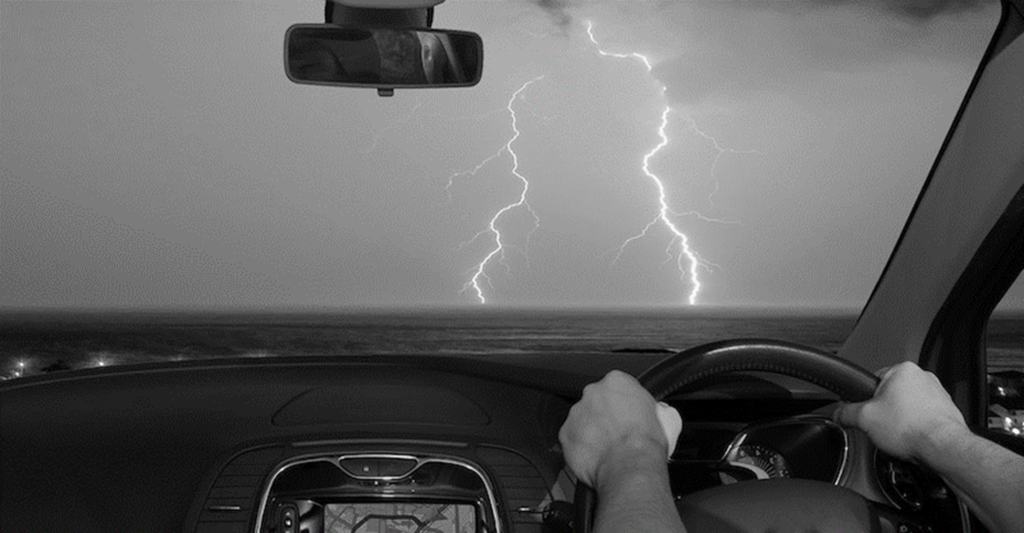
El conductor claramente calculó mal al encontrarse en una posición en la que está conduciendo en una peligrosa tormenta eléctrica. O bien calculó mal estar en la carretera al no seguir los informes meteorológicos, o bien decidió conducir a pesar de los informes meteorológicos sobre la iluminación.


Gasoline Safety Fatality Report – Spanish

Un hombre muere en la explosión de un tanque de combustible.

TENSAS PARISH – Los agentes del Jefe de Bomberos del Estado han concluido su investigación sobre la causa de la explosión de un tanque de combustible que se cobró la vida de un operador de un camión dispensador.

Alrededor de las 2 p.m. del 29 de diciembre, el Distrito 1 de Protección contra Incendios de Tensas Parish respondió a un informe de una explosión ubicada en una propiedad fuera de Hogue Road en Newellton. Los bomberos llegaron y encontraron que un tanque de combustible había explotado, matando al operador y quemando un camión de pasajeros así como la maquinaria cercana.

Aunque la identificación oficial está pendiente de la autopsia de la Oficina del Forense de Tensas Parish, se cree que la víctima es un hombre de 56 años de Newellton.

Después de una evaluación de la escena, incluyendo la revisión de los videos de vigilancia, los diputados determinaron que la explosión se produjo cuando la víctima estaba llenando un tanque en la propiedad que estaba siendo utilizado para operar el equipo de construcción necesario para un proyecto de carretera. Aunque la causa oficial de este incendio sigue siendo indeterminada en este momento, los investigadores de SFM no pueden descartar una ignición por electricidad estática del combustible que se estaba dispensando.


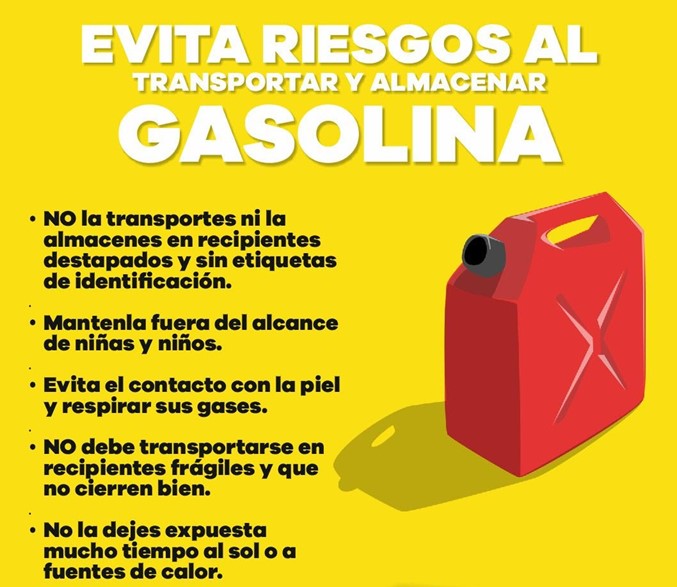
Gasoline Safety – Picture This – Spanish

Fuente: https://www.quadratin.com.mx


Lightning Safety at Work and Home Meeting Kit

INTRODUCTION

Lightning is a serious hazard both on and off the job. There is an average of 25 million lightning strikes that occur in the United States each year alone. Individuals need to identify and plan for the potential of lightning before beginning a work activity or any leisure activity during storm season. Have a plan of when you will cease work and where you will go if lightning occurs during that day. The best practice to avoid getting struck by lightning is to take shelter indoors before a storm is in your immediate area.

RISKS OF LIGHTNING STRIKES

Although the odds of being struck by lightning in a given year are less than 1 in a million, some factors can put you at greater risk. Lightning most often strikes people who work outside or engage in outdoor recreational activities. Regional and seasonal differences can also affect your risk of being injured by lightning.

THE FOLLOWING OCCUPATIONS HAVE THE HIGHEST RISK TO LIGHTNING STRIKES

  • Construction and building maintenance
  • Farming and field labor
  • Logging
  • Explosives handling or storage
  • Heavy equipment operation
  • Pipefitting or plumbing
  • Telecommunications field repair
  • Power utility field repair

TAKE PRECAUTIONS WHEN YOU SEE LIGHTENING

  • If the weather forecast calls for thunderstorms, postpone your trip or activity.
  • Remember: When thunder roars, go indoors. Find a safe, enclosed shelter.
  • Don’t forget the 30-30 rule. After you see lightning, start counting to 30. If you hear thunder before you reach 30, go indoors. Suspend activities for at least 30 minutes after the last clap of thunder.
  • If no shelter is available, crouch low, with as little of your body touching the ground as possible. Lightning causes electric currents along the top of the ground that can be deadly over 100 feet away.
  • Stay away from concrete floors or walls. Lightning can travel through any metal wires or bars in concrete walls or flooring. Although you should move into a non-concrete structure if possible, being indoors does not automatically protect you from lightning. In fact, about one-third of lightning-strike injuries occur indoors.

OUTDOOR SAFETY TIPS

  • Be aware: Check the weather forecast before participating in outdoor activities. If the forecast calls for thunderstorms, postpone your trip or activity, or make sure adequate safe shelter is readily available.
  • Go indoors: Remember the phrase, “When thunder roars, go indoors.” Find a safe, enclosed shelter when you hear thunder. Safe shelters include homes, offices, shopping centers, and hard-top vehicles with the windows rolled up.
  • Seek shelter immediately even if caught out in the open: If you are caught in an open area, act quickly to find adequate shelter. The most important action is to remove yourself from danger. Crouching or getting low to the ground can reduce your chances of being struck, but does not remove you from danger.

If you are caught outside with no safe shelter nearby, the following actions reduce your risk:

  • Immediately get off elevated areas such as hills, mountain ridges, or peaks.
  • Never lie flat on the ground. Crouch down in a ball-like position with your head tucked and hands over your ears so that you are down low with minimal contact with the ground.
  • Never shelter under an isolated tree.
  • Never use a cliff or rocky overhang for shelter.
  • Immediately get out of and away from ponds, lakes, and other bodies of water.
  • Stay away from objects that conduct electricity (barbed wire fences, power lines, windmills, etc.).
  • Separate If you are in a group during a thunderstorm, separate from each other. This will reduce the number of injuries if lightning strikes the ground.

DO NOT

Don’t stay in open vehicles, structures, and spaces: During a thunderstorm, avoid open vehicles such as convertibles, motorcycles, and golf carts. Be sure to avoid open structures such as porches, gazebos, baseball dugouts, and sports arenas. And stay away from open spaces such as golf courses, parks, playgrounds, ponds, lakes, swimming pools, and beaches.

Don’t stay near tall structures: Do NOT lie on concrete floors during a thunderstorm. Also, avoid leaning on concrete walls. Lightning can travel through any metal wires or bars in concrete walls or flooring.

INDOOR SAFETY TIPS

Even though your home is a safe shelter during a lightning storm, you may still be at risk. About one-third of lightning-strike injuries occur indoors. Here are some tips to keep safe.

  • Avoid water: Do NOT bathe, shower, wash dishes, or have any other contact with water during a thunderstorm because lightning can travel through a building’s plumbing.
  • Avoid electronic equipment: Do NOT use your computers, laptops, game systems, washers, dryers, stoves, or anything connected to an electrical outlet. Lightning can travel through electrical systems, radio and television reception systems, and any metal wires or bars in concrete walls or flooring. Equip your home with whole-house surge protectors to protect your appliances.
  • Avoid corded phones: Corded phones are NOT safe to use during a thunderstorm. Do NOT use them. However, it is safe to use cordless or cellular phones during a storm.
  • Avoid windows, doors, porches, and concrete: Do NOT lie on concrete floors during a thunderstorm. Also, avoid leaning on concrete walls. Lightning can travel through any metal wires or bars in concrete walls or flooring.

FINAL WORD

Precautions should be taken to prevent worker exposure to lightning. Employers should recognize lightning as an occupational hazard. Supervisors and workers at outdoor worksites should take lightning safety seriously.


Lightning Safety at Work and Home Stats and Facts

FACTS

  1. Lightning has the ability to send electricity through the metal pipes used for plumbing, electrical wires such as the telephone, and metal reinforcements to concrete floors and walls.
  2. Lightning can occur during any time of the year, but lightning casualties are highest during summer. July is generally the month with the most lightning. Lightning strikes often occur in the afternoon. In fact, two-thirds of all lightning casualties occur between noon and 6pm.
  3. Lightning most often strikes people who work outside or engage in outdoor recreational activities. More than a third of lightning strike deaths occur on farms. Other common places are industrial locations and private residences.
  4. Construction and material handling such as loading and unloading are two of the most common work-related activities where lightning strikes occur.
  5. The majority of work-related lightning strikes occur in Florida and Texas, two states where seasonal lightning deaths and injuries are high.
  6. Lightning is a major cause of storm related deaths in the U.S.A lightning strike can result in a cardiac arrest (heart stopping) at the time of the injury, although some victims may appear to have a delayed death a few days later if they are resuscitated but have suffered irreversible brain damage.

STATS

  • From 2006 to July 2016 there were 326 lightning-related fatalities. 257 of the victims were male and 59 were female.
  • A lightning strike can result in a cardiac arrest (heart stopping) at the time of the injury, although some victims may appear to have a delayed death a few days later if they are resuscitated but have suffered irreversible brain damage.
  • According to the NWS Storm Data, over the 2018 in the U.S. has averaged 43 reported lightning fatalities per year. Only about 10% of people who are struck by lightning are killed, leaving 90% with various degrees of disability. More recently, in the last 10 years (2009-2018), the U.S. has averaged 27 lightning fatalities.
  • Males are five times more likely than females to be struck by lightning; around 85% of lightning fatalities are men.
  • People aged 15–34 years account for almost half of all lightning strike victims (41%). The majority (89%) of lightning deaths occur among whites.
  • About one-third (32%) of lightning injuries occur indoors.
  • Lightning kills an average 49 people each year in the United Sates and hundreds more are injured.


Lightning Safety at Work and Home Fatality Report

A worker for Shelby Industries asked his supervisor if he could leave work early to tend to some personal business. The worker was given permission, and he clocked out. He exited Shelby’s building but remained on its property to wait for his daughter to pick him up. A thunderstorm was approaching.

Three minutes after the worker clocked out, Shelby’s vice president heard a scream from the parking lot. The worker was found lying face down outside near a large oak tree, which was in the vicinity of a metal building. He had been struck by lightning. The worker died two days later from his injuries.

The worker’s estate filed a claim for death and survivors’ benefits. Shelby denied the claim, arguing that the worker’s injury and death were not work-related.

The administrative law judge found that the estate was entitled to benefits, concluding that the claim was not barred by the coming and going rule. The ALJ found that the positional risk doctrine applied, explaining that a Federal Emergency Management Agency fact sheet stated that during a thunderstorm, one should avoid anything that would be considered a “natural lightning rod” such as a tall, isolated tree and “anything metal.” The court of appeals affirmed the ALJ’s award, reasoning that Shelby had no control over the lightning, but control over the instrumentality of the injury was not a determinative factor of whether a worker was entitled to benefits.