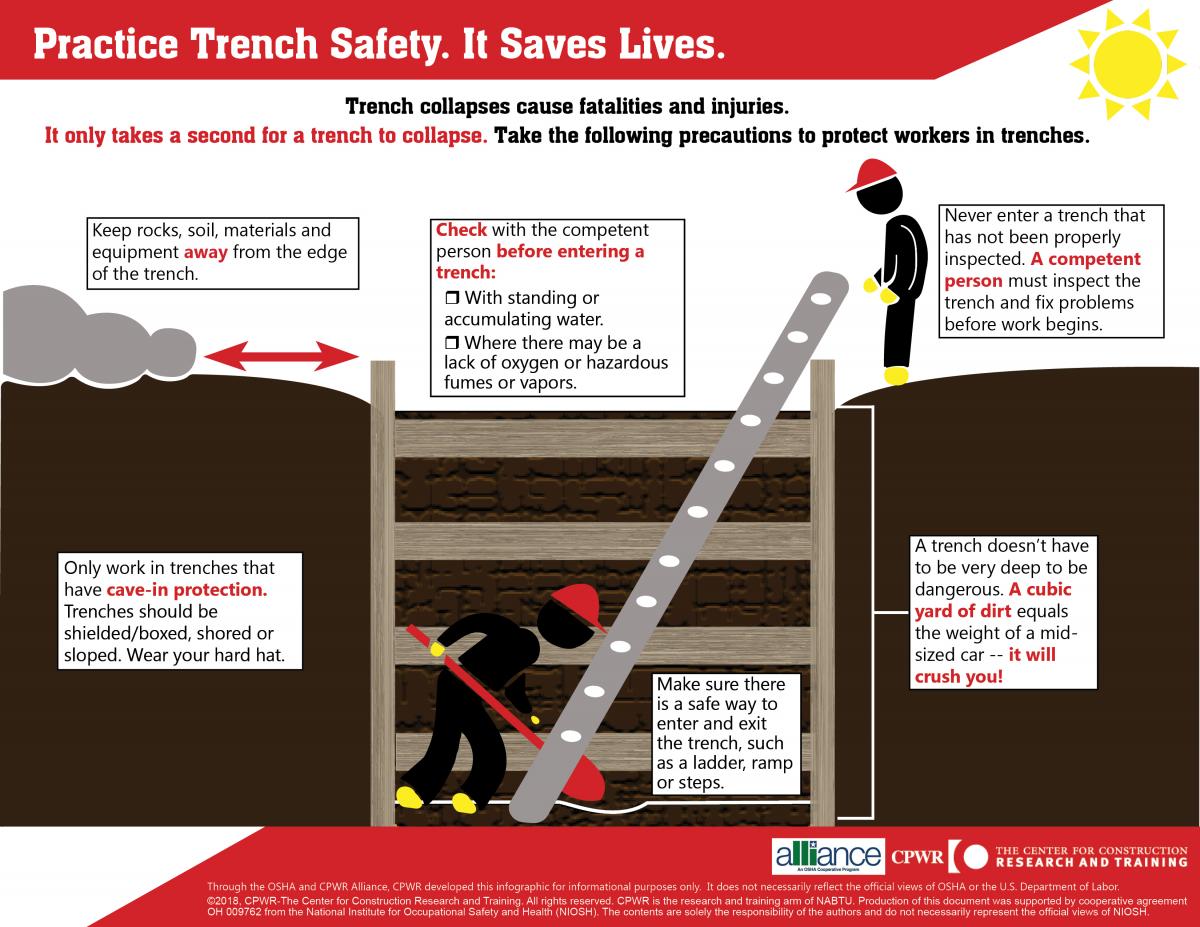
Excavation Safety – Picture This
Source: cpwr.com
Source: cpwr.com
Charla sobre seguridad general en la excavación
Según la Oficina de Estadísticas Laborales, entre 2013 y 2017 se produjeron 97 muertes en zanjas en la industria de la construcción, un promedio de 19 por año, desde un mínimo de 10 muertes en 2014 hasta un máximo de 33 en 2016 [BLS, 2019]. Las excavaciones son algo habitual en las obras de construcción de todo Estados Unidos. Este trabajo puede conllevar numerosos peligros, pero el trabajo de excavación puede ser seguro si se siguen las directrices básicas de seguridad.
Los empleadores pueden ayudar a reducir las lesiones y las muertes causadas por los derrumbes.
La vida de ningún trabajador debería acabar en una zanja. Los derrumbes durante las excavaciones son una de las causas más comunes y espeluznantes de muertes de trabajadores en la construcción, pero son totalmente evitables. Con la formación, los procedimientos y los suministros adecuados, los empresarios pueden ayudar a prevenir estos accidentes.
Las zonas de zanjas a veces tienen niveles de oxígeno agotados, y la atmósfera también puede estar contaminada por gases tóxicos y productos químicos.
Carlos Moncayo, un inmigrante de 22 años procedente de Ecuador. Murió el 6 de abril al derrumbarse una zanja de 4 metros de profundidad en la que trabajaba en una obra de Nueva York. Los inspectores habían advertido repetidamente a los contratistas que supervisaban la obra que la zanja constituía un peligro inminente porque no estaba debidamente apuntalada. Al carecer de muros de apoyo, la zanja acabó derrumbándose. Moncayo quedó enterrado hasta el cuello y murió aplastado por miles de kilos de tierra.
El 5 de agosto, el fiscal del distrito de Manhattan acusó a dos empresas y a dos supervisores de causar la muerte de Moncayo. Harco Construction, Sky Materials, el capataz Wilmer Cueva y el superintendente de la obra Alfonso Prestia han sido acusados de homicidio involuntario, homicidio por negligencia y puesta en peligro.

Failure to understand instructions, especially because of a language barrier, is a recipe for disaster. For a Taiwanese food production worker, it proved fatal.
As a supervisor, you may assume that a worker from another country has a pretty good grasp of English. The following story shows why pretty good isn’t good enough.
A 54-year-old food production worker who was employed by a New York State pizza dough manufacturer died of severe neck lacerations and blood loss after he was struck by an energized cutting blade while cleaning a dough machine.
The victim had turned off and locked power switches controlling the machine before he and a co-worker proceeded to clean it. The plant lockout/tagout procedure called for setting the control buttons of the dough chunker to “off” and “manu.” However, the victim set those controls in the “on” and “auto” positions.
At one point the co-worker asked the victim for the key to unlock the main power switch for one of the machines, so the dough bowl could be raised. The victim was bending over and extended his head through the bottom opening of the hopper when his co-worker activated the power switch.
Hearing noises, the co-worker rushed to the victim and observed that he had been partially decapitated by the energized steel blade. The worker died at the scene.
Investigators determined that the company’s lockout/tagout training program included viewing a 35-minute video in English, along with some text training and hands-on training.
During some of the training sessions, the victim’s employer had hired professional translators to translate written training material into Mandarin Chinese for three employees at the plant. However, the hands-on training sessions were conducted solely in English.
The plant manager and safety coordinator said each worker had been taught how to shut down a machine and isolate its energy source, release any potentially hazardous stored energy, test to verify that the energy source was isolated, and lock the energy control device securely in the “off” position. The plant safety coordinator said the victim had seemed to understand English fairly well.
Their recommendations included the following:
Periodic inspections should be conducted to ensure that company procedures are being followed.
Employees need retraining in the event of an incident, a near miss or changes to procedures or equipment. Those workers whose first language is not English should receive both text training and hands-on training in their native language.
Appearances can be deceiving. Assuming that a worker has adequate English language comprehension to understand complex instructions involves taking a big leap of faith. It’s a risk you cannot afford to take. Make sure training is offered in a language your workers understand.
Stacking materials too high can cause the stack to collapse. So what’s the right height for a stack? It all depends. There are 6 things you need to think about in determining the safe height to stack materials:
Few people get through life without witnessing a traumatic event. Maybe you are driving and spot another car spinning out of control before it crashes it’s hit by a semi-truck. Or perhaps something terrible happens at work and you witness employees losing their lives.
People who have witnessed such events often will say their lives have been turned upside down because nothing shows the fragility of human life quite like knowing that someone who was alive two seconds ago is gone.
It’s common for witnesses to keep replaying horrifying images in their minds for days or weeks. It’s a switch that cannot be shut off, no matter how much one might want to.
Nausea, loss of appetite, dizziness, headache, depression, confusion, grief, nightmares, insomnia, helplessness, fear, confusion, and a sense of detachment from reality are among the symptoms of stress related to involvement in traumatic events.
People handle these events differently. Some want to talk out their feelings are quite emotional, while others clam up and stuff their feelings inside.
But failing to deal with one’s feelings will not make them disappear. Such avoidance can lead to post-traumatic stress disorder (PTSD), and intense emotional/physical reaction to a traumatic event that can last for months.
People suffering from PTSD may withdraw from activities, people, laces and thoughts or feelings related to the traumatic incident.
They also may become irritable and prone to outbursts of anger and find it difficult to concentrate. Flashbacks and nightmares along with physical symptoms, such as chills and shaking are associated with PTSD.
As a supervisor who witnesses a traumatic event, you will be caught in a whirlwind of activities in the days following it, including being interviewed by police and government occupational safety and health officials.
You may believe it’s important to not show or share your feelings with workers, because you may be seen as a weak person who cannot handle a tough situation. In reality, not taking to workers about what you are all feeling may lead them to believe you are cold and unfeeling. How you decide to deal with that issue is your business, but you’ll need to deal with your own feelings in the aftermath of a traumatic event.
Here are some coping strategies from the US CDD you can use. Share these with others that may be going through the same thing.
According to the CDC, about half of those with PTSD recover within three months without treatment. This is not always the case – sometimes, symptoms do not go away on their own or last for more than three months. This depends on the many factors including the severity of the event, exposure to the event or seriousness of the threat to life, the number of times an event happened, a history of past trauma, and psychological problems before the event.
Everyone deals with trauma differently – there is no single solution for everyone but using some of these coping strategies for yourself or knowing them so you are able to help others can start the path for healing.
In a past survey, 82% of safety professionals said they observed their workers failing to use required personal protective equipment (PPE) at least once in the span of a year.
Of course, ensuring proper use of PPE by workers isn’t just a compliance obligation; it’s a vital safety measure. So why don’t workers use the stuff?
At over 85%, the most common worker reason survey respondents cited was lack of awareness about PPE and why it’s important to use. This is clearly a problem that providing appropriate safety training would solve.
Another common reason for not using PPE: the workers said that PPE wasn’t available at their workplace or that it didn’t fit right. Each of these reasons could and should have been addressed by the employer.
So, if any of your workers are citing reasons like this, shame on you.
The other common reasons cited are not so much reasons as excuses by workers who understood the importance of using PPE but chose not to due to some complaint about the PPE.
Complaint – PPE Was Uncomfortable
If your workers are saying this, you can easily help them find an alternate solution – whether it’s a different style of eye protection or a better fitting hardhat. In many cases, if the PPE isn’t comfortable the worker may not be wearing it properly.
Complaint – PPE Made Them Too Hot
If your workers are finding it hot, you may want to consider checking out the temperature in the area – check your ventilation and get some airflow. This may not solve the issue completely but could help with your workers objections.
Complaint – PPE Hampered Productivity or Made Job Tasks Harder
Find out how the PPE is causing issues with getting work done. In some cases, you may be able to find a way to improve efficiencies. In other cases, you and your workers may just have to understand that in order to be safe, the work may take a little longer.
Complaint – PPE Made Them Look Unattractive
Not much to say here! It’s not about looks – it’s about being safe. End of story.
We all understand that lack of comfort and such aren’t valid excuses for not using PPE. So, it would be easy to label the excuses as “shame-on-the worker”.
But it’s not as simple as that. At the end of the day, who’s to blame for a workers’ failure to use PPE is less important than understanding why they’re not using it and making sure they do.
So, if your workers are using excuses like “it’s too hot,” you need to know what they’re complaining about and address the problem—either by making the PPE “less hot” or getting the worker to use it the way it is. Anything less might result in an OSHA violation and a fatal or serious injury.
Almost every worker handles materials at some point during the work day. Using the right method of moving materials combined with the correct personal protective equipment is the only way to reduce the threat of injury.
When it comes to preventing injury, stacking materials properly is just as important as using proper lifting techniques and the right equipment to move a load.
Hand cart injuries occur when wrists and fingers are caught in the cart itself, between the cart and the load, or between the load and another stationary object. Also in danger are feet and legs being crushed by the cart or the load being moved. Handcart use can result in serious back and shoulder strain, as well as straining leg and arm muscles.
Roughly 75 per cent of all material handling workers will suffer a back injury at some time during their working life. Using a hand cart, instead of strength when moving objects can save workers from a stress injury. If they have to lift, use correct lifting and moving methods for loads within your strength limit combined with proper protective equipment. Prior to lifting materials, assess each load for weight, sharp edges, slivers, and wet or greasy spots. Also assess the route to ensure it is clear of clutter, spills and obstructions.
If the load requires a team to lift the material, chose team members who are of similar size and strength. Choose one leader to direct the team and issue lifting, moving and setting down commands. Try to equally distribute the load among all team members.
Although boxes and cartons are not considered to be irregular shaped objects, there is still a correct way to lift and carry. Grasp a carton with one hand on the top and one hand on the bottom, both placed in opposite corners of the box. Sacks should also be lifted using opposite corners. But once the sack has been lifted, it should be shifted so that it rests against your hip or stomach so you can swing the sack up and over your shoulder. If you cannot swing it over your shoulder, then the sack is too heavy. Irregular objects can be shaped irregularly or unevenly weighted. Such objects require special solutions. If the object is unwieldy and will not allow you to securely grasp and lift the object, then you should seek assistance and/or use a handcart. When carrying long objects such as pipes and tubing, the correct method is to balance the objects on your shoulders. When carrying long sections, use a guide to make sure the way is always clear of workers who could be injured by the jutting pipes.
A high percentage of all annual work-related fatalities are caused by motor vehicle crashes. Many of these deaths could have been avoided if the drivers and passengers in these vehicles had worn their seatbelts.
At one time or another, almost everyone has one time or another pulled a “harmless” joke on a friend. But there is difference between true witty joke that does not cause any harm and what is commonly known as “horseplay”. The task at hand is to avoid any acceptance of the horseplay mentality in the workplace
An employer or supervisor can’t stand by you every second to see that safety rules are followed. You must take charge of your safety because you have the most to gain — and the most to lose.
Being involved in an accident like drink driving, affects more than just yourself. It affects your family emotionally as well as financially.
The first thing to come to mind is the expensive nature of drunk driving. Cost is measured in financial terms and the affect on the person’s life. The average cost for a person’s first DUI connection is anywhere from $9000 to $24,000.
A DUI can also cost you your job or make it difficult for you to find a new job. Many employers will not hire someone with a recent DUI or will fire someone who has got one while working for them. Many employers require employees to be able to drive a company vehicle and maintain a clean driving record. A DUI is virtually an instant way to lose your ability to drive a company vehicle.
If someone drives drunk and survives a crash that injures or kills other people, he or she must live with the consequences. That emotional burden can be worse than any bodily harm.
But the physical perils of drunk driving are immense, too. Impaired driving can cause accidents that lead to paralysis, disfigurement, brain damage, and even death.
Impaired driving is also a crime. Drunk drivers often pay significant fines, lose their license, and face higher insurance costs. Common punishments for conviction of a drunken driving-related offense can include:
Find your designated driver. Designate a driver who will not drink before you go out. Never assume that someone will volunteer, and make sure that you don’t put all the responsibility on the same person every time. If you feel guilty, offer to buy their dinner or to pay for gas.
Hold each other accountable. When you do go out with friends, coworkers, or family, make a plan with friends to hold each other accountable. Encourage each other to drink water in between alcoholic beverages. If they’ve been drinking, take their keys away from them. Call a cab or offer to give them a ride to pick their car up in the morning.
Be a responsible host. If you’re hosting your own gathering, offer non-alcoholic beverages and make sure everyone has a safe ride home. Monitor your own drinking to ensure that you help guests make safe choices.
Plan alcohol-free activities. Plan activities with friends and family that don’t always involve drinking. Whether it’s being active, enjoying good conversation, exploring a new place, or visiting your favorite spot, you don’t need alcohol to make the evening a memorable one.
There is never such a thing as “just a drive down the street” when you are drunk. It may seem like an easier and quicker option compared to finding a designated driver, but it is a decision that could change your life or someone else’s life forever. Think before you decide to drive drunk.
The Carrollton Crash
The crash occurred around 11 p.m. when a drunk driver in a pickup truck was traveling on the wrong side of the interstate and slammed into the oncoming school bus.
Ten-year-old Patty Nunnallee was among the 24 children killed, and Chuck Kytta, one of the chaperones on the trip, was one of three adults who died.
His wife, Janet Kytta Hancock, said she later learned that he had been standing in the stairwell at the front of the bus when the crash happened, and he burned to death.
At first, when she arrived at the First Assembly of God Church that night after receiving a call about a problem with the bus, there were lists of names posted that divided up the passengers into injured and missing. Her husband’s name was on the missing list.
“I couldn’t figure out why he would be missing. He was an adult, he had a wallet,” she said. “The fire was so fast, and it was so hot that Chuck actually burned to death. He didn’t die of smoke inhalation. It was horrible. It was just unimaginable.”
Don Karol, a senior highway accident investigator with the National Transportation Safety Board, told ABC News that he believes that no one died as a direct result of the collision, but rather from the fire and smoke inhalation in the aftermath.
The truck “hit the bus in the right front, and it was enough to basically damage the suspension, and the whole front end of the bus got pushed rearward. The fuel tank that is right behind that area got punctured,” Karol said.
The bus was filled to capacity, Karol said, with 66 passengers and a driver, and because the front exit was inaccessible due to the crash, all 67 adults and children were trying to get out of the one rear exit.
That one rear exit was partially blocked by coolers that had been pushed toward the back of the bus, which Karol said “exacerbated the problem.”
The layout of seats was also a factor, as the bus’s “very wide” rows of seats left only left 12 inches for the aisle, Karol said.
Two other safety issues that reared their dangerous heads that night were a lack of guard frames around the fuel tank, which could have prevented it from being punctured in the crash, and the toxic, highly flammable material in the bus seats.
Autopsy reports showed Patty Nunnallee had certain toxins in her system which indicated she was the last one to die, her mother said.
“I was honestly hoping that the immense heat would have killed her instantly,” Nunnallee said. “But the autopsy showed that because of the gas in her blood, she had to have breathed it in and she was the only one” to have such toxins in her system.

DRINKING AND DRIVING IS DEADLY
What’s wrong in this picture? Drinking and driving while either impaired or drunk is dangerous. Drivers with high blood alcohol concentration (BAC) are at much greater risk of traffic crashes. This means more injuries and deaths.
Every single injury and death caused by drunk driving is preventable. In fact, the proportion of alcohol-impaired driving crashes has dropped greatly over time.
Plenty of people know that drinking and driving don’t mix — but many still do it. According to the Centers for Disease Control and Prevention, there are over 300,000 incidents of drinking and driving each day. And arrest doesn’t typically mark the first time a person drives under the influence: The average drunk driver does so over 80 times before getting caught. The risks are high, but the solutions are simple.
Driving after even one drink is just not worth it. Ride with a sober friend, ask someone else to drive or call a parent or older sibling. Be sure to always keep a DUDE around: DESIGNATED UNIMPAIRED DRIVER EXTRAORDINAIRE.
Estar involucrado en un accidente como el de la conducción bajo los efectos del alcohol, afecta a algo más que a uno mismo. Afecta a su familia tanto emocional como económicamente.
Lo primero que nos viene a la mente es el coste de la conducción bajo los efectos del alcohol. El costo se mide en términos financieros y el efecto en la vida de la persona. El coste medio de la primera conexión de una persona con un DUI es de entre 9.000 y 24.000 dólares.
Un DUI también le puede costar su trabajo o hacer que sea difícil para usted encontrar un nuevo trabajo. Muchos empleadores no contratarán a alguien con un DUI reciente o despedirán a alguien que haya obtenido uno mientras trabaja para ellos. Muchos empleadores requieren que los empleados puedan conducir un vehículo de la empresa y mantener un historial de conducción limpio. Un DUI es prácticamente una forma instantánea de perder la capacidad de conducir un vehículo de la empresa.
Si alguien conduce ebrio y sobrevive a un accidente que hiere o mata a otras personas, debe vivir con las consecuencias. Esa carga emocional puede ser peor que cualquier daño corporal.
Pero los peligros físicos de la conducción bajo los efectos del alcohol también son inmensos. La conducción bajo los efectos del alcohol puede causar accidentes que provocan parálisis, desfiguración, daños cerebrales e incluso la muerte.
Conducir bajo los efectos del alcohol es también un delito. Los conductores ebrios suelen pagar multas importantes, perder el carné de conducir y enfrentarse a costes de seguro más elevados. Los castigos comunes por la condena de un delito relacionado con la conducción en estado de ebriedad pueden incluir:
Busque a su conductor designado. Designe a un conductor que no vaya a beber antes de salir. Nunca de por sentado que alguien se ofrecerá, y asegúrese de no cargar toda la responsabilidad en la misma persona cada vez. Si se siente culpable, ofrézcale a pagar la cena o la gasolina.
Responsabilícense mutuamente. Cuando salga con amigos, compañeros de trabajo o familiares, haga un plan con sus amigos para que sean responsables mutuamente. Anímense a beber agua entre las bebidas alcohólicas. Si han estado bebiendo, quíteles las llaves. Llama a un taxi u ofrézcase a llevarles a recoger su vehículo por la mañana.
Sea un anfitrión responsable. Si usted es el anfitrión de su propia reunión, ofrezca bebidas no alcohólicas y asegúrese de que todo el mundo tenga un viaje seguro a casa. Controle su propio consumo de alcohol para asegurarse de que ayuda a los invitados a tomar decisiones seguras.
Planifique actividades sin alcohol. Planifique actividades con amigos y familiares que no siempre impliquen beber. Ya sea estar activo, disfrutar de una buena conversación, explorar un nuevo lugar o visitar su lugar favorito, no es necesario el alcohol para que la velada sea memorable.
Nunca existe la opción de “dar un paseo por la calle” cuando está borracho. Puede parecer una opción más fácil y rápida en comparación con la búsqueda de un conductor designado, pero es una decisión que podría cambiar su vida o la de otra persona para siempre. Piense antes de decidirse a conducir ebrio.
El accidente de Carrollton
El accidente se produjo en torno a las 11 de la noche, cuando un conductor ebrio a bordo de una camioneta circulaba por el lado contrario de la interestatal y chocó contra el autobús escolar que circulaba en sentido contrario.
Patty Nunnallee, de diez años, se encontraba entre los 24 niños muertos, y Chuck Kytta, uno de los acompañantes del viaje, fue uno de los tres adultos que fallecieron.
Su esposa, Janet Kytta Hancock, dijo que más tarde se enteró de que él había estado de pie en la escalera de la parte delantera del autobús cuando se produjo el accidente, y murió calcinado.
Al principio, cuando llegó a la Iglesia de la Primera Asamblea de Dios esa noche tras recibir una llamada sobre un problema con el autobús, había listas de nombres publicadas que dividían a los pasajeros en heridos y desaparecidos. El nombre de su marido estaba en la lista de desaparecidos.
“No podía entender por qué estaba desaparecido. Era un adulto, tenía una cartera”, dijo. “El fuego fue tan rápido y estaba tan caliente que Chuck murió quemado. No murió por inhalación de humo. Fue horrible. Fue simplemente inimaginable”.
Don Karol, investigador principal de accidentes de carretera de la Junta Nacional de Seguridad del Transporte, dijo a ABC News que cree que nadie murió como resultado directo de la colisión, sino por el fuego y la inhalación de humo en las secuelas.
El camión “golpeó el autobús en la parte delantera derecha, y fue suficiente para dañar básicamente la suspensión, y toda la parte delantera del autobús fue empujada hacia atrás … El depósito de combustible, que está justo detrás de esa zona, quedó perforado”, dijo Karol.
El autobús iba lleno, dijo Karol, con 66 pasajeros y un conductor, y como la salida delantera era inaccesible debido al accidente, los 67 adultos y niños intentaban salir por la única salida trasera.
Esa única salida trasera estaba parcialmente bloqueada por neveras que habían sido empujadas hacia la parte trasera del autobús, lo que, según Karol, “agravó el problema”.
La disposición de los asientos también fue un factor, ya que las filas de asientos “muy anchas” del autobús sólo dejaban 12 pulgadas para el pasillo, dijo Karol.
Otros dos problemas de seguridad que asomaron sus peligrosas cabezas aquella noche fueron la falta de marcos de protección alrededor del depósito de combustible, que podría haber evitado que se pinchara en el accidente, y el material tóxico y altamente inflamable de los asientos del autobús.
Los informes de la autopsia mostraron que Patty Nunnallee tenía ciertas toxinas en su sistema que indicaban que fue la última en morir, dijo su madre.
“Sinceramente, esperaba que el inmenso calor la hubiera matado al instante”, dijo Nunnallee. “Pero la autopsia demostró que, debido al gas que había en su sangre… tuvo que haberlo respirado y fue la única” que tenía esas toxinas en su organismo.
BEBER Y CONDUCIR ES MORTAL
¿Qué hay de malo en esta imagen? Beber y conducir en estado de embriaguez es peligroso. Los conductores con una alta concentración de alcohol en sangre corren un riesgo mucho mayor de sufrir accidentes de tráfico. Esto significa más lesiones y muertes.
Todas las lesiones y muertes causadas por la conducción bajo los efectos del alcohol se pueden evitar. De hecho, la proporción de accidentes por conducción bajo los efectos del alcohol ha disminuido mucho con el tiempo.
Mucha gente sabe que beber y conducir no son compatibles, pero muchos siguen haciéndolo. Según los Centros para el Control y la Prevención de Enfermedades, cada día se producen más de 300.000 incidentes de conducción bajo los efectos del alcohol. Y la detención no suele ser la primera vez que una persona conduce bajo los efectos del alcohol: El conductor ebrio medio lo hace más de 80 veces antes de ser detenido. Los riesgos son altos, pero las soluciones son sencillas.
Conducir después de una sola copa no merece la pena. Viaja con un amigo sobrio, pide a otra persona que conduzca o llama a uno de tus padres o a un hermano mayor. Asegúrate de tener siempre un DUDE cerca: UN CONDUCTOR DESIGNADO SIN IMPEDIMENTOS EXTRAORDINARIO.
Many people have been in the same line of work for many years, and have seen a lot of changes. With ever improving technologies and accessibility of information through the internet, mankind is moving at incredible speeds. Whether it is the use of computers, improved technologies, law changes, schedule changes, shifts in business, and even the use of robots- there have been drastic changes in the majority of workplaces over the last few decades.
Change can be good or bad depending on what the changes are. How one reacts and deals with change is the key.
1st Question. What happens when business does not change?
Companies who are stuck in their ways or who are unbending in the way they approach the business are opting for a stale working environment.
This environment doesn’t have the capacity to adapt to new possibilities including creative ideas …ideas that may lead to an overall improved operation or maybe a totally fresh new product or service.
That said, while change may be difficult, it can be beneficial to both the company and the employees.
2nd Question
Why is it important to adopt to change in the workplace?
Change in the workplace can make us uncomfortable as we step out of what we normally do and attempt new ways of working. Adapting to change in the workplace is often difficult because it’s too easy to stay accustomed to our habits.
Those companies that don’t change can stagnate and not develop. Having the ability to face these new challenges head-on will not only develop the company as a whole but also those who work within it.
Change in the workplace tend to cause alarm for employees. It’s a manager’s job to ensure employees are informed as much as possible, leaving no room for confusion or muddy waters. When everyone feels like they are on the same page, and understands the reason behind a change, it’s much easier for employees to embrace change in the workplace.
Anyone working in business knows that changes are inevitable, and they can occur at a breathtaking rate. For instance, technology that did not exist just five years ago has become commonplace now. As the world around us continues to evolve, businesses and processes must also adjust along with them.
Learning how to push for positive change within the workplace is an important skill for leaders who want to remain at the forefront of their industry. Here is what you should know about embracing change in the workplace.
When you hear about a new impending change, gather as much information as you can about how it will affect you and the other employees. Discuss with organizational leaders an effective way to implement the change and how to get other members of the organization on board. Make sure you fully understand why this step is important to help keep you motivated throughout implementation and help you broach the topic with others who might be less sure about the change in the organization.
Change can sometimes be challenging for people, particularly those who felt as though the old systems worked fine. Therefore, focusing on the benefits and potential positive outcomes can help you embrace the changes and continue to push towards the new opportunities.
Although it can be hard to see the benefits of a particular change in the moment, when you think about the problem long-term, the benefits become more clear. As adopting a new system may cause struggles and growing pains in the present, remember the benefits that you know are coming once the change has been fully adopted.
Even as you embrace new changes in the workplace, you need to stay focused on your job responsibilities. Although it may be distracting, do not allow it to negatively impact your work performance. Allowing yourself to lose focus on your work will only add to your stress, which in turn will make it harder to adapt to the change and feel comfortable in the new system.
When it comes to accepting changes, adaptability is key. Now that change is coming to your workplace, you have the chance to influence the changes and even become a go-to person on your team as others struggle with the implementation. Therefore, this can be your opportunity to shine and build your reputation within your organization.
And there are numerous benefits of having an open mind throughout periods of change!
The positive aspects of change for employees:
We cannot fight or slowdown change. All too often news stories are published about major businesses closing their doors for good such as Sears recently announced they may be doing. Companies must embrace change to continue operations and their employees must not only accept change, but think of how they can add value to the change on an individual level to continue to thrive themselves.
“A worker’s first day at work shouldn’t be his last day on earth,” said OSHA administrator David Michaels about a 21-year-old temporary worker who was crushed to death his first day on the job. (Updated Feb. 14 with statement from Bacardi.)
OSHA has issued 12 violations to Bacardi Bottling Corp. in connection with the death of Lawrence Davis at the company’s Jacksonville, FL, facility in August 2012. Associated fines total $192,000.
Davis was cleaning glass from under the hoist of a palletizing machine when an employee restarted the palletizer. The machine crushed Davis. OSHA says Bacardi had failed to train temporary employees on using locks and tags to prevent the unexpected start-up of machines and to ensure its own employees used lockout/tagout procedures.
Bacardi was using temporary staffers from Remedy Intelligent Staffing.
“We are seeing untrained workers — many of them temporary workers — killed very soon after starting a new job. This must stop,” said Michaels. The OSHA administrator said companies must train all employees, including those who are retained from temporary employment agencies, before they start working.

What’s wrong in this picture?
We use power tools and other power equipment in the construction industry for one simple reason: they’re stronger than we’ll ever be. Some people fail to realize that and put themselves in peculiar situations and many times set themselves up for an injury.
Such was the case when two construction workers were using a gas powered auger to dig a hole in some asphalt. The machine ended up getting stuck and then proved too much to handle for the poor guys. One was smart enough to let go, but the other decided to hang on to the handle, as the machine whipped him around like a rag doll, sending him flying into a pile of wood.