Five Common Contributing Factors Stats and Facts

FACTS

  1. Wet or damp floors are not the only cause of slip, trip and fall accidents within a facility. Clutter, footwear and improper cleaning can also cause hazards for both employees and building occupants alike. 
  2. Housekeeping includes keeping work areas neat and orderly and keeping aisles, floors and stairs free from slip and trip hazards. The removal of waste (paper, cardboard, containers, used chemicals, etc.) from the work area is valuable in reducing accidents.
  3. Housekeeping requires focusing attention on important details in the workplace such as layout, aisle markings, adequacy of storage facilities and maintenance. 
  4. Experience has shown that good housekeeping is an essential and effective part of a safety and health program. Effective housekeeping helps eliminate workplace hazards and promotes a safer, more efficient work environment.

STATS

  • A 2016 survey of 2,000 US hiring and HR managers by CareerBuilder showed in the workplace that the top distraction culprits included smartphones (55%), the internet (41%), gossip (37%), social media (37%), co-workers dropping by (27%), smoking or snack breaks (27%), email (26%), meetings, (24%), and noisy co-workers (20%).
  • The latest workplace injury statistics for 2020, as published by the U.S. Bureau of Labor Statistics (BLS), the U.S. Occupational Safety and Health Administration (OSHA), and the U.S. Centers for Disease Control and Prevention (CDC).
  • Nearly 3 out of 4 workers (70%) admit they feel distracted at work, with 16% of people stating that they’re almost always distracted.
  • Almost three-quarters of employers surveyed by CareerBuilder said that two or more hours a day were lost in productivity because of workplace distractions, with nearly half (43%) estimating they lost three or more hours a day.
  • A Survey of 2,000 people by financial management service Think Money in the UK reported that a third of employees are distracted at work for up to three hours a day.
  • Only 30% of the employees in America are engaged in work. If we look at workplace complacency statistics from a global perspective, there are only 13% of the employees worldwide who are engaged in an office environment. 
  • Top distractions identified by Udemy for Business in their survey included talkative co-workers (cited by 80% of workers surveyed), and office noise (70%).
  • Meetings were blamed for low productivity by 60% of respondents, while 58% said that, although they don’t need social media to do their jobs, they couldn’t make it through the working day without checking platforms such as Facebook, Twitter and Instagram.
  • Workplace injuries are alarmingly common. According to the National Safety Council, in the United States, a worker is injured on the job every seven seconds. This equates to:
  • 540 work injuries per hour
  • 12,900 work injuries per day
  • 90,400 work injuries per week
  • 7 million work injuries per year!


Fire Extinguishers Use and Inspection Stats and Facts

FACTS 

  1. There are many common misconceptions related to OSHA’s fire safety requirements. One is that all employers are required to have portable fire extinguishers on-site. While this is not the case in most industries, OSHA does require that if employers do choose to provide extinguishers, employees must be trained on their use. Another misconception is that OSHA requires all employers to have fixed extinguishing or automatic sprinkler systems in all workplaces.
  2. OSHA stipulates that businesses should train workers regarding potential fire hazards in their workplace, and also on what procedures should be followed in the event of a fire emergency.
  3. OSHA recommends that all employers have an emergency evacuation/action plan in place in case of fire—featuring safety assignments for key personnel—and requires these plans for certain industries, such as hazardous chemical processing.
  4. Many of OSHA’s fire safety recommendations are industry- or even job-specific. In the construction industry, OSHA calls for a “fire plan” to be formulated prior to any demolition job. Other OSHA-mandated standards — like the presence of adequate fire exits — are required in every industry.

STATS 

  • Fire extinguishers can effectively put out 80% of all fires, even if the extinguisher is classified as a portable unit. When a fire extinguisher is used on a fire in the United States, 75% of the time, the fire department is not required to attend the incident. (EnGauge Inc.)
  • In 60% of all fire incidents which occur, the fire department is never notified if a fire extinguisher is present and accessible. Almost 2 million fires are handled entirely by a fire extinguisher in the U.S. every year. (EnGauge Inc.)
  • Structure fires account for 20% of municipal fire department calls and are responsible for 49% of deaths that are associated with fires. (National Fire Protection Association)
  • The most popular type of fire extinguisher sold by the industry today is the Class A extinguisher, which accounts for 41.8% of total sales. 
  • Cooking is also the primary cause of non-residential building fires, accounting for 29.5% of tracked incidents. (United States Fire Administration)
  • About 40% of people in the 85+ age demographic are killed when caught in a fire, which is 4x higher than the national fire death rate in the United States. (United States Fire Administration)


Fire Extinguishers Use and Inspection Stats and Facts – Spanish

HECHOS

  1. Hay muchos conceptos erróneos relacionados con los requisitos de seguridad contra incendios de la OSHA. Uno de ellos es que todos los empleadores están obligados a tener extintores portátiles en sus instalaciones. Si bien este no es el caso en la mayoría de las industrias, OSHA requiere que si los empleadores deciden proporcionar extintores, los empleados deben ser entrenados en su uso. Otro concepto erróneo es que la OSHA exige que todos los empleadores tengan sistemas fijos de extinción o rociadores automáticos en todos los lugares de trabajo.
  2. OSHA estipula que las empresas deben formar a los trabajadores sobre los posibles riesgos de incendio en su lugar de trabajo, y también sobre los procedimientos que deben seguirse en caso de emergencia por incendio.
  3. OSHA recomienda que todos los empresarios dispongan de un plan de evacuación/actuación de emergencia en caso de incendio -que incluya asignaciones de seguridad para el personal clave- y exige estos planes para determinadas industrias, como la de procesamiento de productos químicos peligrosos.
  4. Muchas de las recomendaciones de seguridad contra incendios de la OSHA son específicas para cada sector o incluso para cada trabajo. En el sector de la construcción, OSHA exige que se formule un “plan contra incendios” antes de cualquier trabajo de demolición. Otras normas exigidas por OSHA, como la presencia de salidas de emergencia adecuadas, son obligatorias en todos los sectores.

ESTADÍSTICAS

  • Los extintores pueden apagar eficazmente el 80% de los incendios, incluso si el extintor está clasificado como unidad portátil. Cuando se utiliza un extintor en un incendio en Estados Unidos, el 75% de las veces no es necesario que los bomberos acudan al incidente. (EnGauge Inc.)
  • En el 60% de los incidentes de incendio que se producen, nunca se avisa a los bomberos si hay un extintor presente y accesible. Casi 2 millones de incendios son manejados completamente por un extintor en los Estados Unidos cada año. (EnGauge Inc.)
  • Los incendios de estructuras representan el 20% de las llamadas de los departamentos de bomberos municipales y son responsables del 49% de las muertes asociadas a los incendios. (Asociación Nacional de Protección contra Incendios)
  • El tipo de extintor más popular vendido por la industria hoy en día es el extintor de clase A, que representa el 41,8% de las ventas totales. 
  • La cocina es también la principal causa de los incendios en edificios no residenciales, ya que representa el 29,5% de los incidentes registrados. (Administración de Incendios de los Estados Unidos)
  • Alrededor del 40% de las personas de más de 85 años mueren al verse atrapadas en un incendio, lo cual es 4 veces superior a la tasa nacional de mortalidad por incendio en los Estados Unidos. (Administración de Incendios de los Estados Unidos)


Fire Extinguishers Use and Inspection Picture This

Source: Slidesharecdn.com


Fire Extinguishers Use and Inspection Picture This – Spanish

Fuente: https://womenforsafety.medium.com


Fire Watch General Safety Meeting Kit

OSHA mandates the presence of both hole and fire watch personnel in the Code of Federal Regulations. Fire watch personnel provide surveillance of areas where ¨hot work¨, such as welding or cutting with torches, is occurring. Fire watch workers may be part of a welding team that make sure that smoldering fires result from cutting or welding metal. They are vital part of construction and industrial maintenance safety programs.

The main job for fire watch personnel is to sound the alarm if there is an emergency so that firefighters can be brought in. They may attempt to control the fire but their primary role is not fight the flames, but to simply alert professionals so that they can come in take care of it.

Fire Watch Responsibilities Include: 

  • Constantly patrolling areas where ¨hot work¨ is being performed, maintaining vigilance of potential fires.
  • Being familiar with facilities and procedures for sounding an alarm in the event of a fire and having a means of notifying emergency services.
  • Having fire-extinguishing equipment readily available and being well-trained in its use.
  • Maintaining the conditions and requirements stated on the safety permit.
  • Inspecting the entire work area to look for potential release of flammable vapors or liquids before, during, and at the end of each shift.
  • Being prepared to operate fire extinguishers, hydrants, fixed monitors, and hose carts anytime.
  • Fire watchers are required to be familiar with facilities for sounding an alarm in the event of a fire.
  • Fire watchers should refrain from all other job duties.
  • According to the NFPA 51B standard, fire watchers must remain on the scene for 60 minutes after work is complete. The fire watch may need to stay on-site longer, depending on the conditions of the worksite.

When is a Fire Watch Needed?

A fire watch is usually required for one of four reasons:

  • The building´s fire alarm, fire sprinkler, or fire suppression system is out of order or an outage is preplanned for a period to exceed four hours. The fire marshal often requires notification for conditions like these.
  • Hot work is occurring in the building. Hot work includes welding, using a torch, or other spark or flame producing work. Many building fires have been ignited by activities considered hot work.
  • During demolition of a building during certain hazardous activities similar to hot work.
  • Dense crowds in a building requiring extra precautions. Some public assembly buildings are required to conduct fire watches during events for extra crowd protection.

HOW IS A FIRE WATCH CONDUCTED?

A fire watch consists of one or more qualified persons performing these functions:

  • Keeping diligent watch for fires.
  • Preventing fire ignition sources.
  • Ensuring adequate means of egress and removing obstructions to egress as necessary.
  • Promptly remediating hazards that are found.

BASIC REQUIREMENTS FOR FIRE WATCHES

According to the NFPA, for fire alarm systems, a fire watch is required if the system is impaired for more than four hours in a 24-hour period. For water-based fire protection systems, fire watches are required for impairments lasting 10 hours or more in a 24-hour period. In both cases, the fire department must be notified.

 A common misconception with the fire watch requirements is that systems must be out of service for more than four consecutive hours before the requirement to implement a fire watch is invoked. However, this is not the case. The requirement applies when the sum of all outages in a 24-hour period exceeds more than four hours.

Fire watches require the continuous patrol of all areas of the building affected by the impairment to look for evidence of smoke, fire, or any abnormal conditions. As noted in its definition, if a life-threatening situation is discovered, the person conducting the fire watch must immediately contact emergency personnel, alert the occupants to the emergency and assist in their evacuation.

In addition to the occupied areas affected by the impairment, fire watchers must also check all unoccupied areas including storage rooms, crawl spaces, and any concealed areas. It is important that those conducting a fire watch be very familiar with the building and the equipment they are watching. They must also know the locations of all manual fire alarm stations and fire protection equipment available to them should they discover a fire. In addition, all activities associated with a fire watch must be documented. Therefore, anyone conducting the fire watch must also be trained in how to fill out fire watch log sheets.

The fire watch must remain in effect until the entire system is restored to proper working order and only after any necessary inspections and tests have been conducted to verify that affected systems are operational and the fire department has been notified.

FIRE WATCH BEST PRACTICES

  • Always read, understand, and maintain the conditions stated on the hot work permit
  • Inspect the work area before and after each shift for the potential release of flammable liquids or vapors.
  • Keep flammable materials away from ignition sources.
  • Maintain communication with the workers in the area.
  • Stop operations immediately if you identify a hazard.
  • Know the wind direction to understand where sparks and open flames with blow.
  • Never leave the work area while hot work is going on. If you must go, stop the job, and notify the workers.
  • Being prepared to contact the fire department.
  • Being ready to extinguish any fires using a portable extinguisher or hose.

FINAL WORD

Fire watch personnel and practices are often under valuated and unappreciated because their work is not glamorous. But very necessary and appreciated by workers on the front line. They know their safety and security depends in the professionalism of these personnel.


Fire Watch General Safety Meeting Kit – Spanish

QUÉ ESTÁ EN RIESGO

OSHA ordena la presencia de personal de vigilancia de agujeros y de incendios en el Código de Reglamentos Federales. El personal de vigilancia contra incendios vigila las áreas en las que se realizan “trabajos en caliente”, como la soldadura o el corte con soplete. Los trabajadores de vigilancia de incendios pueden formar parte de un equipo de soldadores que se aseguran de que no se produzcan incendios por el corte o la soldadura de metales. Son parte vital de los programas de seguridad en la construcción y el mantenimiento industrial.

CUÁL ES EL PELIGRO

El trabajo principal del personal de vigilancia de incendios es hacer sonar la alarma si hay una emergencia para que los bomberos puedan acudir. Pueden intentar controlar el fuego, pero su función principal no es luchar contra el fuego, sino simplemente alertar a los profesionales para que puedan acudir a ocuparse de él.

COMO PROTEGERSE

Las responsabilidades de la vigilancia de incendios incluyen: 

  • Patrullar constantemente las zonas en las que se realizan “trabajos en caliente”, manteniendo la vigilancia de posibles incendios.
  • Estar familiarizado con las instalaciones y los procedimientos para hacer sonar la alarma en caso de incendio y tener un medio para notificar a los servicios de emergencia.
  • Disponer de equipos de extinción de incendios y estar bien entrenado en su uso.
  • Mantener las condiciones y los requisitos indicados en el permiso de seguridad.
  • Inspeccionar toda el área de trabajo para buscar la posible liberación de vapores o líquidos inflamables antes, durante y al final de cada turno.
  • Estar preparado para manejar extintores, bocas de incendio, monitores fijos y carros portamangueras en cualquier momento.
  • Los vigilantes de incendios deben estar familiarizados con las instalaciones para hacer sonar la alarma en caso de incendio.
  • Los vigilantes de incendios deben abstenerse de realizar cualquier otra tarea.
  • Según la norma NFPA 51B, los vigilantes de incendios deben permanecer en el lugar de los hechos durante 60 minutos una vez finalizado el trabajo. Es posible que el vigilante de incendios deba permanecer en el lugar más tiempo, dependiendo de las condiciones del lugar de trabajo.

¿Cuándo se necesita un vigilante contra incendios?

La vigilancia de incendios suele ser necesaria por una de estas cuatro razones:

  1. La alarma de incendios del edificio, el sistema de rociadores contra incendios o el sistema de supresión de incendios no funciona o se ha planificado una interrupción por un período superior a cuatro horas. El jefe de bomberos suele exigir una notificación en estas condiciones.
  2. Se están realizando trabajos en caliente en el edificio. Los trabajos en caliente incluyen la soldadura, el uso de un soplete o cualquier otro trabajo que produzca chispas o llamas. Muchos incendios en edificios han sido provocados por actividades consideradas como trabajos en caliente.
  3. Durante la demolición de un edificio durante ciertas actividades peligrosas similares a los trabajos en caliente.
  4. La presencia de una gran cantidad de personas en un edificio requiere precauciones adicionales. Algunos edificios de reunión pública están obligados a realizar guardias contra incendios durante los eventos para una mayor protección de la multitud.

¿CÓMO SE REALIZA UNA VIGILANCIA DE INCENDIOS?

  • Una guardia contra incendios está formada por una o varias personas cualificadas que realizan estas funciones
  • Mantener una vigilancia diligente de los incendios.
  • Prevenir las fuentes de ignición del fuego.
  • Asegurar los medios de salida adecuados y eliminar las obstrucciones a la salida cuando sea necesario.
  • Reparar con prontitud los peligros que se encuentren.

REQUISITOS BÁSICOS PARA LA VIGILANCIA DE INCENDIOS

Según la NFPA, en el caso de los sistemas de alarma contra incendios, se requiere una vigilancia contra incendios si el sistema se ve afectado durante más de cuatro horas en un período de 24 horas. En el caso de los sistemas de protección contra incendios basados en el agua, se requiere una vigilancia contra incendios si las averías duran 10 horas o más en un período de 24 horas. En ambos casos, se debe notificar a los bomberos.

 Un error común con los requisitos de vigilancia de incendios es que los sistemas deben estar fuera de servicio durante más de cuatro horas consecutivas antes de que se invoque el requisito de implementar una vigilancia de incendios. Sin embargo, este no es el caso. El requisito se aplica cuando la suma de todas las interrupciones en un período de 24 horas supera las cuatro horas.

La vigilancia de incendios requiere el patrullaje continuo de todas las zonas del edificio afectadas por la avería para buscar indicios de humo, fuego o cualquier condición anormal. Como se indica en su definición, si se descubre una situación de peligro para la vida, la persona que realiza la vigilancia contra incendios debe ponerse en contacto inmediatamente con el personal de emergencia, alertar a los ocupantes de la emergencia y ayudar a su evacuación.

Además de las zonas ocupadas afectadas por el impedimento, los vigilantes de incendios también deben comprobar todas las zonas desocupadas, incluidos los almacenes, los espacios de arrastre y cualquier zona oculta. Es importante que los encargados de la vigilancia de incendios estén muy familiarizados con el edificio y el equipo que vigilan. También deben conocer la ubicación de todas las estaciones manuales de alarma contra incendios y los equipos de protección contra incendios de los que disponen en caso de descubrir un incendio. Además, todas las actividades relacionadas con la vigilancia de incendios deben estar documentadas. Por lo tanto, cualquier persona que lleve a cabo la vigilancia de incendios también debe recibir formación sobre cómo rellenar las hojas de registro de la vigilancia de incendios.

La vigilancia de incendios debe permanecer en vigor hasta que todo el sistema vuelva a funcionar correctamente y sólo después de que se hayan realizado las inspecciones y pruebas necesarias para verificar que los sistemas afectados están operativos y se haya notificado al departamento de bomberos.

PRÁCTICAS RECOMENDADAS PARA LA VIGILANCIA DE INCENDIOS

  • Lea, comprenda y mantenga siempre las condiciones establecidas en el permiso de trabajo en caliente
  • Inspeccione el área de trabajo antes y después de cada turno para detectar la posible liberación de líquidos o vapores inflamables.
  • Mantenga los materiales inflamables alejados de las fuentes de ignición.
  • Mantenga la comunicación con los trabajadores de la zona.
  • Detenga las operaciones inmediatamente si identifica un peligro.
  • Conozca la dirección del viento para saber hacia dónde soplan las chispas y las llamas abiertas.
  • No abandone nunca la zona de trabajo mientras se esté realizando un trabajo en caliente. Si debe irse, detenga el trabajo y notifique a los trabajadores.
  • Este preparado para contactar con los bomberos.
  • Este preparado para extinguir cualquier fuego utilizando un extintor portátil o una manguera.

CONCLUSIÓN

El personal de vigilancia de incendios y las prácticas a menudo está infravalorados y poco apreciados porque su trabajo no es glamuroso. Pero es muy necesario y apreciado por los trabajadores en primera línea. Saben que su seguridad depende de la profesionalidad de este personal.


Fire Watch General Safety Fatality File

Worker Dies During Hot Work

In November 2011, two contractors at the E. I. DuPont De Nemours Co. located in Buffalo, New York, were performing welding atop a 10,000-gallon slurry tank when hot sparks ignited flammable vapors, causing an explosion that killed one contractor and seriously injured another. 

The CSB’s final report and safety video, entitled “Hot Work: Hidden Hazards,” were released at an April 19, 2012, public meeting. 

A primary cause of the blast was established by the CSB as the failure of the company to require that the interior of storage tanks—on which hot work was to be performed—be monitored for flammable vapor. 

The CSB issued a recommendation urging DuPont to require monitoring inside and around storage tanks prior to performing any hot work.


Fire Watch General Safety Fatality File – Spanish

Muere un trabajador durante un trabajo en caliente

En noviembre de 2011, dos contratistas de la empresa E. I. DuPont De Nemours Co. ubicada en Buffalo, Nueva York, realizaban trabajos de soldadura sobre un tanque de lodo de 10.000 galones cuando las chispas calientes encendieron vapores inflamables, provocando una explosión que mató a un contratista e hirió gravemente a otro. 

El informe final de la CSB y el vídeo de seguridad, titulado “Hot Work: Hidden Hazards”, se dieron a conocer en una reunión pública celebrada el 19 de abril de 2012. 

La CSB determinó que una de las causas principales de la explosión fue que la empresa no exigió que se controlara el interior de los tanques de almacenamiento en los que se iban a realizar trabajos en caliente para detectar vapores inflamables. 

La CSB emitió una recomendación en la que instaba a DuPont a exigir la supervisión del interior y los alrededores de los tanques de almacenamiento antes de realizar cualquier trabajo en caliente.


Fire Watch General Safety Stats and Facts

FACTS 

HOT WORK WILL BE OCCURRING IN THE BUILDING

  1. While ¨hot work¨ is most typically associated with welding and cutting, it can mean any type of work that produces a spark or flame, including using a torch or griding. Hot work is leading cause of industrial fires.
  2. Hot work can throw sparks and molten material more than 35 feet during welding, cutting, and grinding. These sparks and hot slag typically burning above 1,000F–more than enough to easily ignite paper, wood, flammable liquids, vapors, and any other combustibles in the area.
  3. There are few locations in the average facility that consistently lack combustible materials within 35 feet in all directions. Cracks in floor openings and ducts can transmit sparks to hidden locations as well. The intense heat generated by hot work can also ignite nearby combustibles, such as walls with combustible coverings or insulation.

STATS

  • U.S. fire departments responded to an average of 4,630 structure fires involving hot work per year in 2013-2017. These fires caused an average of 15 civilian deaths, 198 civilian injuries and $355 million in direct property damage per year.
  • Forty-three percent of the fires involving hot work in 2013-2017 occurred in or on homes, including one or two-family homes and apartments or other multi-family homes, while 57 percent occurred in or non-home properties.
  • Welding torches ranked first among the type of hot work equipment involved in fires with 36 percent of the fires. The leading types of hot work equipment involved in structure fires were different in homes than in non-home properties.
  • The peak areas for home fires involving hot work were wall assemblies or concealed spaces (16 percent), and bathrooms or lavatories (13 percent). Exterior roof surfaces (12 percent) and processing or manufacturing areas (11 percent) were peak for non-home fires.
  • From 2001-2018, five firefighters were fatally injured in four unintentional fires started by torches.


Fire Watch General Safety Stats and Facts – Spanish

HECHOS

SE REALIZARÁN TRABAJOS EN CALIENTE EN EL EDIFICIO

  1. Aunque el “trabajo en caliente” se asocia normalmente con la soldadura y el corte, puede significar cualquier tipo de trabajo que produzca una chispa o una llama, incluido el uso de un soplete o una rejilla. El trabajo en caliente es la principal causa de los incendios industriales.
  2. El trabajo en caliente puede lanzar chispas y material fundido a más de 35 pies durante la soldadura, el corte y el esmerilado. Estas chispas y la escoria caliente suelen arder por encima de los 1.000F -más que suficiente para encender fácilmente el papel, la madera, los líquidos inflamables, los vapores y cualquier otro combustible en la zona.
  3. Hay pocos lugares en una instalación media que carezcan sistemáticamente de materiales combustibles en un radio de 35 pies en todas las direcciones. Las grietas en las aberturas del suelo y los conductos pueden transmitir chispas a lugares ocultos también. El intenso calor generado por el trabajo en caliente también puede encender los combustibles cercanos, como las paredes con revestimientos o aislamientos combustibles.

ESTADÍSTICAS

  • Los departamentos de bomberos de Estados Unidos respondieron a una media de 4.630 incendios de estructuras que implicaban trabajos en caliente por año en 2013-2017. Estos incendios causaron una media de 15 muertes de civiles, 198 lesiones de civiles y 355 millones de dólares en daños materiales directos al año.
  • El 43% de los incendios relacionados con trabajos en caliente entre 2013 y 2017 se produjeron en o sobre viviendas, incluidas las viviendas unifamiliares o bifamiliares y los apartamentos u otras viviendas multifamiliares, mientras que el 57% se produjeron en o sobre propiedades que no son viviendas.
  • Los sopletes de soldadura ocuparon el primer lugar entre el tipo de equipo de trabajo caliente involucrado en los incendios con el 36 por ciento de los incendios. Los principales tipos de equipos de trabajo caliente implicados en los incendios de estructuras fueron diferentes en los hogares que en las propiedades no residenciales.
  • Las áreas más importantes en las que se produjeron incendios en viviendas con trabajos calientes fueron los conjuntos de paredes o espacios ocultos (16%) y los baños o lavabos (13%). Las superficies exteriores de los tejados (12 por ciento) y las áreas de procesamiento o fabricación (11 por ciento) fueron los picos de los incendios no domésticos.
  • Entre 2001 y 2018, cinco bomberos resultaron heridos de muerte en cuatro incendios no intencionados iniciados por sopletes.


Fire Watch General Safety Picture This

Hot work can throw sparks and molten material more than 35 feet during welding, cutting, and grinding. These sparks and hot slag are typically burning above 1,000°F—more than enough to easily ignite paper, wood, flammable liquids, vapors, and any other combustibles in the area.

Fire watches are required during any hot work activity and for at least 30 minutes after the work is completed in order to reduce the potential for ignitions and large fire losses.


Fire Watch General Safety Picture This – Spanish

El trabajo en caliente puede lanzar chispas y material fundido a más de 35 pies durante la soldadura, el corte y el amolado. Estas chispas y la escoria caliente suelen arder a más de 1.000 °F, lo que es más que suficiente para encender fácilmente el papel, la madera, los líquidos inflamables, los vapores y cualquier otro combustible en la zona.

Es necesario vigilar el fuego durante cualquier actividad de trabajo en caliente y durante al menos 30 minutos después de la finalización del trabajo para reducir el potencial de igniciones y grandes pérdidas por incendio.


Firework Safety and Injury Prevention Meeting Kit

Fireworks Safety Talk

The Fourth of July brings colourful fireworks that symbolize bombs bursting in air to remind us of those who valiantly fought for our freedom and independence. But with so many community displays being cancelled this year due to the coronavirus pandemic, it´s more important than ever to realize that those fireworks can cause a lot of pain if not handled safely.

The hands and fingers are the most often injured body parts resulting from fireworks, but injury can occur to any part of the body.  Hand Safety is constantly preached at most workplaces because of the effect hand injuries can have on your life. Because of this fact, hand safety should also be a focus point at home.  While injuries from fireworks are often just burns that will heal with time, many individuals experience completely losing their hand or fingers.  It is important to consider how losing even just one finger will affect your life at home as well as your ability to work.  If you choose to use fireworks, it is important to handle them safely. 

DANGER OF FIREWORKS

If not handled properly, fireworks can cause burns and eye injuries in kids and adults.  The best way to protect your family is not to use any fireworks at home – period. Attend public fireworks displays, and leave lighting to the professionals.

Any firecracker with more than 50 milligrams of explosive powder and any aerial firework with more than 130 milligrams of flash powder are banned under federal law, as are mail order kits and components designed to build these fireworks.

However, 92% of the fireworks injuries treated in hospital emergency rooms involved fireworks that Federal regulations permit customers to use.

TYPES OF FIREWORKS

Among the various types of fireworks, some of which are sold legally in some states, bottle rockets can fly into pleoples’ faces and cause eye injuries or start roof fires; sparklers can ignite clothing. Sparklers burn at 1,200⁰F, which is hot enough to cause third degree burns; and firecrackers can injure the hands or face if they explode at close range.

Damage Associated with Fireworks:

  • 30,100-Estimated number of fires caused by fireworks each year.
  • These fires resulted in $34 million in direct property damage. 
  • Younger children often lack the physical coordination to handle fireworks safely.
  • There were 1,100 injuries associated with sparklers, many never being reported.
  • Sparklers cause 200 injuries to children less than 5 years of age. 
  • Think about your pet.  Animals have sensitive ears and can be extremely frightened or stressed on the Fourth of July.  Keep pets indoors to reduce the risk that they’ll run loose or get injured. 

The safest way to prevent fireworks-related injuries and to keep your family protected is to attend fireworks displays and leave the lighting to trained professionals.

FIREWORKS SAFETY FIRST

Keep these safety tips to mind:

  • Kids should never play with fireworks.  Things like firecrackers, rockets, and sparklers are just too dangerous. If you give kids sparklers, make sure they keep them outside and away from the face, clothing and hair.  Sparklers can reach 1,800⁰F (982⁰C) – hot enough to melt gold.
  • Buy only legal fireworks (legal fireworks have a label with the manufacturer’s name and directions; illegal ones are unlabeled), and store them in a cool, dry place. Illegal fireworks usually go by the names M-80, M100, blockbuster, or quarterpounder.  These explosives were banned in 1966, but still account for many fireworks injuries.
  • Never try to make your own fireworks.
  • Always use fireworks outside and have a bucket of water and a hose nearby in case of accidents.
  • Steer clear of others setting off fireworks. They can backfire or shoot off in the wrong direction. 
  • Never throw or point fireworks at someone, even as a joke.
  • Don’t hold fireworks in your hand or have any part of your body over them while lighting. Wear eye protection, and don’t carry fireworks in your pocket — the friction could set them off.
  • Point fireworks away from homes, and keep away from brush and leaves and flammable substances. The National Fire Protection Association estimates that local fire departments respond to more than 50,000 fires caused by fireworks each year.
  • Light one firework at a time (not in glass or metal containers), and never relight a dud.
  • Don’t allow kids to pick up pieces of fireworks after an event. Some may still be ignited and can explode at any time.
  • Soak all fireworks in a bucket of water before throwing them in the trash can. 
  • Never lean over lit fireworks when lighting the fuse. Back up to a safe distance right after lighting them.
  • If you find unexploded fireworks, leave them be. Never try to relight or handle them. Soak them with water and throw them away.
  • Light fireworks one at a time, then move away from them quickly.
  • Never carry fireworks in a pocket or shoot them off in metal or glass containers.
  • Parents and caretakers should always closely supervise teens using fireworks.
  • Only use fireworks outdoors.

FINAL WORD

Holiday weekends are meant to be enjoyed. The 4th of July is a major holiday for most Americans. If you choose to celebrate with fireworks please do so safely. Protect not only yourself, but your loved ones as well, especially children. Injuries sustained resulting from making a poor decision can last a lifetime.


Firework Safety and Injury Prevention Meeting Kit – Spanish

QUÉ ESTÁ EN RIESGO

Charla sobre la seguridad de los fuegos artificiales

El 4 de julio trae consigo coloridos fuegos artificiales que simbolizan bombas que estallan en el aire para recordarnos a aquellos que lucharon valientemente por nuestra libertad e independencia. Pero con tantas exhibiciones comunitarias canceladas este año debido a la pandemia de coronavirus, es más importante que nunca darse cuenta de que esos fuegos artificiales pueden causar mucho dolor si no se manejan con seguridad.

Las manos y los dedos son las partes del cuerpo que se lesionan con más frecuencia a causa de los fuegos artificiales, pero las lesiones pueden producirse en cualquier parte del cuerpo.  La seguridad de las manos se predica constantemente en la mayoría de los lugares de trabajo, no sólo por el gran número de lesiones que pueden tener en su vida. Debido a este hecho, la seguridad de las manos también debería ser un punto de atención en casa.  Mientras que las lesiones provocadas por los fuegos artificiales suelen ser sólo quemaduras que se curan con el tiempo, muchas personas sufren la pérdida total de la mano o los dedos.  Es importante tener en cuenta cómo la pérdida de un solo dedo afectará a su vida en el hogar y a su capacidad de trabajo.  Si decide utilizar fuegos artificiales, es importante que los maneje con seguridad.

CUÁL ES EL PELIGRO

PELIGRO DE LOS FUEGOS ARTIFICIALES

Si no se manipulan adecuadamente, los fuegos artificiales pueden provocar quemaduras y lesiones oculares en niños y adultos.  La mejor manera de proteger a su familia es no utilizar fuegos artificiales en casa, y punto. Asista a espectáculos pirotécnicos públicos y deje el encendido a los profesionales.

La ley federal prohíbe los petardos con más de 50 miligramos de pólvora explosiva y los fuegos artificiales aéreos con más de 130 miligramos de pólvora flash, así como los kits de venta por correo y los componentes diseñados para fabricar estos fuegos artificiales.

Sin embargo, el 92% de las lesiones por fuegos artificiales atendidas en las salas de urgencias de los hospitales estaban relacionadas con fuegos artificiales que la normativa federal permite utilizar a los clientes.

TIPO DE FUEGOS ARTIFICIALES

Entre los diversos tipos de fuegos artificiales, algunos de los cuales se venden legalmente en algunos estados, los cohetes de botella pueden volar hacia la cara de los espectadores y causar lesiones en los ojos o iniciar incendios en los tejados; las bengalas pueden incendiar la ropa. Las bengalas arden a 1.200⁰F, temperatura suficiente para causar quemaduras de tercer grado; y los petardos pueden herir las manos o la cara si explotan a corta distancia.

Daños asociados a los fuegos artificiales:

  • 30.100: número estimado de incendios causados por fuegos artificiales cada año.
  • Estos incendios provocaron 34 millones de dólares en daños materiales directos. 
  • Los niños más pequeños suelen carecer de la coordinación física necesaria para manipular los fuegos artificiales con seguridad.
  • Se produjeron 1.100 lesiones relacionadas con las bengalas, muchas de las cuales nunca se denunciaron.
  • Las bengalas causan 200 lesiones a niños menores de 5 años. 
  • Piense en su mascota.  Los animales tienen oídos sensibles y pueden asustarse o estresarse mucho el 4 de julio.  Mantenga a las mascotas dentro de casa para reducir el riesgo de que se escapen o se lesionen. 

La forma más segura de prevenir las lesiones relacionadas con los fuegos artificiales y de mantener a su familia protegida es asistir a los espectáculos pirotécnicos y dejar la iluminación en manos de profesionales capacitados.

COMO PROTEGERSE

LA SEGURIDAD DE LOS FUEGOS ARTIFICIALES ES LO PRIMERO

Tenga en cuenta estos consejos de seguridad:

  • Los niños nunca deben jugar con fuegos artificiales.  Los petardos, cohetes y bengalas son demasiado peligrosos. Si les das bengalas a los niños, asegúrese de que las mantengan fuera y lejos de la cara, la ropa y el cabello.  Las bengalas pueden alcanzar los 1.800⁰F (982⁰C), temperatura suficiente para fundir el oro.
  • Pero sólo utilice fuegos artificiales legales (los legales tienen una etiqueta con el nombre del fabricante y las instrucciones; los ilegales no tienen etiqueta), y guárdelos en un lugar fresco y seco. Los fuegos artificiales ilegales suelen llamarse M-80, M100, blockbuster o quarterpounder.  Estos explosivos se prohibieron en 1966, pero siguen siendo la causa de muchas lesiones por fuegos artificiales.
  • Nunca intente fabricar sus propios fuegos artificiales.
  • Utilice siempre los fuegos artificiales en el exterior y tenga cerca un cubo de agua y una manguera en caso de accidente.
  • No se acerque a los fuegos artificiales de otras personas. Pueden petardear o salir disparados en la dirección equivocada. 
  • Nunca lance o apunte a alguien con fuegos artificiales, ni siquiera en broma.
  • No sostenga los fuegos artificiales en la mano ni tenga ninguna parte del cuerpo sobre ellos mientras los enciende. Utilice protección para los ojos y no lleve los fuegos artificiales en el bolsillo, ya que la fricción podría hacerlos estallar.
  • Apunte los fuegos artificiales lejos de las casas y manténgalos alejados de la maleza, las hojas y las sustancias inflamables. La Asociación Nacional de Protección contra Incendios estima que los departamentos de bomberos locales responden a más de 50.000 incendios causados por fuegos artificiales cada año.
  • Encienda un solo artefacto pirotécnico a la vez (no en recipientes de vidrio o metal), y nunca vuelva a encender un artefacto fallido.
  • No permita que los niños recojan trozos de fuegos artificiales después de un evento. Algunos pueden seguir encendidos y pueden explotar en cualquier momento.
  • Sumerja todos los fuegos artificiales en un cubo de agua antes de tirarlos a la basura. 
  • No se incline nunca sobre los fuegos artificiales encendidos cuando encienda la mecha. Retroceda hasta una distancia segura justo después de encenderlos.
  • Si encuentra fuegos artificiales sin explotar, déjelos. Nunca intentes volver a encenderlos o manipularlos. Empápalos con agua y tíralos.
  • Encienda los fuegos artificiales de uno en uno y aléjese rápidamente de ellos.
  • No lleve nunca fuegos artificiales en el bolsillo ni los dispares en recipientes de metal o cristal.
  • Los padres y cuidadores deben supervisar siempre de cerca a los adolescentes que utilizan fuegos artificiales.
  • Utilice los fuegos artificiales sólo en el exterior.

CONCLUSIÓN

Los fines de semana festivos son para disfrutarlos. El 4 de julio es una fiesta importante para la mayoría de los estadounidenses. Si decide celebrarlo con fuegos artificiales, hágalo de forma segura. Proteja no sólo a usted, sino también a sus seres queridos, especialmente a los niños. Las lesiones sufridas por una mala decisión pueden durar toda la vida.


Firework Safety and Injury Prevention Fatality File

A man who lost an eye when a firework exploded in his hand is urging others to heed safety advice on Bonfire Night.

Antony Barry, 25, from Cardiff, admits he should not have returned to a lit firework that had toppled over.

He is still coming to terms with the consequences of losing his right eye and said he suffered from anxiety and flashbacks.

“When it exploded, it was like being in a war zone. It was really scary,” said Mr Barry.

He was with friends and their families in a field near his home in Llanrumney when part of a lit rocket fell over.

“There were kids around so I went to get it out of the way and then it blew up in my hand,” he said.

“It was really scary. After the operation, the surgeon told me he couldn’t save the eye.

“It was a real shock, but I was also lucky to be alive.”

Antony Barry has warned other people over the dangers of fireworks

Mr Barry has spent the last year adjusting to life with one eye.

“I’m still getting over it,” he said.

“At first I was walking into things, bumping into people by accident and it has been hard to get a job.

“I’m still suffering anxiety and flashbacks.

“I don’t go out very much in case people look at me funny. It’s been hard.

“Mentally I feel drained, but I’ve got to try and move on and look forward to the future. I can’t let it keep getting me down.”

The memories of the accident have been stirred once more with Guy Fawkes Night approaching, but Mr Barry is eager to warn others.

“I don’t want fireworks banned, but people need to be careful,” he said.

“I’d heard the message myself so many times about not going back to a lit firework, but in the moment you don’t think about it.”


Firework Safety and Injury Prevention Fatality File – Spanish

Un hombre que perdió un ojo cuando le estalló un fuego artificial en la mano insta a los demás a tener en cuenta los consejos de seguridad en la noche de las hogueras.

Antony Barry, de 25 años, de Cardiff, admite que no debería haber vuelto a acercarse a un fuego artificial encendido que se había volcado.

Todavía está asimilando las consecuencias de haber perdido su ojo derecho y afirma que sufre ansiedad y recuerdos.

“Cuando explotó, fue como estar en una zona de guerra. Fue realmente aterrador”, dijo el Sr. Barry.

Estaba con amigos y sus familias en un campo cercano a su casa en Llanrumney cuando cayó parte de un cohete encendido.

“Había niños alrededor, así que fui a apartarlo y me explotó en la mano”, dijo.

“Fue realmente aterrador. Después de la operación, el cirujano me dijo que no podía salvar el ojo.

“Fue un verdadero shock, pero también tuve suerte de estar vivo”.

Antony Barry ha advertido a otras personas sobre los peligros de los fuegos artificiales

El Sr. Barry ha pasado el último año adaptándose a la vida con un solo ojo.

“Todavía estoy superándolo”, dijo.

“Al principio me tropezaba con las cosas, chocaba con la gente por accidente y ha sido difícil conseguir un trabajo.

“Todavía sufro ansiedad y recuerdos.

“No salgo mucho por si la gente me mira raro. Ha sido duro.

“Mentalmente me siento agotado, pero tengo que intentar seguir adelante y mirar al futuro. No puedo dejar que me siga deprimiendo”.

Los recuerdos del accidente se han avivado una vez más con la proximidad de la Noche de Guy Fawkes, pero el Sr. Barry está ansioso por advertir a los demás.

“No quiero que se prohíban los fuegos artificiales, pero la gente debe tener cuidado”, dijo.

“Yo mismo había escuchado muchas veces el mensaje de no volver a encender fuegos artificiales, pero en el momento no piensas en ello”.


Firework Safety and Injury Prevention Stats and Facts

FACTS

  1. About two-thirds of the 11,000 to 13,000 fireworks-related injuries reported each year happen around the July Fourth holiday — between mid-June to mid-July.
  2. Children under 15 years of age experienced about 36 percent of the injuries, and males of all ages were involved in 70 percent.
  3. Burns to fingers, hands and arms are the most common injury.
  4. Public displays of fireworks are involved in less than one percent of injuries.
  5. Experts say that consumer fireworks use and sales could hit an all-time high this year.
  6. In 2017, Sparklers accounted for 14 percent of the estimated injuries; reloadable shells were involved in 12 percent of the estimated injuries; and firecrackers were associated with 10 percent. Bottle rockets and homemade/altered devices were involved in three percent of the injuries each.

STATS

  • More than 9,000 people were treated for fireworks-related injuries last year, according to the US Consumer Product Safety Commission.
  • Nearly 62 percent of those injuries happened during a one-month study period between June 22, 2018 and July 22, 2018.
  • Firecrakers were involved in most of injuries. About 1,000 injuries wee from firecrackers, 500 from sparklers 400 from Roman candles and 200 from bottle rockets.
  • Mostly men were the ones getting injured. Of the number of reported injuries in 2018, 64 percent were to men, whil 36 percent were to women.
  • Young people were commonly treated. Nearly half of the estimated treated fireworks-related injuries were to people younger than 20 years old. Kids under age of 15 made up 36 percent of the estimated injuries.
  • Body parts most injured were hands and fingers: hands and fingers in 2018 were an estimated 28 percent of injuries treated, while arms were about 4 percent. Legs were 24 percent, eyes 19 percent and head, face and ear injuries made up 15 percent.


Firework Safety and Injury Prevention Stats and Facts – Spanish

HECHOS

  1. Aproximadamente dos tercios de las 11.000 a 13.000 lesiones relacionadas con los fuegos artificiales que se registran cada año se producen en torno a la festividad del 4 de julio, entre mediados de junio y mediados de julio.
  2. Los niños menores de 15 años sufrieron cerca del 36% de las lesiones, y los varones de todas las edades estuvieron implicados en el 70%.
  3. Las quemaduras en los dedos, manos y brazos son la lesión más común.
  4. Las exhibiciones públicas de fuegos artificiales están implicadas en menos del uno por ciento de las lesiones.
  5. Los expertos afirman que el uso y la venta de fuegos artificiales por parte de los consumidores podría alcanzar un máximo histórico este año.
  6. En 2017, las bengalas representaron el 14% de las lesiones estimadas; los proyectiles recargables estuvieron implicados en el 12% de las lesiones estimadas; y los petardos se asociaron al 10%. Los cohetes de botella y los dispositivos caseros/alterados estuvieron implicados en el 3% de las lesiones cada uno.

ESTADÍSTICAS

  • Más de 9.000 personas fueron atendidas por lesiones relacionadas con los fuegos artificiales el año pasado, según la Comisión de Seguridad de Productos de Consumo de Estados Unidos.
  • Casi el 62% de esas lesiones se produjeron durante un período de estudio de un mes entre el 22 de junio de 2018 y el 22 de julio de 2018.
  • Los fuegos artificiales estuvieron involucrados en la mayoría de las lesiones. Alrededor de 1.000 lesiones se produjeron por petardos, 500 por bengalas, 400 por velas romanas y 200 por cohetes de botella.
  • La mayoría de los heridos fueron hombres. Del número de lesiones notificadas en 2018, el 64% fueron de hombres, mientras que el 36% fueron de mujeres.
  • Los jóvenes fueron comúnmente tratados. Casi la mitad de las lesiones tratadas relacionadas con los fuegos artificiales estimadas fueron a personas menores de 20 años. Los niños menores de 15 años representaron el 36% de las lesiones estimadas.
  • Las partes del cuerpo más lesionadas fueron las manos y los dedos: las manos y los dedos en 2018 fueron un 28 por ciento estimado de las lesiones tratadas, mientras que los brazos fueron alrededor del 4 por ciento. Las piernas fueron el 24 por ciento, los ojos el 19 por ciento y las lesiones en la cabeza, la cara y el oído representaron el 15 por ciento.


Firework Safety and Injury Prevention Picture This

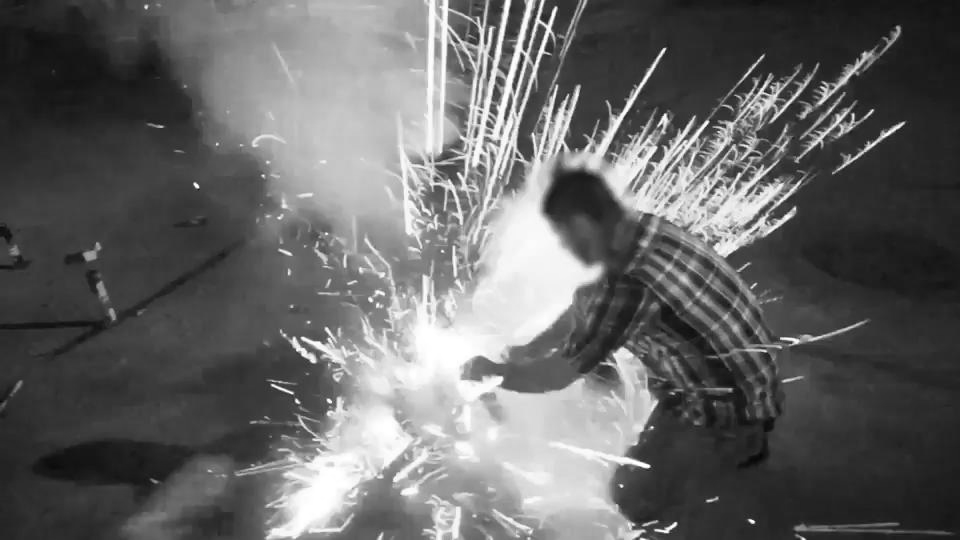
What’s wrong in this picture?

There is guy standing to close to an explosion of fireworks, he is putting himself in high risk that can result in a fatality. 

Fireworks are no joke, and you or someone else can get seriously injured while using them. “These are very risky devices that require extreme caution, Fireworks hold such a high risk for serious burns, fires, and eye injuries.

The National Safety Council and the National Fire Protection Association, recommend people avoid consumer fireworks entirely and enjoy public displays put on by professionals.


Firework Safety and Injury Prevention Picture This – Spanish

¿Qué hay de malo en esta foto?

Hay un tipo parado demasiado cerca de una explosión de fuegos artificiales, se está poniendo en alto riesgo que puede resultar en una fatalidad. 

Los fuegos artificiales no son una broma, y usted o alguien más puede resultar gravemente herido al utilizarlos. “Se trata de dispositivos muy arriesgados que requieren una precaución extrema, los fuegos artificiales presentan un alto riesgo de quemaduras graves, incendios y lesiones oculares.

El Consejo Nacional de Seguridad y la Asociación Nacional de Protección contra los Incendios recomiendan evitar por completo los fuegos artificiales de consumo y disfrutar de los espectáculos públicos organizados por profesionales.


Fatigue on the Job Picture This – Spanish


Fire Extinguishers Use and Inspection Meeting Kit

The federal portable fire extinguisher rule applies to the placement, use, maintenance, and testing of portable fire extinguishers provided for the use of employees. Employers are generally required to provide portable fire extinguishing equipment in the workplace for use in fighting incipient-stage fires. An “incipient-stage fire” means initial or beginning stage that can be controlled or extinguished by portable fire extinguishers.

ACCIDENTS WAITING TO HAPPEN 

Organizations of all kinds can take steps to reduce their chances of a fire-related accident:

  • Limit access to flammable or combustible materials, and store them in a cool, dry place—away from other materials or devices that could catch on fire.
  • Inspect electronic devices, as well as flammable and combustible materials, for damage and degradation. If something is broken or has expired, get rid of it.
  • Plan ahead. Use flammable or combustible materials in a safe, open space, and wear proper protective materials. Create an emergency action plan, and train and periodically remind employees what to do in the event of a fire.
  • Practice common-sense safety. Don’t light fireworks indoors, in crowded spaces, or during a windy day. Follow the instructions for using flammable or combustible materials. Don’t mix fire and alcohol.

Safety tips  

Use a portable fire extinguisher when the fire is confined to a small area, such as a wastebasket, and is not growing; everyone has exited the building; the fire department has been called or is being called; and the room is not filled with smoke. 

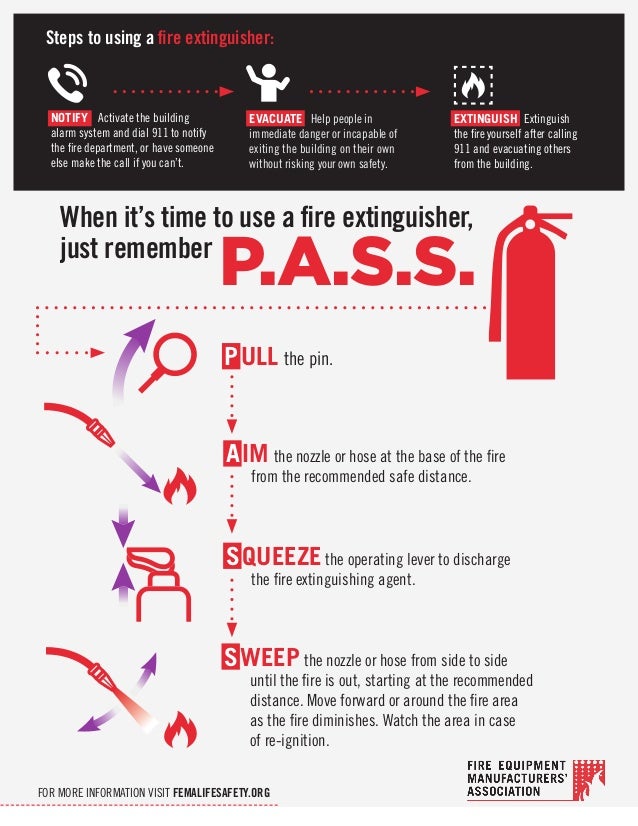
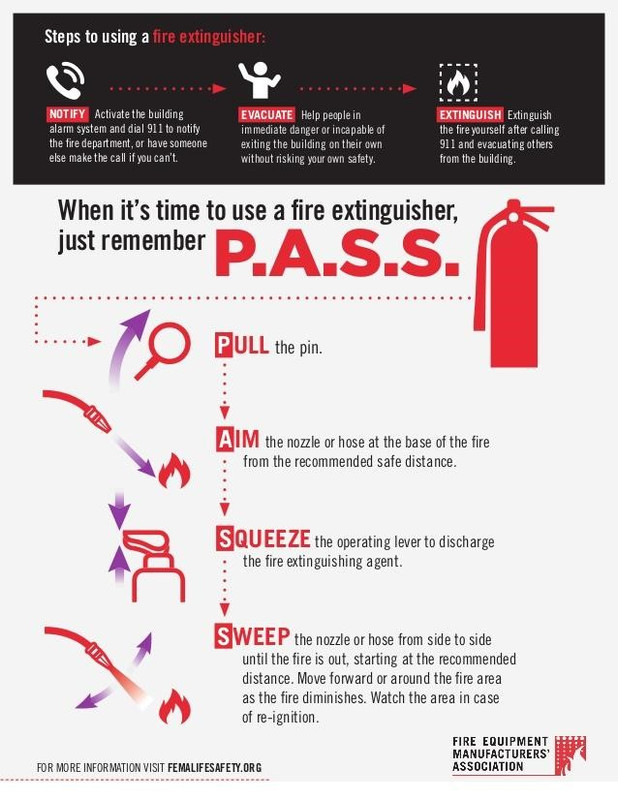
P.A.S.S. Method 

The easiest way to remember how to use a fire extinguisher is to follow the P.A.S.S. method. The PASS acronym was developed to allow people to remember the basic four steps to properly using a fire extinguisher.

P- Pull. Pull the pin. Hold the extinguisher away and release the locking mechanism.

A- Aim. Aim the stream towards the base of the fire. Spraying the flames will not put the fire out.

S- Squeeze. Squeeze the lever slowly and evenly. Pulling the lever too fast may shoot the stream from your target wasting the valuable firefighting agent.

S- Sweep. Sweep the nozzle side to side to combat the fire.

PORTABLE FIRE EXTINGUISHERS 

Portable fire extinguishers are specifically designed to fight different types of fires. The most common fire extinguisher classifications are as follows:

Class A– Solid combustibles excl. wood, metal, cloth, paper, plastics, and rubber

Class B– Flammable liquids incl. oil, gasoline, paint, and grease

Class C– Energized electrical fire (Class C fire becomes null and void if electrical source is removed)

Class D– Electrical equipment incl. outlets and appliances

Class K– Cooking oil, animal and vegetable fats, and grease

TRAINING AND EDUCATION 

  • Employers must provide an educational program to familiarize employees with the general principles of fire extinguisher use and the hazards involved with incipient stage fire fighting.
  • Provide this education when employees are first hired and once a year thereafter.
  • Train employees (who have been designated to use fire fighting equipment in the emergency action plan) in the use of the equipment.

Provide this training when employees are first given this assignment and once a year thereafter.

FIRE EXTINGUISHER LIMITATIONS

  • A dry chemical fire extinguisher such as the common red “ABC” extinguishers will reach a distance between 5 and 20 feet. It is important to be familiar with the models used in your work areas and the effective distance they can be used for.
  • A 10lb to 20lb dry chemical fire extinguisher will last anywhere from 10 to 25 seconds. Again, this depends on the model and weight you are using.
  • Fire extinguishers are only designed to fight small fires. A rule of thumb a lot of professional’s use is the size of the fire should not be any larger than the size of a small trash can.

FIRE EXTINGUISHER INSPECTION TIPS 

  • Extinguishers should be periodically checked every 30 days. There should be a formal check of all fire extinguishers onsite annually. These inspections should be documented.
  • Ensure the pressure is okay when inspecting a fire extinguisher. There is a gauge that has an arrow that should be in the green portion of the gauge. If the arrow is in the red the fire extinguisher needs to be tagged out of service until recharged.
  • Check to make sure the pin is still in place. Often times the pin is bumped out of place leaving the chance of accidental discharge occurring.
  • Look for rust on the container and ensure that the label is in good readable condition.

MORE TIPS

  • Make Fire Extinguishers Readily Available 
  • Only Use Approved Fire Extinguishers 
  • Avoid Fire Extinguishers with Carbon Tetrachloride or Chlorobromomethane 
  • Test Regularly 

FINAL WORD

It is important to know more than just where the fire extinguishers are located in your work area. Make sure you know how to properly use them in case the time comes where you need to extinguish a fire. Always make sure the fire extinguishers in your work areas are in good condition through thorough inspections.


Fire Extinguishers Use and Inspection Meeting Kit – Spanish

QUÉ ESTÁ EN RIESGO

La norma federal sobre extintores portátiles se aplica a la colocación, el uso, el mantenimiento y las pruebas de los extintores portátiles proporcionados para el uso de los empleados. Por lo general, los empleadores están obligados a proporcionar equipos portátiles de extinción de incendios en el lugar de trabajo para su uso en la lucha contra los incendios en fase incipiente. Un “incendio en fase incipiente” significa la fase inicial o de comienzo que puede ser controlada o extinguida por extintores portátiles.

CUÁL ES EL PELIGRO

ACCIDENTES A PUNTO DE OCURRIR 

Las organizaciones de todo tipo pueden tomar medidas para reducir las posibilidades de sufrir un accidente relacionado con el fuego:

  • Limite el acceso a los materiales inflamables o combustibles y guárdelos en un lugar fresco y seco, lejos de otros materiales o dispositivos que puedan incendiarse.
  • Inspeccione los dispositivos electrónicos, así como los materiales inflamables y combustibles, en busca de daños y degradación. Si algo está roto o ha caducado, deshágase de él.
  • Planifique con antelación. Utilice los materiales inflamables o combustibles en un espacio abierto y seguro, y lleve los materiales de protección adecuados. Cree un plan de acción de emergencia, y forme y recuerde periódicamente a los empleados qué deben hacer en caso de incendio.
  • Practique la seguridad de sentido común. No encienda fuegos artificiales en interiores, en espacios concurridos o durante un día de viento. Siga las instrucciones de uso de materiales inflamables o combustibles. No mezcles fuego y alcohol.

COMO PROTEGERSE

Consejos de seguridad  

Utilice un extintor portátil cuando el fuego esté confinado en una zona pequeña, como una papelera, y no esté creciendo; todo el mundo haya salido del edificio; se haya llamado o se esté llamando a los bomberos; y la habitación no esté llena de humo. 

Método P.A.S.S. 

La forma más fácil de recordar cómo utilizar un extintor es seguir el método P.A.S.S. El acrónimo PASS fue desarrollado para permitir que la gente recuerde los cuatro pasos básicos para utilizar correctamente un extintor.

P- Pull. Tire del perno. Aleje el extintor y libere el mecanismo de cierre.

A- Aim. Apunte el chorro hacia la base del fuego. Rociar las llamas no apagará el fuego.

S- Squeeze. Apriete la palanca lenta y uniformemente. Tirar de la palanca demasiado rápido puede disparar el chorro desde su objetivo, desperdiciando el valioso agente de extinción.

S- Sweep. Desplace la boquilla de lado a lado para combatir el fuego.

EXTINTORES PORTÁTILES 

Los extintores portátiles están diseñados específicamente para combatir diferentes tipos de incendios. Las clasificaciones más comunes de los extintores son las siguientes:

Clase A- Combustibles sólidos, excluyendo madera, metal, tela, papel, plásticos y caucho

Clase B- Líquidos inflamables, incluidos el aceite, la gasolina, la pintura y la grasa

Clase C- Fuego eléctrico energizado (el fuego de clase C queda anulado si se retira la fuente eléctrica)

Clase D– Equipos eléctricos, incluidos enchufes y aparatos

Clase K- Aceite de cocina, grasas animales y vegetales, y grasa

FORMACIÓN Y EDUCACIÓN 

  • Los empleadores deben proporcionar un programa educativo para familiarizar a los empleados con los principios generales del uso de extintores y los peligros que conlleva la lucha contra incendios en fase incipiente.
  • Proporcionar esta educación cuando los empleados son contratados por primera vez y una vez al año a partir de entonces.
  • Forme a los empleados (que han sido designados para utilizar el equipo de lucha contra incendios en el plan de acción de emergencia) en el uso del equipo.

Proporcione esta formación cuando los empleados reciban por primera vez esta asignación y una vez al año a partir de entonces.

LIMITACIONES DE LOS EXTINTORES

  • Un extintor de incendios químico seco, como los extintores rojos comunes “ABC”, alcanzará una distancia de entre 5 y 20 pies. Es importante estar familiarizado con los modelos que se utilizan en sus áreas de trabajo y la distancia efectiva a la que pueden ser utilizados.
  • Un extintor químico seco de 10 a 20 libras durará entre 10 y 25 segundos. Una vez más, esto depende del modelo y del peso que esté utilizando.
  • Los extintores sólo están diseñados para combatir incendios pequeños. Una regla general que utilizan muchos profesionales es que el tamaño del fuego no debe ser mayor que el de un cubo de basura pequeño.

CONSEJOS PARA LA INSPECCIÓN DE EXTINTORES 

  • Los extintores deben revisarse periódicamente cada 30 días. Se debe realizar una revisión formal de todos los extintores en el sitio anualmente. Estas inspecciones deben documentarse.
  • Asegúrese de que la presión está bien cuando inspeccione un extintor. Hay un manómetro que tiene una flecha que debe estar en la parte verde del manómetro. Si la flecha está en rojo, el extintor debe ser etiquetado como fuera de servicio hasta que se recargue.
  • Compruebe que el pasador sigue en su sitio. A menudo, el pasador se sale de su sitio, dejando la posibilidad de que se produzca una descarga accidental.
  • Busque óxido en el contenedor y asegúrese de que la etiqueta está en buenas condiciones de lectura.

MÁS CONSEJOS

  • Tenga los extintores a mano 
  • Utilice únicamente extintores homologados 
  • Evite los extintores con tetracloruro de carbono o cromobromometano 
  • Realice pruebas periódicas

CONCLUSIÓN

Es importante saber algo más que dónde se encuentran los extintores en su área de trabajo. Asegúrese de saber cómo utilizarlos correctamente en caso de que llegue el momento en que tenga que extinguir un incendio. Asegúrese siempre de que los extintores de sus áreas de trabajo estén en buen estado mediante inspecciones exhaustivas.


Fire Extinguishers Use and Inspection Fatality File

One Worker Killed, Another Injured in Manhattan Fire Extinguisher Explosion

On the morning of Wednesday, May 13, 2020, 35-year-old worker Victor Pando was killed and his 26-year-old colleague injured when a fire extinguisher exploded at the Morgan General Mail Facility at 341 Ninth Avenue in Manhattan.

The two men were injured by shrapnel that flew everywhere when the fire extinguisher exploded. Pando was struck in the neck with a piece of shrapnel; he was rushed to Lenox Hill Hospital, but tragically died of his injuries. His colleague, who was struck less severely, was transported to Bellevue Hospital. The younger worker' injuries are reported to be non-life threatening.

The two workers were recharging fire extinguishers on the fourth floor of the Morgan General Mail Facility when one of them exploded, said Department of Buildings (DOB) Press Secretary Andrew Rudansky. The two men were contractors employed by Nordest Services, LLC. The Occupational Safety and Health Administration (OSHA) is now investigating the incident and Nordest Services. According to Gothamist.com, the employer could not be reached for comment.

These men and their families are in our thoughts. We send our condolences to the family of the worker who was killed, and hope for a speedy recovery for the injured worker.

Deaths and injuries caused by explosions on a work site are rare; according to the Bureau of Labor Statistics' 2018 National Census of Fatal Occupational Injuries, there were only 115 fatal work injuries caused by fires and explosions in 2018. Clearly, however, they can still occur, and although it is not clear what exactly caused the fire extinguisher to explode in the above incident, it is always best to follow proper safety precautions to try and prevent such explosions from happening. It is important to note that fire extinguishers must comply with certain regulations in order to be considered safe for use.