Eye Damage Due to Sunlight Fatality Report – Spanish

Un hombre de Portland que experimentó daños permanentes en los ojos por mirar al sol durante un eclipse solar en 1963 está advirtiendo ahora a otros que no cometan el mismo error cuando vean el eclipse solar total del lunes.

Louis Tomososki, que ahora tiene 70 años, dijo que tenía 16 años cuando vio un eclipse solar parcial sin ninguna protección para los ojos desde el campo de béisbol de su escuela secundaria en Portland, Oregón, según la afiliada de Fox KPTV. Cerró el ojo izquierdo y lo vio con el derecho durante unos 20 segundos.

“Eso es todo lo que hizo falta”, dijo Tomososki a KPTV. Ahora tiene un pequeño punto ciego en el centro de su ojo derecho, que no ha mejorado ni empeorado desde 1963.

Tomososki dijo que le preocupa que otros puedan experimentar consecuencias similares si no toman precauciones durante el eclipse solar del lunes 21 de agosto, que será visible en todo Estados Unidos.


Eye Damage Due to Sunlight – Picture This – Spanish

Fuente: http://insteractua.ins.gob.pe


Heart Attacks Meeting Kit

WHAT IS A HEART ATTACK?

A heart attack, also called a myocardial infarction, happens when a part of the heart muscle doesn’t get enough blood.

The more time that passes without treatment to restore blood flow, the greater the damage to the heart muscle.

Coronary artery disease (CAD) is the main cause of heart attack. A less common cause is a severe spasm, or sudden contraction, of a coronary artery that can stop blood flow to the heart muscle.

WHAT ARE THE SYMPTOMS OF HEART ATTACK?

The major symptoms of a heart attack are:

  • Chest pain or discomfort. Most heart attacks involve discomfort in the center or left side of the chest that lasts for more than a few minutes or that goes away and comes back. The discomfort can feel like uncomfortable pressure, squeezing, fullness, or pain.
  • Feeling weak, light-headed, or faint. You may also break out into a cold sweat.
  • Pain or discomfort in the jaw, neck, or back.
  • Pain or discomfort in one or both arms or shoulders.
  • Shortness of breath. This often comes along with chest discomfort, but shortness of breath also can happen before chest discomfort.

HEART ATTACKS CAUSED BY ENVIRONMENTAL FACTORS

The first type of heart attack involves some environmental aspect of the workplace that causes cardio-vascular deterioration (that eventually leads to a heart attack).

HEART ATTACKS CAUSED BY PHYSICAL WORK ACTIVITY

The second type of work-related heart attack is precipitated by some physical work activity, usually, but not necessarily, of a heavy physical nature.

HEART ATTACKS CAUSED BY EMOTIONAL FACTORS

The third type of heart attack is induced by emotional stress or excitement, including worry, fear, surprise, or anxiety. For example, a heart attack that occurs after a worker witnesses a tragic event or is yelled at by a superior may be compensable under the law.

STRATEGIES TO PREVENT HEART DISEASE

  1. Don’t smoke or use tobacco

Chemicals in tobacco can damage your heart and blood vessels. Cigarette smoke reduces the oxygen in your blood, which increases your blood pressure and heart rate because your heart has to work harder to supply enough oxygen to your body and brain.

  1. Get moving: Aim for at least 30 to 60 minutes of activity daily

Regular, daily physical activity can lower your risk of heart disease. Physical activity helps you control your weight and reduce your chances of developing other conditions that may put a strain on your heart, such as high blood pressure, high cholesterol and type 2 diabetes.

You should aim for at least:

  • 150 minutes a week of moderate aerobic exercise, such as walking at a brisk pace
  • 75 minutes a week of vigorous aerobic activity, such as running
  1. Eat a heart-healthy diet

A healthy diet can help protect your heart, improve your blood pressure and cholesterol, and reduce your risk of type 2 diabetes. A heart-healthy eating plan includes:

  • Vegetables and fruits
  • Beans or other legumes
  • Lean meats and fish
  • Low-fat or fat-free dairy foods
  • Whole grains
  • Healthy fats, such as olive oil
  1. Maintain a healthy weight

Being overweight — especially around your middle — increases your risk of heart disease. Excess weight can lead to conditions that increase your chances of developing heart disease — including high blood pressure, high cholesterol and type 2 diabetes.

One way to see if your weight is healthy is to calculate your body mass index (BMI), which uses your height and weight to determine whether you have a healthy or unhealthy percentage of body fat. A BMI of 25 or higher is considered overweight and is generally associated with higher cholesterol, higher blood pressure, and an increased risk of heart disease and stroke.

  1. Get good quality sleep

Most adults need at least seven hours of sleep each night. Make sleep a priority in your life. Set a sleep schedule and stick to it by going to bed and waking up at the same times each day. Keep your bedroom dark and quiet, so it’s easier to sleep.

  1. Manage stress

Some people cope with stress in unhealthy ways — such as overeating, drinking or smoking. Finding alternative ways to manage stress — such as physical activity, relaxation exercises or meditation — can help improve your health.

  1. Get regular health screenings

High blood pressure and high cholesterol can damage your heart and blood vessels.

FINAL WORD

Take heart attack symptoms seriously. We know most of the people we work with pretty well. If something seems wrong talk to the person or get a supervisor involved. Know what your emergency response plan at your worksite for a medical emergency like a heart attack. Knowing who to call, what the address of the worksite is, and who is CPR trained onsite can save the victim’s life.


Heart Attacks Stats and Facts

FACTS

Certain behaviors also put you at risk for heart disease. These include:

  1. Smoking: Smoking is a major cause of cardiovascular disease and causes approximately 1 in 4 heart disease deaths.
  2. Eating a poor diet: A diet that’s high in fat, salt, sugar, and cholesterol can contribute to the development of heart disease.
  3. Not exercising: Even though exercise reduces the risk for heart disease and early death, only about half of Americans get the recommended amount of aerobic activity.
  4. Drinking alcohol excessively: Heavy alcohol use can increase the risk for heart attack, heart failure, and death. Excess drinking can damage the heart before symptoms even appear.
  5. Depression: Adults with a depressive disorder or symptoms of depression have a 64 percent greater risk of developing coronary artery disease.
  6. Obesity: Being overweight or obese is linked to several factors that increase the risk for cardiovascular disease, including diabetes and high blood pressure.
  7. Heart disease is responsible for most deaths worldwide for both men and women of all races.

STATS

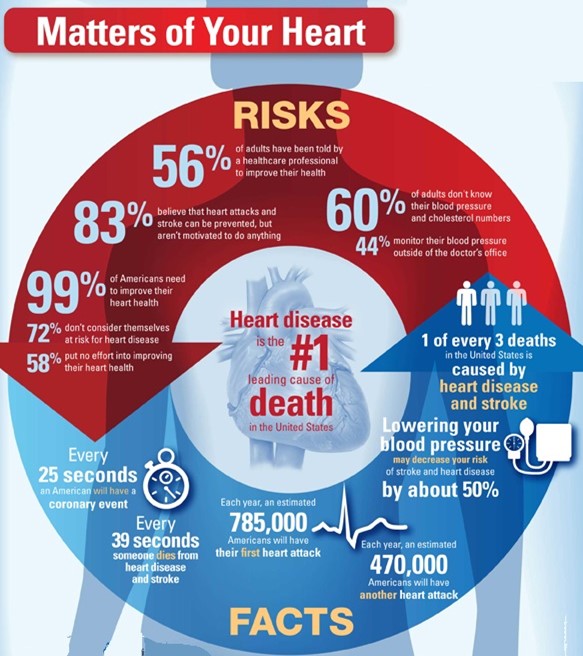
  • As of 2018, 30.3 million U.S. adults were diagnosed with heart disease. Every year, about 647,000 Americans die from heart disease, making it the leading cause of death in the United States. Heart disease causes 1 out of every 4 deaths.
  • According to the Centers for Disease Control and Prevention (CDC) approximately every 40 seconds an American will have a heart attack. Every year, 805,000 Americans have a heart attack, 605,000 of them for the first time.
  • About 12 percent of people who have a heart attack will die from it.
  • Coronary artery disease, a blockage of the arteries that supply blood to the heart, is the most common type of heart disease. Coronary heart disease affects about 18.2 million Americans age 20 and older, and it killed nearly 366,000 in 2017.
  • Heart disease is the number one cause of death for most racial and ethnic groups. In 2015, it was responsible for 23.7 percent of deaths in white people and 23.5 percent in Black people.


Heart Attacks Fatality Report

Martan Kelly Jr. was a technician for Card Heating & Air Conditioning in Pennsylvania. One morning, he reported to work at a funeral home where the company was installing heating and air conditioning equipment. He told his foreman that he felt weak, tired and had a kink in his neck from sleeping poorly the night before. Kelly declined an offer to go home and was given a light-duty assignment of running thermostat wire.

Feeling better around noon, Kelly decided to run wire in the attic of the one-story building by climbing a 12-15-foot ladder. A short time later, employees heard moaning coming from the attic and found Kelly lying incoherent on the floor, bleeding from his head, face and leg.

Kelly was pronounced dead at a local hospital a short time later.

An autopsy revealed coronary artery and heart disease, three heart arteries significantly blocked (60-90%), and 90% stenosis of the left main descending coronary artery. The cause of death was a heart attack.

Kelly’s widow filed a workers’ compensation claim for survivors’ benefits, claiming his heart attack occurred as a result of his employment. Card denied the claim, and the case went before a workers’ comp judge (WCJ).

Kelly’s widow testified he didn’t have any health problems, didn’t complain about chest pain, never saw a heart doctor and wasn’t on any medications. She acknowledged her husband smoked a pack of cigarettes a day for the last 30 years.

The company doctor also said Kelly had been suffering from insufficient blood flow to the heart for 8 to 12 hours before coming to work. The doctor noted Kelly slept in a recliner chair the previous night because he wasn’t able to lie flat in bed due to his cardiac symptoms. The doctor also said Kelly’s duties the day he died were insufficient to cause the heart attack. Climbing the ladder wouldn’t have elevated Kelly’s heart rate enough to cause a cardiac event unless he had done it quickly or repeatedly and for more than nine minutes.

The WCJ ruled in favor of the company. The judge found the company doctor’s testimony to be more credible and agreed with the foreman that the work Kelly was doing wasn’t strenuous. The judge also noted Kelly’s pre-existing blockages that put him at risk of an imminent heart attack with or without physical exertion.

Kelly’s widow appealed, and the Pennsylvania Workers’ Compensation Appeal Board affirmed the WCJ’s ruling. She took her case to a state court

Not enough proof it was work-related

The burden is on the claimant (in this case Kelly’s widow) to show that a fatal heart attack is work-related. Specifically, the claimant must show the heart attack:

  • arose in the course of employment, and
  • was related to employment.


Heart Attacks – Picture This

Source: https://cprblog.heart.org


Workplace Housekeeping

Effective housekeeping can help control or eliminate workplace hazards. This course will cover why it’s important to pay attention to housekeeping at work, benefits of good housekeeping and elements of an effective housekeeping program.


Electrical Safety

Key Takeaways:

  • Identifying all workplace chemical hazards and the risks associated with them.
  • Understanding the conditions which present an exposure risk, possible routes of exposure, and the factors influencing an individual’s reaction to a chemical exposure incident.
  • Practicing safety precautions on the behalf of both workers and employers to minimize exposure to chemicals.
  • Learning safe storage, transport, and disposal practices for hazardous chemicals.
  • Understanding appropriate response actions in the event of a chemical incident.

Course Description

To enable employees to reduce workplace accidents involving electricity by learning to identify electrical hazards, take proper control measures and follow safe work practices, and response actions in the event of shock or fire.


Essential 29: Electrical Safety (Spanish)

Course Description

To enable employees to reduce workplace accidents involving electricity by learning to identify electrical hazards, take proper control measures and follow safe work practices, and response actions in the event of shock or fire. (Spanish Version)


Sexual Harassment for Employees – Connecticut

This course covers the two main types of sexual harassment – quid pro quo and hostile work environment, rights and responsibilities of employees and employers, how to recognize harassing behaviors, reporting harassment, and prevention strategies. It is geared towards employees.


Excavator Quick Coupler Device Safety Meeting Kit

Excavators are some of the most common pieces of heavy machinery found in the average construction site.

These devices were designed to make life easier for the average construction worker. More specifically, those who are working with an excavator. These devices are designed to quickly change out the tool being used by the excavator. While these devices have made life easier, they also have created a significant threat.

THE DANGERS OF QUICK COUPLER DEVICES

It has been known for many years now that quick couplers can pose a danger to ground workers who are working around the excavator. There have been multiple fatalities due to the unexpected release of a bucket due to the quick coupler device opening up or failing.

COMMON EXCAVATOR HAZARDS

Machine Rollovers

Machine rollovers can occur at any moment if the operator isn’t being safe. The ground giving out beneath the machine can cause rollovers. Other causes include traveling too quickly, traveling on a too-steep slope, and traveling with the attachments improperly lowered.

Contact with Power Lines

While regulations dictate that machines must stay at least 20 feet away from nearby power lines, electrocution still kills many excavator operators. Generally, contact occurs when operators fail to check if they have enough overhead clearance.

When a worker strikes a power line, they might panic and let go of the controls for a moment. When they attempt to touch the controls again or exit the machine, they get electrocuted.

Maintenance Errors

When operators fail to properly maintain their machines, they put themselves and those nearby at risk. Even a misplaced lock pin could make a heavy component come loose and crush someone.

Trenching Accidents

Trenching accidents occur when the ground cannot support the changes in pressure caused by excavation. The weight of the machine can cause loose dirt to shift, which in turn can tip the machine.

Other trenching accidents result from improper trenching techniques or unskilled workers trying too complicated techniques. These can include attempting to straddle a trench or using the bucket arm to climb down the side of a trench.

Debris

Falling debris poses a significant risk to both the excavator operator and nearby pedestrians. Material from a load could dislodge and strike workers or civilians located too close to the machine.

Buckets

Besides the falling debris, buckets can pose a serious threat to safety and well-being. An operator unaware of a nearby pedestrian could strike or crush them when turning or lowering the bucket arm. An operator could also put themselves at risk by attempting to leave an active machine with the bucket arm lowered.

HOW TO AVOID INJURY WHEN WORKING WITH A QUICK COUPLER

The number of incidents involving quick coupler devices has decreased significantly in recent years. This is because manufacturers have gone out of their way to make the devices safer to use. Most manufacturers of these devices have come up with some type of locking pins that do not allow for an unexpected release. Some other precautions include:

  • Follow manufacturer’s recommendations for installation, maintenance, and use for these devices.
  • Inspect quick coupler devices before use. Look for locking pins or other safety devices that will prevent an unexpected release of a bucket or attachment.
  • Never work directly under or close to an excavator bucket or attachment, even if there are safety pins in the quick coupler device.
  • Communicate to fellow coworkers when quick coupler devices are used.

OSHA OFFERS THESE SAFETY TIPS WHEN USING QUICK COUPLERS ON THE JOBSITE:

  • Inspect all quick couplers to determine if the one you are using is subject to unexpected release hazards. Determine if manually installed locking pins and installation procedures have been provided by the manufacturer.
  • If necessary, obtain and install retrofits recommended by the manufacturer.
  • Be sure to include positive locking pins and other devices that need to be manually installed.
  • Consider using newer models of quick couplers that have been specifically designed to prevent the unintended release of attachments.
  • Follow the manufacturer’s recommendations for maintenance of the quick coupler to prevent malfunction.
  • Follow the manufacturer’s installation procedures and recommendations on testing quick coupler and attachment connections every time an attachment is made.
  • Train employees how to properly use a quick coupler. Include training on how to make visual inspections.
  • Require employees to use the proper procedures for engaging excavation attachments and incorporate the procedures into the company’s safety and health program.

FINAL WORD

While the prevalence of these incidents have been greatly reduced through better design, unexpected releases can still occur. Take the necessary steps to ensure that these devices are properly functioning. Protect ground workers further by forbidding any work to be done underneath or near the bucket of an excavator.


Excavator Quick Coupler Device Stats and Facts

FACTS

  1. Most coupler-related injuries are the result of an operator not properly securing the safety pin on semi-automatic or manual models.
  2. Numerous injuries, some resulting in fatalities, have occurred as a result of poor coupler connections and dropped buckets.
  3. Failure to properly engage and lock the coupler is likely the cause of accidents in most cases.
  4. According to OSHA, unintended coupler releases tend to happen because users may not be aware of changeout hazards, they fail to properly insert locking pins or they have insufficient training on installation and testing procedures.

STATS

  • According to a study conducted by the U.S. Occupational Health and Safety Administration (OSHA), there were 15 injury-related accidents between 1998 and 2005 in the U.S. involving the unanticipated release of excavator buckets from quick couplers on hydraulic excavators.
  • Eight of those accidents resulted in fatalities.


Excavator Quick Coupler Device Fatality Report

Construction worker killed by hydraulic excavator while working in trench.

A 26-year-old construction worker was killed while trying to remove a concrete sewer casing in an 8-foot deep trench. He was part of a crew constructing new sanitary sewer lines along a residential street. The victim was standing inside an iron trench box, while a hydraulic excavator was being used to remove the concrete casing around a sewer pipe. The victim was giving hand signals to a co-worker operating the excavator above him because it was impossible for the operator to see the bottom of the trench where the casing was located. While prying off the casing with sideways pressure, the bucket teeth slipped off the edge of the concrete and the excavator arm and bucket snapped toward the victim, crushing him against the metal side of the trench box (see diagram). The excavator operator immediately moved the bucket away from the wall and went to aid his co-worker, who was still conscious. The man soon became unresponsive and was pronounced dead approximately one hour later in a local hospital from severe internal chest injuries.


Excavator Quick Coupler Device – Picture This

Source: i.pinimg.com


Excavator Quick Coupler Device Safety Meeting Kit – Spanish

QUÉ ESTÁ EN RIESGO

Charla sobre la seguridad del dispositivo de enganche rápido para excavadoras

Las excavadoras son algunas de las piezas más comunes de la maquinaria pesada que se encuentra en el sitio de construcción promedio.

Estos dispositivos se diseñaron para facilitar la vida del trabajador medio de la construcción. Más concretamente, a los que trabajan con una excavadora. Estos dispositivos están diseñados para cambiar rápidamente la herramienta utilizada por la excavadora. Aunque estos dispositivos han facilitado la vida, también han creado una amenaza importante.

CUÁL ES EL PELIGRO

PELIGROS DE LOS ANCLAJES RÁPIDOS

Desde hace muchos años se sabe que los enganches rápidos pueden suponer un peligro para los trabajadores del suelo que están trabajando alrededor de la excavadora. Se han producido múltiples muertes por la liberación inesperada de un cazo debido a que el dispositivo de enganche rápido se ha abierto o ha fallado.

RIESGOS COMUNES DE LAS EXCAVADORAS

Vuelcos de la máquina

Los vuelcos de la máquina pueden ocurrir en cualquier momento si el operador no está siendo seguro. El terreno que cede bajo la máquina puede provocar vuelcos. Otras causas son viajar demasiado rápido, viajar en una pendiente demasiado pronunciada y viajar con los accesorios mal bajados.

Contacto con las líneas eléctricas

Aunque la normativa dicta que las máquinas deben permanecer al menos a 6 metros de distancia de las líneas eléctricas cercanas, la electrocución sigue matando a muchos operadores de excavadoras. Por lo general, el contacto se produce cuando los operadores no comprueban si tienen suficiente espacio libre por encima de la cabeza.

Cuando un trabajador choca con una línea eléctrica, puede entrar en pánico y soltar los controles por un momento. Cuando intentan volver a tocar los mandos o salir de la máquina, se electrocutan.

Errores de mantenimiento

Cuando los operarios no realizan un mantenimiento adecuado de sus máquinas, se ponen a sí mismos y a los que están cerca en peligro. Incluso un pasador de bloqueo mal colocado puede hacer que un componente pesado se suelte y aplaste a alguien.

Accidentes de zanja

Los accidentes de zanja se producen cuando el suelo no puede soportar los cambios de presión provocados por la excavación. El peso de la máquina puede hacer que la tierra suelta se desplace, lo que a su vez puede hacer volcar la máquina.

Otros accidentes de zanjeo son consecuencia de técnicas de zanjeo inadecuadas o de trabajadores no cualificados que intentan aplicar técnicas demasiado complicadas. Por ejemplo, si se intenta atravesar una zanja o se utiliza el brazo de la excavadora para bajar por el lateral de la zanja.

Escombros

La caída de escombros supone un riesgo importante tanto para el operador de la excavadora como para los peatones cercanos. El material de una carga podría desprenderse y golpear a los trabajadores o a los civiles situados demasiado cerca de la máquina.

Cuchara

Además de la caída de escombros, las cuñas pueden suponer una grave amenaza para la seguridad y el bienestar. Un operador que no se percate de la presencia de un peatón cercano podría golpearlo o aplastarlo al girar o bajar el brazo de las cuñas. Un operario también podría ponerse en peligro al intentar abandonar una máquina activa con el brazo de la cuchara bajada.

COMO PROTEGERSE

CÓMO EVITAR LESIONES AL TRABAJAR CON UN ENGANCHE RÁPIDO

El número de incidentes relacionados con los dispositivos de enganche rápido ha disminuido considerablemente en los últimos años. Esto se debe a que los fabricantes se han esforzado por hacer que estos dispositivos sean más seguros. La mayoría de los fabricantes de estos dispositivos han creado algún tipo de pasadores de bloqueo que no permiten una liberación inesperada. Algunas otras precauciones son:

  • Seguir las recomendaciones del fabricante para la instalación, el mantenimiento y el uso de estos dispositivos.
  • Inspeccionar los dispositivos de enganche rápido antes de utilizarlos. Busque pasadores de bloqueo u otros dispositivos de seguridad que impidan la liberación inesperada de un cazo o accesorio.
  • Nunca trabajar directamente debajo o cerca de un cazo o accesorio de la excavadora, incluso si hay pasadores de seguridad en el dispositivo de enganche rápido.
  • Comunicar a sus compañeros de trabajo el uso de dispositivos de enganche rápido.

OSHA OFRECE ESTOS CONSEJOS DE SEGURIDAD AL UTILIZAR ACOPLADORES RÁPIDOS EN EL LUGAR DE TRABAJO:

  • Inspeccionar todos los acopladores rápidos para determinar si el que está utilizando está sujeto a riesgos de liberación inesperada. Determine si el fabricante ha proporcionado pasadores de bloqueo de instalación manual y procedimientos de instalación.
  • Si es necesario, obtener e instale las adaptaciones recomendadas por el fabricante.
  • Asegurarse de incluir los pasadores de bloqueo positivo y otros dispositivos que deban instalarse manualmente.
  • Considerar la posibilidad de utilizar los nuevos modelos de enganches rápidos que han sido diseñados específicamente para evitar la liberación involuntaria de los enganches.
  • Seguir las recomendaciones del fabricante sobre el mantenimiento del enganche rápido para evitar un mal funcionamiento.
  • Seguir los procedimientos de instalación y las recomendaciones del fabricante sobre la comprobación de las conexiones del enganche rápido y del accesorio cada vez que se realice un enganche.
  • Formar a los empleados en el uso correcto del enganche rápido. Incluya formación sobre cómo realizar inspecciones visuales.
  • Exijir a los empleados que utilicen los procedimientos adecuados para acoplar accesorios de excavación e incorpore los procedimientos al programa de seguridad y salud de la empresa.

CONCLUSIÓN

Aunque la prevalencia de estos incidentes se ha reducido en gran medida gracias a un mejor diseño, todavía pueden producirse liberaciones inesperadas. Tome las medidas necesarias para asegurarse de que estos dispositivos funcionan correctamente. Proteja aún más a los trabajadores del suelo prohibiendo que se realicen trabajos por debajo o cerca de la cuchara de una excavadora.


Excavator Quick Coupler Device Stats and Facts – Spanish

HECHOS

  1. La mayoría de las lesiones relacionadas con el enganche son el resultado de que el operador no asegure correctamente el pasador de seguridad en los modelos semiautomáticos o manuales.
  2. Numerosas lesiones, algunas con resultado de muerte, se han producido como consecuencia de una mala conexión del enganche y de la caída de las cuñas.
  3. El hecho de no enganchar y bloquear correctamente el enganche es probablemente la causa de los accidentes en la mayoría de los casos.
  4. Según OSHA, los desenganches involuntarios de los enganches suelen producirse porque los usuarios pueden no ser conscientes de los peligros del cambio, no insertan correctamente los pasadores de bloqueo o no tienen suficiente formación sobre los procedimientos de instalación y prueba.

ESTADÍSTICAS

  • Según un estudio realizado por la Administración de Salud y Seguridad Ocupacional (OSHA) de los Estados Unidos, entre 1998 y 2005 se produjeron 15 accidentes relacionados con lesiones en los que se soltaron de forma imprevista las cuñas de las excavadoras de los enganches rápidos de las excavadoras hidráulicas.
  • Ocho de esos accidentes se saldaron con víctimas mortales.


Excavator Quick Coupler Device Fatality Report – Spanish

Un trabajador de la construcción muere atropellado por una excavadora hidráulica mientras trabajaba en una zanja.

Un obrero de la construcción de 26 años murió mientras intentaba retirar un revestimiento de hormigón del alcantarillado en una zanja de 2 metros de profundidad. Formaba parte de una cuadrilla que construía nuevas líneas de alcantarillado sanitario a lo largo de una calle residencial. La víctima estaba de pie dentro de una caja de zanja de hierro, mientras se utilizaba una excavadora hidráulica para retirar el revestimiento de hormigón alrededor de una tubería de alcantarillado. La víctima estaba haciendo señales con la mano a un compañero de trabajo que operaba la excavadora por encima de él, ya que al operador le resultaba imposible ver el fondo de la zanja donde se encontraba el revestimiento. Al arrancar el revestimiento con una presión lateral, los dientes de la cuchara se deslizaron por el borde del hormigón y el brazo de la excavadora y la cuchara se abrieron paso hacia la víctima, aplastándola contra el lado metálico de la caja de la zanja (véase el diagrama). El operador de la excavadora apartó inmediatamente la cuchara de la pared y fue a socorrer a su compañero de trabajo, que seguía consciente. El hombre pronto dejó de responder y fue declarado muerto aproximadamente una hora más tarde en un hospital local a causa de graves lesiones internas en el pecho.


Excavator Quick Coupler Device – Picture This – Spanish

Fuente: https://www.cpwr.com


Muddy Work Areas Meeting Kit

When holding a job that is primarily done on the outside, there are many weather conditions that can pose a problem. When it rains, it is going to create damp, wet, and muddy situations. That can make certain tasks dangerous or even impossible to complete.

There are usually deadlines to meet and you don’t always have time for the rain to slow you down. The health and safety of employees always come first. If things are too muddy precautions will need to be put into place.

HAZARDS AND INJURIES CREATED BY MUDDY WORK AREAS

  • Equipment/ vehicle crashes or rollovers. Traction and control is greatly reduced when operating on mud.
  • Slips, trips, and falls. Walking around or getting into equipment in the mud can lead to slipping or falling.
  • Sprains/ strains. Many people will pull muscles due to getting their boots stuck in the mud and trying to yank them out. Also, falling over with your feet stuck in an awkward position can lead to suffering a sprain or strain injury.

HOW TO WORK SAFELY IN MUD

Here are some of the best practices to remember when you are working in muddy situations.

Try to Keep Things Clean: The most beneficial thing that you can do is to try and clean things up as much as possible. If you have ladders, steps, or any other surfaces that you are working on with mud, clean them off before stepping on them. If your boots get packed with mud, take the time to stop and knock it off before continuing to work.

Don’t Rush and Be Patient: If you find your boot stuck in the mud, don’t try to rush and yank it out. Try to slow down, and take a minute to work it out of the mud safely.

Watch Where You Are Going: When on a construction site that has mud present, there are going to be certain areas that are slick. When you are driving the equipment around or a vehicle, try to pay close attention to where you are driving.

Make Accommodations for Dangerous Areas: If you are using heavy equipment and you notice there is an area that is struggling that you need to cross to get to your work area, take the time to fix the problem. Take the extra time to make a situation safer and in the long run, it will save you time.

Don’t Work In Areas That Can Wait: If there is an area of your worksite that can wait till conditions are drier, then wait. There isn’t a good enough reason to risk the problems that can occur. If your time schedule allows it, stop operations till drier weather, or just eliminate that one area till situations are better.

Make Good Decisions: It is so easy to get comfortable with your job and push through certain situations. When you have been doing a job for a long time, you can sometimes push the issue. It is very important to always go back to your training and follow the best protocol for all involved.

PERSONAL PROTECTIVE EQUIPMENT – MORE PROTECTION

There are many PPE items that are required to wear on a worksite.

  • Hard hats
  • Steel toe boots
  • Work gloves
  • Eye protection
  • Safety vests
  • Earplugs
  • Earmuffs
  • Face shields
  • Safety harnesses

All of these things have and should be worn at all appropriate times. The problem is, that most of these things are not going to be any help to you in muddy conditions. Getting equipment stuck and possibly getting injured due to the slick conditions is not able to be prevented with these items. That is why all operations should stop if possible when the weather is a problem and causes muddy conditions for you.

Muddy conditions can spring up any time of year, but they’re especially prevalent (and costly) in the spring. The risks to businesses are trifold, including loss of production, equipment issues, and potential for employee injuries.

BEST PRACTICES FOR WORKERS WHEN WORKING IN MUD

  • The single best practice is eliminating work in excessively muddy areas until it clears up or work areas are addressed.
  • Dress up areas with equipment such as a bulldozer to get down to more solid ground.
  • If work is continuing in an area that is muddy, stop when needed to dress it up again.
    • It takes less time to fix an area to make it safer than it does to pull out stuck vehicles or equipment that tips over.
  • Never drive into excessively muddy areas or down slick slopes.
    • Getting stuck creates more hazards due to other personnel having to come into the field to pull out your vehicle or equipment.
  • If you get your foot stuck in the mud, slowly work it out by moving your foot back and forth.
    • Yanking on it is not very effective and can result in injury.
  • Maintain clean steps on equipment and remove mud off of your boots before climbing up and down equipment.
    • Always use three points of contact.

TAKE AWAY

While these safeguards seem like common sense, many injuries and property damage incidents occur every year due to poor site conditions. Use your best judgement when working in the mud. Do not put yourself in a situation where you make a bad situation worse. Always adjust work plans to site conditions.

FINAL WORD

While these safeguards seem like common sense, many injuries and property damage incidents occur every year due to poor site conditions. Use your best judgement when working in the mud. Do not put yourself in a situation where you make a bad situation worse. Always adjust work plans to site conditions.


Muddy Work Areas Fallen Phrases


Muddy Work Areas Fatality Report

Every year, thousands of injuries occur across the country as a result of unsafe working conditions. As a result, a number of these injuries generate personal injury lawsuits because company owners and managers fail to maintain a hazard-free working environment for employees.

Recently an employee of the Texas-based company Petrohawk Energy Corporation has filed a workplace injury lawsuit stemming from an on-site injury that caused him to undergo major lower-back surgery.

The lawsuit alleges that Petrohawk failed to properly prepare the site for drilling, and when the worker dismounted a forklift, his foot stuck in the mud, and he sustained a fall that caused serious back injury. He continued as directed by his supervisor, and attempted to pick up a tool that had fallen in the mud, but this action further aggravated the back injury. The worker claims that Petrohawk rushed through the site preparation to avoid additional costs and delays, and in doing so, left deep ruts in the ground surface that allowed water to accumulate and turn the dirt into thick mud.

The ground condition caused a substantial risk of harm to employees working on the site, and as a result, the owners of the company are liable for injuries caused.

The company has the responsibility of maintaining a safe work environment, as well as providing proper equipment and tools, and proper training to employees to prevent injuries.


Muddy Work Areas – Picture This

What’s wrong in this picture? Every worker should be aware that weather can create many hazards and slow down projects on outdoor work sites. Poor ground conditions not only effect ground level workers, but also effect any type of machinery that moves along the surface of the jobsite as we can see in the picture above. In addition, muddy conditions can ruin construction materials, effect trenches and other excavations, pull and strain muscles, cause slip and falls, and get vehicles stuck which is just happening in this scene.

Don’t drive in mud unless it’s absolutely necessary. It will likely cause track damage, potentially cause vehicle damage and, worst-case scenario, you could get stuck.

Driving the mud can be challenging, but there are a number of ways that you can make the journey safer for you and your vehicle. Start by getting the right tires and keeping them properly inflated. Check out the depth of any mud before you drive into it and keep your speed slow and steady. If you begin to skid, regain control by steering in the same direction as your front tires. Don’t forget to call for emergency assistance if you need it.

Jumping in muddy puddles can be a lot of fun – just ask Peppa Pig – but driving though muddy puddles can be fraught with danger.


Muddy Work Areas Meeting Kit – Spanish

QUÉ ESTÁ EN RIESGO

Cuando se lleva a cabo un trabajo que se realiza principalmente en el exterior, hay muchas condiciones meteorológicas que pueden suponer un problema. Cuando llueva, se crearán situaciones de humedad, humedad y barro. Eso puede hacer que ciertas tareas sean peligrosas o incluso imposibles de completar.

Suele haber plazos que cumplir y no siempre se tiene tiempo para que la lluvia te frene. La salud y la seguridad de los empleados son siempre lo primero. Si hay demasiado barro, habrá que tomar precauciones.

CUÁL ES EL PELIGRO

PELIGROS Y LESIONES CREADOS POR LAS ZONAS DE TRABAJO CON BARRO

Choque o vuelco de equipos o vehículos. La tracción y el control se reducen considerablemente cuando se trabaja en el barro.

Resbalones, tropiezos y caídas. Caminar o meter el equipo en el barro puede provocar resbalones o caídas.

Esguinces/tensiones. Muchas personas sufren tirones musculares al quedarse las botas atascadas en el barro y tratar de sacarlas. Además, caerse con los pies atascados en una posición incómoda puede llevar a sufrir una lesión por esguince o torcedura.

COMO PROTEGERSE

CÓMO TRABAJAR CON SEGURIDAD EN EL BARRO

Estas son algunas de las mejores prácticas que debe recordar cuando trabaje en situaciones de barro.

Intente mantener las cosas limpias: Lo más beneficioso que puede hacer es tratar de limpiar las cosas lo más posible. Si tiene escaleras, peldaños o cualquier otra superficie en la que esté trabajando con barro, límpielos antes de pisarlos. Si tus botas se llenan de barro, tómese el tiempo de parar y quitarlo antes de seguir trabajando.

No se apresure y tenga paciencia: Si se encuentra con una bota atascada en el barro, no intente apresurarse y sacarla. Intente ir más despacio y tómese un minuto para sacarla del barro con seguridad.

Mira por dónde vas: Cuando en una obra de construcción hay barro, habrá ciertas áreas que son resbaladizas. Cuando usted está conduciendo el equipo alrededor o un vehículo, trate de prestar mucha atención a donde usted está conduciendo.

Haga ajustes para las áreas peligrosas: Si usted está usando equipo pesado y nota que hay un área que está luchando y que necesita cruzar para llegar a su área de trabajo, tómese el tiempo para arreglar el problema. Tómese el tiempo extra para hacer una situación más segura y, a la larga, le ahorrará tiempo.

No trabaje en áreas que pueden esperar: Si hay un área de su lugar de trabajo que puede esperar hasta que las condiciones sean más secas, entonces espere. No hay razón suficiente para arriesgarse a los problemas que pueden ocurrir. Si su calendario lo permite, detenga las operaciones hasta que el tiempo sea más seco, o simplemente elimine esa zona hasta que la situación mejore.

Tome buenas decisiones: Es muy fácil sentirse cómodo con el trabajo y pasar por encima de ciertas situaciones. Cuando lleve mucho tiempo haciendo un trabajo, a veces puede forzar la situación. Es muy importante volver siempre a su formación y seguir el mejor protocolo para todos los implicados.

En EQUIPO DE PROTECCIÓN PERSONAL – MÁS PROTECCIÓN

Hay muchos equipos de protección individual que es necesario llevar en un lugar de trabajo.

  • Cascos de protección
  • Botas con puntera de acero
  • Guantes de trabajo
  • Protección para los ojos
  • Chalecos de seguridad
  • Tapones para los oídos
  • Orejeras
  • Protectores faciales
  • Arneses de seguridad

Todas estas cosas tienen y deben llevarse en todo momento. El problema es que la mayoría de estas cosas no van a ser de ninguna ayuda en condiciones de barro. No es posible evitar que el equipo se atasque y que se produzcan lesiones debido a las condiciones resbaladizas con estos elementos. Por eso, todas las operaciones deben detenerse, si es posible, cuando el tiempo es un problema y le causa condiciones de barro.

Las condiciones de barro pueden surgir en cualquier momento del año, pero son especialmente frecuentes (y costosas) en primavera. Los riesgos para las empresas son triples, incluyendo la pérdida de producción, los problemas con los equipos y las posibles lesiones de los empleados.

MEJORES PRÁCTICAS PARA LOS TRABAJADORES CUANDO TRABAJAN EN EL BARRO

  • La mejor práctica es eliminar el trabajo en zonas excesivamente fangosa hasta que se aclare o se solucionen las zonas de trabajo.
  • Prepare las zonas con equipos como una excavadora para llegar a un terreno más sólido.
  • Si se sigue trabajando en una zona fangosa, hay que detenerse cuando sea necesario para volver a prepararla.
  • Se tarda menos en arreglar una zona para hacerla más segura que en sacar los vehículos atascados o las maquinarias que se vuelcan.
  • No conduzca nunca por zonas excesivamente embarradas o por pendientes resbaladizas.
  • Quedarse atascado crea más peligros debido a que otro personal tiene que entrar en el campo para sacar su vehículo o maquinaria.
  • Si se le atasca el pie en el barro, sáquelo lentamente moviendo el pie hacia delante y hacia atrás.
  • Tirar de él no es muy eficaz y puede provocar lesiones.
  • Mantenga limpios los escalones de la maquinaria y quítese el barro de las botas antes de subir y bajar de la maquinaria.
  • Utilice siempre tres puntos de contacto.

CONCLUSIÓN

Aunque estas precauciones parecen de sentido común, cada año se producen muchas lesiones y daños materiales debido a las malas condiciones de la obra. Utilice su mejor criterio cuando trabaje en el barro. No se ponga en una situación en la que empeore una situación mala. Ajuste siempre los planes de trabajo a las condiciones del lugar.


Muddy Work Areas Fallen Phrases – Spanish


Muddy Work Areas Fatality Report – Spanish

Cada año se producen miles de lesiones en todo el país como resultado de condiciones de trabajo inseguras. Como resultado, varias de estas lesiones generan demandas por lesiones personales porque los propietarios y gerentes de las empresas no mantienen un entorno de trabajo libre de peligros para los empleados.

Recientemente, un empleado de la empresa Petrohawk Energy Corporation, con sede en Texas, ha presentado una demanda por lesiones en el lugar de trabajo derivada de una lesión que le hizo someterse a una importante operación de la zona lumbar.

En la demanda se alega que Petrohawk no preparó adecuadamente el emplazamiento para la perforación y que, cuando el trabajador se bajó de una carretilla elevadora, su pie se atascó en el barro y sufrió una caída que le causó una grave lesión en la espalda. Siguió las indicaciones de su supervisor e intentó recoger una herramienta que se había caído al barro, pero esta acción agravó aún más la lesión de espalda. El trabajador afirma que Petrohawk se apresuró en la preparación de la obra para evitar costes y retrasos adicionales y, al hacerlo, dejó surcos profundos en la superficie del suelo que permitieron que el agua se acumulara y convirtiera la tierra en un lodo espeso.

El estado del suelo causó un riesgo sustancial de daños a los empleados que trabajaban en la obra y, en consecuencia, los propietarios de la empresa son responsables de las lesiones causadas.

La empresa tiene la responsabilidad de mantener un entorno de trabajo seguro, así como de proporcionar el equipo y las herramientas adecuadas, y la formación apropiada a los empleados para evitar lesiones