Concrete Burns Fatality Report – Spanish

Dos hombres que trabajaban para un subcontratista de la municipalidad murieron a causa de las quemaduras recibidas mientras instalaban una válvula en un canal de desagüe de hormigón. Las víctimas tenían formación en seguridad en espacios confinados y estaban utilizando un martillo neumático para astillar la pared del canal de hormigón.

La ropa del primer hombre se incendió repentinamente. El segundo hombre saltó al canal para ayudar al primero, pero su ropa también se incendió. Los compañeros de trabajo les gritaron que se detuvieran, se tiraran al suelo y rodaran, pero los hombres sufrieron quemaduras en el 80% de su cuerpo. Los hombres fueron trasladados a un centro de quemados, donde murieron a causa de sus heridas.

El canal transportaba aguas residuales, inyectadas con un 60% de oxígeno para ayudar al tratamiento. El exceso de oxígeno se liberaba en el aire, y la ropa de los trabajadores se saturó. Al parecer, el martillo neumático hizo saltar una chispa del muro de hormigón, que prendió fuego a los dos hombres. Debido a la atmósfera rica en oxígeno y a la ropa, el fuego fue extremadamente caliente y rápido.

En la planta de aguas residuales no había un programa de entrada en espacios confinados ni un plan de rescate, y no se realizó ninguna prueba de atmósfera.

El empleador anfitrión no informó al equipo de trabajo del contratista de lo que debía esperar en el canal ni de los peligros que podía haber. Los empleados del contratista deberían ser informados como se informa a los nuevos trabajadores para que tomen conciencia del peligro.


Concrete Burns – Picture This – Spanish

¿Qué hay de malo en esta foto? Hay un obrero de la construcción trabajando con hormigón sin ningún EPP adecuado para proteger sus manos de las quemaduras del hormigón.

El cemento no sólo puede irritar tus manos, sino que puede quemarlas. Protege tus manos. Las necesitas para recoger tu cheque.

Las quemaduras de cemento pueden tener un aspecto tan desagradable como cualquier quemadura procedente de una fuente de calor, y pueden ser igual de intensas: de segundo o tercer grado. Están causadas por una exposición más prolongada al cemento húmedo.

Cuando se trabaja con cemento es necesario llevar guantes y botas de goma, meter las mangas dentro de los guantes, y los pantalones dentro de las botas, y luego poner cinta adhesiva en los bordes, y también limpiar el EPP a diario.


OSHA Form 300A Summary Posting Requirements Begin February 1st

The Occupational Safety and Health Administration (OSHA) requires employers subject to its injury and illness recordkeeping requirements to post copies of their OSHA Form 300A on February 1 until April 30 of each year.

Form 300A is known as the “Summary of Work Related Injuries and Illnesses.”

Do I need to file this form?
You are not required to complete the OSHA injury and illness forms if you are:

  • An employers with 10 or fewer employees throughout 2022, or
  • Are in a partially exempt industry, as listed by OSHA, and have not been requested by OSHA to keep this record.

What is involved with filling out the form?
After December 2022, companies that are required to complete the forms will need to:

  • Calculate the average number of employees during the year and
  • Calculate the number of hours worked by all employees, hourly and salary.

This information will be used to complete the paper 300A form that is to be displayed by February 1, 2023, and the electronic report that is to be completed and submitted online. Read our bulleting attached for more information.

Action Steps

On February 1, employers subject to OSHA recordkeeping requirements must ensure that copies of their completed 2022 Forms 300A are posted in each of their establishments. The form must be displayed in a conspicuous place or places where notices to employees are customarily posted. The Form 300A postings must remain in place until April 30, 2023.


OSHA Form 300 -Recordkeeping and Workplace Injury Reporting

The Occupational Safety and Health Administration (OSHA) requires organizations to maintain OSHA recordkeeping in order to be compliant with certain safety standards. These elements are set to help safety professionals ensure they are protecting workers from any potential risk on-site.

OSHA Form 300 is one of these requirements organizations with 10+ employees in high-risk industries need to regularly update, record, and post. What exactly is this form? OSHA Form 300 helps you log all injuries and illnesses at your organization. Failure to maintain your OSHA 300 Log can result in hefty fines, hurting your bottom line.

What are the OSHA Injury and Illness 300 Forms?

First, let’s begin by diving into the 3 different types of forms which make up OSHA 300 Reporting. Each is essential to remain compliant with OSHA injury reporting, so ensure they are always completed and updated as necessary especially if and when OSHA presents themselves at your work site for an inspection.

Let’s break them down:

1. OSHA Form 300 

As stated earlier, think of OSHA Form 300 as the document where you write down the different injuries and illnesses that have occurred on-site. Though it’s important to have a record of all injuries and illnesses on-site, not every injury or illness needs to be included. Allow us to explain:

OSHA states that injuries and illnesses only need to be logged if they have resulted in a fatality, medical treatment beyond first aid, days off work, loss of consciousness, and a few other elements. 

If any of these have occurred, you must fill out the OSHA Form 300 detailing the person who was injured, permanent or temporary, the details of the injury or illness itself, including the date and where it occurred, as well as the result, such as hospitalization or days away from work.

2. OSHA Form 300A

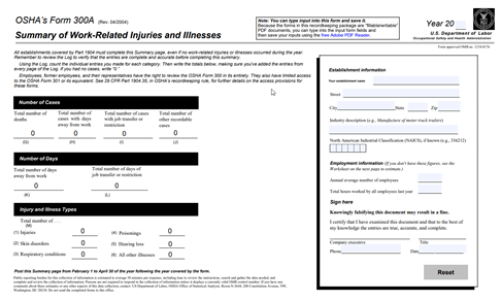
OSHA Form 300A is the total summary of all work-related injuries that have occurred on-site during the year. This includes the total number of injuries, illnesses, deaths, days away from work, recordable cases, etc., without identifying the personal details of involved workers.

3. OSHA Form 301 

Lastly, is the OSHA Form 301. This form is a compliment to the OSHA Form 300, as it allows you to go into more detail about the injury or illness mentioned. Here you can paint the picture of exactly what happened and what the outcomes were.

Changes to OSHA Reporting Requirements

In a fast-paced environment, OSHA’s injury and illness incident reporting has changed requirements over the years. In 2002, for example, the 300, 300A, and 301 Forms were introduced, and in 2015 fatalities, hospitalizations, and the loss of an eye had to be reported within a certain time frame.

In 2016, OSHA updated requirements again to state you only have to submit OSHA Form 300, 300A, and 301 every year if you have over 250 employees in a high-risk industry. Those who have anywhere between 20 and 240 employees only need to submit OSHA Form 300A by March 2nd, annually.

COVID-19 OSHA Injury and Illness Reporting Requirements

With the current pandemic, OSHA has updated its requirements once again to include COVID-19 related information. In November 2020, they stated all COVID-19 cases must be recorded if work-related and if it resulted in effects outlined in standard 29 CFR 1904.7, which include death, days away from work, loss of consciousness, etc.

Though not every case must be recorded, each needs to be investigated to decide whether it has been caused by elements on the worksite. If this is the case, the OSHA 300 log forms must be completed.

New guidance was also recently released in January 2021. Click here, to learn more.

How and Where to Submit the OSHA 300 Log

Now that you know the information that needs to be recorded, let’s discuss how and where to submit the OSHA 300 log. Your OSHA 300 log must be posted between the months of February and April, for the previous year; however, all three OSHA forms must be regularly updated, and not just during this time period. As outlined by OSHA, all records must also be maintained for at least five years.

Though OSHA has stated that forms 300 and 301 no longer need to be submitted electronically to protect the privacy of workers involved, Form 300A needs to be submitted by March 2nd for the previous calendar year. This can be done electronically through OSHA’s Injury Tracking Application Login.

OSHA recordkeeping and reporting is vital to not only keep your organization away from citations but to ensure all workers are protected every day. Once injuries and illnesses are logged and recorded, you can start to investigate what led to them and if there are any patterns or trends that appear to help you mitigate these risks in the future.


Injury and Illness Recordkeeping Forms – 300, 300A, 301

Forms 300, 300A, 301 and Instructions – PDF Fillable Format

Forms 300, 300A, 301 Excel format (Forms ONLY) – Requires Microsoft Excel or equivalent


Printing Files

Please note that these forms are not designed for printing on standard 8.5 x 11″ paper. If you want to print on 8.5 x 11″ paper, you may need to change your Acrobat® application settings to use “Shrink to Fit”, and you may also need to make configuration changes for your specific printer. It is also recommended that you do not attempt to print these forms from your web browser — download the PDF file and open it directly in Acrobat®.

If you do not have the ability to reproduce the original 8.5 x 14″ forms, you may want to contact a local printer or publishing company to have the forms professionally reproduced for you — simply provide the printer with a copy of the PDF file on disk.

The Microsoft Excel template is customizable and exportable to other formats, but the end user assumes full responsibility for making all changes, and for the results generated by any such changes.


Brief Tutorial on Completing the OSHA Recordkeeping Forms

Many but not all employers must complete the OSHA injury and illness recordkeeping forms on an ongoing basis. Employers with 10 or fewer employees throughout the previous calendar year do not need to complete these forms. In other words, if there are more than 10 employees at any time during that calendar year, the employer may come under the requirement. When counting employees, you must include full‐time, part‐time, temporary, and seasonal workers. This exemption is based on the employment of the entire company rather than the establishment. For example, if a company has two establishments, one with five employees and one with seven employees, the company must fill out the forms for each establishment because the company employment is greater than 10.


How to Complete the OSHA Form 300

The Log of Work-Related Injuries and Illnesses (Form 300) is required by the Occupational Safety and Health Administration (OSHA) to classify work-related injuries and illnesses and to record the extent and severity of each case. Employers are required to complete the OSHA Form 300 log unless they are exempt. Employers will also be required to post an annual summary (Form 300A) in their workplaces from February 1 until April 30 of each year.

Step 1: Determine the Establishment Locations

A Form 300 log is required for each physical establishment location that is expected to be in operation for at least one year. For employees who work from home, OSHA does not consider the worker’s home to be an establishment for record-keeping purposes. OSHA considers the worker’s establishment to be the office to which he or she reports, from which he or she receives direction or supervision, collects pay, and otherwise stays in contact with the employer. It is at this establishment that the log is kept.

Step 2: Identify Required Recordings

Work-related injuries and illnesses that result in the following must be recorded:

  • Death.
  • Loss of consciousness.
  • Days away from work.
  • Restricted work activity or job transfer.
  • Medical treatment beyond first aid.
  • Any work-related case involving cancer, chronic irreversible disease, a fractured or cracked bone, or a punctured eardrum.

In addition to the above cases, employers must record the following conditions when work-related:

  • Any needle-stick injury or cut from a sharp object that is contaminated with another person’s blood or other potentially infectious material.
  • Any case requiring an employee to be medically removed under the requirements of an OSHA health standard.
  • Tuberculosis (TB) infection as evidenced by a positive skin test or diagnosis by a licensed health care professional after exposure to a known case of active TB.
  • An employee’s hearing test result that the employee has experienced a standard threshold shift in hearing in one or both ears.

The OSHA Regulation 29 C.F.R. §1904.7 contains an in-depth overview of recordable injuries and illnesses. Additional information on determining medical treatment and first aid can be located at 29 C.F.R. §1904.7(b)(5).

Step 3: Determine Work-Relatedness

When an accident occurs, an employer must document a recordable injury or illness on the OSHA Form 300 log within seven days. An injury or illness is considered work-related and must be recorded on the log unless an exception applies. Some exceptions include:

  • At the time of the injury or illness, the employee was at work as a member of the general public and not as an employee. For example, if an employee returns to work after the end of his or her shift to pick up an item the employee forgot to take home and is injured during this visit.
  • The injury or illness surfaces while at work, but results solely from a nonwork-related event or exposure. For example, an employee suffers a heart attack while at work but has a history of heart disease.
  • The injury or illness results solely from voluntary participation in a wellness program. For example, an employee is injured while working out in the company gym.
  • The injury or illness is the result of eating or drinking or preparing food or drink for personal consumption. For example, an employee chokes while eating a sandwich for lunch.
  • The injury is the result of an employee doing personal tasks outside of work hours. For example, the employee sustains an injury while visiting with co-workers after his or her work shift.

Step 4: Complete the OSHA Form 300

Employers must take the following steps to fill out the OSHA Form 300:

  1. Fill in the year, establishment name, city and state.
  2. Assign each event an employer-created case number on the OSHA log. This can be as simple as number 1, 2, 3, 4 and so on. The only requirement is that each case number for a given year is unique.
  3. Identify the employee, the employee’s job title, the date of the injury or onset of the illness and the exact location where the event occurred.
  4. Specifically describe the case, along with the parts of the body affected and the object/substance that directly injured or made the employee ill, using more than one line if necessary.
  5. Classify the case by choosing only one of the categories. The most serious outcome will need to be recorded; the employer should revise the log if the injury or illness progresses or the outcome is more serious than was originally recorded. The original entry must be crossed out, deleted or concealed with correctional fluid.
  6. Enter the number of days the employee was on restricted work or job transfer, the number of days away from work, or both.
  7. Indicate whether the case is an injury or an illness.
  8. Total all columns at the end of the year.

The Form 300 will contain information related to an employee’s health and must be kept confidential to the extent possible while using the information for occupational safety and health purposes. OSHA provides guidance that includes the forms needed for maintaining occupational injury and illness records along with step-by-step instructions.

Step 5: Complete and Post the OSHA 300A Annual Summary

The information from the OSHA Form 300 Log is transferred onto the 300A Summary by matching the corresponding lettered column on the log with the lettered blank space on the summary.

The employer must complete the establishment information section and have the summary signed by an authorized executive of the company.

Employers must complete the 300A summary form and post the summary in the workplace from February 1 to April 30 of the year following the year covered by the form at each job site in a conspicuous area where notices to employees are customarily placed. For example, accidents occurring in 2015 will be summarized on the Form 300A and posted from February through April 2016. Copies of the 300A summary should be provided to any employees who may not see the posted summary because they do not regularly report to a fixed location.

Step 6: Submit Electronic Reports to OSHA

Employers with 20 or more employees that are subject to OSHA’s recordkeeping regulation must electronically submit to OSHA information from Form 300A (Summary of Work-Related Injuries and Illnesses) by March 2.

Employers with fewer than 20 employees at all times during the year do not have to submit information electronically to OSHA.

The requirement to electronically submit information from OSHA Form 300 (Log of Work-Related Injuries and Illnesses), and OSHA Form 301 (Injury and Illness Incident Report) was eliminated in 2019. See Tracking of Workplace Injuries and Illnesses Final Rule.

Step 7: Retain the Log and Summary

The OSHA Form 300 Log and the OSHA 300A Summary must be kept for five years following the year that the log and summary pertain to.

Source: SHRM


OSHA Recordkeeping: Should COVID-19 Claims be Recorded?

Recordkeeping requirements and COVID-19
The question: How does the pandemic affect OSHA’s recordkeeping requirements?

Answer: It is complicated. Suspected work-related cases and an insurance carrier’s investigation can cause confusion as to how to proceed in determining if cases are to be documented on an organization’s OSHA 300 Log or not.

A workers’ compensation determination of compensability, either accepted or denied, does not automatically dictate whether the illness should be on your OSHA 300 Log. Generally speaking, we treat workers’ compensation and OSHA requirements as separate entities for recordkeeping purposes. While investigating to determine whether a case should be on your OSHA 300 Log, there will be many factors to consider. We recommend using a workers’ compensation determination as just one factor in your determination.

Under OSHA’s recordkeeping requirements, COVID-19 is a recordable illness, and thus employers are responsible for recording cases of COVID-19, if:

  1. The case is a confirmed case of COVID-19, as defined by the Centers for Disease Control and Prevention (CDC);
  2. The case is work-related as defined by 29 CFR § 1904.5; and
  3. The case involves one or more of the general recording criteria set forth in 29 CFR § 1904.7

OSHA released COVID-19 recordability guidelines that require organizations to perform their own investigations as to the work-relatedness (step #2 above) of any case to be placed on an OSHA 300 Log. Employers should:

  • Document investigations
  • Consider interviewing
  • Request a statement from affected employees
  • Reference OSHA’s website for guidance here

OSHA allows employers to amend logs as an injury/illness case develops, whether it be Coronavirus-related or not.  Appropriately reporting workers’ compensation claims is critical. Over reporting can lead to higher incident rates, which can negatively affect an organization’s safety standings.

Source: Marsh & McLennan Agency Risk Consultant


Carcinogens Meeting Kit

WHAT’S AT STAKE

CARCINOGENS

It is estimated that an average of 1,500 people die a day due to cancer. Cancer is caused by carcinogens. Carcinogens are defined as any substance or agent that tends to produce a cancer. These carcinogens are found in the workplace.

WHAT’ S THE DANGER

WHAT IS A CARCINOGEN?

A carcinogen is a substance, mixture or agent that can cause cancer or it increases the risk of developing cancer. Known carcinogens include viruses (e.g., Hepatitis B), hormones (e.g., estrogens), chemicals (e.g., benzene), naturally occurring minerals (e.g., asbestos), alcohol, and solar radiation (e.g., ultraviolet radiation).

TEN COMMON WORKPLACE CARCINOGENS

There are many different types of carcinogens found in all kinds of workplaces. Some of these carcinogens include:

  • Asbestos
  • Crystalline silica
  • Benzene
  • Wood dust
  • Chromium (hexavalent
  • Nickel
  • Formaldehyde
  • Ionizing radiation and radioactive elements
  • Cadmium
  • Lead

CARCINOGENS EXPOSURE

Reducing exposure will reduce your risk of developing cancer from exposure to a carcinogen.

Typically, there are 3 important routes of exposure in a workplace setting — inhalation (breathing in), skin contact and ingestion (swallowing). In addition, there are several factors that can influence how likely a product is to cause a specific effect (e.g., cancer), for example:

  • Route of entry into the body (e.g., some carcinogens will only cause cancer if inhaled, but not by skin contact).
  • Amount or dose entering the body (in general, a higher exposure increases risk).
  • Potency of the carcinogen (some carcinogens cause cancer if there is exposure to even a very small amount, while others may require intense exposure over many years).
  • Individual susceptibility (e.g., some people may be more susceptible to developing cancer due to their genetic make-up).
  • Personal habits (e.g., smoking acts synergistically with many carcinogens. This action means that if you smoke, your risk of developing cancer following a workplace exposure to a carcinogen is MUCH higher).

HOW TO PROTECT YOURSELF

OCCUPATIONAL CANCER

Occupational cancer is cancer that is caused wholly or partly by exposure to a carcinogen at work.

How do we know if an agent can cause cancer?

Scientists identify cancer-causing agents using information from:

  • studies that look at the relationship between an exposure and the risk of developing cancer in human populations
  • experiments that examine the relationship between an exposure and the risk of developing cancer in laboratory animals
  • tests that examine the ability of an agent to cause mutations (genetic changes) in cells, and
  • knowledge of chemical structures and the way in which chemicals interact with the body
  • Scientists generally use information or evidence from all of these sources when determining if an agent can cause cancer.

HAZARD CONTROL

The following general advice can help you work safely with a carcinogen:

  • Consult the MSDS/SDS for information about the hazards and necessary precautions for the specific carcinogenic product you are using.
  • Understand all of the hazards associated with the product, including additional health concerns (e.g., serious short-term health effects or irritation), reactivity and flammability.
  • Know how to use the product safely to protect yourself and co-workers.
  • Ensure engineering controls (e.g., ventilation) are operating. Closed handling systems may be necessary to prevent the release of the product (dust, mist, vapour, gas) into the workplace.
  • Use the smallest quantity possible.
  • Follow safe work practices specified by your employer.
  • Wear the appropriate personal protective equipment specified for the job. This equipment may include respiratory protection and chemical protective clothing, such as an apron and gloves, made from materials that protect against the chemicals being handled.
  • Report ventilation failures, leaks, or spills to your supervisor immediately.
  • Understand and practice emergency procedures so that you know what to do in case of a spill or other emergency.

FINAL WORD

There are hundreds of other known and probable carcinogens found in the world around us. Many of the carcinogens will not be a concern for you, but there are some that you could be exposed to on a daily basis. It is important to understand what a carcinogen is and which ones could be in your environment both at work and at home.


Carcinogens Stats and Facts

FACTS

  1. Millions of U.S. workers are exposed to substances that have been tested as carcinogens in animal studies or found to be possibly carcinogenic in human studies.
  2. Based on well-documented associations between occupational exposures and cancer, it has been estimated that 3-6% of all cancers worldwide are caused by exposures to carcinogens in the workplace.
  3. Cancers that occur as a result of exposures in the workplace are preventable, if exposures to known or suspected carcinogens can be reduced.
  4. Cancer is by far the biggest contributor to those deaths, making up roughly 70% of workplace diseases.
  5. More than 200 different known factors, including toxic chemicals and radiation, have been identified to date as known or probable human carcinogens, and workers are exposed to many of these in the course of their jobs.

STATS

  • There were an estimated 349 000 deaths and 7.2 million DALYs in 2016 due to exposure to the included occupational carcinogens—3.9% of all cancer deaths and 3.4% of all cancer DALYs;
  • 79% of deaths were of males and 88% were of people aged 55 –79 years.
  • Lung cancer accounted for 86% of the deaths, mesothelioma for 7.9% and laryngeal cancer for 2.1%.
  • Asbestos was responsible for the largest number of deaths due to occupational carcinogens;
  • Other important risk factors were second-hand smoke, silica and diesel engine exhaust.
  • The highest mortality rates were in high-income regions, largely due to asbestos-related cancers, whereas in other regions cancer deaths from second-hand smoke, silica and diesel engine exhaust were more prominent.

From 1990 to 2016, there was a decrease in the rate for deaths and DALYs due to exposure to occupational carcinogens.


Carcinogens Fatality Report

In a far-reaching human rights case, Ella Kissi-Debrah could become the first person to have toxic air given as their cause of death – and finally make this silent killer visible

From a tiny office on the top floor of the old town hall in Catford, south-east London, Rosamund Kissi-Debrah is leading a campaign to push air pollution on to the political agenda as never before. It has been claimed for years that pollution caused by motor vehicles, especially diesel cars, buses and Lorries, is a killer, with talk of tens of thousands of premature deaths. But the number was always abstract, the identities of the dead unknown. Now, for the first time, campaigners have the name of a young victim they say died as a direct result of air pollution: Ella Roberta Kissi-Debrah, Rosamund’s daughter, and if they can prove it they believe an invisible killer will become all too real.

Ella, who suffered from severe asthma, died in 2013 at the age of nine. She had been suffering asthma-related seizures like the one which killed her for three years. Kissi-Debrah says her daughter, who grew up and went to school close to the busy South Circular Road in Lewisham, had cough syncope – a condition usually associated with long-distance lorry drivers who’d been driving for decades. “I couldn’t work out why a nine-year-old child should have that,” she tells me.

While Ella was alive, Kissi-Debrah sought a medical explanation for the condition. Now she is convinced it was related to air pollution, arguing that her daughter’s lungs had been weakened over the course of her short life, with pollution spikes then triggering the attacks that repeatedly hospitalised her in the final three years. “When she first became ill, I just went to the GP and got normal antibiotics and thought ‘a few days and that will be it’,” recalls Kissi-Debrah. “But she developed this cough and it was really strange-sounding, like a whooping cough.”

The cough persisted. On the third visit to the surgery the doctor referred her to a specialist, and eventually Great Ormond Street took over Ella’s treatment. “By New Year’s Eve 2010 she was in intensive care,” says Kissi-Debrah. “It now turns out that all we were doing for the next two years was maintaining her. She would have times when the cough disappeared, but it was never long enough.” Kissi-Debrah contends that the damage her daughter suffered to her lungs in the early years of her life condemned her to death.

Supported by the human rights lawyer Jocelyn Cockburn, Kissi-Debrah is pressing for a new inquest into her daughter’s death that for the first time would make it explicit that pollution was the cause. To get a second inquest, they will need to show there is new evidence that was not taken into account at the original investigation in 2014. Step forward Stephen Holgate, professor of immunopharmacology at the University of Southampton, who has taken a fresh look at Ella’s medical records and concluded there is a “real prospect that without illegal levels of air pollution Ella would not have died”.


Carcinogens – Picture This

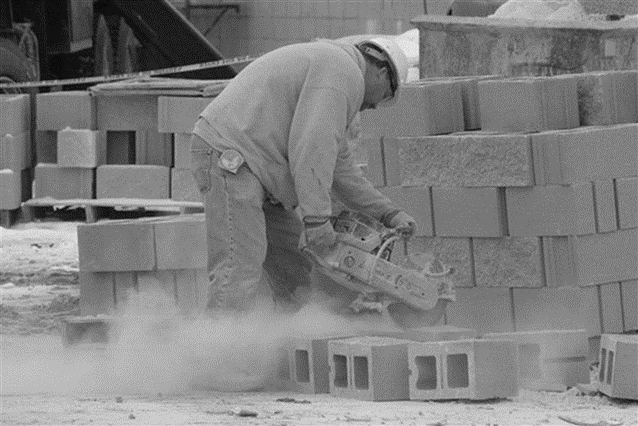
Look at the image above and see what is wrong in the picture, there is a construction worker doing a task around a high exposure of dust without any proper PPE. Construction workers have been identified in many other studies as being at risk of exposure to a number of carcinogens, particularly asbestos, wood, dust, crystalline silica, solar UV radiation and diesel engine exhaust.

The construction industry was identified as having the highest prevalence of potential exposure to carcinogens with a (60%) of “dust” (concrete and cement, wood dust, “environmental dust” and “road dust”).

Every second of reduced exposure to occupational carcinogens could mean an investment in a life.


Carcinogens Meeting Kit – Spanish

QUÉ ESTÁ EN RIESGO

CARCINÓGENOS

En Estados Unidos, en 2017, se estima que una media de 1.500 personas mueren al día a causa del cáncer. El cáncer es causado por carcinógenos. Los carcinógenos se definen como cualquier sustancia o agente que tiende a producir un cáncer. Estos carcinógenos se encuentran en el lugar de trabajo.

CUÁL ES EL PELIGRO

¿QUÉ ES UN CARCINÓGENO?

Un carcinógeno es una sustancia, mezcla o agente que puede causar cáncer o que aumenta el riesgo de desarrollarlo. Entre los carcinógenos conocidos se encuentran los virus (por ejemplo, la hepatitis B), las hormonas (por ejemplo, los estrógenos), los productos químicos (por ejemplo, el benceno), los minerales naturales (por ejemplo, el amianto), el alcohol y la radiación solar (por ejemplo, la radiación ultravioleta).

DIEZ CARCINÓGENOS COMUNES EN EL LUGAR DE TRABAJO

Hay muchos tipos diferentes de carcinógenos que se encuentran en todo tipo de lugares de trabajo. Algunos de estos carcinógenos son:

  • Asbesto
  • Sílice cristalina
  • Benceno
  • Polvo de madera
  • Cromo (hexavalente)
  • Níquel
  • Formaldehído
  • Radiación ionizante y elementos radiactivos
  • Cadmio
  • Plomo

EXPOSICIÓN A CARCINÓGENOS

La reducción de la exposición reducirá el riesgo de desarrollar cáncer por exposición a un carcinógeno.

Normalmente, hay tres vías importantes de exposición en el lugar de trabajo: la inhalación (aspiración), el contacto con la piel y la ingestión (tragar). Además, hay varios factores que pueden influir en la probabilidad de que un producto cause un efecto específico (por ejemplo, cáncer), por ejemplo:

Vía de entrada en el organismo (por ejemplo, algunos carcinógenos sólo causan cáncer si se inhalan, pero no por contacto con la piel).

Cantidad o dosis que entra en el cuerpo (en general, una mayor exposición aumenta el riesgo).

Potencia del carcinógeno (algunos carcinógenos causan cáncer si se produce una exposición incluso a una cantidad muy pequeña, mientras que otros pueden requerir una exposición intensa durante muchos años).

Susceptibilidad individual (por ejemplo, algunas personas pueden ser más susceptibles de desarrollar cáncer debido a su composición genética).

Hábitos personales (por ejemplo, el tabaquismo actúa de forma sinérgica con muchos carcinógenos. Esta acción significa que si usted fuma, su riesgo de desarrollar cáncer tras una exposición a un carcinógeno en el lugar de trabajo es MUCHO mayor).

COMO PROTEGERSE

CÁNCER PROFESIONAL

El cáncer profesional es un cáncer causado total o parcialmente por la exposición a un agente cancerígeno en el trabajo.

¿Cómo sabemos si un agente puede causar cáncer?

Los científicos identifican los agentes causantes de cáncer utilizando información procedente de:

  • Estudios que examinan la relación entre una exposición y el riesgo de desarrollar cáncer en poblaciones humanas.
  • Experimentos que examinan la relación entre una exposición y el riesgo de desarrollar cáncer en animales de laboratorio.
  • Pruebas que examinan la capacidad de un agente para causar mutaciones (cambios genéticos) en las células, y
  • Conocimiento de las estructuras químicas y de la forma en que las sustancias químicas interactúan con el organismo.
  • Los científicos suelen utilizar información o pruebas de todas estas fuentes para determinar si un agente puede causar cáncer.

CONTROL DE RIESGOS

Los siguientes consejos generales pueden ayudarle a trabajar de forma segura con un carcinógeno:

  • Consulte la FDS/SDS para obtener información sobre los peligros y las precauciones necesarias para el producto cancerígeno específico que esté utilizando.
  • Comprenda todos los peligros asociados al producto, incluidos los problemas de salud adicionales (por ejemplo, efectos graves a corto plazo sobre la salud o irritación), la reactividad y la inflamabilidad.
  • Sepa cómo utilizar el producto de forma segura para protegerse a sí mismo y a sus compañeros de trabajo.
  • Asegúrese de que los controles de ingeniería (por ejemplo, la ventilación) están funcionando. Pueden ser necesarios sistemas de manipulación cerrados para evitar la liberación del producto (polvo, niebla, vapor, gas) en el lugar de trabajo.
  • Utilice la menor cantidad posible.
  • Siga las prácticas de trabajo seguras especificadas por su empleador.
  • Utilice el equipo de protección personal adecuado especificado para el trabajo. Este equipo puede incluir protección respiratoria y ropa de protección química, como un delantal y guantes, fabricados con materiales que protegen contra los productos químicos que se manipulan.
  • Informe inmediatamente a su supervisor de los fallos de ventilación, fugas o derrames.
  • Comprenda y practique los procedimientos de emergencia para saber qué hacer en caso de derrame u otra emergencia.

CONCLUSIÓN

Hay cientos de otros carcinógenos conocidos y probables que se encuentran en el mundo que nos rodea. Muchos de los carcinógenos no serán motivo de preocupación para usted, pero hay algunos a los que podría estar expuesto a diario. Es importante entender qué es un carcinógeno y cuáles pueden estar en su entorno, tanto en el trabajo como en casa.


Carcinogens Stats and Facts – Spanish

HECHOS

  1. Millones de trabajadores estadounidenses están expuestos a sustancias que han sido probadas como carcinógenas en estudios con animales o que han sido encontradas como posiblemente carcinógenas en estudios con humanos.
  2. Basándose en las asociaciones bien documentadas entre las exposiciones laborales y el cáncer, se ha estimado que entre el 3 y el 6% de todos los cánceres del mundo están causados por exposiciones a carcinógenos en el lugar de trabajo.
  3. Los cánceres que se producen como resultado de las exposiciones en el lugar de trabajo son prevenibles, si se pueden reducir las exposiciones a carcinógenos conocidos o sospechosos.
  4. El cáncer es, con mucho, el mayor contribuyente a esas muertes, constituyendo aproximadamente el 70% de las enfermedades laborales.
  5. Hasta la fecha se han identificado más de 200 factores diferentes, entre ellos productos químicos tóxicos y radiaciones, como carcinógenos humanos conocidos o probables, y los trabajadores están expuestos a muchos de ellos en el curso de su trabajo.

ESTADÍSTICAS

  • Se estima que en 2016 se produjeron 349 000 muertes y 7,2 millones de AVAD debido a la exposición a los carcinógenos laborales incluidos: el 3,9% de todas las muertes por cáncer y el 3,4% de todos los AVAD por cáncer;
  • El 79% de las muertes fueron de hombres y el 88% de personas de entre 55 y 79 años.
  • El cáncer de pulmón representó el 86% de las muertes, el mesotelioma el 7,9% y el cáncer de laringe el 2,1%.
  • El amianto fue el responsable del mayor número de muertes por carcinógenos laborales;
  • Otros factores de riesgo importantes fueron el humo de segunda mano, el sílice y los gases de escape de los motores diesel.
  • Las tasas de mortalidad más elevadas se registraron en las regiones de ingresos altos, en gran parte debido a los cánceres relacionados con el amianto, mientras que en otras regiones las muertes por cáncer debidas al humo ajeno, al sílice y a los gases de escape de los motores diésel fueron más destacadas.
  • De 1990 a 2016, se produjo una disminución de la tasa de muertes y AVAD debidos a la exposición a carcinógenos profesionales.


Carcinogens Fatality Report – Spanish

En un caso de derechos humanos de gran alcance, Ella Kissi-Debrah podría convertirse en la primera persona a la que se le atribuye la causa de la muerte por aire tóxico, y hacer por fin visible este asesino silencioso

Desde una diminuta oficina en el último piso del antiguo ayuntamiento de Catford, al sureste de Londres, Rosamund Kissi-Debrah lidera una campaña para que la contaminación atmosférica se incluya en la agenda política como nunca antes. Durante años se ha afirmado que la contaminación causada por los vehículos de motor, especialmente los coches, autobuses y camiones diésel, es mortal, y se habla de decenas de miles de muertes prematuras. Pero la cifra era siempre abstracta, y la identidad de los muertos, desconocida. Ahora, por primera vez, los activistas tienen el nombre de una joven víctima que, según dicen, murió como consecuencia directa de la contaminación atmosférica: Ella Roberta Kissi-Debrah, la hija de Rosamund, y si pueden demostrarlo creen que un asesino invisible se convertirá en algo muy real.

Ella, que sufría de asma severa, murió en 2013 a la edad de nueve años. Llevaba tres años sufriendo ataques relacionados con el asma como el que la mató. Kissi-Debrah dice que su hija, que creció y fue a la escuela cerca de la concurrida South Circular Road en Lewisham, tenía síncopes de tos, una condición generalmente asociada a los conductores de camiones de larga distancia que habían estado conduciendo durante décadas. “No podía entender por qué una niña de nueve años podía tener eso”, me dice.

Mientras Ella vivía, Kissi-Debrah buscó una explicación médica para la enfermedad. Ahora está convencida de que está relacionada con la contaminación atmosférica, argumentando que los pulmones de su hija se debilitaron a lo largo de su corta vida, y que los picos de contaminación desencadenaron los ataques que la hospitalizaron repetidamente en los últimos tres años. “Cuando enfermó por primera vez, fui al médico de cabecera y le di antibióticos normales y pensé: ‘unos días y ya está'”, recuerda Kissi-Debrah. “Pero desarrolló una tos que sonaba realmente extraña, como una tos ferina”.

La tos persistía. En la tercera visita a la consulta, el médico la derivó a un especialista y, finalmente, Great Ormond Street se hizo cargo del tratamiento de Ella. “En la víspera de Año Nuevo de 2010 estaba en cuidados intensivos”, dice Kissi-Debrah. “Ahora resulta que todo lo que hicimos durante los dos años siguientes fue mantenerla. Tenía momentos en los que la tos desaparecía, pero nunca era suficiente”. Kissi-Debrah sostiene que los daños que su hija sufrió en los pulmones durante los primeros años de su vida la condenaron a la muerte.

Apoyada por la abogada de derechos humanos Jocelyn Cockburn, Kissi-Debrah está presionando para que se realice una nueva investigación sobre la muerte de su hija que, por primera vez, explique que la contaminación fue la causa. Para conseguir una segunda investigación, tendrán que demostrar que hay nuevas pruebas que no se tuvieron en cuenta en la investigación original de 2014. En este sentido, Stephen Holgate, profesor de inmunofarmacología de la Universidad de Southampton, ha examinado de nuevo el historial médico de Ella y ha llegado a la conclusión de que existe una “posibilidad real de que, sin los niveles ilegales de contaminación atmosférica, Ella no habría muerto”.


Carcinogens – Picture This – Spanish

Observe la imagen de arriba y vea lo que está mal en la foto, hay un trabajador de la construcción haciendo una tarea en torno a una alta exposición al polvo sin ningún EPP adecuado. Los trabajadores de la construcción han sido identificados en muchos otros estudios como personas con riesgo de exposición a una serie de carcinógenos, en particular el amianto, la madera, el polvo, la sílice cristalina, la radiación solar UV y los gases de escape de los motores diésel.

El sector de la construcción fue identificado como el de mayor prevalencia de exposición potencial a carcinógenos con un (60%) de “polvo” (hormigón y cemento, polvo de madera, “polvo ambiental” y “polvo de la carretera”).

Cada segundo de reducción de la exposición a carcinógenos laborales podría significar una inversión en una vida.


Mechanical Issue-Related Crashes Meeting Kit

Mechanical Issue-Related Crashes Safety Talk

Mechanical failure traffic accidents are a major problem. On the road, safety is critical. While distracted driving, human error and intoxication cause a considerable number of traffic accidents, mechanical failure is equally dangerous. All drivers have a duty to maintain their vehicles as well as all mechanical parts and safety devices. A tire blowout or faulty turn signal is not an unforeseeable condition. Drivers can prevent these issues by inspecting their cars regularly and performing recommended maintenance. Commercial drivers and companies that transport goods also have a duty to maintain and inspect their trucks. Motorists who fail to keep their vehicles in good working order should be held responsible for property damage, injuries and any fatalities resulting from their negligence.

CHECK YOUR CAR FOR PROBLEMS – VEHICLE INSPECTION

Vehicles could be realistically inspected prior to every time you drive them; however, many people choose to go longer without inspecting their vehicle if at all. So many things outside of your immediate control can affect your vehicle that you do not know about. For example, any single trip can result in a nail or other object compromising your tire and causing a dangerous hazard for you the next time you drive your vehicle. A simple walk around of your car or truck prior to operation can avoid an accident.

KEEP THESE TIPS IN MIND TO CHECK YOUR CAR FOR MECHANICAL ISSUES:

  • Check your tires frequently
  • Look underneath for puddles
  • Listen to the engine
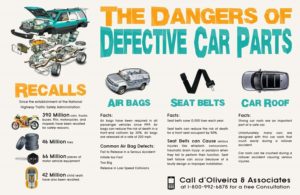
  • Check for recalls

TOP MECHANICAL FAILURES CAUSING CAR ACCIDENT

Common Contributing Factors To Brake-Related Car Accidents Include:

Faulty/worn brake lines. Leaks in brake lines may allow brake fluid to drain away, compromising brake performance.

Abs malfunctions. An Antilock Brake System (ABS) is designed to automatically prevent the wheels from locking up when drivers hit the brakes hard—preventing slipping and loss of control. ABS malfunctions can compromise braking performance.

Worn brake pads & discs. The brake pads and discs in your car wear out a little bit more with each and every use. Over time, this wear makes it harder to stop your vehicle, resulting in longer stop distances and increased accident risks.

Steering and Suspension

Steering and suspension problems can cause a loss of control over your vehicle at inopportune moments. Transmission and engine problems could keep you from being able to accelerate quickly if the need arises—leaving you stranded in an intersection with oncoming traffic.

Routine vehicle maintenance is the best way to prevent steering and suspension issues that could contribute to a car crash. If your vehicle’s due for a full inspection, it’s important to have that inspection done and get a report so you know if there are any issues with your steering, suspension, transmission, or engine.

Headlights/Taillights

Headlights and taillights increase visibility significantly, showing you not only more of the road, but making it so that other drivers are better able to see your vehicle too. Broken vehicle lights make your car much harder to see in the dark or in inclement weather, increasing your risk of getting rear-ended or sideswiped.

Vehicle lights are important even on a clear day. Turn signals (a.k.a. blinkers) let other drivers know when you’re preparing to change lanes or slow down for a turn. Without working blinkers, your lane changes are made unannounced.

Windshield Wipers

Worn out wiper blades are less effective at clearing rain and debris, leaving streaks that continue to block your sight. Worse yet, if the motors controlling the wipers malfunction or break, the sudden loss of vision could cause a car crash right away if you’re in heavy traffic or traveling at high speed.

Check your windshield wipers once every month or so, or if you notice that they’re not clearing your windshield effectively during a light rainstorm. If the blades are damaged, replace them as soon as possible.

Be sure to check your windshield wiper fluid and top it off when necessary—during your next oil change is a good time to check.

Engine Failure

Car engines are designed to operate well with very little maintenance. However, there are problems that can occur that can result in a broken-down vehicle and confusion about what went wrong.

It is important to keep an eye on your car’s temperature gauge. If you notice your vehicle’s temperature shifting towards the red, it may indicate that there is a serious problem with the car’s liquid cooling system. Without a properly working cooling system, the combustion process can overheat the car’s engine, resulting in engine failure.

A lack of oil in your car can also lead to engine failure and expensive repairs. Oil provides lubrication for your car’s engines. Without it, metal parts would scrape and grind together, causing friction and overheating. Over time, oil loses its ability to lubricate and needs to be replaced. Waiting too long to change the oil can cause overheating and damage to your car’s engine. An undetected oil leak can lead to low oil pressure and potential damage to your engine. Keeping up with routine maintenance for your car will prevent damage to your engine from old oil and oil leaks, as well as reduce the chance of your vehicle suffering from engine failure on the road.

Remember, while mechanical failures are not cited as the critical reason for car accidents in most cases, they can be a major contributing factor—especially since many mechanical failures might go undetected.

The best protection is regular vehicle maintenance and to be alert whenever you’re behind the wheel. However, despite your best efforts, car accidents can still happen to the best drivers in the most well-maintained vehicles.

FINAL WORD

While the majority of the time you will never experience any problems with mechanical issue-related crashes, the one time you do it could result in a serious accident. Take mechanical issues seriously and when you find one during an inspection get it fixed by a professional to ensure the vehicle is safe to operate.


Mechanical Issue-Related Crashes Stats and Facts

FACTS

  1. A study led by the Department of Transportation found that brake-related issues are especially common in accidents that involve large trucks and semis.
  2. In nearly one-third of truck accidents, brake failure, improper brake adjustments and other braking issues were causative factors.
  3. Other mechanical failures causing accidents include:
  • Defective parts and equipment
  • Faulty, weak, mismatched or improperly inflated tires
  • Broken taillights or turn signals
  • Damaged brake lines
  • Defective brake components
  • Worn steering mechanisms
  • Shifting cargo and improper loading

STATS

  • Federal statistics show that mechanical failure plays a role in 12 percent of all motor vehicle accidents.
  • Tire failure is of the most common causes of a car crash due to mechanical failure. According to NHTSA surveys, tires and wheel-related problems were responsible for 35% of all accidents due to mechanical failure.

California Experience

  • According to the California Highway Patrol’s Annual Report of Fatal and Injury Motor Vehicle Traffic Collisions, defective lights cause 51 injury crashes and two fatalities per year on average.
  • Defective brakes cause 306 injury crashes annually. More than 90 injury crashes and 2.4 fatalities are attributed to other equipment failures. In accidents caused by commercial truck drivers in California, equipment failure is responsible for 12 injury crashes each year.


Mechanical Issue-Related Crashes Fatality Report

Man dies in crash following mechanical failure in vehicle

MORGAN COUNTY — A Barnett man was killed Saturday after troopers said he crashed his truck following a mechanical failure.

A Missouri State Highway Patrol crash report indicated 61-year-old Billy Scrivner was headed eastbound on Highway 52 when his 2002 Ford Excursion suffered a mechanical failure.

Troopers said this caused Scrivner’s vehicle to cross the center line and travel off the roadway into a field where the vehicle overturned several times. The crash occurred near Buttercup Road. Scrivner was pronounced dead at the scene.

A passenger riding in Scrivner’s vehicle sustained serious injuries and was taken to Capital Region Hospital.

The crash report stated neither were wearing seat belts at the time of the crash.


Mechanical Issue-Related Crashes Picture This

Source: https://www.prweb.com


Mechanical Issue-Related Crashes Meeting Kit – Spanish

QUÉ ESTÁ EN RIESGO

Accidentes relacionados con problemas mecánicos charla de seguridad

Los accidentes de tráfico por fallos mecánicos son un problema importante. En la carretera, la seguridad es fundamental. Mientras que la conducción distraída, los errores humanos y la intoxicación causan un número considerable de accidentes de tráfico, los fallos mecánicos son igualmente peligrosos. Todos los conductores tienen el deber de mantener sus vehículos, así como todas las partes mecánicas y dispositivos de seguridad. El reventón de un neumático o un intermitente defectuoso no es una situación imprevisible. Los conductores pueden prevenir estos problemas inspeccionando sus vehículos regularmente y realizando el mantenimiento recomendado. Los conductores comerciales y las empresas que transportan mercancías también tienen la obligación de mantener e inspeccionar sus camiones. Los conductores que no mantengan sus vehículos en buen estado de funcionamiento deben ser considerados responsables de los daños materiales, las lesiones y las posibles muertes derivadas de su negligencia.

CUÁL ES EL PELIGRO

COMPRUEBE SI SU VEHICULO TIENE PROBLEMAS – INSPECCIÓN DE VEHÍCULOS

Los vehículos podrían ser inspeccionados de forma realista antes de conducirlos; sin embargo, muchas personas optan por pasar más tiempo sin inspeccionar su vehículo, si es que lo hacen. Hay muchas cosas fuera de su control inmediato que pueden afectar a su vehículo y que usted desconoce. Por ejemplo, un simple viaje puede dar lugar a que un clavo u otro objeto comprometa su neumático y cause un peligro para usted la próxima vez que conduzca su vehículo. Un simple paseo por su vehículo o camión antes de ponerlo en marcha puede evitar un accidente.

TENGA EN CUENTA ESTOS CONSEJOS PARA REVISAR SU COCHE EN BUSCA DE PROBLEMAS MECÁNICOS:

  • Compruebe los neumáticos con frecuencia
  • Busque charcos por debajo
  • Escuche el motor
  • Compruebe si hay llamadas a revisión

COMO PROTEGERSE

PRINCIPALES FALLOS MECÁNICOS QUE CAUSAN ACCIDENTES DE VEHICULO

Los factores comunes que contribuyen a los accidentes vehiculares relacionados con los frenos incluyen:

Líneas de freno defectuosas/desgastadas. Las fugas en los conductos de los frenos pueden permitir que el líquido de frenos se drene, comprometiendo el rendimiento de los frenos.

Mal funcionamiento del ABS. Un sistema de frenos antibloqueo (ABS) está diseñado para evitar automáticamente que las ruedas se bloqueen cuando los conductores pisan los frenos con fuerza, evitando el deslizamiento y la pérdida de control. El mal funcionamiento del ABS puede comprometer el rendimiento de los frenos.

Pastillas y discos de freno desgastados. Las pastillas y los discos de freno de tu coche se desgastan un poco más con cada uso. Con el tiempo, este desgaste hace que sea más difícil detener su vehículo, lo que resulta en distancias de parada más largas y un mayor riesgo de accidente.

Dirección y suspensión

Los problemas de dirección y suspensión pueden hacer que pierda el control de su vehículo en momentos inoportunos. Los problemas en la transmisión y el motor pueden impedirle acelerar rápidamente en caso de necesidad, dejándole tirado en un cruce con tráfico en dirección contraria.

El mantenimiento rutinario del vehículo es la mejor manera de prevenir problemas de dirección y suspensión que podrían contribuir a un accidente vehicular. Si su vehículo debe someterse a una inspección completa, es importante realizarla y obtener un informe para saber si hay algún problema con la dirección, la suspensión, la transmisión o el motor.

Faros delanteros/traseros

Los faros delanteros y traseros aumentan la visibilidad de forma significativa, mostrando no sólo más de la carretera, sino haciendo que otros conductores puedan ver mejor su vehículo también. Las luces del vehículo rotas hacen que su vehiculo sea mucho más difícil de ver en la oscuridad o en las inclemencias del tiempo, lo que aumenta el riesgo de sufrir un choque por detrás o un choque lateral.

Las luces del vehículo son importantes incluso en un día claro. Los intermitentes permiten a los demás conductores saber cuándo se está preparando para cambiar de carril o reducir la velocidad para girar. Si los intermitentes no funcionan, los cambios de carril se realizan sin previo aviso.

Limpiaparabrisas

Los limpiaparabrisas desgastados son menos eficaces a la hora de eliminar la lluvia y la suciedad, dejando rayas que siguen bloqueando la vista. Peor aún, si los motores que controlan los limpiaparabrisas funcionan mal o se rompen, la repentina pérdida de visión podría provocar un accidente vehicular de inmediato si se encuentra en un tráfico intenso o viaja a alta velocidad.

Compruebe los limpiaparabrisas una vez al mes o si notas que no limpian el parabrisas de forma eficaz durante una tormenta ligera. Si las escobillas están dañadas, sustitúyalas lo antes posible.

Asegúrese de comprobar el líquido del limpiaparabrisas y de rellenarlo cuando sea necesario; durante el próximo cambio de aceite es un buen momento para hacerlo.

Fallo del motor

Los motores de los vehículos están diseñados para funcionar bien con muy poco mantenimiento. Sin embargo, hay problemas que pueden ocurrir y que pueden resultar en un vehículo averiado y en la confusión sobre lo que salió mal.

Es importante que vigiles el indicador de temperatura de su vehículo. Si nota que la temperatura de su vehículo se desplaza hacia el rojo, puede indicar que hay un problema grave con el sistema de refrigeración líquida del vehículo. Sin un sistema de refrigeración que funcione correctamente, el proceso de combustión puede sobrecalentar el motor del vehículo y provocar un fallo del mismo.

CONCLUSIÓN

Aunque la mayoría de las veces nunca experimentará ningún problema relacionado con problemas mecánicos, la única vez que lo haga podría resultar en un accidente grave. Tómese en serio los problemas mecánicos y cuando encuentre uno durante una inspección, haga que lo arregle un profesional para asegurarse de que el vehículo es seguro para operar.


Mechanical Issue-Related Crashes Stats and Facts – Spanish

HECHOS

  1. Un estudio dirigido por el Departamento de Transporte descubrió que los problemas relacionados con los frenos son especialmente comunes en los accidentes que involucran a camiones grandes y semirremolques.
  2. En casi un tercio de los accidentes de camiones, los fallos de los frenos, los ajustes inadecuados de los mismos y otros problemas de frenado fueron factores causantes.
  3. Otros fallos mecánicos que causan accidentes son

Piezas y equipos defectuosos

  • Neumáticos defectuosos, débiles, desajustados o mal inflados
  • Luces traseras o intermitentes rotos
  • Líneas de freno dañadas
  • Componentes de freno defectuosos
  • Mecanismos de dirección desgastados

ESTADÍSTICAS

  • Las estadísticas federales muestran que los fallos mecánicos desempeñan un papel en el 12% de los accidentes de tráfico.
  • El fallo de los neumáticos es una de las causas más comunes de un accidente de coche debido a un fallo mecánico. Según las encuestas de la NHTSA, los problemas relacionados con los neumáticos y las ruedas fueron responsables del 35% de todos los accidentes debidos a fallos mecánicos.
  • La experiencia de California
  • Según el Informe Anual de la Patrulla de Carreteras de California sobre Colisiones de Tráfico de Vehículos de Motor con Víctimas Mortales y Heridas, las luces defectuosas causan 51 choques con heridas y dos víctimas mortales por año en promedio.
  • Los frenos defectuosos causan 306 accidentes con heridos al año. Más de 90 accidentes con heridos y 2,4 víctimas mortales se atribuyen a otros fallos del equipamiento. En los accidentes causados por conductores de camiones comerciales en California, los fallos de equipamiento son responsables de 12 accidentes con heridos cada año.


Mechanical Issue-Related Crashes Fatality Report – Spanish

Un hombre muere en un accidente tras un fallo mecánico en su vehículo

CONDADO DE MORGAN – Un hombre de Barnett murió el sábado después de que los policías dijeron que estrelló su camión después de una falla mecánica.

Un informe del accidente de la Patrulla de Carreteras del Estado de Missouri indicó que Billy Scrivner, de 61 años, se dirigía hacia el este en la carretera 52 cuando su Ford Excursion 2002 sufrió un fallo mecánico.

Los policías dijeron que esto causó que el vehículo de Scrivner cruzara la línea central y se saliera de la carretera hacia un campo donde el vehículo volcó varias veces. El accidente ocurrió cerca de Buttercup Road. Scrivner fue declarado muerto en la escena.

Un pasajero que viajaba en el vehículo de Scrivner sufrió heridas graves y fue trasladado al Capital Region Hospital.

El informe del accidente indica que ninguno de los dos llevaba puesto el cinturón de seguridad en el momento del accidente.


Mechanical Issue-Related Crashes Picture This – Spanish

ACCIDENTES RELACIONADOS CON PROBLEMAS MECÁNICOS

VISUALIZE ESTO


Quick Course – Get Moving – Why Health and Wellness Matters

Even those of us who have more active jobs likely don’t get enough exercise. A lack of physical activity is hazardous to your overall health and wellness.