Learning the Hard Way Meeting Kit – Spanish

QUÉ ESTÁ EN RIESGO

Todos hemos oído el dicho “aprender por las malas”. Hay muchas lecciones en la vida que se aprenden por las malas porque puede ser la única manera de aprender realmente esa lección concreta a nivel personal. Un aspecto de la vida que no podemos permitirnos aprender por las malas es evitar las lesiones en el trabajo (o en casa).

CUÁL ES EL PELIGRO

APRENDER POR LAS MALAS EQUIVALE A LESIONES O PÉRDIDAS MATERIALES

Cuando se trata de la seguridad en el lugar de trabajo, no podemos permitirnos que los demás aprendan por las malas. Aprender por las malas puede dar lugar a lesiones, daños materiales, pérdidas de producción o algo peor. Aprender una lección por las malas es de naturaleza reactiva. Alguien tiene que fallar para que se aprenda la lección.

Todos cometemos errores. Nadie es perfecto. Pero ¿cuántos errores se pueden evitar? La verdad es que algunas personas repiten errores con una regularidad alarmante. Cometen un error, se levantan de la caída y vuelven a estrellarse contra el muro… de nuevo.

Todos los días, los trabajadores que se lesionan en el trabajo aprenden la lección por las malas. Muchas veces nos enteramos de las historias de horror de las lesiones y los accidentes mortales a través de un parte de seguridad o de un documento de lecciones aprendidas. Con demasiada frecuencia, las lecciones que podemos aprender de estas acciones de seguridad no se aceptan porque no nos han ocurrido a nosotros o a alguien cercano.

Los empleados deben aprovechar las lecciones aprendidas de los incidentes ocurridos en otras empresas o instalaciones que provocan lesiones y ser proactivos para evitar que se produzca un incidente similar en su lugar de trabajo.

COMO PROTEGERSE

CUANDO LOS EMPLEADOS SON PROACTIVOS, SE CREA SEGURIDAD

Para lograr la seguridad en el trabajo, los trabajadores deben ser proactivos. Muchas normas y políticas de seguridad se crean después de que se produzca un incidente o una lesión, lo cual es de naturaleza reactiva. Para evitar que vuelva a producirse un incidente similar, las lecciones aprendidas se convierten en medidas proactivas que deben aplicarse. Cada reunión de seguridad, la formación en materia de seguridad y el tiempo dedicado a aplicar las medidas de protección antes de comenzar el trabajo es un intento de ser proactivo a la hora de abordar la seguridad en el lugar de trabajo.

DEFINICIÓN DE SEGURIDAD PROACTIVA

En resumen, las medidas de seguridad proactivas implican cualquier táctica empleada para minimizar la probabilidad de que se produzca un incidente. Ser proactivo significa anticiparse a los accidentes, estar preparado, minimizar los tiempos de respuesta y disminuir el número de lesiones que se producen en el lugar de trabajo.

LA SEGURIDAD REACTIVA SE DISTINGUE DE LA PROACTIVA

Las medidas de seguridad reactiva son esencialmente lo contrario. Una de las ventajas que se perciben al operar con este método es el ahorro de dinero. Sin embargo, los costes directos e indirectos de una lesión en el lugar de trabajo son notables. Con unos gastos inesperados que podrían afectar a los beneficios de su empresa a largo plazo, no merece la pena correr el riesgo.

LA PROACTIVIDAD ES LA CLAVE DE LA SEGURIDAD EN EL TRABAJO

La seguridad en el lugar de trabajo a menudo se pasa por alto o simplemente se da por sentada. Ningún trabajador quiere lesionarse, y ningún empleador quiere ser responsable de una lesión de un empleado. Un trabajador que diga “nunca me he lesionado” no está siendo necesariamente proactivo para prevenir las lesiones, sino que simplemente está contando la suerte que ha tenido. Al igual que en el mercado de valores, donde los resultados pasados no son un indicador de los rendimientos futuros, un buen historial de seguridad no es una garantía de seguridad para los empleados. La complacencia es la mayor amenaza para la seguridad en el trabajo.

LA CULTURA DE LA SEGURIDAD Y EL PAPEL DEL EMPLEADO

La cultura de la seguridad engloba las expectativas, los sentimientos y las perspectivas de los empleados respecto a la seguridad de todos los trabajadores de una organización: es la forma en que se gestiona la seguridad en el lugar de trabajo. Por supuesto, adoptar un enfoque proactivo para construir una cultura de seguridad positiva tendrá un gran impacto en su empresa. Una cultura de seguridad positiva puede disminuir la rotación de personal, reducir el absentismo, reducir los costes de formación, disminuir los accidentes laborales, reducir las posibles reclamaciones al seguro y tener un efecto positivo en la reputación de su empresa.

CADA ERROR DE LOS EMPLEADOS ES UNA OPORTUNIDAD DE APRENDIZAJE

  • Los errores lo hacen humano. Cometer un error es aceptable. Pero no permita que vuelva a repetirse.
  • Admita sus errores y asúmalos. Trate cada error como una oportunidad de aprendizaje.
  • Acepte los comentarios. Trata los comentarios como un regalo y no como una bofetada en la cara.
  • Póngase una nota. Cada vez que termine una actividad, pregúntese: “Si tuviera la oportunidad de hacer esto de nuevo, ¿qué haría de forma diferente?”
  • Desafíe sus rutinas. Salga de su zona de confort y sea receptivo al cambio.
  • Modifique sus hábitos. Abandone sus malos hábitos. La práctica no hace la perfección si lo haces mal.
  • Piense antes de empezar una actividad. Determine si lo ha hecho en el pasado.
  • Aprenda de los demás. Si aprendes de los errores de los demás, no tendrá que cometer todos los errores usted mismo.

CONCLUSIÓN

Cuando se trata de la seguridad en el trabajo, es responsabilidad de todos. Permitir que alguien “aprenda por las malas” no puede ocurrir con la seguridad en el trabajo. Las lesiones y los daños a la propiedad afectan a todos en un trabajo, no sólo a la persona culpable o a la que es víctima en el escenario.


Learning the Hard Way Fallen Phrases – Spanish


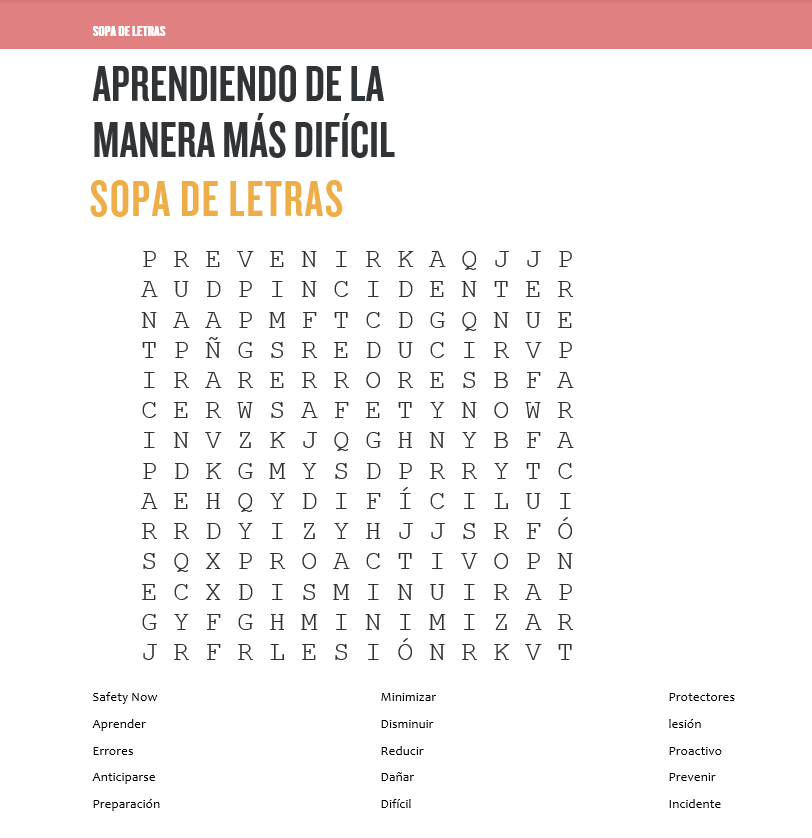
Learning the Hard Way Word Search – Spanish


Learning the Hard Way – Picture This – Spanish

Fuente: https://www.cdc.gov


Pressure Washing Meeting Kit

Pressure Washer Safety

A pressure washer is a power tool that sprays water at high pressures to clean large, sturdy surfaces such as buildings, farm equipment and roads.

While the pressure of the water can be considered the biggest exposure to risk during this work task, there are certainly many more hazards to be considered.

RISKS OF PRESSURE WASHING

The strong spray from a pressure washer can cause serious wounds that might first appear minor. Wounds that appear minor can cause a person to delay treatment, increasing risk for infection, disability or amputation.

The fast, strong spray can throw objects that strike and injure others who are close by.

Electric shock can occur if the pressure washer is not used properly and if safety instructions are not followed.

Workers should not use any equipment powered by gasoline engines inside buildings or other partially enclosed spaces unless the gasoline engine can be placed outdoors and away from air intakes.

HAZARDS AND INJURIES CAUSED BY PRESSURE WASHERS

Some of the injuries that cleaning technicians can suffer while using pressure washers include:

  • Penetration wounds from thrown glass fragments, rocks, and other debris
  • Abrasions
  • Infections such as tetanus
  • Eye injuries
  • Injection injuries caused when cleaning chemicals penetrate the skin
  • Slip-and-fall injuries occurring on flat surfaces
  • Electrocution injuries
  • Falls from height when use of a pressure washer on a ladder or scaffolding causes a worker to lose balance

MORE HAZARDS INFORMATION

Long-term use of these pressure washers can cause hearing loss. Use of gas pressure washers in enclosed spaces lead to the buildup of carbon monoxide and result in asphyxiation.

A significant danger for workers is the innocuous appearance of some of these injuries when they first occur. But a penetration wound, for example, can result in an infection, which in turn can lead to eventual disability or even amputation.

PRESSURE PRECAUTIONS FOR WORKERS

  • Never point a pressure washer at yourself or others.
  • Never attempt to push or move objects with spray from the washer.
  • Never use a gasoline powered washer in an enclosed space.
  • Always test the ground fault circuit interrupter (circuit breaker or outlet) before using a pressure washer.
  • Always plug a properly grounded pressure washer into a properly grounded receptacle.
  • Wear rubber-soled shoes that provide some insulation when using the pressure washer.
  • Never cut or splice the pressure washer’s power cord or extension cords.
  • Never remove the grounding prong from the pressure washer’s power cord plug or the extension cord.
  • Always have a qualified electrician check the pressure washer for electrical problems after it has tripped a circuit breaker.
  • Never allow children to operate a pressure washer. Keep children at a safe distance when an adult is using a pressure washer.

WORKERS CAN REDUCE THE LIKELIHOOD OF PRESSURE WASHER INJURIES

Those who use pressure washers as part of their work duties understand their power. But when people use a tool every day, they can grow complacent and even careless. Workers can minimize the possibility of injury by taking these steps:

  • Don’t depress the trigger until you have pointed the nozzle at the thing you want to spray.
  • When using an electrically-powered pressure washer, make sure that the power cord and any extension cord are not in standing water.
  • If you have to operate a pressure washer on a ladder, lift, or scaffold, use a safety harness.
  • Avoid the use of solid stream nozzles. Use a wide-angle or fan nozzle instead.
  • Set up your work area where other people are not in the line of fire of the water stream or flying debris.
  • Use a longer wand that makes it hard for the individual who is using the pressure washer to make contact with their own body.
  • When using a pressure washer that is also supplied with heat, do not turn it all the way up. Using heat can be more effective to remove debris; however it also creates the opportunity for a burn.
  • Maintain good housekeeping. Keep the area free of trip hazards. Remove excess mud to prevent slip injuries.
  • Wear the proper PPE. Depending on what is being cleaned and the power of the pressure washer will dictate what exact PPE is needed. A good start is rain gear, safety toe boots, gloves, safety glasses, and face shield.
  • Never use a pressure washer to spray off yourself or your boots.
  • Never use zero tips. These tips are usually painted red. Choose a tip with a wider angle of spray to reduce the chance of a severe injury if the stream makes contact with the body.

FINAL WORD

Consider all of the risks of pressure washing and what steps you need to take to protect yourself and the others around you. While the main hazard considered is the pressure of the water, there are many more secondary hazards that could lead to the actual injury.


Pressure Washing Stats and Facts

FACTS

  1. Use of pressure washers can cause hearing loss.
  2. Use of pressure washers in enclosed spaces lead to the buildup of carbon monoxide and result in asphyxiation.
  3. A pressure washer’s powerful spray is hazardous when misdirected, it’s strong enough to damage or lacerate the skin in an instant. Lacerations are the most common injury, followed by bruises, punctures, infections and eye injuries.
  4. Other injuries caused when using pressure washers include:
  • Infections such as tetanus.
  • Injection injuries caused when cleaning chemicals penetrate the skin.
  • Slip-and-fall injuries occurring on flat surfaces.
  • Falls from height when use of a pressure washer on a ladder or scaffolding causes a worker to lose balance.
  • Electrocution injuries.

STATS

  • In 2014 alone, over 6,000 people were admitted into emergency rooms due to injuries they suffered while using power washers. While many only needed emergency medical treatment, almost 15 % of the injuries suffered were so severe that hospitalization was required.
  • Up to 30% of pressure injuries eventually require amputation and expert surgical opinions in case reports even recommend that all high-pressure injection injuries receive a fasciotomy within six hours from injury onset in order to decrease amputation risk.
  • Four hundred thirty-five cases of high-pressure injection injury to the upper extremity were identified. The amputation rate after these injuries was 30%. The location of the injury and the material injected contributed significantly to the need for amputation. For injections of paint, paint thinner, gasoline, oil, or jet fuel (organic solvents), the amputation risk was lower if wide surgical debridement occurred within 6 hours of injury.
  • An estimated 6,057 people in 2017 alone went to an emergency room with injuries related to pressure washer use, according to the Consumer Product Safety Commission. And 14% of those ER visits led to additional hospitalization.


Pressure Washing Fatality Report

Standing In fall of 2015, a 34-year-old Hispanic man was electrocuted while using a pressure washer to clean the interior of a swine finishing barn.1 He and a coworker had been assigned to pressure wash buildings at local farms managed by their employer.

The victim was a native of Honduras who had worked in the US for several months before moving to the local area. The incident occurred on his sixth day of work.

The day of the fatality, the victim and his coworker arrived to work at the farm where the incident later occurred. Their supervisor, the site manager, instructed them to clean the finishing barn’s concrete floors and steel gate partitions using the electric-powered high pressure washer they had used in other buildings that week.

At mid-morning, the coworker left to work at a different farm, but he returned to eat lunch with the victim over the noon hour. During lunch, the two workers discussed that the washer continued to malfunction just as it had during the week. After lunch, the coworker went back to the farm where he had been working, and the victim resumed pressure washing alone. The site manager returned to the barn at 15:30 to check on the victim’s progress and saw him inside, slumped over a steel gate partition along the center aisle of the main room.

The manager tried to rouse the unresponsive victim and pulled him to the loading dock area adjacent to the main room. The victim was cold and without a pulse. The manager called 911, and he then disconnected power at the circuit breaker and turned off the faucet supplying water to the pressure washer. Within several minutes, the county Sheriff, an ambulance crew, and local emergency responders arrived from a town nearby. The county Medical Examiner arrived at the site and pronounced the victim dead at 16:00.

The position of the victim’s body when found suggested that he had been leaning over the gate to reach the pressure washer. An autopsy identified an electrical burn injury to the victim’s right thigh where it had contacted the steel gate. The cause of death was determined to be electrocution.

Law enforcement agencies and the Iowa Division of Labor Services/Occupational Safety and Health Bureau (IOSHA) investigated the fatality. Interviews with the victim’s manager and coworker revealed that the pressure washer had a history of electric malfunction that was known to the manager and employees for several days preceding the fatality: workers who handled the metal wand or high pressure hose had received electric shocks; the machine “threw sparks” when its metal wand contacted other metal surfaces in the buildings; power surges of the pressure washer motor caused room lights on the same circuit to dim; and the machine periodically shut off while in operation. Four days before the fatality, it had short-circuited, tripping circuit breakers and burning a receptacle at a different farm building.


Pressure Washing – Picture This


NFPA 30 Flammable Liquids – Quick Tips

The mission of the National Fire Protection Association (NFPA) is to help save lives and reduce loss with information, knowledge and passion. NFPA is a trade association established in 1896 that creates and maintains over 300 private, copyrighted standards and codes aimed at eliminating death, injury, property and economic loss due to fire, electrical and related hazards. NFPA also conducts research, training, education, outreach and advocacy that are designed to minimize the risk and effects of fire by establishing criteria for building, processing, design, service and installation around the world.

What is NFPA 30?

On August 17, 2017, the NFPA Standards Council issued the 2018 edition of NFPA 30: Flammable and Combustible Liquids Code with an effective date of September 17, 2017. NFPA 30 provides fundamental safeguards for the storage, handling and use of flammable and combustible liquids, including waste liquids. It is the best practice widely used in industry and by insurers.

The 2018 edition highlights 19 notable changes from the 2015 edition. Most of the changes clarify the Code’s intent and help reduce conflicts or confusion. Other changes provide essential safety updates and references to current Underwriter Laboratory (UL) standards, as well as completely revised requirements for General Purpose Warehouses to only allow specific liquid/container combinations to be stored in such facilities. Other key changes include:

  • Nonmetallic intermediate bulk containers are now recognized as meeting the fire exposure test protocols found in 9.4.1.1.
  • Subsection 18.5.4 has been completely revised to reflect current maximum allowable quantities (MAQs) found in section 9.6.
  • Definitions of “rack,” “rack bay,” and “rack section” have been added to section 3.3.
  • Definitions of “protected” and “unprotected” as they related to storage of containers have been modified.
  • UL standard 2368 and FM Class 6020 has been referenced in paragraph 9.4.1.1 and deleted from Table 9.4.3 and added to subsection 16.3.7.
  • UL standard 1275 and FM Class 6050 has been referenced in paragraph 9.4.3(4).
  • Provisions have been added to section 12.8 General Warehouses that only allow specific liquid/container combinations to be stored in such facilities.
  • The requirement to use foam-water sprinkler system designed in accordance to NFPA 16 has been removed from paragraph 16.5.1.6.
  • Alternative means to calculate the water demand for the most hydraulically remote in-rack sprinklers were added to paragraph 16.6.4.4(3).
  • Reference to the single horizontal barrier was removed in paragraphs 16.6.2.4(3) and 16.6.2.4(4).
  • Alternate means were added to calculate the water demand for the most hydraulically remote in-rack sprinklers to paragraph 16.6.3.4(3).
  • Text relating to listed flexible connectors was removed from subsection 18.4.7 to avoid duplication found in subsection 27.5.2.
  • A new paragraph 19.7.2.2.2 adds a requirement that nonmetallic cooking oil tanks be listed in accordance with UL standard 2152.
  • The requirement of permitted means of securing cooking oil tanks was clarified in paragraph 19.7.3.2.1.
  • Paragraph 21.4.3.4 was amended to eliminate a potential conflict with paragraph 21.4.2.1.2.
  • The reference to API 1604 found in paragraph 21.7.4.3.1 was moved to Annex A.21.7.4.3.1.
  • The required separation distance between liquid storage tanks and LP-Gas containers was amended in paragraph 22.4.2.4.2 to match requirement found in NFPA 58.
  • A requirement that flexible connectors be listed in accordance with UL standard 2039 was added to subsection 27.5.2.
  • The extinguisher’s weight was replaced with its rating as the appropriate criteria was amended in paragraph 29.3.28.4. Existing extinguishers provided on a weight basis are allowed to remain in service.

NFPA 30 Handbook: The NFPA Handbook is a companion to the NFPA 30 code. It includes the texts of both NFPA 30 and NFPA 30A (Code for Motor Fuel Dispensing Facilities and Repair Garages) with added expert commentary that explains the provisions of the standards. It also adds hundreds of visuals, including full-color photographs that help visualize concepts, more detailed descriptions of the changes made from the 2015 edition and various other enhancements to help better understand the NFPA 30 provisions.

What Was New in the 2015 Edition of NFPA 30?

The 2015 edition of NFPA 30 highlighted 11 notable changes from the 2012 edition. Most notable of these changes is the definition of a safety can. It has been amended to incorporate a screen/strainer in each fill and pour opening. Other changes to the 2015 edition of NFPA 30 include:

  • The definition of “safety can” has been amended to incorporate a screen/strainer in each fill and pour opening.
  • A new storage height restriction of 12 feet for unprotected storage in mercantile occupancies.
  • Numerous amendments to Chapter 16 to eliminate inconsistencies between NFPA 30 and NFPA 13: Installation of Sprinkler System rules.
  • Separation distances were increased between process vessels and adjacent important buildings and property lines as recommended by the U.S. Chemical Safety and Hazard Investigation Board.
  • A new subsection was added to cover hand-operated pumps to dispense liquids that require the use of compressed air.
  • A new section governs the installation of bulk cooking oil storage and dispensing systems for use in commercial kitchens.
  • The use of a weak roof-to-shell seam was eliminated as a means of emergency venting for aboveground steel storage tanks.
  • A maximum capacity of 50,000 gallons was set for all secondary containment type storage tanks for Class I, Class II and Class IIIA liquids.
  • Provisions for the use of low melting point piping material were strengthened.
  • Added additional requirements for those responsible for loading and unloading tank vehicles.
  • Security of storage tanks in remote areas is now addressed in Annex A.

Frequently Asked Questions

Q: What is a safety can?/b>

A: NFPA 30 paragraph 3.3.49 defines a safety can as a listed container of not more than 5.3 gallons (20 liters) capacity having a screen or strainer in each fill-and-pour opening and having a spring-closing lid and spout cover designed to safely relieve internal pressure when exposed to fire.

Q: Are wooden cabinets acceptable for flammable storage?

A: NFPA 30, chapter 9.5.3(3) states, “Wooden cabinets constructed in the following manner are acceptable. The bottom, sides and top shall be constructed of exterior grade plywood at least 1 inch (25 millimeters) in thickness, which shall not break down or delaminate under fire conditions. All joints shall be rabbeted and shall be fastened in two directions with wood screws. When more than one door is used, there shall be a rabbeted overlap of not less than 1 inch (25 millimeters). Doors shall be equipped with a means of latching, and hinges shall be constructed and mounted in such a manner as to not lose their holding capacity when subjected to fire exposure. A raised sill or pan capable of containing a 2 inch (50 millimeter) depth of liquid shall be provided at the bottom of the cabinet to retain spilled liquid within the cabinet.”

Q: Do flammable liquid storage cabinets have to be vented?

A: NFPA 30, paragraph 9.5.4 states that a flammable liquid storage is not required to be vented for fire protection purposes. Paragraph 9.5.4.2 states if the storage cabinet is vented for any reason, the vent openings must be ducted directly to a safe location outdoors or to a treatment device designed to control volatile organic compounds (VOCs) and ignitable vapors in such a manner that will not compromise the specified performance of the cabinet and in a manner that is acceptable to the authority having jurisdiction.


The information contained in this article is intended for general information purposes only and is based on information available as of the initial date of publication. No representation is made that the information or references are complete or remain current. This article is not a substitute for review of current applicable government regulations, industry standards, or other standards specific to your business and/or activities and should not be construed as legal advice or opinion. Readers with specific questions should refer to the applicable standards or consult with an attorney.

Source: Grainger Know How – https://www.grainger.com/know-how


Chemical Compatibility Storage Guidelines – Quick Tips

Reduce or eliminate chemical-related storage risks.

Chemicals play an important role in many workplace applications. The inherent hazards of chemicals can be reduced by minimizing the quantity of chemicals on hand. However, when chemicals must be in-house, proper storage and handling can reduce or eliminate some of the associated risks.

Proper storage information can be obtained from Section 7 of the Safety Data Sheet (SDS). As required by 29 Code of Federal Regulations (CFR) 1910.1200, an SDS must be on hand for every hazardous chemical in your workplace. Sections 7, 9, and 10 of the SDS can also answer questions such as:

  • Is the chemical a flammable?
  • Is the chemical a corrosive?
  • Does the chemical need to be stored other than at ambient temperature?
  • Is the chemical an oxidizer or reducer?
  • Is the chemical light sensitive?
  • Does the chemical require any special handling procedures?

Typical storage considerations may include temperature, ignition control, ventilation, segregation and identification. Proper segregation is necessary to prevent incompatible materials from inadvertently coming into contact. If incompatible materials were to come into contact, fire, explosion, violent reactions or toxic gases could result.

When segregating chemicals, acids should not be stored with bases, and oxidizers should not be stored with organic materials or reducing agents. Physical barriers and/or distance are effective for proper segregation.

If cabinets are used to segregate chemicals, consider the compatibility of the chemicals with the cabinet. For example, corrosives, like strong acids and caustics, will corrode most metal cabinets. Non-metallic or epoxy-painted cabinets are available and will provide a better service life with these types of chemicals. Some acids and bases may damage the epoxy-painted surfaces of a cabinet if a spill occurs. Also, perchloric acid should not be stored in a wooden cabinet.

There are cabinets designed specifically to store flammable liquids. It is important to be aware of the maximum allowable container size and maximum quantities for storage in cabinets based on the category of the flammable. The category of a flammable is determined by its flash point and boiling point. The Occupational Safety and Health Administration (OSHA) has defined a flammable liquid as any liquid having a flash point of not more than 93° C or 199.4° F (29CFR 1910.106(a)(19)). OSHA further classifies flammables into four categories. 29 CFR 1910.106(a)(19)(i-v) and Table B.6.1 of 29 CFR 1910.1200 Appendix B provides the criteria for the four flammable liquid categories:

Category Criteria
1 Flash point
2 Flash point 95 °F
3 Flash point > 73.4 °F and ≤ 140 °F
4 Flash point > 140 °F and ≤ 199.4 °F

The following chart lists the maximum volume of flammables that can be stored in a single container type:

Maximum Allowable Size of Containers and Portable Tanks
Container Type
Category 1 Category 2 Category 3 Category 4
Glass or approved plastic 1 pint 1 quart 1 gallon 1 gallon
Metal (other than DOT drums) 1 gallon 5 gallons 5 gallons 5 gallons
Safety Cans 2 gallons 5 gallons 5 gallons 5 gallons
Metal Drums (DOT spec.) 60 gallons 60 gallons 60 gallons 60 gallons
Approved Portable Tanks 660 gallons 660 gallons 660 gallons 660 gallons

The following chart lists the maximum volume of flammables that can be stored in a single flammable storage cabinet.

Maximum Storage Quantities for Cabinets
Liquid Class Maximum Storage Capacity
Category 1 60 Gallons
Category 2 60 Gallons
Category 3 60 Gallons
Category 4 120 Gallons*

*Not more than 60 gallons may be Category 1, 2, or 3 liquids. No more than 120 gallons of Category 4 liquids may be stored in a storage cabinet, according to OSHA 29 CFR 1910.106(d)(3)(i).

For ease of locating chemicals, many storerooms organize chemicals alphabetically. However, chemical storage based upon an alphabetical arrangement of chemicals may inadvertently locate incompatible materials in close proximity to one another. A few examples of this potentially dangerous storage method are demonstrated by the following pairs of incompatible materials:

Chemical Reaction
Acetic acid and acetaldehyde Polymerization of acetaldehyde
Copper (II) sulfide and cadmium chlorate Explosive reaction
Hydrogen peroxide and iron (II) sulfide Reacts vigorously
Sodium nitrite and sodium thiosulfate Explosive when heated

Other common examples of incompatible chemicals:

Chemical Is Incompatible and Should Not Be Mixed or Stored With
Acetic acid Chromic acid, nitric acid, hydroxyl compounds, ethylene glycol, perchloric acid, peroxides, permanganates
Acetylene Chlorine, bromine, copper, fluorine, silver, mercury
Acetone Concentrated nitric and sulfuric acid mixtures
Alkali and alkaline earth metals (such as powdered aluminum or magnesium, calcium, lithium, sodium, potassium) Water, carbon tetrachloride or other chlorinated hydrocarbons, carbon dioxide, halogens
Ammonia (anhydrous) Mercury, chlorine, calcium hypochlorite, iodine, bromine, hydrofluoric acid (anhydrous)
Ammonium nitrate Acids, powdered metals, flammable liquids, chlorates, nitrates, sulfur, finely divided organic or combustible materials
Aniline Nitric acid, hydrogen peroxide
Arsenical materials Any reducing agent
Azides Acids
Bromine See Chlorine
Calcium oxide Water
Carbon (activated) Calcium hypochlorite, all oxidizing agents
Carbon tetrachloride Sodium
Chlorates Ammonium salts, acids, powdered metals, sulfur, finely divided organic or combustible materials
Chromic acid and chromium trioxide Acetic acid, naphthalene, camphor, glycerol, alcohol, flammable liquids in general
Chlorine Ammonia, acetylene, butadiene, butane, methane, propane (or other petroleum gases), hydrogen, sodium carbide, benzene, finely divided metals, turpentine
Chlorine dioxide Ammonia, methane, phosphine, hydrogen sulfide
Copper Acetylene, hydrogen peroxide
Cumene hydroperoxide Acids (organic or inorganic)
Cyanides Acids
Flammable liquids Ammonium nitrate, chromic acid, hydrogen peroxide, nitric acid, sodium peroxide, halogens
Fluorine Everything
Hydrocarbons (such as butane, propane, benzene) Fluorine, chlorine, bromine, chromic acid, sodium peroxide
Hydrocyanic acid Nitric acid, alkali
Hydrofluoric acid (anhydrous) Ammonia (aqueous or anhydrous)
Hydrogen peroxide Copper, chromium, iron, most metals or their salts, alcohols, acetone, organic materials, aniline, nitromethane, combustible materials
Hydrogen sulfide Fuming nitric acid, oxidizing gases
Hypochlorites Acids, activated carbon
Iodine Acetylene, ammonia (aqueous or anhydrous), hydrogen
Mercury Acetylene, fulminic acid, ammonia
Nitrates Sulfuric acid
Nitric acid (concentrated) Acetic acid, aniline, chromic acid, hydrocyanic acid, hydrogen sulfide, flammable liquids, flammable gases, copper, brass, any heavy metals
Nitrites Acids
Nitroparaffins Inorganic bases, amines
Oxalic acid Silver, mercury
Oxygen Oils, grease, hydrogen, flammable liquids, solids or gases
Perchloric acid Acetic anhydride, bismuth and its alloys, alcohol, paper, wood, grease, oils
Peroxide, organic Acids (organic or mineral), avoid friction, store cold
Phosphorus (white) Air, oxygen, alkalis, reducing agents
Potassium Carbon tetrachloride, carbon dioxide, water
Potassium chlorate Sulfuric and other acids
Potassium perchlorate (see also chlorates) Sulfuric and other acids
Potassium permanganate Glycerol, ethylene glycol, benzaldehyde, sulfuric acid
Selenides Reducing agents
Silver Acetylene, oxalic acid, tartartic acid, ammonium compounds, fulminic acid
Sodium Carbon tetrachloride, carbon dioxide, water
Sodium nitrate Ammonium nitrate and other ammonium salts
Sodium peroxide Ethyl or methyl alcohol, glacial acetic acid, acetic anhydrite, benzaldehyde, carbon disulfide, glycerin, ethylene glycol, ethyl acetate, methyl acetate, furfural
Sulfides Acids
Sulfuric acid Potassium chlorate, potassium perchlorate, potassium permanganate (similar compounds of light metals, such as sodium, lithium)
Tellurides Reducing agents


General Incompatibilities by Chemical Groups
Acids Alkalines, Combustibles, Flammables, Cyanides, Nitrates and Reactive Sulfides
Oxidizers Organics
Nitrates Acids
Ammoniated Compounds Hypochlorites / Bleach
Organics Nitrates Perchlorates / Oxidizers / Metals

In addition to chemical compatibility concerns, safe chemical handling requires regular inspections of chemical storage areas and maintenance of stringent inventory control.

Commonly Asked Questions

Q: What are some things to look for when inspecting a chemical storage area?

A: All chemicals should be properly labeled. Chemicals should have their caps secured at all times. No chemicals should be stored on bench tops, fume hoods, on the floor or extending into traffic aisles. Chemical shelves should not be over crowded. Chemicals should not be stored above eye level.

Q: What should we do if we have old, unlabeled chemicals in house?

A: Hire a hazardous waste contractor to come in and evaluate the situation and properly dispose of the materials.

Q: What emergency equipment should be located near the chemical storage area?

A: First aid supplies, emergency phone numbers, eyewash and shower facilities, fire extinguishers, spill cleanup supplies and personal protective equipment should be readily available.

Sources

  • Prudent Practices for Handling Hazardous Chemicals in Laboratories. National Academy Press, Washington D.C. 2011.
  • 29 CFR 1910.106, Flammable Liquids.
  • 29 CFR 1910.1200 Hazard Communication.
  • Fire Protection Guide to Hazardous Materials. National Fire Protection Association, Quincy, MA. 2010.
  • CRC Handbook of Chemistry and Physics, 96th edition, CRC Press. 2016.

(Rev. 4/2016)

The information contained in this article is intended for general information purposes only and is based on information available as of the initial date of publication. No representation is made that the information or references are complete or remain current. This article is not a substitute for review of current applicable government regulations, industry standards, or other standards specific to your business and/or activities and should not be construed as legal advice or opinion. Readers with specific questions should refer to the applicable standards or consult with an attorney.

Source: Grainger Know How – https://www.grainger.com/know-how


Recordkeeping Requirements – Quick Tips

Understand how OSHA’s extensive recordkeeping and reporting rules affect your business.

The Occupational Safety and Health Administration’s (OSHA’s) recordkeeping requirements in place since 1971 (29 Code of Federal Regulations CFR Part 1904) are designed to help employers recognize workplace hazards and correct hazardous conditions by keeping track of work-related injuries and illnesses and their causes. These requirements were updated in 2002, 2015, 2016 and 2019.

2002 Changes

The 2002 revision was written in plain language using a question and answer format. OSHA changed the injury and illness reporting forms, eliminating the 200 form and replacing it with the new 300 series of forms: OSHA Form 300 (Log of Work-Related Injuries and Illnesses), Form 300A (Summary of Work-Related Injuries and Illnesses) and Form 301 (Injury and Illness Incident Report) were introduced. The list of exempted industries was updated to reflect then recent industry data. The revised rule included provisions for recording needlestick and sharps injuries, musculoskeletal disorders (MSDs), standard threshold shift (STS) hearing loss cases and tuberculosis transmission cases. It also clarified the definition of restricted work or light duty making it easier to record those cases; promoted employee awareness and involvement in the process; and addressed employee privacy concerns. Medical treatment and first aid definitions were also modified to simplify recording decisions.

2015 Changes

In 2015, OSHA updated the recordkeeping rule to include two key changes. The first change updated the list of industries exempt from the requirement to routinely keep OSHA injury and illness records due to relatively low occupational injury and illness rates.

The second change expanded the list of severe work-related injuries and illnesses that all covered employers must report to OSHA. This revision retained the requirement to report all fatalities within 8-hours and added a requirement to report all inpatient hospitalizations, amputations and loss of an eye within 24-hours to OSHA.

Reporting Flowchart
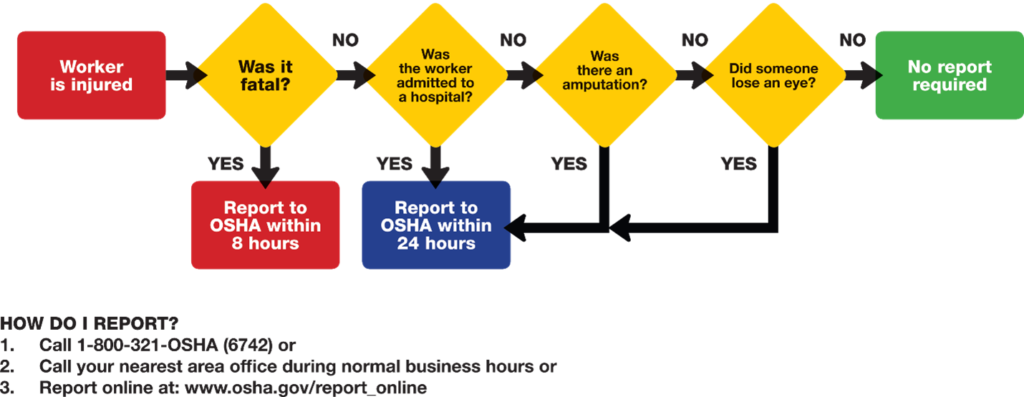
 

To Make a Report

Source: OSHA

2016 Changes

On May 12, 2016, OSHA published the injury and illness reporting rule, known as “Improved Tracking of Workplace Injuries and Illnesses” and it became effective January 1, 2017. This rule does not change the core requirements of the existing recordkeeping rule but  required identified establishments to submit their OSHA 300, 300A, or 301 forms to OSHA on an annual basis. The forms required are dependent on the size (number of employees) of each establishment covered:

  • Establishments with 250 or more employees in industries covered by the recordkeeping regulation must submit the 300, 300A and all 301 forms by March 2 of the year following data has been recorded.
  • Establishments with 20-240 employees in certain high-risk industries must submit the 300A form by March 2 of the year following data has been recorded. Establishments of less than 20 employees do not need to report.

2019 Changes

On January 25, 2019 OSHA published a final rule that eliminates the requirement for establishments with 250 or more employees to electronically submit information from OSHA Form 300 and OSHA Form 301 to OSHA each year.  It became effective on February 25, 2019.  These establishments are still required to electronically submit information from OSHA Form 300A.

OSHA felt this change was necessary to eliminate the possibility of sensitive information found on Forms 300 and 301 such as descriptions of workers’ injuries and body parts affected being disclosed to the public.  OSHA felt it will better protect personally identifiable information or data that could be re-identified with a particular worker.  OSHA also felt this change will allow it to focus on information gathered from their severe injury reporting initiative along with data collected from Form 300A.  This rule also eliminated the requirement to electronically submit an Employer Identification Number (EIN) with the 300A form.

Scope of Recordkeeping Standard

Employers are classified by OSHA’s injury and illness recordkeeping requirements into one of three groups: employers regularly exempt from OSHA recordkeeping; employers exempted from preparing and maintaining injury and illness records; and employers that are not classified under the prior two groups.

Employers regularly exempt from OSHA recordkeeping includes small businesses with fewer than 11 full- or part-time employees during the previous calendar year and employers classified in low-hazard industries. However, these employers are required to report all inpatient hospitalizations and fatalities as required by 29 CFR 1904.39. In addition, if the employer is notified in writing by OSHA to participate in a statistical survey, the employer must maintain injury and illness records in accordance with 29 CFR 1904.41. Employers who receive a Survey of Occupational Injuries and Illnesses Form from the Bureau of Labor Statistics (BLS) must promptly complete the form and return it (29 CFR 1910.42).

Employers exempted from preparing and maintaining injury and illness records include industries listed in Appendix A of Subpart B of the revised recordkeeping standard.

OSHA Form 300

The OSHA Form 300 log is used by each employer’s establishment to record and maintain information about employee injuries and illnesses. An establishment, as defined by OSHA, is a single physical location where business is conducted, or where services or industrial operations are performed; the place where employees report for work, operate from or from which they are paid.

The form itself is divided into three general sections: Identity (e.g. name, case number, job title), Descriptive (e.g. date, injury location, description of incident) and Classification (e.g. type of injury, days away from work, days on restriction).

Every injury or illness that meets the recording criteria must be entered as a new case on the OSHA 300 form and maintained as the case conditions change such as the number of days accumulated as transfer, restricted or away from work. If the status of the case changes, then the entry must be changed.  For example, if the injured employee is experiencing days away from work, then dies, the employer must remove (or line out) the days away entry and the day count and check the box for a fatality.

OSHA Form 301

If an injury or illness is recordable, a supplementary form (e.g. OSHA Form 301) must be completed. This form provides more information about the case. Such information as the events leading up to the injury or illness, body parts affected, object(s) or substance(s) involved, etc., must be included on this form.

Within seven calendar days after receiving information that a recordable work-related injury or illness has occurred, a 301 incident report or equivalent must be completed.   Equivalent forms may be used if it contains the same information as OSHA Form 301. Examples of equivalent forms may come from: state workers’ compensation reports, insurance claim reports or the employer’s incident report form.

Process to Determine if a Case is Recordable

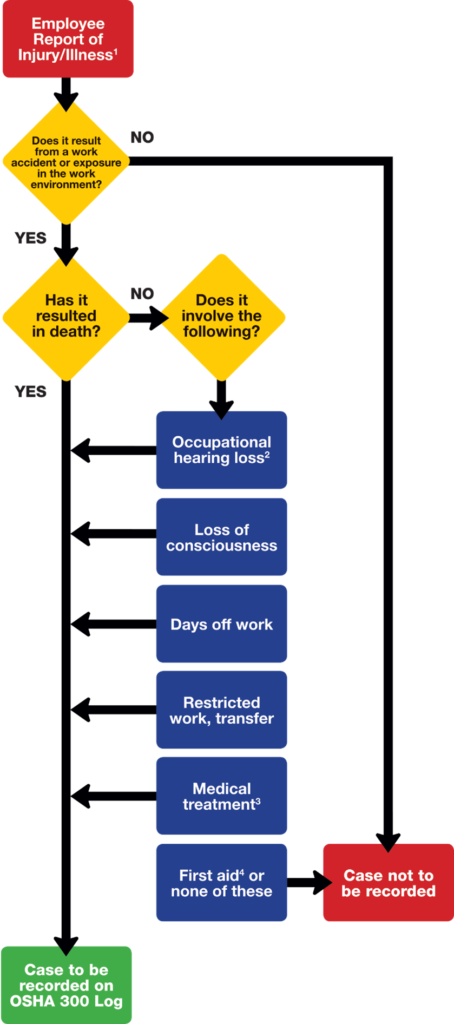
Employers are responsible for reporting all recordable injuries and illnesses. To help determine if an injury or illness is recordable, refer to the flow chart below. If you are unable to determine if an injury or illness is recordable, call the OSHA area office nearest you.
Source: OSHA

Definitions

  • Employee Report of Injury/Illness: Injury or illness reported assumes the individual reporting the injury or illness is an employee of host employer. If the employee is a temporary employee from a temporary staffing agency, incidents are to be recorded in the OSHA Form 300 log; however, the temporary staffing agency would be responsible for reporting workers’ compensation claims to the carrier.
  • Occupational Hearing Loss:
    • A change in hearing threshold relative to the baseline audiogram as an average of 10 decibels (dB) or more in either ear at 2000, 3000 and 4000 hertz.
    • An employee’s total hearing level of 25dB or more above audiometric zero in both ears at the same hertz levels.
  • Medical Treatment: The management and care of a patient to combat disease or disorder. It does not include:
    • Visits to practitioners for observation and/or evaluation only
    • Diagnostic procedures
    • First aid
  • First Aid: Treatments that are considered first aid include:
    • The use of nonprescription medication at nonprescription strength
    • Tetanus immunizations
    • Cleaning, flushing or soaking surface wounds
    • Use of wound coverings, butterfly bandages, Steri-Strips tape
    • Hot or cold therapy
    • Use of non-rigid means of support
    • Temporary immobilization devices used to transport victims
    • Drilling of fingernails, toenails or draining fluid from a blister
    • Eye patches
    • Removal of foreign bodies from eye using irrigation or cotton swab
    • Removal of splinters or foreign material from areas other than the eye by irrigation, tweezers, cotton swabs or other simple means
    • Finger guards
    • Massage therapy
    • Drinking fluids for relief of heat stress

OSHA Form 300A

The employer is responsible for preparing an annual summary of injuries and illnesses that occurred during the calendar year. The annual summary, OSHA Form 300A, displays the totals from columns G through M of the OSHA Form 300 log. The summary also displays the calendar year covered, company name and address, annual average number of employees and total hours worked by all employees covered by the OSHA Form 300 log. OSHA Form 300A is a separate form and does not display any of the personal information, shown on the OSHA Form 300 log. OSHA Form 300A also makes it easier to calculate incident rates. The annual summary must be:

  • Posted by February 1 and remain posted until April 30th
  • Posted in areas where other notices are normally placed
  • Certified (signed) by a company executive, stating that the information is correct and complete to the best of the employers ability
  • Retained for five years following the calendar year to which they relate

If no cases are recorded during a reporting period, a summary must still be posted. Zeros are entered into all spaces provided on form 300A.

Sources for More Information

OSHA FactSheet: Updates to Recordkeeping Rule: An Overview
OSHA FactSheet: Final Rule to Improve Tracking of Workplace Injuries and Illness, May 2016
U.S. Department of Labor
OSHA — Injury Tracking Application (ITA) Landing Page
OSHA — Report a Fatality or Severe Injury
OSHA Injury and Illness Recordkeeping and Reporting Requirements

Frequently Asked Questions

Q: Where can I get a copy of OSHA Form 300, 301 and 300A?

A: Contact the area OSHA office nearest you, or download the information off of the OSHA website.

Q: What is restricted work activity?

A: When the employee is kept from performing one or more routine (regularly performed at least once per week) functions of his or her job, or when the employee is kept from working a full workday. Production of fewer goods or services is not considered restricted work activity.

Q: Our company is closed on Saturday and Sunday. Do these still need to be counted as days away?

A: Yes, all calendar days the employee was unable to work including weekend days, holidays, vacation days, etc., must be counted. Cap day count at 180 days. The day the illness or injury occurred is not counted as a day away.

Q: If an employee is injured and misses the remainder of the work shift, is this a day away?

A: No, injuries and illnesses are not considered lost-time cases until they affect the employee beyond the day of injury or onset of illness.

Q: How are days away calculated if an employee works a normal shift that is longer than 8 hours?

A: A single workday for record keeping purposes is 12 hours.

Q: Does the tracking of workplace injuries and illnesses rule require employers to start keeping new records or change how they keep the records?

A: No. The new requirement does not add to or change an employer’s obligation to complete, retain, and certify injury and illness records. It only requires certain employers to electronically submit some of the information from these records to OSHA.

Q: Are the electronic reporting requirements based on the size of the establishment or the firm?

A: The electronic reporting requirements are based on the size of the establishment. The OSHA injury and illness records are maintained at the establishment level. An establishment is defined as a single physical location where business is conducted or where services or industrial operations are performed. A firm may be comprised of one or more establishments. To determine if you need to provide OSHA with the required data for an establishment, you need to determine the establishment’s peak employment during the last calendar year. Each individual employed in the establishment at any time during the calendar year counts as one employee, including full-time, part-time, seasonal, and temporary workers.


The information contained in this article is intended for general information purposes only and is based on information available as of the initial date of publication. No representation is made that the information or references are complete or remain current. This article is not a substitute for review of current applicable government regulations, industry standards, or other standards specific to your business and/or activities and should not be construed as legal advice or opinion. Readers with specific questions should refer to the applicable standards or consult with an attorney.

Source: Grainger Know How – https://www.grainger.com/know-how


Quick Course – Spill Prevention and Management

When an accident happens and a hazardous chemical spill occurs, several different outcomes are possible. Businesses that want to successfully cope and recover after an accident must take a comprehensive approach to spill prevention and management.


High Wind Dangers (Construction) Meeting Kit – Spanish

QUÉ ESTÁ EN RIESGO

PELIGROS DEL VIENTO FUERTE

Cuando se trabaja en el exterior, a veces se está a merced del clima. La lluvia, la nieve, el hielo y el calor pueden desempeñar un papel importante en la capacidad de trabajar al aire libre, pero un peligro del que se habla menos es el de los vientos fuertes. Es importante saber también que los vientos fuertes pueden suponer una amenaza y son un peligro para la seguridad.

CUÁL ES EL PELIGRO

PELIGROS DE LOS VIENTOS FUERTES PARA LOS TRABAJADORES

El viento fuerte es un viento de tal velocidad que uno o más de los siguientes peligros estarían presentes:

  • El viento podría arrastrar a un empleado desde un lugar elevado.
  • El viento podría hacer que un empleado o el equipo que manipula el material perdiera el control del mismo.
  • El viento podría exponer a un empleado a otros peligros no controlados por la norma en cuestión.

Los vientos que superan las 40 millas por hora se consideran vientos fuertes. Si el trabajo implica la manipulación de materiales, los vientos fuertes pueden considerarse a 30 millas por hora, a menos que el empleador tome precauciones para proteger a los empleados de los peligros del viento.

PELIGROS CUANDO SE TRABAJA CON VIENTOS FUERTES

  • Posibilidad de lesiones cuando el viento mueve objetos.
  • Lesiones en los ojos por el polvo o los escombros en el aire.
  • Esguinces o torceduras cuando el viento obliga a los trabajadores a caer, cuando los trabajadores intentan alcanzar un objeto.
  • Posibilidad de sufrir lesiones por la rotura de cristales como consecuencia de objetos que golpean una ventana o una puerta que se balancea con fuerza.
  • Exposición de la piel, especialmente en el frío.
  • Cargas, equipos o vehículos que se caen, se precipitan o vuelcan.
  • Rotura de ramas o desarraigo de árboles.
  • Derrumbe de edificios, tejados, andamios, vallas, torres, etc.
  • Rotura de líneas eléctricas, con riesgo de electrocución y pérdida de electricidad.
  • Reducción de la visibilidad (debido al polvo, la nieve, etc.)
  • Propagación del fuego por chispas o equipos.
  • Golpes por objetos que se desplazan por el aire.
  • Resbalones, tropiezos y caídas debidos a que los trabajadores reaccionan ante la caída de un casco u objeto debido a que el viento les arrebata estos elementos.
  • Caída de cargas al completar los ascensores con presencia de viento.
  • Caída de objetos desde superficies elevadas.
  • Vuelco de un camión volquete.

COMO PROTEGERSE

MEJORES PRÁCTICAS PARA ELIMINAR LOS PELIGROS Y LAS LESIONES RELACIONADAS CON LOS VIENTOS FUERTES

LO QUE DEBE HACER

  • Elimine las tareas o detenga el trabajo cuando éste se vuelva demasiado peligroso debido a los vientos fuertes.
  • Asegure todos los elementos, por ejemplo, introduciéndolos en el interior o utilizando pesos, cuerdas, cadenas o estacas.
  • Asegure los pestillos, puertas, ventanas, andamios, escaleras, etc.
  • Tenga en cuenta que al transportar o levantar objetos grandes, como madera contrachapada, estos objetos pueden actuar como una vela.
  • Tenga en cuenta que las estructuras u objetos pueden moverse repentinamente.
  • Resguárdese. Permanezca en el interior. Cuando esté en el interior, aléjese de las paredes y ventanas exteriores siempre que sea posible.
  • Lleve a las mascotas o al ganado para que se refugien.
  • Si está conduciendo y no puede refugiarse en un edificio, permanezca en su vehículo. Si es posible, diríjase a una zona en la que sea menos probable que le alcancen los árboles o las líneas eléctricas que caen.
  • Manténgase alejado de los vehículos altos, como los camiones de transporte, los autobuses y los vehículos que arrastran remolques. Las fuertes ráfagas de viento pueden volcar estos vehículos.
  • Utilice edificios o vehículos para ayudar a bloquear el viento.
  • Lleve protección contra caídas y asegúrese correctamente cuando trabaje en altura.
  • Utilice gafas de seguridad, según corresponda.

LO QUE NO DEBE HACER

  • No realice operaciones de elevación, ni utilice grúas, ni realice actividades similares cuando no sea seguro hacerlo.
  • No trabaje en altura cuando se prevean vientos fuertes.
  • No alcance o trate de agarrar un objeto, como el casco, si éste se desprende.
  • No se refugie en grandes áreas abiertas dentro de edificios, como gimnasios o centros comerciales.

RESULTADOS FINALES

En las obras de construcción, es fundamental que planifique previamente su jornada y sus tareas para garantizar la seguridad. Descubrirá que el tiempo puede desempeñar un papel importante en las tareas que podrá realizar ese día y en las que tendrá que esperar. Cuando vaya a haber vientos fuertes, planifique el trabajo en consecuencia. Evite ciertas tareas durante los vientos fuertes y utilice las medidas de seguridad que le han enseñado para garantizar su seguridad y la de sus compañeros de trabajo.

CONCLUSIÓN

La planificación previa de las tareas es fundamental para garantizar un comienzo sólido del trabajo seguro en una obra. Cuando vaya a haber vientos fuertes, planifique el trabajo en consecuencia. Evite ciertas tareas durante los eventos de vientos fuertes, así como implementar protecciones adicionales para garantizar la seguridad durante las tareas normales del trabajo.


High Wind Dangers (Construction) Fallen Phrases – Spanish

Respuesta: Cuando vaya a haber vientos fuertes, planifique el trabajo en consecuencia. Evite ciertas tareas durante los vientos fuertes. Es importante saber que los vientos fuertes pueden suponer una amenaza y son un peligro para la seguridad.


High Wind Dangers (Construction) Word Search – Spanish


High Wind Dangers (Construction) – Picture This – Spanish

Fuente: https://informalesdigital.com/noticia/recomendaciones-por-vientos-fuertes


First Day Back to Work Meeting Kit

FIRST DAY BACK TO WORK SAFETY TALK

Workplace injuries are subject to many different and various risk factors. There is an increased chance of likelihood of injury at work after coming into work after extended breaks. Mondays are in the same category. A worker, as laid bare by statistics, is more likely to be injured on a Monday.

The Bureau of Labor Statistics reports that since 2007, Mondays have had the highest number of workplace injuries out of the days of the week every single year with the exception of 2 years.

THE DANGERS OF THE FIRST DAY BACK AT WORK

The Bureau of Labour Statistics data reports there are more injuries on Monday than any other day. But why is that? Lack of focus is an obvious reason.

Other cogent possibilities include:

  • Individuals exhibit lower energy levels and lower morale on Mondays. This leads to caring less about the tasks at hand and not taking the time to take the extra steps to work safely.
  • Distraction arises in the workplace due to personal issues that one imports to the workplace. These issues occurred over the weekend can take the worker’s mind off their work and responsibilities.
  • The first several hours of work on the Monday can be busier or more frenetic that other times of the week.

PREVENT INJURY ON FIRST DAY BACK

There is no question about it. Being away from work is good for one’s mental health. We recharge and refocus.

However, before you head back to work, you need to prepare yourself. Back to work safety should be one of your first priorities as you return from time off. You might have gotten used to sleeping in or a brand new routine. Whether you were off for the weekend, a vacation or a holiday, it is important to prepare yourself for getting back into the swing of things. Statistics show that it does not take much time away from work for us to lose our good safety habits that we have worked so hard to develop.

TAKE THESE STEPS TO PROTECT YOURSELF

  • Get the proper amount of sleep.
  • Clear your head of any off-job issues and remember your work routine.
  • Play this memory game to get you focused: envision putting on your seatbelt, the drive to work, and then the parking space you normally use.
  • It’s helpful to scan your path of travel for hazards. When we are away from work, we tend to forget about even the small things that we are used to seeing or avoiding on a daily basis. Also, when we are away, things can change so make sure your safe areas haven’t changed and walkways are still the same.
  • Be sure to review the critical steps of your job and the specific things you have to do in order to stay safe.
  • Take the time to settle back in to your work area and make sure everything is where you need it to be.
  • Do a self-check to see whether you are fit for work or not before you start your shift. Ensure your head is in the game and you are able to focus on your work.
  • Complete inspections of your work area as well as any tools or equipment used.
  • Take the time and energy to ensure all the necessary safeguards are in place for your work tasks.
  • Look out for your coworkers.
  • Stop work if needed to address hazards.

FINAL TAKE AWAYS

When you return to work, it’s important to guard yourself from distractions. No matter what mood you are in, the gears on your machines still turn, gravity is still in force, chemicals are still hazardous, and certain areas are still loud. As you prepare to return to work, no matter the environment, be on the lookout for any changes that may been made and allow yourself the time to settle back in and take in your surroundings.

FINAL WORD

The first day back to work has its own unique hazards. It is important to consider how or why injuries are more likely to occur on the first day back to work. Take the time to ensure you are taking the necessary steps to avoid injury during the first few hours of work after being off for a few days.


First Day Back to Work Stats and Facts

FACTS

  1. A targeted wellness program should be an integral part of any workplace environment, and a major step in preventing workplace injuries.
  2. The severity of the injury or illness often has a direct impact on the number of days an employee will be out of work, and how much the injury or illness will cost the employee and employer.
  3. The longer an employee is out of work as a result of an illness or injury, the less-likely they are to return to work. Studies suggest that when an employee is out of work for more than six months, they have less than a 50% chance of ever returning to work in any capacity.
  4. According to the Bureau of Labor Statistics, returning to work after a period of absence comes with many risks. There is an increased likelihood of workplace injuries on Mondays, which is often the first day back at work after absence due to days off, vacation or an injury.

STATS

Injured Workers and Lost Work Days

  • According to the Bureau of Labor Statistics, there were nearly 3 million non-fatal workplace injuries in 2014 – resulting in the equivalent of 3.2 cases for every 100 full-time-equivalent employees. This number doesn’t include non-workplace related injuries and illness, making it clear just how many of these types of events occur each year.
  • Nearly 30% of employees that are injured on the job lose days from work. As an example, 1.1 million people suffered a workplace injury in 2008, resulting in over 8.5 million days of combined lost productivity throughout the U.S. This lost productivity has a direct impact on the employer, the employee, and the economy a whole.

The Impact of Return to Work Programs

  • The good news is that these studies also show that 80-90% of injured employees would rather return to work than collect disability.
  • According to the RAND Institute for Civil Justice, having a return to work program in place reduces the length of an injured employee’s absence by an average of 3.6 weeks. Even for an employee who faces a permanent disability, a return to work program reduces the average number of weeks out of work by 12.6 weeks.


First Day Back to Work Word Search


First Day Back to Work – Picture This

What’s wrong in this picture? According to the Bureau of Labor Statistics, returning to work after a period of absence come with many risks. Recorded injury data of workers nationwide, including Oklahoma, shows an increased likelihood of workplace injuries on Mondays, which is often the first day back at work after absence due to days off, vacation or an injury. Safety authorities say one of the reasons for this could be a lack of focus and low energy levels.

One way for a returning worker to get his or her mind focused on the job might be to carry out an inspection of his or her workstation, including all the tools and equipment, before working with it. Checking the presence of all the necessary safeguards before work commences is crucial. Returning workers might need a few days to get their heads in the game and focus on job safety.


First Day Back to Work Meeting Kit – Spanish

QUÉ ESTÁ EN RIESGO

CHARLA DE SEGURIDAD DEL PRIMER DÍA DE VUELTA AL TRABAJO

Las lesiones en el lugar de trabajo están sujetas a muchos y variados factores de riesgo. Existe una mayor probabilidad de sufrir una lesión en el trabajo después de incorporarse al mismo tras unas pausas prolongadas. Los lunes están en la misma categoría. Según las estadísticas, es más probable que un trabajador se lesione un lunes.

La Oficina de Estadísticas Laborales informa de que, desde 2007, los lunes han tenido el mayor número de lesiones laborales de entre los días de la semana todos los años, con la excepción de dos años.

CUÁL ES EL PELIGRO

LOS PELIGROS DEL PRIMER DÍA DE VUELTA AL TRABAJO

Los datos de la Oficina de Estadísticas Laborales informan de que los lunes se producen más lesiones que cualquier otro día. Pero, ¿a qué se debe esto? La falta de concentración es una razón obvia.

Otras posibilidades convincentes son:

  • Los individuos muestran niveles de energía más bajos y una moral más baja los lunes. Esto hace que se preocupen menos por las tareas que tienen entre manos y no se tomen el tiempo necesario para tomar las medidas adicionales para trabajar con seguridad.
  • La distracción surge en el lugar de trabajo debido a cuestiones personales que uno importa al lugar de trabajo. Estos asuntos ocurridos durante el fin de semana pueden apartar al trabajador de su trabajo y de sus responsabilidades.
  • Las primeras horas de trabajo del lunes pueden ser más ajetreadas o frenéticas que en otros momentos de la semana.

COMO PROTEGERSE

PREVENIR LAS LESIONES EN EL PRIMER DÍA DE VUELTA

No hay duda. Estar lejos del trabajo es bueno para la salud mental. Nos recargamos y volvemos a centrarnos.

Sin embargo, antes de volver al trabajo, hay que prepararse. La seguridad en la vuelta al trabajo debe ser una de sus primeras prioridades cuando regrese de sus vacaciones. Puede que te hayas acostumbrado a dormir hasta tarde o a una nueva rutina. Tanto si ha estado de baja durante el fin de semana, como si se ha tomado unas vacaciones o un día festivo, es importante que se prepare para volver a la rutina. Las estadísticas demuestran que no hace falta mucho tiempo de ausencia del trabajo para que perdamos los buenos hábitos de seguridad que tanto nos ha costado desarrollar.

TOME ESTAS MEDIDAS PARA PROTEGERSE

  • Duerma lo suficiente.
  • Despeje su cabeza de cualquier problema ajeno al trabajo y recuerde su rutina laboral.
  • Juegue a este juego de memoria para concentrarse: imagine que se pone el cinturón de seguridad, el camino al trabajo y luego la plaza de aparcamiento que utiliza normalmente.
  • Resulta útil escudriñar el trayecto en busca de peligros. Cuando estamos fuera del trabajo, tendemos a olvidarnos incluso de las pequeñas cosas que estamos acostumbrados a ver o evitar a diario. Además, cuando estamos fuera, las cosas pueden cambiar, así que asegúrese de que sus zonas seguras no han cambiado y que los caminos siguen siendo los mismos.
  • Asegúrese de repasar los pasos críticos de su trabajo y las cosas específicas que tiene que hacer para mantenerse seguro.
  • Tómese el tiempo necesario para volver a instalarse en su zona de trabajo y asegúrese de que todo este donde debe estar.
  • Hágase una autocomprobación para ver si está en condiciones de trabajar o no antes de empezar su turno. Asegúrese de que su cabeza este en el juego y sea capaz de concentrarse en su trabajo.
  • Realice inspecciones completas de su área de trabajo, así como de cualquier herramienta o equipo utilizado.
  • Tómese el tiempo y la energía necesarios para asegurarse de que se han tomado todas las precauciones necesarias para sus tareas laborales.
  • Vigile a sus compañeros de trabajo.
  • Detenga el trabajo si es necesario para hacer frente a los peligros.

CONCLUSIONES FINALES

Cuando vuelva al trabajo, es importante que se proteja de las distracciones. No importa el estado de ánimo, los engranajes de las máquinas siguen girando, la gravedad sigue vigente, los productos químicos siguen siendo peligrosos y ciertas áreas siguen siendo ruidosas. Cuando se prepare para volver al trabajo, sea cual sea el entorno, estese atento a cualquier cambio que se haya producido y permítase el tiempo necesario para acomodarse y asimilar el entorno.

CONCLUSIÓN

El primer día de vuelta al trabajo tiene sus propios peligros. Es importante tener en cuenta cómo o por qué es más probable que se produzcan lesiones en el primer día de vuelta al trabajo. Tómese el tiempo necesario para asegurarse de que toma las medidas necesarias para evitar lesiones durante las primeras horas de trabajo después de estar de baja unos días.


First Day Back to Work Stats and Facts – Spanish

HECHOS

  1. Un programa de bienestar específico debe ser una parte integral de cualquier entorno de trabajo, y un paso importante en la prevención de lesiones en el lugar de trabajo.
  2. La gravedad de la lesión o enfermedad suele tener un impacto directo en el número de días que un empleado estará de baja, y en el coste que la lesión o enfermedad tendrá para el empleado y el empresario.
  3. Cuanto más tiempo esté de baja un empleado como consecuencia de una enfermedad o lesión, menos probable será que se reincorpore al trabajo. Los estudios sugieren que cuando un empleado está de baja durante más de seis meses, tiene menos del 50% de posibilidades de volver a trabajar en cualquier puesto.
  4. Según la Oficina de Estadísticas Laborales, volver al trabajo después de un periodo de ausencia conlleva muchos riesgos. Hay una mayor probabilidad de que se produzcan lesiones en el lugar de trabajo los lunes, que suele ser el primer día de vuelta al trabajo después de una ausencia debida a días libres, vacaciones o una lesión.

ESTADÍSTICAS

Trabajadores lesionados y días de trabajo perdidos

  • Según la Oficina de Estadísticas Laborales, en 2014 se produjeron casi 3 millones de lesiones no mortales en el lugar de trabajo, lo que equivale a 3,2 casos por cada 100 empleados equivalentes a tiempo completo. Esta cifra no incluye las lesiones y enfermedades no relacionadas con el lugar de trabajo, lo que deja claro el número de este tipo de sucesos que se producen cada año.
  • Casi el 30% de los empleados que se lesionan en el trabajo pierden días de trabajo. Por ejemplo, 1,1 millones de personas sufrieron una lesión en el lugar de trabajo en 2008, lo que supuso más de 8,5 millones de días de pérdida de productividad combinada en todo Estados Unidos. Esta pérdida de productividad tiene un impacto directo en el empresario, el empleado y la economía en su conjunto.

El impacto de los programas de reincorporación al trabajo

  • La buena noticia es que estos estudios también demuestran que entre el 80 y el 90% de los empleados lesionados preferirían volver al trabajo que cobrar la incapacidad.
  • Según el Instituto RAND de Justicia Civil, contar con un programa de reincorporación al trabajo reduce la duración de la ausencia de un empleado lesionado en una media de 3,6 semanas. Incluso en el caso de un empleado que se enfrenta a una incapacidad permanente, un programa de reincorporación al trabajo reduce el número medio de semanas de baja en 12,6 semanas.


First Day Back to Work Word Search – Spanish


First Day Back to Work – Picture This – Spanish

¿Qué hay de malo en esta imagen? Según la Oficina de Estadísticas Laborales, el regreso al trabajo tras un periodo de ausencia conlleva muchos riesgos. Los datos de lesiones registradas de los trabajadores de todo el país, incluido Oklahoma, muestran una mayor probabilidad de lesiones en el lugar de trabajo los lunes, que suele ser el primer día de vuelta al trabajo después de una ausencia por días libres, vacaciones o una lesión. Las autoridades de seguridad afirman que una de las razones podría ser la falta de concentración y los bajos niveles de energía.

Una forma de que el trabajador que se reincorpora consiga centrar su mente en el trabajo podría ser llevar a cabo una inspección de su puesto de trabajo, incluyendo todas las herramientas y equipos, antes de trabajar con ellos. Es fundamental comprobar la presencia de todas las protecciones necesarias antes de empezar a trabajar. Los trabajadores que se reincorporan pueden necesitar unos días para ponerse al día y centrarse en la seguridad del trabajo.


High Wind Dangers (Construction) Meeting Kit

HIGH WIND DANGERS

When you are working outside sometimes you are at the mercy of the weather. Rain, snow, ice, and heat all can play a huge role in the ability to work outside but a less talked about hazard is high winds. it is important to also realize that high winds can pose a threat and are a safety hazard.

HIGH WINDS DANGERS FOR WORKERS

High wind is a wind of such velocity that one or more of the following hazards would be present:

  • The wind could blow an employee from an elevated location.
  • The wind could cause an employee or equipment handling material to lose control of the material.
  • The wind would expose an employee to other hazards not controlled by the standard involved.

Winds that exceed 40 miles (64 km) per hour are considered high winds. If the work involves material handling, high winds can be considered at 30 miles (48 km) per hour, unless the employer takes precautions to protect employees from the hazards of the wind.

HAZARDS WHEN WORKING IN HIGH WIND CONDITIONS

  • Potential for injury when wind moves objects.
  • Eye injuries from dust or debris in the air.
  • Sprains or strains when the wind forces workers to fall, when workers try to reach for an object.
  • Potential for injury from broken glass because of objects striking a window or a door swinging with force.
  • Exposure to skin, especially in the cold.
  • Loads, equipment, or vehicles that fall, drop, or tip over.
  • Breaking of branches or uprooting of trees.
  • Collapse of building, roof, scaffolding, fencing, towers, etc.
  • Broken power lines, leading to risk of electrocution and loss of electricity.
  • Reduced visibility (due to dust, snow, etc.)
  • Spreading of fire from sparks or equipment.
  • Struck-by incidents due to objects being blown around.
  • Slips, trips, falls due to workers reacting to a falling hardhat or object due to wind blowing these items from them.
  • Dropped loads while completing lifts with wind present.
  • Objects falling from elevated surfaces.
  • Dump truck tip-over.

BEST PRACTICES TO ELIMINATE HAZARDS AND INJURIES RELATED TO HIGH WINDS

DO

  • Eliminate tasks or stop work when that work becomes too dangerous due to high winds.
  • Secure all items by bringing indoors or by using weights, ropes, chains, or stakes.
  • Secure latches, doors, windows, scaffolding, ladders, etc.
  • Be aware when carrying or lifting large objects, such as plywood, that these objects can act as a sail.
  • Be aware that structures or objects can suddenly move.
  • Take Shelter. Stay indoors. When indoors, stay away from outside walls and windows where possible.
  • Bring in pets or livestock for shelter.
  • If driving and unable to find shelter in a building, stay in your vehicle. If possible, move to an area where you will be less likely to be hit by falling trees or power lines.
  • Keep a distance from high vehicles such as transport trucks, buses, and vehicles towing trailers. Strong gusts of wind can flip these vehicles.
  • Use buildings or vehicles to help block the wind.
  • Wear fall protection and secure yourself properly when working at heights.
  • Wear safety glasses or goggles, as appropriate.

DO NOT

  • Do not perform lifting operations, use cranes, or conduct similar activities when it is unsafe to do so.
  • Do not work at heights when high winds are forecasted.
  • Do not reach or try to grab an object such as your hardhat if it blows away.
  • Do not shelter in large open areas inside building, such as gymnasiums or malls.

FINAL TAKEAWAYS

On construction sites, it is critical that you pre plan your day and your tasks to ensure safety. You will find that weather can play a major role in what tasks you will be able to do that day and ones you will have to wait on. When high winds are going to be present, plan work accordingly. Avoid certain tasks during high winds as well as use the safeguards you have been taught to ensure your safety as well as the safety of your coworkers.

FINAL WORD

Preplanning of tasks is critical to ensure a solid start to working safely on a construction site. When high winds are going to be present, plan work accordingly. Avoid certain tasks during high wind events as well as implement extra safeguards to ensure safety during the normal job tasks.