AI and Safety – Safe Robot-Human Interaction Stats and Facts

FACTS

  1. Robots operating at high speed or with high force can cause serious injury when unexpected contact occurs, due to insufficient modelling of human-body dynamics in collisions.
  2. Lack of comprehensive sensors and validation for transient contact (i.e., brief collisions or sand-wiched contact) remains a major hazard in human-robot collaborative environments.
  3. Many HRI systems still rely on standard risk assessment methods that do not fully capture dynamic human motion or unpredictable human behaviour, creating safety blind spots.
  4. Poorly defined workspace boundaries or overlap zones where humans and robots share space increase risk of pinching, trapping or collisions such as when humans enter a robot’s cell unexpectedly.
  5. Maintenance and setup phases of robot systems present heightened hazard: workers often enter robot envelopes, disable guards, or face unexpected robot activation.
  6. Psychosocial and organisational hazards are emerging in HRI: e.g., increased stress when humans work alongside robots that behave unpredictably or when trust is low, which can lead to distraction or errors and thereby physical hazard.

STATS

  • AI-enabled robots have reduced factory accidents by up to 25% in US manufacturing facilities through enhanced collision avoidance and predictive monitoring.
  • By 2025, over 16 million service robots are deployed worldwide, with 57% AI-enabled for safer human interactions; in the US and Canada, this includes 620,000 units in elderly care and healthcare settings to minimize worker exposure to hazards.
  • In the US, 52% of large hospitals use autonomous AI logistics robots for internal deliveries, reducing patient handling injuries by 18.4% via safe human-robot coordination.
  • From 2020-2025, collaborative robots (cobots) in Canadian manufacturing increased by 60%, with safety features like power and force limiting preventing an estimated 20% of potential interaction-related incidents.
  • US workplaces adopting AI-driven human-robot interaction (HRI) systems report 30% lower service costs and 45% annual growth in voice-controlled industrial robotics, improving safety in high-risk tasks.
  • In Canada, 70% of organizations using cobots cite AI for ergonomics and safety as key, reducing ergonomic injuries by 15-20% through adaptive task allocation in shared workspaces.


AI and Safety – Safe Robot-Human Interaction Picture This

AI and Safety Safe Robot Human Interaction Picture This

This image clearly demonstrates the psychological risks associated with increasing automation and AI integration in the workplace. The warehouse worker in the foreground is visibly distressed—holding his head in his hand, overwhelmed by mental fatigue. Behind him, an autonomous mobile robot efficiently transports boxes, highlighting the contrast between automated productivity and the worker’s emotional strain. Surrounded by tall racks of inventory and operating alone, the worker appears isolated, overextended, and impacted by the constant pressure of working alongside fast-paced robotic systems.
AI-related stress, also known as “automation anxiety,” can significantly affect a worker’s mental health. When robots dictate workflow speed, remove decision-making from employees, or reduce meaningful human interaction, workers may experience burnout, job insecurity, emotional exhaustion, and diminished sense of purpose. These psycho-social hazards can lead to depression, anxiety, poor sleep, and long-term declines in well-being.
To prevent these outcomes, employers must ensure that automation is introduced with adequate training, transparent communication, job redesign, and access to mental health support. Workers should be encouraged to report stress symptoms early, maintain reasonable workloads, and receive reassurance about their role in the evolving workplace. Proper planning, psychological safety programs, and responsible AI implementation are essential to protect workers from this modern, but very real, occupational hazard


AI and Safety – Safe Robot-Human Interaction Picture This – Spanish

AI and Safety Safe Robot Human Interaction Picture This

Esta imagen muestra claramente los riesgos psicológicos asociados al aumento de la automatización y la integración de la inteligencia artificial en el lugar de trabajo. El trabajador del almacén en primer plano está visiblemente angustiado, con la cabeza entre las manos, abrumado por la fatiga mental. Detrás de él, un robot móvil autónomo transporta cajas de manera eficiente, lo que resalta el contraste entre la productividad automatizada y la tensión emocional del trabajador. Rodeado de altas estanterías de inventario y trabajando solo, el trabajador parece aislado, sobrecargado y afectado por la presión constante de trabajar junto a sistemas robóticos de ritmo acelerado.

El estrés relacionado con la IA, también conocido como «ansiedad por la automatización», puede afectar significativamente a la salud mental de un trabajador. Cuando los robots dictan la velocidad del flujo de trabajo, eliminan la toma de decisiones de los empleados o reducen la interacción humana significativa, los trabajadores pueden experimentar agotamiento, inseguridad laboral, agotamiento emocional y disminución del sentido de propósito. Estos riesgos psicosociales pueden provocar depresión, ansiedad, falta de sueño y un deterioro a largo plazo del bienestar.

Para evitar estos resultados, los empleadores deben asegurarse de que la automatización se introduzca con una formación adecuada, una comunicación transparente, un rediseño de los puestos de trabajo y acceso a apoyo en materia de salud mental. Se debe animar a los trabajadores a que informen tempranamente sobre los síntomas de estrés, mantengan cargas de trabajo razonables y reciban garantías sobre su papel en el lugar de trabajo en evolución. Una planificación adecuada, programas de seguridad psicológica y una implementación responsable de la IA son esenciales para proteger a los trabajadores de este riesgo laboral moderno, pero muy real.


AI and Safety – Safe Robot-Human Interaction Fatality File

The dark side of artificial intelligence adoption

A 45-year-old warehouse picker begins working at a facility where mobile robots deliver items to his station for scanning and packing. Over several months, he finds that his tasks are increasingly repetitive, his decision-making removed, and his pace dictated by machine timing. He is no longer interacting with co-workers, he feels his job has no meaning, and he begins to experience persistent anxiety—wondering if his job will be replaced entirely.

He reports feeling exhausted emotionally, isolated even though surrounded by technology, and starts showing signs of low mood, insomnia and reduced life satisfaction. His supervisor notes a drop in his engagement, and the worker later seeks counselling for depression linked to these changes in his work environment.

Source: Nature.com


AI and Safety – Safe Robot-Human Interaction Fatality File – Spanish

El lado oscuro de la adopción de la inteligencia artificial.

Un recolector de almacén de 45 años comienza a trabajar en una instalación donde los robots móviles entregan los artículos a su estación para su escaneo y embalaje. A lo largo de varios meses, descubre que sus tareas son cada vez más repetitivas, que se le ha quitado la capacidad de tomar decisiones y que su ritmo lo dicta la sincronización de las máquinas. Ya no interactúa con sus compañeros de trabajo, siente que su trabajo no tiene sentido y comienza a experimentar una ansiedad persistente, preguntándose si su trabajo será sustituido por completo.
Afirma sentirse agotado emocionalmente, aislado a pesar de estar rodeado de tecnología, y comienza a mostrar signos de bajo estado de ánimo, insomnio y menor satisfacción con la vida. Su supervisor nota una disminución en su compromiso y, más tarde, el trabajador busca ayuda psicológica por depresión relacionada con estos cambios en su entorno laboral.

Fuente: Nature.com


Intro to Hydraulic Safety

Course Description

This course will explore what hydraulics are, the hazards they pose, real-world lessons from past incidents, and the everyday practices that can keep you—and your coworkers—safe.


Intro to Hydraulic Safety – Spanish

Course Description

This course will explore what hydraulics are, the hazards they pose, real-world lessons from past incidents, and the everyday practices that can keep you—and your coworkers—safe. (Spanish Version)


Ladder Safety for Agriculture Meeting Kit

WHAT’S AT STAKE

In agriculture, ladders are part of the everyday routine — whether you’re picking fruit, accessing grain bins, repairing structures, or pruning trees. But one slip, one missed rung, or one unstable base can send a worker crashing to the ground in seconds. Falls from ladders are one of the leading causes of injury on farms and ranches — and they’re almost always preventable. A fall may only take a second, but the recovery could take months — or might not happen at all.

WHAT’S THE DANGER

Ladders on farms are exposed to unpredictable conditions that can change in an instant.

Unstable or Shifting Ground – Agricultural terrain is rarely flat or firm. Soil can be muddy, sandy, loose, or uneven, causing the ladder to slide, sink, or tilt. Even a small shift under one foot can send the whole ladder off balance.

Damaged or Weather-Worn Ladders – Some farm ladders stay outdoors year-round, exposed to rain, sun, and chemical sprays. Over time, rails weaken, rungs loosen, and materials degrade. A ladder may look fine on the outside but fail as soon as weight is applied.

Climbing While Carrying Loads – This is one of the most common causes of falls on farms. Buckets of feed, harvest crates, irrigation tools, pruning equipment — anything in your hands reduces balance and prevents you from gripping the ladder properly.

Environmental Conditions – Wind, rain, and heat create extra hazards that workers often underestimate:

  • Wind gusts can push a ladder or throw a climber off balance.
  • Rain, irrigation spray, or dew create slippery rungs.
  • Heat causes fatigue, dizziness, and reduced focus, increasing missteps.

Improper Ladder Positioning – If the angle is wrong or the ladder isn’t secured, it becomes unstable the moment you climb. Leaning ladders against soft soil, loose boards, tree trunks, or machinery creates a high risk of tipping or sliding backward.

HOW TO PROTECT YOURSELF

Staying safe on a ladder in agricultural work means slowing down, choosing the right gear, and following a few smart habits every time. Whether you’re pruning, harvesting, repairing, or checking equipment, treat ladders with respect — they’re tools, not shortcuts. Use this checklist to keep yourself on solid ground, even when you’re working at height.

LADDER SAFETY FOR AGRICULTURE – PROTECTION CHECKLIST

Rails and Frame

□  Check both side rails for cracks, bends, splinters, or soft spots.

□  Make sure the rails are straight and not twisted.

□  Inspect rail end caps (if present) to ensure they are secure.

Rungs and Steps

□  Inspect each rung for looseness, dents, warping, or missing grip surfaces.

□  Confirm rung-to-rail connections are tight with no movement.

□  Check for worn or slippery treads on steps.

Feet and Base

□  Verify ladder feet are not worn, cracked, or missing rubber pads.

□  Ensure feet make full contact with the ground.

□  Look for dirt, mud, or debris that could affect stability.

Locks, Hinges, and Hardware

□  Confirm spreaders and locking mechanisms open and lock smoothly.

□  Ensure no rivets, bolts, or fasteners are missing or loose.

□  Check for any instability when gently pressing the ladder from side to side.

Material Condition

□  Look for corrosion, rust, or chemical damage on metal ladders.

□  Check for rot, swelling, or insect damage on wooden ladders.

□  Inspect fiberglass ladders for UV fading, cracks, or fibers sticking out.

Top Cap and Accessories

□  Make sure the top cap is secure and not cracked.

□  Inspect any attached shelves or tool trays for stability.

FINAL WORD

Ladders make farm work faster, but they also introduce risks that can be avoided with the right habits. Taking a minute to check the ladder, choose solid ground, and climb the right way is far easier than dealing with the pain, lost time, or long recovery that follows a fall.



Ladder Safety for Agriculture Meeting Kit – Spanish

QUÉ ESTÁ EN RIESGO

En la agricultura, las escaleras forman parte de la rutina diaria, ya sea para recoger fruta, acceder a silos de grano, reparar estructuras o podar árboles. Pero un resbalón, un peldaño fallido o una base inestable pueden hacer que un trabajador se estrelle contra el suelo en cuestión de segundos. Las caídas desde escaleras son una de las principales causas de lesiones en granjas y ranchos, y casi siempre se pueden prevenir. Una caída puede durar solo un segundo, pero la recuperación puede llevar meses, o incluso no producirse.

CUÁL ES EL PELIGRO

Las escaleras en las granjas están expuestas a condiciones impredecibles que pueden cambiar en un instante.

Suelo Inestable o Movedizo: el terreno agrícola rara vez es plano o firme. El suelo puede estar embarrado, arenoso, suelto o irregular, lo que puede hacer que la escalera se deslice, se hunda o se incline. Incluso un pequeño desplazamiento bajo un pie puede desequilibrar toda la escalera.

Escaleras Dañadas o Desgastadas por el Clima: algunas escaleras agrícolas permanecen al aire libre durante todo el año, expuestas a la lluvia, el sol y los aerosoles químicos. Con el tiempo, los rieles se debilitan, los peldaños se aflojan y los materiales se degradan. Una escalera puede parecer en buen estado por fuera, pero fallar tan pronto como se le aplica peso.

Subir con Cargas: esta es una de las causas más comunes de caídas en las granjas. Cubetas de pienso, cajas de cosecha, herramientas de riego, equipo de poda… cualquier cosa que lleve en las manos reduce el equilibrio y le impide agarrarse correctamente a la escalera.

Condiciones Ambientales: el viento, la lluvia y el calor crean peligros adicionales que los trabajadores suelen subestimar:

  • Las ráfagas de viento pueden empujar una escalera o desequilibrar a quien sube por ella.
  • La lluvia, el rocío de riego o el rocío crean peldaños resbaladizos.
  • El calor provoca fatiga, mareos y disminución de la concentración, lo que aumenta los pasos en falso.

Colocación Incorrecta de la Escalera: si el ángulo es incorrecto o la escalera no está bien sujeta, se vuelve inestable en el momento en que se sube. Apoyar las escaleras contra suelo blando, tablas sueltas, troncos de árboles o maquinaria crea un alto riesgo de vuelco o deslizamiento hacia atrás.

COMO PROTEGERSE

Para mantener la seguridad al utilizar una escalera en trabajos agrícolas, es necesario reducir la velocidad, elegir el equipo adecuado y seguir siempre algunos hábitos inteligentes. Ya sea que esté podando, cosechando, reparando o revisando equipos, trate las escaleras con respeto: son herramientas, no atajos. Utilice esta lista de verificación para mantenerse en terreno firme, incluso cuando trabaje en altura.

SEGURIDAD EN LAS ESCALERAS PARA LA AGRICULTURA: LISTA DE VERIFICACIÓN DE PROTECCIÓN

Barandillas y Estructura

□  Revise ambas barandillas laterales en busca de grietas, dobleces, astillas o puntos blandos.

□  Asegúrese de que las barandillas estén rectas y no torcidas.

□  Inspeccione los tapones de los extremos de las barandillas (si los hay) para asegurarse de que estén bien sujetos.

Peldaños y Escalones

□  Inspeccione cada peldaño en busca de holguras, abolladuras, deformaciones o superficies de agarre faltantes.

□  Confirme que las conexiones entre los peldaños y los rieles estén firmes y sin movimiento.

□  Compruebe si los escalones están desgastados o resbaladizos.

Pies y Base

□  Verifique que los pies de la escalera no estén desgastados, agrietados o que no les falten las almohadillas de goma.

□  Asegúrese de que los pies estén en contacto total con el suelo.

□  Busque suciedad, barro o residuos que puedan afectar a la estabilidad.

Cerraduras, Bisagras y Herrajes

□  Confirme que los separadores y los mecanismos de bloqueo se abren y se bloquean con suavidad.

□  Asegúrese de que no falten ni estén flojos remaches, pernos o sujetadores.

□  Compruebe si hay inestabilidad al presionar suavemente la escalera de lado a lado.

Estado del Material

□  Busque corrosión, óxido o daños químicos en las escaleras metálicas.

□  Compruebe si hay podredumbre, hinchazón o daños causados por insectos en las escaleras de madera.

□  Inspeccione las escaleras de fibra de vidrio en busca de decoloración por los rayos UV, grietas o fibras que sobresalgan.

Tapa Superior y Accesorios

□  Asegúrese de que la tapa superior esté bien fijada y no presente grietas.

□  Inspeccione la estabilidad de los estantes o bandejas para herramientas que estén fijados.

CONCLUSIÓN

Las escaleras agilizan el trabajo agrícola, pero también conllevan riesgos que pueden evitarse con los hábitos adecuados. Dedicar un minuto a revisar la escalera, elegir un terreno firme y subir de la manera correcta es mucho más fácil que lidiar con el dolor, la pérdida de tiempo o la larga recuperación que sigue a una caída.


Ladder Safety for Agriculture Stats and Facts

FACTS

  1. Damaged ladder parts can collapse under load, especially on farms where ladders are exposed to moisture, rust, and heavy wear — leading to sudden structural failure during use.
  2. Uneven or soft ground makes ladders shift or sink, a common farm hazard when working on dirt, gravel, mud, or grass instead of firm, level surfaces.
  3. Carrying tools or buckets while climbing removes proper hand contact, increasing the chance of slipping or losing balance on farm ladders.
  4. Using the wrong ladder height forces workers to overreach, a leading cause of sideways tipping when accessing barn lofts, silos, or fruit trees.
  5. Wet or muddy boots reduce traction on ladder rungs, especially around irrigation areas, cleaning zones, or early-morning farm work.
  6. Metal ladders used near electrical lines or equipment can energize, creating a severe electrocution hazard around irrigation pumps, lighting, or power lines.
  7. Poor ladder inspections let cracks, rot, and loose rungs go unnoticed, increasing the risk of failure — especially in wooden ladders commonly stored in barns.

STATS

  • In 2020, there were 161 fatal work injuries in the US involving ladders as the primary source, with agriculture contributing significantly due to orchard and farm maintenance tasks.
  • Nonfatal ladder injuries in the US remained stable at 22,710 cases in 2020, many in agricultural settings like crop harvesting where uneven terrain increases slip risks.
  • From 2020 to 2024, ladder-related accidents resulting in serious injury or death decreased by 21% in the US, though agriculture saw persistent risks from portable ladder use on farms.
  • In Canada, approximately 14,000 workers are injured annually from falls from heights, with ladders involved in the majority, including agricultural operations like barn repairs.
  • Agriculture-related fatalities in Canada averaged 70 per year from 2006-2020, with ladder falls as a leading cause in non-transport incidents on farms.
  • Ladders account for about 2% of all occupational accidents in Canada, equating to roughly one serious injury per 2,000 agricultural workers annually due to farm-specific hazards.


Ladder Safety for Agriculture Stats and Facts – Spanish

HECHOS

  1. Las piezas dañadas de las escaleras pueden colapsar bajo el peso, especialmente en granjas donde las escaleras están expuestas a la humedad, el óxido y un uso intensivo, lo que puede provocar fallos estructurales repentinos durante su uso.
  2. Los terrenos irregulares o blandos hacen que las escaleras se desplacen o se hundan, un peligro habitual en las granjas cuando se trabaja sobre tierra, grava, barro o hierba en lugar de sobre superficies firmes y niveladas.
  3. Llevar herramientas o cubetas mientras se sube impide un contacto adecuado con las manos, lo que aumenta la posibilidad de resbalar o perder el equilibrio en las escaleras agrícolas.
  4. El uso de una escalera de altura incorrecta obliga a los trabajadores a estirarse demasiado, lo que es una de las principales causas de caídas laterales al acceder a graneros, silos o árboles frutales.
  5. Las botas mojadas o embarradas reducen la tracción en los peldaños de la escalera, especialmente en las zonas de riego, las zonas de limpieza o el trabajo agrícola matutino.
  6. Las escaleras metálicas utilizadas cerca de líneas o equipos eléctricos pueden energizarse, lo que crea un grave peligro de electrocución alrededor de bombas de riego, iluminación o líneas eléctricas.
  7. Las inspecciones deficientes de las escaleras permiten que las grietas, la podredumbre y los peldaños sueltos pasen desapercibidos, lo que aumenta el riesgo de fallos, especialmente en las escaleras de madera que se suelen guardar en los graneros.

ESTADÍSTICAS

  • En 2020, se produjeron 161 accidentes laborales mortales en Estados Unidos en los que las escaleras fueron la causa principal, con una contribución significativa de la agricultura debido a las tareas de mantenimiento de huertos y granjas.
  • Los accidentes no mortales relacionados con escaleras en Estados Unidos se mantuvieron estables en 22 710 casos en 2020, muchos de ellos en entornos agrícolas como la cosecha, donde el terreno irregular aumenta el riesgo de resbalones.
  • Entre 2020 y 2024, los accidentes relacionados con escaleras que provocaron lesiones graves o la muerte disminuyeron un 21 % en los Estados Unidos, aunque la agricultura siguió presentando riesgos persistentes por el uso de escaleras portátiles en las granjas.
  • En Canadá, aproximadamente 14 000 trabajadores se lesionan cada año por caídas desde alturas, en la mayoría de los casos relacionadas con escaleras, incluidas las operaciones agrícolas como la reparación de graneros.
  • Las muertes relacionadas con la agricultura en Canadá promediaron 70 al año entre 2006 y 2020, siendo las caídas de escaleras la principal causa de los accidentes no relacionados con el transporte en las granjas.
  • Las escaleras representan alrededor del 2 % de todos los accidentes laborales en Canadá, lo que equivale a aproximadamente una lesión grave por cada 2000 trabajadores agrícolas al año debido a los riesgos específicos de las granjas.


Ladder Safety for Agriculture Fatality File

Brain Injury Forces Tough Decision

Worker: 28-year-old male farm worker, named Aaron Moore

Incident: The worker climbed near the top of the ladder, reached out toward the ceiling, lost his balance, the ladder went one way and he went the other. He fell and hit his head on the concrete floor.

Injuries: Traumatic brain injury — skull fractured in six places, a quart of blood removed from his brain during surgery, resulting in long-term disabilities (left side movement difficulty, short-term memory issues, unable to handle stress as before).

Consequences: The family was forced to sell the farm (succession plan wiped away) because the worker could no longer work as before.

Source: https://www.dtnpf.com


Ladder Safety for Agriculture Fatality File – Spanish

Una Lesión Cerebral Obliga a Tomar una Decisión Difícil

Trabajador: hombre de 28 años, trabajador agrícola, llamado Aaron Moore

Incidente: el trabajador subió hasta la parte superior de la escalera, se estiró hacia el techo, perdió el equilibrio, la escalera se inclinó hacia un lado y él hacia el otro. Cayó y se golpeó la cabeza contra el piso de concreto.

Lesiones: Lesión cerebral traumática: fractura de cráneo en seis lugares, extracción de un litro de sangre del cerebro durante la cirugía, lo que le provocó discapacidades a largo plazo (dificultad para mover el lado izquierdo, problemas de memoria a corto plazo, incapacidad para manejar el estrés como antes).

Consecuencias: La familia se vio obligada a vender la granja (el plan de sucesión se esfumó) porque el trabajador ya no podía trabajar como antes.

Fuente: https://www.dtnpf.com


Ladder Safety for Agriculture Picture This

LSA

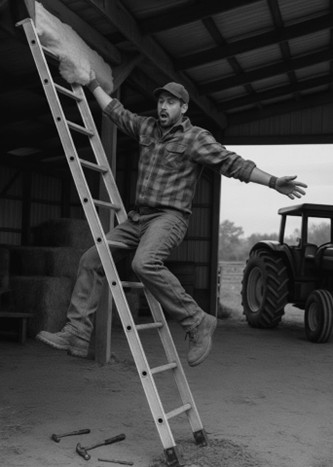
This image clearly illustrates the serious hazards associated with improper ladder use in agricultural work. The worker is standing near the top of an extension ladder while installing insulation inside a barn. He is over-reaching far outside the ladder’s side rails, causing the ladder to shift and tip on uneven dirt flooring. The worker has no spotter, no ladder stabilization, and no fall-protection measures in place—leaving him moments away from a potentially life-altering fall.

Falls from even moderate heights can result in severe head injuries, spinal trauma, fractures, or long-term disability, especially when landing on hard surfaces or around scattered tools. Many ladder accidents occur when workers attempt to carry materials, work alone, or stretch beyond the ladder’s safe limits. Always ensure ladders are set on stable ground, maintain three points of contact, avoid over-reaching, and consider safer alternatives—such as scaffolding or mobile platforms—when working at height. Proper planning and safe ladder practices are essential to prevent tragic, preventable injuries on the farm.


Ladder Safety for Agriculture Picture This – Spanish

LSA

Esta imagen ilustra claramente los graves peligros asociados con el uso inadecuado de escaleras en trabajos agrícolas. El trabajador está de pie cerca de la parte superior de una escalera extensible mientras instala aislamiento dentro de un granero. Se inclina demasiado hacia fuera de los rieles laterales de la escalera, lo que hace que esta se desplace y se incline sobre el suelo irregular de tierra. El trabajador no cuenta con un observador, ni con estabilización de la escalera, ni con medidas de protección contra caídas, lo que lo deja a unos segundos de una caída que podría cambiarle la vida.

Las caídas, incluso desde alturas moderadas, pueden provocar lesiones graves en la cabeza, traumatismos espinales, fracturas o discapacidades a largo plazo, especialmente cuando se aterriza sobre superficies duras o cerca de herramientas esparcidas. Muchos accidentes con escaleras se producen cuando los trabajadores intentan transportar materiales, trabajan solos o se inclinan más allá de los límites de seguridad de la escalera. Asegúrese siempre de que las escaleras estén colocadas sobre un terreno estable, mantenga tres puntos de contacto, evite inclinarse demasiado y considere alternativas más seguras, como andamios o plataformas móviles, cuando trabaje en altura. Una planificación adecuada y unas prácticas seguras con las escaleras son esenciales para prevenir lesiones trágicas y evitables en la granja.


Fire Extinguishers: Monthly Inspections – Small Checks, Big Safety

Course Description

This course will cover why making sure every fire extinguisher is ready to do its job when you need it most is so important.


Fire Extinguishers: Monthly Inspections – Small Checks, Big Safety – Spanish

Course Description

This course will cover why making sure every fire extinguisher is ready to do its job when you need it most is so important. (Spanish Version)


Newsletter – July 2026

Download the July 2026 newsletter which highlights key strategies for strengthening workplace safety and engagement. Featured articles include How to Deliver an Effective Safety Talk on Combustible Dust Hazards, offering practical guidance for addressing a serious workplace risk, and Why Safety Training Fades and How to Make the Message Stick, which explores ways to improve knowledge retention. Readers will also discover why organizations should Stop Training Generations Differently, Start Training Risk Differently to better focus on hazard awareness and prevention. In addition, the newsletter introduces four new meeting kits designed to support safety discussions, shares lessons learned through the latest Fatality Files, and emphasizes the importance of Mental Health Awareness in Safety Programs as part of a comprehensive approach to worker well-being.


GHS – Pictograms Meeting Kit

WHAT’S AT STAKE

Every time you handle a chemical at work — whether it’s a cleaner, solvent, gas, or corrosive — you’re relying on one thing to keep you informed: the label. And at the heart of that label are GHS pictograms. These small red and black symbols pack a serious punch. They tell you if something is toxic, flammable, explosive, or capable of causing long-term health damage. If you ignore them or don’t know what they mean, you could expose yourself to deadly hazards without even realizing it. Recognizing and understanding GHS pictograms is your first line of defense — because when it comes to chemicals, what you don’t know can hurt you.

WHAT’S THE DANGER

GHS pictograms aren’t just symbols on a label — they’re warning signs about serious chemical hazards that can threaten your health and safety if ignored. Each one tells you something critical: whether a product can poison you, burn you, blow up, or damage your organs over time. If you don’t recognize or understand them, you’re working blind around chemicals that can kill.

  1. Misidentifying a Chemical – A Shortcut to Serious Harm
  • If you mistake a flammable liquid for something harmless, a small spark could trigger a fire or explosion. If you don’t recognize the skull and crossbones, you might breathe in or absorb a fatal toxin without even realizing it.
  • Workers have sprayed flammable cleaning agents near heat sources, not knowing they were highly combustible
  • Accidental skin contact with corrosives has led to chemical burns because workers didn’t check the label
  1. Missing PPE Warnings – No Protection When You Need It
  • Each pictogram also signals what kind of PPE (personal protective equipment) is needed. If you ignore a corrosion symbol, for example, and wear thin gloves instead of chemical-resistant ones, you could end up with serious hand injuries or eye damage.
  • The health hazard symbol indicates risks like cancer, reproductive harm, or respiratory disease — but those aren’t always obvious unless you know what it means
  • Not using the right respirator or gloves could allow toxins to enter your body silently
  1. Incompatible Storage – Explosion or Toxic Gas Risk
  • GHS pictograms help identify which chemicals must be kept apart. Storing an oxidizer near a flammable liquid, or mixing an acid with a base, can lead to violent reactions or the release of toxic gases.
  • Without recognizing the flame, exploding bomb, or gas cylinder symbols, incompatible chemicals may be stored side-by-side
  • One misstep in storage or disposal can create a workplace-wide emergency

HOW TO PROTECT YOURSELF

Protecting yourself from chemical hazards starts with understanding what you’re handling — and the GHS pictograms are your cheat sheet. These symbols tell you the dangers at a glance, but only if you know what they mean and how to act on them. Here’s how to stay safe:

Learn All Nine GHS Pictograms – Know What You’re Dealing With

There are nine pictograms used in the Globally Harmonized System (GHS), each representing a different class of hazard. Take the time to memorize them — it only takes a few minutes, but it can save your life.

  • Flame: flammable gases, liquids, solids
  • Skull and Crossbones: acute toxicity (fatal or toxic)
  • Corrosion: skin burns, eye damage, metal corrosion
  • Health Hazard: cancer, organ damage, fertility harm
  • Exclamation Mark: irritants, skin sensitizers, narcotic effects
  • Flame Over Circle: oxidizers
  • Gas Cylinder: compressed gases
  • Exploding Bomb: explosives, self-reactives
  • Environment: aquatic toxicity (note: not mandatory in the U.S. but still important)

Read the Label and SDS – Don’t Guess

Every chemical container should have a label with pictograms and a Safety Data Sheet (SDS) available. Don’t assume you know what a chemical is just because of its appearance or common use. Read the label before you open it, and review the SDS for PPE requirements, handling instructions, and first-aid measures.

Use the Right PPE for the Hazard – The pictogram will tell you what you need. For example:

  • Corrosion = chemical-resistant gloves, apron, and face shield
  • Health Hazard = respiratory protection
  • Flame = flame-resistant clothing and no ignition sources nearby

Never assume one set of PPE works for every chemical. Tailor your protection to the pictogram.

Follow Safe Storage and Handling Rules – Pictograms help identify incompatible materials. Keep flammables away from oxidizers, and corrosives away from bases or metals. Store gases in ventilated areas and check that labels are intact and visible.

Label Secondary Containers  – If you transfer chemicals to another container, you must relabel it with the correct GHS pictogram. Unlabeled bottles or spray cans are one of the most common violations — and one of the easiest ways to get someone hurt.

Respond the Right Way in an Emergency

If exposure occurs, the GHS pictograms guide emergency responders, too. Keep SDS copies accessible in your work area, and report all incidents immediately — even if they seem minor.

FINAL WORD

GHS pictograms may be small, but they carry big warnings. When you understand what each symbol means, you’re better prepared to protect yourself and your team.


Criticality Safety: Preventing the Unthinkable (Spanish)

Course Description

Criticality safety is about managing materials so they stay subcritical—safe, stable, and harmless. This course will talk about – what it means, why it matters and how you play a role in preventing accidents. (Spanish Version)


Workplace Cleanliness – SPANISH

Course Description

This course will identify the hazards that arise from failing to maintain workspace organization. Good housekeeping implies that a workplace is kept in an organized, uncluttered, and hazard-free condition. While this is a relatively simple concept, the benefits that can be realized from good housekeeping practices are far reaching and affect not only workers’ safety but also their health and productivity. (Spanish Version)


Drug and Alcohol-Free Workplace – USA (Spanish)

Course Description

The costs of substance abuse are high. Upon completion, the learner will be able to identify issues of substance abuse, signs and symptoms of substance abuse, best practices for internal reporting, and requirements for a Drug-Free Workplace program. (Spanish Version)


Hurricane Preparedness – Spanish

Course Description

Hurricanes are dangerous and can cause major damage because of storm surge, wind damage, and flooding. They typically form around the equator, but hurricanes can hit much more Northern or Southern coastlines and any territory in the Atlantic or Pacific oceans. This course will help you understand how to prepare for a hurricane. (Spanish Version)


ESSENTIAL 29: Drug and Alcohol-Free Workplace – USA

Course Description

The costs of substance abuse are high. Upon completion, the learner will be able to identify issues of substance abuse, signs and symptoms of substance abuse, best practices for internal reporting, and requirements for a Drug-Free Workplace program.


Domestic Violence in the Workplace for Managers

Course Description

This course helps managers and employers recognize, respond to, and prevent domestic violence in and outside of the workplace, emphasizing privacy, respect, non-stigmatizing language, and supportive policies that foster safety and dignity for all.