ATV Safety and Gear Fatality File – Spanish

Un agricultor muere dos semanas después de volcar su todo terreno

Frank aguantó “hasta que las vacas volvieron a casa”, pero al final no pudo lidiar con un coágulo de sangre.

Este agricultor de 66 años de Wisconsin murió dos semanas después de que su vehículo todoterreno (ATV) se le echara encima durante un proyecto de reparación de una valla. La semana en que iba a recibir el alta hospitalaria, murió inesperadamente al levantarse de la cama. La causa de la muerte fue una insuficiencia respiratoria debida a una embolia pulmonar (coágulo de sangre).

La investigación

Según la investigación, Frank había terminado de arreglar una valla dañada por un temporal de viento. Estaba conduciendo su cuatriciclo lentamente por una colina cuando trató de maniobrar sobre un pequeño árbol que crecía de un tocón. Frank supuso que los neumáticos del todoterreno aplastarían el árbol, pero no fue así. En su lugar, la máquina volcó, haciéndole caer por un terraplén de 6 metros. El todoterreno siguió a Frank colina abajo y rodó sobre él, causándole múltiples heridas, entre ellas un corte en la cabeza y costillas rotas. No llevaba casco.

Frank, que fue descrito como muy consciente de la seguridad, logró sobrevivir al vuelco, pero el traumatismo cerrado que sufrió fue demasiado al final.

Tras la muerte de Frank se hicieron las siguientes recomendaciones:

Los agricultores y otros trabajadores al aire libre deben realizar una evaluación exhaustiva del terreno para identificar los peligros antes de manejar cualquier vehículo todoterreno, incluidos los cuatriciclos. Frank era consciente del terreno, pero calculó mal el impacto que tendría el pequeño árbol en el cuatriciclo.

Los agricultores (y otros empleadores) deben elegir un vehículo utilitario todoterreno equipado con una estructura de protección contra vuelcos (ROPS) y un cinturón de seguridad.

Los operadores de vehículos utilitarios todoterreno deben llevar casco y seguir el código básico de seguridad para vehículos todoterreno.


Overhead Wire Safety Fatality File

Man dies after electric shock from overhead cables throws him from his truck 

A man was killed while working in a field after a crane mounted on the truck he was driving touched high voltage overhead cables and electrocuted him.

Sussex Police said that the man, who has not been named, died shortly after the incident at Pond Farm in East Ashling, near Chichester in Sussex.

At around 9:30 on the morning of Saturday 18 July, the man was preparing to load hay bales onto the truck in a field.

After the truck-mounted crane touched the cable, the man was immediately thrown from the cab of the vehicle by the electric shock he suffered, and power was knocked out to 400 nearby homes.

He was taken by helicopter the Queen Alexandra Hospital in Portsmouth, but sadly died. 


Overhead Wire Safety Fatality File – Spanish

Un hombre muere después de que una descarga eléctrica de cables aéreos lo arrojara de su camión 

Un hombre murió mientras trabajaba en un campo después de que una grúa montada en el camión que conducía tocara cables elevados de alta tensión y lo electrocutara.

La policía de Sussex dijo que el hombre, que no ha sido nombrado, murió poco después del incidente en Pond Farm en East Ashling, cerca de Chichester en Sussex.

Alrededor de las 9:30 de la mañana del sábado 18 de julio, el hombre se disponía a cargar balas de heno en el camión en un campo.

Después de que la grúa montada en el camión tocara el cable, el hombre fue arrojado inmediatamente de la cabina del vehículo por la descarga eléctrica que sufrió, y se cortó la electricidad en 400 viviendas cercanas.

Fue trasladado en helicóptero al hospital Queen Alexandra de Portsmouth, pero lamentablemente falleció.


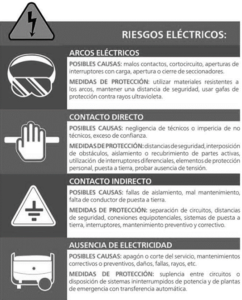
Overhead Wire Safety Picture This

Source: https://www.entergynewsroom.com/media-kit/electric-safety-power-lines/


Overhead Wire Safety Picture This – Spanish

Fuente: https://charlasdeseguridad.com.ar/ 


Newsletter – June 2022

  • Heat Illness Recognition and Prevention;
  • Safety Talks on AED Safety, Pesticide Safety, PPE Eye Safety, Working in the Heat Safety;
  • Fatality Reports;
  • Staying Healthy in the Heat Infographic;
  • 5 Key Reasons to Embrace eLearning;
  • and more…


ATV Safety and Gear Meeting Kit

WHAT IS AN ATV OR ALL-TERRAIN VEHICLE? 

An ATV, is any two, three or four wheeled motorized vehicle designed for off-road, rugged landscapes. By design, ATVs are “driver active” where the operator sits on a saddle-like seat, and steers with handlebars, similar to a motorcycle or snowmobile. On “driver active” vehicles, the operator´s body movements help control the steering and direction, requiring a strong combination of skill, good judgement, attention and physical strength.

ATV FACTS

ATVs have unique features that enable them to operate in harsh work environments where larger, less mobile vehicles cannot safely be used. Their oversized, deep tread, and low-pressure tires (4-5 psi) and light weight (600-1000 pounds) – compared to other motorized vehicles – enhance their maneuverability but also present risks such as a rollover which may occur due to a high center of gravity and a relatively narrow wheelbase.

PRIMARY REASONS FOR WORK-RELATED ACCIDENTS INVOLVING ATV’S

  • Unbalanced loads in excess of the ATV’s specified limits 
  • Operating at excessive speeds for the terrain/operation
  • Operating ATVs on paved roads
  • Not wearing a protective helmet
  • Insufficient or no training
  • Carrying passengers

PRECAUTIONS FOR THE SAFE USE OF ATVS AT WORK FOR EMPLOYEES 

  • Wear PPE including a helmet, eye-protection, long pants, and sturdy boots.
  • Participate in hands-on training in the safe handling and operation of an ATV.
  • Conduct a pre-ride inspection of tires, brakes, headlights, etc., and follow employer’s maintenance polices for upkeep of the ATV.
  • Understand how implements and attachments may affect the stability and handling of the ATV
  • Never exceed the manufacturer’s specified hauling and towing capacity or weight limits and ensure cargo is balanced, secured, and loaded on provided racks.
  • Be aware of potential hazards such as trees, ruts, rocks, streams and gullies, and follow posted hazard warnings.
  • Drive at speeds safe for weather and terrain and never operate ATVs on surfaces not designed for ATVs such as paved roads and highways.
  • Never permit passengers on the ATV, unless the ATV has an additional seat specifically designed to carry them.
  • Never operate an ATV while under the influence of drugs or alcohol.

OPERATIONAL SAFETY: MAKE A PRE-RIDE CHECK 

  • Tires and wheels: Make sure air pressure in tires is at recommended rate and check for cuts or gouges. Tighten axle nuts and secure with cotter pins.
  • Controls and cables: Check controls, cable locations and make sure all work, including throttle and brakes.
  • Lights and electrical system: Ignition switch should stop the engine when in“off”position and when in“on”position, headlights and taillights should work.
  • Oil and fuel: Check oil and fuel levels.
  • Chain and/or drive shaft chassis: Inspect, adjust, and lubricate chain and/or drive shaft chassis. Check for nuts and bolts loosened by vibration.

A SAFETY GEAR CHECKLIST FOR ATV RIDERS

Helmet: The most important piece of safety gear you can wear while riding your ATV. 

The first thing you should do when purchasing a helmet is look at the back to see which safety standards the helmet has met. 

When wearing a helmet, it should fit nice and snug, it shouldn’t be able to rotate while you’re wearing it and you shouldn’t be able to fit your thumb between the helmet and your forehead. If you can, you need one slightly smaller in size.

Long sleeve shirts/pants: A cotton or synthetic riding jersey really comes in handy when weather conditions aren’t ideal. If it is raining or snowing out, the jersey will help wick moisture. Not only that, but make sure to get one with good elbow pads on them.

A good long sleeve shirt and pants will help your skin if you fall. 

Gloves: It may seem like a luxury to wear gloves while riding your ATV out on the trails, but these are essential. Good gloves will protect your hands from flying gravel and rocks, they’ll also protect your hands from bushes and branches as you drive past large trees.

The constant rubbing and squeezing of the handles can cause your hands to get sore, callused and blistery, all of which a good pair of gloves will help prevent. 

Goggles: Of this list of safety gear items to wear while on the trails, probably the most necessary one in terms of usage would be safety goggles. 

The goggles, on the other hand, will get more use than you would imagine. Both tiny and large objects flying rapidly towards your eyes never actually make it into your eyes because they get refracted through the use of goggles.

Motocross goggles keep sweat, dust, dirt, mud, rocks, bugs, sticks and branches out of your eyes and allow you to keep focused of the road in front of you.

Boots: You want to have boots that provide adequate ankle and foot support and that ride up high enough to prevent burns from the engine and exhaust.

Chest Protector: Chest protectors probably aren’t as necessary if your use of the ATV is limited to work on the farm, but if your plan is to do heavy trail riding under high speeds, then a chest protector is a must have!

Neck Protector:  “Do I really need one?”  And when it comes down to it, the answer that seems to stick out most is “what is your level of risk tolerance?”  

FINAL WORD

Injuries and deaths can happen at all points while operating an ATV: mounting and dismounting, transporting farm supplies, driving on slopes and performing maintenance. Rollovers, collisions, flying debris, pinch points, moving parts, uneven surfaces, burn hazards and noises are all things we have to be aware of when operating an ATV.


ATV Safety and Gear Meeting Kit – Spanish

QUÉ ESTÁ EN RIESGO

¿QUÉ ES UN CUADRICICLO O VEHÍCULO TODO TERRENO? 

Un cuatriciclo es un vehículo motorizado de dos, tres o cuatro ruedas diseñado para circular fuera de la carretera y por terrenos accidentados. Por su diseño, los cuatriciclos son “activos para el conductor”, es decir, el operador se sienta en un asiento similar a un sillín y dirige el vehículo con el manillar, como una motocicleta o una moto de nieve. En los vehículos de “conducción activa”, los movimientos del cuerpo del conductor ayudan a controlar la dirección y el sentido de la marcha, lo que requiere una fuerte combinación de habilidad, buen juicio, atención y fuerza física.

CUÁL ES EL PELIGRO

DATOS DE LOS VEHÍCULOS TODOTERRENO

Los cuatriciclos tienen características únicas que les permiten operar en entornos de trabajo difíciles en los que no se pueden utilizar con seguridad vehículos más grandes y menos móviles. Sus neumáticos sobredimensionados, de banda de rodadura profunda y de baja presión (4-5 psi) y su peso ligero (600-1000 libras) -en comparación con otros vehículos motorizados- mejoran su maniobrabilidad, pero también presentan riesgos como el de volcar, que puede producirse debido a un centro de gravedad alto y a una distancia entre ejes relativamente estrecha.

RAZONES PRINCIPALES DE LOS ACCIDENTES LABORALES EN LOS QUE ESTÁN IMPLICADOS LOS CUATRICICLOS 

  • Cargas desequilibradas más allá de los límites especificados del cuatriciclo 
  • Operar a velocidades excesivas para el terreno/operación
  • Operar con cuatriciclos en caminos pavimentados
  • No llevar casco protector
  • Falta de capacitación o capacitación insuficiente
  • Llevar pasajeros

COMO PROTEGERSE

PRECAUCIONES PARA EL USO SEGURO DE LOS CUATRICICLOS EN EL TRABAJO PARA LOS EMPLEADOS 

  • Usar EPP, incluyendo casco, protección para los ojos, pantalones largos y botas resistentes.
  • Participe en una capacitación práctica sobre el manejo y la operación segura de un cuatriciclo.
  • Realice una inspección previa a la conducción de los neumáticos, los frenos, los faros, etc., y siga las políticas de mantenimiento del empleador para la conservación del cuatriciclo.
  • Entienda como los implementos y aditamentos pueden afectar la estabilidad y el manejo del cuatriciclo.
  • Nunca exceda la capacidad de arrastre y remolque o los límites de peso especificados por el fabricante, y asegúrese de que la carga esté equilibrada, asegurada y cargada en los bastidores provistos.
  • Sea consciente de los peligros potenciales como árboles, surcos, rocas, arroyos y barrancos, y siga las advertencias de peligro publicadas.
  • Conduzca a velocidades seguras para el clima y el terreno y nunca opere el cuatriciclo en superficies no diseñadas para cuatriciclos, como caminos pavimentados y carreteras.
  • Nunca permita pasajeros en el cuatriciclo, a menos que el cuatriciclo tenga un asiento adicional específicamente diseñado para llevarlos.
  • Nunca opere un cuatriciclo mientras esté bajo la influencia de drogas o alcohol o de los empleados.

SEGURIDAD OPERATIVA: HAGA UNA COMPROBACIÓN PREVIA A LA CONDUCCIÓN 

  • Neumáticos y ruedas: Asegúrese de que la presión de aire de los neumáticos es la recomendada y compruebe que no hay cortes o desgarros. Apriete las tuercas de los ejes y asegúrelas con chavetas.
  • Controles y cables: Compruebe los mandos, la ubicación de los cables y asegúrese de que todos funcionan, incluidos el acelerador y los frenos.
  • Luces y sistema eléctrico: El interruptor de encendido debe parar el motor cuando está en posición “off” y cuando está en posición “on”, los faros y las luces traseras deben funcionar.
  • Aceite y combustible: Compruebe los niveles de aceite y combustible.
  • Cadena y/o eje de transmisión del chasis: Inspeccione, ajuste y lubrique la cadena y/o el chasis del eje de transmisión. Compruebe si hay tuercas y tornillos aflojados por las vibraciones.
  • Obtenga el equipo de protección adecuado para su cuatriciclo

LISTA DE COMPROBACIÓN DEL EQUIPO DE SEGURIDAD PARA LOS CONDUCTORES DE VEHÍCULOS TODO TERRENO

Casco: La pieza más importante del equipo de seguridad que usted puede usar mientras conduce su cuatriciclo. 

Lo primero que debe hacer al comprar un casco es mirar la parte trasera para ver qué normas de seguridad ha cumplido el casco. 

Cuando se usa un casco, debe quedar bien ajustado, no debe poder girar mientras lo lleva puesto y no debe poder meter el pulgar entre el casco y la frente. Si puedes, necesitas uno de un tamaño ligeramente inferior.

Camisetas/pantalones de manga larga: Una camiseta de algodón o sintética para montar en moto es realmente útil cuando las condiciones meteorológicas no son las ideales. Si llueve o nieva, el maillot ayudará a absorber la humedad. No sólo eso, sino que asegúrese de conseguir uno con buenas coderas.

Una buena camiseta de manga larga y unos pantalones ayudarán a tu piel si te caes. 

Guantes: Puede parecer un lujo usar guantes mientras conduces tu cuatriciclo en los senderos, pero son esenciales. Unos buenos guantes protegerán tus manos de la grava y las rocas que vuelan, y también te protegerán de los arbustos y las ramas cuando pases por delante de grandes árboles.

El constante roce y apriete de los mangos puede hacer que sus manos se llenen de dolor, callos y ampollas, todo lo cual un buen par de guantes ayudará a prevenir. 

Gafas: De esta lista de elementos del equipo de seguridad que hay que llevar en los senderos, probablemente el más necesario en términos de uso serían las gafas de seguridad. 

Las gafas, por otra parte, tendrán más uso del que imagina. Tanto los objetos pequeños como los grandes que vuelan rápidamente hacia sus ojos nunca llegan a ellos porque son refractados por el uso de las gafas.

Las gafas de motocross evitan que el sudor, el polvo, la suciedad, el barro, las piedras, los insectos, los palos y las ramas entren en tus ojos y permiten que mantenga la atención en la carretera que tiene delante.

Botas: Debe tener unas botas que le proporcionen un soporte adecuado para los tobillos y los pies y que sean lo suficientemente altas como para evitar las quemaduras del motor y el escape.

Protector de pecho: Los protectores pectorales probablemente no sean tan necesarios si el uso del cuatriciclo se limita al trabajo en la granja, pero si su plan es hacer una conducción pesada en el camino bajo altas velocidades, entonces un protector pectoral es una necesidad.

Protector de cuello: “¿Realmente necesita uno?”  Y a la hora de la verdad, la respuesta que más parece sobresalir es “¿cuál es su nivel de tolerancia al riesgo?”  

CONCLUSIÓN

Las lesiones y las muertes pueden producirse en todos los puntos mientras se maneja un cuatriciclo: montando y desmontando, transportando suministros agrícolas, conduciendo en pendientes y realizando el mantenimiento. Los vuelcos, las colisiones, los escombros que salen despedidos, los puntos de pellizco, las piezas móviles, las superficies irregulares, los riesgos de quemaduras y los ruidos son cosas que debemos tener en cuenta al manejar un todoterreno.


Africanized Honey Bees Stats and Facts – Spanish

HECHOS

  1. Las muertes relacionadas con los insectos están asociadas a tres tipos de trabajos: agricultura, construcción y jardinería.  
  2. Alrededor del 80% de los que mueren por picaduras de abeja, avispa o avispón son hombres.
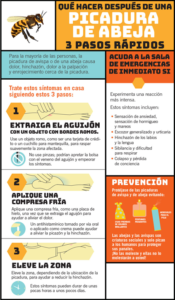
  3. Si una abeja pica a alguien, otras personas deben permanecer junto a la víctima para asegurarse de que no se produce una reacción alérgica. Hay que lavar el lugar de la picadura con agua y jabón y retirar el aguijón, pero hay que utilizar una uña o una gasa, en lugar de apretar o utilizar pinzas
  4. Los consejos del sitio de los CDC para que los trabajadores eviten las picaduras incluyen el uso de ropa de color claro y no usar productos con aroma a plátano.
  5. Las cifras de muertes pueden estar subestimadas debido a diagnósticos erróneos como ataques cardíacos o insolaciones o pueden atribuirse a otras causas. 
  6. La mayoría de las personas sólo experimentan una pequeña hinchazón y dolor después de ser picados, pero muchos individuos pueden experimentar otros síntomas después de una picadura. Las picaduras de insectos pueden provocar cualquiera de los siguientes síntomas
    • Dolor
    • Enrojecimiento
    • Hinchazón 
    • Enrojecimiento
    • Urticaria
    • Anafilaxia.

ESTADÍSTICAS

  • Las abejas Africanizadas suelen ser mucho más defensivas que otras variedades de abejas y reaccionan a las perturbaciones más rápidamente que las abejas europeas. Pueden perseguir a una persona hasta 400 metros; han matado a unos 1.000 seres humanos, cuyas víctimas reciben 10 veces más picaduras que las abejas melíferas europeas.
  • Son sin duda las abejas más agresivas del mundo y son responsables de al menos 1.000 muertes sólo en Estados Unidos.
  • En un año normal, las picaduras de abeja causan casi 100 muertes en Estados Unidos. De hecho, esta cifra probablemente representa una subestimación, ya que algunas muertes por picadura de abeja se atribuyen erróneamente a ataques cardíacos, insolaciones y otras causas.
  • Estudios recientes informan de 1.109 muertes por picaduras de abejas, avispones y avispas. Y si ha tenido una reacción alérgica grave a una picadura de abeja, hay un 30-60% de posibilidades de que experimente una anafilaxia completa la próxima vez que le piquen.


Africanized Honey Bees Stats and Facts

FACTS

  1. Insect-related deaths are associated with three types of jobs: farming, construction, and landscaping.  
  2. About 80 percent of those who die of bee, wasp or hornet stings are men.
  3. If a bee does sting someone, others should stay with the victim to make sure an allergic reaction doesn’t occur. The sting site should be washed with water and soap and the stinger should be removed — but a fingernail or gauze should be used, rather than squeezing or using tweezers
  4. The CDC’s site tips for workers to avoid stings include wearing light-colored clothing and not using banana-scented products.
  5. Numbers of death may be underreported because of mistaken diagnoses as heart attacks or sunstrokes or may be attributed to other causes. Most individuals only experience minor swelling and pain after being stung, but many individuals can experience other symptoms after a sting. Insect stings can result in any of the following:
    • Pain
    • Redness
    • Swelling 
    • Flushing
    • Hives
    • Anaphylaxis.

STATS

  • Africanized honeybees are typically much more defensive than other varieties of honeybees, and react to disturbances faster than European honeybees. They can chase a person a quarter of a mile (400 m); they have killed some 1,000 humans, with victims receiving 10 times more stings than from European honeybees.
  • They are undeniably the most aggressive honeybees in the world and are responsible for at least 1,000 deaths in the United States alone.
  • In a typical year, nearly 100 American deaths are caused by bee stings. In fact, this number probably represents an underestimate, since some bee sting deaths are erroneously attributed to heart attacks, sun stroke and other causes.
  • Recent studies report 1,109 deaths from bee, hornet and wasp stings. And if you’ve had a severe allergic reaction to a bee sting, there is a 30-60% chance you will experience full-blown anaphylaxis the next time you are stung.


Africanized Honey Bees Fatality File

40,000 ‘Killer Bees’ Sting Texas Man to Death 

A hive of approximately 40,000 Africanized honeybees killed a farmer near Waco, Texas, on Saturday, after he drove past their hive on a tractor.

The victim was identified Monday as Larry Goodwin of Moody, Texas, the Waco Herald-Tribune reports. McLennan County Chief Sheriff’s Deputy Matt Cawthon told the paper that Goodwin bumped into an unused chicken coop where the hive was living, prompting them to give chase.

Goodwin dashed 50 feet to a garden hose, which he attempted to use to dispel the bees. A woman identified by KCEN-TV as a neighbor attempted to help, but was stung repeatedly, as were volunteer firefighters who responded.

Allen Miller was called to remove the bees from Goodwin’s farm. Miller, the owner of Bees Be Gone, told U.S. News he typically exterminates six hives of Africanized bees per year. In the past 30 days alone, he said, he’s exterminated six hives.

“If this is a sign of things to come I’m getting out of this business,” Miller said. “I’ve been seeing a whole lot more.”

Miller kills the bees where he finds them, using various insecticides that are safe for humans 2 hours after application. “I have a 90-day warranty, so I’m real serious,” he said. When they cover his body and sting through his gloves and clothing, Miller retreats to his car and turns on the air conditioning, which causes the bees to flee.

“The killer bees are the only ones that give me any problem,” Miller said, “because they can get in my gloves and in my pants. It’s amazing what killer bees can do. With killer bees, all 100 percent [of the hive] think they’re supposed to save the queen and be killers. They terrify people out of their gourds because there are so many of them.”

Miller gets stung during most Africanized bee exterminations. For the killers, he takes off his “sissy gloves” and puts on heavier ones. “I’ve got a full suit, but I usually don’t use it because it’s so hot,” he said, opting for a veiled hat suit and heavyweight jeans.

He didn’t get stung on Saturday, which he attributes to a ferocious surprise-attack on the bee colony. “I laid it on, I did not give them an equal chance,” he said.

Family members said the 62-year-old victim’s skin was entirely covered by red sting marks, KCEN-TV reports.

Africanized honeybees, popularly known as “killer bees,” are similar to farm-raised honeybees used to pollinate plants and make honey. The bees look similar and have “almost identical” venom in individual stings, according to an Ohio State University fact sheet. The Africanized bees, however, are notably more aggressive. Entire hives pursue perceived attackers, often killing their target. 


Africanized Honey Bees Fatality File – Spanish

40.000 “abejas asesinas” matan a un hombre de Texas 

Una colmena de aproximadamente 40.000 abejas africanizadas mató a un agricultor cerca de Waco, Texas, el sábado, después de que pasara por delante de su colmena en un tractor.

La víctima fue identificada el lunes como Larry Goodwin, de Moody, Texas, informa el Waco Herald-Tribune. El ayudante del sheriff jefe del condado de McLennan, Matt Cawthon, declaró al periódico que Goodwin chocó con un gallinero en desuso en el que vivía la colmena, lo que les llevó a emprender una persecución.

Goodwin corrió 15 metros hasta llegar a una manguera de jardín, que intentó utilizar para disipar las abejas. Una mujer identificada por KCEN-TV como vecina intentó ayudar, pero fue picada repetidamente, al igual que los bomberos voluntarios que acudieron.

Allen Miller fue llamado para retirar las abejas de la granja de Goodwin. Miller, propietario de Bees Be Gone, dijo a U.S. News que normalmente extermina seis colmenas de abejas africanizadas al año. Sólo en los últimos 30 días, dijo, ha exterminado seis colmenas.

“Si esto es una señal de lo que está por venir, voy a dejar este negocio”, dijo Miller. “He visto muchas más”.

Miller mata a las abejas donde las encuentra, utilizando varios insecticidas que son seguros para los humanos dos horas después de su aplicación. “Tengo una garantía de 90 días, así que soy muy serio”, dijo. Cuando le cubren el cuerpo y le pican a través de los guantes y la ropa, Miller se retira a su vehículo y enciende el aire acondicionado, lo que hace que las abejas huyan.

“Las abejas asesinas son las únicas que me dan problemas”, dijo Miller, “porque pueden meterse en mis guantes y en mis pantalones. Es increíble lo que pueden hacer las abejas asesinas. Con las abejas asesinas, el 100% [de la colmena] cree que debe salvar a la reina y ser asesina. Aterrorizan a la gente porque son muchas”.

Miller es picado durante la mayoría de los exterminios de abejas africanizadas. Para las asesinas, se quita los “guantes de marica” y se pone unos más pesados. “Tengo un traje completo, pero no suelo usarlo porque hace mucho calor”, dice, y opta por un traje con sombrero velado y unos vaqueros gruesos.

El sábado no le picaron, lo que atribuye a un feroz ataque sorpresa de la colonia de abejas. “Me la jugué, no les di la misma oportunidad”, dijo.

Los familiares dijeron que la piel de la víctima, de 62 años, estaba totalmente cubierta por marcas de picaduras rojas, informa KCEN-TV.

Las abejas africanizadas, conocidas popularmente como “abejas asesinas”, son similares a las abejas de granja utilizadas para polinizar las plantas y fabricar miel. Las abejas tienen un aspecto similar y un veneno “casi idéntico” en sus picaduras, según una hoja informativa de la Universidad Estatal de Ohio. Sin embargo, las abejas africanizadas son notablemente más agresivas. Colmenas enteras persiguen a las atacantes, a menudo matando a su objetivo.


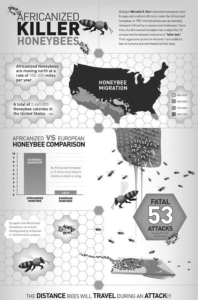
Africanized Honey Bees Picture This

Source: https://www.jcehrlich.com/blog/infographic-africanized-killer-bees/


Africanized Honey Bees Picture This – Spanish

Fuente: https://www.msdmanuals.com/


HACCP Understanding Hazard Analysis and Critical Control Point – Quick Tips

Introduction

If you work in the U.S. food industry, it’s important to have a clear understanding of the food safety system known as hazard analysis and critical control point (HACCP). The concepts of HACCP date back over fifty years. Simply put, HACCP is a science-based system used to ensure that food safety hazards are controlled to prevent unsafe food from reaching consumers. The Pillsbury Company first implemented this approach in collaboration with the National Aeronautics and Space Administration (NASA) during the development of food to be used in the U.S. space program.

Since then, numerous U.S. food companies have incorporated the system into their manufacturing processes. HACCP is required by the United States Department of Agriculture (USDA) for processing meat and poultry (9 Code of Federal Regulations (CFR) Part 417); it’s also required by the Food and Drug Administration (FDA) for juice (21 CFR Part 120) and seafood (21 CFR Part 123) processors.

In 2011, the FDA passed the Food Safety Modernization Act (FSMA) (21 CFR Part 117) that regulates all other food manufactures who were not required to follow HACCP. These other food manufactures must now follow a close offshoot of HACCP called hazard analysis and risk-based preventive control (HARPC). This means that now, all U.S. food manufacturers regulated by the USDA and FDA are required to have proactive rather than reactive food contamination control measures in place.

The FDA is urging that HACCP principles be applied to retail and food service sectors of the food industry as well.

Why hazard analysis and critical control point is important

Before the HACCP, food inspection relied on the senses (sight, smell and touch) to detect potential hazards. Guidelines were developed in the 1930s when the threat of physical contaminants and diseased animals were of great concern. However, the “process” of relying on senses failed to prevent hazards from occurring. Today, the challenges facing the food industry are predominantly microbiological and chemical in nature. Of the two, microbiological contaminants such as Salmonella, Clostridium botulinum, Listeria, Campylobacter and Escherichia coli O157:H7 pose the most significant threat. Since microbes cannot be detected by sight, a system that prevents the growth and spread of these organisms is required. Additionally, with the growth of the food industry; the increasing variety of products; and the number of processes used; federal, state and local agencies are continuously challenged to ensure food safety. HACCP places the responsibility for food safety on the processing plants, allowing them to develop a program that addresses their specific applications.

Fundamentals of HACCP

For HACCP to be most effective, its principles must be applied to all aspects of the food industry including growing, harvesting, processing, manufacturing, distributing, merchandising and preparing food for consumption. A successful HACCP program requires a strong management commitment to implement the principles. This management commitment provides employees with a clear understanding of the importance in producing safe food.

Prerequisites

HACCP must build upon a solid foundation of pre-existing programs for it to be successful. These programs provide the basic framework necessary for the production of safe food products. The National Advisory Committee on Microbiological Criteria for Foods states that programs such as current Good Manufacturing Practices (cGMP), personal hygiene, supplier control and cleaning/sanitation are critical in the development and implementation of an effective HACCP plan. Many of these programs and practices are outlined in federal, state and local regulations and guidelines.

Details of hazard analysis and critical control point

The concept of HACCP is relatively simple; however, application of the program can be challenging. HACCP is based upon seven basic principles.

  • Conduct a hazard analysis
  • Identification of Critical Control Points(CCP)
  • Establishment of Critical Limits
  • Monitoring of CCPs
  • Application of Corrective Actions
  • Documentation of the System
  • Verification Procedures

(Specifics regarding these seven principles are mentioned later in this document.)

Prior to applying a HACCP plan to a specific product and process, five tasks must be accomplished:

  • Establish a team of individuals with detailed knowledge and experience of the process to be analyzed.
  • Describe the food involved and its distribution.
  • Categorize the intended use and consumers of the food.
  • Establish a flow diagram for the process outlining the steps involved (a simple block diagram is sufficient).
  • Verify the flow diagram through on-site inspection of the operation.

Once these preliminary tasks have been completed, implementation of the HACCP principles can take place. The following is an overview of the seven HACCP principles. Please consult the references at the end of this document for additional information.

  • Conduct a Hazard Analysis
    Identify potential food-related hazards and suggest appropriate control measures. A hazard is any biological (e.g., bacterium), chemical (e.g., toxin) or physical contaminant (e.g., broken glass) that could cause illness or injury if not properly controlled. During this step it is important to review the entire flow process of an item from receipt, storage and preparation to its final distribution. After a thorough review is conducted and the potential hazards are identified, a list of control measures should be generated. Control measures are actions or activities that will prevent, eliminate or reduce the hazard. A detailed study of process hazards is critical for successful implementation of an effective HACCP plan.
  • Identify Critical Control Point
    A critical control point (CCP) is defined as a point, procedure or step at which a food safety hazard could be eliminated, prevented or reduced. Examples of CCPs include testing for metal fragments, conducting thermal processing, preventing cross-contamination of microbes between different foods, chilling and testing for chemical residues. CCPs should be carefully developed and documented. Initially, there is a tendency to identify an excessive number of steps or procedures as CCPs thereby making the process unwieldy and less effective.
    Some questions to ask when developing CCPs are:

    • Can the CCP be monitored?
    • How will the CCP be documented or recorded?

Thorough analysis and identification of CCPs by knowledgeable professionals is fundamental in controlling food safety hazards.

  • Establish Critical Limits
    Preventative measures with critical limits are established for each control point. Critical limits are maximum and/or minimum values that will prevent, eliminate or reduce a biological, chemical or physical hazard. A CCP will have at least one and possibly several control measures to achieve this goal. Critical limits or standards must be scientifically based and readily monitored. Examples of critical limits include time, temperature, pH, water activity, moisture and titratable (means of measuring) acidity. Potential sources for establishing critical limits are regulatory standards and guidelines, demonstrated results and expert consultants. An example of a critical limit is the control of time and temperature in the cooking of hamburger patties to destroy enteric pathogens such as E. coli O157:H7.
  • Monitor the Critical Control Points
    Established monitoring is a planned sequence of observations or measurements used to determine whether or not a CCP is under control. Ideally, monitoring should be continuous to assure accurate readings. In addition, most monitoring procedures require near-immediate results so that loss of control or deviations can be observed instantly. Tests related to microbiological observations are usually not practical due to the lag-time in producing results; chemical and physical measurements are frequently preferred because their results are achieved quickly and are generally more effective for assuring control of microbiological hazards. However, in some applications there may be no substitute for microbiological testing. Potential methods for monitoring CCPs include time and temperature recordings, pH measurements and observation of the procedure by sight or smell. Another important component of this step is to record and log the measurements, establishing a written record for later use in verification. The individual(s) chosen for monitoring should understand the purpose and significance of monitoring; be adequately trained in the monitoring procedure; be unbiased in their duties and reporting; and accurately report the monitoring data.
  • Define Corrective Action(s)
    Prior to enforcing a HACCP plan, corrective actions should be established for each CCP. Unfortunately, deviations will likely occur and an individual must be empowered to prevent possible hazardous foods from reaching consumers. When a deviation is noted from established critical limits, immediate and documented corrective actions are crucial. Corrective actions should determine and correct the cause of deviation and establish whether a food product should be discarded. In addition, the actions taken to restore the procedure to compliance should be documented. Examples of corrective actions include adjusting thermostats for proper temperature control, reheating or re-cooking a product and discarding a product that is deemed to potentially pose a health hazard.
  • Establish Record-Keeping and Documentation Procedures
    Maintaining records of the HACCP plan is necessary to ensure that critical limits are working and being monitored. Documentation should be kept for the entire food process. These records should include a summary of the hazard analysis, a detailed listing of the HACCP plan, verification records and any documentation generated during the HACCP plan operation. The records associated with this process should be kept on file at the establishment and easily accessible.
  • Establish Verification Procedures
    Verification activities determine the effectiveness of the HACCP plan and ensure the system is operating correctly. One of the most important aspects of this principle is the initial validation that the HACCP plan is scientifically and technically reliable. Using the verification procedures, an establishment should conduct frequent review of the HACCP plan and its components. In addition to in-house reviews, periodic verification by an independent expert or team should be performed. If deficiencies are noted during the verification step (in-house or independent), the HACCP plan must be modified to correct the problem(s).

Conclusion

HACCP is a proactive plan developed to prevent and reduce the incidents of food safety hazards. By monitoring and detecting potential problems throughout an entire process, identification of hazards and application of corrective measures can be implemented immediately. HACCP enables companies to apply prevention and detection methods to their specific application(s), giving them the freedom to adopt new techniques and technologies more rapidly. A successful HACCP plan is built upon a firm commitment from upper management with well-trained and motivated employees actively involved in the process. Under HACCP, responsibility for ensuring food safety is now appropriately placed on the food manufacturer or distributor. Adoption of this plan will result in the reduced likelihood of hazards and assure consumers that the products they consume are as safe as science and technology allow.

Frequently Asked Questions

Q: What is the difference between a control measure, a critical control point and a critical limit?

A: A control measure is an action or procedure that will reduce, prevent or eliminate a potential hazard. A critical control point is a step at which a control measure is applied. A critical limit is a maximum and/or minimum value for controlling a chemical, biological or physical parameter.

Q: What is the greatest hazard in the food industry today?

A: Microbiological contamination is the chief hazard in the food industry. However, chemical and physical hazards should not be overlooked.

Q: Does end-product testing of bacteria play a role in HACCP?

A: Testing for microbes can play a valuable role in confirming the HACCP system is working properly. Testing is also useful in profiling and tracking products and processes. However, testing for microbes at the end of a process is not effective in identifying and eliminating contamination.

Sources

National Advisory Committee on Microbiological Criteria for Foods, HACCP Principles & Application Guidelines
U.S. Department of Agriculture Food Safety and Inspection Service (FSIS)
U.S. Food and Drug Administration International
HACCP Alliance, Texas A&M University


The information contained in this article is intended for general information purposes only and is based on information available as of the initial date of publication. No representation is made that the information or references are complete or remain current. This article is not a substitute for review of current applicable government regulations, industry standards, or other standards specific to your business and/or activities and should not be construed as legal advice or opinion. Readers with specific questions should refer to the applicable standards or consult with an attorney.

Source: Grainger Know How – https://www.grainger.com/know-how


Battery Boosting Meeting Kit – Spanish

QUÉ ESTÁ EN RIESGO

¿ES SENCILLO CARGAR LA BATERÍA? 

Si una batería no se cuida adecuadamente, no se utiliza durante mucho tiempo o se acerca al final de su vida útil, puede debilitarse y perder su carga.

CUÁL ES EL PELIGRO

PELIGROS DE LA CARGA DE LA BATERÍA 

Una carga de batería inadecuada puede provocar lesiones graves si se hace de forma incorrecta.  Las baterías suelen explotar cuando se cargan de forma incorrecta, lo que hace que los trabajadores se expongan al riesgo de quemaduras por ácido y a lesiones por objetos voladores.

La siguiente composición y constitución de las baterías explica por qué el refuerzo de estas es más de lo que “parece”.

  1. Las baterías de plomo-ácido se construyen con varias celdas individuales que contienen capas de placas de plomo sumergidas en ácido sulfúrico. Cuando el ácido sulfúrico entra en contacto con la placa de plomo, se produce energía. La batería tendrá un terminal negativo y otro positivo en la parte superior o lateral de la batería y tendrá tapas de ventilación en la parte superior. El propósito de las tapas de ventilación es permitir el escape de los gases que se forman cuando la batería se está cargando. Además, los tapones de ventilación permiten comprobar los niveles de agua y ácido de la batería durante el mantenimiento.
  2. Las baterías de plomo-ácido pueden producir mezclas explosivas de gases de hidrógeno y oxígeno cuando se están cargando. Si la ventilación es deficiente, el hidrógeno que se escapa crea una atmósfera explosiva alrededor de la batería. Mantenga siempre las chispas, las llamas, los cigarrillos encendidos y otras fuentes de ignición lejos de la zona del puente para la batería, ya que el gas puede inflamarse. El resultado de una explosión podría ser quemaduras graves y/o un incendio.

COMO PROTEGERSE

FUNCIÓN DE ASISTENCIA EN CARRETERA

Si la batería de su vehículo se ha agotado, lo mejor es llamar a un Servicio de Asistencia en Carretera, cuyos expertos pueden asesorarle sobre el procedimiento a seguir.

PASOS POR SEGUIR EN LA CARGA DE LA BATERÍA 

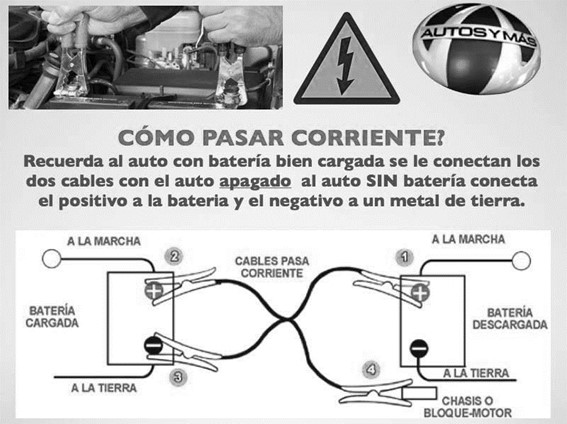
  1. Para hacer un puente de arranque con una batería descargada a partir de una batería buena (donante), estacione ambos vehículos cerca uno del otro, pero sin que se toquen. No tenga el vehículo donante en marcha durante este proceso porque podría causar daños eléctricos si se produce una sobrecarga eléctrica mientras los cables están conectados. Más vale prevenir que lamentar.
  2. Abra los capós y localice los terminales de la batería, que a menudo están encerrados por una cubierta de plástico. Abra la tapa para exponer los terminales y limpie el exceso de corrosión con un trapo. No intente hacer un puente con una batería dañada o con fugas, ya que podría provocar una chispa o un incendio. En los vehículos con una batería situada en el maletero, debajo de un asiento, o que utiliza terminales de batería laterales, debería encontrar una cubierta de plástico roja etiquetada como positivo (+) en el compartimento del motor. Esto está ahí para que usted haga la conexión positiva de la batería.

Cables conectados al vehículo para hacer un puente

  1. Utilice cables de refuerzo de alta resistencia de calibre 2 (lo mejor) o 4 para conectar las baterías en el siguiente orden. En primer lugar, conecte la pinza del cable positivo (rojo) al borne positivo de la batería descargada. A continuación, conecte la otra pinza positiva al terminal positivo de la batería buena. 

A continuación, en la batería buena, conecte la pinza negativa (negra) al terminal negativo (-) de la batería. Por último, conecte la otra pinza negativa a una parte metálica desnuda del bloque del motor en el vehículo muerto. Algunos vehículos incluso tienen puntos de tierra negativos (-) designados en el compartimento del motor.

Asegúrese de hacer esta última conexión lo más lejos posible de la batería porque una batería muerta emitirá gas hidrógeno que podría encenderse si hay un deslizamiento con las pinzas causando una chispa. Tenga en cuenta también las piezas móviles del compartimento del motor (como las correas) para asegurarse de que los cables y las abrazaderas del reforzador están libres y sin obstáculos. Para su protección, asegúrese de usar gafas de seguridad o una máscara facial y guantes al hacer las conexiones.

  1. Ahora que ha completado el circuito conectado, espere unos minutos para que el voltaje se transfiera de la batería buena a la descargada, y luego póngalo en marcha con todas las luces accesorias y características de potencia apagadas para minimizar la carga de energía. Una vez que el vehículo esté en marcha, desconecte los cables del reforzador en el orden inverso: negativo del vehículo reforzado, negativo del vehículo auxiliar, positivo del vehículo auxiliar, positivo del vehículo reforzado.
  2. Deje que el vehículo reforzado funcione durante al menos diez minutos para cargar parcialmente la batería antes de salir. Si el vehículo no se reinicia por sí solo después de un largo viaje, haga que un mecánico revise la batería, el alternador y el sistema eléctrico.

RECORDATORIOS/CONSEJOS SOBRE LA CARGA DE LA BATERÍA

Antes de colocar los cables de puente, asegúrese de mantener siempre las chispas, las llamas y los cigarrillos alejados de las baterías. Asegúrese de que los vehículos no se tocan y ponga los frenos de estacionamiento de ambos vehículos. Coloque las transmisiones automáticas en el modo de estacionamiento y las transmisiones manuales en el modo neutro. Apaga ambos motores y añade agua a la batería si es necesario. No haga un puente si el líquido de la batería está congelado o si las baterías de ambos vehículos no tienen el mismo voltaje.

Todas las personas que trabajen con baterías de vehículos o estén cerca deben llevar gafas protectoras. Pueden evitar que los fragmentos de la batería que salen despedidos y los productos químicos entren en contacto con los ojos. En muchas ferreterías se pueden comprar gafas de seguridad baratas.

Si el ácido de la batería entra en los ojos, lávelos inmediatamente con agua durante 15 minutos, manteniendo los párpados abiertos. A continuación, busque atención médica sin demora.

A la hora de elegir los cables de la batería, éstos deben tener una longitud mínima de 3 metros, ser de gran calibre, estar bien aislados, tener pinzas de cocodrilo afiladas y limpias y estar codificados por colores para evitar conexiones erróneas.

CONCLUSIÓN

La carga de la batería es muy común, sobre todo en los climas del Norte. Sin embargo, a menudo se subestiman los peligros asociados a la carga de la batería. Esto da lugar a muchas lesiones que podrían haberse evitado con una capacitación adecuada. 


Battery Boosting Meeting Kit

IS BATTERY BOOSTING SIMPLE? 

If a battery is not cared for properly, not used for a long time or is nearing the end of its useful life expectancy, then it can become weak and lose its charge.

BATTERY BOOSTING DANGERS 

Improper battery boosting can lead to serious injury if done improperly. Batteries commonly explode when improperly boosted, leading to worker exposure to risk of acid burns and injuries from flying objects.

The following composition and make-up of batteries explains why battery boosting is more than what “meets the eye”.

  1. Lead-acid batteries are built with a number of individual cells containing layers of lead plates immersed in sulphuric acid. When the sulphuric acid comes into contact with the lead plate, energy is produced. The battery will have a negative and a positive terminal on the top or side of the battery, and will have vent caps on top. The purpose of the vent caps is to allow for the escape of gases formed when the battery is charging. In addition, the vent caps allow water and acid levels of the battery to be checked during maintenance.
  2. Lead-acid batteries can produce explosive mixtures of hydrogen and oxygen gases when they are being charged. If ventilation is poor, the escaping hydrogen creates an explosive atmosphere around the battery. Always keep sparks, flames, burning cigarettes, and other sources of ignition away from the battery recharging area because the gas can be ignited. The result of an explosion could be severe burns and/or fire.

ROADSIDE ASSISTANCE ROLE

If your car battery is dead, the best thing to do is call a Roadside Assistance Service, whose experts can advise you on the procedure to follow.

STEPS TO FOLLOW IN A BATTERY BOOST 

  1. To jump start a discharged battery from a good (donor) battery, park both vehicles close to each other but not touching. Do not have the donor vehicle running during this process because it could cause electrical damage if there is an electrical surge while the cables are connected. Better safe than sorry.
  2. Open the hoods and locate the battery terminals, which are often enclosed by a plastic cover. Open the cover to expose the terminals and wipe off any excess corrosion with a rag. Do not attempt to jump start a damaged or leaking battery as this could cause a spark or fire. On vehicles with a battery located in the trunk, under a seat, or use side battery terminals, you should find a red plastic cover labeled as positive (+) in the engine compartment. This is there for you to make the positive booster connection.

Cables attached to the car for a jump start

  1. Use heavy duty 2 gauge (best) or 4 gauge booster cables to connect the batteries in the following order. First start by connecting the positive (red) cable clamp to the positive terminal on the dead battery. Next connect the other positive clamp to the positive terminal on the good battery.

Next while at the good battery, connect the negative (black) clamp to the negative (-) battery terminal. Finally, connect the other negative clamp to a bare metal part of the engine block on the dead car. Some vehicles even have designated negative (-) ground spots in the engine bay.

Be sure to make this last connection as far away from the battery as possible because a dead battery will emit hydrogen gas that could ignite if there is a slip with the clamps causing a spark. Also be aware of moving parts in the engine bay (such as belts) to ensure that the booster cables and clamps are clear and unobstructed. For your protection, be sure to wear safety goggles or a face mask and gloves when making the connections.

  1. Now that you’ve completed the connected circuit, wait a few minutes for the voltage to transfer from the good battery to the discharged, then start it up with all of the accessory lights and power features turned off to minimize the power load. Once the vehicle is running, disconnect the booster cables in the reverse order: negative off the boosted car, negative off the helper car, positive off the helper car, positive off the boosted car.
  2. Allow the boosted car to run for at least ten minutes to partially charge the battery before driving off. If the car does not restart on it’s own after going for a lengthy drive then have your battery, alternator and electrical system checked by a mechanic.

BATTERY BOOSTER REMINDERS/TIPS

Before attaching the jumper cables, be sure to keep sparks, flames, and cigarettes away from batteries at all times. Make sure the cars don’t touch and set both cars’ parking brakes. Place automatic transmissions in Park and manual transmissions in neutral. Turn both ignitions off and add battery water if needed. Don’t jump start a car if battery fluid is frozen or if the batteries of both cars are not the same voltage.

Protective goggles should be worn by everyone working with car batteries or standing nearby. They can keep flying battery fragments and chemicals out of the eyes. Inexpensive safety eyewear can be purchased at many hardware stores.

Should battery acid get into the eyes, immediately flush them with water continuously for 15 minutes, holding the eyelids open. Then seek medical attention without delay.

When selecting battery cables, they should be at least 12 feet in length, heavy gauge wire, well-insulated, have sharp and clean alligator clips and be color-coded to avoid wrong connections.

FINAL WORD

Battery boosting is very common particularly in northern climates. But the dangers associated with battery boosting is often underappreciated. This results in many injuries that could have been prevent with proper training.


Battery Boosting Stats and Facts – Spanish

HECHOS

  1. Un error al cargar la batería de los vehículos modernos puede tener a veces consecuencias nefastas. En el mejor de los casos, podría freír el sistema informático de su vehículo y, en el peor, podría provocar una explosión de la batería, lo que provocaría lesiones graves o incluso la muerte. 
  2. Hoy en día, cuando los expertos dan un impulso a los vehículos, llevan gafas de seguridad, guantes de seguridad y monos de protección. 
  3. El riesgo de explosión está etiquetado en cada batería de automóvil, aunque pocos automovilistas se molestan en leer esas advertencias, y mucho menos en tomarlas en serio. 
  4. El ácido de la batería puede dañar gravemente el compartimento del motor, corroyendo cables y mangueras, además de dañar la pintura.
  5. El peligro es que el hidrógeno explote si se produce una chispa cerca. Una fuente de chispas puede ser la propia batería.
  6. La causa más común de las explosiones de la batería en el momento del arranque son los postes y cables de la batería sucios.
  7. Otra de las causas principales de las explosiones es hacer un puente inadecuado. El error que cometen muchos automovilistas es conectar los cables de puente a la batería buena de otro vehículo y luego a la batería muerta, una práctica que provoca chispas.

ESTADÍSTICAS

  • Los automovilistas pueden resultar gravemente heridos por la explosión de una batería. En Estados Unidos, una investigación de la Asociación Nacional de Seguridad del Tráfico en Carretera estimó que unas 442 personas resultaron heridas por la explosión de baterías al intentar hacer un puente.
  • Se obtuvieron de NEISS 134 casos de lesiones asociadas a baterías de vehículos de motor. Sobre la base de estos 134 casos, se estima que 7.051 personas fueron tratadas en las salas de emergencia de los hospitales por lesiones resultantes de una actividad relacionada con las baterías de vehículos de motor en todo el país.
  • Se estima que 2.280 personas (el 32% de las 7.051 lesiones por baterías de vehículos de motor) resultaron heridas como consecuencia directa de la explosión de una batería de vehículo de motor. 
  • El 31% de las personas heridas por explosiones de baterías estaban cargando la batería (702 personas heridas).
  • Más de una cuarta parte (26%) de las lesiones estaban asociadas a una actividad relacionada con los cables de la batería (sustitución, fijación o apriete).
  • Un número casi igual de personas resultaron heridas al “hacer un puente” con la batería (19%) o al comprobar/añadir líquido (19%).
  • La mayoría (62%) de las 2.280 personas que se calcula que resultaron heridas por explosiones de baterías de vehículos de motor fueron diagnosticadas con quemaduras químicas.
  • Al 21% de los heridos se les diagnosticaron laceraciones. Casi tres cuartas partes (72%) de los heridos sufrieron una lesión ocular.


Battery Boosting Stats and Facts

FACTS

  1. An error when boosting the battery of modern cars can sometimes have dire consequences. At best, you could fry your car’s computer system and at worst, you could cause a battery explosion, leading to serious injury or even death. 
  2. Today, when experts give cars a boost, they wear safety googles, safety gloves, and protective overalls. 
  3. The risk of explosion is labeled on every automotive battery, though few motorists bother to read such warnings, let alone take them seriously. 
  4. Battery acid can severely damage the engine compartment, eating away wires and hoses as well as damaging paint.
  5. The danger is that hydrogen will explode if a spark occurs nearby. One source of sparks can be the battery itself.
  6. The most common cause of battery explosions upon start-up is dirty battery posts and cables.
  7. Improper jump-starting is another leading cause of explosions. The mistake many motorists make is to connect the jumper cables to another car’s good battery and then to the dead battery, a practice that causes sparking.

STATS

  • Motorists can be severely injured by a battery explosion. In the United States, a research note by the National Highway Traffic Safety Association estimated that about 442 persons were injured by exploding batteries while attempting a jump-start.
  • 134 cases of injuries associated with motor vehicle batteries were obtained from NEISS. Based upon these 134 cases, an estimated 7,051 persons were treated in hospital emergency rooms for injuries resulting from an activity involving motor vehicle batteries nationwide.
  • An estimated 2,280 persons (32% of 7,051 motor vehicle battery injuries) were injured as a direct result of a motor vehicle battery explosion. 
  • Thirty-one percent (31%) of the persons injured by battery explosions were charging the battery (702 persons injured).
  • More than one-fourth (26%) of the injuries were associated with an activity involving the battery cables (replacing, securing, or tightening).
  • An almost equal number of persons were injured as a result of “jump starting” the battery (19%) or checking/adding fluid (19%).
  • The majority (62%) of the 2,280 persons estimated to have been injured by motor vehicle battery explosions were diagnosed as having chemical burns.
  • Twenty one percent (21%) of the persons injured were diagnosed with lacerations. Almost three-fourths (72%) of those injured suffered an eye.


Battery Boosting Fatality File – Spanish

Un hombre de Texas y su perro mueren tras quedar atrapados en un Corvette 

No pudo salir de su Corvette cerrado, según la policía.

La policía cree que cuando James Rogers se metió en el vehículo, un cable se soltó y cortó la corriente para hacer funcionar el claxon y las cerraduras. Rogers no sabía cómo desbloquear manualmente el vehículo y quedó atrapado dentro, según el Departamento de Policía de Port Arthur.

La policía cree que el agotamiento por calor acabó matando a los dos, mientras estaban sentados en el aparcamiento de un Waffle House en Port Arthur.

Mike Flash, el propietario de Corvette Specialties, dijo a 12News que el Corvette 2007 tiene una liberación manual situada en el tablero del suelo junto al asiento del conductor. Pero Rogers no lo sabía.

Los primeros en responder también lucharon para encontrar una manera de sacar a Rogers del vehículo, dijo M.J. Ponsegrau, que estaba en la escena.

Ponsegrau dijo que finalmente los bomberos tuvieron que romper la ventana.

“Hay una manera de entrar, pero no es de conocimiento común”, dijo.

La hija de James Rogers, Tricia Hernández, dijo que es desgarrador que el vehículo de sus sueños haya acabado con su vida. Hernández dijo que la policía cree que su padre hizo un valiente esfuerzo por escapar y posiblemente murió mientras miraba el manual del vehículo. No pudo pedir ayuda porque había dejado su teléfono dentro de Waffle House.

Por extraño que parezca el accidente, no es aislado.

Isabel Moreno dijo a los periodistas que tenía un Corvette de 2006 y que se quedó atrapada en su interior cuando se agotó la batería.

Afortunadamente, dijo que finalmente la batería empezó a recargarse lo suficiente como para poder bajar la ventanilla y pudo salir sana y salva.


Battery Boosting Fatality File

Texas man, dog die after being trapped in Corvette 

Standing unable to get out of his locked Corvette, according to police.

Police believe that when James Rogers got into the vehicle, a cable became loose and cut off the power to the operate the horn and locks. Rogers did not know how to manually unlock the vehicle and became trapped inside, according to the Port Arthur Police Department.

Police believe heat exhaustion eventually killed the two, as they sat in the parking lot of a Waffle House in Port Arthur.

Mike Flash, the owner of Corvette Specialties, told 12News that the 2007 Corvette has a manual release located on the floorboard by the driver’s seat. But Rogers did not know that.

First responders also struggled to find a way to get Rogers out of the car, said M.J. Ponsegrau, who was at the scene.

Ponsegrau said eventually firefighters had to break the window.

“There’s is a way to get in, but it’s not common knowledge,” he said.

James Rogers’, daughter Tricia Hernandez, said it’s heartbreaking that his dream car ended up taking his life. Hernandez said police believe her dad made a valiant effort to escape and possibly died while looking through the car’s manual. He could not call for help because he had left his phone inside Waffle House.

As strange as the accident seems, it’s not isolated.

Isabel Moreno told reporters he owned a 2006 Corvette and was trapped inside when the battery went out.

Fortunately, he said eventually the battery started recharging itself enough to be able to roll the window down, and he was able to get out safely.

Source:https://www.usatoday.com/story/news/nation-now/2015/06/11/texas-man-dog-die-trapped-corvette/71053474/


Valley Fever Awareness

Course Description

Valley fever is a disease caused by a fungus that gets into your body through your lungs. This course will review what valley fever is, where it occurs, symptoms and treatment.


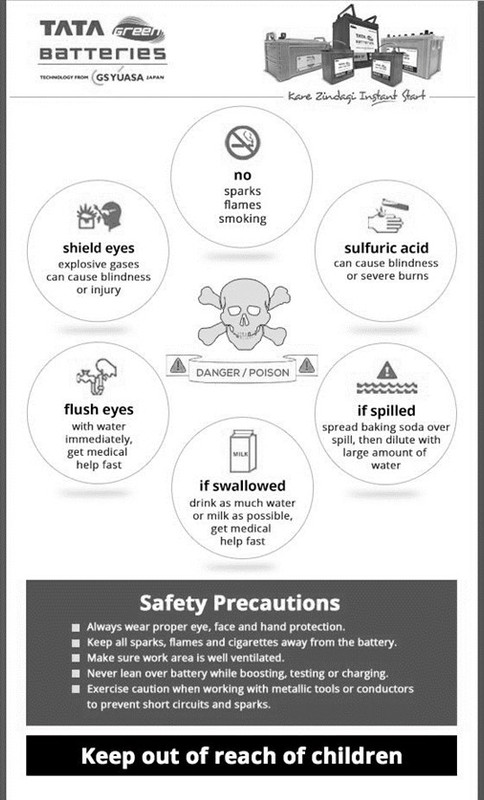
Battery Boosting Picture This

Source: https://i.pinimg.com        


Battery Boosting Picture This – Spanish

Fuente: https://www.fullkeys.cl/


Valuing Diversity at Work – Spanish

Course Description

La verdadera inclusión sólo puede existir cuando las personas en el lugar de trabajo se sienten libres de ser ellas mismas. Las opiniones, habilidades y contribuciones de todos no sólo deben ser toleradas, sino también valoradas para que todos los empleados tengan la oportunidad de maximizar su potencial. Este curso tratará de la importancia de la diversidad en su lugar de trabajo.