Identify, Evaluate and Control Meeting Kit

Risk management is the overall process used to eliminate or minimize the health and safety risks to people in the workplace, and involves the following three steps:

  1. Identify (the Hazards) – what situation or thing has the potential to cause harm.
  2. Evaluate (the Risk) – what is the possibility that harm (death, injury or illness) might occur when exposed to a hazard.
  3. Control (the Hazard) – taking action to eliminate or minimize the hazards as far as is reasonably practicable.

IDENTIFY HAZARDS 

One of the most important aspects of risk management is the identification of potential hazards.  A hazard is anything that has the potential to cause harm, such as chemicals, electricity, working at height etc. It can be a specific thing or a situation.

Some tips to help identify hazards include:

  • Checking manufacturer instructions for equipment.
  • Checking safety data sheets (SDS) for chemicals.
  • Consult with your co-workers or someone who has undertaken the task before and may have more knowledge of potential hazards.
  • Review incidents and hazards reported previously.
  • Consult relevant online resources.
  • Consult industry groups and professional associations. 

Evaluate and Control the Hazards: After identifying the hazards, the next steps are to properly evaluate and control the hazards. These steps may be very specific, so be sure to take your time and ask for help when needed. 

Evaluate: Evaluating risks is a key step in working with hazardous materials, instrumentation, and equipment. A risk assessment will in part examine the probability that an adverse event will occur and the consequence of that event. Ultimately, this can help to determine the proper controls that will be needed to avoid the adverse event. 

Control: After hazards have been identified and evaluated, all must be controlled to avoid exposure. Traditionally, a hierarchy of controls is used to determine how to implement feasible and effective controls for any hazard. Control methods at the top of the hierarchy are potentially more effective and protective than those at the bottom. This is why it is important to always follow the order when considering how to control any and all hazards. Following the hierarchy can lead to the implementation of inherently safer systems, where the risk of illness or injury can be substantially reduced. The sections below describe the individual portions of the hierarchy in order: elimination, substitution, engineering controls, work practices, and personal protective equipment.

  1. ELIMINATION: Eliminating the hazard is the most effective method of minimizing an exposure to any hazard.  However, elimination is not often a viable option.

Example:

  • Dispose of an old hazardous chemical
  1. SUBSTITUTION: Substitution replaces a hazard with an action or material that is less hazardous.

Examples: Replace ethidium bromide, a mutagen, with GelRed, SafeRed, or SYBR Safe.

However, be wary of marketing terms such as “natural”, “green”, etc.  Carefully review the Safety Data Sheet of any replacement product. 

  1. ENGINEERING CONTROLS: Engineering controls are used to remove a hazard or place a barrier between the user and the hazard. Engineering controls may be ducted and exhausted out of the building or may use a filter to capture aerosols, particles, etc. Well-designed engineering controls can provide highly effective protection to the user.

The initial cost of an engineering control can often be higher than the cost of administrative controls or personal protective equipment. However, over the long term, operating costs are frequently lower. Engineering controls often require some form of maintenance such as calibration of monitors and alarms, filter replacement, and/or specific airflow certifications upon installation or annually.

  1. WORK PRACTICES

Work practices or “administrative controls” include altering the way procedures are monitored and/or restricted.

Examples:

  • Using proper labeling and signage to communicate the hazard to others
  • Conducting monthly self-inspections to regularly eliminate any noticeable hazards
  • Instituting a “buddy system” when hazardous work is being performed
  • Having an emergency plan: considering the “What if….” then train users before an emergency happens
  • Relocating a piece of equipment so the flow of work can be done safely and more efficiently
  • Restricting the length of time that a person is exposed to noise, a particular substance, or a specific activity
  • Enforcing rules about daily housekeeping
  • Performing regular equipment maintenance
  1. PERSONAL PROTECTIVE EQUIPMENT: Personal protective equipment (PPE) is often referred to as the last line of defense.  As a control method, PPE has proven to be less effective than other control measures, which is why it is generally used with some form of engineering and/or administrative control.

FINAL WORD

Conducting an effective risk assessment requires a meaningful dialogue and cooperative approach to hazard reduction in the workplace on the parts of both employers and employees. 


Working alone Picture This – Spanish

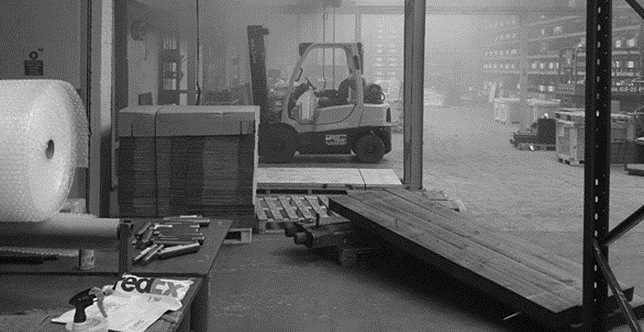
¿Qué ve en esta imagen que podría ser peligroso si estuviera trabajando en este espacio, especialmente si estuviera solo?

Hay varias condiciones inseguras en esta imagen que podrían ser perjudiciales para cualquier trabajador, pero especialmente para un trabajador solitario.

  1. La “niebla” de origen desconocido que se instala en la zona. ¿Es humo de un incendio? ¿Escape de un vehículo? ¿Vapor de una reacción química accidental de dos materiales derramados?
  • Si estuviera solo aquí y la “niebla” empezara a aparecer, ¿qué haría? ¿Seguir trabajando? ¿Intentar encontrar la fuente? ¿Abrir una ventana?
  1. La carretilla elevadora con propano también podría provocar una atmósfera peligrosa, que no es visible como la “niebla”. Si estaba trabajando solo manejando la carretilla o reparando la carretilla mientras estaba en marcha (no es la mejor idea en la mayoría de las circunstancias) existe la posibilidad de que le invada el monóxido de carbono antes de que se dé cuenta de lo que está ocurriendo.
  • La mayoría de las personas no experimentarán ningún síntoma por la exposición prolongada a niveles de CO de aproximadamente 1 a 70 ppm, pero algunos pacientes cardíacos podrían experimentar un aumento del dolor en el pecho.
  • A medida que los niveles de CO aumentan y se mantienen por encima de 70 ppm, los síntomas se hacen más notables y pueden incluir dolor de cabeza, fatiga y náuseas.
  • Con concentraciones de CO sostenidas por encima de 150 a 200 ppm, es posible la desorientación, la pérdida de conciencia y la muerte.

¿Qué otros peligros potenciales ven usted? ¿Qué procedimientos existen para protegerle a usted y a otras personas que trabajan solas, en lugares remotos fuera de las instalaciones o en lugares apartados en las instalaciones?


Working alone Picture This

What do you see in this picture that could be dangerous if you were working in this space, particularly if you were alone?

There are several unsafe conditions in this image that could be harmful to any worker, but especially a lone worker.

  1. The “fog” of an unknown origin settling in over the area. Is it smoke from a fire? Exhaust from a vehicle? Vapor from an accidental chemical reaction of two spilled materials?
  • If you were alone in here and the “fog” started to appear, what would you do? Continue to work? Try and find the source? Open a window?
  1. The propane-powered forklift could also cause a hazardous atmosphere – one that’s not visible like the “fog”. If you were working alone operating the lift or repairing the lift while it was running (not the best idea in most circumstances) there’s a chance you could be overcome by carbon monoxide before you realized what was happening.
  • Most people will not experience any symptoms from prolonged exposure to CO levels of approximately 1 to 70 ppm, but some heart patients might experience an increase in chest pain.
  • As CO levels increase and remain above 70 ppm, symptoms become more noticeable and can include headache, fatigue, and nausea.
  • At sustained CO concentrations above 150 to 200 ppm, disorientation, unconsciousness, and death are possible.

What other potential hazards do you see? What procedures are in place to protect you and others who work alone, in remote locations off-site, or in out-of-the-way spots on-site?


Learning from Close Calls Meeting Kit

WHAT IS A NEAR MISS? 

The definition of a near miss is easy to remember. It’s an event where there isn’t any property damage or injuries – but there could have been. Near misses happen more often than employers, and employees, think. 

Human nature means we often want to forget a near miss. They are moments where we narrowly avoid injury or damage. A near miss means you’ve gotten lucky. Do not rely on luck when it comes to safety. A close call is a red flag – and a warning. 

NEAR MISSES: IMPORTANT CHANCES FOR EMPLOYERS AND EMPLOYEES TO LEARN 

A lot of people don’t consider near misses worth documenting. After all, no one is hurt. If nothing was broken, then there’s nothing to look in to – right? A near miss is a chance to ask an important question: “‘What can we do differently next time to prevent it?’”

IDENTIFY CONTRIBUTING FACTORS

Pick out all of the contributing factors. Did a machine break down or malfunction? Was the employee tired or distracted? Make a report from your findings. 

PLAN TO MAKE CHANGE

A completed near miss report offers important insights. Changes can be organized into three categories:

  • Safety policy changes. Are new or better safety steps needed to help employees?
  • Engineering changes. Do you need to repair or replace equipment?
  • Personal protective equipment (PPE) changes. Do employees need more protection?

Change can be difficult for management. The business may require new equipment, training, or computer programs. Show employees that their reports are making a difference. 

SAFETY MANAGEMENT PROGRAM

Investigations cannot take place if the near miss is not reported accurately. Setting up a successful safety management program to ensure near misses are reported and investigated is an important step in reducing occurrences of serious incidents. 

  • Create a clear definition of a near miss.
  • Make a written disclosure and report the identified near miss.
  • Prioritize reports and classify information for future actions.
  • Distribute information to the people involved in the near miss.
  • Analyze the causes of the problem.
  • Identify solutions to the problem.
  • Disseminate the solutions to the people impacted.
  • Resolve actions and check changes.

Avoid The Blame Game

Do not assign blame for close calls. There is the need for a blame-free environment. 

Questions to ask about near misses 

  • Were the conditions unsafe?
  • Was there proper lighting?
  • Was the proper equipment or tool being used for the task?
  • Was the task too repetitious?
  • Were there enough people for the task?
  • Was the person trained in that task?
  • Was the person using unsafe work practices?

FINAL WORD

A close call is a warning of an incident in the making. We need to accept these warnings and look for the causes to prevent future injuries. 


Learning from Close Calls Meeting Kit – Spanish

QUÉ ESTÁ EN RIESGO

¿QUÉ ES UN CASI ACCIDENTE? 

La definición de un casi accidente es fácil de recordar. Es un suceso en el que no hay daños materiales ni lesiones, pero que podría haberlos habido. Los cuasi accidentes ocurren más a menudo de lo que creen los empleadores y los empleados. 

La naturaleza humana hace que a menudo queramos olvidar un casi accidente. Son momentos en los que evitamos por poco las lesiones o los daños. Un casi accidente significa que se ha tenido suerte. No confíe en la suerte cuando se trata de seguridad. Un casi-accidente es una bandera roja – y una advertencia. 

CUÁL ES EL PELIGRO

LOS CASI-ACCIDENTES: OPORTUNIDADES IMPORTANTES PARA QUE EMPLEADORES Y EMPLEADOS APRENDAN 

Mucha gente no considera que merezca la pena documentar los casi accidentes. Al fin y al cabo, nadie resulta herido. Si no se ha roto nada, no hay nada que investigar, ¿verdad? Un casi accidente es una oportunidad para plantear una pregunta importante: “¿Qué podemos hacer de forma diferente la próxima vez para evitarlo?”

IDENTIFICAR LOS FACTORES QUE CONTRIBUYEN

Identifique todos los factores que han contribuido. ¿Se averió una máquina o funcionó mal? ¿Estaba el empleado cansado o distraído? Haga un informe con sus conclusiones. 

COMO PROTEGERSE

PLANIFICAR EL CAMBIO

Un informe de un casi accidente completado ofrece una visión importante. Los cambios pueden organizarse en tres categorías:

  • Cambios en la política de seguridad. ¿Se necesitan nuevas o mejores medidas de seguridad para ayudar a los empleados?
  • Cambios en la maquinaria. ¿Es necesario reparar o sustituir el equipo?
  • Cambios en el equipo de protección personal (EPP). ¿Necesitan los empleados más protección?

El cambio puede ser difícil para la dirección. La empresa puede necesitar nuevos equipos, capacitación o programas informáticos. Demuestre a los empleados que sus informes marcan la diferencia.

PROGRAMA DE GESTIÓN DE LA SEGURIDAD

Las investigaciones no pueden llevarse a cabo si el casi accidente no se notifica con exactitud. El establecimiento de un programa de gestión de la seguridad que garantice la notificación e investigación de los casi accidentes es un paso importante para reducir los incidentes graves.  

  • Establezca una definición clara de un casi accidente.
  • Haga una declaración por escrito y notifique el cuasi accidente identificado.
  • Dar prioridad a los informes y clasificar la información para futuras acciones.
  • Distribuir la información a las personas implicadas en el cuasi accidente.
  • Analizar las causas del problema.
  • Identificar las soluciones al problema.
  • Difundir las soluciones a las personas afectadas.
  • Resolver las acciones y comprobar los cambios. 

Evite el juego de la culpa

No atribuya la culpa a los eventos peligrosos. Es necesario un entorno sin culpas. 

Preguntas que hay que hacer sobre los casi-accidentes 

  • ¿Eran las condiciones inseguras?
  • ¿Había una iluminación adecuada?
  • ¿Se utilizó el equipo o la herramienta adecuada para la tarea?
  • ¿Era la tarea demasiado repetitiva?
  • ¿Había suficiente personal para la tarea?
  • ¿Estaba la persona capacitada para esa tarea?
  • ¿La persona utilizaba prácticas de trabajo inseguras?

CONCLUSIÓN

Un evento peligroso es una advertencia de un incidente en ciernes. Tenemos que aceptar estas advertencias y buscar las causas para evitar futuras lesiones.


Hazards Points and Guarding on farm equipment Meeting Kit

It is important to be aware of HAZARD POINTS created by the motion of machinery components. Guards are the physical barriers that prevent access to these hazard points.

POINT OF OPERATION AND MACHINE GUARDING

When it comes to machine guarding, you have to know what hazards you’re trying to protect against.

One of the most important areas for machine guarding is the point of operation.

All machines consist of three parts

  • Operating controls
  • Power transmission device
  • Point of operation

Operating controls are mechanical or electrical controls allowing the operator to cut off power to a machine without leaving their operating position. The power transmission device refers to all parts of a mechanical system that transmit energy to the part of the machine performing the work. The point of operation is the point at which the work of the machine occurs, it is the point which is most likely to cause immediate harm to a worker. That’s because many potentially hazardous motions and actions occur at the point of operation.

Basic types of hazardous motions include:

  • Rotating, Reciprocating, Transverse. In-running nip points

Basic types of hazardous actions include:

  • Cutting, Boring, Shearing, Punching, Bending

DANGERS OF HAZARDOUS ACTIONS AND MOTIONS OF FARM EQUIPMENT TO WORKERS

Hazard Points

Shear/cutting points: Shear points are created when the edges of two objects are moved close enough together to cut a material, as in the case of a pair of shears or an auger.

Workers should be aware of shear points and shields or use guards to prevent exposure or access.

Pinch points: Pinch points form when two objects move together and at least one of them is moving in a circle. Belt drives, chain drives and gear drives are other examples of pinch points in power transmission devices.

Body parts such as fingers, hands and feet can be caught directly in pinch points, or they may be drawn into the pinch points by loose clothing that becomes entangled.

Wrap points: Rotating shafts are the most common source of wrap point accidents, although any exposed machine part that rotates can be a wrap point. Clothing or hair can catch on a rotating part.

Workers who operate machinery should be aware of wrap points and should not wear loose clothing.

Crush points: Two objects can create crush points when they move toward each other or one object moves toward a stationary one. For example, hitching a tractor to an attachment may create a potential crush point.

Crushing injuries most commonly occur to fingers. To prevent a crushing injury, workers should be aware of crush points and wait until a tractor has stopped before stepping into the hitching area.

Pull-in points: Pull-in points usually occur when plant material or other obstacles become stuck in feed rolls or other machinery parts, preventing the mechanism from operating. A worker trying to free such material without shutting down or locking out the power can be rapidly pulled into the mechanism when the material is freed.

Free-wheeling parts: Many machine parts continue to spin after the power is either shut off or locked out. Workers should not start repair or maintenance work until all parts have stopped moving, even if equipment is locked out.

BEST GUARDING PRACTICES ON FARM EQUIPMENT

Guarding in the form of a physical or other type of barrier can:

  • prevent contact with moving parts that do not require regular adjustment
  • control access to dangerous moving parts, machines and equipment
  • screen harmful emissions (eg radiation)
  • minimise noise (use of sound-absorbing materials)
  • prevent ejected parts or off-cuts from striking people.

Safety solutions – When implementing a guard, ensure that it:

  • is a permanently fixed barrier, if access to the area of plant requiring guarding is not necessary during operation, maintenance or cleaning, or
  • is an interlocked physical barrier, if access to the area requiring guarding is necessary during operation, maintenance or cleaning, or
  • can only be altered or removed with a tool, if it is not reasonably practicable to use either a permanently fixed or interlocked physical barrier, or
  • includes a presence-sensing safeguarding system, if it is not reasonably practicable to use either a permanently fixed, interlocked or fixed- in-position physical barrier.

Guarding must:

  • be of solid construction, securely mounted and resistant to impact or shock
  • prevent by-passing or disabling of the guard, and disable operation if it is removed
  • not create a risk in itself (eg it must not obstruct operator visibility, weaken the plant, cause operator discomfort or create new hazards such as pinch points or sharp edges)
  • be properly maintained, and enable ease of servicing, maintenance and repair
  • control any risk from broken/ejected parts and workpieces.

FINAL WORD

Working around moving parts on farm equipment can be very dangerous if safe work procedures are not followed. Machinery guards, when they are in place and properly maintained, provide a physical barrier to the hazard points and reduce the risk of injury.


Hazards Points and Guarding on farm equipment Meeting Kit – Spanish

QUÉ ESTÁ EN RIESGO

Es importante conocer los PUNTOS DE PELIGRO creados por el movimiento de los componentes de la maquinaria. Las protecciones son las barreras físicas que impiden el acceso a estos puntos de peligro.

PUNTO DE OPERACIÓN Y PROTECCIÓN DE LA MÁQUINA

Cuando se trata de la protección de máquinas, hay que saber contra qué peligros se intenta proteger.

Una de las áreas más importantes para la protección de máquinas es el punto de operación.

Todas las máquinas constan de tres partes

  • Controles de operación
  • Dispositivo de transmisión de potencia
  • Punto de funcionamiento

Los controles de operación son controles mecánicos o eléctricos que permiten al operador cortar la energía de una máquina sin abandonar su posición de operación. El dispositivo de transmisión de potencia se refiere a todas las partes de un sistema mecánico que transmiten energía a la parte de la máquina que realiza el trabajo. El punto de funcionamiento es el punto en el que se produce el trabajo de la máquina, es el punto que tiene más probabilidades de causar un daño inmediato a un trabajador. Esto se debe a que muchos movimientos y acciones potencialmente peligrosos se producen en el punto de funcionamiento.

Los tipos básicos de movimientos peligrosos son:

  • Rotatorios, alternativos y transversales. Puntos de pinzamiento en marcha

Los tipos básicos de acciones peligrosas incluyen:

  • Corte, perforación, cizallamiento, punzonado, doblado

CUÁL ES EL PELIGRO

PELIGROS/RIESGOS DE LAS ACCIONES PELIGROSAS MOVIMIENTOS DE LOS EQUIPOS AGRÍCOLAS PARA LOS TRABAJADORES

Puntos de peligro

Puntos de cizallamiento/corte: Los puntos de corte se crean cuando los bordes de dos objetos se acercan lo suficiente como para cortar un material, como en el caso de un par de cizallas o un sinfín.

Los trabajadores deben ser conscientes de los puntos de cizallamiento y protegerse o utilizar protectores para evitar la exposición o el acceso.

Puntos de pellizco: Los puntos de pellizco se forman cuando dos objetos se mueven juntos y al menos uno de ellos se mueve en círculo. Las transmisiones por correa, las transmisiones por cadena y las transmisiones por engranaje son otros ejemplos de puntos de pellizco en los dispositivos de transmisión de potencia.

Partes del cuerpo como los dedos, las manos y los pies pueden quedar atrapados directamente en los puntos de pellizco, o pueden ser arrastrados hacia los puntos de pellizco por la ropa suelta que se enreda.

Puntos de enrollamiento: Los ejes giratorios son la fuente más común de accidentes por puntos de pellizco, aunque cualquier parte expuesta de la máquina que gire puede ser un punto de pellizco. La ropa o el pelo pueden engancharse en una pieza giratoria.

Los trabajadores que manejan maquinaria deben ser conscientes de los puntos de enrollamiento y no deben llevar ropa suelta.

Puntos de aplastamiento: Dos objetos pueden crear puntos de aplastamiento cuando se mueven el uno hacia el otro o cuando un objeto se mueve hacia otro inmóvil. Por ejemplo, enganchar un tractor a un accesorio puede crear un posible punto de aplastamiento.

Las lesiones por aplastamiento suelen producirse en los dedos. Para evitar una lesión por aplastamiento, los trabajadores deben ser conscientes de los puntos de aplastamiento y esperar hasta que el tractor se haya detenido antes de entrar en la zona de enganche.

Puntos de enganche: Los puntos de enganche suelen producirse cuando el material vegetal u otros obstáculos se atascan en los rodillos de alimentación o en otras partes de la maquinaria, impidiendo el funcionamiento del mecanismo. Un trabajador que intente liberar dicho material sin apagar o bloquear la energía puede ser rápidamente halado hacia el mecanismo cuando el material se libera.

Piezas que giran libremente: Muchas piezas de las máquinas siguen girando después de que se haya cortado o bloqueado la alimentación. Los trabajadores no deben comenzar los trabajos de reparación o mantenimiento hasta que todas las piezas hayan dejado de moverse, incluso si el equipo está bloqueado.

COMO PROTEGERSE

MEJORES PRÁCTICAS DE PROTECCIÓN EN EQUIPOS AGRÍCOLAS

La protección en forma de barrera física o de otro tipo puede

  • evitar el contacto con las piezas móviles que no requieren un ajuste regular
  • controlar el acceso a piezas móviles, máquinas y equipos peligrosos
  • proteger las emisiones nocivas (por ejemplo, la radiación)
  • minimizar el ruido (uso de materiales que absorben el sonido)
  • evitar que las piezas expulsadas o los recortes golpeen a las personas.

Soluciones de seguridad – Al implantar un resguardo, asegúrese de que

  • sea una barrera fija, si el acceso a la zona de la planta que requiere protección no es necesario durante el funcionamiento, el mantenimiento o la limpieza, o
  • sea una barrera física con enclavamiento, si el acceso a la zona que requiere protección es necesario durante el funcionamiento, el mantenimiento o la limpieza, o
  • sólo puede modificarse o retirarse con una herramienta, si no es razonablemente posible utilizar una barrera física fija o con enclavamiento, o
  • incluye un sistema de protección por detección de presencia, si no es razonablemente factible utilizar una barrera física permanentemente fija, con enclavamiento o fija en su posición.

Las protecciones deberán:

  • ser de construcción sólida, montada de forma segura y resistente a los impactos o choques
  • impedir que se eluda o se inutilice el resguardo, e inutilizar su funcionamiento si se retira
  • no crear un riesgo en sí mismo (por ejemplo, no debe obstruir la visibilidad del operador, debilitar la planta, causar incomodidad al operador o crear nuevos peligros como puntos de pellizco o bordes afilados)
  • estar bien conservado y facilitar el servicio, el mantenimiento y las reparaciones
  • controlar cualquier riesgo derivado de la rotura/expulsión de piezas y partes de trabajo.

CONCLUSIÓN

Trabajar cerca de las piezas móviles de la maquinaria agrícola puede ser muy peligroso si no se siguen los procedimientos de trabajo seguros. Los protectores de la maquinaria, cuando están colocados y se mantienen adecuadamente, proporcionan una barrera física a los puntos peligrosos y reducen el riesgo de lesiones.


Learning from Close Calls Stats and Facts – Spanish

HECHOS

  1. Estar con prisa o enfadarse le tienta a cometer actos inseguros. No sucumba a la tentación; manténgase centrado en su compromiso de seguridad.
  2. Tómese un momento para considerar la seguridad de cada acción que realice y evite volverse complaciente con los peligros de su área de trabajo.
  3. Si se descubren condiciones inseguras, corrija o informe de la situación de inmediato.
  4. No permita que una mala actitud ponga en riesgo a otros trabajadores.
  5. Recuerde que informar de los casi incidentes puede mejorar las instalaciones y los procedimientos de trabajo, lo que contribuye a crear un lugar de trabajo más seguro y productivo para todos.

ESTADÍSTICAS

  • Según las estadísticas, en los centros de trabajo de Estados Unidos se producen anualmente alrededor de 3.000 millones de “eventos peligrosos” o ” casi accidentes”. Las estadísticas también muestran que por cada 300 casi-accidentes, se producen 29 lesiones menores, junto con una lesión lo suficientemente grave como para mantener a la persona lesionada fuera del trabajo.
  • Cada año, la Oficina de Estadísticas Laborales (BLS) recopila datos sobre accidentes laborales mortales. El número de lesiones laborales mortales ha aumentado en los últimos 10 años. En 2019, se registraron 5.333 muertes relacionadas con el trabajo, que fue más que cualquier otro año desde 2007.
  • Tendencias en 2019:
    • Los trabajadores mayores de 55 años tuvieron el mayor número de muertes desde que se empezó a hacer el seguimiento en 1970.
    • Los conductores tuvieron más que cualquier otro momento desde 2003.
    • Los trabajadores de mantenimiento de terrenos tuvieron el mayor número de muertes desde 2003.
    • La industria de la construcción privada tuvo más muertes que en cualquier momento desde 2007.


Learning from Close Calls Stats and Facts

FACTS

  1. Being in a hurry or becoming angry tempts you to commit unsafe acts. Don’t succumb to temptation; stay focused on your safety commitment.
  2. Take a moment to consider the safety of every action you take and avoid becoming complacent with the hazards of your work area.
  3. If unsafe conditions are discovered, correct or report the situation right away.
  4. Don’t allow a poor attitude to place other workers at risk.
  5. Remember that reporting close calls and near miss incidents can improve your work facilities and job procedures, which helps create a safer, more productive workplace for everyone. 

STATS

  • According to statistics, about 3 billion “close calls” or “near misses” occur annually in United States workplaces. Statistics also show that for every 300 near misses, 29 minor injuries occur, along with one injury serious enough to keep the injured person out of work.
  • Each year the Bureau of Labor Statistics (BLS) compiles data on fatal workplace accidents. The number of fatal work injuries has climbed over the last 10 years. In 2019, there were 5,333 recorded work-related deaths, which was more than any other year since 2007.
  • Trends in 2019:
    • Workers over 55 had the highest number of deaths since they began being tracked in 1970.
    • Drivers had more than any time since 2003.
    • Grounds maintenance workers saw the highest number of fatalities since 2003.
    • The private construction industry had more deaths than any time since 2007. 


Hazard Points and Guarding on farm equipment Stats and Facts

FACTS

  1. Timely maintenance programs keep equipment in good operating condition. It is the responsibility of machinery operators to recognize hazards and take the necessary steps to protect themselves and others.
  2. Any exposed, rotating machine component is a potential wrap point. Injuries usually occur when loose clothing or long hair catch wrap around rotating shafts. Protruding shaft ends can be wrap points.
  3. Crush points are created when two objects move toward each other, or when one object moves toward a stationary object. Crushing accidents often victimize a second person, during such operations as hitching.
  4. Injuries occur when operators shut off equipment and attempt to clean or adjust a machine before components have completely stopped moving.
  5. Farmers and agricultural workers are at risk of fatal or serious injury while operating or working with tractors, harvesters, sprayers, trucks, 2-wheel and 4-wheel motorbikes, farm implements and attachments.
  6. Machinery that has hydraulic equipment can have extremely high energy as it is used to shift and support large loads. Serious crush injuries can result from normal movement of the hydraulic equipment and when the hydraulic systems fail.

STATS

  • Data from the NTOF surveillance system indicates that at least 346 farm workers aged 16 or older died from farm-related entanglement injuries,112 of those deaths were caused by entanglement in PTO-driven drivelines and shafts of farm machinery.
  • Employee exposure to unguarded or inadequately guarded machines is prevalent in many workplaces. Approximately 18,000 amputations, lacerations, crushing injuries, abrasions, and over 800 deaths per year. Amputation is one of the most severe and crippling types of injuries in the occupational workplace, and often results in permanent disability.
  • Seventy-five percent (75%) of farm worker deaths in 2016 involved a vehicle.
  • Farm machinery is associated with approximately 11% of traumatic deaths on farms
  • Statistics show that farming equipment related accidents are responsible for 2,600 deaths and 230,000 disabilities every year.


Hazard Points and Guarding on farm equipment Stats and Facts – Spanish

HECHOS

  1. Los programas de mantenimiento oportunos mantienen el equipo en buenas condiciones de funcionamiento. Es responsabilidad de los operadores de maquinaria reconocer los peligros y tomar las medidas necesarias para protegerse a sí mismos y a los demás.
  2. Cualquier componente de la máquina que esté expuesto y gire es un punto potencial de enrollamiento. Las lesiones suelen producirse cuando la ropa suelta o el pelo largo se enrollan alrededor de los ejes giratorios. Los extremos de los ejes que sobresalen pueden ser puntos de enrollamiento.
  3. Los puntos de aplastamiento se crean cuando dos objetos se mueven el uno hacia el otro, o cuando un objeto se mueve hacia un objeto inmóvil. Los accidentes por aplastamiento suelen tener como víctima a una segunda persona, durante operaciones como el enganche.
  4. Las lesiones se producen cuando los operarios apagan el equipo e intentan limpiar o ajustar una máquina antes de que los componentes hayan dejado de moverse por completo.
  5. Los agricultores y los trabajadores agrícolas corren el riesgo de sufrir lesiones mortales o graves mientras operan o trabajan con tractores, cosechadoras, pulverizadores, camiones, motocicletas de 2 y 4 ruedas, implementos agrícolas y accesorios.
  6. La maquinaria que cuenta con equipos hidráulicos puede tener una energía extremadamente alta, ya que se utiliza para desplazar y soportar grandes cargas. Pueden producirse graves lesiones por aplastamiento debido al movimiento normal del equipo hidráulico y cuando los sistemas hidráulicos fallan.

ESTADÍSTICAS

  • Los datos del sistema de vigilancia NTOF indican que al menos 346 trabajadores agrícolas de 16 años o más murieron a causa de lesiones por enredo relacionadas con las explotaciones agrícolas,112 de las cuales fueron causadas por enredos en las líneas de transmisión y los ejes de la maquinaria agrícola impulsados por la toma de fuerza.
  • La exposición de los empleados a máquinas sin protección o con una protección inadecuada es frecuente en muchos lugares de trabajo. Cada año se producen aproximadamente 18.000 amputaciones, laceraciones, lesiones por aplastamiento, abrasiones y más de 800 muertes. La amputación es uno de los tipos de lesiones más graves e incapacitantes en el lugar de trabajo, y a menudo provoca una discapacidad permanente.
  • El setenta y cinco por ciento (75%) de las muertes de trabajadores agrícolas en 2016 estuvieron relacionadas con un vehículo.
  • La maquinaria agrícola está asociada con aproximadamente el 11% de las muertes traumáticas en las granjas
  • Las estadísticas muestran que los accidentes relacionados con la maquinaria agrícola son responsables de 2.600 muertes y 230.000 discapacidades cada año.


Learning from Close Calls Fatality File – Spanish

Un conductor de una carretilla elevadora chocó con una estantería de almacenamiento, empujándola hacia el pasillo del otro lado. Este incidente no se denunció. A continuación, un manipulador de materiales que no podía ver por encima de su carga chocó con la estantería en el pasillo mientras llevaba la carga a una zona de almacenamiento. Como nadie más vio el incidente y aparentemente no causó daños, el manipulador de materiales no informó del mismo. Lo que no sabía era que la colisión había perforado un contenedor de líquido lubricante en una de las cajas de la estantería de almacenamiento.

Cuando llegó el siguiente turno, el líquido había formado un charco en el pasillo.   Un empleado que se apresuraba a pasar por la zona se topó con el derrame, pero consiguió mantener el equilibrio. Asumiendo que no era su trabajo limpiar el derrame o reportarlo, lo dejó como estaba. Entonces, el operador de una carretilla elevadora, que manejaba a demasiada velocidad, dio un volantazo para evitar la estantería y atravesó el lubricante derramado. Al resbalar por el suelo resbaladizo, la carretilla elevadora no alcanzó a un grupo de trabajadores. Afortunadamente, se informó de este incidente, que podría haber causado fácilmente una muerte, y se inició una investigación.

Resultados de la investigación

La investigación sobre el casi accidente reveló varios factores que contribuyeron al mismo:

  • Retroceder sin comprobar detrás de la carretilla contribuyó a que la primera carretilla golpeara la estantería.
  • Exceder la velocidad de operación segura contribuyó a que la segunda carretilla elevadora se desviara alrededor de la estantería y entrara en el fluido.
  • Manejar con la vista obstruida contribuyó a la colisión entre la transpaleta y la estantería de almacenamiento.
  • No prestar atención y tener prisa contribuyó a un casi resbalón y caída.
  • No informar de ninguno de los tres incidentes menores contribuyó a una escalada de peligros que desembocó en el incidente final.
  • Si se hubieran notificado todos estos incidentes, los problemas podrían haberse corregido antes de que pudieran contribuir a otros incidentes.


Learning from Close Calls Fatality File

A forklift driver backed into a storage rack, pushing the rack into the aisle on the other side. This close call went unreported. Then a material handler who was unable to see over his load collided with the rack in the aisle while taking the load to a storage area. Since no one else saw the incident and it had apparently caused no damage, the material handler neglected to report the incident. What he didn’t realize was that the collision had punctured a container of lubricating fluid in one of the boxes on the storage rack.

By the time the next shift had arrived, the fluid had formed a puddle in the aisle way.   An employee hurrying through the area walked right into the spill but managed to keep his balance. Assuming it was not his job to clean up the spill or report it, he left it as it was. Then a forklift operator, traveling too fast, swerved to avoid the rack and ran through the spilled lubricant. Sliding on the slippery floor, the forklift narrowly missed a group of workers. Fortunately, this close call, which could have easily caused a fatality, was reported and an investigation was started.

Results Of The Investigation

The near miss investigation revealed several contributing factors:

  • Backing without checking behind the forklift contributed to the first forklift hitting the rack.
  • Exceeding safe operating speed contributed to the second forklift swerving around the rack and into The fluid.
  • Traveling with an obstructed view contributed to the collision between the pallet jack and the storage rack.
  • Not paying attention and being in a hurry contributed a near slip and fall.
  • Not reporting any of the three smaller incidents contributed to an escalation of hazards that resulted in the final incident.
  • Had all of these incidents been reported, the problems could have been corrected before they could contribute to other incidents. 


Hazard Points and Guarding on farm equipment Fatality File

The New York AHNP and the NIOSH Division of Safety Research recently investigated five scalping incidents involving five female farm workers or farm family members. Each woman was scalped totally or partially when her hair became entangled around the rotating secondary driveline of hay baling equipment

Case No. 1

A 47-year-old woman was baling hay on a windy day. After positioning the tractor throttle on idle but not disengaging the PTO, she dismounted and walked toward the back of the tractor past a rotating secondary driveline that powered the bale thrower. This driveline was located 4 feet above ground and was guarded by a tunnel guard (i.e., an inverted U-shaped guard) that left the underside of the driveline exposed. While the woman was at the rear of the baler, her hair (which was reportedly tied back, covered with a bandanna, and tucked inside her shirt) became entangled around the driveline. The rotating driveline tore her entire scalp from her head. These injuries required extensive skin grafting and left her permanently disfigured.

Case No. 2

A 30-year-old woman was baling hay with a recently purchased used baler. After recognizing a problem with the bale tension, she reduced the tractor speed to idle, dismounted from the tractor, and walked toward the rear of the baler past the driveline of the bale thrower. This secondary driveline was shielded with a tunnel guard. As the woman bent over to adjust the bale tension, her hair (which was tied back in a long ponytail) became entangled around the driveline and her entire scalp was torn from her head.

Case No. 3

A 42-year-old woman was leaning against a tunnel guard for the rotating driveline that powered the bale thrower on a hay baler. As she bent over to evaluate a problem with the machinery, her shoulder-length hair became entangled around the secondary driveline, and her right ear and the right side of her scalp were torn from her head.

Case No. 4

A 42-year-old woman who was baling hay walked toward the rear of the baler past the rotating secondary driveline of the bale thrower. The driveline was guarded by a tunnel guard. Her hair (reportedly tied in a bun) became entangled around the driveline and her entire scalp was torn from her head. She also received serious facial injuries that required extensive reconstructive surgery.

Case No. 5

A 12-year-old girl was walking in a hayfield while her father baled hay. Her father slowed the tractor to an idle and asked the girl to check the bale counter to see how many bales had been made. To check the counter, the girl lowered her head under a rotating, tunnel-guarded driveline that powered the bale thrower. The girl’s ponytail became entangled around the driveshaft, causing the ponytail and the attached skin to be torn from her head.


Hazard Points and Guarding on farm equipment Fatality File – Spanish

El AHNP de Nueva York y la División de Investigación de Seguridad del NIOSH han investigado recientemente cinco incidentes de descamación en los que se vieron implicadas cinco trabajadoras agrícolas o miembros de su familia. Todas las mujeres sufrieron cortes de cuero cabelludo totales o parciales cuando su cabello se enredó en la línea de transmisión secundaria giratoria del equipo de empacado de heno.

Caso nº 1

Una mujer de 47 años estaba empacando heno en un día ventoso. Después de poner el acelerador del tractor en ralentí, pero sin desconectar la toma de fuerza, se bajó y caminó hacia la parte trasera del tractor, pasando por delante de una línea de transmisión secundaria en rotación que accionaba el lanzador de balas. Esta línea de transmisión estaba situada a 1,2 metros del suelo y estaba protegida por un protector de túnel (es decir, un protector en forma de U invertida) que dejaba expuesta la parte inferior de la línea de transmisión. Mientras la mujer estaba en la parte trasera de la empacadora, su pelo (que al parecer estaba atado, cubierto con un pañuelo y metido dentro de la camisa) se enredó en la línea de transmisión. La línea de transmisión en rotación le arrancó todo el cuero cabelludo. Estas lesiones requirieron un extenso injerto de piel y la dejaron permanentemente desfigurada.

Caso nº 2

Una mujer de 30 años estaba empacando heno con una empacadora usada recién comprada. Después de reconocer un problema con la tensión de las balas, redujo la velocidad del tractor a ralentí, se bajó del tractor y caminó hacia la parte trasera de la empacadora pasando por la línea de transmisión del lanzador de balas. Esta línea de transmisión secundaria estaba protegida con un protector de túnel. Cuando la mujer se agachó para ajustar la tensión de la paca, su cabello (que estaba atado en una larga cola de caballo) se enredó alrededor de la línea de transmisión y se le arrancó todo el cuero cabelludo.

Caso nº 3

Una mujer de 42 años estaba apoyada en la protección del túnel de la línea de transmisión giratoria que accionaba el lanzador de balas de una empacadora de heno. Cuando se inclinó para evaluar un problema con la maquinaria, su cabello hasta los hombros se enredó alrededor de la línea de transmisión secundaria, y su oreja derecha y el lado derecho de su cuero cabelludo fueron arrancados de su cabeza.

Caso nº 4

Una mujer de 42 años que estaba empacando heno se dirigió hacia la parte trasera de la empacadora y pasó por delante de la línea de transmisión secundaria en rotación de la lanzadora de balas. La línea de transmisión estaba protegida por un protector de túnel. Su pelo (al parecer atado en un moño) se enredó en la línea de transmisión y se le arrancó todo el cuero cabelludo. También sufrió graves lesiones faciales que requirieron una extensa cirugía reconstructiva.

Caso nº 5

Una niña de 12 años caminaba por un campo de heno mientras su padre empacaba heno. Su padre redujo la velocidad del tractor y le pidió a la niña que comprobara el contador de pacas para ver cuántas se habían hecho. Para comprobar el contador, la niña bajó la cabeza por debajo de una línea de transmisión giratoria y protegida por un túnel que accionaba el lanzador de balas. La cola de caballo de la niña se enredó en el eje de transmisión, lo que provocó que la cola de caballo y la piel adherida se desgarraran de su cabeza.


Learning from Close Calls Picture This – Spanish

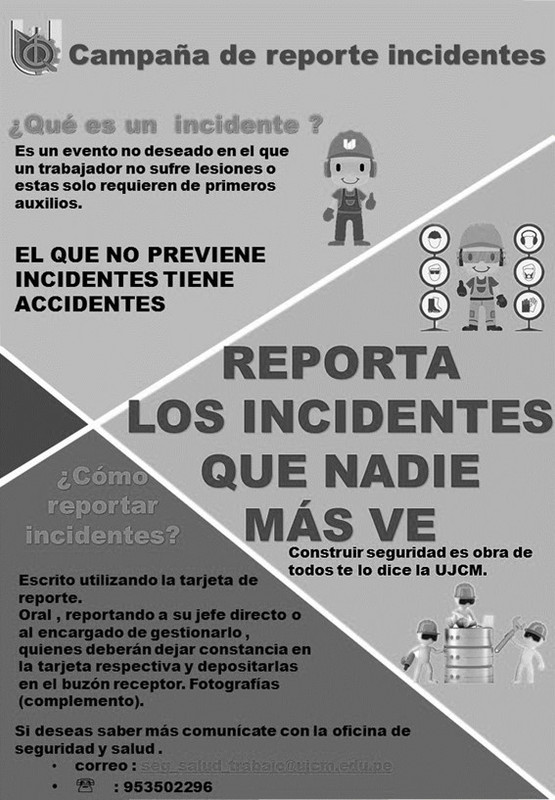
Fuente:  https://www.ujcm.edu.pe/


Learning from Close Calls Picture This


Hazard Points and Guarding on farm equipment Picture This

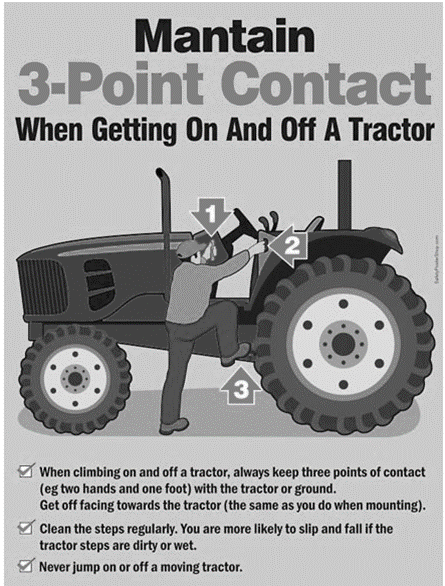
Source: https://www.safetypostershop.com/


Hazard Points and Guarding on farm equipment Picture This – Spanish

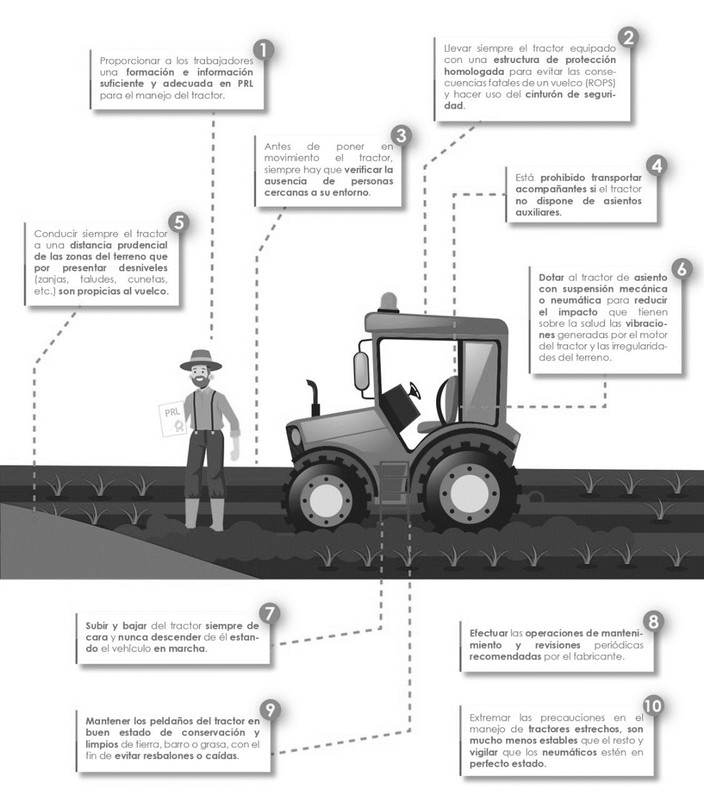
Fuente: http://netriskprevencion.com/


Basic Tractor Operation Meeting Kit

Tractor safety is for everyone who uses a tractor, whether in farming, forestry, horticulture, or other industries.

DANGERS / HAZARDS

Runovers and rollovers are the top ways people are killed on the farm. Rollovers occur when tractors are improperly operated.

OTHER RISKS

  • Tractor fires.
  • Working under raised loads.
  • Touching overhead power lines.
  • Noise-induced hearing loss.
  • Slips, trips, and falls while getting off the tractor.

STANDARD OPERATIONAL PROCEDURES

All operators must follow standard operating procedures in using a tractor.

  • Drive at speeds slow enough to retain control in unexpected circumstances.
  • Reduce speed before turning or applying brakes.
  • Watch out for ditches, embankments, and depressions – crumbling and slippery banks can cause overturns.
  • When stuck in soft ground, back out. If unsuccessful, get help.
  • Reverse up steep slopes, rather than driving forward (ensure no trailing implements are attached).
  • Use as wide a wheel track as possible when working on hillsides and sloping ground. Descend slopes cautiously. Keep the tractor in low gear and allow the motor compression to act as a brake.
  • Follow the manufacturer’s instructions for adding ballast to improve tractor stability.

PERFORM PRE-OPERATIONAL INSPECTIONS

Before mounting the tractor, walk around the machine to check for obstructions, bystanders and to check the general condition of the tractor.

HEALTH ISSUES

Operators must pay particular attention to back safety.

  • Adjust the seat to suit your body. Consider the type of seating when buying your next tractor.
  • A tractor with a seat that has vibration absorbing suspension is highly recommended.
  • Never jump down from the tractor.
  • Wear footwear that provides a firm grip when mounting or dismounting the tractor or operating foot pedals.

Safety Checks and Safe Stops

  • Start the tractor only from the driving position and not from the ground.
  • Do not dismount from a moving tractor.
  • Ensure the park brake is on and operating effectively before dismounting.
  • Do not park a tractor on a steep slope.
  • Remove the starting key when the tractor is not in use.

OVERVIEW

  • Operators must be trained/experienced enough to do the job.
  • Always wear a seatbelt if the tractor has a Roll-Overprotective Structure (ROPS).
  • Do not carry passengers on tractors that do not have instructor seats, ROPS, and safety belts.

FINAL WORD

Tractors are not passenger vehicles. Except for those built with instructional seats, they are built for one person to operate. Passengers on tractors can interfere with safe operation.


Basic Tractor Operation Meeting Kit – Spanish

QUÉ ESTÁ EN RIESGO

La seguridad de los tractores se dirige a todos los que utilizan un tractor, ya sea en la agricultura, la silvicultura, la horticultura u otros sectores.

CUÁL ES EL PELIGRO

PELIGROS/RIESGOS

Los atropellos y los vuelcos son las principales formas de morir en la granja. Los vuelcos se producen cuando los tractores se manejan de forma incorrecta.

OTROS RIESGOS

  • Incendios de tractores.
  • Trabajar bajo cargas elevadas.
  • Tocar líneas eléctricas aéreas.
  • Pérdida de audición inducida por el ruido.
  • Resbalones, tropiezos y caídas al bajar del tractor.

COMO PROTEGERSE

PROCEDIMIENTOS OPERATIVOS ESTÁNDAR

Todos los operadores deben seguir los procedimientos operativos estándar al utilizar un tractor.

  • Conduzca a velocidades lo suficientemente lentas como para mantener el control en circunstancias inesperadas.
  • Reduzca la velocidad antes de girar o aplicar los frenos.
  • Tenga cuidado con las zanjas, los terraplenes y las depresiones: los bancos que se desmoronan y resbalan pueden provocar vuelcos.
  • Si te quedas atascado en un terreno blando, retrocede. Si no lo consigue, pida ayuda.
  • Suba las pendientes en reversa, en lugar de conducir hacia adelante (asegúrese de que no haya implementos de arrastre).
  • Utilice una vía de ruedas lo más amplia posible cuando trabaje en laderas y terrenos inclinados. Descienda las pendientes con precaución. Mantenga el tractor en marcha baja y deje que la compresión del motor actúe como freno.
  • Siga las instrucciones del fabricante para añadir lastre para mejorar la estabilidad del tractor.

REALICE LAS INSPECCIONES PREVIAS A LA OPERACIÓN

Antes de montar en el tractor, camine alrededor de la máquina para comprobar que no haya obstáculos, transeúntes y para comprobar el estado general del tractor.

CUESTIONES DE SALUD

Los operadores deben prestar especial atención a la seguridad de la espalda.

  • Ajuste el asiento para que se adapte a su cuerpo. Tenga en cuenta el tipo de asiento cuando compre su próximo tractor.
  • Es muy recomendable un tractor con un asiento con suspensión que absorba las vibraciones.
  • No se baje nunca del tractor.
  • Lleve un calzado que le proporcione un agarre firme al montar o desmontar el tractor, o al accionar los pedales.

Controles de seguridad y paradas seguras

  • Arranque el tractor sólo desde el puesto de conducción y no desde el suelo.
  • No se baje de un tractor en movimiento.
  • Asegúrese de que el freno de estacionamiento está puesto y funciona correctamente antes de desmontar.
  • No estacione el tractor en una pendiente pronunciada.
  • Retire la llave de arranque cuando el tractor no esté en uso.

VISTA GENERAL

  • Los operadores deben tener la capacitación/experiencia suficiente para realizar el trabajo.
  • Utilice siempre el cinturón de seguridad si el tractor dispone de una estructura de protección contra el vuelco (ROPS).
  • No lleve pasajeros en tractores que no tengan asientos de instructor, ROPS y cinturones de seguridad.

CONCLUSIÓN

Los tractores no son vehículos de pasajeros. A excepción de los construidos con asientos de instrucción, están construidos para que los maneje una sola persona. Los pasajeros en los tractores pueden interferir con la operación segura.


Operating Portable Augers Meeting Kit

PURPOSE AND USE OF AUGERS 

A grain auger is a tube containing a solid shaft in the center with flighting on it. Flighting is a spiral of flat steel that is welded onto the center shaft. As the center shaft turns in a clockwise direction, the flighting pulls the grain in and pushes it up the shaft.

Augers of various sizes, lengths and rotational speeds are used with a variety of farm implements. Several augers may be used to move harvested, threshed grain from the grain pans of the combine up and into the grain-holding tank. When the tank is full, an unloading auger with a spout may be used to move the grain from the tank into a grain cart for transport to a truck. The grain cart also has an unloading auger for unloading grain from the cart into the truck or, in some cases, the grain may be directly unloaded from the combine into a truck.

AUGER CONVEYOR HAZARDS AND SAFETY

Electrocution and entanglement are among the most common injuries associated with auger conveyors. 

Electrocution: When transporting augers, the auger needs to be lowered to prevent the possibility of coming into contact with overhead power lines. 

  • Ensure all warning labels are in place, visible, and being followed.
  • Check wires between circuit breaker and auger motor, and internal motor wiring for wear and repair if needed
  • Use Ground-Fault Circuit Interrupters (GFCIs) to mitigate unintentional grounding.
  • Over-current protection such as circuit breakers and fuses can prevent overheating and fires.
  • Ensure there are no exposed (e.g., bare, unsheathed, etc.) wires anywhere when checking your electric system including power line, circuit breaker, and equipment wiring
  • Lockout/Tagout equipment before servicing.
  • Identify and map out the safest route before transporting

Entanglement: Entanglements are severely traumatic life-threatening injuries.

  • Guards should be free of holes, dents, or deformations which can decrease effectiveness.
  • Keeps hands, feet, hair, and clothing away from moving parts of machinery.
  • Avoid wearing loose clothing and jewelry.
  • Lockout /Tagout equipment before servicing equipment or entering a bin.
  • Shutdown the equipment prior to doing any type of maintenance.

Entrapment/Engulfment: Grain entrapment and engulfment may also occur when using augers. When an auger is powered on, the grain in the bin begins flowing down the channel and escapes from underfoot, pulling the individual further into the grain. 

  • Ensure all warning labels are present and visible.
  • Use a lifeline, full-body safety harness, and have someone observe activity inside the bin from outside the bin.
  • Lockout/Tagout all power sources before entering the bin.
  • Never enter a bin while an auger is running.
  • Never enter a grain bin alone.

TRAINING TO STAY SAFE IN AUGER OPERATIONS

  • Training on safe operating procedures is a must.
  • New and returning workers require orientation and training on the safe operations of augers.
  • If an auger hasn’t been used in a few months, take the time to review how to safely use the machine before starting it up.
  • A new auger or a new-to-you auger also requires some pre-operational learning.
  • When purchasing an auger, ask for training.
  • It’s better for both efficiency and safety to understand the intricacies of the machine.

FINAL WORD

Portable grain augers are used on the farm as a fast and simple way to move grain. However, using the auger improperly or without the guards can lead to serious injury. The simplicity of augers often leads users to disregard the hazards. The primary danger in using an auger is getting caught in moving parts. 


Operating Portable Augers Meeting Kit – Spanish

QUÉ ESTÁ EN RIESGO

FINALIDAD Y USO DE LOS SINFINES 

Un sinfín de grano es un tubo que contiene un eje macizo en el centro con una hilera. La banda es una espiral de acero plano que se suelda al eje central. Al girar el eje central en el sentido de las agujas del reloj, las aletas halan el grano y lo empujan hacia arriba.

Los sinfines de diversos tamaños, longitudes y velocidades de rotación se utilizan con una gran variedad de aperos agrícolas. Se pueden utilizar varios sinfines para desplazar el grano cosechado y trillado desde las cubetas de la cosechadora hasta el depósito de grano. Cuando el depósito está lleno, se puede utilizar un sinfín de descarga con un pico para trasladar el grano del depósito a un carro de grano para su transporte a un camión. El carro de grano también tiene un sinfín de descarga para descargar el grano del carro al camión o, en algunos casos, el grano puede descargarse directamente de la cosechadora a un camión.

CUÁL ES EL PELIGRO

RIESGOS Y SEGURIDAD DEL SINFÍN 

La electrocución y el enredo son algunas de las lesiones más comunes asociadas a los transportadores de tornillo. 

Electrocución: Cuando se transportan sinfines, es necesario bajar el sinfín para evitar la posibilidad de que entre en contacto con líneas eléctricas aéreas. 

  • Asegúrese de que todas las etiquetas de advertencia están colocadas, son visibles y se respetan.
  • Compruebe el desgaste de los cables entre el disyuntor y el motor del sinfín, así como el cableado interno del motor, y repárelo si es necesario.
  • Utilice interruptores de circuito por falla a tierra (GFCI) para mitigar la conexión a tierra involuntaria.
  • La protección contra la sobre corriente, como los disyuntores y los fusibles, puede evitar el sobrecalentamiento y los incendios.
  • Asegúrese de que no haya cables expuestos (por ejemplo, desnudos, sin funda, etc.) en ningún lugar cuando revise su sistema eléctrico, incluyendo la línea eléctrica, el disyuntor y el cableado del equipo
  • Bloquee y etiquete los equipos antes de realizar el mantenimiento.
  • Identifique y trace la ruta más segura antes del transporte

Enredos: Los enredos son lesiones gravemente traumáticas que ponen en peligro la vida.

  • Las protecciones deben estar libres de agujeros, abolladuras o deformaciones que puedan disminuir su eficacia.
  • Mantenga las manos, los pies, el pelo y la ropa alejados de las partes móviles de la maquinaria.
  • Evite llevar ropa suelta y joyas.
  • Bloquee/etiquete el equipo antes de realizar el mantenimiento del equipo o de entrar en un contenedor.
  • Apague el equipo antes de realizar cualquier tipo de mantenimiento.

Atrapamiento/engullimiento: El atrapamiento y el engullimiento del grano también pueden ocurrir cuando se utilizan sinfines. Cuando se pone en marcha un sinfín, el grano del silo empieza a fluir por el canal y se escapa por debajo de los pies, arrastrando a la persona hacia el interior del grano. 

  • Asegúrese de que todas las etiquetas de advertencia estén presentes y visibles.
  • Utilice una línea de vida, un arnés de seguridad para todo el cuerpo y haga que alguien observe la actividad dentro del silo desde el exterior.
  • Bloquee y etiquete todas las fuentes de energía antes de entrar en el silo.
  • No entrar nunca en un silo con el sinfín en marcha.
  • Nunca entre en un silo de grano solo.

COMO PROTEGERSE

CAPACITACIÓN PARA MANTENER LA SEGURIDAD EN LAS OPERACIONES DE LOS SINFINES

  • La capacitación sobre los procedimientos de operación segura es una necesidad.
  • Los trabajadores nuevos y los que regresan requieren orientación y capacitación sobre las operaciones seguras de los sinfines.
  • Si un sinfín no se ha utilizado en unos meses, tómese el tiempo necesario para repasar cómo utilizar la máquina de forma segura antes de ponerla en marcha.
  • Una barrena nueva o una recién adquirida por usted también requiere un aprendizaje previo a su uso.
  • Cuando compre un sinfín, solicite capacitación.
  • Es mejor, tanto para la eficiencia como para la seguridad, entender los entresijos de la máquina.

CONCLUSIÓN

Los sinfines de grano portátiles se utilizan en la granja como una forma rápida y sencilla de mover el grano. Sin embargo, utilizar el sinfín de forma inadecuada o sin las protecciones puede provocar lesiones graves. La simplicidad de los sinfines a menudo lleva a los usuarios a ignorar los peligros. El principal peligro al utilizar un sinfín es quedar atrapado en las piezas móviles.


Basic Tractor Operation Stats and Facts

FACTS

  1. Tractors are leading cause of deaths on the farm, and the most frequent cause of tractor-related deaths is side and rear overturns.
  2. Tractor overturn incidents can result in major injuries (crushing injuries, broken bones, and so on) and even death.
  3. Side overturns are the most common type of tractor overturn incident.
  4. The two major factors at play inside overturn incidents are center of gravity and centrifugal force.
  5. Along with rollovers, other injuries associated with defective tractor design include:
    • Runovers—these cause about 60 fatalities annually.
    • Collisions with motor vehicles−these account for about 50 operator deaths and numerous motor-vehicle accidents/deaths annually.
    • Entanglement in moving parts (shafts, pulleys, belts, chains, and gears)—these cause about 10 deaths annually.
    • Driving in hazardous weather conditions or over uneven terrain.

STATS

  • If tractors without ROPS are not retrofitted, NIOSH estimates that 2,800 rollover-related deaths could occur during the period that these tractors remain in use (an estimated 31 years).
  • The most common type of tractor accident is rollovers—The U.S. Department of Labor (USDL) reports that 44% of farm accidents are due to tractor rollovers.
  • Of the 4.8 million tractors currently operated in the U.S., 50% don’t have ROPS or seat belts.
  • 1 in 10 operators overturn a tractor in his or her lifetime.
  • 80% of deaths caused by tractor overturns involve experienced operators.
  • 1 in 7 farmers involved in tractor overturns is permanently disabled.
  • 7 of 10 farms will go out of business within 5 years following a tractor-related fatality.
  • Tractor rollovers are the single deadliest type of farm accident in the United States. Latest figures from the National Institute of Occupational Safety and Health (NIOSH) said there are approximately 250 tractor rollover fatalities each year.


Basic Tractor Operation Stats and Facts – Spanish

HECHOS

  1. Los tractores son la principal causa de muerte en las explotaciones agrícolas, y la causa más frecuente de las muertes relacionadas con los tractores son los vuelcos laterales y traseros.
  2. Los incidentes de vuelco de tractores pueden provocar lesiones importantes (lesiones por aplastamiento, rotura de huesos, etc.) e incluso la muerte.
  3. Los vuelcos laterales son el tipo más común de incidente de vuelco de tractor.
  4. Los dos factores principales que entran en juego en los incidentes de vuelco lateral son el centro de gravedad y la fuerza centrífuga.
  5. Junto con los vuelcos, otras lesiones asociadas al diseño defectuoso de los tractores son:
    • Los atropellos, que causan unas 60 muertes al año.
    • Colisiones con vehículos de motor: son responsables de unas 50 muertes de operadores y de numerosos accidentes/muertes de vehículos de motor al año.
    • Enredos en piezas móviles (ejes, poleas, correas, cadenas y engranajes): causan unas 10 muertes al año.
    • Conducir en condiciones meteorológicas peligrosas o en terrenos irregulares.

ESTADÍSTICAS

  • Si los tractores sin ROPS no se adaptan, el NIOSH estima que podrían producirse 2.800 muertes relacionadas con vuelcos durante el período en que estos tractores permanezcan en uso (un estimado de 31 años).
  • El tipo de accidente de tractor más común es el vuelco: el Departamento de Trabajo de los Estados Unidos (USDL) informa de que el 44% de los accidentes agrícolas se deben a vuelcos de tractores.
  • De los 4,8 millones de tractores que operan actualmente en Estados Unidos, el 50% no tienen ROPS ni cinturones de seguridad.
  • 1 de cada 10 operadores vuelca un tractor a lo largo de su vida.
  • El 80% de las muertes causadas por vuelcos de tractores afectan a operadores experimentados.
  • 1 de cada 7 agricultores implicados en vuelcos de tractores queda permanentemente discapacitado.
  • 7 de cada 10 explotaciones agrícolas dejarán de funcionar en un plazo de 5 años tras un accidente mortal relacionado con un tractor.
  • Los vuelcos de tractores son el tipo de accidente agrícola más mortífero en Estados Unidos. Las últimas cifras del Instituto Nacional de Seguridad y Salud Laboral (NIOSH) indican que cada año se producen aproximadamente 250 muertes por vuelco de tractor.