HazCom Employer’s Guide
Step 7: Labelling Requirements

What You NEED To Do
All labels are required to have pictograms, a signal word, hazard and precautionary statements, the product identifier, and supplier identification. Any chemical in your workplace must have an SDS and a label that complies with HazCom standards. Click here for the OSHA Brief on Hazard Communication Standard: Labels and Pictograms, and here for some direction on identifying pictograms.

BACK TO START | NEXT STEP OF 12

Let’s take a closer look at the requirements for shipped labels and workplace labels.


Shipped Label Requirements

Shipped Label Requirements

If you are a manufacturer, distributor or importer who ships chemicals to downstream users, you’re going to need to develop shipped labels and affix them to the immediate containers of those chemicals before you ship them to customers.

Of course, the very first thing you need to do is to classify the hazards of your chemical products. Appendix A of the HazCom Standard describes how to classify the health hazards of your chemicals, and Appendix B describes how to classify the physical hazards of the chemicals. Once you’ve completed that process, you’re ready to move on to Appendix C, which tells you how to allocate physical and health hazard information on a shipped container label.

There are six required elements of a shipped label:

  • Manufacturer identification: The name, address and telephone number for the chemical manufacturer. An OSHA letter of interpretation recently clarified that if you import chemicals, and the SDSs authored outside the United States list foreign phone numbers and addresses as primary contacts in Section 1, you may be responsible for authoring new SDSs containing domestic contacts in Section 1.
  • Product identification: The identification of the hazardous chemical, either by the chemical name, CAS registry number or batch number.
  • Signal word: This is a word used to indicate the severity of the chemical hazards. There are only two possible signal words you’ll see: “Danger” and “Warning.” The most severe hazards are designated by the signal word “Danger.” What if the same chemical product has hazards that merit a “warning” and others that merit a “danger?” You’ll still only see “danger” on the label, because it’s the more severe of the two.
  • Hazard statement: These are statements describing the specific hazards of a chemical, such as “Causes damage to kidneys through prolonged or repeated exposure when absorbed through the skin.” Chemical manufacturers should always use the same exact statement for the same chemical hazards, so that the dangers are completely clear to all users.
  • Precautionary statement: These are recommendations for measures users can take to minimize risks of use and storage, or to respond to chemical incidents. These statements may address storage practices, including incompatible materials to avoid. For example, keep drums of strong acids away from strong bases! (As a consultant, I once saw a location that had drums of sulfuric acid stacked directly on top of drums of sodium hydroxide. If you know even a little bit about chemistry, you know that’s probably not a good idea!) Statements may also include clean-up and disposal measures in the event of a release, and first-aid treatment following an exposure.
  • Pictograms: In Intro to HazCom, Part One, we talked a little about the reasons behind the United Nations’ (UN) development of the Globally Harmonized System. As you may recall, stakeholders from multiple countries and agencies discussed shortcomings with hazard communication regulations. The GHS incorporates methods to correct these issues, for example, by replacing the high degree of variability in SDS format with a standardized 16-section format. The GHS also harmonized the pictograms that could be used by chemical manufacturers to communicate the hazards of their chemical products.

There are 9 pictograms that can be used to represent the various hazard classifications. Eight of them are mandatory if triggered by the hazard classification process, while the ninth pictogram (for environmental hazards) is optional. The pictograms are shown below, and must be represented exactly as shown to avoid confusion.

These don’t have to be presented in any particular order on the shipped label, but they must be present when required based on the classification process. You may provide any additional information you think might be helpful as long as the shipped label includes the six required elements above, and doesn’t include any information that contradicts the required information or causes confusion.

What would OSHA consider to be contradictory or confusing information? Great question! One example might be a diamond-shaped symbol in red, white and black that is not one of the nine pictograms shown above. Such a symbol could be easily confused for a GHS/HazCom pictogram. In an emergency, any uncertainty about a chemical’s hazards is dangerous.


Workplace Labeling Requirements

Workplace Labeling Requirements

The first thing to know about workplace containers is that you most likely have a lot more of them than you realize.

You probably aware of some of the more visible containers, such as transfer buckets and safety cans, but you might not realize that machine reservoirs are workplace containers, too. These are the internal tanks within larger machines for holding oil or coolant. These tend to be out of sight and out of mind, because you don’t notice them the way you notice a drum or tank sitting in the corner. However, you have obligations to communicate the hazards of these chemicals to your employees all the same.

In some workplaces, there may be dozens or even hundreds of machines with fluid reservoirs, and if you don’t have a labeling system for those containers, your employees are at risk. Knowing the number and capacity of all of these containers will also help you determine the applicability of environmental regulations like Spill Prevention Countermeasure and Control Act (SPCC), or Emergency Planning and Community Right to Know Act (EPCRA) Tier II reporting.

While you’re inspecting the reservoirs of large machines out on the shop floor, you may also want to direct your attention to the area underneath those machines. You’ll likely see “drip pans” beneath the fluid hoses and fittings, as well as a little bit of leakage of whatever fluid is in the system – typically some form of oil. Hopefully you’ll also see a workplace label on the pan indicating the fluid inside and any associated hazard information. If you don’t, you at least can take consolation in knowing you’re far from being the first person to forget to label these containers, but it’s important that you get busy labeling them right away!

So, a big part of getting workplace labeling right is recognizing all of your secondary containers, and making sure that any and all of them are labeled. Another important piece is understanding the HazCom Standard’s requirements for workplace labeling.

Unlike the very prescriptive requirements for shipped container labels, HazCom requirements for workplace labels are more flexible. Employers do have a few options. You can either replicate the manufacturer’s shipped container label, or you can create your own workplace labels containing the product identifier and a combination of other pieces of chemical hazard information. Please see the image below to get an idea what these options might look like.

But please realize that these options aren’t equally good! The easiest, most effective option is to simply replicate the manufacturer’s shipped label. Do this, and you’ve met your labeling obligations. If you choose an option other than that, you’re going to need a system in place to provide any information from the shipped label that isn’t directly included on your workplace label. That additional information may include training, work instructions, risk assessments, signage, and the SDSs for the chemical in question.

The key point here is that any alternative workplace labeling system, consisting of the label plus other information, must provide your workers with immediate access to specific information regarding the physical and health hazards of the chemical. Even more importantly, you’ll need to be ready to prove to OSHA that your system works in the event they ever ask – such as during an inspection. That’s why we recommend simply replicating the shipped label whenever possible.

If you consistently work with specific chemicals in your operations and place them in workplace containers, you can buy secondary containers from certain industrial supply stores that come with pre-affixed labels containing the chemical name and other hazard communication elements, such as pictograms. In a recent letter of interpretation, OSHA stated that the use of these pre-labeled containers is consistent with their workplace labeling requirements, as long as your system makes all hazardous chemical information available to workers. This includes any information from the shipped label that’s not included on the workplace label. So again, use the labeling system that works best for you, but replicating the shipped label for use on your workplace containers remains the easiest, most direct way to demonstrate compliance in the event of an OSHA inspection.

A good software-based chemical management solution can be a big help here. The right software can let you quickly print a workplace label that replicates the shipped label, giving you a consistent workplace labeling system that efficiently conveys chemical hazard information to your workers. Do you have smaller workplace containers such as test tubes and vials that don’t have enough space for a full shipped label, and may often need to be replaced as they become illegible? A good solution will enable you to easily create and print labels containing selected GHS elements that, in combination with training and other elements, can help you provide the required hazard information to your employees.

Source: https://www.msdsonline.com/2019/01/28/intro-to-hazard-communication-part-three-labeling-requirements/


Additional Resources


BACK TO START | NEXT STEP


HazCom Employer’s Guide
Step 8: Maintain SDS

What You NEED To Do
An important aspect of the HazCom program is to ensure that someone (e.g., the HazCom Coordinator or a designee) is responsible for obtaining and maintaining the SDSs for every hazardous chemical in the workplace. If an SDS is not received automatically from the distributor, one must be requested as soon as possible. If the request for an SDS does not produce the information needed, the local OSHA area office should be contacted for assistance.

BACK TO START | NEXT STEP OF 12

Paragraph (g) of HazCom 2012 states that employers must have an SDS in the workplace for each hazardous chemical they use.

If an SDS is missing, one must be requested from the distributor. To shows good faith effort to obtain an SDS, it is prudent to document the request (e.g., keep copy of the letter or e-mail; make a note regarding telephone contact). A hazardous chemical for which there is no SDS on file should not be used until the SDS is obtained.

An important aspect of the HazCom program is to ensure that someone (e.g., the HazCom Coordinator or a designee) is responsible for obtaining and maintaining the SDSs for every hazardous chemical in the workplace. If an SDS is not received automatically from the distributor, one must be requested as soon as possible. If the request for an SDS does not produce the information needed, the local OSHA area office should be contacted for assistance.

The SDSs have 16 internationally agreed upon components or sections that contain information for many different audiences (e.g., employers, workers, safety and health professionals, emergency responders, government agencies, and consumers). Consequently, the sections have been organized so that the information of most use to exposed workers, emergency responders, and others who do not need extensive technical detail is in the beginning of the SDS (Table 5).

Image: Major components of a safety data sheet

For example, a description of a chemical’s health effects appears in Section 2 (Hazard identification), but the toxicological data upon which the determination of these effects is based appears in Section 11 (Toxicological information). All of the sections are available to any reader, but there is a difference between what is necessary for a broader audience and what might be needed by others designing protective measures or providing medical services.

The information in some of the sections is non-mandatory because they address information that involves the requirements of other government bodies, and thus they are not under OSHA’s jurisdiction. Even though these sections are not considered mandatory by OSHA, the sections are still required. They provide useful information related to ecological, disposal, and transportation-specific issues under the regulatory control of other agencies.

Employers must not only maintain copies of SDSs, they must also ensure that the SDSs are readily accessible to workers during their work shifts. Some employers keep the SDSs in a binder in a central location, others provide access electronically. However, if access to SDSs is provided electronically, there must be an adequate back-up system in place in the event of a power outage, equipment failure, or other emergency involving the primary electronic system.

Familiarity with the information in each section of an SDS will enable both employers and employees to quickly access this information in case of an emergency. A section-by-section description of the information required for each part of the SDS is available in Appendix D of HazCom 2012.

OSHA also developed a QuickCard™ on SDSs (OSHA 3493) available on the OSHA Hazard Communication website.

The SDSs must be in English, although the employer may maintain copies in other languages.

Software is available to help you easily author SDSs based on required standards, manage and maintain your collection of SDSs as well as access your safely cloud-based safety data sheets at any time.

BACK TO START | NEXT STEP


HazCom Employer’s Guide
Step 10: Quiz/Knowledge Checks

What You NEED To Do
Your occupational safety and health responsibility to your employees is not that HazCom training is given, it is that HazCom training is understood. Use knowledge checks and reinforce your training to make sure that employees know their responsibilities and understand what they are required to do as a part of your HazCom program.

BACK TO START | NEXT STEP OF 12

Both workers and employers have a responsibility to work together when it comes to safety in the workplace.

Your responsibility as an employer doesn’t stop once the training session is completed, you need to ensure the training is absorbed.

Research in cognitive science and psychology shows that testing, done right, can be an exceptionally effective way to learn. Taking tests, as well as engaging in well-designed activities before and after tests, can produce better recall of facts—and deeper and more complex understanding—than an education without exams.

Of course, all of Safety OnDemand training includes quizzes and knowledge checks throughout the training, but here are some additional resources you can use to conduct some HazCom quizzes:


BACK TO START | NEXT STEP


HazCom Employer’s Guide
Step 11: Retrain/Retention

What You NEED To Do
It cannot be stated enough, your occupational health and safety responsibility to your employees is not that HazCom training is given, it is that HazCom training is understood. Use knowledge checks and reinforce your training to make sure that employees know their responsibilities and understand what they are required to do as a part of your HazCom program. Click here to assign retraining to your employees.

BACK TO START | NEXT STEP OF 12


OSHA Citation

Employees are to be trained at the time they are assigned to work with a hazardous chemical. The intent of this provision (1910.1200(h)) is to have information prior to exposure to prevent the occurrence of adverse health effects. This purpose cannot be met if training is delayed until a later date. The training provisions of the HCS are not satisfied solely by giving employee the data sheets to read. An employer’s training program is to be a forum for explaining to employees not only the hazards of the chemicals in their work area, but also how to use the information generated in the hazard communication program. This can be accomplished in many ways (audiovisuals, classroom instruction, interactive video), and should include an opportunity for employees to ask questions to ensure that they understand the information presented to them. Training need not be conducted on each specific chemical found in the workplace, but may be conducted by categories of hazard (e.g., carcinogens, sensitizers, acutely toxic agents) that are or may be encountered by an employee during the course of his duties. Furthermore, the training must be comprehensible. If the employees receive job instructions in a language other than English, then the training and information to be conveyed under the HCS will also need to be conducted in a foreign language.

Reference Interpretation and Compliance Letters:


What are the Requirements for Refresher Training or Retraining a New Hire?

What are the Requirements for Refresher Training or Retraining a New Hire?

Additional training is to be done whenever a new physical or health hazard is introduced into the work area, not a new chemical. For example, if a new solvent is brought into the workplace, and it has hazards similar to existing chemicals for which training has already been conducted, then no new training is required. As with initial training, and in keeping with the intent of the standard, the employer must make employees specifically aware which hazard category (i.e., corrosive, irritant, etc.) the solvent falls within. The substance-specific data sheet must still be available, and the product must be properly labeled. If the newly introduced solvent is a suspect carcinogen, and there has never been a carcinogenic hazard in the workplace before, then new training for carcinogenic hazards must be conducted for employees in those work areas where employees will be exposed. It is not necessary that the employer retrain each new hire if that employee has received prior training by a past employer, an employee union, or any other entity. General information, such as the rudiments of the HCS could be expected to remain with an employee from one position to another. The employer, however, maintains the responsibility to ensure that their employees are adequately trained and are equipped with the knowledge and information necessary to conduct their jobs safely. It is likely that additional training will be needed since employees must know the specifics of their new employers’ programs such as where the MSDSs are located, details of the employer’s in-plant labeling system, and the hazards of new chemicals to which they will be exposed. For example, (h)(3)(iii) requires that employees be trained on the measures they can take to protect themselves from hazards, including specific procedures the employer has implemented such as work practices, emergency procedures, and personal protective equipment to be used. An employer, therefore, has a responsibility to evaluate an employee’s level of knowledge with regard to the hazards in the workplace, their familiarity with the requirements of the standard, and the employer’s hazard communication program.

Reference Interpretation and Compliance Letters:

BACK TO START | NEXT STEP


Chemical Storage Is A Matter Of Safety And Common Sense Fatality File

Man Killed in Chemical Storage Tank

A contractor hired to clean a chemical storage tank in Wheeling was found dead at the bottom of the structure at the Sunnyside Corporation on Thursday.

“I don’t know if he may have fallen or if he may have just been overcome by the fumes, but again it is an immediately dangerous to life and health environment inside that tank,” Wheeling Fire Chief Keith MacIsaac told reporters.

MacIsaac said the tank was an “oxygen-deficient atmosphere” and that the worker, who is believed to be in his 30s, was not wearing the proper equipment needed to deal with the chemicals.

Emergency personnel who responded to the facility required decontamination treatment because of possible exposure to dangerous chemicals.

The 6,000 gallon tank, which measures 50 feet high by 28 feet wide, had methylene chloride at the bottom, MacIsaac said.

Methylene chloride, also called dichloromethane, is a volatile, colorless liquid with a chloroform-like odor, according to the United States Department of Labor. It’s used in various industrial processes in many different industries: paint stripping, pharmaceutical manufacturing, paint remover manufacturing, metal cleaning and degreasing, adhesives manufacturing and use, polyurethane foam production, film base manufacturing, polycarbonate resin production, and solvent distribution and formulation.

Sunnyside makes paint thinner, cleaners and other chemical solvents and removers, according to its website.

The man’s name has not been publicly released. OSHA is investigating. 


Childcare Worker Safety WordSearch – Spanish

Childcare-worker-Word-Search

Palabras:

Acoso

Ascensor

Bebés

Cordones

Cuidados

Estrés

Fuego

Instalación

Llevar

Mover

Niños

Objetos

Resbalones


Childcare Worker Safety Infographic

Childcare-worker-Safety-Infographic


Chocking and Blocking Safety Meeting Kit – Spanish

QUÉ ESTÁ EN RIESGO

El calzamiento es el acto de utilizar una cuña o calzo para inmovilizar las ruedas de un vehículo o equipo para evitar que se mueva accidentalmente. Al calzar las ruedas de un vehículo, como un camión o un remolque, se detiene físicamente el movimiento de las ruedas para evitar fugas que puedan herir a los trabajadores y destruir la propiedad.

El bloqueo es el acto de utilizar madera para mantener la carga en su sitio. El bloqueo estabiliza la carga para evitar desplazamientos y vuelcos del remolque. El bloqueo también crea una barrera física en el equipo para evitar su activación involuntaria.

CUÁL ES EL PELIGRO

CALZAMIENTO 

  • Si conduce un camión, tractor u otro equipo móvil, tenga especial cuidado al salir del vehículo.
  • Asegúrese de que los frenos están puestos, que el vehículo está completamente parado y que no va a rodar hacia delante o hacia atrás antes de salir.
  • Para calzar un vehículo autónomo, coloque calzos en las ruedas del eje trasero izquierdo y derecho.
  • Lo más seguro es calzar las ruedas delanteras y traseras de ambos lados del vehículo.
  • Es posible que también sea necesario calzar las ruedas de algunos vehículos en la parte delantera y trasera de cada neumático.
  • Para asegurar los vehículos en el muelle de carga, primero asegúrese de que el remolque está apoyado contra los bordes del muelle de carga y coloque calzos en las ruedas izquierda y derecha que están más cerca del muelle de carga.
  • Esta colocación permite que una carretilla elevadora empuje hacia abajo las ruedas del remolque y las asiente más firmemente contra el calzo.
  • Cuando sólo se pone un calzo en el eje delantero, el movimiento hacia delante de una carretilla elevadora que entra en el remolque puede aflojar el calzo, permitiendo que el vehículo se arrastre hacia delante o salte del calzo.
  • Lo más seguro es poner calzos en las ruedas delanteras y traseras de ambos lados del vehículo.
  • Utilice únicamente calzos diseñados para ser utilizados con camiones, vehículos y equipos. Aléjese de la madera, los bloques de cemento, las piedras u otros artículos caseros.
  • Guarde los calzos dentro de los remolques para que sean fáciles de encontrar y estén disponibles.
  • Encadene los calzos a los muelles de carga para evitar que se extravíen. 

COMO PROTEGERSE

CÓMO COLOCAR CORRECTAMENTE LOS CALZOS DE LAS RUEDAS

  • Asegúrese siempre de que el calzo esté centrado y a escuadra con el neumático.
  • Coloque el calzo cómodamente contra la banda de rodadura del neumático.
  • Utilice siempre los calzos por parejas.
  • Los calzos deben colocarse cuesta abajo y por debajo del centro de gravedad del vehículo.
  • En una pendiente descendente, coloque los calzos delante de las ruedas delanteras.
  • En una pendiente ascendente, coloque los calzos detrás de las ruedas traseras.
  • En una pendiente nivelada, coloque los calzos en la parte delantera y trasera de una sola rueda.

BLOQUEO: El bloqueo es el acto de utilizar madera para mantener la carga en su lugar. El bloqueo estabiliza la carga para evitar desplazamientos y vuelcos del remolque. 

  • Bloquee la carga para evitar que se desplace durante el transporte y la descarga. Si no lo hace, un cambio repentino en el centro de gravedad puede volcar un remolque y las cargas inestables pueden golpear, aplastar o engullir a los trabajadores cuando se descargan los materiales.
  • Acostúmbrese a bloquear toda la carga, no sólo los artículos con ruedas o redondos.
  • Los artículos deben bloquearse por separado y en los cuatro lados con madera y clavos o picos lo suficientemente gruesos y largos para mantener la carga en su sitio.
  • Clave los clavos o picos en la madera en ángulos opuestos.
  • Nunca utilice otra carga para bloquearla, ya que no impide el movimiento de la misma manera que un bloque y puede hacer que la carga vuelque.
  • Mantenga sus manos, dedos y el resto de su cuerpo fuera de los puntos de pellizco peligrosos.

MÁS PROCEDIMIENTOS DE SEGURIDAD Y DE BLOQUEO QUE DEBEN SEGUIRSE

  1. Revise las Prácticas Operativas Estándar completas de cada año o al inicio de la temporada en la que vaya a utilizar este tipo de equipos.
  2. Las máquinas y los equipos deben estar apoyados con el sistema de arriostramiento de seguridad del fabricante. 
  3. Bloquee ambos lados de las ruedas en los equipos agrícolas parcialmente elevados con ruedas de arrastre.
  4. Apagar el motor del tractor y poner los frenos durante los trabajos de mantenimiento, a menos que el fabricante indique lo contrario.
  5. La carga debe bloquearse al cargar o descargar un remolque. No utilice otra carga como bloqueo. Utilice materiales adecuados para el bloqueo.
  6. Utilice bloques más grandes en la parte inferior. Haga la plataforma lo más amplia posible.
  7. Duplique y altere la posición de los bloques mientras construye la plataforma.

Una cosa importante que no se debe hacer No confíe en los gatos, polipastos o sistemas hidráulicos para sostener el equipo elevado. 

PROTOCOLO DE BLOQUEO CON EQUIPOS/MÁQUINAS: Es fundamental bloquear todas las formas de energía peligrosa, incluyendo: la energía potencial debida a la gravedad, la presión hidráulica o cualquier energía almacenada que pueda hacer que el equipo se mueva o se desplace, como la energía eléctrica o mecánica. La falta de bloqueo permite que los equipos se muevan o caigan, golpeando a los trabajadores, lo que podría provocar lesiones mortales y críticas. Estos sucesos implican:

  • cuchillas levantadas de bulldozers;
  • cubos elevados de retroexcavadoras;
  • cajas elevadas de camiones volquetes;
  • horquillas elevadas de carretillas elevadoras;
  • prensas perforadoras;
  • equipos de elevación.

CONCLUSIÓN

Si está cargando o descargando, enganchando o desenganchando, o realizando el mantenimiento de un vehículo, debe tomarse el tiempo necesario para calzar y bloquear el equipo para protegerse a sí mismo y a los demás del movimiento involuntario del equipo y/o la carga.


Chocking and Blocking Safety Stats and Facts

FACTS

  1. To prevent the hazards associated with trailer creep, all trailers should be restrained during loading and unloading operations. The most common form of restraint is wheel chocks, which are wedge-shaped blocks placed in front of the rear wheels of the trailer. When used correctly, wheel chocks prevent trailer creep by limiting the forward movement of the trailer. Lack of traction between the chock and the pavement, often caused by rain, snow and ice, may cause the chock to slip, thereby reducing its effectiveness.
  2. It is critical to block all forms of hazardous energy including: potential energy due to gravity, hydraulic pressure, or any stored energy that may cause equipment to move or drift, such as electrical or mechanical energy. The lack of blocking allows equipment to move or drop, striking workers, which could lead to fatal and critical injuries. 
  3. Unless you have ensured that raised equipment cannot move by securely blocking movement, the potential for collapse is very great. In the majority of incidents where equipment has unexpectedly come down, the person under it had no time to react and escape – it happens faster than you can move. 
  4. Chocking (or blocking) prevents tractor trailer trucks from rolling or overturning while being loaded, unloaded or serviced. Chocking is especially important on uneven or sloped surfaces. 

STATS

  • In 2020, the U.S. mining industry saw fatal accidents claim the lives of 29 workers, according to the U.S. Department of Labor. Vehicle-related incidents cause a large portion of these accidents year after year and highlight the need for proper mining safety equipment, such as wheel chocks.
  • More than 25% of all industrial accidents happen at the loading dock, and for every accident, there are about 600 near misses. 
  • In a number of cases, (28 %) instances of wheels not being properly secured resulted in trucking catastrophes—injuries or fatalities that could have been avoided with proper use of tractor trailer safety equipment like industrial wheel chocks.
  • In 2017, there were 270,000 injuries reported in the transportation and warehousing industry caused by improper truck wheel choking and blocking. The same industry also saw 819 deaths, a number only surpassed by the construction industry. The number of preventable fatal work injuries in transportation and warehousing grew 5.3% in 2017.
  • Data from the Bureau of Labor Statistics (BLS) indicates that an average of 3 workers are killed and many more are injured in loading dock accidents caused by inadequate or improper wheel chocks each year.


Cleaning Pesticide Soiled Clothing Stats an Facts – Spanish

HECHOS

  1. La exposición a plaguicidas puede provocar síntomas como
    • náuseas/vómitos
    • dolores de cabeza
    • mareos
    • dificultad para respirar
  1. Los pesticidas pueden entrar en el cuerpo de varias maneras: a través de la piel, la boca, los pulmones y los ojos. La contaminación de la piel es la principal causa de enfermedades relacionadas con los plaguicidas. Para evitar que los plaguicidas entren en contacto con la piel se necesita un equipo de protección especial. Limite la ropa que se usa mientras se manipulan los plaguicidas sólo para ese uso.
  2. Siempre que trabaje con plaguicidas, necesitará al menos una camisa de manga larga, pantalones largos, guantes, un gorro, calcetines y zapatos. Lea siempre las etiquetas de los plaguicidas para saber qué ropa debe llevar.
  3. Cuanto más tóxico sea un plaguicida, más cuidado se debe tener en la protección contra la contaminación y en el lavado de la ropa. 
  4. La ropa puede mantener los plaguicidas lejos de la piel, sin embargo, esa misma ropa puede convertirse en una fuente de contaminación si los plaguicidas no se lavan después de cada uso.

ESTADÍSTICAS

  • Una media de unas 200.000 personas muere al año en todo el mundo por la exposición tóxica de los plaguicidas, según Naciones Unidas, que pide una regulación mundial más estricta de las sustancias destinadas a controlar las plagas o las malas hierbas para el cultivo de plantas.
  • La Organización Mundial de la Salud calcula que el total de casos de intoxicación por plaguicidas en el mundo oscila entre los 2 y los 5 millones de trabajadores al año, de los cuales 40.000 son mortales.
  • La exposición a plaguicidas y productos agroquímicos constituye uno de los principales riesgos a los que se enfrentan los trabajadores agrícolas, y en algunos países representa hasta el 14% de todas las lesiones laborales en el sector agrícola y el 10% de todas las lesiones mortales.
  • Los países en desarrollo consumen más del 20% de la producción mundial de productos agroquímicos, que son responsables de aproximadamente el 70% del total de casos de intoxicación aguda en la población trabajadora, es decir, más de 1,1 millones de casos.


Cleaning Pesticide Soiled Clothing Fallen Phrases – Spanish

CLEANING-PESTICIDE-SOILED-Spanish

Respuesta: 

La ropa contaminada con plaguicidas altamente tóxicos y concentrados debe manipularse con sumo cuidado, ya que estos plaguicidas pueden ser absorbidos por la piel y causar graves lesiones cutáneas. La ropa que se lleva mientras se aplican los plaguicidas normalmente se contamina. A partir de esta ropa, el cuerpo puede entrar en contacto con el producto químico y absorberlo.


Childcare Worker Safety Stats and Facts – Spanish

HECHOS

  1. Los trabajadores de las guarderías están expuestos a varios riesgos de salud y seguridad en su entorno de trabajo, siendo los más comunes las enfermedades infecciosas, las lesiones musculoesqueléticas, los accidentes y el estrés laboral. 
  2. El trabajo de puericultura requiere que los cuidadores satisfagan las necesidades físicas básicas de los niños y les proporcionen actividades de aprendizaje. Es física y emocionalmente exigente y requiere una interacción constante con niños que son activos, a veces impulsivos o pesados. 
  3. Los trabajadores de las guarderías están expuestos a desinfectantes y desinfectantes que contienen lejía. Se sabe que este compuesto irrita la piel y los ojos. Otros productos de limpieza comunes pueden contener compuestos orgánicos volátiles que, si se inhalan, pueden provocar irritación de las vías respiratorias superiores o dolores de cabeza. Los materiales de arte y artesanía, como la pintura en polvo, los rotuladores permanentes y los fijadores o esmaltes en aerosol, contienen disolventes orgánicos que pueden provocar mareos, alergias, cambios psicológicos y de comportamiento, daños nerviosos y respiratorios con una exposición crónica.
  4. Los factores de estrés en el entorno de las guarderías se originan en cuestiones como la falta de personal, los tiempos de descanso inadecuados, las largas horas de trabajo, los recursos limitados, los programas no estructurados y la descripción y evaluación ambigua del trabajo. Dependiendo de la dirección del centro, los factores sociales pueden incluir una comunicación deficiente, conflictos en las relaciones con los compañeros de trabajo/padres, apoyo y reconocimiento profesional inadecuados y diferencias en las filosofías y la ética del trabajo.
  5. La pérdida de trabajadores de la guardería por lesiones y enfermedades provoca un efecto en cadena que repercute en la familia de los niños y en las tareas de otros trabajadores que deben ocuparse más de lo normal. Ese ciclo promete una espiral de nuevas enfermedades y accidentes, lo que hace que el objetivo de la capacitación preventiva sea una política gubernamental sólida para seguir. Uno de los problemas es que algunas guarderías no ofrecen un seguro de indemnización a los trabajadores.

ESTADÍSTICAS

  • El empleo en el sector de las guarderías sigue disminuyendo en más de 126.000 puestos, ya que los trabajadores se marchan para ocupar puestos mejor pagados como cajeros de banco, auxiliares administrativos y dependientes de comercio. Los padres luchan por volver al trabajo a medida que disminuyen las guarderías y los programas extraescolares.
  • El sector de los servicios de cuidado de niños sigue perdiendo 126.700 trabajadores, lo que supone un descenso de más del 10% respecto a los niveles anteriores a la pandemia, según los datos del Departamento de Trabajo.
  • Las tareas de cuidado de niños con alto riesgo biomecánico (como llevar a un niño en un vehículo), y la percepción de la torcedura psicológica de los padres relacionada con el cuidado de sus hijos. El 92% de los proveedores eran madres. El sesenta y seis por ciento (66%) de la muestra informó de la presencia de dolor musculoesquelético. Las partes del cuerpo más afectadas fueron la zona lumbar (48%), el cuello (17%), la parte superior de la espalda (16%) y los hombros (11,5%).
  • La Oficina de Estadísticas Laborales informa de que los trabajadores de guarderías tienen un 18% más de probabilidades de sufrir una lesión con baja laboral que la población trabajadora en general.


Childcare Worker Safety WordSearch

image

Words: 

Bullying

Carry

Childcare

Children

Cords

Facility

Fire

Trips

Harrassment

Infants

Lift

Move

Objects

Safety Now

Slips

Stress


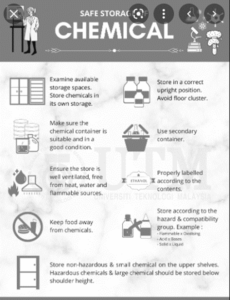
Chemical Storage Is A Matter Of Safety And Common Sense Infographic


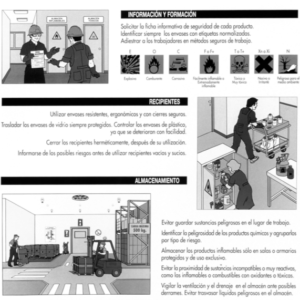
Chemical Storage Is A Matter Of Safety And Common Sense Infographic – Spanish

Fuente: https://iescelia.org/web/


Childcare Worker Safety Infographic – Spanish

Childcare-worker-Safety-Infographic-Spanish

Fuente: http://geseme.blogspot.com


Cleaning Pesticide Soiled Clothing

Clothing worn while applying pesticides normally becomes contaminated. From these clothes, the body can contact and absorb the chemicals. Protective clothing (long-sleeve shirts, pants, gloves, hat, and boots) can reduce pesticide exposure, but unless they are laundered properly, significant amounts of pesticides can remain on them or be passed onto other clothing. 

TOXICITY AND PESTICIDE RESIDUES

Hazards are less pronounced in handling clothing exposed to low toxicity pesticides. The ease of pesticide removal through laundering does not depend on toxicity level; however, it depends on chemical class, solubility, and formulation of the pesticide. For example, 2,4-D amine is easily removed through laundering because it is soluble in water; 2,4-D ester is much more difficult to remove through laundering.

Clothing contaminated with highly toxic and concentrated pesticides must be handled most carefully, as these pesticides can be absorbed through the skin, and/or cause serious skin injury. In general, as the concentration of active ingredients (i.e) in the pesticide increases, the removal of pesticide residue by laundering decreases.

Ordinary laundry procedures won’t rid the clothes of highly toxic and concentrated pesticide residues. 

BEFORE WASHING CLOTHING WITH PESTICIDE RESIDUE

  • Handle dirty clothing with gloves.
  • Throw away clothes soaked with pesticides. Do not try to clean them. When in doubt, remember that residue may contaminate your washing machine.
  • Leather items cannot be laundered. Discard these items to avoid being exposed every time you wear them.
  • Shake clothing outside if you worked with pesticides that are granular, dust, or powders. Check pockets and cuffs for pesticide particles.

HOW TO CHOOSE LAUNDRY DETERGENT: Choose a phosphate (powdered) detergent or a heavy-duty liquid detergent. Heavy-duty liquid detergents are particularly effective in removing oily mollifiable concentrate (EC) formulations and are insensitive to water hardness.  Phosphate-powdered detergents are particularly effective in removing particulate soils (wettable powder formulations) but are sensitive to hard water. 

REPELLENT FINISHES: Research also indicates that fluorochemical soil repellent finishes for pesticide applicator protective apparel fabric reduce pesticide absorption, and thus give barrier properties to work clothes. However, such finishes are temporary, and should be reapplied after every second laundering. Scotchgarde is a trade name of a spray fluorochemical soil repellent finish. 

LAUNDERING RECOMMENDATIONS FOR PESTICIDE-CONTAMINATED CLOTHING. 

  • Keep contaminated clothing separate from other garments. Use a disposable plastic bag placed in a plastic box to hold them rather than a cloth bag or laundry basket. Wear rubber gloves when putting contaminated garments into the bag, and again when placing garments in the washer. If pesticide has left a stain, apply a prewash soil and stain remover, or rub in a heavy-duty liquid detergent. 
  • Pre-rinse contaminated clothing by hosing down outdoors, soaking in a separate tub or pail, or agitating in the washing machine. If rinsing outdoors, rinse and dispose of water away from ground water sources and away from areas where children play, or animals are kept. 
  • Ideally, a separate washer should be purchased and used to wash pesticide contaminated clothing but always wash contaminated clothing separately from the family wash. Research shows that pesticide residues are transferred from contaminated clothing to other clothing when they are laundered together.
  • Wash only a few contaminated garments at a time. Wash garments contaminated by the same pesticides together. 
  • Use as hot a water temperature as possible–the hotter the better. Cold water washing may save energy, but it will not remove the pesticide effectively. 
  • Set washer water level for extra large or large load to flush fabrics thoroughly. Use regular cycle (at least 12 minutes) and normal wash speed settings. A double rinse is recommended. 
  • Laundry additives such as chlorine bleach or ammonia do not improve removal of pesticide residues. Never use ammonia and chlorine bleach in the same wash load. 
  • Clothing worn while using low toxicity products may be laundered effectively in one machine washing. Check the pesticide label for keywords indicating toxicity levels. Remember to discard clothing heavily soiled with full-strength or concentrated liquid pesticides.  
  • Line dry the garments. This prevents the possibility of residues collecting in the dryer. 
  • Remove any leftover pesticides from the washer by running an “empty load” through the complete cycle, using hot water, full or normal water level, detergent, and normal or regular machine settings and cycles.

FINAL WORD

Ordinary laundry procedures will not rid clothes of highly toxic pesticide residues. Clothing contaminated with highly toxic and concentrated pesticide can be absorbed through the skin and cause serious skin injury.


Cleaning Pesticide Soiled Clothing – Spanish

QUÉ ESTÁ EN RIESGO

La ropa que se lleva al aplicar los plaguicidas normalmente se contamina. A través de esta ropa, el cuerpo puede entrar en contacto con los productos químicos y absorberlos. La ropa de protección (camisas de manga larga, pantalones, guantes, gorro y botas) puede reducir la exposición a los plaguicidas, pero a menos que se lave adecuadamente, pueden permanecer en ella cantidades significativas de plaguicidas o pasar a otras prendas. 

CUÁL ES EL PELIGRO

TOXICIDAD Y RESIDUOS DE PLAGUICIDAS

Los riesgos son menos pronunciados en la manipulación de la ropa expuesta a plaguicidas de baja toxicidad. La facilidad para eliminar los plaguicidas mediante el lavado no depende del nivel de toxicidad; sin embargo, depende de la clase química, la solubilidad y la formulación del plaguicida. Por ejemplo, la amina del 2,4-D se elimina fácilmente con el lavado porque es soluble en agua; el éster del 2,4-D es mucho más difícil de eliminar con el lavado.

La ropa contaminada con plaguicidas altamente tóxicos y concentrados debe manipularse con sumo cuidado, ya que estos plaguicidas pueden absorberse a través de la piel y/o causar graves lesiones cutáneas. En general, a medida que aumenta la concentración de ingredientes activos (es decir, en el plaguicida), disminuye la eliminación de los residuos de plaguicidas mediante el lavado.

Los procedimientos ordinarios de lavado no librarán a la ropa de los residuos de plaguicidas altamente tóxicos y concentrados. 

COMO PROTEGERSE

ANTES DE LAVAR LA ROPA CON RESIDUOS DE PLAGUICIDAS

  • Manipule la ropa sucia con guantes.
  • Tire la ropa empapada de plaguicidas. No intente limpiarlas. En caso de duda, recuerde que los residuos pueden contaminar su lavadora.
  • Los artículos de cuero no se pueden lavar. Deseche estos artículos para evitar estar expuesto cada vez que los use.
  • Sacuda la ropa al aire libre si ha trabajado con plaguicidas en forma de gránulos, polvo o polvos. Revise los bolsillos y los puños en busca de partículas de plaguicidas.

CÓMO ELEGIR EL DETERGENTE PARA LAVANDERÍA: Elija un detergente con fosfato (en polvo) o un detergente líquido de alta resistencia. Los detergentes líquidos de uso intensivo son especialmente eficaces para eliminar las fórmulas de concentrados aceitosos molibles (EC) y son insensibles a la dureza del agua.  Los detergentes con polvo de fosfato son especialmente eficaces para eliminar la suciedad en partículas (formulaciones de polvo mojable), pero son sensibles al agua dura. 

ACABADOS REPELENTES: Las investigaciones también indican que los acabados fluoroquímicos repelentes de la suciedad para los tejidos de las prendas de protección de los aplicadores de plaguicidas reducen la absorción de plaguicidas y, por tanto, confieren propiedades de barrera a la ropa de trabajo. Sin embargo, estos acabados son temporales y deben volver a aplicarse después de cada dos lavados. Scotchgarde es el nombre comercial de un acabado fluoroquímicos repelente de la suciedad en aerosol.

RECOMENDACIONES PARA EL LAVADO DE LA ROPA CONTAMINADA CON PLAGUICIDAS 

  • Mantenga la ropa contaminada separada de las demás prendas. Utilice una bolsa de plástico desechable colocada en una caja de plástico para guardarlas en lugar de una bolsa de tela o un cesto de la ropa. Utilice guantes de goma cuando introduzca las prendas contaminadas en la bolsa y, de nuevo, cuando coloque las prendas en la lavadora. Si el plaguicida ha dejado una mancha, aplique un quitamanchas antes del lavado, o frote con un detergente líquido de alta resistencia. 
  • Enjuague previamente la ropa contaminada con una manguera al aire libre, remojándola en una bañera o cubo separado, o agitándola en la lavadora. Si se aclara al aire libre, aclare y elimine el agua lejos de las fuentes de agua subterránea y de las zonas donde juegan los niños o donde hay animales. 
  • Lo ideal es comprar una lavadora independiente y utilizarla para lavar la ropa contaminada con plaguicidas, pero siempre hay que lavar la ropa contaminada por separado de la ropa familiar. Las investigaciones demuestran que los residuos de plaguicidas se transfieren de la ropa contaminada a otras prendas cuando se lavan juntas.
  • Lave sólo unas pocas prendas contaminadas a la vez. Lave juntas las prendas contaminadas por los mismos plaguicidas. 
  • Utilice la temperatura del agua más caliente posible: cuanto más caliente, mejor. El lavado con agua fría puede ahorrar energía, pero no eliminará el plaguicida de forma eficaz. 
  • Ajuste el nivel de agua de la lavadora para una carga extragrande o grande para lavar bien los tejidos. Utilice el ciclo normal (al menos 12 minutos) y los ajustes de velocidad de lavado normales. Se recomienda un doble aclarado. 
  • Los aditivos para la ropa, como la lejía o el amoníaco, no mejoran la eliminación de los residuos de plaguicidas. No utilice nunca amoníaco y lejía en la misma carga de lavado. 
  • La ropa que se utiliza con productos de baja toxicidad puede lavarse eficazmente en un solo lavado a máquina. Compruebe en la etiqueta del plaguicida las palabras clave que indican los niveles de toxicidad. Recuerde que debe desechar la ropa muy ensuciada con plaguicidas líquidos de gran potencia o concentrados.  
  • Seque las prendas en la cuerda. Esto evita la posibilidad de que los residuos se acumulen en la secadora. 
  • Elimine los restos de plaguicidas de la lavadora haciendo pasar una “carga vacía” por el ciclo completo, utilizando agua caliente, el nivel de agua completo o normal, el detergente y los ajustes y ciclos normales o habituales de la máquina.

CONCLUSIÓN

Los procedimientos ordinarios de lavado no eliminan los residuos de plaguicidas altamente tóxicos de la ropa. La ropa contaminada con plaguicidas altamente tóxicos y concentrados puede ser absorbida por la piel y causar graves lesiones cutáneas.


Chocking and Blocking Safety Stats and Facts – Spanish

HECHOS

  1. Para evitar los peligros asociados a la fluencia del remolque, todos los remolques deben estar sujetos durante las operaciones de carga y descarga. La forma más común de sujeción son los calzos para las ruedas, que son bloques en forma de cuña colocados delante de las ruedas traseras del remolque. Cuando se utilizan correctamente, los calzos de las ruedas evitan el deslizamiento del remolque limitando su movimiento hacia delante. La falta de tracción entre el calzo y el pavimento, a menudo causada por la lluvia, la nieve y el hielo, puede hacer que el calzo se deslice, reduciendo así su eficacia.
  2. Es fundamental bloquear todas las formas de energía peligrosa, incluida la energía potencial debida a la gravedad, la presión hidráulica o cualquier energía almacenada que pueda hacer que el equipo se mueva o derive, como la energía eléctrica o mecánica. La falta de bloqueo permite que los equipos se muevan o caigan, golpeando a los trabajadores, lo que podría provocar lesiones mortales y críticas. 
  3. A menos que se haya asegurado de que el equipo elevado no pueda moverse bloqueando de forma segura el movimiento, el potencial de colapso es muy grande. En la mayoría de los incidentes en los que el equipo se ha venido abajo de forma inesperada, la persona que estaba debajo no tuvo tiempo de reaccionar y escapar: ocurre más rápido de lo que se puede mover. 
  4. Los calzos (o bloqueos) evitan que los camiones con remolque se desplacen o vuelquen mientras se cargan, descargan o revisan. Los calzos son especialmente importantes en superficies irregulares o inclinadas.

ESTADÍSTICAS

  • En 2020, la industria minera estadounidense vio cómo los accidentes mortales se cobraban la vida de 29 trabajadores, según el Departamento de Trabajo de Estados Unidos. Los incidentes relacionados con vehículos causan una gran parte de estos accidentes año tras año y ponen de manifiesto la necesidad de contar con equipos de seguridad minera adecuados, como calzos para las ruedas.
  • Más del 25% de los accidentes industriales se producen en el muelle de carga, y por cada accidente se producen unos 600 cuasi accidentes. 
  • En varios casos, (28 %) los casos de ruedas que no estaban bien sujetas dieron lugar a catástrofes en los camiones: lesiones o muertes que podrían haberse evitado con el uso adecuado de equipos de seguridad para remolques de tractores, como los calzos para ruedas industriales.
  • En 2017, se registraron 270.000 lesiones en la industria del transporte y el almacenamiento causadas por el estrangulamiento y el bloqueo inadecuado de las ruedas de los camiones. La misma industria también vio 819 muertes, un número sólo superado por la industria de la construcción. El número de lesiones laborales mortales evitables en el transporte y el almacenamiento creció un 5,3% en 2017.
  • Los datos de la Oficina de Estadísticas Laborales (BLS) indican que un promedio de 3 trabajadores muere y muchos más resultan heridos en accidentes en muelles de carga causados por calzos de ruedas inadecuados o incorrectos cada año.


Cleaning Pesticide Soiled Clothing Stats an Facts

FACTS

  1. Pesticide exposures can lead to symptoms including:
    • nausea/vomiting
    • headaches
    • dizziness
    • shortness of breath
  1. Pesticides can enter the body in several ways — through the skin, mouth, lungs, and eyes. Skin contamination is the number one cause of pesticide-related illness. To keep pesticides off your skin you will need special protective gear. Limit clothing worn while handling pesticides to that use only.
  2. Any time you work with pesticides, you will need at least a long-sleeved shirt, long pants, gloves, a hat and socks and shoes. Always read pesticide labels for information on what to wear.
  3. The more toxic a pesticide, the more care should be taken in protecting against contamination and in laundering clothes. 
  4. Clothing can keep pesticides away from the skin, however, that same clothing can become a source of contamination if pesticides aren’t laundered out after each wearing. 

STATS

  • An average of about 200,000 people die from the toxic exposure of pesticides per year across the world, the United Nations says, calling for tougher global regulation of substances meant to control pests or weeds for plant cultivation.
  • The World Health Organization estimates the total cases of pesticide poisoning worldwide at between 2 and 5 million workers each year, of which 40,000 are fatal.
  • Exposure to pesticides and agrochemicals constitutes one of the major risks faced by farm workers, accounting in some countries for as much as 14% of all occupational injuries in the agricultural sector and 10% of all fatal injuries.
  • Developing countries consume more than 20% of the world production of agrochemicals, which are responsible for approximately 70% of the total cases of acute poisoning in the working population, i.e., more than 1.1 million cases.


Chocking and Blocking Safety Fatality File

Passenger struck by propeller while attempting to move wheel chocks

The pilot reported that he performed the pre-flight inspection at night and started the airplane, but the Cessna 172 would not move forward as he attempted to taxi from parking to the runway at the airport in Key West, Florida.

He looked out the left window in search of wheel chocks, while his passenger exited the right door and checked the right main landing gear wheel for chocks.

The passenger then moved to the front of the airplane and attempted to remove the chocks from the nose wheel. His right hand was struck by the propeller, causing serious injury.

The pilot reported that there were no pre-accident mechanical failures or malfunctions with the airplane that would have precluded normal operation.

Probable Cause: The pilot’s and the passenger’s improper decision to have the passenger attempt to move a wheel chock while the propeller was turning, which resulted in a serious injury. 


Chocking and Blocking Safety Fatality File – Spanish

Pasajero golpeado por la hélice al intentar mover los calzos de las ruedas

El piloto informó de que realizó la inspección previa al vuelo por la noche y puso en marcha el avión, pero la Cessna 172 no avanzaba cuando intentaba rodar desde el aparcamiento hasta la pista en el aeropuerto de Key West, Florida.

Miró por la ventanilla izquierda en busca de calzos en las ruedas, mientras que su pasajero salió por la puerta derecha y comprobó si había calzos en la rueda derecha del tren de aterrizaje principal.

A continuación, el pasajero se dirigió a la parte delantera del avión e intentó quitar los calzos de la rueda de morro. Su mano derecha fue golpeada por la hélice, lo que le causó lesiones graves.

El piloto informó de que no había fallos mecánicos o mal funcionamiento del avión antes del accidente que hubieran impedido su funcionamiento normal.

Causa probable: La decisión inadecuada del piloto y del pasajero de que éste intentara mover un calzo de la rueda mientras la hélice estaba girando, lo que provocó una lesión grave.  


Cleaning Pesticide Soiled Clothing Fallen Phrases

CLEANING-PESTICIDE-SOILED

Answer: 

Clothing contaminated with highly toxic and concentrated pesticides must be handled most carefully, as these pesticides can be absorbed through the skin and cause serious skin injury. Clothing worn while applying pesticides normally becomes contaminated. From these clothes, the body can contact and absorbed the chemical.


Chocking and Blocking Safety Infographic – Spanish

Fuente: https://www.interempresas.net


Cleaning Pesticide Soiled Clothing Infographic

Cleaning-Pesticide-Soiled-Clothing-Infographic

Source: https://crops.extension.iastate.edu