Fatigue Infographic

Source: https://www.ccohs.ca
Source: https://www.ccohs.ca

Fuente: https://ticsyformacion.com
WORKING AT HEIGHT
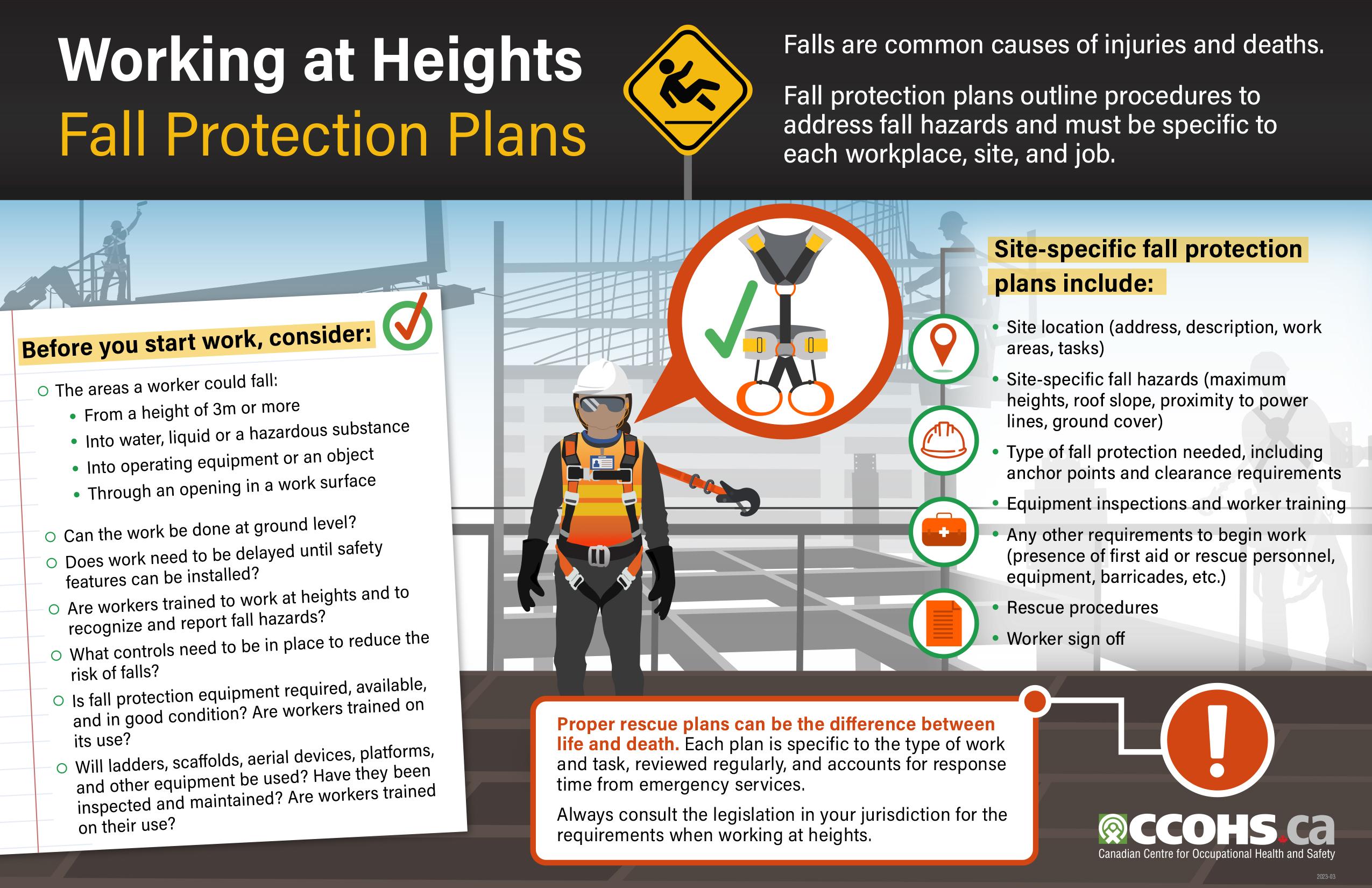
Working at height refers to any work where a person could potentially fall and injure themselves. A ladder, a roof’s edge, an opening on the floor, and even a loading dock can be considered working at height. In general industry, fall protection is required by OSHA for any height change of 4 feet or more.
Site specific risk assessment
Construction work carried out where there is a risk of a person falling more than 2 metres is deemed high risk construction work and therefore requires a safe work method statement. A safe work method statement is based on a site specific risk assessment and includes the measures for eliminating workplace risks or minimising these risks as far as is reasonably practicable. A safe work method statement must be developed in consultation with workers who are carrying out the high risk construction work before the commencement of any construction work’.
HAZARD IDENTIFICATION
Identified hazards must be assessed by considering the likelihood of a fall occurring and the severity of any injury that may result. Things to consider when assessing risk might include the height at which the work is to be undertaken, the surface underneath the work area, the potential for slipping on the surfaces, the slope of surfaces, the stability of the structures on which the work will be undertaken, the stability of the ground that work structures are resting on and protection from falling from open edges where there is a change of level.
EXAMPLES
Reduce the risk. Fall protection must be provided for anyone when the risk of a fall from height cannot be eliminated and it is likely that an injury could occur as a result of the fall. However, if the type of work makes it difficult for a worker to be fully aware of the location of the platform edge (for example, welding, oxy acetylene cutting and other work involving restricted vision) fall protection should be provided regardless of height.
Eliminate the hazard. Working on the ground is the most effective method of protecting workers from fall hazards.
Substitute with a safer surface. Work from a solid construction (a level surface that is structurally capable of supporting workers, material and any other loads.
Isolate the hazard. Use physical barriers to protect workers from falls.
Engineering controls.
Administrative controls. Require a high level of training and supervision to be effective. They should generally be used to support other control measures rather than as the sole control measure. Administrative controls include:
Personal protective equipment. Individual fall arrest systems are designed to arrest a falling person safely and their correct use relies on many factors, including the availability of properly engineered anchorage points.
Fall arrest systems and travel restraint systems personal protective equipment, should only be used when other means of providing fall protection, such as scaffolds, guardrails and elevating work platforms have been considered and are not practicable.
GETTING HIGH ON SAFETY OVERVIEW
Workers should try to avoid working at height if at all possible. If they can’t, they should ensure that they use the right equipment and safety procedures for their specific task and ensure their personal workspace is safe.
Although there are many hazardous situations that are common to most construction work sites, there are also hazards particular to a specific project or work site. It’s important that safety plans and training programs address the potential hazards specific to project and its site especially working at heights.
TRABAJO EN ALTURA
Por trabajo en altura se entiende cualquier trabajo en el que una persona pueda caerse y lesionarse. Una escalera, el borde de un tejado, una abertura en el suelo e incluso un muelle de carga pueden considerarse trabajos en altura. En la industria general, la OSHA exige protección contra caídas para cualquier cambio de altura de 4 pies o más.
Evaluación de riesgos específicos de la obra
Los trabajos de construcción realizados cuando existe el riesgo de que una persona caiga más de 2 metros se consideran trabajos de construcción de alto riesgo y, por lo tanto, requieren una declaración de método de trabajo seguro. Una declaración de método de trabajo seguro se basa en una evaluación de riesgos específica de la obra e incluye las medidas para eliminar los riesgos del lugar de trabajo o minimizar estos riesgos en la medida en que sea razonablemente factible. Una declaración de método de trabajo seguro debe desarrollarse en consulta con los trabajadores que realizan el trabajo de construcción de alto riesgo antes del comienzo de cualquier trabajo de construcción”.
IDENTIFICACIÓN DE PELIGROS
Los peligros identificados deben evaluarse teniendo en cuenta la probabilidad de que se produzca una caída y la gravedad de cualquier lesión que pudiera resultar. Entre los aspectos que deben tenerse en cuenta al evaluar el riesgo se incluyen la altura a la que se va a realizar el trabajo, la superficie bajo la que se encuentra la zona de trabajo, la posibilidad de resbalar en las superficies, la pendiente de las superficies, la estabilidad de las estructuras sobre las que se va a realizar el trabajo, la estabilidad del suelo sobre el que se apoyan las estructuras de trabajo y la protección frente a caídas desde bordes abiertos donde haya un cambio de nivel.
EJEMPLOS
Reducir el riesgo. Debe proporcionarse protección contra caídas a cualquier persona cuando no pueda eliminarse el riesgo de caída desde altura y sea probable que pueda producirse una lesión como consecuencia de la caída. Sin embargo, si el tipo de trabajo dificulta que un trabajador sea plenamente consciente de la ubicación del borde de la plataforma (por ejemplo, soldadura, corte con oxiacetileno y otros trabajos que impliquen una visión restringida) debe proporcionarse protección contra caídas independientemente de la altura.
Elimine el peligro. Trabajar en el suelo es el método más eficaz para proteger a los trabajadores de los riesgos de caída.
Sustituir por una superficie más segura. Trabaje desde una construcción sólida (una superficie nivelada que sea estructuralmente capaz de soportar a los trabajadores, el material y cualquier otra carga.
Aísle el peligro. Utilice barreras físicas para proteger a los trabajadores de las caídas.
Controles técnicos.
Controles administrativos. Requieren un alto nivel de formación y supervisión para ser eficaces. Por lo general, deben utilizarse como apoyo a otras medidas de control y no como única medida de control. Los controles administrativos incluyen:
Equipos de protección individual. Los sistemas individuales de detención de caídas están diseñados para detener con seguridad a una persona que se cae y su uso correcto depende de muchos factores, incluida la disponibilidad de puntos de anclaje diseñados adecuadamente.
Los sistemas de detención de caídas y el equipo de protección personal de los sistemas de retención de desplazamiento sólo deben utilizarse cuando se hayan considerado otros medios para proporcionar protección contra caídas, como andamios, barandillas y plataformas de trabajo elevadoras, y no sean viables.
VISIÓN GENERAL DE LA SEGURIDAD EN ALTURA
En la medida de lo posible, los trabajadores deben evitar trabajar en altura. Si no pueden, deben asegurarse de que utilizan el equipo y los procedimientos de seguridad adecuados para su tarea específica y de que su espacio de trabajo personal es seguro.
Aunque hay muchas situaciones peligrosas que son comunes a la mayoría de las obras de construcción, también hay peligros específicos de un proyecto o una obra concretos. Es importante que los planes de seguridad y los programas de formación aborden los peligros potenciales específicos del proyecto y su emplazamiento, especialmente el trabajo en altura.
A carpenter died after falling approximately 12 feet on a cement floor at the construction site of a new building. The victim and a co-worker were using a self-propelled elevating work platform to install 12’ x 4’ sheets of drywall when the accident occurred. The platform of the scissor lift was 8 feet long with a 3-foot telescoping extension. Since the drywall sheets were 12 feet long, the end guardrail was removed to accommodate them. The victim inadvertently fell from the unguarded end of the platform.
WorkSafeNB determined the causes of the accident were:
Recommended Preventive Action
The appropriate scissor lift for the job must be used. In this case, a larger scissor lift would have accommodated the sheets of drywall without necessitating the removal of guardrails.
Safe operation of self-propelled elevating work platforms
Un carpintero murió tras caer aproximadamente 12 pies sobre un suelo de cemento en la obra de construcción de un nuevo edificio. La víctima y un compañero de trabajo estaban utilizando una plataforma elevadora de trabajo autopropulsada para instalar placas de yeso de 12′ x 4′ cuando ocurrió el accidente. La plataforma del elevador de tijera tenía 8 pies de largo con una extensión telescópica de 3 pies. Como las planchas de yeso medían 4,5 m, se retiró la barandilla del extremo para poder colocarlas. La víctima cayó inadvertidamente desde el extremo no protegido de la plataforma.
WorkSafeNB determinó que las causas del accidente fueron:
Acción preventiva recomendada
Debe utilizarse la plataforma elevadora de tijera adecuada para el trabajo. En este caso, una plataforma elevadora de tijera más grande habría servido para colocar las placas de yeso sin necesidad de retirar las barandillas.
Utilización segura de plataformas elevadoras autopropulsadas

Fuente: https://charlasdeseguridad.com

Source: https://www.ccohs.ca/images
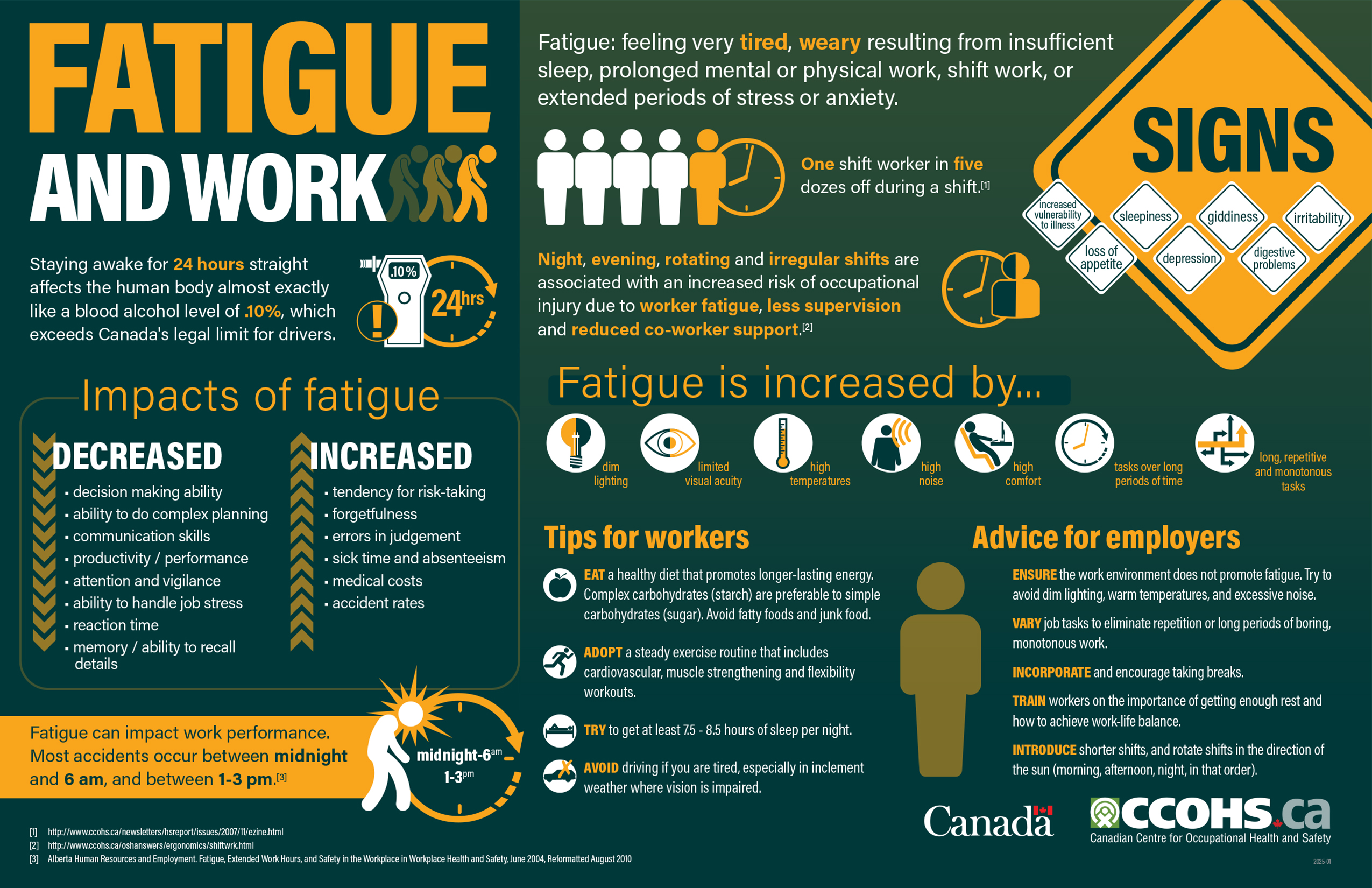
¿QUÉ ES LA FATIGA?
La fatiga puede definirse en términos generales como una sensación de cansancio, fatiga o falta de energía. La fatiga es una dolencia frecuente, pero, desde el punto de vista médico, se reconoce más como síntoma o causa de otras afecciones que como una afección en sí misma. La mejor manera de entender la fatiga es a lo largo de un continuo. En un extremo del espectro está la fatiga que la mayoría de nosotros experimentamos ocasionalmente en el curso de nuestras vidas cuando nos sobrecargamos física o mentalmente. Este tipo de fatiga no es grave y suele resolverse de forma rápida y sencilla, por ejemplo, descansando más. En el otro extremo se encuentra una forma menos frecuente pero más grave de fatiga que es síntoma de una enfermedad más crónica e incapacitante, como el trastorno depresivo mayor o el síndrome de fatiga crónica. Esta forma de fatiga es un estado de cansancio agudo y/o continuo que conduce al agotamiento mental o físico e impide a las personas funcionar como de costumbre.
DAÑOS/PELIGROS DE LA FATIGA
El riesgo de cometer errores en el trabajo aumenta drásticamente si los trabajadores duermen menos de siete u ocho horas, o están despiertos más de 17 horas consecutivas.
La fatiga reduce su capacidad para tomar decisiones y realizar planificaciones complejas.
La fatiga ralentiza su tiempo de reacción y su capacidad para responder a cambios en el entorno o en la información facilitada.
La fatiga disminuye su productividad y rendimiento y su capacidad para manejar el estrés.
La fatiga reduce el bienestar general y aumenta el riesgo de enfermedades.
La fatiga también puede provocar micro sueños involuntarios, o breves periodos de inconsciencia, que pueden durar de dos a treinta segundos. Estos episodios pueden imitar los efectos de estar bajo los efectos del alcohol. Dieciocho horas sin dormir son similares a los efectos de una concentración de alcohol en sangre (BAC) de 0,05, mientras que 24 horas sin dormir son similares a una BAC de 0,10. Estos efectos pueden ser especialmente peligrosos cuando se maneja maquinaria o se conduce.
FATIGA: UN PROBLEMA EN EL LUGAR DE TRABAJO. Todo el mundo debería preocuparse por el impacto de la fatiga, ya que puede considerarse una forma de
deficiencia, lo que la convierte en un peligro en el lugar de trabajo.
La fatiga aumenta por:
En el trabajo, los empleados fatigados pueden:
SUEÑO Y FATIGA EN EL TRABAJO. Los estudios de investigación han demostrado que cuando los trabajadores han dormido menos de 5 horas antes del trabajo o cuando han estado despiertos más de 16 horas, aumentan significativamente sus probabilidades de cometer errores en el trabajo debido a la fatiga.
La investigación ha demostrado que el número de horas despierto puede ser similar a los niveles de alcohol en sangre. Un estudio señala lo siguiente:
17 horas despierto equivale a una tasa de alcoholemia de 0,05
21 horas despierto equivale a un contenido de alcohol en sangre de 0,08 (límite legal en Canadá)
24-25 horas despierto equivale a una tasa de alcoholemia de 0,10.
Se considera que la fatiga influye en el rendimiento laboral. La mayoría de los incidentes se producen cuando la gente tiene más ganas de dormir: entre medianoche y las 6 de la mañana, y entre la 1 y las 3 de la tarde. La fatiga afecta a las personas de forma diferente, pero puede aumentar la exposición de un trabajador a los riesgos al:
BUENAS PRÁCTICAS PARA PROTEGERSE DE LA FATIGA
La fatiga en el trabajo no tiene por qué convertirse en una pesadilla de lesiones y accidentes. Cuídate durmiendo lo suficiente, alimentándote bien y conociendo los factores que desencadenan la fatiga.
Cuando los comensales visitan un restaurante, se preocupan más por la calidad de la comida y la carta de bebidas que por la seguridad. Los trabajadores de los restaurantes, como anfitriones, camareros y ayudantes de camarero comparten la responsabilidad de trabajar de forma segura.
PRINCIPALES RIESGOS PARA LA SALUD Y LA SEGURIDAD DEL PERSONAL DE LOS RESTAURANTES
ORIENTACIONES PARA HACER FRENTE A LAS PRÁCTICAS DEL SERVICIO DE COMIDAS – SEA PROACTIVO
Cortes y trabajo con cuchillos
Seguridad contra incendios
Quemaduras y escaldaduras
Resbalones y caídas
MEJORES PRÁCTICAS SEGURAS EN EL TRABAJO DE RESTAURANTES
Servidores, camareros, anfitriones y azafatas, ayudantes de camarero, chefs y cocineros, lavaplatos y demás personal de hostelería son un retrato robot de lo que supone ofrecer a los comensales un buen plato. Un fallo en la cadena de custodia y entrega de esa comida especial puede significar casi un desastre para el comensal, los propietarios y el personal.
When diners visit a restaurant, they are more concerned with the food quality and the beverage list than safety. Restaurant workers such as hosts, servers, and bussers share the responsibility to work safely together.
PRINCIPAL HEALTH AND SAFETY HAZARDS FOR RESTAURANTS PERSONNEL
GUIDANCE IN DEALING WITH FOOD SERVICE PRACTICES – BE PROACTIVE
Cuts And Working with Knives
Fire Safety
Burns & Scalds
Slips & Falls
BEST SAFE FINE DINING WORK PRACTICES
Servers, table wait staff, hosts and hostesses, bus boys, chefs and cooks, dish washers and other food hospitality staff point a composite picture of what goes into in delivering to you diners a fine food dish. One breakdown in the chain of custody and delivery of that special meal can mean a near disaster for diner, owners and staff.
There are a diverse range of potential safety hazards that restaurant employees can encounter on a daily basis.
Existe una amplia gama de riesgos potenciales para la seguridad que los empleados de restaurantes pueden encontrar a diario.
Una mezcla accidental de productos de limpieza -ácido y lejía- generó gases tóxicos que mataron al gerente de un Buffalo Wild Wings en Massachusetts, según informaron el viernes las autoridades.
El gerente del restaurante, Ryan Baldera, de 32 años, murió y otras 13 personas fueron trasladadas al hospital, según el Departamento de Bomberos de Burlington, Massachusetts, un suburbio de Boston.
El accidente se produjo poco después de las 17.30 horas, cuando un trabajador empezó a limpiar el suelo de la cocina justo antes de la hora punta de la cena.
Pero ese empleado no sabía que antes se había derramado en el suelo un limpiador a base de ácido, Scale Kleen. Así que cuando el trabajador utilizó Super 8 a base de cloro y lejía en el suelo, la mezcla se volvió verde y empezó a burbujear.
Después de que el trabajador huyera de la cocina con ardor en los ojos y problemas respiratorios, el gerente cogió una escobilla de goma y trató de empujar el brebaje verde burbujeante fuera del restaurante y hacia un desagüe exterior antes de que fuera incapaz de continuar, según el jefe.
Fue rápidamente superado … y el squeegeeing le llevó a una condición médica grave.
Tanto la escala Kleen y Super 8 limpiadores tenían etiquetas claras advirtiendo que no se mezclen con otros productos, de acuerdo con funcionarios de bomberos.
Baldera falleció en el Lahey Hospital & Medical Center de Burlington.
Auto-Chlor System, con sede en Memphis, parece ser el fabricante tanto de Scale Kleen como de Super 8. Pero en una declaración de la empresa, sólo se refirió a Super 8.
“Ante todo, nuestras condolencias están con la persona y su familia, así como con los afectados ayer durante el incidente. La seguridad y el bienestar de nuestros clientes son nuestra primera prioridad, siempre.”
El comunicado continúa: “En este momento, trabajando con la OSHA, las autoridades locales y los equipos de emergencia en el lugar, estamos haciendo todo lo posible para determinar todos los detalles detrás de este incidente.”
La Administración de Seguridad y Salud Ocupacional (OSHA) ha abierto una investigación en el Buffalo Wild Wings en Burlington “para determinar si hubo o no violaciones de las normas de salud y seguridad en el lugar de trabajo en relación con su incidente”, dijo un portavoz de la agencia el viernes.
“La lejía por sí sola no debería ser mortal”, dijo Rick Sachleben, químico orgánico jubilado y miembro de la Sociedad Americana de Química. “Sin embargo, cuando se mezcla con productos químicos incompatibles, puede generar gases tóxicos y eso es probablemente lo que ocurrió aquí”.
“Se pueden poner todas las etiquetas que se quiera, pero hay muchas cosas que utilizamos habitualmente que son potencialmente peligrosas”, dijo Sachleben.
An accidental mix of cleaners — acid and bleach — generated toxic fumes that killed the manager of a Buffalo Wild Wings in Massachusetts, authorities said Friday.
The eatery’s 32-year-old manager, Ryan Baldera, was killed and 13others were taken to the hospital, according to the Fire Department in Burlington, Massachusetts, a Boston suburb.
The accident occurred shortly after 5:30 p.m. when a worker began cleaning the kitchen floor just before the dinner rush.
But that employee did not know that an acid-based cleaner, Scale Kleen, had been spilled on the floor earlier. So when the worker used chlorine- and bleached-based Super 8 on the floor, the mixture turned green and started to bubble.
After that worker fled the kitchen with burning eyes and breathing issues, the manager grabbed a squeegee and tried to push the bubbling green concoction out of the restaurant and into an outdoor drain before he was unable to continue, according to the chief.
He was quickly overcome … and the squeegeeing led him to a severe medical condition.
Both the Scale Kleen and Super 8 cleaners had clear labels warning not to mix them with other products, according to fire officials.
Baldera died at Lahey Hospital & Medical Center in Burlington.
Memphis-based Auto-Chlor System appears to be the maker of both Scale Kleen and Super 8. But in a company statement, it only referred to Super 8.
“First and foremost, our condolences are with the individual and their family as well as those affected yesterday during the incident. The safety and well-being of our customers are our first priority, always.”
The statement continued, “At this time, working with OSHA, local authorities, and emergency teams on site, we are doing everything we can to determine all details behind this incident.”
The Occupational Safety and Health Administration (OSHA) has opened an investigation at the Buffalo Wild Wings in Burlington “to determine whether or not there were violations of workplace health and safety standards in connection to his incident,” an agency spokesman said on Friday.
“Bleach by itself shouldn’t be deadly,” said Rick Sachleben, a retired organic chemist and member of the American Chemical Society. “However when it’s a mixed with incompatible chemicals, it can generate toxic gasses and that’s probably what happened here.”
“You can put all the labels you want, but there are lots of things we use on a regular basis that are potential dangerous,” said Sachleben.

Fuente: https://www.rcm.it
Fire extinguishers are an important tool in preventing a small fire from growing larger. However, they should not be used to combat large or rapidly spreading fires. The most important thing to do during a fire is to get yourself to safety then call the proper authorities to combat the fire. A building and the property inside is not worth putting yourself or anyone at risk trying to put it out with a fire extinguisher. It is important to understand how to use a fire extinguisher and the limitations they have.
TYPES OF EXTINGUISHERS
HOW TO CHOOSE A FIRE EXTINGUISHER
HOW TO USE A FIRE EXTINGUISHER – P.A.S.S
The easiest way to remember how to use a fire extinguisher is to follow the P.A.S.S. method. The PASS acronym was developed to allow people to remember the basic four steps to properly using a fire extinguisher.
P- Pull. Pull the pin. Hold the extinguisher away and release the locking mechanism.
A- Aim. Aim the stream towards the base of the fire. Spraying the flames will not put the fire out.
S- Squeeze. Squeeze the lever slowly and evenly. Pulling the lever too fast may shoot the stream from your target wasting the valuable firefighting agent.
S- Sweep. Sweep the nozzle side to side to combat the fire.
FIRE EXTINGUISHER LIMITATIONS
FIRE EXTINGUISHER INSPECTION TIPS
TRAINING AND EDUCATION
Provide this training when employees are first given this assignment and once a year thereafter.
WHEN WORKERS SHOULD NOT USE A FIRE EXTINGUISHER
If any of the following conditions are present, workers should follow evacuation procedures immediately and should not attempt to fight the fire with an extinguisher:
It is important to know more than just where the fire extinguishers are located in your work area. Make sure you know how to properly use them in case the time comes where you need to extinguish a fire. Always make sure the fire extinguishers in your work areas are in good condition through thorough inspections.
Los extintores son una herramienta importante para evitar que un incendio pequeño crezca. Sin embargo, no deben utilizarse para combatir incendios grandes o que se propaguen rápidamente. Lo más importante en caso de incendio es ponerse a salvo y llamar a las autoridades competentes para que combatan el fuego. No merece la pena poner en peligro ni a uno mismo ni a nadie intentando apagar un incendio con un extintor. Es importante entender cómo utilizar un extintor y las limitaciones que tienen.
TIPOS DE EXTINTORES
CÓMO ELEGIR UN EXTINTOR
CÓMO UTILIZAR UN EXTINTOR – J.A.A.M
La forma más fácil de recordar cómo utilizar un extintor es seguir el método J.A.A.M El acrónimo J.A.A.M. se desarrolló para permitir que la gente recuerde los cuatro pasos básicos para utilizar correctamente un extintor de incendios.
J- Jalar. Jale del pasador. Aleje el extintor y libere el mecanismo de bloqueo.
A- Apuntar. Dirija el chorro hacia la base del fuego. Rociar las llamas no apagará el fuego.
A – Apretar. Apriete la palanca lenta y uniformemente. Tirar de la palanca demasiado rápido puede disparar el chorro de su objetivo desperdiciando el valioso agente de extinción.
M – Mover en forma de barrido. Mueva la boquilla de lado a lado para combatir el fuego.
LIMITACIONES DE LOS EXTINTORES
CONSEJOS PARA LA INSPECCIÓN DE EXTINTORES
FORMACIÓN Y EDUCACIÓN
CUANDO LOS TRABAJADORES NO DEBEN UTILIZAR UN EXTINTOR DE INCENDIOS
Si se da alguna de las siguientes condiciones, los trabajadores deben seguir inmediatamente los procedimientos de evacuación y no deben intentar combatir el fuego con un extintor:
Es importante saber algo más que dónde están situados los extintores en su zona de trabajo. Asegúrese de que sabe utilizarlos correctamente por si llega el momento de apagar un incendio. Asegúrese siempre de que los extintores de sus áreas de trabajo están en buenas condiciones mediante inspecciones minuciosas.
On the morning of Wednesday, May 13, 2020, 35-year-old worker Victor Pando was killed and his 26-year-old colleague injured when a fire extinguisher exploded at the Morgan General Mail Facility at 341 Ninth Avenue in Manhattan.
The two men were injured by shrapnel that flew everywhere when the fire extinguisher exploded. Pando was struck in the neck with a piece of shrapnel; he was rushed to Lenox Hill Hospital, but tragically died of his injuries. His colleague, who was struck less severely, was transported to Bellevue Hospital. The younger worker's injuries are reported to be non-life threatening.
The two workers were recharging fire extinguishers on the fourth floor of the Morgan General Mail Facility when one of them exploded, said Department of Buildings (DOB) Press Secretary Andrew Rudansky. The two men were contractors employed by Nordest Services, LLC. The Occupational Safety and Health Administration (OSHA) is now investigating the incident and Nordest Services. According to Gothamist.com, the employer could not be reached for comment.
These men and their families are in our thoughts. We send our condolences to the family of the worker who was killed, and hope for a speedy recovery for the injured worker.
Deaths and injuries caused by explosions on a work site are rare; according to the Bureau of Labor Statistics' 2018 National Census of Fatal Occupational Injuries, there were only 115 fatal work injuries caused by fires and explosions in 2018. Clearly, however, they can still occur, and although it is not clear what exactly caused the fire extinguisher to explode in the above incident, it is always best to follow proper safety precautions to try and prevent such explosions from happening. It is important to note that fire extinguishers must comply with certain regulations in order to be considered safe for use.
En la mañana del miércoles 13 de mayo de 2020, el trabajador Víctor Pando, de 35 años, murió y su compañero, de 26, resultó herido al explotar un extintor de incendios en las instalaciones de Morgan General Mail, en el número 341 de la Novena Avenida, en Manhattan.
Los dos hombres resultaron heridos por la metralla que voló por todas partes al explotar el extintor. Pando fue alcanzado en el cuello por un trozo de metralla; fue trasladado de urgencia al hospital Lenox Hill, pero falleció trágicamente a consecuencia de sus heridas. Su compañero, que resultó herido de menor gravedad, fue trasladado al hospital Bellevue. Según los informes, las heridas del trabajador más joven no ponen en peligro su vida.
Los dos trabajadores estaban recargando extintores en la cuarta planta de las instalaciones de Morgan General Mail cuando uno de ellos explotó, dijo el secretario de prensa del Departamento de Edificios (DOB), Andrew Rudansky. Los dos hombres eran contratistas empleados por Nordest Services, LLC. La Administración de Seguridad y Salud en el Trabajo (OSHA) está investigando el incidente y a Nordest Services. Según Gothamist.com, no fue posible ponerse en contacto con el empleador para que hiciera comentarios.
Estos hombres y sus familias están en nuestros pensamientos. Enviamos nuestras condolencias a la familia del trabajador fallecido y deseamos una pronta recuperación al trabajador herido.
Las muertes y lesiones causadas por explosiones en un sitio de trabajo son raras; según la Oficina de Estadísticas Laborales' 2018 Censo Nacional de Lesiones Ocupacionales Fatales, solo hubo 115 lesiones laborales fatales causadas por incendios y explosiones en 2018. Claramente, sin embargo, todavía pueden ocurrir, y aunque no está claro qué causó exactamente que el extintor explotara en el incidente anterior, siempre es mejor seguir las precauciones de seguridad adecuadas para tratar de evitar que ocurran tales explosiones. Es importante tener en cuenta que los extintores deben cumplir ciertas normas para que su uso se considere seguro.