Roofing Fall Prevention (Single-unit Roof Coverings) Stats and Facts – Spanish

HECHOS

Causa principal de las caídas en tejados

Cuidado con el borde – Perder el borde del tejado puede ser un problema cuando se está trabajando en el tejado. Algunos trabajadores se enfrascan tanto en su proyecto que olvidan dónde está el borde del tejado.

Capacitación inadecuada – Si hay alguien en el tejado que no ha sido capacitado adecuadamente, es un peligro para la seguridad en el tejado y podría causar lesiones graves a sí mismo o a otros.

Uso inadecuado del equipo de protección contra caídas – por ejemplo, una barandilla mal anclada, una cuerda de seguridad demasiado larga o un punto de amarre débil. La comprensión y capacitación sobre cómo utilizar correctamente el equipo de protección contra caídas son fundamentales.

Mala visibilidad – Los respiraderos de la cumbrera, las chimeneas y los haces de tejas pueden bloquear la salida de un tejado. Mantenga una buena línea de visión para saber dónde se encuentra en relación con el borde del tejado.

Inclinación – Cuanto más inclinado es el tejado, mayor es el riesgo de caída. Asegúrese de que la protección contra caídas y los haces de tejas están bien sujetos antes de subir al tejado.

Tejados a dos niveles y alturas de caída – Los empleados que realicen actividades de techado en tejados de pendiente baja y a dos niveles con lados y bordes desprotegidos a 1,8 metros (6 pies) o más por encima de los niveles inferiores deben disponer de un equipo de protección contra caídas adecuado.

ESTADÍSTICAS

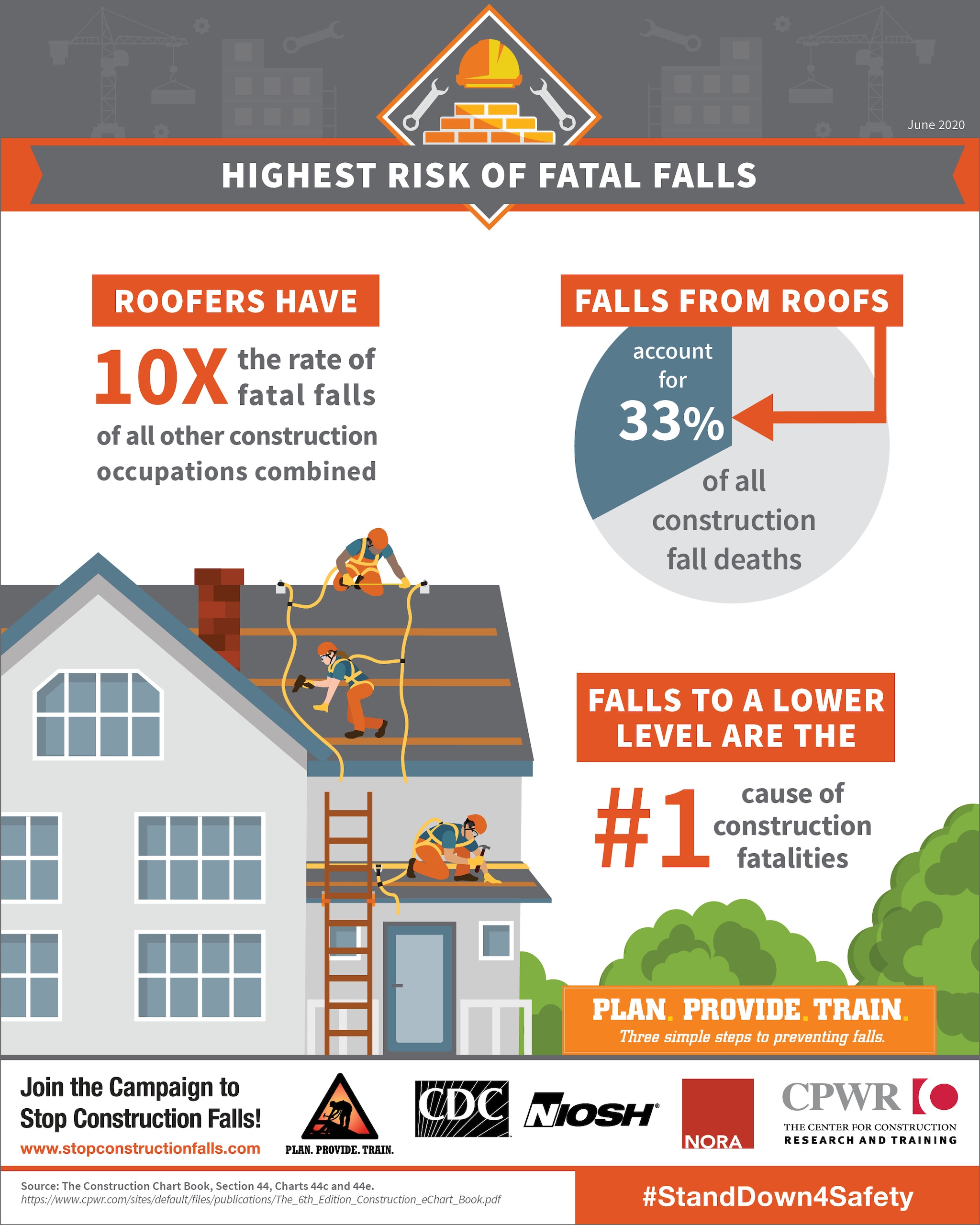
  • La profesión de instalador de tejados es 15 veces más peligrosa que cualquier otro sector. Como resultado, los trabajos de techado tienen una tasa de mortalidad del 54%, una de las más altas relacionadas con el trabajo.
  • La OSHA informa de que las caídas son la principal causa de muerte en el sector de la construcción.
  • OSHA también informa de que las caídas desde tejados representan el 34% de todas las muertes por caídas en la construcción.
  • En 2020, se produjeron 351 caídas mortales a un nivel inferior de un total de 1.008 muertes en la construcción.
  • El Centro de Investigación y Capacitación de la Construcción informa que “los techadores tienen la quinta tasa más alta de muertes relacionadas con el trabajo en la construcción, 29,9 muertes por cada 100,000 trabajadores equivalentes a tiempo completo, aproximadamente el doble del promedio para toda la construcción de 15,2”.
  • Cada año mueren en el trabajo unos 50 techadores, la mayoría por caídas.
  • En el caso de los techadores de la construcción residencial, las caídas desde los bordes del tejado representaron el 70% de las muertes por caídas relacionadas con el trabajo y el 90% de las muertes por caídas desde el tejado.
  • El porcentaje de caídas mortales desde escaleras entre los techadores residenciales es casi el doble que entre todos los techadores.


Roofing Fall Prevention (Single-unit Roof Coverings) Stats and Facts

FACTS

Primary Cause of Rooftop Falls

Edge Awareness – Losing the edge of the roof can be a problem when you are engaged in roof work. Some workers get so wrapped up in their project that they forget where the roof edge is.

Improper Training – If there is someone on the roof who has not been properly trained, they are a rooftop safety hazard and could cause serious injury to themselves or others.

Improper Use of Fall Protection Equipment – Such as poorly anchored railing, lanyard too long, or a weak tie-off point. Understanding and training on how to properly use fall protection equipment are critical.

Poor Line of Sight – Ridge vents, chimneys, shingle bundles may block egress on a roof. Maintain a good line of sight so that you know where you are in relation to the roof’s edge.

Pitch – The steeper the roof is, the risk of falling increases. Ensure that the fall protection and shingle bundles are secure before setting foot on the roof.

Split Level Roofs & Fall Heights – Employees engaged in roofing activities on low-slope and split-level roofs with unprotected sides and edges 6 feet (1.8 meters) or more above lower levels should have proper fall protection equipment.

STATS

  • The roofing profession is over 15 times more hazardous than any other sector. As a result, roofing jobs have a fatality rate of 54%, one of the highest job-related fatalities.
  • OSHA reports that falls are the number one cause of deaths in the construction industry.
  • OSHA also reports that falls from roofs account for 34% of all fall deaths in construction.
  • In 2020, there were 351 fatal falls to a lower level out of 1,008 construction fatalities.
  • The Center for Construction Research and Training reports that “roofers have the fifth-highest work-related death rate in construction, 29.9 deaths per 100,000 full-time equivalent workers, about twice the average for all construction of 15.2.
  • About 50 roofers are killed on the job each year, most by falls.
  • For roofers in residential construction, falls from roof edges accounted for 70% of work-related-fall deaths and 90% of roof fall deaths.
  • Residential roofers had almost twice the percentage of fatal falls from ladders compared to all roofers.


Roofing Fall Prevention (Single-unit Roof Coverings) Fatality Report

Roof Man Dies When He Falls from the Roof of a Two-Story House While Applying a Tent for Fumigation.

A 33-year-old Hispanic roof man died after he fell approximately 25 feet from the roof of a two-story house to the ground below. The victim was carrying a tarp to cover the roof when the incident occurred. The employer of the victim did not have a fall prevention program for their employees, and the victim was not wearing any personal fall protection device. The CA/FACE investigator determined that:

Structural fumigation companies should establish and implement a fall protection program for employees who work on roofs.

INVESTIGATION

In the process of structural fumigation, heavy-duty gauge plastic tarps are used to cover the structure prior to fumigation with sulfuryl fluoride gas. The tarps must be placed and secured on the roof of the structure by work crews. The roof man ascends a ladder from the ground to the roof while carrying the folded or rolled tarps. Each tarp can weigh up to 150 pounds. After climbing onto the roof, he unfolds the tarps and drapes them over the sides of the structure. It is usually necessary to stand on the roof while securing the tarp in place.

On the day of the incident, a three-person tenting crew was assigned to a fumigation job at a two-story home. The victim, working as the roof man, climbed an extension ladder onto the roof while carrying a tarp. A neighbor heard the sounds of the ladder movement and saw the victim sliding off the roof and falling to the ground 25 feet below. The neighbor immediately called 911. The victim’s co-workers did not witness the incident, as they were working on the other side of the house. The paramedics found the victim unresponsive and without spontaneous respirations and pronounced the victim dead at the scene.

CAUSE OF DEATH

The cause of death according to the death certificate was traumatic injuries of the head.


Roofing Fall Prevention (Single-unit Roof Coverings) Infographic

288

Source: https://www.cdc.gov


Roofing Fall Prevention (Single-unit Roof Coverings) Infographic – Spanish

289

Fuente: https://www.segurmaniazurekin.eus


Roofing Fall Prevention (Single-unit Roof Coverings) Fatality Report – Spanish

Muere un Tejador al Caer del Tejado de una Casa de Dos Plantas Mientras Aplicaba una Carpa para Fumigar.

Un hombre hispano de 33 años que trabajaba en el tejado murió tras caer aproximadamente 25 pies desde el tejado de una casa de dos plantas al suelo. La víctima llevaba una lona para cubrir el tejado cuando ocurrió el incidente. El empleador de la víctima no tenía un programa de prevención de caídas para sus empleados, y la víctima no llevaba ningún dispositivo personal de protección contra caídas. El investigador de CA/FACE determinó que:

Las empresas de fumigación estructural deben establecer e implementar un programa de protección contra caídas para los empleados que trabajan en techos.

INVESTIGACIÓN

En el proceso de fumigación estructural, se utilizan lonas de plástico de calibre grueso para cubrir la estructura antes de la fumigación con gas fluoruro de sulfurilo. Las lonas deben ser colocadas y aseguradas en el techo de la estructura por cuadrillas de trabajo. El trabajador del tejado asciende por una escalera desde el suelo hasta el tejado mientras transporta las lonas plegadas o enrolladas. Cada lona puede pesar hasta 45 kilos. Tras subir al tejado, despliega las lonas y las coloca sobre los laterales de la estructura. Suele ser necesario permanecer de pie en el tejado mientras asegura la lona en su sitio.

El día del incidente, una cuadrilla de tres personas que trabajaban en el tejado estaba asignada a un trabajo de fumigación en una casa de dos plantas. La víctima, que trabajaba en el tejado, subió al tejado por una escalera de extensión mientras llevaba una lona. Un vecino oyó el ruido del movimiento de la escalera y vio cómo la víctima se deslizaba por el tejado y caía al suelo unos 25 pies más abajo. El vecino llamó inmediatamente al 911. Los compañeros de trabajo de la víctima no presenciaron el incidente, ya que estaban trabajando en el otro lado de la casa. Los paramédicos encontraron a la víctima inconsciente y sin respiración espontánea y la declararon muerta en el lugar de los hechos.

CAUSA DE LA MUERTE

Según el certificado de defunción, la causa de la muerte fueron lesiones traumáticas en la cabeza.


Newsletter – April 2024

  • Comply with Confined Spaces Safety Training Requirements;
  • Safety Talks on Confined Spaces, Heat Stress, PPE and Lead in Construction;
  • Fatality Reports;
  • Welder’s Safety and Health Guide;
  • and more…


Retail Tagger Safety Meeting Kit

WHAT’S AT STAKE

Tagging guns used to attach price, brand, and information tags on clothing and other goods in the garment industry and retail establishments pose a bloodborne pathogen hazard to the workers that use them if they get stuck with the needles. Workers need to know the risks of using tagging guns and needles and take precautions to avoid bloodborne pathogen exposures.

TAG ATTACHMENT GUN PROCEDURE

Employees in the garment industry use tag attachment guns (a device which puts the price tags onto garments). The procedure used with these guns is common in the industry and occurs across the country, and employees are being stuck on a regular basis; it appears to be a recognized hazard in the industry.

There is potential for employees to be stuck, and actual exposure on an anticipated level. The issue of concern relating the bloodborne pathogen standard is that these needle guns can retain blood in the hollow needle and on the tool. The needle itself, which actually penetrates the skin, would be reasonably anticipated to involve the presence of blood or other potentially infectious material. When guns are exchanged between employees, e.g., during shift changes, the result is a potential transmission of bloodborne pathogens.

BLOODBORNE PATHOGENS IN THE GARMENT INDUSTRY

Bloodborne pathogens are microorganisms that are present in human blood and can cause disease in humans. The organisms that are medically crucial within health and safety are those that are transmitted person-to-person, such as Hepatitis B (HBV), Hepatitis C (HCV), and Human Immunodeficiency Virus (HIV).

There is no population that is risk free for human immunodeficiency virus or hepatitis B virus infectivity, any employee who has occupational exposure to blood or other potentially infectious material is included within the scope of this standard. Employees in the garment industry are generally considered to have occupational exposure.

WHAT’S THE DANGER

DANGERS OF TAGGER GUN USE AND BLOODBORNE PATHOGENS

  • Possible serious hazards from bloodborne pathogens associated with sharing tagging guns when instruments are not disinfected.
  • A worker that uses a tagger gun on the job may get stuck accidentally with the needle. You are at risk of a bloodborne pathogen exposure if you and others use the same tagging gun and also get stuck accidentally with the same needle. If this happens, you have been exposed to the blood of other workers and any potential bloodborne pathogens that may be in their blood such as hepatitis B and HIV. This occurs when one worker accidentally punctures his or her skin with the needle of a tagging gun and another worker using the same gun, with the same needle, sustains the same type of injury.
  • In the garment manufacturing or processing industry or other manufacturing settings there is very frequent use of a tagging gun. In the retail industry tagger guns are used less frequently. Either way, there is a “reasonably anticipated exposure to blood” with a tagger and your employer is responsible for controlling this hazard.

HOW TO PROTECT YOURSELF

AVOID INFECTIONS BLOOD – PREVENTION

Blood-borne pathogens are infectious microorganisms in human blood that can cause disease. These pathogens include, but are not limited to, hepatitis B (HBV), hepatitis C (HCV) and human immunodeficiency virus (HIV). Needle sticks and other sharps-related injuries may expose workers to blood-borne pathogens.

Take “universal precautions,” which means treating all blood and blood-containing materials as though they do actually contain blood-borne pathogens. Prevention includes:

  • regular hand washing
  • wearing protective clothing such as latex gloves when dealing with an injured person
  • avoid poking yourself with the needle from tagging guns.
  • take care if handing garbage bags to ensure no sharp objects are protruding from the bag.

WHEN A WORKER GETS A NEEDLESTICK USING A TAGGER GUN

  • Immediately wash the area with soap and water.
  • Use antiseptic cleaner until you get to soap and water ASAP.
  • Seek immediate medical attention if you are in doubt about the cleanliness of the needle.
  • Medical Treatment may include hepatitis B vaccination and drug therapy.
  • To be effective, this medical treatment should be within 24 hours of exposure.
  • Immediately report a needlestick to your employer.

SAFETY STEPS IN TAGGER OPERATIONS

  • make it a policy for workers clean and disinfect tagger needles often each use.
  • issue new needles to workers for each use.
  • assign each employee their own tagger and needle.
  • if a worker is issued their own tagger gun, only use your own gun, and do not share it with other workers.
  • get training on bloodborne pathogens, exposures, and learn the potential health consequences of violating clear needle policy.

BEST PRACTICES USE OF TAGGER GUNS

  • Make sure to watch what you are doing and know where your hands are at all times.
  • Tag clothing and materials away from your body.
  • Use a firm surface to tag against.
  • If you cannot see where you are holding the tagger and needle, reposition the work and use the tagger where you can see it and your hands.

FINAL WORD

In the garment manufacturing or processing industry or other manufacturing settings there is very frequent use of a tagging gun. In the retail industry tagger guns are used less frequently. Either way, there is a “reasonably anticipated exposure to blood” with a tagger and your employer is responsible for controlling this hazard.


Retail Tagger Safety Meeting Kit – Spanish

QUÉ ESTÁ EN RIESGO

Las pistolas de etiquetado utilizadas para colocar etiquetas de precio, marca e información en prendas de vestir y otros productos en la industria de la confección y los establecimientos minoristas suponen un riesgo de transmisión de patógenos por la sangre a los trabajadores que las utilizan si se clavan las agujas. Los trabajadores deben conocer los riesgos de utilizar pistolas de etiquetado y agujas y tomar precauciones para evitar la exposición a patógenos transmitidos por la sangre.

PROCEDIMIENTO CON PISTOLAS DE ETIQUETADO

Los empleados de la industria de la confección utilizan pistolas de fijación de etiquetas (un dispositivo que coloca etiquetas de precio en las prendas). El procedimiento utilizado con estas pistolas es común en la industria y ocurre en todo el país, y los empleados se atascan con regularidad; parece ser un peligro reconocido en la industria.

Existe la posibilidad de que los empleados queden atrapados, y la exposición real en un nivel previsto. La cuestión que preocupa en relación con la norma sobre patógenos transmitidos por la sangre es que estas pistolas de agujas pueden retener sangre en la aguja hueca y en la herramienta. La propia aguja, que penetra en la piel, podría razonablemente implicar la presencia de sangre u otro material potencialmente infeccioso. Cuando las pistolas se intercambian entre los empleados, por ejemplo, durante los cambios de turno, el resultado es una posible transmisión de patógenos transmitidos por la sangre.

PATÓGENOS TRANSMITIDOS POR LA SANGRE EN LA INDUSTRIA DE LA CONFECCIÓN

Los patógenos transmitidos por la sangre son microorganismos que están presentes en la sangre humana y pueden causar enfermedades en los seres humanos. Los organismos que son médicamente cruciales dentro de la salud y la seguridad son los que se transmiten de persona a persona, como la hepatitis B (VHB), la hepatitis C (VHC) y el virus de la inmunodeficiencia humana (VIH).

Ninguna población está libre de riesgo de infecciosidad por el virus de la inmunodeficiencia humana o el virus de la hepatitis B, por lo que cualquier empleado que tenga una exposición laboral a sangre u otro material potencialmente infeccioso está incluido en el ámbito de aplicación de esta norma. Por lo general, se considera que los empleados de la industria de la confección están expuestos profesionalmente.

CUÁL ES EL PELIGRO

PELIGROS DEL USO DE PISTOLAS ETIQUETADORAS Y PATÓGENOS TRANSMITIDOS POR LA SANGRE

  • Posibles peligros graves por patógenos de transmisión sanguínea asociados al uso compartido de pistolas etiquetadoras cuando no se desinfectan los instrumentos.
  • Un trabajador que utiliza una pistola etiquetadora en el trabajo puede pincharse accidentalmente con la aguja. Corre el riesgo de exposición a patógenos transmitidos por la sangre si usted y otras personas utilizan la misma pistola etiquetadora y también se clavan accidentalmente con la misma aguja. Si esto ocurre, habrá estado expuesto a la sangre de otros trabajadores y a cualquier posible patógeno de transmisión sanguínea que pueda haber en su sangre, como la hepatitis B y el VIH. Esto ocurre cuando un trabajador se pincha accidentalmente la piel con la aguja de una pistola de etiquetado y otro trabajador que utiliza la misma pistola, con la misma aguja, sufre el mismo tipo de lesión.
  • En la industria de fabricación o procesamiento de prendas de vestir u otros entornos de fabricación, es muy frecuente el uso de una pistola etiquetadora. En la industria minorista, las pistolas de etiquetado se utilizan con menos frecuencia. En cualquier caso, existe una “exposición razonablemente prevista a la sangre” con una pistola etiquetadora y su empleador es responsable de controlar este peligro.

COMO PROTEGERSE

EVITAR INFECCIONES SANGUÍNEAS- PREVENCIÓN

Los patógenos transmitidos por la sangre son microorganismos infecciosos presentes en la sangre humana que pueden causar enfermedades. Estos patógenos incluyen, entre otros, la hepatitis B (VHB), la hepatitis C (VHC) y el virus de la inmunodeficiencia humana (VIH). Los pinchazos con agujas y otros objetos punzantes pueden exponer a los trabajadores a agentes patógenos transmitidos por la sangre.

Adopte “precauciones universales”, lo que significa tratar toda la sangre y los materiales que la contengan como si contuvieran agentes patógenos transmitidos por la sangre. La prevención incluye:

  • Lavarse las manos con regularidad
  • Llevar ropa protectora, como guantes de látex, cuando se trate de una persona herida
  • Evitar pincharse con la aguja de las pistolas de pinchar.
  • Tener cuidado al manipular las bolsas de basura para asegurarse de que no sobresalen objetos punzantes de la bolsa.

CUANDO UN TRABAJADOR SE PINCHA CON UNA PISTOLA ETIQUETADORA

  • Lave inmediatamente la zona con agua y jabón.
  • Utilice un limpiador antiséptico hasta que consiga agua y jabón lo antes posible.
  • Busque atención médica inmediata si tiene dudas sobre la limpieza de la aguja.
  • El tratamiento médico puede incluir la vacunación contra la hepatitis B y terapia farmacológica.
  • Para que sea eficaz, este tratamiento médico debe realizarse en las 24 horas siguientes a la exposición.
  • Informe inmediatamente de un pinchazo de aguja a su empleador.

MEDIDAS DE SEGURIDAD EN LAS OPERACIONES CON ETIQUETADORAS

  • Establezca como norma que los trabajadores limpien y desinfecten las agujas de los etiquetadores con frecuencia cada vez que las utilicen.
  • Entregue agujas nuevas a los trabajadores para cada uso.
  • Asigne a cada trabajador su etiquetadora y su aguja.
  • Si a un trabajador se le entrega su pistola etiquetadora, utilice sólo su pistola y no la comparta con otros trabajadores.
  • Reciba formación sobre los patógenos transmitidos por la sangre, y las exposiciones, y conozca las posibles consecuencias para la salud de infringir la política de agujas claras.

BUENAS PRÁCTICAS EN EL USO DE PISTOLAS ETIQUETADORAS

  • Asegúrese de observar lo que está haciendo y de saber dónde tiene las manos en todo momento.
  • Etiquete la ropa y los materiales lejos de su cuerpo.
  • Utilice una superficie firme contra la que etiquetar.
  • Si no puede ver dónde está sujetando el etiquetador y la aguja, cambie la posición del trabajo y utilice el etiquetador donde pueda verlo y ver sus manos.

CONCLUSIÓN

En la industria de fabricación o procesamiento de prendas de vestir u otros entornos de fabricación, es muy frecuente el uso de una pistola etiquetadora. En la industria minorista, las pistolas etiquetadoras se utilizan con menos frecuencia. En cualquier caso, existe una “exposición razonablemente prevista a la sangre” con una pistola etiquetadora y su empleador es responsable de controlar este riesgo.


Retail Tagger Safety Fatality File – Spanish

EMPRESA MINORISTA QUE UTILIZA PISTOLAS DE ETIQUETADO

La persona trabaja para una empresa minorista que utiliza pistolas de etiquetado. Mientras etiquetaba edredones, se pinchó accidentalmente el dedo índice derecho después de etiquetar varios edredones. El dedo empezó a sangrar, así que se lo apretó, se aplicó desinfectante y se lo lavó antes de volver al trabajo. Otro asociado le informó de que él también había sufrido un incidente similar entre 8 y 15 días antes y había dado positivo en una determinada enfermedad. Molesto por la actitud indiferente y la falta de precaución del empleado, se enfrentó a él. El empleado no recordaba la fecha exacta, pero le aconsejó que no se preocupara. Frustrado, se puso en contacto con el CDC para pedir consejo. Sin embargo, como su médico estaba de vacaciones, habló con una enfermera que le dijo que el incidente no constituía una exposición y no requería profilaxis post exposición (PPE). La enfermera le explicó que el virus moría en cuestión de segundos y le aconsejó que no se preocupara. A pesar de que la enfermera le tranquilizó, seguía preocupado por la recomendación de los CDC. En busca de más orientación, se puso en contacto con AIDS Vancouver, donde su asesor le aconsejó que hiciera caso omiso del planteamiento de los CDC, sugiriendo que la organización podría utilizar tácticas de miedo para prevenir infecciones. El incidente ocurrió hace 48 horas, y la pistola de etiquetado está equipada con una cubierta para la aguja que se utiliza cuando no está en funcionamiento.

Preocupado por el posible papel de la tapadera en el mantenimiento del virus, busca ayuda. Está casado, tiene tres hijos y espera un cuarto, y la falta de sueño de los dos últimos días ha agravado su angustia. Pide consejo sobre si debe preocuparse por la situación.


Retail Tagger Safety Fatality File

RETAIL COMPANY THAT USES TAGGING GUNS

The person works for a retail company that utilizes tagging guns. While tagging comforters, he accidentally pricked his right index finger after tagging several comforters. The finger started bleeding, so he squeezed it, applied sanitizer, and washed it before returning to work. Another associate informed him that he had also experienced a similar incident 8 to 15 days earlier and had tested positive for a certain condition. Upset by the associate’s uncaring attitude and lack of caution, he confronted him. The associate couldn’t recall the exact date but advised him not to worry. Feeling frustrated, he contacted the CDC for advice. However, since his doctor was on vacation, he spoke to a nurse who stated that the incident didn’t qualify as exposure and didn’t require post-exposure prophylaxis (PEP). The nurse explained that the virus dies within seconds and advised him not to be concerned. Despite the nurse’s reassurance, he remained worried due to the CDC’s recommendation. Seeking further guidance, he reached out to AIDS Vancouver, where his counselor advised him to disregard the CDC’s approach, suggesting that the organization may use scare tactics to prevent infections. The incident occurred 48 hours ago, and the tagging gun is equipped with a needle cover that is used when not in operation. Concerned about the potential role of the cover in keeping the virus alive, he seeks assistance. He is married with three children and expecting a fourth, and his lack of sleep over the past two days has heightened his distress. He asks for advice on whether he should be worried about the situation.


Retail Tagger Safety Infographic

284

Source: https://www.cdph.ca.gov


Retail Tagger Safety Stats and Facts – Spanish

HECHOS

  1. Debido a la rápida rotación de personal en el sector minorista, muchos nuevos empleadores, supervisores y empleados desconocen los posibles riesgos graves de patógenos transmitidos por la sangre asociados al uso compartido de pistolas de etiquetado cuando los instrumentos no se desinfectan.
  2. Los trabajadores que utilizan pistolas de etiquetado en la industria de la confección y otras industrias asociadas pueden estar cubiertos por las normas de salud y seguridad que protegen a los trabajadores de los peligros asociados con los patógenos transmitidos por la sangre, dependiendo de las circunstancias individuales del trabajo.
  3. El uso de pistolas de etiquetado puede dar lugar a que un trabajador sufra un pinchazo con una aguja contaminada. Esto ocurre cuando un trabajador se pincha accidentalmente la piel con la aguja de una pistola de marcaje y otro trabajador que utiliza la misma pistola, con la misma aguja, sufre el mismo tipo de lesión.
  4. El riesgo de exposición a sangre u otros materiales potencialmente infecciosos puede preverse razonablemente.
  5. Para evitar la contaminación por pinchazo de aguja, impida que los empleados utilicen una pistola de marcado distinta de la que tienen asignada.

ESTADÍSTICAS

  • En un año sólo se habían registrado nueve accidentes con pistolas de etiquetado en centros de distribución que empleaban a 317 trabajadores (principalmente a tiempo parcial). Sin embargo, se reconoció que existía una considerable infranotificación,13 ya que muchos trabajadores no consideran que los pinchazos leves en la piel merezcan una anotación en el libro de accidentes. Los informes anecdóticos sugerían que las tasas de pinchazos de tres por turnos de 4 horas no eran inusuales cuando el etiquetado estaba en curso.
  • Se asumió que si el individuo fuente tenía una enfermedad relacionada con el ATDS no realizaría este tipo de trabajo físico, pero el riesgo global de transmisión se evaluó en no menos de 1 en 300. Así pues, el riesgo global de transmisión del VIH por una herida de perforación con este dispositivo de marcado sería de aproximadamente 1 entre 150.000.
  • La transmisión del HTV por una única transmisión percutánea de una fuente conocida HTV-positiva es, en general, de 1 en 300,6, y el riesgo aumenta considerablemente si la herida es profunda, o si hay sangre visible en el dispositivo.
  • Para la hepatitis B, es probable que el riesgo de un portador sea mayor que para el HTV, y el virus, que se sabe que es más estable, puede persistir en la aguja en estado infeccioso durante más tiempo. Entre el 1% y el 5% son portadores de “alta infectividad” (HB positivo), el riesgo de transmisión puede llegar a ser de 1 entre 6.000. La prevalencia de la hepatitis C en los donantes de sangre en el mundo occidental oscila entre el 0,3 y el 1,5%10 , aunque existen tasas más elevadas (1,3-1,5%).


Retail Tagger Safety Stats and Facts

FACTS

  1. Because of rapid turnover in the retail industry, many new employers, supervisors, and employees are unaware of the possible serious hazards from bloodborne pathogens associated with sharing tagging guns when instruments are not disinfected.
  2. Workers using tagging guns in the garment and other associated industries may be covered by health and safety standards that protect workers from the hazards associated with bloodborne pathogens, depending on the individual circumstances of the work.
  3. Use of tagging guns can result in a worker sustaining a needlestick with a contaminated needle. This happens when one worker accidentally punctures his or her skin with the needle of a tagging gun and another worker using the same gun, with the same needle, sustains the same type of injury.
  4. The risk of exposure to blood or other potentially infectious materials can be reasonably anticipated.
  5. To prevent needlestick contamination assign employees from using any tagging gun other than the one assigned to them.

STATS

  • In one year there had been only nine recorded accidents involving tagging guns at distribution centers which employed 317 (mainly part-time) staff. However, it was recognized that considerable under-reporting existed,13 as many workers do not consider that minor skin punctures are worthy of an entry in the accident book. Anecdotal reports suggested that prick rates of three per 4-hour shifts were not unusual when tagging was in progress.
  • It was assumed that if the source individual had an ATDS-related disease he/she would not be engaged in this kind of physical work, but the overall risk of transmission was assessed at not less than 1 in 300. Thus, the overall risk of transmission of HIV from a piercing wound using this tagging device would be around 1 in 150,000.
  • The transmission of HTV by a single percutaneous transmission from a known HTV-positive source is, overall, 1 in 300,6, and the risk is increased considerably if the injury is deep, or blood is visible on the device.
  • For hepatitis B, the risk from a carrier is likely to be higher than for HTV, and the virus, which is known to be more stable, may persist on the needle in an infectious state for longer. In the workforce of 1% and that 5% of these are ‘high infectivity’ (HB positive) carriers, the risk of transmission may be as high as 1 in 6,000. The prevalence of hepatitis C in blood donors in the Western world ranges from 0.3 to 1.5%10 although higher rates (1.3-1.5%).


Retail Tagger Safety Infographic – Spanish

285

Fuente: https://www.safeatworkca.com


Plastic Molding Safety Stats and Facts

FACTS

Hazards associated with injection molding machines are crushing injuries or amputations and occur if a worker:

  • Reaches into a machine for any reason.
  • Reaches around, under, or over guards.
  • Operates a machine with missing or inoperable guards or interlocks.
  • Not used to the equipment.

Injection molding machines can cause the following:

  • Eye irritation or damage.
  • Breathing problems.
  • Lung damage or cancer.
  • Worsening of existing health problems.
  • Risk of explosion or fire.

The main causes of injuries within plastic molding manufacturing are:

  • Muscular stress caused by manual handling (the largest cause of all injuries in the industry)
  • Slipping or tripping
  • Chemical exposures
  • Accidents with machinery, tools, and equipment

STATS

  • 14% of all reportable accidents happened as a result of contacting moving machinery. Machine safety resulted in the largest number of enforcement notices served by HSE in plastic companies.
  • According to BLS data, the rate of occupational injuries resulting in lost workdays was 21% higher for plastics processing.
  • The 30 reports concerned 26 accidents and/or interventions involving plastic injection moulding machines, one accident/intervention related to a rubber injection moulding machine, one accident/intervention related to a thermoforming machine, and two others related to blow moulding machines. However, the examples presented in this section and the main topics developed therefrom relate only to injection moulding machines.


Plastic Molding Safety Fatality File – Spanish

Muere un supervisor auxiliar mientras liberaba un producto atascado de una máquina de moldeo por inyección de plástico – Massachusetts

Un supervisor asistente de 25 años (la víctima) resultó mortalmente herido mientras trataba de liberar un producto atascado del interior de una máquina de inyección de moldeo de plástico en una planta de fabricación. La víctima se acercó a la máquina y observó que el producto fabricado estaba atascado en la mitad de la matriz de la máquina. La víctima subió al interior de la máquina con un cincel de latón y un martillo para intentar cortar el producto de plástico del molde. Mientras estaba dentro de la máquina, al parecer con la puerta abierta, la máquina giró juntando las matrices y aplastando a la víctima. Los compañeros de trabajo avisaron a los Servicios Médicos de Emergencia (SEM). Los servicios acudieron al lugar del incidente en cuestión de minutos y declararon a la víctima muerta en el lugar. Se avisó a la Oficina del Médico Forense, que acudió para retirar el cuerpo de la víctima. El Programa de Evaluación y Control de Víctimas Mortales (FACE) de Massachusetts llegó a la conclusión de que, para prevenir sucesos similares en el futuro, los empleadores deberían:

  • Elaborar, aplicar y hacer cumplir un programa integral de control de energías peligrosas que incluya un procedimiento de bloqueo y etiquetado, y revisar y actualizar periódicamente el programa y la capacitación.
  • Garantizar que su programa de seguridad integral incluya capacitación sobre el reconocimiento de peligros y la evitación de prácticas y condiciones de trabajo inseguras mediante la realización de un análisis de seguridad en el trabajo (JSA).

El Instituto Nacional Estadounidense de Normalización (ANSI) debería:

  • Considerar la revisión de la norma ANSI/SPI B151.1 para exigir que todas las máquinas de moldeo por inyección de plástico, independientemente de su tamaño, dispongan de un dispositivo de seguridad adicional para proteger a los trabajadores de las piezas móviles en la zona de procesamiento del molde.

Los fabricantes de máquinas de moldeo por inyección de plástico deben:

  • Considerar una medida de seguridad adicional para todas las HIMM, independientemente de su tamaño, para proteger a los trabajadores de las partes móviles en el área de procesamiento del molde.


Plastic Molding Safety Stats and Facts – Spanish

HECHOS

Los peligros asociados a las máquinas de moldeo por inyección son lesiones por aplastamiento o amputaciones y se producen si un trabajador:

  • Introduce la mano en la máquina por cualquier motivo.
  • Alcanza alrededor, por debajo o por encima de las protecciones.
  • Maneja una máquina en la que faltan resguardos o enclavamientos o éstos no funcionan.
  • No está acostumbrado al equipo.

Las máquinas de moldeo por inyección pueden causar lo siguiente:

  • Irritación o daño ocular.
  • Problemas respiratorios.
  • Daños pulmonares o cáncer.
  • Empeoramiento de problemas de salud ya existentes.
  • Riesgo de explosión o incendio.

Las principales causas de lesiones dentro de la fabricación de moldes de plástico son:

  • Estrés muscular causado por la manipulación manual (la mayor causa de todas las lesiones en la industria).
  • Resbalones o tropiezos
  • Exposición a productos químicos
  • Accidentes con maquinaria, herramientas y equipos

ESTADÍSTICAS

  •  El 14% de todos los accidentes notificables se produjeron al entrar en contacto con maquinaria en movimiento. La seguridad de las máquinas dio lugar al mayor número de avisos de cumplimiento notificados por el HSE en empresas de plásticos.
  • Según los datos de la BLS, la tasa de lesiones profesionales con pérdida de días de trabajo fue un 21% superior en la transformación de plásticos.
  • Los 30 informes se referían a 26 accidentes y/o intervenciones relacionados con máquinas de moldeo por inyección de plásticos, un accidente/intervención relacionado con una máquina de moldeo por inyección de caucho, un accidente/intervención relacionado con una máquina de termoformado y otros dos relacionados con máquinas de moldeo por soplado. No obstante, los ejemplos presentados en esta sección y los principales temas desarrollados a partir de ellos se refieren únicamente a las máquinas de moldeo por inyección.


Plastic Molding Safety Infographic

282

Source: https://www.creativesafetysupply.com


Plastic Molding Safety Fatality File

Assistant Supervisor Dies while Releasing a Jammed Product from a Plastic Injection Molding Machine – Massachusetts

A 25-year-old male assistant supervisor (the victim) was fatally injured while trying to release a jammed product from inside a plastic molding injection machine at a manufacturing facility. The victim went to the machine and noticed that the manufactured product was stuck on one-half of the machine’s die. The victim climbed inside the machine with a brass chisel and a hammer to try and cut the plastic product off the mold. While inside the machine, reportedly with the gate open, the machine cycled bringing the dies together and crushing the victim. Coworkers notified Emergency Medical Services (EMS). EMS responded to the incident site within minutes and pronounced the victim dead at the scene. The Medical Examiner’s Office was notified and arrived to remove the victim’s body. The Massachusetts Fatality Assessment and Control Evaluation (FACE) Program concluded that to prevent similar occurrences in the future, employers should:

  • Develop, implement, and enforce a comprehensive hazardous energy control program including a lockout/tagout procedure and routinely review and update the program and training.
  • Ensure that their comprehensive safety program includes training on hazard recognition and the avoidance of unsafe work practices and conditions by conducting a job safety analysis (JSA)

The American National Standards Institute (ANSI) should:

  • Consider revising standard ANSI/SPI B151.1 to require all plastic injection molding machines, regardless of size, to have an additional safety device to protect workers from the moving parts in the mold processing area.

Manufacturers of plastic injection molding machines should:

  • Consider an additional safety measure for all HIMMs, regardless of size, to protect workers from the moving parts in the mold processing area.


Plastic Molding Safety Infographic – Spanish

283

Fuente: https://sentryairsystemsmexico.blogspot.com


Maritime PPE Meeting Kit – Spanish

QUÉ ESTÁ EN RIESGO

Los EPP marítimos son equipos de protección individual diseñados específicamente para su uso en entornos marítimos o marinos. Estos entornos pueden incluir plataformas petrolíferas en alta mar, buques de navegación comercial, barcos de pesca o cualquier otro entorno relacionado con actividades marítimas. Los EPP marítimos son esenciales para garantizar la seguridad y el bienestar de las personas que trabajan en estos entornos.

CUÁL ES EL PELIGRO

PELIGROS POTENCIALES DE LOS EPP MARÍTIMOS

Limitación de movimientos: Algunos EPP marítimos, como los trajes de inmersión o las prendas de protección voluminosas, pueden restringir la libertad de movimientos. Esto puede impedir la agilidad y la destreza, dificultando la realización de determinadas tareas o la respuesta rápida en situaciones de emergencia.

Estrés térmico: Los EPP marítimos, especialmente la ropa de protección, pueden provocar un aumento de la retención de calor y una reducción de la ventilación. En condiciones de calor y humedad, esto puede contribuir al estrés térmico o a las enfermedades relacionadas con el calor si no se toman las medidas adecuadas, como la hidratación y las pausas de descanso.

Visibilidad reducida: Algunos EPP, como los protectores faciales o las gafas, pueden limitar la visión periférica u ocultar la visibilidad debido al empañamiento u otros factores. Esto puede afectar al conocimiento de la situación y provocar accidentes o que no se detecten los peligros.

Deterioro de la comunicación: Los EPP, como los respiradores o los cascos, pueden impedir una comunicación clara entre los trabajadores. Puede resultar difícil oír o entender las instrucciones o advertencias verbales, lo que puede dificultar el trabajo en equipo y la respuesta a emergencias.

Reacciones alérgicas o sensibilidades: Algunas personas pueden ser alérgicas o sensibles a determinados materiales utilizados en los EPP marítimos, como el látex o tejidos específicos. La exposición prolongada o repetida a estos materiales puede causar irritación cutánea, erupciones u otras reacciones alérgicas.

Requisitos de mantenimiento y cuidado: Los EPP marítimos requieren una inspección, limpieza y mantenimiento periódicos para garantizar su eficacia. Si no se mantienen y almacenan adecuadamente, los EPP pueden degradarse, reduciendo su capacidad de protección y comprometiendo potencialmente la seguridad de los trabajadores.

Incompatibilidad con otros equipos: Determinados tipos de EPP marítimos, como los sistemas anticaídas, pueden tener que integrarse con otros equipos o estructuras.

Factores psicológicos: Llevar EPP marítimos durante periodos prolongados, especialmente en entornos difíciles, puede causar incomodidad, claustrofobia o ansiedad.

COMO PROTEGERSE

PROTECCIÓN MARÍTIMA EPP COMÚNMENTE RECONOCIDA Y EFICAZ

Chalecos salvavidas o dispositivos personales de flotación (PFD): Se consideran esenciales y altamente eficaces para garantizar la seguridad personal en entornos marítimos, especialmente en emergencias o situaciones en las que las personas pueden caer por la borda o necesitan evacuar un buque.

Protección de la cabeza: Los cascos se utilizan para proteger la cabeza de la caída de objetos, impactos u otros peligros potenciales. En entornos marítimos en los que se manipulan equipos u objetos pesados, la protección de la cabeza es crucial para evitar lesiones craneales.

Protección contra condiciones meteorológicas adversas: Las prendas de protección especializadas, como chaquetas, pantalones y guantes impermeables, se utilizan para protegerse de la lluvia, el viento y la exposición al agua de mar. Estas prendas ayudan a mantener el confort, prevenir la hipotermia y minimizar el riesgo de enfermedades relacionadas con el frío.

Protección ocular y facial: En las operaciones marítimas en las que se mueven o manipulan materiales, la protección ocular y facial es esencial para evitar lesiones oculares o la exposición a productos químicos.

Protección respiratoria: Dependiendo del entorno marítimo, puede ser necesario utilizar protección respiratoria para protegerse de gases nocivos, humos o partículas suspendidas en el aire.

Protección auditiva: El sector marítimo a menudo implica altos niveles de ruido procedentes de maquinaria, motores y otras fuentes. Para evitar la pérdida de audición inducida por el ruido, los trabajadores utilizan tapones u orejeras para reducir la exposición a niveles de ruido excesivos.

Trajes de inmersión o trajes antiexposición: Estos trajes están diseñados para proporcionar protección contra la hipotermia y mantener la flotabilidad en entornos de agua fría.

Equipos de protección contra caídas: Los arneses de seguridad, los sistemas anticaídas y el calzado antideslizante son fundamentales para evitar caídas desde alturas en plataformas marinas, buques o zonas de trabajo elevadas.

Ropa de protección: la ropa de protección duradera y de alta calidad fabricada con materiales impermeables y resistentes al viento es esencial para protegerse de las condiciones meteorológicas adversas, la lluvia, el viento y la exposición al agua de mar.

Protección ocular y facial: Las gafas de seguridad o los protectores faciales protegen contra los desechos que vuelan, las salpicaduras o los peligros químicos.

Protección respiratoria: En los entornos marítimos en los que existe riesgo de exposición a gases nocivos, humos o partículas en suspensión, es fundamental una protección respiratoria adecuada, como mascarillas o aparatos de respiración.

Dispositivos de comunicación: Aunque no son EPP tradicionales, los dispositivos de comunicación como radios, balizas de socorro o balizas de localización personal desempeñan un papel vital en la mejora de la seguridad en el mar.

DIRECTRICES PARA EL USO CORRECTO DE LOS EPP MARÍTIMOS

  • Familiarícese con el EPP.
  • Seleccione el EPP adecuado.
  • Utilice el EPP de forma sistemática.
  • Compruebe que se ajusta correctamente.
  • Póngase y quítese el EPP correctamente.
  • Inspeccionar el EPP antes de cada uso.
  • Mantener limpio el EPP.
  • Seguir los protocolos de seguridad.
  • Informar de problemas o preocupaciones.

VISIÓN GENERAL DE LA SEGURIDAD DE LOS EPP MARÍTIMOS

Es fundamental impartir una capacitación exhaustiva sobre el uso adecuado, las limitaciones y el mantenimiento de los EPP marítimos. Las evaluaciones periódicas de los riesgos, la supervisión y la comunicación entre los miembros del equipo pueden ayudar a identificar posibles peligros y a garantizar que se aplican las medidas adecuadas para minimizar los riesgos asociados al uso de EPP marítimos.

CONCLUSIÓN

Al utilizar eficazmente los EPP marítimos, los empleadores y los trabajadores demuestran su compromiso con la seguridad y minimizan los riesgos asociados a las actividades marítimas. El uso de EPP marítimos desempeña un papel vital en la protección de vidas y la prevención de lesiones en el sector marítimo.


Maritime PPE Meeting Kit

WHAT’S AT STAKE

Maritime PPE refers to Personal Protective Equipment specifically designed for use in maritime or marine environments. These environments may include offshore oil rigs, commercial shipping vessels, fishing boats, or any other setting related to maritime activities. Maritime PPE is essential for ensuring the safety and well-being of individuals working in such environments.

WHAT’S THE DANGER

POTENTIAL DANGERS OF MARITIME PPE

Limitation of movement: Some maritime PPE, such as immersion suits or bulky protective clothing, may restrict freedom of movement. This can impede agility and dexterity, making it more challenging for individuals to perform certain tasks or respond quickly in emergency situations.

Heat stress: Maritime PPE, especially protective clothing, can lead to increased heat retention and reduced ventilation. In hot and humid conditions, this may contribute to heat stress or heat-related illnesses if adequate measures like hydration and rest breaks are not taken.

Reduced visibility: Certain PPE, such as face shields or goggles, may limit peripheral vision or obscure visibility due to fogging or other factors. This can impact situational awareness and potentially lead to accidents or hazards not being detected.

Impaired communication: PPE like respirators or helmets can impede clear communication between workers. It may be challenging to hear or understand verbal instructions or warnings, which can hinder effective teamwork and emergency response.

Allergic reactions or sensitivities: Some individuals may have allergies or sensitivities to certain materials used in maritime PPE, such as latex or specific fabrics. Prolonged or repeated exposure to these materials can cause skin irritation, rashes, or other allergic reactions.

Maintenance and care requirements: Maritime PPE requires regular inspection, cleaning, and maintenance to ensure its effectiveness. Failure to properly maintain and store PPE can lead to degradation, reducing its protective capabilities and potentially compromising worker safety.

Incompatibility with other equipment: Certain types of maritime PPE, such as fall arrest systems, may need to be integrated with other equipment or structures.

Psychological factors: Wearing maritime PPE for extended periods, especially in challenging environments, can cause discomfort, claustrophobia, or anxiety.

HOW TO PROTECT YOURSELF

COMMONLY RECOGNIZED AND EFFECTIVE MARITIME PPE PROTECTION

Life jackets or Personal Flotation Devices (PFDs): These are considered essential and highly effective for ensuring personal safety in maritime environments, particularly in emergencies or situations where individuals may fall overboard or need to evacuate a vessel.

Head Protection: Hard hats or helmets are worn to protect the head from falling objects, impact, or other potential hazards. In maritime environments where heavy equipment or objects are handled, head protection is crucial to prevent head injuries.

Protection against adverse weather conditions: Specialized protective clothing, such as waterproof jackets, trousers, and gloves, are used to protect against rain, wind, and exposure to seawater. These garments help maintain comfort, prevent hypothermia, and minimize the risk of cold-related illnesses.

Eye and face protection: In maritime operations where materials are being moved or manipulated, eye and face protection are essential to prevent eye injuries or chemical exposure.

Respiratory protection: Depending on the maritime environment, there may be a need for respiratory protection to safeguard against harmful gases, fumes, or airborne particles.

Hearing protection: The maritime industry often involves high noise levels from machinery, engines, and other sources. To prevent noise-induced hearing loss, workers wear earplugs or earmuffs to reduce exposure to excessive noise levels.

Immersion suits or Anti-Exposure Suits: These suits are designed to provide protection against hypothermia and maintain buoyancy in cold-water environments.

Fall Protection Equipment: Safety harnesses, fall arrest systems, and non-slip footwear are critical for preventing falls from heights on offshore platforms, vessels, or elevated working areas.

Protective Clothing: High-quality and durable protective clothing made from waterproof and windproof materials is essential for protection against adverse weather conditions, rain, wind, and seawater exposure.

Eye and Face Protection: Safety goggles or face shields protect against flying debris, splashes, or chemical hazards.

Respiratory Protection: In maritime environments where there is a risk of exposure to harmful gases, fumes, or airborne particles, appropriate respiratory protection such as respirators or breathing apparatus is crucial.

Communication Devices: While not traditional PPE, communication devices such as radios, distress beacons, or personal locator beacons play a vital role in enhancing safety at sea.

GUIDELINES HOW TO CORRECTLY USE MARITIME PPE

  • Familiarize yourself with the PPE.
  • Select the appropriate PPE.
  • Wear PPE consistently.
  • Check for proper fit.
  • Don and doff PPE correctly.
  • Inspect PPE before each use.
  • Maintain PPE cleanliness.
  • Follow safety protocols.
  • Report issues or concerns.

MARITIME PPE SAFETY OVERVIEW

It is crucial to provide comprehensive training on the proper use, limitations, and maintenance of maritime PPE. Regular risk assessments, supervision, and communication among team members can help identify potential hazards and ensure appropriate measures are in place to minimize risks associated with the use of maritime PPE.

FINAL WORD

By utilizing maritime PPE effectively, employers and workers demonstrate a commitment to safety and minimize the risks associated with maritime activities. The use of maritime PPE plays a vital role in protecting lives and preventing injuries in the maritime industry.


Maritime PPE Stats and Facts

FACTS

  1. Drowning: Failure to wear life jackets or personal flotation devices (PFDs) can result in drowning incidents if individuals fall overboard or encounter emergencies in the water.
  2. Cold-water injuries: In cold-water environments, not wearing appropriate immersion suits or anti-exposure suits can lead to hypothermia and cold-related injuries.
  3. Falls from heights: Not utilizing fall protection equipment, such as safety harnesses and fall arrest systems, can result in falls from elevated working areas. Fall into the water or onto hard surfaces on vessels or offshore platforms.
  4. Head and body injuries: Failure to wear hard hats or helmets can leave individuals vulnerable to head injuries caused by falling objects, impacts, or collisions.
  5. Eye and face injuries: Without appropriate eye and face protection, individuals are at risk of sustaining injuries from flying debris, splashes, or chemical hazards. These injuries can range from minor irritations to severe eye damage or blindness.
  6. Respiratory hazards: Not using respiratory protective equipment in environments with harmful gases, fumes, or airborne particles can lead to respiratory illnesses, chemical exposure, or asphyxiation.
  7. Reduced visibility and communication: Failure to utilize reflective elements on PFDs or clothing, as well as not using communication devices, can hinder visibility and communication in emergency situations.
  8. Non-compliance with regulations: Failure to use maritime PPE can result in non-compliance with regulatory requirements and standards specific to the maritime industry.

STATS

According to the Centers for Disease Control and Prevention (CDC), drowning is the leading cause of unintentional injury deaths worldwide. In maritime environments, the failure to wear life jackets or PFDs significantly increases the risk of drowning, especially during boating accidents, falls overboard, or emergencies at sea.

As part of the study, researchers surveyed 354 maritime workers. Among injury risk factors such as age, risk awareness, experience, PPE availability and others, PPE availability “was shown to have the greatest potential to decrease injury probability,” the researchers said.

Other findings:

  • 14% of the respondents indicated they had suffered at least one injury during their most recent tour of duty.
  • 4% reported they had received inadequate PPE training; the injury rate among this group was as much as 33% higher than that of other respondents.
  • 18% said their employers did not always share incident lessons with crew members.


Maritime PPE Fatality File

Royal Caribbean Crew Member Dies from Maritime Injury

A 26-year-old Royal Caribbean crew member has died after a maritime injury he suffered while working on the cruise ship Vision of the Seas.   The crew member was performing maintenance work when he fell off the side of the ship.  Divers subsequently located and recovered his body.  This crew member marks the 349th person to fall overboard while on a cruise ship since 2000.

The crew member, Marvin Galero, was married with a 3-year-old child.  He was the third of nine siblings, and will be terribly missed.  Circumstances pertaining to this maritime injury and death remain cloudy.  In fact, four people are under investigation, including the captain of the ship.  Media reports state that manslaughter charges could result from Galero’s death.

Neglected Safety Procedures and Maritime Injury

At the time of the accident, it appears that the cruise line was not following proper safety procedures.  Galero was not wearing personal protective equipment (PPE).  Royal Caribbean’s safety quality manual (SQM) outlines “work aloft” procedures.  The worker should have been wearing appropriate PPE, including a safety harness and other equipment.

The Royal Caribbean SQM obliges crew supervisors, department heads, and safety officers to sign off on the training that each crew member receives.  This is to make sure they are familiar with necessary safety equipment as they carry out dangerous aspects of their work.  Studies show this education and training is one of the most important factors in maritime safety.