Research Laboratories Fatality File

Cannabis Lab Explosion Kills Two: A Wake-up Call for a Fast-Growing Industry

Two workers died in a chemical explosion at a cannabis lab on May 7, raising questions about how to maintain high safety standards within a rapidly expanding industry.

Samuel Cuffaro, 19, and Elisabetta D’Innocenti, 52, have become the latest additions to the Laboratory Safety Institute’s Memorial Wall, a webpage that tracks lab-related deaths worldwide.

Although the exact cause of the explosion in Italy is still unknown, the lab was using pentane, and authorities are investigating how, where, and how much of the flammable chemical was being stored prior to the explosion, according to Italy24 News.

The inherent risks in cannabis labs are well known. Commercially extracting substances such as tetrahydrocannabinol (THC) or its non-psychoactive cousin, cannabidiol (CBD) from the plant requires the use of either highly toxic and flammable solvents or liquid carbon dioxide, a cryogen.

All labs have hazardous chemicals and associated risks, even the ones that only handle strawberries and petunias. In most labs, such risks are minimized by proper training, hazard analysis and controls.

While the legal cannabis industry has worked hard to earn a reputation for high standards of quality and safety, doing so hasn’t been easy in an industry that is speeding like a runaway train, as seen in the following examples:

  • In October 2020, two workers were hospitalized following an explosion at a New Mexico cannabis manufacturing facility. Five years before that, New Mexico’s Occupational Safety and Health Bureau had fined a medical marijuana dispensary $13,500 after a hash-oil explosion so powerful that it separated the roof from the wall and sent two employees to the hospital.
  • In 2018, Cal/OSHA issued a $50,470 fine to Future2 Labs after a worker was badly burned in a propane explosion.
  • In 2016, felony charges and an $8.9 million civil lawsuit were brought against the owner of a legal marijuana lab in Oregon after two people received severe burns in an explosion.

All totaled, at least a 10 serious fires or explosions have occurred in the last five years at legal cannabis labs in the U.S.


Research Laboratories Fatality File – Spanish

Dos muertos en una explosión en un laboratorio de cannabis: una llamada de atención para un sector en rápido crecimiento

Dos trabajadores murieron el 7 de mayo en una explosión química en un laboratorio de cannabis, lo que plantea interrogantes sobre cómo mantener unas normas de seguridad estrictas en un sector en rápida expansión.

Samuel Cuffaro, de 19 años, y Elisabetta D’Innocenti, de 52, se han convertido en las últimas incorporaciones al Muro Conmemorativo del Instituto de Seguridad en los Laboratorios, una página web que hace un seguimiento de las muertes relacionadas con los laboratorios en todo el mundo.

Aunque aún se desconoce la causa exacta de la explosión en Italia, el laboratorio utilizaba pentano, y las autoridades están investigando cómo, dónde y qué cantidad del producto químico inflamable se almacenaba antes de la explosión, según Italy24 News.

Los riesgos inherentes a los laboratorios de cannabis son bien conocidos. La extracción comercial de sustancias como el tetrahidrocannabinol (THC) o su primo no psicoactivo, el cannabidiol (CBD) de la planta requiere el uso de disolventes altamente tóxicos e inflamables o dióxido de carbono líquido, un criógeno.

Todos los laboratorios tienen productos químicos peligrosos y riesgos asociados, incluso los que sólo manipulan fresas y petunias. En la mayoría de los laboratorios, esos riesgos se reducen al mínimo con una capacitación adecuada, análisis de peligros y controles.

Aunque la industria legal del cannabis ha trabajado duro para ganarse una reputación de altos estándares de calidad y seguridad, hacerlo no ha sido fácil en una industria que va a toda velocidad como un tren desbocado, como se ve en los siguientes ejemplos:

  • En octubre de 2020, dos trabajadores fueron hospitalizados tras una explosión en una planta de fabricación de cannabis de Nuevo México. Cinco años antes de eso, la Oficina de Seguridad y Salud Ocupacional de Nuevo México había multado a un dispensario de marihuana medicinal con $ 13,500 después de una explosión de aceite de hachís tan poderosa que separó el techo de la pared y envió a dos empleados al hospital.
  • En 2018, Cal/OSHA emitió una multa de 50.470 dólares a Future2 Labs después de que un trabajador sufriera quemaduras graves en una explosión de propano.
  • En 2016, se presentaron cargos por delitos graves y una demanda civil de 8,9 millones de dólares contra el propietario de un laboratorio legal de marihuana en Oregón después de que dos personas sufrieran quemaduras graves en una explosión.

En total, en los últimos cinco años se han producido al menos 10 incendios o explosiones graves en laboratorios legales de cannabis en Estados Unidos.


Research Laboratories Infographic

292

Source: https://www.nih.gov


Research Laboratories Infographic – Spanish

293

Fuente: https://www3.gobiernodecanarias.org


Repetitive Motion Injuries in the Manufacturing Industry Meeting Kit – Spanish

QUÉ ESTÁ EN RIESGO

Las lesiones derivadas de tareas que requieren un alto nivel de movimientos repetitivos, también conocidas como lesiones por movimientos repetitivos (RMI), pueden ser muy debilitantes. Este tipo de lesiones también se conocen como trastornos por traumatismo acumulativo (TTA) o trastornos por movimientos repetitivos y son lesiones de los sistemas musculoesquelético y nervioso.

CUÁL ES EL PELIGRO

PELIGROS DE LAS LESIONES POR MOVIMIENTOS REPETITIVOS

Entre las lesiones por movimientos repetitivos más comunes se encuentran el síndrome del túnel carpiano, la bursitis y la tendinitis, junto con todo tipo de lesiones musculoesqueléticas de la parte superior e inferior del cuerpo. Cualquier trabajo que implique movimientos repetitivos está en riesgo, como, por ejemplo:

  • Soldadores
  • Fabricación de automóviles
  • Construcción
  • Fabricación aeroespacial
  • Procesado de alimentos
  • Electricista
  • Construcción naval
  • Minería del carbón
  • Instalación solar
  • Trabajadores de cadenas de montaje
  • Logística, cumplimiento y envío
  • Decoradores de tartas
  • Costureras y sastres
  • Peluqueros
  • Cajeros

Los síntomas de la RSI pueden incluir cualquiera de los siguientes:

  • Ardor, dolor o dolor punzante
  • Temblores, torpeza
  • Hormigueo, entumecimiento en manos y brazos
  • Fatiga o falta de fuerza
  • pérdida de sensibilidad en los dedos, o blancura en las puntas
  • Debilidad en manos o antebrazos

Causas comunes de lesiones por movimientos repetitivos

  • Trabajar en posturas estáticas o incómodas (en lugar de neutras y relajadas), durante periodos prolongados.
  • Realizar tareas repetitivas, con demasiada frecuencia, demasiado rápido o durante demasiado tiempo (las tareas repetitivas se definen como tareas que tienen un ciclo de menos de 30 segundos, o que requieren el mismo conjunto de movimientos más del 50% del tiempo).
  • Aplicar una fuerza excesiva para levantar, mover, agarrar, utilizar o girar un objeto.
  • Manejar herramientas, equipos o maquinaria que vibran.

COMO PROTEGERSE

PREVENIR LESIONES – EVALUACIÓN DE RIESGOS

El primer paso en la prevención de cualquier lesión es identificar los peligros o peligros potenciales asociados a la tarea, seguido de la realización de una evaluación de riesgos.

Otros pasos para reducir/prevenir las RMI

  • Mantener una buena postura corporal.
  • Inspecciones periódicas de los puestos de trabajo, o siempre que cambie una tarea.
  • Realice un análisis del puesto de trabajo para todos los puestos “de riesgo”.
  • Capacite a los empleados con un profesional en ergonomía o un proveedor de atención médica.
  • Informar al jefe de los primeros signos y síntomas de una complicación.
  • Anime a los empleados a hacer micro descansos y estiramientos.
  • Implemente un programa de rotación de puestos.
  • Utilice ayudas mecánicas y aplique controles de ingeniería siempre que sea posible.
  • Intente eliminar o reducir las horas extraordinarias.

MEJORES PRÁCTICAS GENERALES PARA PREVENIR LA RMI EN EL LUGAR DE TRABAJO

  • Mantener una buena postura.
  • Asegúrese de que la técnica de levantamiento es correcta.
  • Asegúrese de que el equipo es adecuado y está bien ajustado.
  • Hacer pausas regulares cuando se realicen tareas repetitivas.
  • Trabaje a un ritmo constante.
  • Ajuste su posición / interrumpa una actividad en cuanto empiece a sentir dolor o tensión.
  • Cambie regularmente de posición cuando sea factible.
  • Entrene de la forma más segura para completar la tarea.
  • Educación sobre programas de estiramiento y fortalecimiento específicos para la función.
  • Llevar guantes antivibración adecuados cuando se utilicen herramientas eléctricas manuales.
  • Utilizar la última tecnología en herramientas eléctricas y asegurarse de que el equipo está bien mantenido.
  • Utilizar herramientas adecuadas a su finalidad y utilizarlas de la forma para la que fueron concebidas.
  • Calentar antes de realizar actividades de alto riesgo cuando se trabaje a temperaturas inferiores a 16 °C.

CONCLUSIÓN

No debe ignorar sus síntomas. Cuanto más tiempo pase sin tratar una lesión por movimientos repetitivos, peor será el pronóstico y los síntomas.


Repetitive Motion Injuries in the Manufacturing Industry Meeting Kit

WHAT’S AT STAKE

Injuries resulting from tasks that require a high level of repetitive motion, also known as Repetitive Motion Injuries (RMI), can be very debilitating. These types of injuries are also referred to as cumulative trauma disorders (CTD) or repetitive motion disorders and are injuries to the musculoskeletal and nervous systems.

WHAT’S THE DANGER

DANGERS OF REPETITIVE MOTION INJURIES

Common RMI include carpal tunnel syndrome, bursitis, and tendonitis, along with all manner of upper and lower body musculoskeletal injuries. Any job that involves repetitive motions is at risk, such as:

  • Welders
  • Automotive manufacturing
  • Construction
  • Aerospace manufacturing
  • Food processing
  • Electrician
  • Shipbuilding
  • Coal mining
  • Solar installation
  • Assembly line workers
  • Logistics, fulfillment, and shipping
  • Cake decorators
  • Seamstresses and tailors
  • Hairdressers
  • Cashiers

Symptoms of RSI can include any of the following:

  • Burning, aching, or shooting pain
  • Tremors, clumsiness
  • Tingling, numbness in the hands and arms
  • Fatigue or lack of strength
  • loss of sensation in the fingers, or whiteness in the tips
  • Weakness in the hands or forearms

Common Causes of Repetitive Motion Injury

  • Working in static or awkward (as opposed to neutral & relaxed) positions, for extended periods.
  • Performing repetitive tasks, too often, too quickly or for too long (repetitive tasks are defined as tasks that have a cycle of less than 30 seconds, or that require the same set of movements more than 50% of the time).
  • Applying excessive force to lift, move, grip, use, or twist an object.
  • Operating vibrating tools, equipment, or machinery.

HOW TO PROTECT YOURSELF

PREVENT INJURIES – RISK ASSESSMENT

The first step in preventing any injury is identifying the hazards or potential hazards associated with the task, followed by completing a risk assessment.

Other Steps to Reduce/Prevent RMI

  • Maintain good body posture.
  • Periodic walk-through surveys, or whenever a job task changes.
  • Complete a job analysis for all “at risk” positions.
  • Train employees with an ergonomic professional or health care provider.
  • Report early signs and symptoms of a complication to a manager.
  • Encourage employees to take micro-breaks and stretch.
  • Implement a job rotation schedule.
  • Use mechanical assists and implement engineering controls wherever possible.
  • Try to eliminate or reduce overtime work.

BEST GENERAL PRACTICES TO PREVENT RMI IN THE WORKPLACE

  • Maintain good posture.
  • Ensure correct lifting technique.
  • Ensure equipment is adequate and well fitted.
  • Take regular breaks when performing repetitive tasks.
  • Work at a steady pace.
  • Adjust your position / break from an activity as soon as you begin to experience pain or strain.
  • Regular change of positions where feasible.
  • Train in the safest way to complete the task.
  • Education on stretching and strengthening programs specific to the role.
  • Wear appropriate anti-vibration gloves when operating handheld power tools.
  • Use the latest power tool technology and ensure equipment is well maintained.
  • Use tools that are fit for purpose and using them in the way they were intended.
  • Warm up prior to performing high risk activities when working in temperatures below 16 °C.

FINAL WORD

You shouldn’t ignore your symptoms. The longer a repetitive-motion injury goes without treatment, the worse your prognosis and symptoms may become.


Repetitive Motion Injuries in the Manufacturing Industry Stats and Facts

FACTS

Repetitive motion injuries are among the most common injuries in the United States. All of these disorders are made worse by the repetitive actions of daily living.

The most common types of repetitive motion injuries are tendinitis and bursitis. These two disorders are difficult to differentiate, and many times may coexist.

Causes of repetitive strain injury (RSI). Repetitive strain injury (RSI) is caused by repeated use of a body part, such as your shoulder, elbow, forearm, wrist, or hand. You can get RSI if:

  • you do repetitive activities like hairdressing, decorating, typing, or working on an assembly line.
  • you play sports like golf or tennis that involve lots of repetitive movements.
  • you have poor posture when sitting or standing at work.
  • you use hand-held power tools regularly.

STATS

  • 1.8 million workers are afflicted by RSIs per year.
  • 1 in every 50 workers has RSI symptoms.
  • Half of people who work with computers suffer from RSI symptoms.
  • Wrists are the most common RSI trouble spot.
  • 6 out of 10 office workers suffer from wrist pain.
  • 63.5% of women experience neck and shoulder pain while only 39.7% of men do. The same goes for back pain, which is more common in women (51.4%) than men (44%).
  • 55% of RSI-afflicted employees are women.
  • 33% of workers with RSI are below 45 years old.
  • 62.2% of young workers do repetitive motions at least 25% of their work time.
  • 34% of all lost workdays are due to work-related musculoskeletal disorders.
  • Employees suffering from occupational RSI’s take an average of 23 days to recover.
  • Every day, 6 workers are forced to leave their jobs due to permanent RSI disability.
  • Musculoskeletal Disorders account for one out of three dollars spent on worker’s compensation.


Repetitive Motion Injuries in the Manufacturing Industry Stats and Facts – Spanish

HECHOS

Las lesiones por movimientos repetitivos figuran entre las más frecuentes en Estados Unidos. Todos estos trastornos empeoran por las acciones repetitivas de la vida diaria.

Los tipos más comunes de lesiones por movimientos repetitivos son la tendinitis y la bursitis. Estos dos trastornos son difíciles de diferenciar, y muchas veces pueden coexistir.

Causas de las lesiones por movimientos repetitivos (LER). La lesión por movimientos repetitivos (LER) está causada por el uso repetido de una parte del cuerpo, como el hombro, el codo, el antebrazo, la muñeca o la mano. Puede sufrir una RSI si:

  • realice actividades repetitivas como peluquería, decoración, mecanografía o trabaja en una cadena de montaje
  • practica deportes como el golf o el tenis que implican muchos movimientos repetitivos
  • adopte una postura incorrecta cuando está sentado o de pie en el trabajo
  • utilice con frecuencia herramientas eléctricas manuales

ESTADÍSTICAS

  • 1,8 millones de trabajadores sufren TME al año.
  • 1 de cada 50 trabajadores tiene síntomas de RSI.
  • La mitad de las personas que trabajan con ordenadores padecen síntomas de RSI.
  • Las muñecas son el punto problemático más común de las RSI.
  • 6 de cada 10 trabajadores de oficina sufren dolor de muñeca.
  • El 63,5% de las mujeres experimentan dolor de cuello y hombros, mientras que sólo lo hace el 39,7% de los hombres. Lo mismo ocurre con el dolor de espalda, que es más frecuente en las mujeres (51,4%) que en los hombres (44%).
  • El 55% de los trabajadores con RSI son mujeres.
  • El 33% de los trabajadores con RSI tienen menos de 45 años.
  • El 62,2% de los trabajadores jóvenes realizan movimientos repetitivos al menos el 25% de su tiempo de trabajo.
  • El 34% de las bajas laborales se deben a trastornos musculoesqueléticos relacionados con el trabajo.
  • Los empleados que sufren RSI laborales tardan una media de 23 días en recuperarse.
  • Cada día, 6 trabajadores se ven obligados a abandonar su puesto de trabajo debido a una incapacidad permanente por RSI.
  • Los trastornos musculoesqueléticos suponen uno de cada tres dólares gastados en indemnizaciones laborales.


Repetitive Motion Injuries in the Manufacturing Industry Fatality File

A patient in her 30s suddenly develops pain and swelling in her wrist.

Treatment: Her wrist pain was treated though ultrasound guided injection in the office along with self-paced exercises and hand splint to prevent additional strain.

Outcome: Pain levels significantly decreased after the ultrasound-guided injection while increased strength with the hand and wrist self-paced exercises.

Details: A female patient in her 30s suddenly developed severe pain and swelling in her wrist. She had no specific injury to warrant her symptoms. The day before her symptoms started, she was taking down holiday lights from her house. During the holidays, she had also been using her hands and wrist more than usual. Her thumb and wrist were very painful to the touch, swollen, and slightly red. An ultrasound examination at the office showed swelling around the thumb tendons, called tenosynovitis. An ultrasound-guided injection of corticosteroid placed around the inflamed tendon relieved her pain. Patient was provided hand and wrist exercises to maintain normal joint function along with a splint to use during normal hand use. At the three-week follow-up, the patient continued to be pain-free while gradually increasing the use of the hand/wrist.

The main causes of Tenosynovitis are:

  • Overuse of the wrist with repetitive motion such as typing, knitting, using tools, holding a baby, carrying heavy items, and many others
  • Strain or injury to the wrist area
  • Arthritis

Symptoms of Tenosynovitis:

  • Pain at the side of your wrist under the base of your thumb. Moving your thumb can increase this pain.
  • Wrist pain that has spread into your forearm and thumb.
  • Mild swelling, redness, or warmth at your wrist.
  • A fluid-filled cyst near the thumb side of your wrist.


Repetitive Motion Injuries in the Manufacturing Industry Fatality File – Spanish

Una paciente de unos 30 años presenta repentinamente dolor e hinchazón en la muñeca

Tratamiento: Su dolor de muñeca fue tratado mediante inyección guiada por ultrasonidos en la consulta, junto con ejercicios de autoaprendizaje y una férula de mano para evitar un esfuerzo adicional.

Resultados: Los niveles de dolor disminuyeron significativamente después de la inyección guiada por ultrasonidos, mientras que aumentó la fuerza con los ejercicios a ritmo propio de la mano y la muñeca.

Detalles: Una paciente de unos 30 años desarrolló repentinamente dolor intenso e hinchazón en la muñeca. No tenía ninguna lesión específica que justificara sus síntomas. El día anterior al inicio de los síntomas, estaba quitando las luces navideñas de su casa. Durante las fiestas, también había estado utilizando las manos y la muñeca más de lo habitual. El pulgar y la muñeca le dolían mucho al tacto, estaban hinchados y ligeramente enrojecidos. Una ecografía en la consulta mostró inflamación alrededor de los tendones del pulgar, lo que se denomina tenosinovitis. Una inyección de corticoesteroides guiada por ecografía colocada alrededor del tendón inflamado alivió su dolor. A la paciente se le proporcionaron ejercicios de mano y muñeca para mantener la función normal de la articulación junto con una férula para utilizar durante el uso normal de la mano. A las tres semanas de seguimiento, la paciente continuaba sin dolor mientras aumentaba gradualmente el uso de la mano/muñeca.

Las principales causas de tenosinovitis son:

  • Uso excesivo de la muñeca con movimientos repetitivos como teclear, tejer, utilizar herramientas, sostener a un bebé, transportar objetos pesados y muchos otros.
  • Tensión o lesión en la zona de la muñeca
  • Artritis

Síntomas de la tenosinovitis:

  • Dolor en el lateral de la muñeca, bajo la base del pulgar. Mover el pulgar puede aumentar este dolor.
  • Dolor en la muñeca que se ha extendido al antebrazo y al pulgar.
  • Leve hinchazón, enrojecimiento o calor en la muñeca.
  • Quiste lleno de líquido cerca del pulgar.


Repetitive Motion Injuries in the Manufacturing Industry Infographic

290

Source: https://workerscomplawsd.com


Repetitive Motion Injuries in the Manufacturing Industry Infographic – Spanish

291

Fuente: https://www.tuvsud.com


Roofing Fall Prevention (Single-unit Roof Coverings) Meeting Kit – Spanish

QUÉ ESTÁ EN RIESGO

IMPORTANCIA DE LA PREVENCIÓN DE CAÍDAS EN LOS TEJADOS

Incluso con leyes estrictas de prevención de caídas y programas de inspección en vigor, año tras año los trabajadores de la construcción siguen lesionándose, e incluso muriendo, cuando trabajan en altura. Por desgracia, las caídas desde altura (incluidos los tejados) siguen siendo una de las principales causas.

CUÁL ES EL PELIGRO

RIESGOS/PELIGROS DEL TRABAJO EN TEJADOS

Muchos accidentes y lesiones por caídas en tejados no se producen en el tejado en sí, sino al acceder a él. Pueden producirse puntos de fallo alrededor incluso de equipos estabilizados, por lo que el propio tejado debe inspeccionarse y ser seguro antes de intentar acceder a él. Las lesiones en el punto de acceso también pueden producirse en el descenso, si los empleados no se aseguran correctamente mientras descienden.

EVITE LAS CAÍDAS DESDE TEJADOS IDENTIFICANDO LOS RIESGOS DE SEGURIDAD MÁS COMUNES

  • Parapetos bajos
  • Bordes de tejado sin protección
  • Claraboyas
  • Agujeros en el tejado
  • Escombros sueltos
  • Escaleras mal aseguradas o colocadas
  • Equipo de seguridad del tejado no asegurado
  • Tiempo impredecible
  • Herramientas eléctricas
  • Cables y equipos eléctricos
  • Sustancias peligrosas

COMO PROTEGERSE

MEDIDAS DE PREVENCIÓN DE CAÍDAS Y EQUIPOS DE SEGURIDAD PARA TEJADOS

Sistemas de barandillas. Un sistema de barandilla se instala alrededor del perímetro de un tejado para evitar caídas accidentales. Pueden ser permanentes o temporales. La OSHA proporciona directrices sobre la altura, composición y ubicación de las barandillas en distintos edificios. Suelen utilizarse en tejados empinados con lados desprotegidos a una altura de al menos 1,80 metros del suelo y, a menudo, en combinación con redes de seguridad o sistemas personales de detención de caídas.

Sistemas personales de detención de caídas (SPDC), Un sistema personal de detención de caídas (SPDC) consta de un anclaje, conectores y un arnés corporal. Los trabajadores se sujetan al tejado mediante un elemento de amarre de resistencia suficiente para soportar un peso determinado. Todos los sistemas SPDC deben estar certificados por la OSHA y someterse a pruebas periódicas para comprobar si están desgastados o dañados.

Redes de seguridad. Una red de seguridad es una red palmeada o de malla fabricada con fibras resistentes que se cuelga justo debajo del borde del tejado o de la claraboya. Está pensada como medida de emergencia en caso de que falle un sistema de SPDC o de barandilla. Los reglamentos de la OSHA también prescriben los materiales de los que deben estar hechas las redes de seguridad, su resistencia a la tracción, dónde y cómo deben colgarse y con qué frecuencia debe comprobarse si están dañadas.

Sistemas de líneas de advertencia. Los sistemas de líneas de advertencia difieren de los sistemas de barandillas en que son simplemente una barrera de alambre, cuerda o cadena que impide a los contratistas entrar en zonas desprotegidas. Aunque este sistema de advertencia de alta resistencia es capaz de soportar hasta 500 libras de presión, se suelen utilizar en tejados con poca pendiente, donde es más fácil mantener el equilibrio. También pueden combinarse con un sistema de barandillas, SPDC o una red de seguridad.

ELABORE UN PLAN DE PREVENCIÓN DE CAÍDAS – TRES DIRECTRICES PARA CADA PROYECTO

Planificar – Antes de cada proyecto, un jefe de proyecto o superintendente debe inspeccionar el edificio/área circundante para planificar en consecuencia. Las tareas para completar el trabajo deben definirse y comunicarse para que no existan zonas grises.

Proporcionar – Una de las claves de la protección contra caídas en tejados es inspeccionar el lugar de cada proyecto para disponer del equipo de seguridad adecuado (por ejemplo, escaleras, SPDC (sistema personal de detención de caídas), redes de seguridad y sistemas de barandillas).

Capacitar – Una capacitación adecuada significa demostrar las pautas de seguridad correctas y el uso del equipo en el trabajo. La capacitación también es necesaria para TODOS, independientemente de su experiencia o antigüedad. Los empleados deben estar capacitados a un alto nivel.

CAPACITAR, VOLVER A CAPACITAR… Y LUEGO CAPACITAR DE NUEVO

No existe el exceso de capacitación cuando las lesiones pueden prevenirse. La capacitación en protección y prevención de caídas en tejados debe ser obligatoria para todos los empleados, a fin de garantizar que todos sean responsables. Asegúrese de que se imparte una formación repetitiva, se celebran reuniones de seguridad semanales y se actualiza periódicamente el manual de seguridad.

INSPECCIONAR, INSPECCIONAR, INSPECCIONAR

En el lugar de trabajo, nada previene más las caídas que estar atento a los peligros. El objetivo de un superintendente de proyectos debe ser siempre mantener un entorno de trabajo seguro y saludable, libre de peligros. Los empleados deben estar capacitados para detectar los peligros e informar inmediatamente a la dirección. También se realizan inspecciones y auditorías de seguridad periódicas en los lugares de trabajo para garantizar que la obra cumple siempre las normas de seguridad.

LAS MEJORES MEDIDAS DE SEGURIDAD CONTRA CAÍDAS EN TEJADOS

  1. Esté atento a cualquier daño en el tejado. Las zonas blandas del tejado dañadas por el mal tiempo o las goteras pueden suponer un gran peligro para los techadores. Revise los resultados de la inspección inicial del tejado con su cuadrilla antes de comenzar el proyecto. Asegúrese de que saben dónde están todas las zonas de peligro antes incluso de subir a la escalera.
  2. Asegure sus herramientas de techado. Intentar atrapar las herramientas golpeadas mientras se deslizan por el tejado también supone una gran amenaza para la seguridad de los techadores. Esto puede eliminarse fácilmente mediante el uso de cuerdas o cuerdas elásticas para asegurar las herramientas al techo y mantenerlas fuera del camino.
  3. Mantenga las alargaderas y otras herramientas de techado en el interior cuando no las utilice. Aunque los techadores utilicen el calzado más duradero y con mayor agarre, las escaleras de extensión y los andamios resbaladizos aumentan las posibilidades de perder el equilibrio. Almacenar este equipo fuera de la intemperie evitará que se forme rocío o escarcha en los peldaños, protegiendo mejor a los miembros de su cuadrilla cuando utilicen el equipo en el siguiente trabajo.
  4. Protección en escaleras altas. Las escaleras de tijera y las escaleras de extensión son las dos escaleras más comunes utilizadas en techos comerciales. Cuando las escaleras tienen más de 24 pies de altura, deben tener mecanismos de seguridad, como jaulas, sistemas de protección de escaleras, pozos, etc. Las jaulas y los pozos deben soportar una fuerza similar a la de las barandillas, y las barandillas laterales deben extenderse un metro por encima de la zona a la que el trabajador intenta acceder.

CONCLUSIÓN

Hacer hincapié en la seguridad en los tejados y capacitar a los trabajadores sobre los peligros más comunes de los tejados y cómo utilizar el equipo de protección anticaídas adecuado puede salvar vidas y limitar las lesiones.


Roofing Fall Prevention (Single-unit Roof Coverings) Meeting Kit

WHAT’S AT STAKE

IMPORTANCE OF ROOFING FALL PREVENTION

Even with strict fall prevention laws and inspection programs in place, year after year, construction workers continue to get hurt, and even die, when working at height. Unfortunately, falls from height (including roofs) continue to be a leading cause.

WHAT’S THE DANGER

HAZARDS/DANGERS OF ROOFTOP WORK

Many rooftops fall accidents and injuries occur not on the roof itself, but when accessing it. Points of failure can occur around even stabilized equipment, so the roof itself must be inspected and safe before attempting to reach it. Access-point injuries can also occur on the way down, if employees do not make sure that they are properly secured while descending.

AVOID ROOFTOP FALLS BY IDENTIFYING THE MOST COMMON SAFETY HAZARDS

  • Low parapets
  • Unprotected roof edges
  • Skylights
  • Roof holes
  • Loose debris
  • Unsecured or misplaced ladders
  • Unsecured roof safety equipment
  • Unpredictable weather
  • Power tools
  • Electrical cables and equipment
  • Hazardous substances

HOW TO PROTECT YOURSELF

FALL PREVENTITIVE MEASURES AND ROOF SAFETY EQUIPMENT

Guardrail Systems. A guardrail system is installed around a roof perimeter to prevent accidental falls. They can be permanent or temporary. OSHA provides guidelines for a guardrail’s height, composition and location for various buildings. These are commonly used on steep roofs with unprotected sides at least six feet or higher off the ground and are often used in combination with safety nets or personal fall arrest systems.

Personal Fall Arrest (PFA) Systems, A personal fall arrest (PFA) system consists of an anchor, connectors and a body harness. Workers are attached to the roof by a lanyard that is of sufficient strength to hold a certain weight. Every PFA system must be certified by OSHA and tested regularly for wear or damage.

Safety Nets. A safety net is a webbed or mesh net made from strong fibers that is suspended just below the roof edge or skylight. It is intended to be a fallback measure if a PFA or guardrail system fails. OSHA regulations also prescribe the materials safety nets are to be made from, their tensile strength, where and how they are to be hung and how often they should be tested for damage.

Warning Line Systems. Warning line systems differ from guardrail systems in that they are simply a wire, rope or chain barrier that prevents contractors from entering unprotected areas. While this heavy-duty warning system is able to withstand up to 500 pounds of pressure, they are typically used on low-sloped roofs where maintaining footing is easier. They can also be combined with a guardrail system, PFA or a safety net.

MAKE A FALL PREVENTION PLAN – THREE GUIDELINES FOR EVERY PROJECT

Plan – Prior to every project, a project manager or superintendent should inspect the building/surrounding area to plan accordingly. Tasks to complete the job should be outlined and communicated so no grey areas exist.

Provide – A key to roofing fall protection, is having every project site inspected in order to have the proper safety equipment supplied (ie. ladders, PFA (personal fall-arrest system), safety-nets, and guardrail systems).

Train – Proper training means demonstrating the correct safety guidelines and use of equipment on the job. Training is also required for EVERYONE regardless of experience or seniority. Employees must be trained at high levels.

TRAIN, RETRAIN…THEN TRAIN AGAIN

There’s no such thing as over-training when injuries can be prevented. Roofing fall protection & prevention training should be mandated for all employees to make sure everyone is held accountable. Ensure repetitive training, weekly safety meetings are enforced along with regular updates to the Safety Manual.

INSPECT, INSPECT, INSPECT

When on the job site, nothing prevents falls more than keeping eyes out for hazards. A project superintendent’s focus should always be to maintain a safe and healthy work environment free of hazards. Employees must be trained to spot and report hazards immediately to management. Regular safety inspections and audits are also performed on job sites to ensure the site is always meeting safety standards.

BEST ROOFING FALL SAFETY STEPS

  1. Be aware of all roof damage. Soft spots on the roof where it’s been damaged by bad weather or leaking can pose a major hazard for roofers. Review the results of the initial roof inspection with your crew before the project begins. Make sure they know where all the danger zones are before they even climb the ladder.
  2. Secure your roofing tools. Trying to catch bumped tools as they slide down the roof also poses a huge threat to roofers’ safety. This can easily be eliminated by using rope or bungee cords to secure the tools to the roof and keep them out of the way.
  3. Keep extension ladders and other roofing tools inside when not in use. Even when roofers are using the most gripping and durable shoes, slippery extension ladders and scaffolding will increase the chance of losing their balance. Storing this equipment out of the elements will prevent dew or frost from forming on the rungs, better protecting your crew members when they use the equipment on the next job.
  4. Protection On Tall Ladders. Stepladders and extension ladders are the two most common ladders used in commercial roofing. When ladders are over 24 feet in height, they must have safety mechanisms, such as cages, ladder protection systems, wells, etc. The cages and wells need to withstand a force similar to that of guard rails, and the side rails should extend three feet above the area the worker is trying to access.

FINAL WORD

Emphasizing roof safety and training workers on common rooftop hazards and how to use the proper fall protection equipment can save lives and limit injuries.


Roofing Fall Prevention (Single-unit Roof Coverings) Stats and Facts

FACTS

Primary Cause of Rooftop Falls

Edge Awareness – Losing the edge of the roof can be a problem when you are engaged in roof work. Some workers get so wrapped up in their project that they forget where the roof edge is.

Improper Training – If there is someone on the roof who has not been properly trained, they are a rooftop safety hazard and could cause serious injury to themselves or others.

Improper Use of Fall Protection Equipment – Such as poorly anchored railing, lanyard too long, or a weak tie-off point. Understanding and training on how to properly use fall protection equipment are critical.

Poor Line of Sight – Ridge vents, chimneys, shingle bundles may block egress on a roof. Maintain a good line of sight so that you know where you are in relation to the roof’s edge.

Pitch – The steeper the roof is, the risk of falling increases. Ensure that the fall protection and shingle bundles are secure before setting foot on the roof.

Split Level Roofs & Fall Heights – Employees engaged in roofing activities on low-slope and split-level roofs with unprotected sides and edges 6 feet (1.8 meters) or more above lower levels should have proper fall protection equipment.

STATS

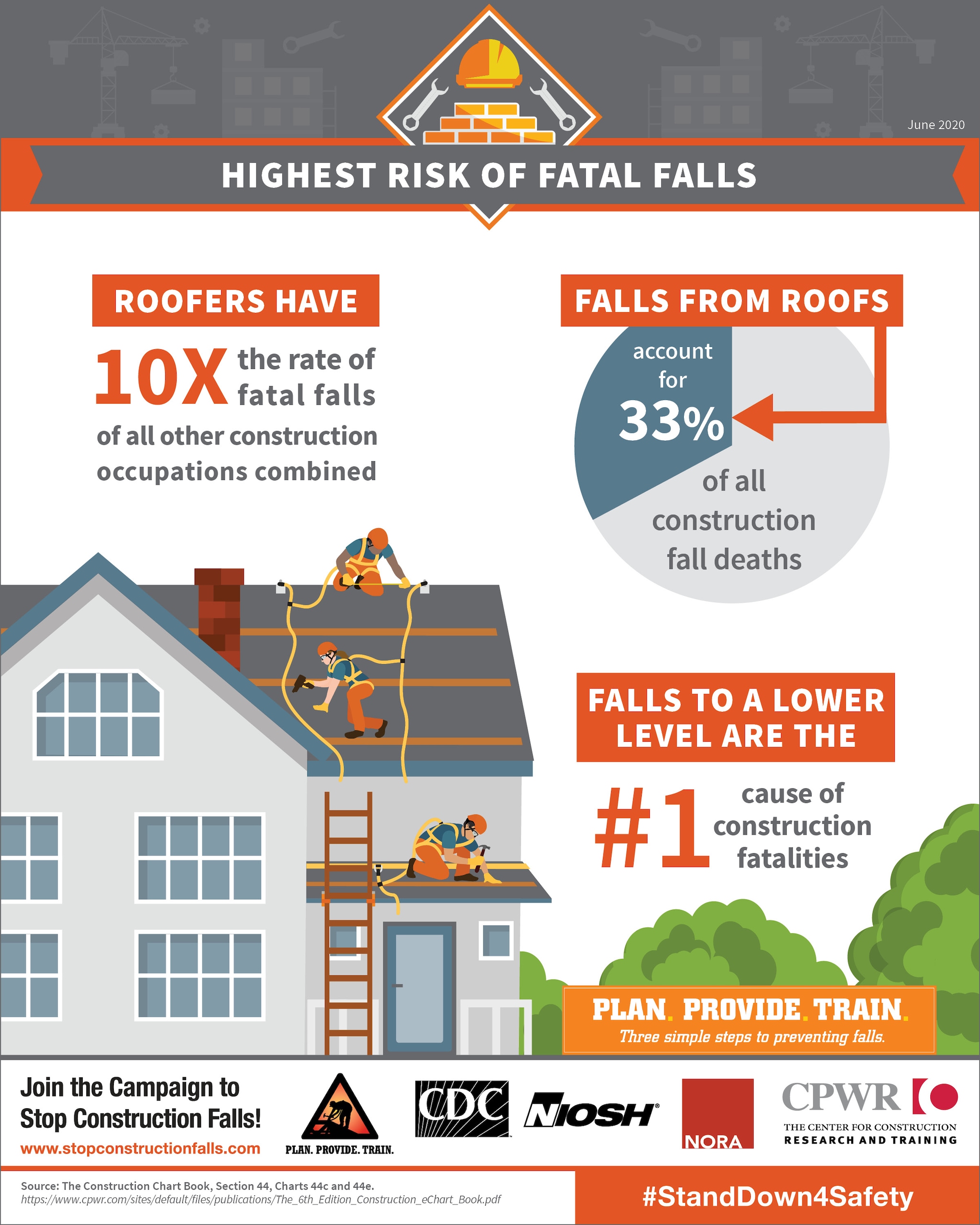
  • The roofing profession is over 15 times more hazardous than any other sector. As a result, roofing jobs have a fatality rate of 54%, one of the highest job-related fatalities.
  • OSHA reports that falls are the number one cause of deaths in the construction industry.
  • OSHA also reports that falls from roofs account for 34% of all fall deaths in construction.
  • In 2020, there were 351 fatal falls to a lower level out of 1,008 construction fatalities.
  • The Center for Construction Research and Training reports that “roofers have the fifth-highest work-related death rate in construction, 29.9 deaths per 100,000 full-time equivalent workers, about twice the average for all construction of 15.2.
  • About 50 roofers are killed on the job each year, most by falls.
  • For roofers in residential construction, falls from roof edges accounted for 70% of work-related-fall deaths and 90% of roof fall deaths.
  • Residential roofers had almost twice the percentage of fatal falls from ladders compared to all roofers.


Roofing Fall Prevention (Single-unit Roof Coverings) Stats and Facts – Spanish

HECHOS

Causa principal de las caídas en tejados

Cuidado con el borde – Perder el borde del tejado puede ser un problema cuando se está trabajando en el tejado. Algunos trabajadores se enfrascan tanto en su proyecto que olvidan dónde está el borde del tejado.

Capacitación inadecuada – Si hay alguien en el tejado que no ha sido capacitado adecuadamente, es un peligro para la seguridad en el tejado y podría causar lesiones graves a sí mismo o a otros.

Uso inadecuado del equipo de protección contra caídas – por ejemplo, una barandilla mal anclada, una cuerda de seguridad demasiado larga o un punto de amarre débil. La comprensión y capacitación sobre cómo utilizar correctamente el equipo de protección contra caídas son fundamentales.

Mala visibilidad – Los respiraderos de la cumbrera, las chimeneas y los haces de tejas pueden bloquear la salida de un tejado. Mantenga una buena línea de visión para saber dónde se encuentra en relación con el borde del tejado.

Inclinación – Cuanto más inclinado es el tejado, mayor es el riesgo de caída. Asegúrese de que la protección contra caídas y los haces de tejas están bien sujetos antes de subir al tejado.

Tejados a dos niveles y alturas de caída – Los empleados que realicen actividades de techado en tejados de pendiente baja y a dos niveles con lados y bordes desprotegidos a 1,8 metros (6 pies) o más por encima de los niveles inferiores deben disponer de un equipo de protección contra caídas adecuado.

ESTADÍSTICAS

  • La profesión de instalador de tejados es 15 veces más peligrosa que cualquier otro sector. Como resultado, los trabajos de techado tienen una tasa de mortalidad del 54%, una de las más altas relacionadas con el trabajo.
  • La OSHA informa de que las caídas son la principal causa de muerte en el sector de la construcción.
  • OSHA también informa de que las caídas desde tejados representan el 34% de todas las muertes por caídas en la construcción.
  • En 2020, se produjeron 351 caídas mortales a un nivel inferior de un total de 1.008 muertes en la construcción.
  • El Centro de Investigación y Capacitación de la Construcción informa que “los techadores tienen la quinta tasa más alta de muertes relacionadas con el trabajo en la construcción, 29,9 muertes por cada 100,000 trabajadores equivalentes a tiempo completo, aproximadamente el doble del promedio para toda la construcción de 15,2”.
  • Cada año mueren en el trabajo unos 50 techadores, la mayoría por caídas.
  • En el caso de los techadores de la construcción residencial, las caídas desde los bordes del tejado representaron el 70% de las muertes por caídas relacionadas con el trabajo y el 90% de las muertes por caídas desde el tejado.
  • El porcentaje de caídas mortales desde escaleras entre los techadores residenciales es casi el doble que entre todos los techadores.


Roofing Fall Prevention (Single-unit Roof Coverings) Fatality Report

Roof Man Dies When He Falls from the Roof of a Two-Story House While Applying a Tent for Fumigation.

A 33-year-old Hispanic roof man died after he fell approximately 25 feet from the roof of a two-story house to the ground below. The victim was carrying a tarp to cover the roof when the incident occurred. The employer of the victim did not have a fall prevention program for their employees, and the victim was not wearing any personal fall protection device. The CA/FACE investigator determined that:

Structural fumigation companies should establish and implement a fall protection program for employees who work on roofs.

INVESTIGATION

In the process of structural fumigation, heavy-duty gauge plastic tarps are used to cover the structure prior to fumigation with sulfuryl fluoride gas. The tarps must be placed and secured on the roof of the structure by work crews. The roof man ascends a ladder from the ground to the roof while carrying the folded or rolled tarps. Each tarp can weigh up to 150 pounds. After climbing onto the roof, he unfolds the tarps and drapes them over the sides of the structure. It is usually necessary to stand on the roof while securing the tarp in place.

On the day of the incident, a three-person tenting crew was assigned to a fumigation job at a two-story home. The victim, working as the roof man, climbed an extension ladder onto the roof while carrying a tarp. A neighbor heard the sounds of the ladder movement and saw the victim sliding off the roof and falling to the ground 25 feet below. The neighbor immediately called 911. The victim’s co-workers did not witness the incident, as they were working on the other side of the house. The paramedics found the victim unresponsive and without spontaneous respirations and pronounced the victim dead at the scene.

CAUSE OF DEATH

The cause of death according to the death certificate was traumatic injuries of the head.


Roofing Fall Prevention (Single-unit Roof Coverings) Fatality Report – Spanish

Muere un Tejador al Caer del Tejado de una Casa de Dos Plantas Mientras Aplicaba una Carpa para Fumigar.

Un hombre hispano de 33 años que trabajaba en el tejado murió tras caer aproximadamente 25 pies desde el tejado de una casa de dos plantas al suelo. La víctima llevaba una lona para cubrir el tejado cuando ocurrió el incidente. El empleador de la víctima no tenía un programa de prevención de caídas para sus empleados, y la víctima no llevaba ningún dispositivo personal de protección contra caídas. El investigador de CA/FACE determinó que:

Las empresas de fumigación estructural deben establecer e implementar un programa de protección contra caídas para los empleados que trabajan en techos.

INVESTIGACIÓN

En el proceso de fumigación estructural, se utilizan lonas de plástico de calibre grueso para cubrir la estructura antes de la fumigación con gas fluoruro de sulfurilo. Las lonas deben ser colocadas y aseguradas en el techo de la estructura por cuadrillas de trabajo. El trabajador del tejado asciende por una escalera desde el suelo hasta el tejado mientras transporta las lonas plegadas o enrolladas. Cada lona puede pesar hasta 45 kilos. Tras subir al tejado, despliega las lonas y las coloca sobre los laterales de la estructura. Suele ser necesario permanecer de pie en el tejado mientras asegura la lona en su sitio.

El día del incidente, una cuadrilla de tres personas que trabajaban en el tejado estaba asignada a un trabajo de fumigación en una casa de dos plantas. La víctima, que trabajaba en el tejado, subió al tejado por una escalera de extensión mientras llevaba una lona. Un vecino oyó el ruido del movimiento de la escalera y vio cómo la víctima se deslizaba por el tejado y caía al suelo unos 25 pies más abajo. El vecino llamó inmediatamente al 911. Los compañeros de trabajo de la víctima no presenciaron el incidente, ya que estaban trabajando en el otro lado de la casa. Los paramédicos encontraron a la víctima inconsciente y sin respiración espontánea y la declararon muerta en el lugar de los hechos.

CAUSA DE LA MUERTE

Según el certificado de defunción, la causa de la muerte fueron lesiones traumáticas en la cabeza.


Roofing Fall Prevention (Single-unit Roof Coverings) Infographic

288

Source: https://www.cdc.gov


Roofing Fall Prevention (Single-unit Roof Coverings) Infographic – Spanish

289

Fuente: https://www.segurmaniazurekin.eus


Newsletter – April 2024

  • Comply with Confined Spaces Safety Training Requirements;
  • Safety Talks on Confined Spaces, Heat Stress, PPE and Lead in Construction;
  • Fatality Reports;
  • Welder’s Safety and Health Guide;
  • and more…


Retail Tagger Safety Meeting Kit

WHAT’S AT STAKE

Tagging guns used to attach price, brand, and information tags on clothing and other goods in the garment industry and retail establishments pose a bloodborne pathogen hazard to the workers that use them if they get stuck with the needles. Workers need to know the risks of using tagging guns and needles and take precautions to avoid bloodborne pathogen exposures.

TAG ATTACHMENT GUN PROCEDURE

Employees in the garment industry use tag attachment guns (a device which puts the price tags onto garments). The procedure used with these guns is common in the industry and occurs across the country, and employees are being stuck on a regular basis; it appears to be a recognized hazard in the industry.

There is potential for employees to be stuck, and actual exposure on an anticipated level. The issue of concern relating the bloodborne pathogen standard is that these needle guns can retain blood in the hollow needle and on the tool. The needle itself, which actually penetrates the skin, would be reasonably anticipated to involve the presence of blood or other potentially infectious material. When guns are exchanged between employees, e.g., during shift changes, the result is a potential transmission of bloodborne pathogens.

BLOODBORNE PATHOGENS IN THE GARMENT INDUSTRY

Bloodborne pathogens are microorganisms that are present in human blood and can cause disease in humans. The organisms that are medically crucial within health and safety are those that are transmitted person-to-person, such as Hepatitis B (HBV), Hepatitis C (HCV), and Human Immunodeficiency Virus (HIV).

There is no population that is risk free for human immunodeficiency virus or hepatitis B virus infectivity, any employee who has occupational exposure to blood or other potentially infectious material is included within the scope of this standard. Employees in the garment industry are generally considered to have occupational exposure.

WHAT’S THE DANGER

DANGERS OF TAGGER GUN USE AND BLOODBORNE PATHOGENS

  • Possible serious hazards from bloodborne pathogens associated with sharing tagging guns when instruments are not disinfected.
  • A worker that uses a tagger gun on the job may get stuck accidentally with the needle. You are at risk of a bloodborne pathogen exposure if you and others use the same tagging gun and also get stuck accidentally with the same needle. If this happens, you have been exposed to the blood of other workers and any potential bloodborne pathogens that may be in their blood such as hepatitis B and HIV. This occurs when one worker accidentally punctures his or her skin with the needle of a tagging gun and another worker using the same gun, with the same needle, sustains the same type of injury.
  • In the garment manufacturing or processing industry or other manufacturing settings there is very frequent use of a tagging gun. In the retail industry tagger guns are used less frequently. Either way, there is a “reasonably anticipated exposure to blood” with a tagger and your employer is responsible for controlling this hazard.

HOW TO PROTECT YOURSELF

AVOID INFECTIONS BLOOD – PREVENTION

Blood-borne pathogens are infectious microorganisms in human blood that can cause disease. These pathogens include, but are not limited to, hepatitis B (HBV), hepatitis C (HCV) and human immunodeficiency virus (HIV). Needle sticks and other sharps-related injuries may expose workers to blood-borne pathogens.

Take “universal precautions,” which means treating all blood and blood-containing materials as though they do actually contain blood-borne pathogens. Prevention includes:

  • regular hand washing
  • wearing protective clothing such as latex gloves when dealing with an injured person
  • avoid poking yourself with the needle from tagging guns.
  • take care if handing garbage bags to ensure no sharp objects are protruding from the bag.

WHEN A WORKER GETS A NEEDLESTICK USING A TAGGER GUN

  • Immediately wash the area with soap and water.
  • Use antiseptic cleaner until you get to soap and water ASAP.
  • Seek immediate medical attention if you are in doubt about the cleanliness of the needle.
  • Medical Treatment may include hepatitis B vaccination and drug therapy.
  • To be effective, this medical treatment should be within 24 hours of exposure.
  • Immediately report a needlestick to your employer.

SAFETY STEPS IN TAGGER OPERATIONS

  • make it a policy for workers clean and disinfect tagger needles often each use.
  • issue new needles to workers for each use.
  • assign each employee their own tagger and needle.
  • if a worker is issued their own tagger gun, only use your own gun, and do not share it with other workers.
  • get training on bloodborne pathogens, exposures, and learn the potential health consequences of violating clear needle policy.

BEST PRACTICES USE OF TAGGER GUNS

  • Make sure to watch what you are doing and know where your hands are at all times.
  • Tag clothing and materials away from your body.
  • Use a firm surface to tag against.
  • If you cannot see where you are holding the tagger and needle, reposition the work and use the tagger where you can see it and your hands.

FINAL WORD

In the garment manufacturing or processing industry or other manufacturing settings there is very frequent use of a tagging gun. In the retail industry tagger guns are used less frequently. Either way, there is a “reasonably anticipated exposure to blood” with a tagger and your employer is responsible for controlling this hazard.


Retail Tagger Safety Meeting Kit – Spanish

QUÉ ESTÁ EN RIESGO

Las pistolas de etiquetado utilizadas para colocar etiquetas de precio, marca e información en prendas de vestir y otros productos en la industria de la confección y los establecimientos minoristas suponen un riesgo de transmisión de patógenos por la sangre a los trabajadores que las utilizan si se clavan las agujas. Los trabajadores deben conocer los riesgos de utilizar pistolas de etiquetado y agujas y tomar precauciones para evitar la exposición a patógenos transmitidos por la sangre.

PROCEDIMIENTO CON PISTOLAS DE ETIQUETADO

Los empleados de la industria de la confección utilizan pistolas de fijación de etiquetas (un dispositivo que coloca etiquetas de precio en las prendas). El procedimiento utilizado con estas pistolas es común en la industria y ocurre en todo el país, y los empleados se atascan con regularidad; parece ser un peligro reconocido en la industria.

Existe la posibilidad de que los empleados queden atrapados, y la exposición real en un nivel previsto. La cuestión que preocupa en relación con la norma sobre patógenos transmitidos por la sangre es que estas pistolas de agujas pueden retener sangre en la aguja hueca y en la herramienta. La propia aguja, que penetra en la piel, podría razonablemente implicar la presencia de sangre u otro material potencialmente infeccioso. Cuando las pistolas se intercambian entre los empleados, por ejemplo, durante los cambios de turno, el resultado es una posible transmisión de patógenos transmitidos por la sangre.

PATÓGENOS TRANSMITIDOS POR LA SANGRE EN LA INDUSTRIA DE LA CONFECCIÓN

Los patógenos transmitidos por la sangre son microorganismos que están presentes en la sangre humana y pueden causar enfermedades en los seres humanos. Los organismos que son médicamente cruciales dentro de la salud y la seguridad son los que se transmiten de persona a persona, como la hepatitis B (VHB), la hepatitis C (VHC) y el virus de la inmunodeficiencia humana (VIH).

Ninguna población está libre de riesgo de infecciosidad por el virus de la inmunodeficiencia humana o el virus de la hepatitis B, por lo que cualquier empleado que tenga una exposición laboral a sangre u otro material potencialmente infeccioso está incluido en el ámbito de aplicación de esta norma. Por lo general, se considera que los empleados de la industria de la confección están expuestos profesionalmente.

CUÁL ES EL PELIGRO

PELIGROS DEL USO DE PISTOLAS ETIQUETADORAS Y PATÓGENOS TRANSMITIDOS POR LA SANGRE

  • Posibles peligros graves por patógenos de transmisión sanguínea asociados al uso compartido de pistolas etiquetadoras cuando no se desinfectan los instrumentos.
  • Un trabajador que utiliza una pistola etiquetadora en el trabajo puede pincharse accidentalmente con la aguja. Corre el riesgo de exposición a patógenos transmitidos por la sangre si usted y otras personas utilizan la misma pistola etiquetadora y también se clavan accidentalmente con la misma aguja. Si esto ocurre, habrá estado expuesto a la sangre de otros trabajadores y a cualquier posible patógeno de transmisión sanguínea que pueda haber en su sangre, como la hepatitis B y el VIH. Esto ocurre cuando un trabajador se pincha accidentalmente la piel con la aguja de una pistola de etiquetado y otro trabajador que utiliza la misma pistola, con la misma aguja, sufre el mismo tipo de lesión.
  • En la industria de fabricación o procesamiento de prendas de vestir u otros entornos de fabricación, es muy frecuente el uso de una pistola etiquetadora. En la industria minorista, las pistolas de etiquetado se utilizan con menos frecuencia. En cualquier caso, existe una “exposición razonablemente prevista a la sangre” con una pistola etiquetadora y su empleador es responsable de controlar este peligro.

COMO PROTEGERSE

EVITAR INFECCIONES SANGUÍNEAS- PREVENCIÓN

Los patógenos transmitidos por la sangre son microorganismos infecciosos presentes en la sangre humana que pueden causar enfermedades. Estos patógenos incluyen, entre otros, la hepatitis B (VHB), la hepatitis C (VHC) y el virus de la inmunodeficiencia humana (VIH). Los pinchazos con agujas y otros objetos punzantes pueden exponer a los trabajadores a agentes patógenos transmitidos por la sangre.

Adopte “precauciones universales”, lo que significa tratar toda la sangre y los materiales que la contengan como si contuvieran agentes patógenos transmitidos por la sangre. La prevención incluye:

  • Lavarse las manos con regularidad
  • Llevar ropa protectora, como guantes de látex, cuando se trate de una persona herida
  • Evitar pincharse con la aguja de las pistolas de pinchar.
  • Tener cuidado al manipular las bolsas de basura para asegurarse de que no sobresalen objetos punzantes de la bolsa.

CUANDO UN TRABAJADOR SE PINCHA CON UNA PISTOLA ETIQUETADORA

  • Lave inmediatamente la zona con agua y jabón.
  • Utilice un limpiador antiséptico hasta que consiga agua y jabón lo antes posible.
  • Busque atención médica inmediata si tiene dudas sobre la limpieza de la aguja.
  • El tratamiento médico puede incluir la vacunación contra la hepatitis B y terapia farmacológica.
  • Para que sea eficaz, este tratamiento médico debe realizarse en las 24 horas siguientes a la exposición.
  • Informe inmediatamente de un pinchazo de aguja a su empleador.

MEDIDAS DE SEGURIDAD EN LAS OPERACIONES CON ETIQUETADORAS

  • Establezca como norma que los trabajadores limpien y desinfecten las agujas de los etiquetadores con frecuencia cada vez que las utilicen.
  • Entregue agujas nuevas a los trabajadores para cada uso.
  • Asigne a cada trabajador su etiquetadora y su aguja.
  • Si a un trabajador se le entrega su pistola etiquetadora, utilice sólo su pistola y no la comparta con otros trabajadores.
  • Reciba formación sobre los patógenos transmitidos por la sangre, y las exposiciones, y conozca las posibles consecuencias para la salud de infringir la política de agujas claras.

BUENAS PRÁCTICAS EN EL USO DE PISTOLAS ETIQUETADORAS

  • Asegúrese de observar lo que está haciendo y de saber dónde tiene las manos en todo momento.
  • Etiquete la ropa y los materiales lejos de su cuerpo.
  • Utilice una superficie firme contra la que etiquetar.
  • Si no puede ver dónde está sujetando el etiquetador y la aguja, cambie la posición del trabajo y utilice el etiquetador donde pueda verlo y ver sus manos.

CONCLUSIÓN

En la industria de fabricación o procesamiento de prendas de vestir u otros entornos de fabricación, es muy frecuente el uso de una pistola etiquetadora. En la industria minorista, las pistolas etiquetadoras se utilizan con menos frecuencia. En cualquier caso, existe una “exposición razonablemente prevista a la sangre” con una pistola etiquetadora y su empleador es responsable de controlar este riesgo.


Retail Tagger Safety Stats and Facts

FACTS

  1. Because of rapid turnover in the retail industry, many new employers, supervisors, and employees are unaware of the possible serious hazards from bloodborne pathogens associated with sharing tagging guns when instruments are not disinfected.
  2. Workers using tagging guns in the garment and other associated industries may be covered by health and safety standards that protect workers from the hazards associated with bloodborne pathogens, depending on the individual circumstances of the work.
  3. Use of tagging guns can result in a worker sustaining a needlestick with a contaminated needle. This happens when one worker accidentally punctures his or her skin with the needle of a tagging gun and another worker using the same gun, with the same needle, sustains the same type of injury.
  4. The risk of exposure to blood or other potentially infectious materials can be reasonably anticipated.
  5. To prevent needlestick contamination assign employees from using any tagging gun other than the one assigned to them.

STATS

  • In one year there had been only nine recorded accidents involving tagging guns at distribution centers which employed 317 (mainly part-time) staff. However, it was recognized that considerable under-reporting existed,13 as many workers do not consider that minor skin punctures are worthy of an entry in the accident book. Anecdotal reports suggested that prick rates of three per 4-hour shifts were not unusual when tagging was in progress.
  • It was assumed that if the source individual had an ATDS-related disease he/she would not be engaged in this kind of physical work, but the overall risk of transmission was assessed at not less than 1 in 300. Thus, the overall risk of transmission of HIV from a piercing wound using this tagging device would be around 1 in 150,000.
  • The transmission of HTV by a single percutaneous transmission from a known HTV-positive source is, overall, 1 in 300,6, and the risk is increased considerably if the injury is deep, or blood is visible on the device.
  • For hepatitis B, the risk from a carrier is likely to be higher than for HTV, and the virus, which is known to be more stable, may persist on the needle in an infectious state for longer. In the workforce of 1% and that 5% of these are ‘high infectivity’ (HB positive) carriers, the risk of transmission may be as high as 1 in 6,000. The prevalence of hepatitis C in blood donors in the Western world ranges from 0.3 to 1.5%10 although higher rates (1.3-1.5%).


Retail Tagger Safety Stats and Facts – Spanish

HECHOS

  1. Debido a la rápida rotación de personal en el sector minorista, muchos nuevos empleadores, supervisores y empleados desconocen los posibles riesgos graves de patógenos transmitidos por la sangre asociados al uso compartido de pistolas de etiquetado cuando los instrumentos no se desinfectan.
  2. Los trabajadores que utilizan pistolas de etiquetado en la industria de la confección y otras industrias asociadas pueden estar cubiertos por las normas de salud y seguridad que protegen a los trabajadores de los peligros asociados con los patógenos transmitidos por la sangre, dependiendo de las circunstancias individuales del trabajo.
  3. El uso de pistolas de etiquetado puede dar lugar a que un trabajador sufra un pinchazo con una aguja contaminada. Esto ocurre cuando un trabajador se pincha accidentalmente la piel con la aguja de una pistola de marcaje y otro trabajador que utiliza la misma pistola, con la misma aguja, sufre el mismo tipo de lesión.
  4. El riesgo de exposición a sangre u otros materiales potencialmente infecciosos puede preverse razonablemente.
  5. Para evitar la contaminación por pinchazo de aguja, impida que los empleados utilicen una pistola de marcado distinta de la que tienen asignada.

ESTADÍSTICAS

  • En un año sólo se habían registrado nueve accidentes con pistolas de etiquetado en centros de distribución que empleaban a 317 trabajadores (principalmente a tiempo parcial). Sin embargo, se reconoció que existía una considerable infranotificación,13 ya que muchos trabajadores no consideran que los pinchazos leves en la piel merezcan una anotación en el libro de accidentes. Los informes anecdóticos sugerían que las tasas de pinchazos de tres por turnos de 4 horas no eran inusuales cuando el etiquetado estaba en curso.
  • Se asumió que si el individuo fuente tenía una enfermedad relacionada con el ATDS no realizaría este tipo de trabajo físico, pero el riesgo global de transmisión se evaluó en no menos de 1 en 300. Así pues, el riesgo global de transmisión del VIH por una herida de perforación con este dispositivo de marcado sería de aproximadamente 1 entre 150.000.
  • La transmisión del HTV por una única transmisión percutánea de una fuente conocida HTV-positiva es, en general, de 1 en 300,6, y el riesgo aumenta considerablemente si la herida es profunda, o si hay sangre visible en el dispositivo.
  • Para la hepatitis B, es probable que el riesgo de un portador sea mayor que para el HTV, y el virus, que se sabe que es más estable, puede persistir en la aguja en estado infeccioso durante más tiempo. Entre el 1% y el 5% son portadores de “alta infectividad” (HB positivo), el riesgo de transmisión puede llegar a ser de 1 entre 6.000. La prevalencia de la hepatitis C en los donantes de sangre en el mundo occidental oscila entre el 0,3 y el 1,5%10 , aunque existen tasas más elevadas (1,3-1,5%).