Working Safely With Solvents Stats and Facts

FACTS

  1. Solvents may enter the body through inhalation or through the skin.
  2. Solvent waste must be separated from other waste and in separate solvent waste streams.
  3. A major risk of solvent use is its volatility (low boiling point) causing flammable or toxic vapour.
  4. The exposure limits are the maximum amount you may legally be exposed to in an 8-hour period (long-term limit), or in a 15-minute period (short-term limit).
  5. Solvent vapours can be inhaled or absorbed through the skin, passing into the blood stream.
  6. Contaminated food or hands can also lead to solvents being swallowed.
  7. Short term exposure to solvents can irritate eyes, lungs and skin and may cause headaches, nausea, dizziness and light-headedness.
  8. Chronic effects can include dermatitis, toxicity to the nervous system, reproductive damage, liver and kidney damage, respiratory impairment and cancer.
  9. Exposure to high concentrations of solvent vapours can result in loss of consciousness or may be fatal.
  10. Solvents can be highly volatile and may explode or catch fire if stored or handled incorrectly.

STATS

  • 83 people died from methylene chloride exposure.
  • 83 people died from methylene chloride exposure.
  • More than 50 people have died in the U.S. from accidental exposure to methylene chloride.
  • A Center analysis identified at least 56 accidental exposure deaths linked to methylene chloride.
  • The National Institute for Occupational Safety and Health (NIOSH) warns of the hazards of exposure to chemicals in the workplace. The federal agency estimates that 9.8 million workers may face such exposure in the United States. There are a wide variety of potential chemical injuries, including those from exposure to solvents, asbestos, latex rubber and gasoline.
  • In 2017, 41 U.S. workers died on the job after a single episode of inhaling chemicals and chemical products.


Working Safely With Solvents Meeting Kit – Spanish

QUÉ ESTÁ EN RIESGO

Los disolventes son tan comunes en muchos lugares de trabajo que los trabajadores olvidan lo peligrosos que son. Un disolvente puede describirse generalmente como una sustancia -normalmente, un líquido- que se utiliza para disolver otra sustancia. Los disolventes se encuentran en una gran variedad de productos, como limpiadores, pinturas, abrillantadores de suelos y tinta de impresora.

CUÁL ES EL PELIGRO

PELIGROS DE TRABAJAR CON DISOLVENTES – EFECTOS ADVERSOS

Debido a su naturaleza volátil, cualquier cosa que pueda considerarse una fuente de ignición, como el humo o las chispas de la soldadura, debe mantenerse alejada de los disolventes y de los vapores que se producen a partir de ellos.

  • El contacto con la piel provocará sequedad y grietas. Esto puede provocar trastornos cutáneos, más comúnmente dermatitis. Tenga especial cuidado con el contacto con la piel, ya que algunos disolventes pueden penetrar en la piel y entrar en la circulación sanguínea.
  • La inhalación de disolventes provocará ardor en la nariz, la garganta y los pulmones.
  • Tragar o ingerir disolventes quemará la garganta y afectará al sistema digestivo.
  • La exposición prolongada a disolventes tendrá efectos negativos generales sobre la salud, principalmente sobre el sistema respiratorio, pero también sobre el sistema nervioso, el sistema reproductor y los riñones.

LA EXPOSICIÓN A UN DISOLVENTE TIENE VÍAS DE ENTRADA

  • Absorción por contacto directo en la piel: Si no hay “barreras” entre el disolvente y la piel, el disolvente puede absorberse a través de la piel.
  • Inhalación al respirar los vapores del disolvente.
  • Ingestión: por ingerir literalmente el producto químico al no practicar una buena higiene después de manipular disolventes.
  • El contacto directo con las manos y la boca al comer o fumar puede provocar la ingestión inesperada de disolventes.
  • Perforación de la piel por una herramienta u otro objeto que tenga una capa de disolvente.

COMO PROTEGERSE

MEDIDAS DE SEGURIDAD AL UTILIZAR DISOLVENTES

  • Utilice equipo de protección personal como guantes, protección ocular, botas o cualquier otra barrera cuando trabaje con disolventes. Asegúrese de que el empleador le proporciona todo el equipo necesario si se encuentra en el lugar de trabajo.
  • Asegúrese de que la sala está bien ventilada, especialmente si el espacio de trabajo es pequeño. Los disolventes suelen entrar en el aire a través de los vapores emitidos, por lo que se necesita ventilación para ayudar a la circulación del aire.
  • Infórmese sobre el tipo de disolvente con el que está trabajando. Familiarícese con la información de seguridad y los procedimientos de manipulación segura incluidos.
  • Extreme las precauciones con los disolventes inflamables y tenga extintores fácilmente accesibles en cualquier zona en la que se utilicen o almacenen estos disolventes.
  • Capacite a los empleados sobre qué hacer si se produce un derrame o una emergencia.
  • Por supuesto, utilice una alternativa de disolvente de base biológica más segura siempre que sea posible, de modo que muchas de estas medidas de seguridad adicionales puedan evitarse en primer lugar.

LO QUE LOS EMPLEADOS DEBEN SABER SOBRE EL TRABAJO CON DISOLVENTES

Uno de los riesgos para la salud más comunes asociados a la exposición a disolventes es la dermatitis. La dermatitis de contacto puede desarrollarse a partir de una única o de múltiples exposiciones. Puede dejar la piel susceptible a una infección a corto plazo o a una afección crónica. La exposición también puede provocar sensibilización al disolvente, que es una reacción alérgica retardada que suele agravarse con las exposiciones posteriores.

Un gran peligro de los disolventes es que pueden causar problemas antes de que nos demos cuenta de lo que está ocurriendo. Dependiendo del tipo y la concentración del disolvente, los efectos de la exposición pueden ir desde una leve irritación respiratoria hasta graves daños en órganos y sistemas corporales. En casos extremos, la sobreexposición a los vapores de disolventes puede causar insuficiencia respiratoria y la muerte.

EL PERSONAL NECESITA HACER ESTO CUANDO SE TRABAJA CON DISOLVENTES

  • Lea las etiquetas y las fichas de datos de seguridad (FDS) de los disolventes. En ellas se enumeran los peligros, los efectos sobre la salud y los procedimientos de manipulación segura.
  • Utilice los guantes recomendados, protección ocular y facial, botas, cremas de barrera u otro equipo de protección personal según sea necesario.
  • Tenga cuidado al verter disolventes de un recipiente a otro, ya que pueden producirse incendios o explosiones debido a la acumulación de electricidad estática.
  • Prohibir soldar, cortar, soldar y otras fuentes de ignición en zonas donde se utilicen disolventes.
  • Almacene los disolventes inflamables en áreas bien ventiladas construidas con materiales resistentes al fuego. Conecte a tierra todos los tanques y equipos de almacenamiento.
  • Instale extintores de incendios fácilmente accesibles en las zonas de almacenamiento y de trabajo.
  • Limpie rápidamente los derrames de disolventes. No se lave nunca las manos con disolventes.
  • Esté preparado para responder en caso de emergencias. Por ejemplo, si un empleado entra en contacto con un disolvente o si algo se incendia.
  • Si es posible, considere alternativas de disolventes menos tóxicos.

CONCLUSIÓN

La exposición a disolventes entraña numerosos riesgos para la salud, como toxicidad para el sistema nervioso, daños orgánicos, problemas respiratorios, cáncer y alteraciones cutáneas.


Working Safely With Solvents Stats and Facts – Spanish

HECHOS

  1. Los disolventes pueden penetrar en el organismo por inhalación o a través de la piel.
  2. Los residuos de disolventes deben separarse de otros residuos y en flujos de residuos de disolventes separados.
  3. Uno de los principales riesgos del uso de disolventes es su volatilidad (bajo punto de ebullición) que provoca vapores inflamables o tóxicos.
  4. Los límites de exposición son la cantidad máxima a la que puede exponerse legalmente en un periodo de 8 horas (límite a largo plazo), o en un periodo de 15 minutos (límite a corto plazo).
  5. Los vapores de los disolventes pueden inhalarse o absorberse a través de la piel, pasando al torrente sanguíneo.
  6. Los alimentos o las manos contaminados también pueden provocar la ingestión de disolventes.
  7. La exposición de corta duración a los disolventes puede irritar los ojos, los pulmones y la piel y provocar dolores de cabeza, náuseas, mareos y aturdimiento.
  8. Los efectos crónicos pueden incluir dermatitis, toxicidad para el sistema nervioso, daños reproductivos, daños hepáticos y renales, alteraciones respiratorias y cáncer.
  9. La exposición a altas concentraciones de vapores de disolventes puede provocar la pérdida de conciencia o ser mortal.
  10. Los disolventes pueden ser muy volátiles y pueden explotar o incendiarse si se almacenan o manipulan incorrectamente.

ESTADÍSTICAS

  • 83 personas murieron por exposición al cloruro de metileno.
  • 83 personas murieron por exposición al cloruro de metileno.
  • Más de 50 personas han muerto en EE.UU. por exposición accidental al cloruro de metileno.
  • Un análisis del Centro identificó al menos 56 muertes por exposición accidental relacionadas con el cloruro de metileno.
  • El Instituto Nacional de Seguridad y Salud en el Trabajo (NIOSH) advierte de los peligros de la exposición a sustancias químicas en el lugar de trabajo. La agencia federal calcula que 9,8 millones de trabajadores pueden sufrir este tipo de exposición en Estados Unidos. Existe una amplia variedad de lesiones químicas potenciales, incluidas las derivadas de la exposición a disolventes, amianto, látex de caucho y gasolina.
  • En 2017, 41 trabajadores estadounidenses murieron en el trabajo tras un único episodio de inhalación de sustancias y productos químicos.


Working Safely With Solvents Meeting Kit

WHAT’S AT STAKE

Solvents are so common in many workplaces that workers forget how dangerous they are. A solvent can be generally described as a substance—usually, a liquid—that is used to dissolve another substance. Solvents are found in a variety of products including cleaners, paints, floor polishes, and printer ink.

WHAT’S THE DANGER

DANGERS OF WORKING WITH SOLVENTS – ADVERSE AFFECTS

Because of their volatile nature, anything that could be considered an ignition source, such as smoke or sparks from welding, should be kept away from solvents and the vapors that are produced from them.

  • Contact with the skin will cause dryness and cracking. This may lead to skin disorders, most commonly dermatitis. Take extra care with contact with the skin, as some solvents can possibly penetrate the skin and enter the blood circulation.
  • Inhaling solvents will cause burning in the nose, throat, and lungs.
  • Swallowing or ingesting solvents will burn the throat and affect the digestive system.
  • Prolonged exposure to solvents will have overall negative health effects, mainly on the respiratory system, but also on the nervous system, reproductive system, and kidneys.

EXPOSURE TO A SOLVENT HAS ROUTES OF ENTRY

  • Absorption by direct contact on the skin: If there are no “barriers” between the solvent and your skin, the solvent can be absorbed through your skin.
  • Inhalation by breathing solvent vapors.
  • Ingestion: from literally eating the chemical by not practicing good hygiene after handling solvents.
  • Direct contact with your hands and mouth through eating or smoking may result in unexpected ingestion of solvents.
  • Puncture of the skin by a tool or other object that has a coating of solvent.

HOW TO PROTECT YOURSELF

SAFETY MEASURES WHEN USING SOLVENTS

  • Use personal protective equipment such as gloves, eye protection, boots, or any other barriers when working with solvents. Make sure all necessary equipment is provided by an employer if in the workplace.
  • Make sure the room is properly ventilated, especially if the workspace is small. Solvents often get into the air through emitted vapors, ventilation is needed to help with air circulation.
  • Be informed on what type of solvent you’re working with. Familiarize yourself with any safety information and safe handling procedures included.
  • Be extra cautious with flammable solvents and keep fire extinguishers readily accessible in any areas in which these solvents are used or stored.
  • Train employees on what to do if a spill occurs or an emergency happens.
  • Of course, use a safer bio-based solvent alternative whenever possible, so a lot of these additional safety measures can be avoided in the first place.

EMPLOYEES NEED TO KNOW ABOUT WORKING WITH SOLVENTS

One of the most common health hazards associated with exposure to solvents is dermatitis. Contact dermatitis can develop from a single or from multiple exposures. It can leave the skin susceptible to a short-term infection or to a chronic condition. Exposure can also result in sensitization to the solvent, which is a delayed allergic reaction that often becomes more severe with subsequent exposures.

One big danger with solvents is that they can cause trouble before you realize what’s happening. Depending on the type and concentration of the solvent, exposure effects can range from mild respiratory irritation to severe damage to body organs and systems. In extreme cases, overexposure to solvent vapors can cause respiratory failure and death.

EMPLOYEES NEED TO DO THIS WHEN WORKING WITH SOLVENTS

  • Read the labels and the safety data sheets (SDS) of the solvents. They list the hazards, health effects, and safe handling procedures.
  • Use recommended gloves, eye and face protection, boots, barrier creams, or other personal protective equipment as required.
  • Take care when pouring solvents from one container to another, as fire or explosions can occur from static electricity buildup.
  • Prohibit welding, cutting, soldering, and other sources of ignition in areas where solvents are used.
  • Store flammable solvents in well-ventilated areas constructed of fire-resistant materials. Ground and bond all tanks and equipment for storage.
  • Install readily accessible fire extinguishers in storage and work areas.
  • Clean up solvent spills promptly. Never wash your hands with solvents.
  • Be ready to respond in the event of emergencies. These include an employee coming in contact with a solvent or should something catch on fire.
  • If possible, consider less-toxic solvent alternatives.

FINAL WORD

There are a lot of different health hazards associated with solvent exposure including but not limited to toxicity to the nervous system, organ damage, respiratory issues, cancer and skin impairment.


Working Safely With Solvents Fatality File

West Coast firm Coastwide Flooring fined $160k after worker killed by solvent fumes.

A West Coast flooring company must pay out more than $160,000 after a worker was killed by solvent fumes.

The man was laying carpet in a Greymouth building in March 2019 and was using a strong solvent-based adhesive.

A colleague found him unconscious, and he died three days later in Christchurch Hospital’s intensive care unit.

His employer, Coastwide Flooring, appeared in Greymouth District Court today and was fined $60,000 for failing to ensure the health and safety of its workers.

It was also ordered to pay a $105,000 in reparations to the victim’s family.

WorkSafe investigations manager for the South Island Steve Kelly said the company had a lax approach to health and safety.

“The particular adhesive the worker was using was known to be a health hazard, but the company had not undertaken a risk assessment on its use; it had no safe system of work for working with the adhesive – particularly in relation to ventilation and the use of fans; and nor did it provide effective information, training and instruction for workers,” he said in a statement.

“The company largely relied on the experience of its workers to protect themselves from the effects of the adhesive, and that approach was simply unacceptable.”

Kelly said Coastwide Flooring had since improved its operations since the tragic accident but it was too little, too late.


Working Safely With Solvents Infographic – Spanish

380

Fuente: https://www.ucm.es


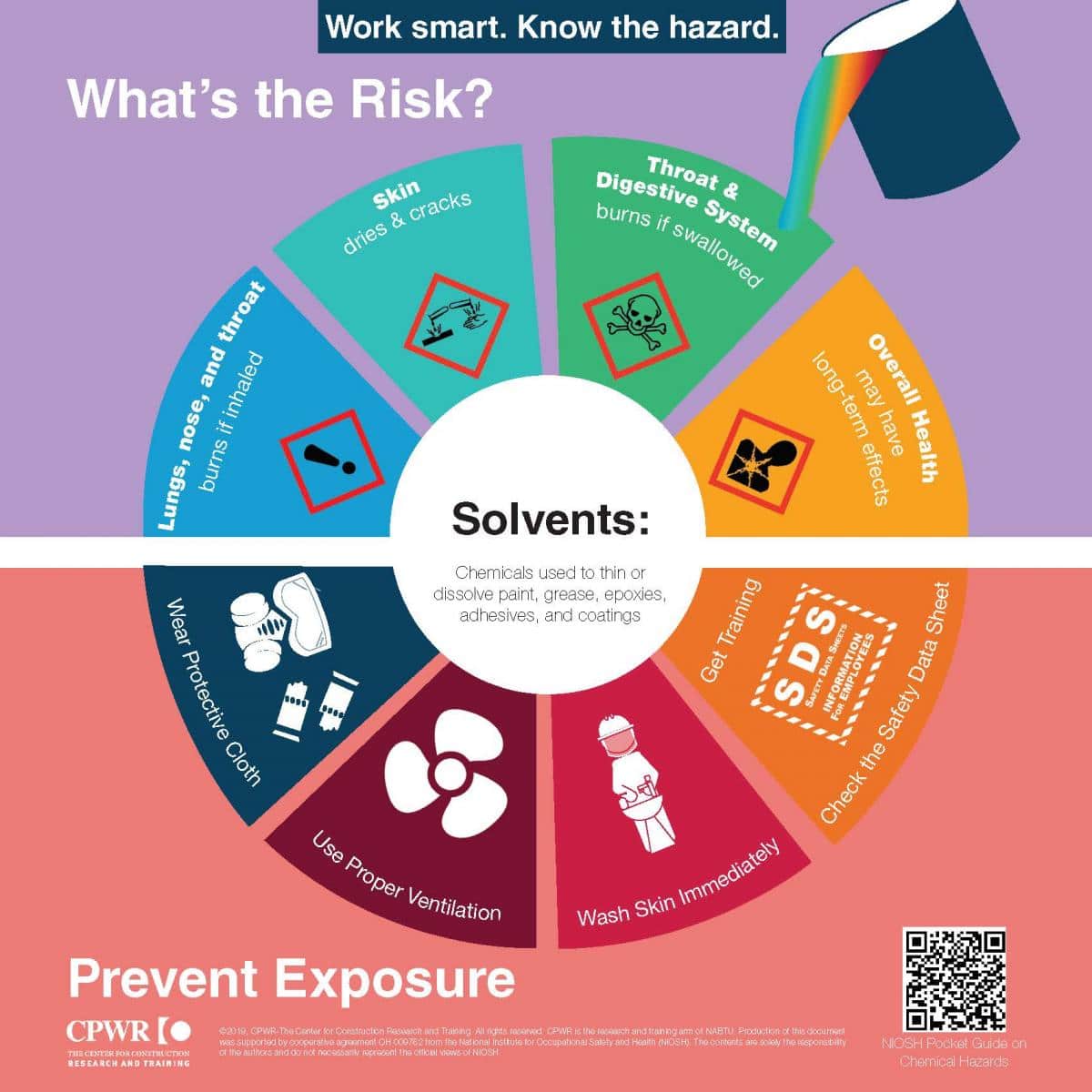
Working Safely With Solvents Infographic

379

Source: https://www.cpwr.com


Working Safely With Solvents Fatality File – Spanish

Coastwide Flooring, empresa de la costa oeste, multada con 160.000 dólares tras la muerte de un trabajador por emanaciones de disolvente.

Una empresa de pavimentos de la Costa Oeste debe pagar más de 160.000 dólares después de que un trabajador muriera por los vapores de un disolvente.

El hombre estaba colocando moqueta en un edificio de Greymouth en marzo de 2019 y estaba utilizando un fuerte adhesivo a base de disolvente.

Un colega lo encontró inconsciente y murió tres días después en la unidad de cuidados intensivos del Hospital Christchurch.

Su empleador, Coastwide Flooring, compareció hoy ante el Tribunal de Distrito de Greymouth y fue multado con 60.000 dólares por no garantizar la salud y la seguridad de sus trabajadores.

También se le ordenó pagar una indemnización de 105.000 dólares a la familia de la víctima.

El director de investigaciones de WorkSafe en la Isla Sur, Steve Kelly, declaró que la empresa era poco estricta en materia de salud y seguridad.

“Se sabía que el adhesivo que utilizaba el trabajador era peligroso para la salud, pero la empresa no había realizado una evaluación de riesgos sobre su uso; no disponía de un sistema de trabajo seguro para trabajar con el adhesivo, sobre todo en relación con la ventilación y el uso de ventiladores; y tampoco proporcionaba información, capacitación e instrucción efectivas a los trabajadores”, afirmó en un comunicado.

“La empresa confió en gran medida en la experiencia de sus trabajadores para protegerse de los efectos del adhesivo, y ese planteamiento era sencillamente inaceptable”.

Kelly dijo que Coastwide Flooring había mejorado sus operaciones desde el trágico accidente, pero que era demasiado poco y demasiado tarde.


Overhead Electrical Hazards for Municipalities Meeting Kit

WHAT´S AT STAKE

An overhead power line is an electric power transmission line suspended by towers or poles. Towers for support of the lines are made of wood (as grown or laminated), steel (either lattice structures or tubular poles), concrete, aluminum, and occasionally reinforced plastics. The bar wire conductors on the line are generally made of aluminum (either plain or reinforced with steel or sometimes composite materials), though some copper wires are used in medium-voltage distribution and low-voltage connections to customer premises.

WHAT´S THE DANGER

HAZARDS OF HIGH VOLTAGE POWER LINES

  • Overhead high voltage transmission lines are not insulated and if a person comes in contact or even closer to them through a ladder, crane, truck a person may get a life-threatening electrical shock.
  • Electricity can flash over a gap, so any equipment or a person at some distance from the power lines can still be in danger.
  • During storms or strong winds, overhead electric lines may fall to the ground.
  • Working at heights on overhead power lines is not safe as an operator may fall to the ground if not properly equipped with relevant PPE (personal protective equipment).

OTHER HAZARDS – TIPPING OVERHEAD POWER LINE

Workers are at risk in a number of scenarios.

  • The equipment is high enough to reach the line while driving along in its normal configuration.
  • A trailer is tipped up, making contact with the line, rendering the entire vehicle “live”.
  • A hydraulic boom or jib, controlled from a cab, makes contact with an overhead line, e.g., a crane lifting a load.
  • A hydraulic boom, jib, pipe, or conveyor, controlled by an operator in a standing position, makes contact with a line while lifting or conveying material.

HOW TO PROTECT YOURSELF

OVERHEAD POWER LINE ELECTRICAL HAZARD BEST PRACTICES

  1. Locate and identify hazards. Look for overhead power lines. Select safe job site locations with ample power line clearances for equipment and materials. Many power lines are buried underground. Contact a utility locator service at least two full business days before digging if the task involves any excavating.
  2. De-energize power lines. Always assume all overhead power lines are energized. Call the utility company to determine the line’s voltage and to discuss de-energizing and grounding or shielding the lines before performing any work near power lines.
  3. Work at a safe distance. A safe working distance depends on the voltage of the power lines. Always maintain a distance of at least 10 feet from overhead lines and more than 10 feet if the voltage to ground is over 50 kilovolts (50,000 volts). The higher the voltage, the greater the distance that is needed between the lines and the workers.
  4. Wear personal protective equipment (PPE). Employers need to provide employees with free PPE for protection from electrical hazards. Depending on the job task performed, PPE when working near power lines includes safety glasses, face shields, hard hats, insulated boots, rubber gloves with leather protectors, insulating sleeves, and flame-resistant clothing to reduce the risk of electrocution.
  5. Use insulated protective equipment. Crews should use ladders made of wood or other non-conductive materials as needed, such as line hoses, rubber hoods, rubber blankets, and insulating live-line tools. Never rely solely on insulated equipment for protection.
  6. Use extreme caution around trees or when moving equipment. Watch for power lines when putting up scaffolding, framing a building, painting, pruning, or picking fruit. Trees conduct electricity, so take extra caution when working with trees around overhead power lines. Equipment carried by workers – such as metal or non-metallic ladders, paint equipment with extensions, and pieces of building materials – can hit live lines, creating a path through workers’ bodies.
  7. Stay away from downed power lines. Downed power lines can energize other nearby objects, such as fences, water pipes, bushes, trees, buildings, and telephone, television, or fiber optic cables. Even maintenance hole castings and reinforcement bars (rebar) in the pavement can become energized by downed wires. Ensure workers are trained never to approach fallen power lines.
  8. Know when to move and when to stay. If equipment comes into contact with power lines, but there is no threat of fire or power-line strikes, stay put and remain inside the equipment until the power company de-energizes the circuit. If fire or power-line strikes present an immediate threat, jump as far away from the equipment as possible. Keep both feet together to avoid landing in power ripples with different voltage.
  9. Never touch an electrocuted worker. A worker who tries to touch or grab another worker who is receiving an electrical shock can become part of the electric circuit and sustain personal injuries or death. If an employee is electrocuted stay away and warn other to stand back at least 35 feet. Call 911 immediately.

POWER LINE SAFETY PRECAUTIONS TO AVOID OVERHEAD ELECTRICAL HAZARDS

  • Towers carrying live conductors must not be climbed as it can cause electric shock if the tower is energized.
  • Animals should never be tied to a transmission tower as it can risk their life.
  • Any object made up of metal or conducting material should not be thrown on overhead lines.
  • During rain, towers or poles must not be touched by any person because the tower body becomes energized due to the conductivity of water.
  • During storms or strong winds, keep a safe distance from powerlines as live conductors may accidentally fall over a person.
  • If a person sees any spark on overhead live conductors, the first responsibility should be to inform the relevant authorities to avoid any accident.

FINAL WORD

Electricity it creates a number of hazards and health issues thus endangering our life. If we properly follow the safety rules, standards, and precautions, then we can reduce and even eliminate the risks and hazards caused by electricity.


Overhead Electrical Hazards for Municipalities Meeting Kit – Spanish

QUÉ ESTÁ EN RIESGO

Una línea eléctrica aérea es una línea de transmisión de energía eléctrica suspendida de torres o postes. Las torres que soportan las líneas son de madera (en bruto o laminada), acero (ya sean estructuras de celosía o postes tubulares), hormigón, aluminio y, ocasionalmente, plásticos reforzados. Los conductores de la línea suelen ser de aluminio (liso o reforzado con acero o, a veces, materiales compuestos), aunque se utilizan algunos hilos de cobre en la distribución de media tensión y en las conexiones de baja tensión a las instalaciones de los clientes.

CUÁL ES EL PELIGRO

PELIGROS DE LAS LÍNEAS DE ALTA TENSIÓN

  • Las líneas aéreas de transmisión de alta tensión no están aisladas y si una persona entra en contacto con ellas o se acerca a ellas a través de una escalera, una grúa o un camión, puede recibir una descarga eléctrica potencialmente mortal.
  • La electricidad puede saltar por encima de un hueco, por lo que cualquier equipo o una persona que se encuentre a cierta distancia de las líneas de alta tensión puede seguir estando en peligro.
  • Durante las tormentas o los vientos fuertes, las líneas eléctricas aéreas pueden caer al suelo.
  • Trabajar en altura en líneas eléctricas aéreas no es seguro, ya que un operario puede caer al suelo si no va debidamente equipado con los EPP (equipos de protección individual) pertinentes.

OTROS PELIGROS – VUELCO DE LÍNEAS ELÉCTRICAS AÉREAS

Los trabajadores corren peligro en varias situaciones.

  • El equipo está lo suficientemente alto como para alcanzar la línea mientras circula en su configuración normal.
  • Un remolque se vuelca y entra en contacto con la línea, con lo que todo el vehículo queda “bajo tensión”.
  • Una pluma o brazo hidráulico, controlado desde una cabina, entra en contacto con una línea aérea, por ejemplo, una grúa que eleva una carga.
  • Un brazo, pluma, tubería o transportador hidráulico, controlado por un operador de pie, entra en contacto con una línea mientras eleva o transporta material.

COMO PROTEGERSE

PRÁCTICAS RECOMENDADAS PARA EVITAR RIESGOS ELÉCTRICOS EN LÍNEAS ELÉCTRICAS AÉREAS

  1. Localice e identifique los peligros. Busque líneas eléctricas aéreas. Seleccione ubicaciones seguras en el lugar de trabajo con amplios espacios libres para equipos y materiales. Muchas líneas eléctricas están enterradas. Póngase en contacto con un servicio de localización de servicios públicos al menos dos días hábiles completos antes de excavar si la tarea implica alguna excavación.
  2. Desconecte las líneas eléctricas. Asuma siempre que todas las líneas eléctricas aéreas están bajo tensión. Llame a la empresa de servicios públicos para determinar el voltaje de la línea y para discutir la desenergización y la conexión a tierra o el blindaje de las líneas antes de realizar cualquier trabajo cerca de líneas eléctricas.
  3. Trabaje a una distancia segura. La distancia de trabajo segura depende de la tensión de las líneas eléctricas. Mantenga siempre una distancia de al menos 3 metros de las líneas aéreas y de más de 3 metros si la tensión a tierra es superior a 50 kilovoltios (50.000 voltios). Cuanto mayor sea la tensión, mayor será la distancia necesaria entre las líneas y los trabajadores.
  4. Utilice equipos de protección individual (EPP). Los empleadores deben proporcionar a los trabajadores EPP gratuitos para protegerlos de los riesgos eléctricos. Dependiendo de la tarea realizada, el EPP cuando se trabaja cerca de líneas eléctricas incluye gafas de seguridad, protectores faciales, cascos, botas aislantes, guantes de goma con protectores de cuero, manguitos aislantes y ropa ignífuga para reducir el riesgo de electrocución.
  5. Utilice equipos de protección aislantes. Las cuadrillas deben utilizar escaleras de madera u otros materiales no conductores según sea necesario, como mangueras de línea, capuchas de goma, mantas de goma y herramientas aislantes de línea viva. Nunca confíe únicamente en el equipo aislado para su protección.
  6. Extreme las precauciones alrededor de los árboles o al mover el equipo. Tenga cuidado con las líneas eléctricas cuando monte andamios, enmarque un edificio, pinte, pode o recoja fruta. Los árboles conducen la electricidad, así que extreme las precauciones cuando trabaje con árboles cerca de líneas eléctricas aéreas. Los equipos transportados por los trabajadores -como escaleras metálicas o no metálicas, equipos de pintura con extensiones y piezas de materiales de construcción- pueden golpear las líneas vivas, creando una trayectoria a través de los cuerpos de los trabajadores.
  7. Manténgase alejado de las líneas eléctricas caídas. Las líneas eléctricas caídas pueden energizar otros objetos cercanos, como vallas, tuberías de agua, arbustos, árboles, edificios y cables de teléfono, televisión o fibra óptica. Incluso las piezas de fundición de los agujeros de mantenimiento y las barras de refuerzo (barras corrugadas) del pavimento pueden recibir energía de los cables caídos. Asegúrese de que los trabajadores están capacitados para no acercarse nunca a los cables eléctricos caídos.
  8. Sepa cuándo moverse y cuándo quedarse. Si el equipo entra en contacto con cables de alta tensión, pero no hay riesgo de incendio o de impacto con ellos, no se mueva y permanezca dentro del equipo hasta que la compañía eléctrica desconecte el circuito. Si hay riesgo inmediato de incendio o de caída de tensión, salte lo más lejos posible del equipo. Mantenga ambos pies juntos para evitar aterrizar en ondas de potencia con diferente voltaje.
  9. No toque nunca a un trabajador electrocutado. Un trabajador que intente tocar o agarrar a otro que esté recibiendo una descarga eléctrica puede pasar a formar parte del circuito eléctrico y sufrir lesiones personales o la muerte. Si un trabajador se electrocuta, aléjese y avise a los demás para que retrocedan al menos 35 pies. Llame inmediatamente al 911.

PRECAUCIONES DE SEGURIDAD EN LÍNEAS ELÉCTRICAS PARA EVITAR RIESGOS ELÉCTRICOS AÉREOS

  • No se debe subir a torres que lleven conductores bajo tensión, ya que puede provocar una descarga eléctrica si la torre está energizada.
  • Nunca se debe atar a los animales a una torre de transmisión ya que puede poner en riesgo su vida.
  • No se debe arrojar ningún objeto de metal o material conductor a las líneas aéreas.
  • Durante la lluvia, las torres o postes no deben ser tocados por ninguna persona porque el cuerpo de la torre se energiza debido a la conductividad del agua.
  • Durante las tormentas o vientos fuertes, manténgase a una distancia prudencial de los tendidos eléctricos, ya que los conductores bajo tensión pueden caer accidentalmente sobre una persona.
  • Si una persona ve alguna chispa en los conductores aéreos bajo tensión, la primera responsabilidad debe ser informar a las autoridades pertinentes para evitar cualquier accidente.

CONCLUSIÓN

La electricidad crea una serie de peligros y problemas de salud que ponen en peligro nuestra vida. Si seguimos correctamente las reglas, normas y precauciones de seguridad, podemos reducir e incluso eliminar los riesgos y peligros causados por la electricidad.


Overhead Electrical Hazards for Municipalities Fatality File

On Friday 22 March 2019, WorkSafe ACT was called to a multi-level residential construction site in Curtin. A worker on site had received an electric shock when the metal top hat roofing purlin he was installing came into contact with nearby overhead electric power lines.

Thankfully upon the top hat contacting the power lines, the Residual Current Device (RCD) fused to overload and trip, with the worker receiving a minor electric shock. The worker was transported to a medical facility where the relevant medical assessment cleared him of any serious concerns. Had the top hat contacted the power lines in another sequence the result may well have been catastrophic.

An investigation into the incident has identified that a number of factors that contributed to the incident. These included:

  • due to the additional dwellings being constructed, the building envelope has come within approximately 3.5metres of the existing overhead power lines.
  • suitable controls had not been implemented to ensure visual indicators were in place denoting the presence of overhead power lines.
  • the length of the metal top hat was in excess of 3.5m and when being positioned for installation had exceeded the safe approach distance of 3m.
  • before works had commenced a specific visual risk assessment had not clearly identified hazards in the immediate work area
  • the worker advised a major factor leading to the incident has been complacency on his behalf given he has been working predominately on residential sites in green field areas where underground utility services where installed.


Overhead Electrical Hazards for Municipalities Stats and Facts – Spanish

HECHOS

Las lesiones eléctricas por accidentes en líneas de alta tensión siguen siendo un riesgo peligroso en diversos sectores. Sin el equipo o los procedimientos de seguridad adecuados, los trabajadores corren el riesgo de sufrir descargas eléctricas, quemaduras graves o incluso la muerte.

Los accidentes de líneas eléctricas pueden producirse debido a diversas circunstancias, como la necesidad de observar múltiples objetivos en el mismo lugar, la visibilidad reducida debido a las condiciones meteorológicas o el paisaje ambiental, o la complacencia de los trabajadores. Estos accidentes siguen siendo un riesgo grave y pueden y deben tomarse precauciones para evitarlos.

Los accidentes de líneas eléctricas pueden producirse por diversas circunstancias, como la necesidad de observar varios objetivos en el mismo lugar, la visibilidad reducida debida a las condiciones meteorológicas o al paisaje ambiental, o la complacencia de los trabajadores. Sin embargo, estos accidentes siguen siendo un riesgo grave y pueden y deben tomarse precauciones para evitarlos.

Las lesiones eléctricas pueden ser causadas por una amplia gama de voltajes, pero el riesgo de lesión es generalmente mayor con voltajes más altos y depende de las circunstancias individuales.

Un voltaje tan bajo como 50 voltios aplicado entre dos partes del cuerpo humano hace que fluya una corriente que puede bloquear las señales eléctricas entre el cerebro y los músculos. Esto puede tener varios efectos, entre ellos

  • Impedir que el corazón lata correctamente
  • Impedir que la persona respire
  • Provocar espasmos musculares

ESTADÍSTICAS

  • Las líneas eléctricas aéreas causan el 40% de todas las muertes relacionadas con la electricidad en el lugar de trabajo.
  • Víctimas mortales: Según la Fundación Internacional para la Seguridad Eléctrica (ESFI), una media de 160 personas muere cada año en Estados Unidos como consecuencia del contacto con líneas eléctricas aéreas.
  • Lesiones: Además de las víctimas mortales, también se producen muchas lesiones asociadas a los accidentes de líneas eléctricas aéreas. El ESFI calcula que se producen unas 1.500 lesiones eléctricas no mortales al año en Estados Unidos.
  • Las lesiones causadas por tendidos eléctricos aéreos pueden acarrear importantes gastos médicos y pérdida de salarios. El Instituto Nacional de Seguridad y Salud en el Trabajo (NIOSH) calcula que el coste medio de una lesión eléctrica no mortal es de 80.000 dólares.
  • Los accidentes con tendidos eléctricos aéreos son la principal causa de muerte por accidentes eléctricos en Estados Unidos, y representan aproximadamente el 35% de todas las muertes por accidentes eléctricos en el lugar de trabajo.


Overhead Electrical Hazards for Municipalities Stats and Facts

FACTS

Electrical injuries from power line accidents remain to be a dangerous risk across various industries. Without proper equipment or safety procedures, workers are at risk for electrical shock, severe burns, or even death.

Power line accidents can occur due to various circumstances such as the need to observe multiple targets at the same site, reduced visibility due to weather or environmental landscape, or worker complacency. These accidents remain a serious risk and precautions can and should be taken to avoid them.

Power line accidents can occur due to various circumstances such as the need to observe multiple targets at the same site, reduced visibility due to weather or environmental landscape, or worker complacency. However, these accidents remain a serious risk and precautions can and should be taken to avoid them.

Electrical injuries can be caused by a wide range of voltages, but the risk of injury is generally greater with higher voltages and is dependent upon individual circumstances.

A voltage as low as 50 volts applied between two parts of the human body causes a current to flow that can block the electrical signals between the brain and the muscles. This may have a number of effects including:

  • Stopping the heart beating properly
  • Preventing the person from breathing
  • Causing muscle spasms

STATS

  • Overhead power lines cause 40% of all electrically related fatalities, in the workplace.
  • Fatalities: According to the Electrical Safety Foundation International (ESFI), an average of 160 people in the United States are killed each year as a result of contact with overhead power lines.
  • Injuries: In addition to fatalities, there are also many injuries associated with overhead power line accidents. The ESFI estimates that there are around 1,500 non-fatal electrical injuries each year in the United States.
  • Injuries from overhead power lines can result in significant medical expenses and lost wages. The National Institute for Occupational Safety and Health (NIOSH) estimates that the average cost of a non-fatal electrical injury is $80,000.
  • Overhead power line accidents are the leading cause of occupational electrical fatalities in the United States, accounting for approximately 35% of all electrical fatalities in the workplace.


Overhead Electrical Hazards for Municipalities Fatality File – Spanish

El viernes 22 de marzo de 2019, WorkSafe ACT fue llamado a un sitio de construcción residencial de varios niveles en Curtin. Un trabajador de la obra había recibido una descarga eléctrica cuando la correa metálica de sombrero de copa para tejado que estaba instalando entró en contacto con las líneas eléctricas aéreas cercanas.

Afortunadamente, al entrar en contacto con las líneas eléctricas, el dispositivo de corriente residual (RCD) se sobrecargó y se disparó, por lo que el trabajador recibió una descarga eléctrica leve. El trabajador fue trasladado a un centro médico donde la evaluación médica pertinente le eximió de cualquier preocupación grave. Si el sombrero de copa hubiera entrado en contacto con las líneas eléctricas en otra secuencia, el resultado podría haber sido catastrófico.

La investigación del incidente ha identificado una serie de factores que contribuyeron al mismo. Entre ellos:

  • debido a la construcción de nuevas viviendas, la envolvente del edificio se acercó aproximadamente 3,5 metros a las líneas eléctricas aéreas existentes.
  • no se habían implementado controles adecuados para garantizar la existencia de indicadores visuales que señalasen la presencia de líneas eléctricas aéreas.
  • la longitud del sombrero de copa metálico era superior a 3,5m y cuando se colocó para su instalación había superado la distancia de aproximación segura de 3m.
  • antes de comenzar los trabajos, una evaluación específica de los riesgos visuales no había identificado claramente los peligros en la zona de trabajo inmediata
  • el trabajador informó de que un factor importante que condujo al incidente había sido la complacencia por su parte, dado que había estado trabajando predominantemente en obras residenciales en zonas verdes donde se habían instalado servicios públicos subterráneos.


Overhead Electrical Hazards for Municipalities Infographic – Spanish

377

Fuente: https://safetyculture.com


Overhead Electrical Hazards for Municipalities Infographic

376

Source: https://www.sheilds.org


Underground Electrical Hazards for Municipalities Meeting Kit – Spanish

QUÉ ESTÁ EN RIESGO

Servicios públicos subterráneos significa cualquier línea, estructura, establecimiento o instalación subterránea utilizada por un proveedor de servicios públicos o privados, incluidos, entre otros, las líneas, cables y conductos de la compañía telefónica; las líneas, cables y conductos de televisión por cable; las líneas, cables y conductos de Internet; las líneas de alcantarillado y las líneas de agua, incluidas las líneas individuales de servicio de alcantarillado y agua; las líneas de aguas pluviales; las líneas de gas; las líneas, cables y conductos eléctricos; y las líneas, cables y conductos de señales de tráfico.

CUÁL ES EL PELIGRO

PRINCIPALES RIESGOS ELÉCTRICOS SUBTERRÁNEOS MUNICIPALES

  1. Líneas eléctricas enterradas: Las líneas eléctricas subterráneas pueden suponer un grave peligro para las personas y los equipos si se golpean o desentierran accidentalmente. Los municipios deben disponer de mapas precisos de las líneas eléctricas enterradas para evitar daños accidentales durante los trabajos de construcción o excavación.
  2. Subestaciones: Las subestaciones eléctricas se utilizan para distribuir energía por toda una zona y pueden suponer un peligro si se produce una avería o un fallo del equipo. Los municipios deben asegurarse de que las subestaciones reciben un mantenimiento adecuado y cuentan con los dispositivos de seguridad adecuados.
  3. Bóvedas eléctricas: Las arquetas eléctricas son cámaras subterráneas que contienen equipos eléctricos. Pueden encontrarse en aceras, aparcamientos y otras zonas públicas. Los municipios deben asegurarse de que las cámaras eléctricas estén debidamente protegidas y de que el acceso esté restringido únicamente al personal autorizado.
  4. Farolas: Las farolas suelen estar alimentadas por líneas eléctricas subterráneas y pueden suponer un peligro si están dañadas o mal mantenidas. Los municipios deben asegurarse de que las farolas se inspeccionan y mantienen periódicamente para evitar riesgos eléctricos.
  5. Líneas de comunicación: Además de las líneas eléctricas, las líneas de comunicación subterráneas, como los cables de fibra óptica y las líneas telefónicas, pueden suponer un riesgo si se golpean o desentierran accidentalmente. Los municipios deben disponer de mapas precisos de estas líneas para evitar daños accidentales.

Peligros eléctricos asociados a los cables subterráneos

Si se trabaja cerca de cables subterráneos de alta y baja tensión, o se expone a los mismos, pueden producirse los siguientes riesgos:

  • Electrocución
  • Daños a instalaciones eléctricas subterráneas
  • Interrupción del suministro eléctrico.

Daños en cables subterráneos

Cuando se dañan los cables subterráneos, las personas pueden morir o resultar heridas por descargas eléctricas, arcos eléctricos (que provocan una explosión) y llamas. A menudo se producen quemaduras graves en las manos, la cara y el cuerpo, aunque se lleve ropa protectora.

Pueden producirse daños cuando un cable es:

  • cortado por un objeto afilado, como la punta de una herramienta; o aplastado por un objeto pesado o una máquina potente.

COMO PROTEGERSE

PROCEDIMIENTOS ELÉCTRICOS SUBTERRÁNEOS PARA QUE LOS MUNICIPIOS GARANTICEN LA SEGURIDAD DE LOS TRABAJADORES Y DEL PÚBLICO

  • §  Obtener los permisos necesarios: Antes de iniciar cualquier trabajo, los municipios deben obtener los permisos necesarios de las autoridades reguladoras pertinentes. Estos permisos pueden incluir los de las juntas locales de zonificación, los departamentos de construcción y las autoridades de seguridad eléctrica.
  • §  Realizar un estudio del emplazamiento: Antes de iniciar cualquier trabajo eléctrico subterráneo, debe realizarse un estudio del terreno para evaluar la infraestructura existente y determinar la mejor forma de proceder. Esto puede incluir la identificación de la ubicación de los servicios subterráneos existentes, como las tuberías de gas, agua y alcantarillado.
  • §  Elaborar un plan: Una vez finalizado el estudio del emplazamiento, puede elaborarse un plan que describa el alcance del trabajo, el calendario y el presupuesto.

Este plan debe ser revisado y aprobado por todas las partes interesadas antes de comenzar los trabajos.

  • Excavar el terreno: El primer paso en la instalación de la infraestructura eléctrica subterránea es excavar el terreno. Esto puede implicar la excavación de zanjas, la retirada de tierra y escombros y la instalación de barreras temporales.
  • Instalar conductos y cables: Una vez preparado el terreno, pueden instalarse conductos y cables subterráneos. Esto puede implicar el uso de maquinaria pesada para colocar y enterrar los conductos y, a continuación, pasar los cables eléctricos a través de ellos.
  • Instalar equipos eléctricos: Una vez instalados el conducto y los cables, puede instalarse el equipo eléctrico, como transformadores, interruptores y disyuntores. Estos equipos deben estar correctamente conectados a tierra e instalados de acuerdo con todos los códigos y reglamentos de seguridad pertinentes.
  • Realice las pruebas y la puesta en servicio: Una vez instalado el equipo, debe probarse y ponerse en servicio para garantizar que funciona correctamente y con seguridad. Esto puede implicar la realización de pruebas de aislamiento, pruebas de conexión a tierra y pruebas de carga.
  • Cerrar el emplazamiento: Por último, el emplazamiento puede cerrarse y restaurarse a su estado original. Esto puede implicar rellenar las zanjas, resembrar el césped y retirar las vallas o barreras temporales.

EPP PARA LA SEGURIDAD ELÉCTRICA SUBTERRÁNEA DE LOS TRABAJADORES MUNICIPALES

  1. Casco: El casco es un EPP esencial para cualquier trabajador que vaya a realizar trabajos subterráneos. Proporciona protección contra la caída de escombros y otros peligros.
  2. Gafas de seguridad: Las gafas de seguridad son importantes para proteger los ojos del polvo y los escombros que pueden levantarse durante el trabajo subterráneo.
  3. Guantes: Deben utilizarse guantes para proteger las manos de descargas eléctricas, cortes y abrasiones. A menudo se utilizan guantes de goma, ya que proporcionan aislamiento eléctrico.
  4. Botas de seguridad: Se deben usar botas de seguridad para proteger los pies de la caída de objetos y otros peligros.
  5. Ropa de alta visibilidad: Los trabajadores deben llevar ropa de alta visibilidad para que puedan ser vistos fácilmente por otros trabajadores y automovilistas.
  6. Respiradores: Deben utilizarse respiradores cuando se trabaje en espacios polvorientos o confinados. Esto ayudará a proteger los pulmones de las partículas nocivas.
  7. Tapones para los oídos u orejeras: deben utilizarse protectores auditivos cuando se trabaje en entornos ruidosos.

CONCLUSIÓN

El proceso de instalación de infraestructuras eléctricas subterráneas en los municipios es complejo y requiere una planificación y ejecución cuidadosas para garantizar la seguridad, la eficacia y el cumplimiento de la normativa.


Underground Electrical Hazards for Municipalities Meeting Kit

WHAT´S AT STAKE

Underground Utilities means any below-ground line, structure, facility or installation used by a utility or service provider including, but not limited to, telephone company lines, cable and conduit; cable television lines, cable and conduit; internet lines, cable and conduit; sewer lines and water lines, including individual sewer and water service lines; stormwater lines; gas lines; electrical lines, cables and conduit; and traffic signal lines, cable and conduit.

WHAT’S THE DANGER

MAIN MUNICIPAL UNDERGROUND ELECTRICAL HAZARDS

  1. Buried power lines: Underground power lines can pose a serious danger to people and equipment if they are accidentally hit or dug up. Municipalities should have accurate maps of buried power lines to avoid accidental damage during construction or excavation work.
  2. Substations: Electrical substations are used to distribute power throughout an area and can pose a hazard if there is a malfunction or equipment failure. Municipalities should ensure that substations are properly maintained and have adequate safety features in place.
  3. Electrical vaults: Electrical vaults are underground chambers that contain electrical equipment. They can be found in sidewalks, parking lots, and other public areas. Municipalities should ensure that electrical vaults are properly secured, and that access is restricted to authorized personnel only.
  4. Streetlights: Streetlights are often powered by underground electrical lines and can pose a hazard if they are damaged or improperly maintained. Municipalities should ensure that streetlights are regularly inspected and maintained to prevent electrical hazards.
  5. Communication lines: In addition to power lines, underground communication lines such as fiber optic cables and telephone lines may pose a risk if accidentally hit or dug up. Municipalities should have accurate maps of these lines to avoid accidental damage.

Electrical Hazards Associated with Underground Cables

Hazards when working in proximity to, or exposing low-voltage and high-voltage underground cables may result in:

  • Electrocution.
  • Damage to underground electrical assets.
  • Disruption of the electricity supply.

Underground Cable Damage

When underground cables are damaged, people can be killed and injured by electric shock, electrical arcs (causing an explosion), and flames. This often results in severe burns to hands, face, and body, even if protective clothing is being worn.

Damage can be caused when a cable is:

  • cut through by a sharp object such as the point of a tool; or crushed by a heavy object or powerful machine.

HOW TO PROTECT YOURSELF

UNDERGROUND ELECTRICAL PROCEDURES FOR MUNICIPALITIES TO ENSURE SAFETY OF WORKERS AND PUBLIC

  • Obtain necessary permits: Before any work can begin, municipalities must obtain the necessary permits from the relevant regulatory authorities. These may include permits from local zoning boards, building departments, and electrical safety authorities.
  • Conduct a site survey: Before any underground electrical work can begin, a site survey must be conducted to assess the existing infrastructure and determine the best course of action. This may include identifying the location of existing underground utilities, such as gas, water, and sewer lines.
  • Develop a plan: Once the site survey is complete, a plan can be developed that outlines the scope of work, timeline, and budget. This plan should be reviewed and approved by all relevant stakeholders before work begins.
  • Excavate the site: The first step in the actual installation of underground electrical infrastructure is to excavate the site. This may involve digging trenches, removing soil and debris, and installing temporary barriers.
  • Install conduit and cables: Once the site is prepared, conduit and cables can be installed underground. This may involve using heavy machinery to lay and bury conduit, and then threading electrical cables through the conduit.
  • Install electrical equipment: After the conduit and cables have been installed, electrical equipment such as transformers, switchgear, and circuit breakers can be installed. This equipment should be properly grounded and installed in accordance with all relevant safety codes and regulations.
  • Conduct testing and commissioning: Once the equipment is installed, it must be tested and commissioned to ensure that it is functioning properly and safely. This may involve conducting insulation tests, grounding tests, and load testing.
  • Close the site: Finally, the site can be closed and restored to its original condition. This may involve backfilling trenches, reseeding grass, and removing temporary fencing or barriers.

PPE FOR THE UNDERGROUND ELECTRICAL SAFETY OF MUNICIPAL WORKERS

  1. Hard Hat: A hard hat is an essential piece of PPE for any worker who will be working underground. It provides protection from falling debris and other hazards.
  2. Safety Glasses: Safety glasses are important to protect the eyes from dust and debris that can be kicked up during underground work.
  3. Gloves: Gloves should be worn to protect the hands from electrical shock, cuts, and abrasions. Rubber gloves are often used as they provide electrical insulation.
  4. Safety Boots: Safety boots should be worn to protect the feet from falling objects and other hazards.
  5. High-Visibility Clothing: Workers should wear high-visibility clothing so that they can be easily seen by other workers and motorists.
  6. Respirators: Respirators should be used when working in dusty or confined spaces. This will help to protect the lungs from harmful particles.
  7. Earplugs or Earmuffs: Hearing protection should be used when working in noisy environments.

FINAL WORD

The process of installing underground electrical infrastructure in municipalities is complex and requires careful planning and execution to ensure safety, efficiency, and compliance with regulations.


Underground Electrical Hazards for Municipalities Fatality File – Spanish

Accidentes con cables eléctricos subterráneos

Dos trabajadores de la construcción en el condado de Orange, California, recibieron graves descargas eléctricas y quemaduras en la cara y las manos cuando sus martillos neumáticos entraron en contacto con una línea subterránea de alta tensión.

Naturaleza del incidente: Los dos trabajadores de la construcción recibieron graves descargas eléctricas y quemaduras en la cara y las manos cuando sus martillos neumáticos entraron en contacto con una línea subterránea de alta tensión.

Causa del incidente: Al parecer, los obreros golpearon accidentalmente una línea de alta tensión mientras utilizaban sus martillos neumáticos.

Respuesta al incidente: Se llamó inmediatamente a los servicios de emergencia y los dos trabajadores fueron trasladados a un hospital cercano para recibir tratamiento. No está claro cuál es su estado actual.

Posibles consecuencias: Las descargas eléctricas pueden tener graves consecuencias a largo plazo, como lesiones nerviosas, musculares e incluso paradas cardiacas. Las quemaduras también pueden ser graves y requerir un tratamiento médico exhaustivo.

Importancia de las precauciones de seguridad: Este incidente pone de relieve la importancia de seguir los protocolos de seguridad adecuados cuando se trabaja con maquinaria pesada o cerca de líneas eléctricas. Los empleadores son responsables de proporcionar a sus trabajadores la capacitación y el equipo de seguridad adecuados para evitar que ocurran accidentes como éste.


Underground Electrical Hazards for Municipalities Fatality File

Underground Electrical Wire Accidents

Two construction workers in Orange County, California received severe electrical shocks and burns to their faces and hands when their jackhammers contacted an underground high-voltage line.

Nature of the incident: The two construction workers received severe electrical shocks and burns to their faces and hands when their jackhammers came into contact with an underground high-voltage line.

Cause of the incident: The incident appears to have been caused by the workers accidentally hitting a live power line while using their jackhammers.

Response to the incident: Emergency services were called immediately, and the two workers were taken to a nearby hospital for treatment. It is not clear what their current condition is.

Potential consequences: Electrical shocks can have serious long-term consequences, including nerve damage, muscle damage, and even cardiac arrest. Burns can also be severe and require extensive medical treatment.

Importance of safety precautions: This incident highlights the importance of following proper safety protocols when working with heavy machinery or near electrical lines. Employers are responsible for providing proper training and safety equipment to their workers to prevent accidents like this from happening.


Underground Electrical Hazards for Municipalities Stats and Facts

FACTS

  1. Safety is a top priority: Before beginning any work, ensure that you have the proper training, equipment, and safety gear to protect yourself from electric shock, arc flash, and other hazards.
  2. Underground electrical systems can be difficult to locate: Underground electrical systems can be challenging to locate, especially if they are buried deep or if the records of their location are inaccurate or outdated. It is crucial to use specialized equipment like ground-penetrating radar or electromagnetic locators.
  3. Different types of cables and conduits may be used: Underground electrical systems can use different types of cables and conduits, including direct-buried cables, duct banks, and concrete-encased ducts.
  4. Excavation can cause damage: It is important to follow the proper excavation procedures and avoid damaging the cables or conduits during the digging process.
  5. Permits and approvals may be required: Working with underground electrical systems may require permits and approvals from local authorities, especially if the work involves digging or disturbing the ground.
  6. Maintenance is important: This includes inspecting and testing the cables, conduits, and related equipment for damage or wear and tear, as well as cleaning and repairing any issues that arise.
  7. Training and experience are critical: It is essential to have qualified and experienced personnel who are familiar with the specific requirements and safety procedures for underground electrical work.

STATS

  • Fifty-five construction workers are killed each year by electrocutions from overhead and underground power lines. Thousands suffer from the most painful bums you can imagine. The scars from these bums will never go away. According to one major insurance carrier, the average claim cost for power line electrocutions is over $550,000.
  • Statistics show that over half of the construction workers who were injured or killed from power line electrocutions were between the ages of 20 and 35. Contact with buried underground power lines caused 1% of those fatalities.
  • According to the U.S. B.L.S, working with underground electrical equipment can be hazardous, and the risk of injury is significant. In 2020, the Bureau reported that there were 8,140 nonfatal occupational injuries and illnesses in the electric power generation, transmission, and distribution industry. Of those, 1,620 were classified as “days away from work” cases, meaning the worker was unable to perform their job for at least one full day.


Underground Electrical Hazards for Municipalities Stats and Facts – Spanish

HECHOS

  1. La seguridad es una prioridad absoluta: Antes de comenzar cualquier trabajo, asegúrese de que dispone de la capacitación, el equipo y el material de seguridad adecuados para protegerse de las descargas eléctricas, los arcos eléctricos y otros peligros.
  2. Los sistemas eléctricos subterráneos pueden ser difíciles de localizar: Los sistemas eléctricos subterráneos pueden ser difíciles de localizar, especialmente si están enterrados a gran profundidad o si los registros de su ubicación son inexactos o anticuados. Es crucial utilizar equipos especializados como radares de penetración en el terreno o localizadores electromagnéticos.
  3. Pueden utilizarse distintos tipos de cables y conductos: Los sistemas eléctricos subterráneos pueden utilizar diferentes tipos de cables y conductos, incluidos cables enterrados directamente, bancos de conductos y conductos revestidos de hormigón.
  4. La excavación puede causar daños: Es importante seguir los procedimientos de excavación adecuados y evitar dañar los cables o conductos durante el proceso de excavación.
  5. Puede ser necesario obtener permisos y autorizaciones: Trabajar con sistemas eléctricos subterráneos puede requerir permisos y aprobaciones de las autoridades locales, especialmente si el trabajo implica excavar o remover el suelo.
  6. El mantenimiento es importante: Esto incluye inspeccionar y probar los cables, conductos y equipos relacionados para detectar daños o desgaste, así como limpiar y reparar cualquier problema que surja.
  7. La capacitación y la experiencia son fundamentales: es esencial contar con personal cualificado y experimentado que conozca los requisitos específicos y los procedimientos de seguridad de los trabajos eléctricos subterráneos.

ESTADÍSTICAS

  • Cincuenta y cinco trabajadores de la construcción mueren cada año electrocutados por tendidos eléctricos aéreos y subterráneos. Miles de ellos sufren los vagos más dolorosos que se puedan imaginar. Las cicatrices de estos golpes nunca desaparecerán. Según una importante aseguradora, el coste medio de los siniestros por electrocución de líneas eléctricas supera los 550.000 dólares.
  • Las estadísticas muestran que más de la mitad de los trabajadores de la construcción que resultaron heridos o murieron por electrocuciones en líneas eléctricas tenían entre 20 y 35 años. El contacto con líneas eléctricas subterráneas enterradas causó el 1% de esas muertes.
  • Según la B.L.S. de EE.UU., trabajar con equipos eléctricos subterráneos puede ser peligroso, y el riesgo de lesiones es significativo. En 2020, la Oficina informó de que se produjeron 8.140 lesiones y enfermedades profesionales no mortales en el sector de la generación, transmisión y distribución de energía eléctrica. De ellos, 1.620 se clasificaron como casos de “días de baja laboral”, lo que significa que el trabajador no pudo realizar su trabajo durante al menos un día completo.


Underground Electrical Hazards for Municipalities Infographic – Spanish

Underground-Electrical-Hazards-for-Municipalities-Infographic-Spanish

Fuente: https://www.ilo.org


Underground Electrical Hazards for Municipalities Infographic

Underground-Electrical-Hazards-for-Municipalities-Infographic

Source: https://www.publicpower.org


Load Securement – Securing Pipes and Barrels Meeting Kit

WHAT’S AT STAKE

Loading securement of pipes and barrels is an important aspect of transporting these items safely. Proper loading securement ensures that the pipes and barrels do not shift or fall during transport, which can lead to accidents and injuries. There are several methods for loading securement of pipes and barrels, and the specific method used will depend on the type of transport vehicle being used and the size and weight of the items being transported.

WHAT’S THE DANGER

OCCUPATIONAL LOADING HAZARDS IN THE SECUREMENT OF PIPES/BARREL

Loading and unloading of pipes and barrels are a common occupational hazard in industries such as oil and gas, construction, and manufacturing. These injuries can range from cuts and bruises to more serious injuries like broken bones, back injuries, and even fatalities.

Improper loading of pipes and barrels can lead to transportation accidents, including truck and train derailments, spills, and leaks. This can increase the number of transportation accidents reported each year and impact statistics related to injury and fatalities, property damage, and response and cleanup efforts.

POTENTIAL HAZARDS IN LOADING PIPES AND BARRELS

Overloading: One of the main dangers of load pipes and barrels is overloading. If they are loaded beyond their capacity, they can collapse, leading to serious injuries or even fatalities.

Improper handling: Load pipes and barrels are heavy, and if they are not handled properly, they can cause back injuries or strains. They can also fall and cause crush injuries.

Contamination: Load pipes and barrels are often used to transport chemicals, hazardous materials, and other substances. If they are not properly cleaned and maintained, they can contaminate the materials they carry, leading to health hazards for the people handling them.

Leakage: Load pipes and barrels can leak if they are damaged or not properly sealed. This can cause environmental hazards, such as soil and water pollution.

Fire and explosion: Load pipes and barrels can be used to transport flammable or explosive materials. If they are not handled properly, they can ignite or explode, causing serious injuries or fatalities.

HOW TO PROTECT YOURSELF

BEST LOAD SECUREMENT SAFETY PROTOCOL FOR BARRELS AND PIPES

Know the weight limit: It is important to know the weight limit of the pipes or barrels you are loading and make sure not to exceed it. Overloading can cause damage to the pipes or barrels, as well as the equipment used to load them.

Secure the load: Pipes and barrels should be properly secured during transport to prevent them from shifting or falling off the vehicle. Use straps or chains to secure the load to the vehicle, and make sure they are tightened properly.

Distribute the weight evenly: When loading multiple pipes or barrels, distribute the weight evenly on the vehicle to avoid overloading one side. This will help prevent the vehicle from tipping over during transport.

Use appropriate lifting equipment: When loading or unloading pipes or barrels, use appropriate lifting equipment, such as a forklift or crane, to avoid injury and damage to the equipment.

Follow proper handling procedures: Always follow proper handling procedures when loading or unloading pipes or barrels. This includes wearing appropriate protective gear, such as gloves and safety glasses, and using caution when working with heavy equipment.

PROPER SECUREMENT PRACTICES FOR PIPES AND BARRELS

Securing pipes and barrels is an important safety measure in many industries. There are several ways to secure pipes and barrels, depending on the specific application and the materials involved.

Strapping: Strapping is one of the most common ways to secure pipes and barrels. Metal or plastic straps are used to wrap around the object and hold it in place. Straps can be tightened with a tensioning tool to ensure a snug fit. This method is effective for securing individual pipes and barrels, but it may not be sufficient for large or heavy objects.

Bracing: Bracing is another method for securing pipes and barrels. Braces are used to support the object and prevent it from rolling or shifting. Braces can be made from wood, metal, or other materials, and are typically designed to fit the specific shape of the object being secured. This method is effective for securing large or heavy objects.

Blocking and Chocking: Blocking and chocking are methods used to prevent movement of pipes and barrels during transportation. Blocking involves placing blocks or wedges around the object to prevent it from rolling or shifting. Chocking involves using wedges or other devices to lock the object in place. This method is effective for securing pipes and barrels during transportation.

Cradling: Cradling is a method used to secure pipes and barrels by suspending them in a cradle or support structure. The object is placed in a custom-designed cradle or support structure, which holds it securely in place. This method is effective for securing pipes and barrels during transportation, as well as in storage.

Caging: Caging is a method used to secure pipes and barrels by enclosing them in a cage or other type of protective structure. The cage is designed to fit the specific shape and size of the object being secured and is typically made from metal or other durable materials. This method is effective for securing pipes and barrels during transportation and in storage.

FINAL WORD

The loading of pipes and barrels requires careful planning, specialized equipment, and skilled operators to ensure that the items are loaded safely and securely for transport.