Safe Handling of Flammable Liquids Infographic – Spanish

Fuente: https://contyquim.com
Fuente: https://contyquim.com
Proper communication is crucial for a job to run safely and efficiently. When communication is insufficient or missing totally there can be many negative consequences for employees and the company as a whole. Recognizing the communication tools for work tasks and the work environment is important.
COMMUNICATION BARRIERS IN THE WORKPLACE
Physical Barriers. Physical barriers to communication prevent us from being able to physically see or hear the person we are trying to communicate with. Examples of physical barriers include things like walls, distance, noise, and weather.
Psychological Barriers. Psychological barriers to communication prevent us from being able to effectively process or understand the information we are receiving. Examples include things like stress, fear, anxiety, and fatigue.
Semantic Barriers. Semantic barriers to communication prevent us from being able to effectively understand the meaning of the words or symbols we are using. Examples include things like cultural differences, language barriers, and jargon.
Organizational Barriers. Organizational barriers to communication prevent us from being able to effectively communicate due to organizational structures or processes. Examples include things like silos, bureaucracy, and red tape.
Technical Barriers. Technical barriers to communication prevent us from being able to effectively use the technology we are relying on to communicate. Examples include things like dropped calls, poor signal strength, and broken equipment.
WORKPLACE SAFETY COMMUNICATION BREAKDOWN
A Lack of Knowing Leads to Negativity. Low productivity results when people don’t have the information or knowledge, they feel they need. The reason is straightforward – people tend to avoid situations in which they will be seen as not knowing, not understanding, or not having expertise. Everyone has a fear – whether based in reality or not – of being embarrassed or mocked.
Employee Mistrust, Absenteeism and Low Morale. Employees want to feel connected to the organization. When they are, they are willing to work harder, smarter. Disconnected employees can profoundly affect business through absenteeism, lack of motivation, and turnover.
Bad Interpersonal Relationships. When people don’t feel connected to each other, it opens up the door for misinterpretation and questioning motives and intent.
The “Grapevine Effect”. By not sharing information, you ensure a grapevine will sprout – causing problems and distractions. If you aren’t talking proactively about important issues to your employees, chances are that someone else is –regardless of the accuracy and truthfulness of their “information.”
SOLVE POOR COMMUNICATION IN THE WORKPLACE
COMMUNICATION AND SAFETY NEXUS
Proper communication and safety go hand in hand. If no communication safety is missing.
SAFETY COMMUNICATIONS TAKEAWAY
Recognize all the different tools used in the workplace to communicate a safety message. When communication is not used to its fullest potential there can be an increased chance for injury. Never be afraid to speak up when it comes to safety on the job.
Una comunicación adecuada es crucial para que un trabajo se desarrolle con seguridad y eficacia. Cuando la comunicación es insuficiente o falta totalmente, puede haber muchas consecuencias negativas para los empleados y la empresa en su conjunto. Reconocer las herramientas de comunicación para las tareas y el entorno de trabajo es importante.
BARRERAS DE COMUNICACIÓN EN EL LUGAR DE TRABAJO
Barreras físicas. Las barreras físicas a la comunicación nos impiden ver u oír físicamente a la persona con la que intentamos comunicarnos. Ejemplos de barreras físicas son las paredes, la distancia, el ruido y el tiempo.
Barreras psicológicas. Las barreras psicológicas a la comunicación nos impiden procesar o comprender eficazmente la información que recibimos. Algunos ejemplos son el estrés, el miedo, la ansiedad y la fatiga.
Barreras semánticas. Las barreras semánticas nos impiden comprender el significado de las palabras o símbolos que utilizamos. Algunos ejemplos son las diferencias culturales, las barreras lingüísticas y la jerga.
Barreras organizativas. Las barreras organizativas a la comunicación nos impiden comunicarnos eficazmente debido a estructuras o procesos organizativos. Algunos ejemplos son los silos, la burocracia y los trámites burocráticos.
Barreras técnicas. Las barreras técnicas a la comunicación impiden utilizar eficazmente la tecnología en la que confían para comunicarse. Algunos ejemplos son las llamadas cortadas, la escasa intensidad de la señal y los equipos averiados.
FALLO EN LA COMUNICACIÓN SOBRE SEGURIDAD EN EL TRABAJO
La falta de conocimiento conduce a la negatividad. La baja productividad se produce cuando las personas no disponen de la información o los conocimientos que creen necesitar. La razón es sencilla: las personas tienden a evitar situaciones en las que se les considere que no saben, que no entienden o que no tienen experiencia. Todo el mundo tiene miedo -basado o no en la realidad- a pasar vergüenza o a que se burlen de él.
Desconfianza de los empleados, absentismo y baja moral. Los empleados quieren sentirse vinculados a la organización. Cuando lo están, están dispuestos a trabajar más duro y de forma más inteligente. Los empleados desconectados pueden afectar profundamente al negocio a través del absentismo, la falta de motivación y la rotación.
Malas relaciones interpersonales. Cuando las personas no se sienten conectadas entre sí, se abre la puerta a malas interpretaciones y al cuestionamiento de los motivos y las intenciones.
El “efecto parra”. Al no compartir la información, se asegura que brote una cepa que causa problemas y distracciones. Si usted no está hablando proactivamente sobre temas importantes con sus empleados, lo más probable es que alguien más lo esté haciendo -independientemente de la exactitud y veracidad de su “información”.”
RESOLVER LA MALA COMUNICACIÓN EN EL LUGAR DE TRABAJO
NEXO ENTRE COMUNICACIÓN Y SEGURIDAD
Una comunicación adecuada y la seguridad van de la mano. Si no hay comunicación, falta seguridad.
COMUNICACIONES DE SEGURIDAD PARA LLEVAR
Reconocer todas las herramientas utilizadas en el lugar de trabajo para comunicar un mensaje de seguridad. Cuando la comunicación no se utiliza en todo su potencial, pueden aumentar las posibilidades de que se produzcan lesiones. Nunca tenga miedo de hablar cuando se trate de la seguridad en el trabajo.
Efectos negativos de una comunicación deficiente
Negative Effects of Poor Communication
CHICAGO (CBS) — An investigation by the National Institute for Occupational Safety and Health has found a lack of communication – and insufficient equipment – contributed to the deaths of two Chicago firefighters last year.
The report said poor communication and an insufficient number of radios led to the deaths of 47-year-old Edward Stringer and 34-year-old Corey Ankum.
Ankum and Stringer were killed when the roof collapsed on top of them while they were fighting a fire in a vacant building on the South Side last December.
Only five of the 13 of the firefighters sent in to fight the fire actually had radios–so they were unable to effectively communicate with other firefighters outside, the report said.
And those who did have radios did not properly communicate with supervisors about the conditions they were facing inside the empty, rundown building in the 1700 block of East 75th Street on Dec. 22.
Supervisors also should have had firefighters leave the building once they determined nobody was inside, the report said.
Fifteen other firefighters were injured when the roof collapsed.
CBS 2 earlier reported that the building housed an old laundry business and had been tagged by the city to either be repaired or demolished, but firefighters were never notified.
Weather also played a role. The roof was stacked with snow and hydrants were frozen.
Chicago Fire Department spokesman Larry Langford told WBBM Newsradio the department agrees there could have been better communication and is taking steps to fix the problems.
The Fire Department now requires that firefighters inside a building provide more details to commanders about the situation, Langford told the Chicago Tribune.
One recommendation — providing every firefighter with a radio — won’t be implemented until next year, when a digital radio system will be operational, the Tribune reported.
Tom Ryan, president of Firefighters Union Local 2, agrees there are valid suggestions in the report. But he took issue with one conclusion: that fire supervisors should have ordered all firefighters out the building more quickly. Ankum and Stringer were inside searching for homeless squatters; it turned out there were none.
“Their first and foremost job is to save lives, and that’s what they were doing,” Ryan said. “I will not second-guess them.”
CHICAGO (CBS) – Una investigación del Instituto Nacional de Seguridad y Salud Ocupacional ha encontrado una falta de comunicación – y equipo insuficiente – contribuyó a la muerte de dos bomberos de Chicago el año pasado.
El informe dice que la mala comunicación y un número insuficiente de radios condujo a la muerte de 47 años de edad, Edward Stringer y 34 años de edad, Corey Ankum.
Ankum y Stringer murieron cuando el tejado se les vino encima mientras luchaban contra un incendio en un edificio vacío del South Side el pasado diciembre.
Según el informe, sólo cinco de los 13 bomberos enviados a combatir el incendio disponían de radio, por lo que no pudieron comunicarse eficazmente con otros bomberos que se encontraban fuera.
Y los que sí tenían radios no se comunicaron adecuadamente con los supervisores sobre las condiciones a las que se enfrentaban dentro del edificio vacío y en ruinas del bloque 1700 de la calle 75 Este el 22 de diciembre.
Según el informe, los supervisores también deberían haber ordenado a los bomberos que abandonaran el edificio una vez que hubieran comprobado que no había nadie dentro.
Otros quince bomberos resultaron heridos al derrumbarse el tejado.
CBS 2 informó anteriormente de que el edificio albergaba un antiguo negocio de lavandería y había sido etiquetado por la ciudad para ser reparado o demolido, pero los bomberos nunca fueron notificados.
El tiempo también influyó. El tejado estaba lleno de nieve y las bocas de riego estaban congeladas.
El portavoz del Departamento de Bomberos de Chicago, Larry Langford, declaró a WBBM Newsradio que el departamento reconoce que podría haber habido una mejor comunicación y está tomando medidas para solucionar los problemas.
El Departamento de Bomberos ahora requiere que los bomberos dentro de un edificio proporcionar más detalles a los comandantes acerca de la situación, Langford dijo al Chicago Tribune.
Una de las recomendaciones -proporcionar una radio a cada bombero- no se aplicará hasta el año que viene, cuando entre en funcionamiento un sistema de radio digital, informó el Tribune.
Tom Ryan, presidente del sindicato de bomberos Local 2, está de acuerdo en que el informe contiene sugerencias válidas. Pero no está de acuerdo con una conclusión: que los supervisores de bomberos deberían haber ordenado a todos los bomberos que salieran del edificio más rápidamente. Ankum y Stringer estaban dentro buscando ocupantes ilegales, pero resultó que no había ninguno.
“Su primera y principal tarea es salvar vidas, y eso es lo que estaban haciendo”, dijo Ryan. “No voy a cuestionarles”.

Source: https://visix.com/wp-content

Fuente: https://www.ionos.es
Los taladros eléctricos portátiles son una de nuestras herramientas más útiles y, con cuidado, pueden estar entre las más seguras. Pero los taladros eléctricos pueden ser peligrosos si no se manejan con cuidado.
IDENTIFICAR LOS PELIGROS POTENCIALES DE LOS TALADROS ELÉCTRICOS
BUENAS PRÁCTICAS PARA UTILIZAR CON SEGURIDAD LAS HERRAMIENTAS ELÉCTRICAS
Por su seguridad y la de los que le rodean, debe ser precavido al utilizar una herramienta eléctrica. Prepárese para el uso, lea e infórmese sobre posibles lesiones, problemas y cómo evitarlos.
Portable power drills are one of our most useful tools and, with care, they can be among the safest. But electric drills can be dangerous if not handled carefully.
IDENTIFY POTENTIAL HAZARDS OF POWER DRILLS
BEST PRACTICES TO STAY SAFE USING POWER TOOLS
For your safety, and the safety of others around you, you need to be cautious when using a power tool. Prepare yourself for the usage, read and learn about possible injuries, problems, and how to avoid them.
The electric drill has significant potential hazards that may maim or kill the electric drill user.
Cords. A large number of drills now are cordless, running on battery power instead of relying on electrical outlets. Some heavy duty models, still require users to plug the drill into an electrical outlet. If an electric drill user doesn’t watch his step or how the cord is moving as he works, he trips and fall on the cord or pull other equipment down by accident.
Electrocution. Electric drills, even those that are battery operated, still function via an electrical charge. Drill users may get a potentially deadly shock if they use a drill with a frayed or improperly grounded cord, or if they use a drill that has a worn motor.
Debris. An electric drill can propel debris in many directions with high velocity. Small particles like sawdust can fly into the eyes and cause irritation.
Puncture. Punctures of skin and tissue is a leading hazard with electric drills. Punctures can happen due to debris, but they also can happen any time that the user loses control of the drill or drill bit.
Fire. If an electric drill is improperly wired or plugged in, or if the drill is worn, it may be incapable of handling the electrical current that flows through it. Even if the user does not get shocked, the heat generated by the electrical current may ignite a fire.
Disease. Electric drills work in a number of unsanitary environments–bits enter multiple materials, any one of which could carry pathogens, and then the user handles these bits.
El taladro eléctrico presenta peligros potenciales significativos que pueden mutilar o matar al usuario del taladro eléctrico.
Cables. En la actualidad, un gran número de taladros son inalámbricos y funcionan con batería, en lugar de depender de tomas de corriente. Algunos modelos para trabajos pesados todavía requieren que el usuario enchufe el taladro a una toma de corriente. Si el usuario de un taladro eléctrico no se fija en dónde pisa o en cómo se mueve el cable mientras trabaja, puede tropezar y caerse sobre el cable o derribar otro equipo por accidente.
Electrocución. Los taladros eléctricos, incluso los que funcionan con batería, siguen funcionando con carga eléctrica. Los usuarios de taladros pueden recibir una descarga potencialmente mortal si utilizan un taladro con el cable deshilachado o mal conectado a tierra, o si utilizan un taladro con el motor desgastado.
Escombros. Un taladro eléctrico puede propulsar escombros en muchas direcciones a gran velocidad. Las partículas pequeñas, como el serrín, pueden entrar en los ojos y causar irritación.
Pinchazos. La perforación de piel y tejidos es uno de los principales peligros de los taladros eléctricos. Los pinchazos pueden deberse a los residuos, pero también pueden producirse en cualquier momento en que el usuario pierda el control del taladro o de la broca.
Incendio. Si un taladro eléctrico está mal cableado o enchufado, o si el taladro está desgastado, puede ser incapaz de manejar la corriente eléctrica que circula por él. Aunque el usuario no reciba una descarga, el calor generado por la corriente eléctrica puede provocar un incendio.
Enfermedades. Los taladros eléctricos trabajan en una serie de entornos insalubres: las brocas penetran en múltiples materiales, cualquiera de los cuales podría ser portador de agentes patógenos, y luego el usuario manipula estas brocas.
At approximately 9:00 a.m. on June 13, 2015, Employee #1 was assigned by the employer to install stainless steel kick plates on prehung exterior doors in the building. Employee #1 was using a Makita 14.4-volt cordless drill (Model No. 63370; Serial No. 519429A) and a cordless screwdriver. He had ZTEK model clear plastic safety glasses with an ANSI Z87.1 impact-resistant rating, but he was not wearing them at the time of the accident. Employee #1 was kneeling on the ground and hunched over so that his left shoulder was on or near the ground. He was holding the drill in his left hand, trying to keep the drill bit level and at a right angle to the door as he drilled the bottom row of holes into the door for the kick plate installation. As he was drilling the last hole at the inside corner, the drill bit broke in half, and the sharp end of the drill bit flew into his left eye, puncturing it and causing corneal damage. Employee #1 was hospitalized.
Aproximadamente a las 9:00 a.m. del 13 de junio de 2015, el Empleado #1 fue asignado por el empleador para instalar placas de acero inoxidable en puertas exteriores precolgadas en el edificio. Empleado # 1 estaba usando un taladro inalámbrico Makita 14,4 voltios (Modelo N º 63370; N º de serie 519429A) y un destornillador inalámbrico. Llevaba gafas de seguridad de plástico transparente modelo ZTEK con una clasificación de resistencia a impactos ANSI Z87.1, pero no las llevaba puestas en el momento del accidente. El empleado nº 1 estaba arrodillado en el suelo y encorvado, de modo que su hombro izquierdo estaba en el suelo o cerca de él. Estaba sosteniendo el taladro con la mano izquierda, tratando de mantener el nivel de broca y en un ángulo recto a la puerta mientras perforaba la fila inferior de agujeros en la puerta para la instalación de la placa de la patada. Cuando estaba taladrando el último agujero en la esquina interior, la broca se partió por la mitad y el extremo afilado de la broca voló hacia su ojo izquierdo, perforándolo y causándole daños en la córnea. El empleado nº 1 tuvo que ser hospitalizado.

Fuente: https://ronixtools.com

Source: https://www.toolnerds.com
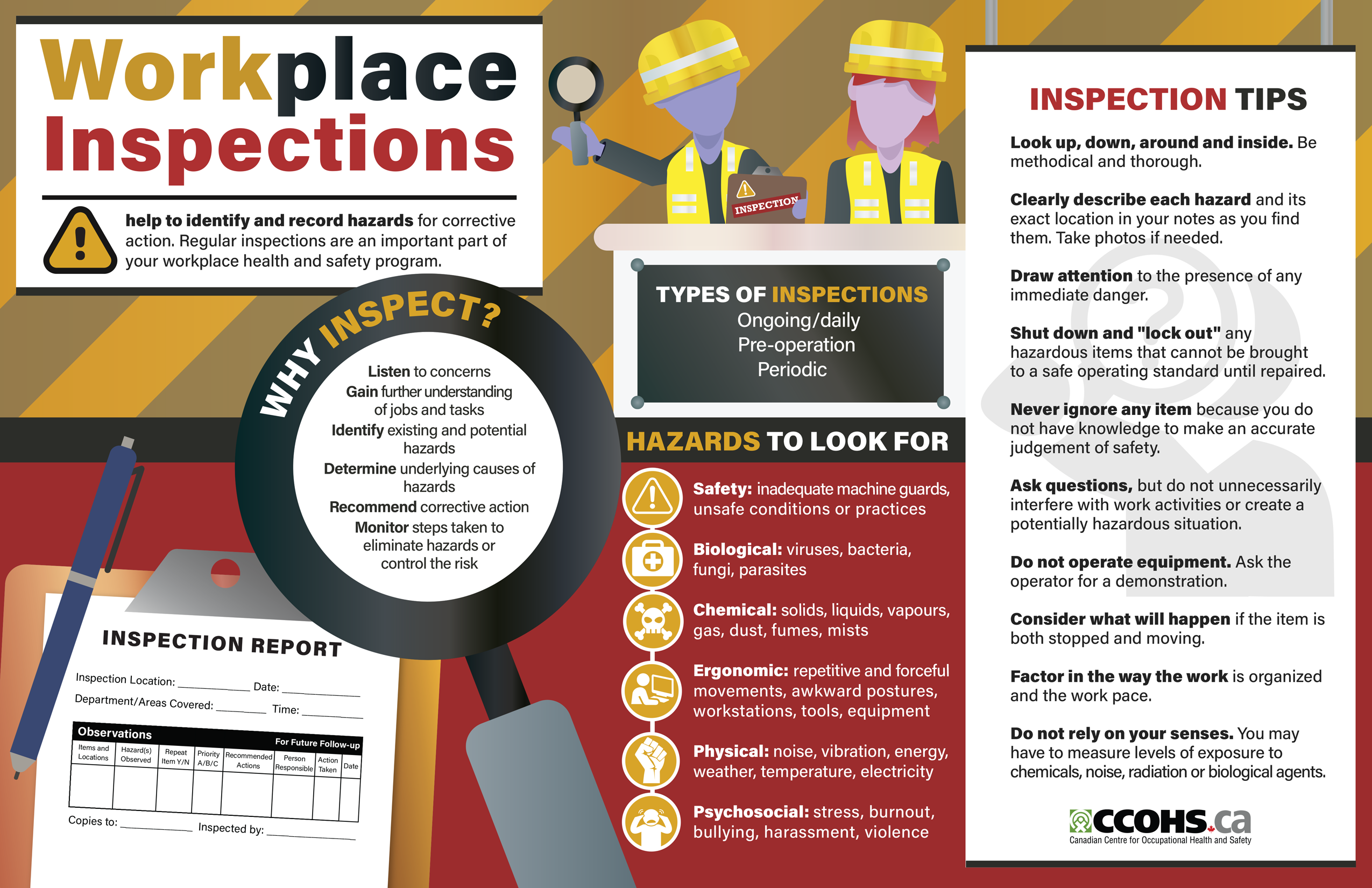
Regular site safety inspections using site-specific hazard checklists keep the workplace safe by identifying and correcting hazards in the workplace. Inspection frequency depends on the hazard level of the workplace; sites may need checks at every shift, or on a daily, quarterly, or annual basis. Document the inspection observations, identified hazards, and the corrective actions taken.
TYPES OF WORKPLACE HAZARDS
Safety hazards such as those caused by inadequate machine guards, hazardous energy (mechanical, electrical, gravitational, pneumatic, etc.), vehicles, machinery, tools, lack of fall protection, confined spaces, and housekeeping.
PREVENT INJURIES/ILLNESSES THROUGH WORKPLACE INSPECTIONS
Workplace inspections help to identify and record hazards for corrective action.
INFORMATION NEEDED TO COMPLETE AN INSPECTION
Diagram of Area. Drawings of the plant floor plans help to draw a diagram.
Equipment Inventory. Know what type of machinery or equipment is present.
Hazardous Product or Chemical Inventory. What products are used and SDSs.
Past Inspection Records. Past inspection records show what has been previously identified. They also show what an earlier inspection team concentrated on and what areas it did not inspect. Do not simply repeat or copy previous inspection results. Use the older inspection reports to help look for issues, and then determine whether recommendations were implemented. Note if the changes have been effective.
BASIC INSPECTION PRINCIPLES TO FOLLOW
The frequency of inspections will depend on the nature of the work. Inspections may be less often, for example, if the work environment is low risk like in a predominantly administrative office. More frequent inspection may be justified, for example on a construction project.
Las inspecciones periódicas de la seguridad en el lugar de trabajo utilizando listas de comprobación de peligros específicas del lugar mantienen la seguridad en el lugar de trabajo mediante la identificación y corrección de los peligros en el lugar de trabajo. La frecuencia de las inspecciones depende del nivel de peligrosidad del lugar de trabajo; puede ser necesario realizar comprobaciones en cada turno, o con una periodicidad diaria, trimestral o anual. Documente las observaciones de la inspección, los peligros identificados y las medidas correctoras adoptadas.
TIPOS DE RIESGOS LABORALES
Peligros de seguridad como los causados por protecciones inadecuadas de las máquinas, energía peligrosa (mecánica, eléctrica, gravitacional, neumática, etc.), vehículos, maquinaria, herramientas, falta de protección contra caídas, espacios confinados y limpieza.
PREVENIR LESIONES/ENFERMEDADES MEDIANTE INSPECCIONES EN EL LUGAR DE TRABAJO
Las inspecciones de los lugares de trabajo ayudan a identificar y registrar los peligros para adoptar medidas correctoras.
INFORMACIÓN NECESARIA PARA COMPLETAR UNA INSPECCIÓN
Diagrama del área. Los planos de la planta ayudan a dibujar un diagrama.
Inventario de equipos. Saber qué tipo de maquinaria o equipos están presentes.
Inventario de productos químicos o peligrosos. Qué productos se utilizan y FDS.
Registros de inspecciones anteriores. Los registros de inspecciones anteriores muestran lo que se ha identificado previamente. También muestran en qué se concentró un equipo de inspección anterior y qué áreas no inspeccionó. No se limite a repetir o copiar los resultados de inspecciones anteriores. Utilice los informes de inspección anteriores como ayuda para buscar problemas y, a continuación, determine si se han aplicado las recomendaciones. Anote si los cambios han sido eficaces.
PRINCIPIOS BÁSICOS DE INSPECCIÓN A SEGUIR
La frecuencia de las inspecciones dependerá de la naturaleza del trabajo. Las inspecciones pueden ser menos frecuentes, por ejemplo, si el entorno de trabajo es de bajo riesgo, como en una oficina predominantemente administrativa. Una inspección más frecuente puede estar justificada, por ejemplo, en un proyecto de construcción.
The Dilworth construction site where three men fell to their deaths on Jan. 2 had never been inspected by the North Carolina Department of Labor.
That isn’t uncommon. North Carolina has about one compliance officer per county to conduct safety inspections. Many work sites are never inspected — unless there’s a tragedy.
Carol Brooke, senior attorney at the North Carolina Justice Center, says the state has grappled with this problem since at least the early ’90s, when 25 poultry workers died in a fire, while locked inside the Imperial Food Products plant in Hamlet, North Carolina.
Much like the Dilworth site, the Hanover East Morehead apartments, the poultry plant had never been inspected — not until after the catastrophe.
“We’ve been behind on the number of inspectors since the Hamlet fire in 1991,” Brooke said. “We are in a sad state. And really, we don’t have nearly the number of inspectors that we need to make sure that our workplaces are safe.”
After the Hamlet fire, a few things occurred. The state passed legislation to protect workers against retaliation when reporting unsafe conditions and increased the number of safety inspectors from 60 to 114.
Since that time, North Carolina has added about four million residents, but the number of active compliance officers hasn’t kept pace. Currently, NCDOL says there are 105 officers working statewide. Thirty-three additional compliance jobs are sitting vacant.
“There also aren’t a lot of them that speak Spanish,” Brooke said. “Given that our state often employs Spanish speakers in highly dangerous industries, that’s a real problem.”
Currently, 11 compliance officers in North Carolina speak Spanish, NCDOL said. Three of them work in the Charlotte office, which covers a 15-county area.
El Departamento de Trabajo de Carolina del Norte nunca había inspeccionado la obra de Dilworth en la que murieron tres hombres al caer el 2 de enero.
Y no es raro. Carolina del Norte cuenta con un funcionario por condado para realizar inspecciones de seguridad. Muchos lugares de trabajo nunca son inspeccionados, a menos que se produzca una tragedia.
Carol Brooke, abogada sénior del Centro de Justicia de Carolina del Norte, afirma que el estado se ha enfrentado a este problema al menos desde principios de los años 90, cuando 25 trabajadores del sector avícola murieron en un incendio mientras estaban encerrados en la planta de Imperial Food Products en Hamlet, Carolina del Norte.
Al igual que las instalaciones de Dilworth, los apartamentos de Hanover East Morehead, la planta avícola nunca había sido inspeccionada, no hasta después de la catástrofe.
“Llevamos un retraso en el número de inspectores desde el incendio de Hamlet en 1991”, declaró Brooke. “Estamos en una situación lamentable. Y realmente, no tenemos ni de lejos el número de inspectores que necesitamos para asegurarnos de que nuestros lugares de trabajo son seguros.”
Tras el incendio de Hamlet, ocurrieron algunas cosas. El estado aprobó una ley para proteger a los trabajadores contra las represalias cuando denunciaran condiciones inseguras y aumentó el número de inspectores de seguridad de 60 a 114. Desde entonces, Carolina del Norte ha añadido más inspectores.
Desde entonces, Carolina del Norte ha sumado unos cuatro millones de residentes, pero el número de inspectores en activo no ha seguido el mismo ritmo. Actualmente, el NCDOL dice que hay 105 funcionarios trabajando en todo el estado. Treinta y tres puestos adicionales están vacantes.
“Tampoco hay muchos que hablen español”, dijo Brooke. “Dado que nuestro estado a menudo emplea a hispanohablantes en industrias altamente peligrosas, eso es un verdadero problema”.
Actualmente, 11 oficiales de cumplimiento en Carolina del Norte hablan español, dijo NCDOL. Tres de ellos trabajan en la oficina de Charlotte, que cubre un área de 15 condados.

Source: https://www.ccohs.ca/

Fuente: https://www.ilo.org