Winery Confined Spaces Picture This – Spanish

Winery-Confined-Spaces

¿Qué hay de malo en esta foto? La asfixia es la principal causa de muerte en espacios confinados.  Un espacio confinado con permiso puede contener una atmósfera peligrosa debido al desplazamiento del oxígeno por los subproductos de la fermentación de la uva durante el proceso de fermentación, cuando el azúcar se convierte en agua, alcohol y dióxido de carbono.

Trabajar con tanques de fermentación durante la temporada de aplastamiento es engullir. Los empleados deben tomar las precauciones adecuadas cuando trabajen en un espacio confinado, como un tanque en el que haya uvas o pieles de uva, para evitar ser engullidos.

Los empresarios, incluidos los de la industria vitivinícola, deben ser conscientes de los peligros a los que pueden enfrentarse sus empleados al entrar en espacios confinados.

La OSHA exige que se compruebe la atmósfera de un espacio confinado potencialmente peligroso antes de entrar en él.

En resumen, si la prueba atmosférica resulta peligrosa, ¡NO ENTRE EN EL DEPÓSITO!


Trucking Safety Meeting Kit

WHAT’S AT STAKE

Trucking and truck drivers are the literal driving force in our commercial manufacturing and industrial world. Witness the effects supply line problems and lack of drivers which has caused unprecedented inflationary woes.

WHAT’S THE DANGER

TRUCK DRIVING CAN BE DANGEROUS

  • The truck driver is the most important link in trucking safety. Stay healthy, fit, and well rested. Driver fatigue and inattention to the road can increase the probability of an accident. To maintain your most alert state when driving, avoid alcohol, drugs, and medications that cause drowsiness. Learn and follow the hours-of-service requirements that apply to you. Don’t multi-task while driving—keep your eyes and mind on the road.
  • Every time a truck driver gets behind the wheel, he or she is at risk. In fact, of the top 25 deadliest occupations in America, truck driving ranks seventh on the list. Truck drivers also face the highest number of fatalities of any job, at a rate of 918 fatalities each year.1
  • According to the U.S. Bureau of Labor, the most common cause of workplace death is transportation accidents, which account for 40% of all on-the-job deaths; and delivery truck drivers experience nearly three times more injuries and deaths than any other occupation.2 And this number is only going up each passing year. The U.S. Department of Labor points out that the number of truck drivers who were killed on the job rose 6.6% from 2016 to 2018.
  • The growing competition in the online retail industry, has also made a big impact on the day-to-day lives of truck drivers. With the “Amazon effect”, consumers are led to believe that one-day turnaround for their online deliveries is a norm. With increasing number of packages flooding the supply chain and the frequency of deliveries being made, truckers are performing under pressure.

MOST SAFETY RISKS ARE ON THE ROAD

Wear a seatbelt: Though decades of research continue to show that seatbelts save lives, a stunning one in six truck drivers doesn’t regularly wear one. Regular seatbelt use is one of the easiest ways to improve your safety.

Check blind spots: Trucks have blind spots. Know where they are and clear before changing lanes. Full seconds before changing lanes and take seven seconds to complete the change.

Monitor speed limits. Speed limits often change with little warning, and the faster you are going the more difficult it will be to stop in an emergency.

Lower speed on curves. Even the posted speed limit can be unsafe when navigating a big truck with its high center of gravity on a curve. Slow to at least 5 mph below the speed limit or even lower on steep curves.

Avoid cell phone use while driving. You’re not allowed to reach for your phone in a way that takes you out of a normal driving position, to push more than a single button, or to hold your phone in your hand.

Follow the seven-second rule. Trucks are far bigger and heavier, with a much greater stopping distance. Increase this to seven seconds of distance on clear, dry roads.

Avoid drugs and alcohol. Driving under the influence is illegal and dangerous. Commercial drivers may not have any measurable alcohol in their bloodstream or consume any alcohol within four hours before taking control of their vehicle.

Stay cool, calm, and collected. If someone angers you on the road, take a deep breath and slow down (but don’t slam on the brakes). Allow that person the needed space to get away from you and give yourself time to calm down.

Always use signals. When you’re driving a large vehicle that is difficult for other drivers to see and maneuver around, it’s essential to signal your intentions for a few seconds before making a turn or a lane change.

Take regular rest breaks. Hours of service regulations govern how long you can drive at a time and how much rest is required before you drive again.

Inspect your truck. At the end of each day or trip, don’t forget the post-trip inspection. You’re required to inspect everything from the tires to the windshield wipers and complete a written report within 24 hours.

THE SAFETY TRIFECTA: PRE – TRIP, ON THE ROAD, POST – TRIP

Pre – Trip: Pre – Planning is The Key for Trip Safety

Plan your route. Whether you’re driving a single load from Point A to Point B or dropping off smaller loads along the way, it’s essential to plan your route.

Develop a preventative maintenance plan. If you’re an owner-operator, you will be responsible for designing your own preventative maintenance plan. If you drive for a company, your carrier should develop the schedule. This plan should be based on things like mileage, days on the road, and any previous history of breakdowns.

Perform a pre-trip inspection. The more thorough you are in checking everything from the lights to the brakes to the coupling system, the safer you will be on the road. Be sure to carry an emergency kit with the tools and spare parts you need to perform minor repairs during your trip.

Check weather and traffic reports. Before you set out, look at the latest weather and traffic reports.

Follow safe loading procedures. In general, be sure to apply the tractor and trailer parking brakes, ensure that all items are properly strapped down, follow all instructions the shipper gives you, and double-check that you have a clear path, and the dock plate is removed before pulling out.

SAFETY DRIVING TIPS FOR TRUCK DRIVING IN WINTER WEATHER

Treat your diesel. Diesel fuel does start to gel at temperatures right around the freezing point of water (32F), and it can become completely unusable at about 17F. Even partially gelled diesel is hard on your engine.

Check brake lights. Make sure your brake lights are working and keep a close eye on those ahead of you. Slow down and double your following distance.

Carry emergency supplies. Carry tire chains, a charged cell phone, and an emergency kit. Make sure you have nonperishable food and a few blankets in case you get stuck on the road.

Watch for black ice. Black ice is a thin layer of ice that forms right around the freezing point, especially on bridges and overpasses. It is nearly impossible to see and can quickly send you into a skid.

Pay attention to tire spray. If the road conditions look wet, check the tires of the vehicles around you. If they’re spraying a lot of water, odds are good that the road is just wet and not yet frozen.

Practice defensive driving. Assume the drivers around you have little experience in winter weather. Drive defensively, ready to evade potentially dangerous situations. Stay cautious and alert.

FINAL WORD

You learn a lot of truck driver safety tips while you were going through training. It’s only natural to forget some of your training once you get on the road. Safety is important on your 1,000th trip as on your first, so refresher courses for truck drivers are necessary.


Trucking Safety Meeting Kit – Spanish

QUÉ ESTÁ EN RIESGO

El transporte por carretera y los camioneros son literalmente la fuerza motriz de nuestro mundo industrial y de fabricación comercial. Los problemas de suministro y la falta de conductores han provocado una inflación sin precedentes.

CUÁL ES EL PELIGRO

CONDUCIR CAMIONES PUEDE SER PELIGROSO

  • El camionero es el eslabón más importante en la seguridad del transporte por carretera. Manténgase sano, en forma y bien descansado. La fatiga del conductor y la falta de atención a la carretera pueden aumentar la probabilidad de accidente. Para mantener su estado de alerta al conducir, evite el alcohol, las drogas y los medicamentos que causan somnolencia. Conozca y cumpla los requisitos de horas de servicio que le correspondan. No haga varias cosas a la vez mientras conduce: mantenga los ojos y la mente en la carretera.
  • Cada vez que un camionero se pone al volante, corre un riesgo. De hecho, de las 25 profesiones más mortíferas de Estados Unidos, la de camionero ocupa el séptimo lugar. Los conductores de camiones también se enfrentan al mayor número de muertes de cualquier trabajo, con una tasa de 918 muertes cada año.
  • Según la Oficina de Trabajo de EE. UU., la causa más común de muerte en el lugar de trabajo son los accidentes de transporte, que representan el 40% de todas las muertes en el trabajo; y los conductores de camiones de reparto sufren casi tres veces más lesiones y muertes que cualquier otra ocupación. Y esta cifra no hace más que aumentar cada año que pasa. El Departamento de Trabajo de Estados Unidos señala que el número de conductores de camiones que murieron en el trabajo aumentó un 6,6% de 2016 a 2018.
  • La creciente competencia en la industria minorista en línea también ha tenido un gran impacto en el día a día de los camioneros. Con el “efecto Amazon”, a los consumidores se les hace creer que el plazo de entrega de un día para sus entregas en línea es una norma. Con el creciente número de paquetes que inundan la cadena de suministro y la frecuencia con la que se realizan las entregas, los camioneros trabajan bajo presión.

COMO PROTEGERSE

LA MAYORÍA DE LOS RIESGOS PARA LA SEGURIDAD ESTÁN EN LA CARRETERA

Utilice el cinturón de seguridad: Aunque décadas de investigación siguen demostrando que el cinturón de seguridad salva vidas, sorprendentemente uno de cada seis conductores de camiones no lo utiliza con regularidad. El uso regular del cinturón de seguridad es una de las formas más sencillas de mejorar su seguridad.

Compruebe los ángulos muertos: Los camiones tienen ángulos muertos. Sepa dónde están y despeje antes de cambiar de carril. Complete los segundos antes de cambiar de carril y tarde siete segundos en completar el cambio.

Controle los límites de velocidad. Los límites de velocidad suelen cambiar sin previo aviso, y cuanto más rápido vaya, más difícil le resultará detenerse en caso de emergencia.

Reduzca la velocidad en las curvas. Incluso el límite de velocidad indicado puede ser inseguro al conducir un camión grande con su alto centro de gravedad en una curva. Reduzca la velocidad al menos 8 km/h por debajo del límite de velocidad o incluso menos en curvas pronunciadas.

Evite utilizar el teléfono móvil mientras conduce. No está permitido coger el teléfono de forma que se salga de la posición normal de conducción, pulsar más de un botón o mantener el teléfono en la mano.

Siga la regla de los siete segundos. Los camiones son mucho más grandes y pesados, con una distancia de frenado mucho mayor. Aumente esta distancia a siete segundos en carreteras despejadas y secas.

Evite las drogas y el alcohol. Conducir bajo sus efectos es ilegal y peligroso. Los conductores comerciales no pueden tener alcohol medible en la sangre ni consumir alcohol en las cuatro horas anteriores a tomar el control del vehículo.

Mantenga la calma y la serenidad. Si alguien le hace enfadar en la carretera, respire hondo y reduzca la velocidad (pero no pise el freno). Deje a esa persona el espacio necesario para alejarse de usted y dese tiempo para calmarse.

Utilice siempre las señales. Cuando conduzca un vehículo de gran tamaño que resulte difícil de ver y maniobrar para los demás conductores, es fundamental que señale sus intenciones durante unos segundos antes de realizar un giro o un cambio de carril.

Descanse con regularidad. Las normas sobre horas de servicio regulan cuánto tiempo puede conducir cada vez y cuánto tiempo de descanso es necesario antes de volver a conducir.

Inspeccione su camión. Al final de cada día o viaje, no olvide la inspección posterior al viaje. Debe inspeccionarlo todo, desde los neumáticos hasta los limpiaparabrisas, y redactar un informe escrito en un plazo de 24 horas.

LA TRIFECTA DE LA SEGURIDAD: ANTES DEL VIAJE, EN LA CARRETERA, DESPUÉS DEL VIAJE

Antes del viaje – La planificación previa es clave para la seguridad del viaje

Planifique su ruta. Tanto si conduce una sola carga del Punto A al Punto B como si deja cargas más pequeñas por el camino, es esencial que planifique su ruta.

Desarrolle un plan de mantenimiento preventivo. Si usted es un propietario-operador, usted será responsable de diseñar su propio plan de mantenimiento preventivo. Si conduce para una empresa, su transportista deberá desarrollar el plan. Este plan debe basarse en aspectos como el kilometraje, los días en carretera y cualquier historial previo de averías.

Realice una inspección antes del viaje. Cuanto más minucioso sea en la comprobación de todo, desde las luces hasta los frenos y el sistema de acoplamiento, más seguro estará en la carretera. Asegúrese de llevar un kit de emergencia con las herramientas y piezas de repuesto necesarias para realizar pequeñas reparaciones durante el viaje.

Consulte los partes meteorológicos y de tráfico. Antes de salir, consulte los últimos partes meteorológicos y de tráfico.

Siga procedimientos de carga seguros. En general, asegúrese de aplicar los frenos de estacionamiento de la cabeza tractora y del remolque, asegúrese de que todos los artículos están bien atados, siga todas las instrucciones que le dé el expedidor y compruebe dos veces que tiene el camino despejado y que la placa del muelle está quitada antes de salir.

CONSEJOS DE SEGURIDAD PARA LA CONDUCCIÓN DE CAMIONES EN INVIERNO

Trate su combustible diesel. El combustible diesel empieza a gelificarse a temperaturas cercanas al punto de congelación del agua (32ºF), y puede volverse completamente inutilizable a unos 17ºF. Incluso el combustible parcialmente gelificado es perjudicial para el motor.

Compruebe las luces de freno. Asegúrese de que sus luces de freno funcionan y vigile de cerca a los que circulan delante de usted. Reduzca la velocidad y duplique la distancia de seguridad.

Lleve provisiones de emergencia. Lleve cadenas para los neumáticos, un teléfono móvil cargado y un kit de emergencia. Asegúrese de llevar alimentos no perecederos y algunas mantas por si se queda atascado en la carretera.

Cuidado con el hielo negro. El hielo negro es una fina capa de hielo que se forma justo alrededor del punto de congelación, especialmente en puentes y pasos elevados. Es casi imposible de ver y puede hacerle derrapar rápidamente.

Preste atención a las salpicaduras de los neumáticos. Si las condiciones de la carretera parecen húmedas, comprueba los neumáticos de los vehículos que te rodean. Si echan mucha agua, lo más probable es que la carretera esté mojada y no helada.

Practica la conducción defensiva. Asuma que los conductores que le rodean tienen poca experiencia con el tiempo invernal. Conduzca a la defensiva, preparado para eludir situaciones potencialmente peligrosas. Sea prudente y manténgase alerta.

CONCLUSIÓN

Usted aprendió muchos consejos de seguridad para camioneros mientras estaba capacitado. Es normal que olvide parte de su capacitación una vez que sale a la carretera. La seguridad es tan importante en su viaje número 1.000 como en el primero, por lo que los cursos de actualización para conductores de camiones son necesarios.


Trucking Safety Stats and Facts

FACTS

  1. IMPROPER LOADING. Loading guidelines exist for a reason: they’re in place to ensure your truck can handle the cargo properly without adversely affecting handling or braking.
  2. DRIVER ERROR. Stay vigilant and aware and anticipate driver error. Always avoid tailgating, even if a car moves in front of you.
  3. BLINDSPOT. Part of truck driver training involves being aware of blind spots and always staying mindful of what’s around you. Old-fashioned diligence is still the best way to monitor your blind spots.
  4. SPEEDING. Always follow posted speed limits to ensure you arrive at your destination safely. You will also consume less fuel, which can add up over the year.
  5. FATIGUE. At the first sign of fatigue, pull off and take a rest. Everything from inadequate sleep to diet and medications can affect your alertness.
  6. FAILURE TO SIGNAL. Although failure to signal may not seem like a big deal, it’s always important to let other drivers know what you’re planning to do.
  7. PARKING LOT MANEUVERS. Always do a walk-around when you are parked to ensure no vehicles, pedestrians or other obstacles are in your way, especially if you’re going to back up.
  8. ROAD CONDITIONS. Sharp curves, steep downgrades, heavy rain, and snowy or icy conditions significantly affect your truck. Knowing when to reduce your speed is an important part of responding to these conditions.
  9. DRIVER DISTRACTION. Transport trucks are loaded up with more and more telematics, guidance, and entertainment options for these days. Don’t let onboard technologies or handheld devices distract you from your job of driving.

STATS

Must-Know Truck Driver Accident Statistics

  • In 2019, there were 7,000 more large truck crashes than the previous year
  • In 2020, there were 110 fewer large truck deaths than in 2019
  • Tire defects are responsible for almost a third of all truck-related crashes
  • Every year, sleep deprivation causes 100,000 truck crashes
  • Over 55% of fatal truck-related accidents took place in rural areas in 2019
  • In the US, Texas had the highest number of truck accidents fatalities (658) in 2019
  • Based on some preliminary estimates for 2020, there were 4,895 large truck fatalities
  • In 2019, large trucks accounted for 9.8% of all vehicles involved in fatal accidents


Trucking Safety Stats and Facts – Spanish

HECHOS

  1. CARGA INADECUADA. Las directrices de carga existen por una razón: están ahí para asegurar que su camión puede manejar la carga adecuadamente sin afectar negativamente a la maniobrabilidad o al frenado.
  2. ERROR DEL CONDUCTOR. Manténgase alerta y anticipe los errores del conductor. Evite siempre ir a rebufo, incluso si un coche se mueve delante de usted.
  3. PUNTOS CIEGOS. Parte de la capacitación de los conductores de camiones implica ser conscientes de los puntos ciegos y estar siempre atentos a lo que hay a su alrededor. La diligencia a la vieja usanza sigue siendo la mejor manera de vigilar tus puntos ciegos.
  4. VELOCIDAD. Respete siempre los límites de velocidad indicados para llegar seguro a su destino. También consumirá menos combustible, que puede acumularse a lo largo del año.
  5. FATIGA. A la primera señal de fatiga, deténgase y descanse. Todo, desde el sueño inadecuado hasta la dieta y los medicamentos, puede afectar a su estado de alerta.
  6. FALTA DE SEÑALIZACIÓN. Aunque no señalizar puede no parecer un gran problema, siempre es importante avisar a los demás conductores de lo que piensa hacer.
  7. MANIOBRAS EN APARCAMIENTOS. De siempre una vuelta cuando esté aparcado para asegurar que no hay vehículos, peatones u otros obstáculos en tu camino, especialmente si va a dar marcha atrás.
  8. CONDICIONES DE LA CARRETERA. Las curvas cerradas, las bajadas pronunciadas, la lluvia intensa y las condiciones de nieve o hielo afectan significativamente a su camión. Saber cuándo reducir la velocidad es una parte importante de la respuesta a estas condiciones.
  9. DISTRACCIÓN DEL CONDUCTOR. Los camiones de transporte están cada vez más cargados de opciones telemáticas, de guiado y de entretenimiento. No deje que las tecnologías de a bordo o los dispositivos portátiles le distraigan de su trabajo de conducir.

ESTADÍSTICAS

Estadísticas de accidentes de conductores de camiones que debe conocer

  • En 2019, hubo 7.000 accidentes de camiones grandes más que el año anterior
  • En 2020, hubo 110 muertes menos de camiones grandes que en 2019
  • Los defectos en los neumáticos son responsables de casi un tercio de todos los accidentes relacionados con camiones
  • Cada año, la falta de sueño causa 100.000 accidentes de camiones
  • Más del 55% de los accidentes mortales relacionados con camiones tuvieron lugar en zonas rurales en 2019
  • En los Estados Unidos, Texas tuvo el mayor número de accidentes mortales relacionados con camiones (658) en 2019
  • Según algunas estimaciones preliminares para 2020, se produjeron 4.895 accidentes mortales de camiones grandes
  • En 2019, los camiones grandes representaron el 9,8% de todos los vehículos implicados en accidentes mortales


Trucking Safety Fatality File

Truck Driver Dies after Being Struck by Semi-Trailer Truck in Trailer Lot of Customer Yard

A 39-year-old truck driver working outside his semi-trailer truck died when he was struck and crushed against his trailer by a semi-trailer truck that swung wide as it pulled out of an adjacent parking stall. The victim was employed by a general freight trucking company that transports refrigerated goods. He had 10 years’ experience driving semi-trailer trucks.

On the day of the incident, the victim was assigned by his dispatcher to pick up freight consisting of a full trailer load of chilled boxed beef at a customer’s meat processing facility. The victim drove his truck to the customer location. He then drove to the empty trailer lot portion of the yard where he unhooked and dropped his refrigeration trailer. An employee of the facility hooked the trailer to a yard hostler and hauled it to the loading dock to be loaded with freight.

After the trailer was loaded, the hostler operator deposited the trailer in the loaded trailer lot. Located across from the loading dock, the lot’s surface is a mixture of asphalt and concrete with yellow lines marking the parking stalls. There are often several trailers parked in the lot. It is a part of the yard where loaded trailers are left awaiting their drivers who then back their trucks up to their trailers and hook them up and prepare for departure. Drivers may pick-up their trailers at any time during the da or night.

The victim backed his truck up to his trailer and hooked it up. As he was doing this and preparing to depart, he chatted with the driver of a truck in the adjacent parking stall who was also preparing to depart. The driver of the other truck finished his pre-trip check and got into the cab of his truck. He reported that he last saw the victim standing at the rear of his own truck’s trailer. Less than a minute after last seeing the victim the other driver checked his mirrors and started moving the truck forward out of the stall.

As he drove forward, he made a sharp turn to the left in order to avoid a hostler parked in front of his truck. The victim was standing on the driver’s side of his trailer near the front cranking up his trailer’s landing gear. It was dark and he was not wearing the high-visibility safety vest which his employer had issued him. As the other truck moved forward and swung left the right rear of its trailer struck the victim. The driver was not aware that the victim had been struck and proceeded to leave the yard. The victim died at the scene.


Trucking Safety Fatality File – Spanish

Un Camionero Muere Tras ser Atropellado por un Camión Semirremolque en el Aparcamiento de un Cliente

Un camionero de 39 años de edad que trabajaba fuera de su camión semirremolque murió al ser golpeado y aplastado contra su remolque por un camión semirremolque que se abrió de par en par al salir de un aparcamiento adyacente. La víctima era empleada de una empresa de transporte de carga general que transportaba mercancías refrigeradas. Tenía 10 años de experiencia conduciendo camiones semirremolque.

El día del siniestro, su expedidor le había asignado la recogida de una carga consistente en un remolque completo de carne de vacuno refrigerada en cajas en las instalaciones de procesamiento de carne de un cliente. La víctima condujo su camión hasta la ubicación del cliente. A continuación, se dirigió a la zona de remolques vacía del astillero, donde desenganchó y dejó caer el remolque frigorífico. Un empleado de las instalaciones enganchó el remolque a un conductor y lo llevó al muelle de carga para cargarlo.

Una vez cargado el remolque, el operario lo depositó en el aparcamiento de remolques cargados. Situado frente al muelle de carga, la superficie del aparcamiento es una mezcla de asfalto y hormigón con líneas amarillas que delimitan las plazas. A menudo hay varios remolques aparcados en el aparcamiento. Es una parte del patio donde se dejan los remolques cargados a la espera de sus conductores, que luego acercan sus camiones a los remolques, los enganchan y se preparan para partir. Los conductores pueden recoger sus remolques en cualquier momento del día o de la noche.

La víctima acercó su camión al remolque y lo enganchó. Mientras lo hacía y se preparaba para partir, charló con el conductor de un camión que estaba en el aparcamiento contiguo y que también se preparaba para partir. El conductor del otro camión terminó su comprobación previa al viaje y subió a la cabina de su camión. Informó de que había visto por última vez a la víctima de pie en la parte trasera del remolque de su propio camión. Menos de un minuto después de ver por última vez a la víctima, el otro conductor comprobó sus retrovisores y empezó a hacer avanzar el camión para salir del estacionamiento.

Mientras avanzaba, hizo un giro brusco a la izquierda para evitar a un azafato aparcado delante de su camión. La víctima estaba de pie en el lado del conductor de su remolque, cerca de la parte delantera, subiendo el tren de aterrizaje de su remolque. Estaba oscuro y no llevaba puesto el chaleco de seguridad de alta visibilidad que le había proporcionado su empleador. Cuando el otro camión avanzó y giró a la izquierda, la parte trasera derecha de su remolque golpeó a la víctima. El conductor no se dio cuenta de que la víctima había sido golpeada y abandonó el patio. La víctima falleció en el lugar del accidente.


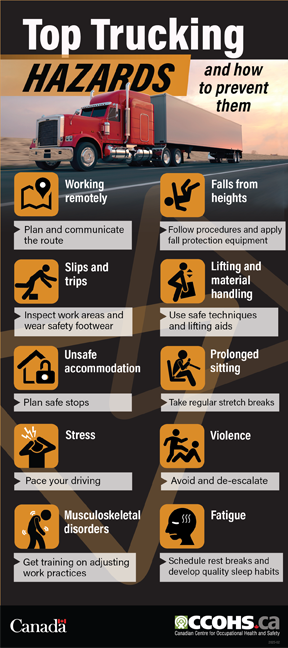
Trucking Safety Infographic

Trucking-Safety-Infographic

Source: https://www.ccohs.ca


Trucking Safety Infographic – Spanish

Trucking-Safety-Infographic-Spanish

Fuente: https://solocamion.es


X-Ray Technician Safety Meeting Kit – Spanish

QUÉ ESTÁ EN RIESGO

Los radiólogos manejan máquinas de rayos X médicas en el entorno sanitario para proporcionar información de diagnóstico valiosa y, a menudo, vital. Los radiólogos deben conocer los riesgos que conllevan sus funciones.

CUÁL ES EL PELIGRO

PELIGROS DEL TRABAJO DE TÉCNICO DE RAYOS X

En todos los trabajos hay riesgos para la salud y riesgos laborales. Cabe señalar que, como técnico de rayos X, puede estar expuesto a niveles de radiación más elevados en función de la demanda. La información de diagnóstico puede utilizarse para ayudar a determinar el mejor curso de acción para el paciente en su recuperación, pero el proceso de obtención de imágenes tiene el potencial de ponerle en riesgo si está expuesto.

Riesgos potenciales. Debido a la naturaleza de su trabajo, también puede encontrarse en el camino de agentes patógenos transmitidos por la sangre o el aire. Los pacientes acuden a ti en busca de ayuda por una tos o un dolor, lo que significa que tendrá que realizarles pruebas y prepararles una radiografía. Dado que sólo se puede emitir un diagnóstico una vez realizadas éstas, los técnicos pueden encontrarse manejando a un paciente con una enfermedad contagiosa.

Estrés físico. Los turnos largos pueden obligarle a estar de pie la mayor parte del día. Es posible que tenga que levantar a pacientes o darles la vuelta para ayudarles si no pueden hacerlo por sí mismos. Cuando se repiten a diario, estas acciones pueden resultar agotadoras y desgastar a la persona. Sin el apoyo adecuado o el conocimiento de la mecánica corporal, el trabajo puede resultar agotador para las articulaciones con el paso de los años. El resultado pueden ser varias lesiones, como rotura de ligamentos, esguinces de rodilla y dolor de espalda.

Trauma emocional y problemas de salud mental. La escuela no puede prepararte para todo. Ver a los pacientes en su peor momento puede hacer mella en tu salud mental. Los profesionales se enfrentan a pacientes con cáncer de mama, maltrato doméstico, accidentes y otros incidentes traumáticos que entran por la puerta. Podrías pasar tu tiempo en Urgencias presenciando casos traumáticos. La exposición a estos casos puede inquietar a cualquiera, por muchos años que lleve trabajando.

COMO PROTEGERSE

MEDIDAS PARA GARANTIZAR LA SEGURIDAD ANTE LA RADIACIÓN DE LOS RADIÓLOGOS

Revisión e informes

La revisión de las radiografías es un paso importante en la seguridad radiológica. Después de que se ha adquirido la imagen, hay ciertos pasos esenciales para que el tecnólogo garantice la seguridad radiológica:

  • Registrar la DAP y el kerma aéreo acumulado en el registro de dosis del paciente y, si no está disponible, utilizar medidas sustitutas como el tiempo de fluoroscopia para estimar la dosis del paciente.
  • Revisar la dosis de radiación. Marcar para seguimiento y aconsejar al paciente si la dosis cutánea supera los 2 Gy o la dosis acumulada supera los 3 Gy (según las directrices del NCI).
  • Auditar la exposición ocupacional

Capacitación

  • Recibir capacitación en seguridad radiológica, física básica de la radiación, así como en los efectos de la radiación.
  • Recibir capacitación continua después de la acreditación inicial y retroalimentación cuando sea necesario.

ALARA (tan bajo como sea razonablemente posible)

ALARA es una filosofía de seguridad que pretende minimizar la dosis de radiación y mantener la exposición tan por debajo del límite establecido como sea prácticamente posible. Implica hacer todos los esfuerzos razonables para mantener baja la exposición a la radiación, teniendo en cuenta consideraciones prácticas como la tecnología y socioeconómicas.

¿Cuáles son los pasos esenciales que deben dar los tecnólogos para garantizar la seguridad radiológica basada en el principio ALARA? El tiempo, la distancia y el blindaje son formas de mantener ALARA la exposición a la radiación externa. La buena higiene, el control de la contaminación, la protección contra los peligros aéreos y el uso adecuado del equipo de protección personal son formas de mantener ALARA la exposición a la radiación interna.

  • Revisar periódicamente las dosis de radiación ocupacional.
  • Informar a la dirección del hospital sobre la exposición ocupacional
  • Revisar los dispositivos de radiación para asegurarse de que incorporan la filosofía ALARA.
  • Establecer niveles de investigación de la exposición ocupacional, que cuando se superen justifiquen una revisión de la técnica.
  • Proporcionar formación y capacitación continuas para mantener ALARA las exposiciones a la radiación.

LOS DETALLES DE LA SEGURIDAD DE LOS RADIÓLOGOS

Aprenda los ajustes adecuados de la máquina y los límites de exposición a la radiación. Esté siempre alerta cuando el tubo de rayos X esté activo. Las luces de advertencia, el blindaje y otros dispositivos de seguridad deben mantenerse en buen estado de funcionamiento. Capacítese para ajustar, mantener y utilizar el equipo correctamente. Colóquese detrás de las paredes protectoras o use un delantal blindado cuando los rayos X estén activos. La dosimetría personal puede utilizarse para controlar su exposición potencial a la radiación y asegurarse de que se encuentra dentro de los límites de seguridad.

Asegúrese de tomar precauciones universales cuando trabaje con pacientes. Utilice guantes en todo momento y gafas, mascarilla y bata cuando sea necesario. Lave y esterilice el equipo después de cada uso para practicar el control de infecciones; esto le protege a usted y a los pacientes.

Al mover el equipo de rayos X, asegúrese de utilizar buenas técnicas ergonómicas. Evite las posturas estáticas y no se estire ni extienda demasiado el cuerpo para mover el equipo. Tenga en cuenta que los pacientes lesionados o doloridos pueden actuar de forma imprevisible. Pida ayuda a otros trabajadores cuando transporte y asista a los pacientes. Utilice buenas técnicas de elevación con la espalda recta y las rodillas blandas para proteger la espalda.

Lea las fichas de datos de seguridad (FDS) de los productos químicos y asegúrese de que sabe manejar el equipo correctamente. Conozca y comprenda las proporciones de mezcla y los niveles de llenado de todos los productos químicos. Utilice guantes resistentes a los productos químicos y gafas contra salpicaduras cuando trabaje con productos químicos húmedos.

CONCLUSIÓN

Ser técnico de rayos X entraña peligros, como el riesgo de cáncer y la exposición a radiaciones. Sin embargo, seguir correctamente las normas de seguridad y utilizar la tecnología moderna puede hacer que riesgos como el desarrollo del cáncer sean menos amenazadores con el paso de los años. Los nuevos técnicos radiólogos deben comprender estos riesgos y venir preparados para trabajar cada día en la carrera que desean.


X-Ray Technician Safety Meeting Kit

WHAT’S AT STAKE

X-Ray technicians operate medical x-ray machines in the healthcare setting to provide valuable and often life-saving diagnostic information. X-Ray technicians should know hazards that accompany their job functions.

WHAT’S THE DANGER

DANGERS OF X-RAY TECHNICIAN WORK

Every job, there come health risks and occupational hazards. It should be noted that as an X-ray technician, you may be exposed to higher radiation levels depending on demand. Diagnostic information can be used to help determine the best course of action for the patient in their recovery, but the imaging process has the potential to put you at risk if you are exposed.

Potential Risks. You may also find yourself in the way of bloodborne or airborne pathogens due to the nature of your work. Patients come to you looking for help with a cough or ache, which means you’ll need to run tests and get an x-ray ready for them. Because a diagnosis can only be delivered after these are performed, technicians may find themselves handling a patient with a contagious disease.

Physical Stress. Long shifts may leave you on your feet for the majority of the day. You may have to lift patients or turn them over to assist them if they can’t do so themselves. When repeated on a daily basis, these actions can be draining and wear one down. Without proper support or knowledge of body mechanics, the work may be strenuous on your joints over the years. Several injuries may come as a result, like torn ligaments, sprained knees, and back pain.

Emotional Trauma and Mental Health Concerns. School can only prepare you for so much. Seeing patients at their worst can take a toll on your mental health. Professionals face patients who have breast cancer, domestic abuse, accidents, and other traumatic incidents that walk through the door. You could spend your time in the ER witnessing trauma cases. Exposure to these cases can make any you uneasy, no matter how many years they have under their belt.

HOW TO PROTECT YOURSELF

STEPS TO ENSURE RADIATION SAFETY FOR X-RAY TECHNICIANS

Reviewing And Reporting

Review of X-rays is an important step in radiation safety. After the image has been acquired, there are certain essential steps for the technologist to ensure radiation safety:

  • Record DAP and cumulative air kerma on the patient’s dose record, and if unavailable, use surrogate measures such as fluoroscopy time to estimate the patient’s dose.
  • Review radiation dose. Flag for follow-up and counsel the patient if the skin dose exceeds 2 Gy or the cumulative dose exceeds 3 Gy (per NCI guidelines)
  • Audit occupational exposure

Training

  • Receive training in radiation safety, basic radiation physics, as well as the effects of radiation.
  • Undergo ongoing education following initial credentialing and feedback when needed.

ALARA (as low as reasonably achievable)

ALARA is a philosophy of safety that aims to minimize radiation dose and keep exposure as much below the established limit as is practically possible. It entails making all reasonable efforts to keep radiation exposure low, taking into account practical considerations such as technology and socioeconomic.

What are the essential steps for technologists to ensure radiation safety based on the ALARA principle? Time, distance, and shielding are ways to keep external radiation exposure ALARA. Good hygiene, contamination control, protection against airborne hazards, and proper use of personal protective equipment are ways to keep internal radiation exposure ALARA.

  • Periodically reviewing occupational radiation doses
  • Briefing the hospital management regarding occupational exposure
  • Reviewing radiation devices to ensure they incorporate the ALARA philosophy.
  • Establishing investigation levels of occupational exposure, which when exceeded warrant a review of technique.
  • Providing ongoing education and training to keep radiation exposures ALARA.

THE NITTY – GRITTY OF X-RAY TECHNICIAN SAFETY

Learn the appropriate machine settings and the exposure limits for radiation. Always be aware when the x-ray tube is active. Warning lights, shielding, and other safety devices should be maintained in good working order. Get the training to adjust, maintain, and operate the equipment properly. Step behind protective walls or wear a shielded apron when the x-ray is active. Personal dosimetry can be used to monitor your potential exposures to radiation and make sure that you are within safe limits.

Make sure that you take universal precautions when working with patients. Wear gloves at all times and goggles, a mask, and gown when necessary. Wash and sterilize equipment after each use to practice infection control; this protects you and the patients.

When moving x-ray equipment, make sure to use good ergonomic techniques. Avoid static postures and don’t overreach or overextend your body to move the equipment. Be aware that patients that have been injured or are in pain may act unpredictably. Get assistance from other workers when transporting and assisting patients. Use good lifting techniques with a straight back and soft knees to protect your back.

Read the safety data sheets (SDS) for chemicals and ensure that you know how to operate the equipment properly. Know and understand the mix ratios and fill levels for all of the chemicals. Wear chemical resistant gloves and splash goggles when working with wet chemicals.

FINAL WORD

There are dangers involved with being a X-ray technician, such as cancer risk and radiation exposure. However, properly following safety regulations and using modern technology may make risks like cancer development less threatening over the years. New radiology technologists need to understand these risks and come prepared to work each day in their desired career.


X-Ray Technician Safety Stats and Facts

FACTS

1. X-Ray and Radiation Exposure

Radiologists are responsible for the medical imaging used for diagnostic purposes. This means that radiation exposure is a potential risk. Lead aprons and leaded glass shields are essential as frontline equipment against radiation exposure. While average radiation doses from an x-ray are not enough to harm, long-term exposure to x-ray radiation can lead to cancer risks.

2. Cancer Risk

Overexposure can lead to cancer risk in some workers, especially if the protective equipment is not up to standard.

3. Other dangers of x-ray technicians

  • Exposure to airborne and bloodborne pathogens is a daily concern.
  • Potential for needle sticks during procedures and IV insertions.
  • Emotional trauma from seeing results of horrible accidents and abuse.
  • Being physically attacked by deranged or drunk/drugged patients.
  • Long term physical injury from standard daily job duties.
  • Excessive radiation exposure from equipment not up to standard.

STATS

  • Of the total number of radiology technicians at risk currently staffed across the country, a minimal number (between 0.53% and 0.87%) will see complications from radiation over their lifetime.
  • According to the (VHA), 42% of all radiology technologists have had a work-related injury. They also report that at least 26% have had multiple injuries, and 7% have had more than 10 injuries.
  • The shoulder, wrist and back injuries suffered by radiologic technologists are similar. Also, a study of 401 American Society of Radiologic Technologists members found that more than half (251, 62.6%) experienced occupational injuries, with the majority of those being muscular injuries (205, 81.7%).
  • The practicing radiologist in the United States receives an annual average x-ray dose of 3.2 mSv. This dose of radiation results in between 17 and 28 cancer deaths among the 19,000 radiologists at risk, or an excess cancer risk of between 0.53% and 0.87%. The sub-population of cardiologists and radiologists who perform special procedures is expected to be at a higher risk of death from cancer than the general or therapeutic radiologist. The genetic risk to the children of the radiologist corresponds to a 0.09 to 1.26 excess of cases of genetically determined disease among the 4047 children in the first generation, or between a 0.02% to 0.31% increase above the expected incidence.


X-Ray Technician Safety Stats and Facts – Spanish

HECHOS

1. Rayos X y exposición a la radiación

Los radiólogos son responsables de las imágenes médicas utilizadas con fines diagnósticos. Esto significa que la exposición a la radiación es un riesgo potencial. Los delantales de plomo y los escudos de vidrio con plomo son esenciales como equipo de primera línea contra la exposición a la radiación. Aunque las dosis medias de radiación de una radiografía no son suficientes para causar daños, la exposición a largo plazo a la radiación de rayos X puede provocar riesgos de cáncer.

2. Riesgo de cáncer

La sobreexposición puede provocar riesgo de cáncer en algunos trabajadores, especialmente si el equipo de protección no cumple las normas.

3. Otros peligros de los técnicos de rayos X

  • La exposición a patógenos transmitidos por el aire y por la sangre es una preocupación diaria.
  • Posibilidad de pinchazos con agujas durante los procedimientos e inserciones intravenosas.
  • Trauma emocional por ver los resultados de horribles accidentes y abusos.
  • Ser atacado físicamente por pacientes trastornados o borrachos/drogados.
  • Lesiones físicas a largo plazo derivadas de las tareas cotidianas.
  • Exposición excesiva a la radiación por equipos que no cumplen las normas.

ESTADÍSTICAS

  • Del total de radiólogos en situación de riesgo que hay actualmente en todo el país, un número mínimo (entre el 0,53% y el 0,87%) sufrirá complicaciones derivadas de la radiación a lo largo de su vida.
  • Según la (VHA), el 42% de todos los técnicos de radiología han sufrido una lesión relacionada con el trabajo. También informan de que al menos el 26% ha tenido múltiples lesiones, y el 7% ha tenido más de 10 lesiones.
  • Las lesiones de hombro, muñeca y espalda sufridas por los tecnólogos radiológicos son similares. Asimismo, un estudio de 401 miembros de la American Society of Radiologic Technologists reveló que más de la mitad (251, el 62,6%) sufrían lesiones profesionales, la mayoría de las cuales eran lesiones musculares (205, el 81,7%).
  • El radiólogo en ejercicio en los Estados Unidos recibe una dosis media anual de rayos X de 3,2 mSv. Esta dosis de radiación provoca entre 17 y 28 muertes por cáncer entre los 19.000 radiólogos en situación de riesgo, o un exceso de riesgo de cáncer de entre el 0,53% y el 0,87%. Se espera que la subpoblación de cardiólogos y radiólogos que realizan procedimientos especiales tenga un mayor riesgo de muerte por cáncer que el radiólogo general o terapéutico. El riesgo genético para los hijos del radiólogo corresponde a un exceso de 0,09 a 1,26 casos de enfermedad genéticamente determinada entre los 4.047 hijos de la primera generación, o entre un 0,02% y un 0,31% de aumento por encima de la incidencia esperada.


X-Ray Technician Safety Fatality File

Patient dies after X-Ray blunder.

ONE patient died and 13 others were seriously affected by an overdose of X-ray radiation at a hospital.

The Jean-Monnet hospital has admitted that the blunder was caused by inadequate training procedures with the equipment. It said when the machines were installed, initial training in their use was carried out by the manufacturer.

However, staff then explained to newcomers how to operate the programmes, who later explained to subsequent trainees, and so on. To add to the confusion, the procedures were all in English.

Eventually, an incorrect default setting was made that resulted in a number of patients being given overdoses of between 20% and 40%.

The patient who died was suffering from prostate cancer and some of the other 13 affected have had colostomies as a result of damage to their intestines.


X-Ray Technician Safety Fatality File – Spanish

Muere un paciente tras un error en una radiografía.

Un paciente murió y otros 13 resultaron gravemente afectados por una sobredosis de rayos X en un hospital.

El hospital Jean-Monnet ha admitido que la causa de la equivocación fue una capacitación inadecuada de los equipos. Cuando se instalaron los aparatos, el fabricante impartió una capacitación inicial sobre su uso.

Sin embargo, el personal explicaba a los recién llegados el funcionamiento de los programas, que a su vez explicaban a los siguientes aprendices, y así sucesivamente. Para mayor confusión, todos los procedimientos estaban en inglés.

Finalmente, se realizó un ajuste incorrecto por defecto que provocó que varios pacientes recibieran sobredosis de entre el 20% y el 40%.

El paciente que falleció padecía cáncer de próstata y algunos de los otros 13 afectados han tenido que someterse a colostomías como consecuencia de los daños sufridos en sus intestinos.


X-Ray Technician Safety Infographic – Spanish

428

Fuente: https://es.scribd.com


X-Ray Technician Safety Infographic

427

Source: https://www.nm.org


Protecting Our Aging Workforce

Baby boomers are projected to represent 1 in 4 U.S. workers in 2024, and age diversity in the current workplace is the widest ever. Join our webinar as we talk about safety and workspace considerations and accommodation for aging workers. We’ll also touch on generational considerations, common myths associated with older workers, and the benefits of an aging workforce.


In this webinar you will learn:

  • Preparing for the future workforce
  • Conducting a Job Safety Analysis for aging workers
  • Age-specific employer health programs

Download these helpful resources

Protecting our aging workforce


Newsletter – August 2024

  • Clamp Down on Complacency;
  • Safety Talks on Excavation Safety, Substance Abuse, HAZCOM Safety and Caught/Crush Injuries;
  • Fatality Reports;
  • Struck-by and Caught-between;
  • and more…


Workplace Violence and Prevention – CA Employees Spanish

Course Description

According to the Occupational Safety and Health Administration, workplace violence is the second leading cause of fatal workplace injuries in the United States, affecting almost 2 million American workers every year. This course will cover general risk factors for violence at work and for your own workplace and type of work you do, the four main types of workplace violence, how to identify and respond to early warning signs of potentially violent behavior or violent situations and how to recall ways to manage a hostile or violent person or situation.​


Workplace Violence and Prevention – CA Employers/Managers Spanish

Course Description

According to the Occupational Safety and Health Administration, workplace violence is the second leading cause of fatal workplace injuries in the United States, affecting almost 2 million American workers every year. This course will cover occupations that are at a higher risk for violent incidents and what risk factors put them at a greater risk, general risk factors for violence at work and for your own workplace and type of work you do, the four main types of workplace violence, Identify and respond to early warning signs of potentially violent behavior or violent situations, ways to manage a hostile or violent person or situation.


Workplace Violence and Prevention – NY Employees Spanish

Course Description

According to the Occupational Safety and Health Administration, workplace violence is the second leading cause of fatal workplace injuries in the United States, affecting almost 2 million American workers every year. This course will cover general risk factors for violence at work and for your own workplace and type of work you do, the four main types of workplace violence, how to identify and respond to early warning signs of potentially violent behavior or violent situations and how to recall ways to manage a hostile or violent person or situation.​ (Spanish Version)


Newsletter – July 2024

  • What are the Kinds of Outdoor Workplace Hazards That Expose Workers?;
  • Safety Talks on Outdoor Hazards, Ultraviolet Radiation, Hand Tools and Use of Personal PPE;
  • Fatality Reports;
  • Outdoor-Animal Hazards;
  • and more…


De-escalation Techniques for Workplace Conflicts

Learning to de-escalate conflicts is crucial for preventing potentially dangerous situations from escalating. The fact of the matter is that Workplace violence can have severe consequences, including physical harm, psychological trauma, and negative impacts on workplace morale and productivity. ​This course will cover how to effectively manage and resolve conflicts before they escalate, you can contribute to a safer, more secure work environment.


Workplace Violence and Prevention – NY Employees

Course Description

According to the Occupational Safety and Health Administration, workplace violence is the second leading cause of fatal workplace injuries in the United States, affecting almost 2 million American workers every year. This course will cover general risk factors for violence at work and for your own workplace and type of work you do, the four main types of workplace violence, how to identify and respond to early warning signs of potentially violent behavior or violent situations and how to recall ways to manage a hostile or violent person or situation.​